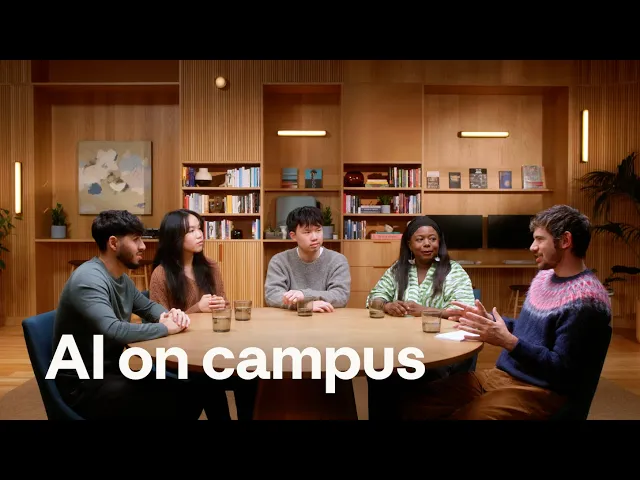
AI on campus
Anthropic
0:00 I think AI and especially how students use AI,
0:02 it's very telling of those motivations.
0:04 You know, there are some students who are using it to complete work for them,
0:08 you know, to do it on their behalf.
0:09 And there are some students who, you know,
0:10 are staying away from AI, or using it proactively.
0:13 They're using it in ways that reinforce their learning.
0:15 It's our responsibility now as students to, you know,
0:18 use this tool to, you know, achieve your own individual outcomes.
0:23 Everyone is talking about how AI is changing education, but we figured,
0:26 what better way to learn about these changes than by asking actual students?
0:31 My name is Greg; I'm from Anthropic,
0:32 and today I'm joined by four university students
0:34 who are here to give us the inside scoop.
0:36 So, why don't you all introduce yourselves?
0:38 Hey, my name is Zain.
0:39 I'm a final year student at the London School of Economics,
0:42 and I study accounting and finance.
0:44 Hi, my name is Chloe.
0:46 I'm a junior at Princeton, studying psychology and computer science.
0:50 Hi, I'm Marcus.
0:51 I'm a senior at UC Berkeley, studying econ and data science.
0:54 I'm Tino.
0:55 I'm a second-year grad student at the Thunderbird
0:57 School of Global Management at Arizona State University,
1:00 and I'm studying a master's in digital transformation.
1:03 Amazing.
1:04 Thank you for being here.
1:05 Thank you.
1:06 So, let's start by setting the scene.
1:08 What are the vibes like on campus these days with AI?
1:12 How are people thinking about it?
1:14 Yeah, so I did a survey not too long ago on how students are using AI,
1:18 and I saw that, you know,
1:20 90% of students are using AI in their day-to-day workflows,
1:24 using it to summarize lectures, using it to answer problem sets,
1:27 to help give feedback on assignments that they had written.
1:31 And so, really a diverse sort of, like, use case for AI within students.
1:37 It's having an impact.
1:39 Universities are having to manage that.
1:40 We're seeing changes in rules and regulations.
1:42 We're seeing, you know, some courses ban it, other courses encourage it.
1:46 And so, students are in a bit of a gray-zone
1:48 right now where they may not know how to use AI.
1:52 Yeah, I also concur.
1:53 There is a lot of chaos in understanding
1:56 AI and what role it'll play in universities, but at the same time,
2:01 there's a lot of energy surrounding it,
2:03 especially being at Berkeley and being so close to AI hype in the Bay Area.
2:07 I also agree that, like, over 90%,
2:11 if not basically everyone uses AI in some way or form,
2:16 mostly in the form of chatbots,
2:19 yeah, like, summarizing lectures, doing assignments,
2:22 answering questions where or when teachers,
2:27 TAs, like, can't answer them for you.
2:29 I will say there is also a lot of confusion on, like, administrations or, like,
2:35 a professor's end on how AI can play a role in the classroom,
2:40 and we're slowly seeing some changes around that.
2:44 As business students, I see even myself and my colleagues,
2:48 like, we use AI for a lot of different things.
2:50 We use AI to understand and analyze business cases, do market research,
2:56 just come up with financial research, as well,
3:00 so people use that for that as well.
3:02 People also use AI, as well, to complete quizzes,
3:06 you know, like, when you don't have time, 'cause when you're a grad student,
3:09 sometimes you've got multiple jobs that you're working,
3:11 and you don't always have time.
3:13 So, sometimes, you can see someone who just,
3:16 you know, quickly submit answers and everything.
3:18 So, that's the bad side of it that, when you're in grad school,
3:22 you know it's supposed to be, like,
3:24 a time for you to expand your critical thinking,
3:26 a time for you to be someone who is, like,
3:30 more decisive, someone who has, like, substance in how you make decisions.
3:34 And so, that's, I think, the bad side of it.
3:37 Yeah, I would say definitely the vibes are, like, really chaotic right now.
3:41 Both I guess in a good and bad way.
3:43 I think the good, obviously, like, Zain said,
3:44 there's a lot of exploration and cool projects and stuff popping up.
3:48 The bad is because everything is such a gray area.
3:51 It can be very difficult to stay resilient and hold yourself accountable.
3:55 It's very easy to just be like,
3:56 "I'm just gonna give up and feed this all to AI and not do any of the thinking.
4:01 I've noticed that there's a lot of tension, as well, between,
4:03 I guess, like, the line of how much is over-relying on AI,
4:06 or how much is it good to actually have,
4:09 like, an actual cooperation between those two.
4:11 And I have also noticed that some people are really into it,
4:15 so they use it a lot in terms of, like,
4:17 all of their different workflows, while others,
4:19 like my humanities and maybe some social science friends are
4:21 a bit more hesitant and have a bit more concern.
4:24 So, there seems to be a growing, like, identity,
4:27 polarization effect that I think will be really interesting to see how it goes.
4:31 I'm curious, you say that they're hesitant.
4:34 Are they hesitant but still using it pretty regularly,
4:38 or is it a mix of some are using it a lot, some are not using it at all?
4:41 Yeah, great question.
4:42 I think there's a spectrum.
4:44 A lot of, especially, like,
4:45 the pure humanity students have just completely opted out,
4:48 I think, because, often, in their classes and research,
4:51 there's a lot more of just close reading, while other, I think, like,
4:54 for social science, I have noticed a slow trend where they're
4:57 trying it out more and just seeing AI being applied beyond just,
5:01 like, pure computational or, like, machine learning,
5:04 like, context, which has been cool.
5:06 And a lot of computer science and also, like,
5:09 other engineering classes, it's still kind of a taboo to use AI.
5:13 I mean, in application these days, we're using a lot of, like,
5:18 AI coding assistance to build actual projects outside the classroom.
5:22 But in the classroom, we're still using, like,
5:24 VS code and blocking out these AI features because professors,
5:28 at least at the moment, are still kind of discouraging it.
5:31 But we might see a shift in the next few years.
5:34 I mean, I know Stanford is beginning to have
5:36 a course about learning to use AI tools in, like,
5:41 software development and engineering.
5:44 I think that's the number one, I guess, breakthrough with these AI tools is
5:50 that the accessibility and barrier into building something,
5:53 like a project or software in general, has gone down a lot.
5:57 And especially with a lot of courses, like,
5:59 with, like, Claude and, like, the developer docs, for example,
6:03 it's been really helpful in teaching folks who don't come from, like,
6:07 computer science background, like in political science or in, like, psychology,
6:12 or even something like math,
6:14 be able to build their own projects on the side from, like, ideation to, like,
6:20 a working prototype that's on a website or some kind
6:24 of app deployment within the span of, like, a few days.
6:28 Yeah, I've seen that a lot at my university where students who,
6:32 you know, don't typically have the confidence to go and build with, you know,
6:38 raw code have now, you know, started using the terminal,
6:41 for example, which is incredible to see.
6:44 And, you know, Claude Code, for example,
6:45 makes that so much more accessible, so much friendlier,
6:48 which I think has been one of, like, the most crazy changes so far.
6:54 Like, myself even, I don't have a computer science background,
6:57 but I'm comfortable in the terminal now,
6:59 which is crazy, and I've seen it within societies as well.
7:02 So, we have a number of societies at LSE, and they each have,
7:06 like, an Instagram page; pretty basic, easy to put together.
7:10 But now, we're seeing societies have websites,
7:13 and these websites have a load more information,
7:15 and they're building them with Claude Code,
7:16 because it's just so much easier now.
7:18 So, it seems like the AI transformation for students has already happened,
7:22 and we have mixed feelings about it.
7:24 One thing that you all share is that you all are Claude campus ambassadors,
7:28 and you are each leading a student organization
7:31 called the Claude Builder Club on your campus.
7:33 So, first of all, maybe can one of you, like,
7:36 give a quick summary of what it means to be a Claude campus ambassador,
7:39 and then the club that you're leading?
7:42 Yeah, I mean, as Claude campus ambassadors,
7:44 our number one job/role is to be the point of contact of engagement
7:52 between what Anthropic and Claude is offering and between that and students,
7:58 and basically being a facilitator for that on campuses.
8:01 Cool.
8:02 And since it's a club about builders, what are people building?
8:05 What are you seeing happen at your clubs?
8:07 A lot of cool things have been built.
8:09 I'll reference an example from a recent Vibe-a-thon I did.
8:12 I think a lot of the most fun ideas is not the most technically-savvy ones,
8:16 but the ones that really start with human emotion.
8:18 So, one that was really cool was there's called the Princeton Prospect.
8:23 There's, like, kind of a bucket list of things people would like
8:26 to do before they graduate and kind of gamifying that through a leaderboard.
8:30 And the best part of it actually was, the winning team,
8:33 they were just a bunch of freshmen and they were all roommates,
8:36 so they just came into this for fun, and with that human insight where it's able
8:40 to build out something that resonated with everyone,
8:42 and that was something really cool that I enjoyed seeing them build.
8:46 I think one cool tool that my friend and I built
8:48 was this place where you could basically put in your lecture slides,
8:52 and it gives you sort of, like,
8:54 professor annotations down the side of each slide.
8:56 So, it's so cool.
8:57 I've been using it so much for, you know,
9:00 just revising through content in preparation for end-of-term exams,
9:04 and it's so good because it kind of preempts my questions,
9:07 and so I've prompted it such that it knows that I
9:10 want to know the definitions of certain things on the slides.
9:13 The slides can sometimes be a bit abstract and missing context.
9:16 So, adding in the context on the side.
9:18 Did you get a good grade in the class?
9:20 We'll see.
9:25 I think one of my favorite things that someone has built with AI is,
9:29 it's an app called Courseer, and we have this challenge where,
9:33 like, the most, like, amazing fun classes,
9:36 like, when it's time to register for classes, they just run out so quickly,
9:39 and you can, like, wait weeks and weeks to get, like, a seat in that class.
9:44 So, what they did is they built this AI,
9:47 and you can, like, just input the course that you want,
9:50 and then it's gonna alert you the moment a seat is open in that class,
9:54 so you can register for it.
9:55 Oh, I like that at our school.
9:57 Yeah, yeah, instead of you, like, going back and checking every day,
9:59 class search, "Is this class available?"- You
10:00 get a notification that you jump on.
10:02 Yeah, you just jump on and you get a seat.
10:03 Yeah, I love that.
10:04 I need that.
10:05 Your next project idea.
10:06 No, exactly.
10:07 It's actually funny, we have, like,
10:09 a shortage of seats at university, at my university.
10:13 I'm talking about, like, actual seats, like in the library for example.
10:16 And so, again, my friend built this amazing tool that basically scans all
10:20 of all of the data that you can get the data on, you know,
10:23 which classrooms are free.
10:25 And so, it basically points all
10:27 the free classrooms and tells students, you know,
10:28 if there are no seats in the library, then go to these ones.
10:31 And again, like, non-technical student building this, which is insane,
10:33 unheard of, but, you know, these are some of the possibilities.
10:37 Yeah.
10:37 Yeah.
10:38 I've seen in the past few hackathons or entrepreneurship classes
10:44 where a lot of students have been looking into, like, healthcare use cases,
10:48 mixing computer vision with a Claude API to interpret a person's,
10:55 like, emotions for, like, a mental health use-case, like, signs of stroke via,
11:02 like, a camera on, like,
11:04 someone's phone or, like, a separate, like, medical device.
11:07 Or even signs of, like, dementia for example.
11:10 And all of them has been really interesting.
11:14 It's so cool that people are spending their time doing that in school,
11:16 'cause that is kind of the magic of being a student is you do have time to just
11:19 work on ideas and try new things and come
11:22 up with projects that are just for fun.
11:23 They're just the side projects.
11:25 Yeah, absolutely.
11:26 Yeah.
11:26 Cool.
11:26 So, let's talk about learning with AI.
11:29 I think one of the more tricky parts of this is that, you know,
11:34 AI can be a tool to help you learn about anything you wanna learn,
11:37 but it can also be used as a crutch to maybe prevent learning if you lean on it.
11:41 So, I'm curious how you each personally balance
11:45 that and how you see students balancing it,
11:47 and if you see students at your university balancing it well.
11:50 I think initially what we noticed was that even, like, amongst our classmates,
11:56 at first it was just like, whatever the AI gives you, that's what you put.
12:00 And then, it's, over time, attitudes have started to change.
12:03 We're like, "Let's just put a little more effort," and not even just,
12:06 "let's just put effort in what we're putting together."
12:09 Because let's say you have a group project and they're,
12:11 like, four or five people on that group project; everyone gets a different part.
12:15 And if everyone just does the first thing that AI gives them,
12:18 that's not gonna produce a very good project at all.
12:20 I think one thing about AI and education
12:22 is that it's very telling of students' motivations,
12:26 like, why you're at university.
12:27 I think students, you know,
12:29 you can typically group three objectives for university.
12:33 The first I would say is to learn,
12:35 to, you know, to deepen your understanding in your chosen topic.
12:38 I would say a second objective is to, you know,
12:41 position yourself for a career, you know, get a good job.
12:44 And I think the third is the social
12:46 element of university where students are coming to network,
12:49 to have fun, enjoy themselves.
12:50 I think, like, those are the three broad objectives for students,
12:53 and every student weights those differently.
12:56 Like, some students prefer, you know, they're coming to learn,
12:59 and they don't really care about the social aspect of uni,
13:01 and there are other students who,
13:03 you know, they're coming because they want to get a good job,
13:05 and they want to enjoy university,
13:06 and they don't really care about the learning really.
13:09 And I think AI and especially how students
13:11 use AI is very telling of those motivations.
13:14 You know, there are some students who are using it to complete work for them;
13:17 you know, to do it on their behalf.
13:19 And those are typically the students who want
13:20 to save time and want to, you know,
13:22 put their efforts and motivations towards other things, which is fine.
13:26 And there are some students who, you know,
13:27 are staying away from AI, or using it proactively.
13:30 They're using it in ways that reinforce their learning,
13:32 that make them better and make them stronger.
13:34 And those are typically students that, they want to learn themselves,
13:37 they want to, you know, have some depth to their knowledge.
13:40 And so, I think that's what AI is revealing,
13:41 like, why you're really at university,
13:43 because we have the tools now, to be honest,
13:45 to get through university without actually learning much.
13:48 It's our responsibility now as students to, you know,
13:51 use this tool to, you know, achieve your own individual outcomes.
13:55 If you want to learn, you can.
13:57 And if you want to bypass, you know,
13:58 a lot of the exams and assignments, you can pretty much do that.
14:02 And I don't think there's gonna be any sort of, like,
14:04 rules or regulations that come in place that can change how students use AI,
14:09 because, like, fundamentally, I don't see how that would be possible.
14:12 And so, I think the responsibility is in the student's hands;
14:15 it's like, you're in control.
14:17 Yeah, definitely.
14:18 I actually agree, and I think a lot
14:19 of, for how I use and approach AI is, like, intention.
14:22 I think, even before I actually start prompting or asking it to do stuff,
14:26 I like to think about am I asking it to, for example,
14:28 directly complete a task for me?
14:30 Or is it more of, like, something that I'm brainstorming and I'd like
14:33 to think about it from different perspectives?
14:34 And I think that piece is, like, I'm starting to see a lot more happen,
14:38 'cause I think AI is very good as, like,
14:41 a catalyst for especially implementing and building things.
14:44 But the intention, I think, really comes from the students themselves.
14:47 I really resonate with that.
14:48 I think, when these AI chatbots start coming out a few years ago,
14:53 either because of the technical limitations back then,
14:57 or just of how little we understood about AI at the time,
15:02 the typical workflow was just you ask the chatbot a question, you get an answer,
15:06 and you do that maybe, like,
15:08 50 to a hundred times across different conversations.
15:12 Now I think people are becoming smarter and, like you said,
15:15 are becoming more intentional with how they're using it.
15:17 We're starting to have, like,
15:19 more extended conversations across talking about one specific topic.
15:24 I've started, like, when I'm studying, I'll have projects on Claude where I
15:30 would have one for each class; upload, like,
15:33 the syllabus and a bunch of different
15:35 course content I'd take in for each project,
15:37 and have a bunch of conversations acting as, like,
15:41 individual files in, like, a folder for example.
15:44 And with these chatbots being able to, in recent years,
15:48 manage context better, manage memory better,
15:51 be a much more helpful assistant and, I guess,
15:55 conversationalist when, like, working with me on a specific task.
15:59 You wonder how long it'll take before the societal aspect of things
16:02 are gonna catch up to how fast the technology is evolving.
16:07 Right now, with one example, is that in, like,
16:11 CS classes, I know a few professors who do say,
16:15 like, "Hey if you do use AI, like,
16:19 you can put a disclaimer in, like, your assignment and also describe,
16:22 like, how you use it in, like,
16:24 each homework or a lab assignment." But there isn't really,
16:28 like, a integrated, like, framework thinking about, like,
16:32 using AI in the class as part of the curriculum.
16:35 And I think we're still kind of waiting on integrations like that into, like,
16:40 education that we may see in the next, like, five years.
16:44 So, you feel like, in general,
16:46 your professors and the administration might be a little bit
16:49 behind the students in terms of AI literacy and adoption?
16:52 Not mine.
16:52 Yeah, I think they're still adapting to it, and I think, naturally,
16:56 students are more like the fastest
16:58 adopters because we're just reacting to, like,
17:01 what's out there, and we access information a lot quicker because we're,
17:06 like, native to the internet.
17:09 Yeah.
17:10 Yeah.
17:10 I have to say, I've seen some, like,
17:11 pretty cool advancements in some of the courses at my university.
17:16 So, we have a course called LSE 100,
17:18 and every first-year student has to take it.
17:20 And when I did it two years ago now, there was no, I mean,
17:24 we had AI, but there was no guidance on how it should be used for this course.
17:28 My brother now actually is in first year,
17:30 and he's doing the course at LSE, and he's told me it's completely changed.
17:34 So, they basically give you guidance on how to use Claude.
17:37 So, they say you should have a conversation with Claude, give it a persona.
17:42 So, they're giving guidance to students on how to actually use
17:46 these and use Claude for ways that aren't just direct outputs,
17:49 you know, like getting the answers for your problems,
17:51 but actually a conversation with it.
17:53 And then, they ask for the conversation log because they wanna see,
17:57 you know, how are you interacting with it?
17:58 Are you asking, you know, good questions back, and is it a good conversation?
18:03 And then, they film a video instead of putting an essay together.
18:06 So, now it's a video of yourself.
18:07 And so, you are encouraged to use AI, but now in terms of, like,
18:11 the marking, you know, you can't use it irresponsibly.
18:15 I have also noted that for some of my classes.
18:17 Like, the machine learning class I was taking this semester,
18:20 they have their own chatbot actually
18:21 they built to specifically answer student questions,
18:24 and if they wanna refer to lecture notes specifically,
18:26 it's pretty helpful for it.
18:28 I do think, however, that this is more of a bandaid approach
18:31 because it doesn't really prevent students from just going
18:34 to other types of AI tools that is not
18:36 the school one to just ask for answers and advice.
18:40 Yeah.
18:40 Yeah.
18:41 University is a one-size-fits-all route at the moment where,
18:43 you know, you have one lecturer for potentially 200, 300 students in a class,
18:48 and those students all learn, you know, in different ways.
18:52 And so, AI is acting more as a personalized tutor
18:56 if you prompt it in the right way and if you, you know, encourage it to do so.
19:00 And I've seen the learning mode from Claude where,
19:04 you know, it's asking questions back to you.
19:06 It's more of a, like, a progressive development of understanding,
19:09 which is good, and there are students that are using it.
19:13 But I think, you know, it's about finding the students that, you know,
19:17 want to learn and want to progress
19:19 because there are many students that, you know,
19:22 if one AI tool goes away from, like,
19:25 giving direct output or giving direct answers,
19:27 we're gonna see just a shift of students to the other.
19:31 Tino, were you gonna say something about this, by the way?
19:33 Yeah, I think I was gonna piggyback on what Zain said,
19:36 like, 'cause at my school, Arizona State University, we are super pro-AI.
19:41 Our career management center, they built, like,
19:44 a prompt bank for us for prompts that we can use to, you know,
19:48 work through different scenarios and roles.
19:51 They also built, like, for our sustainability class,
19:54 as well, the professor built her own bot, as well,
19:57 and we actually, there's a new class that they introduced
20:00 called Artificial Intelligence Chip Strategy and the Future of Work.
20:04 And it was taught, like, for one semester, but people were like, "Yo,
20:08 we need this class," and now it's taught, like, the whole fall and spring.
20:12 This is all very positive, which is great,
20:15 but I know that it's not all positive, it's not all roses.
20:18 So, I'm curious, what are things that you
20:21 are seeing that are not on the right track,
20:23 or things that you're afraid of, or things that scare you?
20:27 I mean, cheating is, like, the top three use case;
20:29 if not, like, top one in universities without a doubt.
20:31 It just comes from, like, what we discussed.
20:35 You put in a prompt or some input, and chat gives out an output.
20:42 And a lot of students, what they started off doing,
20:45 and a lot of them are still doing,
20:46 it's just taking that output and, you know, submitting it in a cycle.
20:50 I think, I mean, if you look at the interface, it's waiting for a question.
20:54 We are given the questions from the university.
20:57 It's never been easier to take that question and put it into the chatbot,
21:00 and get the mark scheme pretty much.
21:03 And so, it's just so easy to get the answer,
21:06 and you really have to be strong as a student to go
21:09 and work on that problem by yourself and do it yourself.
21:11 Yeah, I think a bit more of a nuanced take.
21:14 I have also noticed that, for even students who are
21:17 using AI to build their own projects and, for example,
21:20 to try out different types of, I guess, technical implementations,
21:24 there's been a really strong sense of ownership shame
21:26 that I've noticed whenever AI even gets mentioned that, "Oh,
21:29 when I was building this project,
21:31 I used AI a little bit," just because, like I said,
21:33 I think the line between of how much the human is using the AI versus
21:37 how much is the AI actually just controlling
21:39 the whole project is very blurry right now.
21:42 So, especially at the vibe-a-thon when I was for, example,
21:44 asking the winners, like,
21:45 "How did you use Claude in your projects?" I had seen a lot of them build out,
21:51 brainstorm, think through, and, like, really iterate with Claude.
21:53 But when I asked them that question,
21:55 a lot of them just defaulted to, "Oh, Claude just, like,
21:58 was very helpful and they did everything," which I think right now,
22:01 like, there's a lack of vocabulary and frameworks to, like,
22:04 regard these types of AI usages, which I also think is what's causing a lot
22:08 of this polarization effect where schools are just either completely banning it,
22:12 but students are still using it regardless,
22:14 hence a lot of the cheating and just, like,
22:16 not really being intentional or using
22:18 their brains when they're interacting with AI,
22:20 which I am a bit skeptical about the direction of this, just
22:24 because I think students are now required to be the resilient ones
22:28 in the age of AI where they really need to be skeptical
22:31 of every single time they use it without guidance from schools and institutions.
22:35 So, I feel like, if institutions or schools
22:38 can't really adapt to this quick enough, there is a danger in it just kind
22:41 of skewing and going into a more polarized direction.
22:45 I will say, though, the sentiment and, like,
22:48 how we interact with AI among students is changing.
22:51 I think, like, as university students, we naturally do want to use our brains
22:55 and use it for something that's interesting to us.
23:00 In the past couple years, yes,
23:02 people have just been pasting in questions as, like,
23:05 prompts and taking the outputs to submit as, like, deliverables or assignments.
23:11 But people are beginning to be more interested in, like,
23:15 doing something more of that; like,
23:17 taking more ownership of maybe their assignments,
23:20 but even more importantly, like,
23:21 I guess projects on the side or things they want to make or explore.
23:27 And I think a lot of students just kind of need
23:28 that little push to see what's available and what's out there.
23:32 And back to the point about cheating,
23:33 I think a lot of students are also realizing that AI is pretty bad at cheating
23:37 in context because there's all these patterns
23:40 that start to come up like, "Oh, there's, like,
23:41 a lot of em dashes," or AI has a specific voice or tone,
23:45 or it doesn't actually understand to the level of what you know about the class,
23:52 which could be a whole conversation about how
23:54 students actually know more than they think they do.
23:57 Yep.
23:59 Okay.
23:59 Yeah.
23:59 Yeah, I agree.
24:00 And I think students are evolving, you know, with AI.
24:03 I think, when it first came out, everyone's very excited.
24:06 Students, you know, were using the outputs directly, but now,
24:09 like Marcus said, you know, people, students are being more, you know,
24:13 intentional with their prompts, so potentially,
24:15 you know, writing a little bit longer prompts;
24:17 you know, directing Claude a little bit better than before.
24:20 And I think that's just because we're getting more used to it.
24:23 Like, myself, as a student, I must have spent,
24:25 like, a thousand plus hours, like, talking to Claude now.
24:28 Like, I know, you know, how it responds, and I'm learning more about the tool,
24:33 and as a result, my interactions with it are getting better.
24:35 And like you said, we're students.
24:37 You know, we want to use our brains.
24:39 The majority of us, you know, want to be intellectually simulated.
24:42 And so, I think we're moving to a time where students
24:47 do genuinely use AI tools to benefit themselves and to actually,
24:52 you know, go further, rather than kind of limit themselves,
24:56 I guess, by just relying on its output.
24:59 Yeah.
25:01 I think, when it comes to, like, cheating, for example, you know,
25:06 you've got that first level of you ask a question, you get your output.
25:10 But in my instance, the final boss is can you present to us what you think?
25:15 You gotta put together a presentation, 10 minutes,
25:18 15 minutes defend your position, and the AI is not gonna be there,
25:22 you know, at that time to speak for you or to give your ideas.
25:26 So, in that way, I feel that there's that, like,
25:29 first level of, like, using it like you mentioned, like, maybe.
25:33 But then, you get to a level where you need to, in our case,
25:38 explain what do you mean and everything.
25:41 So, it's not so much a case of like, yes there's that level of, like,
25:45 people are cheating, like, doing just, like, small quizzes.
25:48 But then, in our instance as well,
25:50 you actually have to always defend your position,
25:53 so you have to know what you're talking about.
25:55 Let's talk about, after college, entering the job market.
25:59 First of all, maybe we can do, like, a thumbs up, down, middle.
26:03 How does everyone feel about getting a job after graduation?
26:09 Like, constantly just like this.
26:11 Okay.
26:12 Okay.
26:12 Okay.
26:13 Tell me more.
26:15 Okay, well, I guess, like, the good ones I think is, like, just having AI to be,
26:20 like, a better, like, companion for, like,
26:22 practicing for interviews, brainstorming, tailoring the resumes, et cetera.
26:27 Unfortunately, the downside is that also companies
26:30 are obviously using AI a lot more, which involves a lot of Hirevues.
26:34 I've basically been talking to a, like,
26:36 a screen this entire recruiting cycle, which is great,
26:40 but also can feel a little less human because I don't feel like there's,
26:44 like, no chemistry, like, talking to a screen.
26:48 Are you doing interviews with like you're talking to a robot?
26:52 Not where it's explicitly, but it's just, like,
26:54 kind of a question on a screen for me,
26:55 and then I'm just, like, talking to myself.
26:58 And I have also heard just a lot of anxiety
27:01 about companies also using AI just to screen candidates.
27:05 And I think this also has just not been great for, I guess,
27:08 like, both my self worth and also just, like,
27:10 trying to figure out what the best, like interviewing strategy or even, like,
27:14 what jobs to apply to, 'cause now it just feels so much more random than before.
27:20 I'm curious, what do you guys think?
27:21 I agree with you, especially, like, the screening job candidates.
27:24 It's so painful because you can realize, like, from the entire, "Hi,
27:29 I would like to invite you to apply
27:31 for this job," right up until you submit your CV.
27:34 You've put time together, tailored your application,
27:36 everything, and then 15 minutes later, "Sorry,
27:38 we regret to inform you." when did you have time, you know, to review.
27:44 Yeah, exactly, the AI-generated email.
27:46 The AI-generated email.
27:47 So, that's, like, I think the really, like, big downside of that.
27:51 The upsides really are that AI fluency has become a major like,
27:56 for example, consulting firms now,
27:58 I know the top four consulting firms, they used to hire generalist MBAs,
28:03 but now they're looking for MBAs who've got AI fluency.
28:06 So, if you understand, like, how do you apply AI to different industries,
28:11 then you're, like, their number one candidate.
28:13 Actually, back to, like, Chloe's point,
28:14 I have had an AI, like, interview me before.
28:17 Really?
28:17 Wow.
28:18 And it was so nice.
28:19 It would give me responses like,
28:21 "Your response was super invigorating and informative and exciting." And then,
28:27 "Let's move on to the next question."- Did you get the job?
28:30 No, but it was because I didn't qualify.
28:35 I think they were looking for, like, rising juniors, and I was a rising senior.
28:39 So, I still got auto screened.
28:42 But it wasn't as bad as I thought, I guess.
28:46 Traditionally, like Chloe said, like, there's Hirevues right now where,
28:50 like, they take a recording rather than, like, an interactive conversation.
28:53 I actually kind of enjoyed having a nice interviewer as an AI.
28:59 I agree.
28:59 I agree.
29:00 Okay, speaking of, you know, interesting uses of AI,
29:05 Merriam Webster named "slop" the word of the year,
29:10 so I'm curious what AI slop means to you all,
29:12 and how do you see it impacting the people around you on campus?
29:17 I think, like, AI slop for me is when I receive an output from Claude
29:22 or any other AI tool that I know that if I had just used my own brain,
29:26 like, I could have come up with something better than that.
29:28 Like, that's kind of slop for me.
29:30 So, I think, just going back to job applications,
29:32 when I'm asking it to, you know, help me write a cover letter, for example,
29:34 which is a major use case for a lot of students,
29:37 and it gives me a cover letter which is so generic;
29:39 like, every other student is applying with this, and it's like,
29:42 "This is not gonna get me the job." Like, that's, you know, the AI slop.
29:45 I think it's really funny that, like,
29:47 AI responses can be so generic that it's its own voice at this point.
29:51 That's, like, a common, like, meme, I guess,
29:53 for AI to have a lot of M-dashes and certain sound bites.
29:57 Like, you're absolutely right, or like,
30:00 "Let me think about that." Or it has this, like,
30:03 two-sentence structure that it keeps giving me whenever I try to write, like,
30:07 letters or scripts, for example,
30:10 where it's like, "You're not reinventing the wheel.
30:12 Like, you're building the next Tesla."- Yeah.
30:16 Yeah.
30:17 Honestly, it's everything you guys have said.
30:19 Yeah, and then, like, you get the feedback,
30:22 you get the output, and then it's up to you.
30:25 You know, some people, if you work with them in a group,
30:28 sadly they'll just paste that, and you could see that at the end,
30:32 "Would you like Claude to keep" you know.
30:35 Oh.
30:35 Yeah, that's-- Claude can make mistakes.
30:37 Retry.
30:37 Claude can make mistakes.
30:38 Retry.
30:39 Yeah, that's my definition of AI slop.
30:41 So, you mentioned group projects, and I think this is a big thing, right?
30:44 When you have a group of four or five at university,
30:47 and you have maybe a 5,000 word report due, how do you guys go about it?
30:51 Because at my university, there is sometimes some students who, like,
30:56 don't want to use it, and I remember, like, one student was saying, like,
30:59 "I'm gonna do this project before you guys get
31:01 your grubby AI hands on it." And I was like,
31:04 "Okay." But, like, some students really-- Did he use that term?
31:08 Grubby AI hands.
31:09 Grubby AI hands.
31:10 Oh, man.
31:10 Oh my god.
31:11 Some students feel really strongly against it,
31:12 and when you're working in a group,
31:13 you know, you have to take into consideration other people's thoughts.
31:16 True.
31:17 Yeah, what are your guys' thoughts on that?
31:20 I can go first, 'cause we do a lot of those 5,000 words kind of projects,
31:24 like maybe create a business case out of this business dilemma.
31:28 And how we do it, like, how we've recently started working on it is
31:31 we'll take the paper or the question and we'll, like, create an outline.
31:35 We'll maybe ask AI, "Can you create an outline for this paper for me?" Like,
31:38 "What should be in this paper" and stuff.
31:41 And then, we divide it amongst ourselves.
31:43 One thing I like doing a lot is, yes, using that outline and for, like,
31:48 this example of, like, a 5,000 word report amongst,
31:50 like, four people split it into different sections,
31:52 and then for each person covering each section,
31:57 it's up to you and how you want to use AI, whether you use it or not at all.
32:03 And what I like to do personally is have a lot of, like, bullet points or just,
32:09 like, thought-dumping into Claude and working
32:11 with it to kind of structure my thoughts.
32:13 So, going from random, like,
32:15 bullet points or one-off phrases into more of an outline,
32:20 and then into paragraphs that I can kind of manually edit
32:23 the wording of so it's more like my voice and tone.
32:27 And then, one thing I really like asking Claude actually is
32:32 to give the context of who is usually reviewing my work.
32:37 For a job application, for example, it's, like,
32:40 this VP or, like, recruiter, and then, like,
32:44 in a class it's like a professor or a TA,
32:46 and I ask, like, "Hey, here are some criteria.
32:51 Rate my work score out of 10." And I would do that maybe,
32:56 like, two to three times, and it would always gimme reasons about, like,
32:59 why it graded, gave me a score, a certain score.
33:03 That's a good idea.
33:04 And what I could work and improve on.
33:06 A lot of times, I like the feedback.
33:08 Sometimes I think some of the feedback is a bit overzealous or ridiculous.
33:14 And in newer models, like Sonnet and Opus 4.5, they're starting to give, like,
33:22 a bit of urgency whenever I ask it to evaluate my work too much,
33:26 almost like they're calling me out for overthinking.
33:30 After maybe, like, the third try of, like, this, like,
33:32 evaluation, they'll be like, "It's ready to ship."- Yeah.
33:35 Yeah.
33:36 Nice.
33:36 Nice.
33:36 Are there AI slackers in group projects?
33:39 Like, people who you can tell are not turning on their brains for the project?
33:42 With their grubby AI hands.
33:44 I mean, definitely.
33:45 I think something that is most helpful for me is,
33:48 like, obviously besides alignment and just,
33:50 like, being very intentional when you're using AI,
33:53 a lot of face-to-face time actually.
33:55 So, what I like to do when I work
33:57 on a group project is just block out a time chunk,
33:59 sit down with my group, and we just talk about it as we work through it.
34:03 I think, very often, it's easy to feel like you're alone when you're
34:06 just working on a group project on your self,
34:08 which is what makes AI so tempting, 'cause you're just like, "Oh,
34:11 what if I just had someone write it for me?"
34:13 But if we were all forced to, let's say, sit down and talk together,
34:16 like if someone had a problem and work through it,
34:18 I think that definitely helps a lot
34:20 with the more human piece of working together.
34:22 Yeah,- I agree.
34:24 Okay, I'm gonna shift us to some rapid-fire questions.
34:26 So, each should be, like, one to two sentences maximum.
34:30 So, my first question is, what is a tip that you have for students right
34:35 now who are navigating this whole world of AI in education?
34:39 Learn it.
34:39 Learn it.
34:40 Learn how to use it.
34:41 It's only to your advantage if you understand how it can optimize your career,
34:46 or if you decide to be an entrepreneur, how it can optimize your business.
34:51 If you're trying to learn new concepts or revising for exam,
34:55 start a new project for every class you're taking in university.
35:01 Try and paste in all the relevant files, and perhaps you already have existing
35:06 conversations where you've worked with Claude
35:08 to go through certain assignments and set the writing style to concise mode.
35:15 That's been most helpful for me to get
35:18 a quick rundown in an efficient manner of, like,
35:22 every concept I need to cover for an exam.
35:25 Substack and open-source materials.
35:27 There are so many cool people out there who know
35:30 the best or newest ways to use different types of AI tools,
35:33 and what I've found most helpful is just soaking that up like a sponge,
35:36 and then applying it to my own projects.
35:39 Nate Jones on Substack.
35:40 He's pretty good.
35:42 My tip would be use the styles.
35:44 So, you mentioned it briefly, the concise mode.
35:47 The learning mode is fantastic.
35:48 If you want to augment your own brain and augment your own skills,
35:52 use the learning mode.
35:54 It will ask you questions back.
35:55 Be confident in your replies back, and you genuinely will get a better
35:59 output than just leaning on Claude by itself.
36:02 All right.
36:03 Next question.
36:04 How do you, in one sentence, personally draw the line?
36:08 How do you draw the line between using AI as a tool and using AI as a crutch?
36:13 Where do you find that balance?
36:16 If I was in a room like this, and I can't explain or defend what I've built,
36:22 even if someone asks, like, a super critical or specific question,
36:25 I think that's the line where you
36:28 kind of don't really understand what's going on.
36:31 I totally resonate with that.
36:31 It's a mix of, like, the ownership and intentionality.
36:35 If you can't really explain what you've done along with also
36:41 including what AI's role was in your work or what you're doing,
36:44 then that's a line for me.
36:46 Yeah.
36:46 That's another line for me as well.
36:48 Like, I should be able to explain it
36:50 like I'm explaining to someone in fifth grade, whatever the output is,
36:55 and I should be able to present it as well,
36:57 even at a graduate level, anything that I prepared.
37:00 So, that's my line.
37:01 Anything I create with AI,
37:03 I should be able to give that lower level and that upper level explanation.
37:09 Yeah, I agree with all of you.
37:10 I think, if you're not comfortable with the content that you've produced,
37:14 at the end of the day,
37:15 like, is that really yours or are you just stealing that content from Claude?
37:20 And so, just feeling comfortable, having some sort of, like,
37:24 feeling of ownership that I've produced this work, that's the line for me.
37:28 You know, there have been times where
37:31 I've submitted pieces which are, like, fully AI,
37:33 and it's just like, this is not gonna take me anywhere at the end of the day.
37:38 But you learn that, and I think that's the biggest thing
37:40 with students is that it takes time to learn those feelings,
37:43 and you kind of have to give it that time.
37:45 Like, a student might have to submit
37:47 something 100% AI to realize that, actually, this was not beneficial for me.
37:52 And I think universities need to be
37:53 conscious of the fact that students will learn,
37:55 and you've gotta trust the students, right?
37:57 At the end of the day, they live their own lives,
38:01 and, you know, you wanna set yourself up.
38:03 You have that equality between students, and we'll figure it out.
38:07 Like, we'll figure out what works, where it's good, where it's not.
38:10 Yeah, like holding space.
38:12 Exactly.
38:13 I feel like that's a fantastic place to end.
38:14 I just wanted to say, you know, that "We'll figure it out" mentality.
38:17 This whole time, I kind of expected this conversation to shift into doomerism,
38:22 and it never quite did.
38:23 I think, like, all of you are, you know,
38:26 thoughtfully positive about the future in a way that, I think,
38:30 is really exciting and really encouraging.
38:33 So, thank you all for being here,
38:35 for being honest, and yeah, I really appreciated this conversation.
38:39 Thank you.
38:40 Thank you for having us.