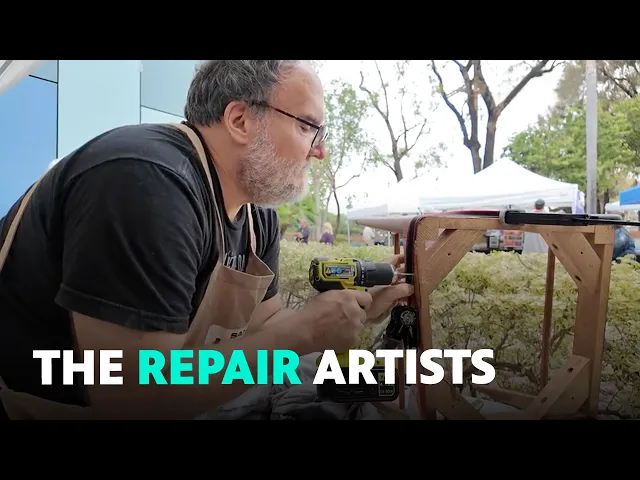
A Visit to Carlsbad's Fix-It Clinic
PBS SoCal
0:00 [background noise] -We're at the Georgina Cole Library
0:05 in Carlsbad at the San Diego Fix-it Clinic.
0:08 Fix-it Clinic is a pop-up repair event where
0:11 neighbors come in that are skilled at fixing things,
0:15 helping other neighbors fix their broken stuff.
0:18 [background noise] -It's amazing what comes in.
0:24 We fix small appliances, electronics, textiles, furniture.
0:29 We're sharpening tools.
0:30 We're doing bicycles.
0:32 My philosophy is, let's try.
0:34 We don't know if we can fix everything.
0:35 There's a 73% repair rate because things cannot be fixed,
0:39 but we don't really turn things away.
0:41 [background noise] -Why can't people just take it to a repair shop?
0:46 -[laughs] We don't have repair shops.
0:50 -Can I ask what the issue is with the lamp?
0:52 -Well, there's something wrong with the socket.
0:55 This is the original socket, and it's very old.
1:00 It comes from Frederick Cooper Lamp Company in Chicago.
1:05 -How long has it been broken, do you think?
1:07 -Oh, 20 years.
1:09 -It's a reaction, actually, of the disposal society as well.
1:12 Everyone thinks, "Oh, I just can get rid of it and not think
1:15 about it again," but we do not have the repair.
1:18 We're losing that skillset.
1:19 We do not have anybody in the community to do
1:22 that, but I would love to see them here.
1:25 -I brought in this Predator generator,
1:27 and we bought it probably six years ago from Costco.
1:31 We thought we needed an emergency generator.
1:34 We used it about three times, and then it wouldn't start.
1:38 -Good shape on oil.
1:39 I'm suspecting it's probably just got some bad fuel in it from sitting
1:43 for a while because that tends to happen with these kind of devices.
1:47 We're going to go through and check everything out.
1:49 I'm going to check the oil.
1:50 It's got an oil pressure switch.
1:51 Make sure there's plenty of oil in it,
1:52 and then we'll start working on figuring out the fuel situation.
1:56 -We don't like throwing out anything into the landfill,
1:59 and so the Fix-it Clinic was announced,
2:02 and we live really close by, so we thought,
2:05 "We'll give that a shot." -My favorite part
2:07 about the Fix-it community and clinics is the volunteers,
2:10 because we have these people who have so much knowledge and experience,
2:16 and they want to share it.
2:18 I know for a fact that's why people keep coming back,
2:21 because the experience they have with our volunteers.
2:24 -You can basically buy a whole piece here- -Oh, really?
2:28 --to replace it.
2:29 Yes, because this is quite beautiful and in beautiful shape.
2:33 -My volunteers are a senior generation.
2:35 I call them the "remember when" generation because they
2:37 remember when there were repair shops available in their community,
2:40 and they're not there.
2:42 We are trying to tell people, just try.
2:45 You don't always have to go and buy a new one.
2:47 You don't have to have the best and the highest thing.
2:49 You can keep the things that you like.
2:50 It's not just things.
2:51 These are your favorite things.
2:53 It's not just stuff either.
2:54 This is family.
2:55 This is culture.
2:56 This is heritage.
2:57 -It's currently going through the coil and up through here.
2:59 -Yes, but not on this.
3:00 -Not on that one.
3:01 -That's what I think is the biggest joy, is seeing their aha moment,
3:06 that, "Oh, that's not hard to do at all.
3:11 I could do that." Then that gets them thinking that things
3:16 aren't just to be thrown away when they don't work.
3:19 -Now we can try to disconnect it from that side also.
3:23 -It has dowels on this side as well.
3:25 -Exactly, yes.
3:25 That's why that part broke, you see.
3:28 -Right at the two points.
3:30 -Yes.
3:30 -When we sit across from you fixing,
3:32 we're not just sitting there fixing, we're educating.
3:35 We're being ambassadors to repair.
3:38 We're helping your curiosity.
3:39 We're trying to hope that you learn something that day.
3:44 I've always fixed things myself.
3:46 It's just part of my family and what I grew up with.
3:49 I think other people missed out on that from maybe grandparents
3:52 or parents who were too busy working or were out of state.
3:56 Now they have a chance to come and learn
3:59 from men and women of all different ages.
4:02 We've got teenagers that are 16 over there that show up every weekend.
4:06 We have fixers that are 85 years old coming
4:08 in to share their knowledge to keep that going.
4:11 -I'm one of the bike guys.
4:13 That's what I come and do.
4:16 I've been working on building bikes for 30 years.
4:20 I do it not professionally.
4:22 I'm a retired scientist.
4:24 I like playing with bikes.
4:28 It's just a great thing.
4:29 You help people out in the community, and it feels good.
4:33 -Oh, it's great, man.
4:34 It brings the community back a little bit.
4:37 It's like a lot of people don't know their neighbors anymore.
4:41 I was born in the '80s, classic generation and all that.
4:45 We used to have nice stuff back then.
4:47 It's not the same anymore.
4:49 You can't fix the new stuff.
4:51 It's all just— -Disposable.
4:55 -Yes.
4:56 -What I'm going to do is I'm going to take out the mechanism.
5:01 -One of the big problems that we have,
5:03 however, is what's called this right to repair.
5:06 A lot of, especially electronic devices, are not really meant to be repaired.
5:12 For instance, right on your phones, or your laptops, or your tablet computers,
5:17 the cases are glued together instead of using screws or mechanical fasteners.
5:24 Because of that, it becomes very,
5:26 very difficult to get them apart without breaking something.
5:30 That just prevents people from wanting to fix them.
5:34 -We brought in a couple of sweatshirt jackets that we
5:37 didn't want to throw away because my husband really likes them.
5:40 The zippers both broke.
5:41 The jackets are still good.
5:43 Luckily, he's working his magic.
5:45 I think it's amazing.
5:46 I think it's great that they're promoting recycling,
5:50 reusing, mending, not throwing things away,
5:53 switching up daily habits so that you're
5:56 basically making the earth a better place.
5:58 -We're going to take you over to Greg and Dave.
6:02 I do believe they'll have the right tools for you.
6:05 -I brought some things, too.
6:06 -Oh, what'd you bring?
6:08 -I brought a rubber mallet.
6:10 -Oh, I love this.
6:12 [laughs] -I brought this because this is what I was using to shimmy it open.
6:17 -Just our fix-it clinic here in San Diego, we've diverted over,
6:20 I think it's 9,500 pounds of trash this year.
6:24 Just this year.
6:25 That's not even our other metric.
6:26 If we replicate this across the country, in every city,
6:32 how much would we be diverting from landfills?
6:36 How much money would we be saving our neighbors?
6:39 How many connections would we have made?
6:41 How much knowledge would we have spread?
6:44 How much joy would there be out there?
6:46 -Thanks for watching.
6:47 If this story helped you see things from a different angle,
6:50 tell us what you think in the comments.
6:52 Stick around for the next video.
6:53 I think you're going to love it.