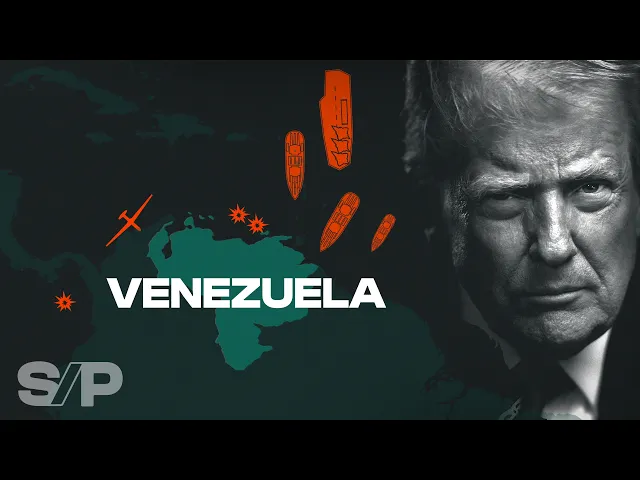
Trump's case for striking Venezuela
Search Party
0:00 [Sam] On September 2nd in the Caribbean Sea,
0:02 a US military drone found what it was looking for, a 12 meter long wooden boat.
0:08 They're commonly used here by fishermen and also drug traffickers.
0:12 Typically, the US would stop and search the boat to find out which,
0:16 but this time the US just blew it up.
0:19 Two weeks later, the US blew up another boat,
0:21 then another, and another, and another.
0:25 Donald Trump claimed that dozens of people
0:27 killed by these strikes worked for drug cartels,
0:30 and that this was just the start of his new strategy to stop them.
0:34 To every terrorist thug smuggling poisonous
0:36 drugs into the United States of America.
0:38 Please be warned that we will blow you out of existence.
0:41 We have no choice.
0:43 [Sam] But most of Trump's strikes were in the wrong place.
0:45 Most drugs are produced in Colombia, Peru, Bolivia,
0:48 and Mexico, then trafficked over land or through the Pacific.
0:51 Then in October, we found out the real target.
0:55 Trump is ramping up his military campaign in the Caribbean.
0:58 [Reporter] Made it clear he wants
0:59 Venezuelan President Nicolás Maduro removed from power.
1:03 [Reporter 2] Trump ordered the Navy's largest
1:04 and most advanced aircraft carrier to the region.
1:07 Authorized the CIA to operate inside Venezuela.
1:10 [Reporter 3] Warn Venezuela and its cartels at striking land is next.
1:15 [Sam] How did Trump turn a war
1:17 on drug cartels into a potential war with Venezuela?
1:20 This is not stretching the envelope.
1:21 This is tearing the envelope apart.
1:23 [Sam] Where could he take that war next?
1:25 It seems like a recipe for a war that could go on forever.
1:28 (upbeat music)- [Sam] Trump's right about one thing.
1:41 The cartels are stronger than ever.
1:44 The first modern drug cartel was formed
1:46 in the 1970s by a Colombian named Pablo Escobar.
1:49 He smuggled cocaine through the Caribbean and made millions of dollars.
1:53 Then he united several gangs into one organization and made billions.
1:57 By the 1980s, the Medellin Cartel was making 80% of the cocaine
2:01 trafficked into the US and its private army wreaked havoc across Colombia.
2:05 [Reporter 4] This is the most violent of cities.
2:07 There's a killing here every three hours,
2:09 some committed by these motorcycle gangs who work on retainers for the cartel.
2:15 The Medellin cartel was too powerful
2:16 for the Colombian government to take on alone.
2:18 So the US helped by sending its law enforcement agencies and its military.
2:23 America's public enemy number one in the United States is drug abuse.
2:30 [Sam] Richard Nixon was the first president to declare a war on drugs,
2:33 but Ronald Reagan supercharged the military's role in it.
2:36 He sent so-called military advisors and weapons to Colombia
2:39 and order the Navy to shut down trafficking rounds.
2:41 But the war on drugs wasn't an actual war,
2:44 and the Medellin cartel wasn't an invading
2:46 force that the military could shoot without warning.
2:49 It was a group of criminals.
2:50 So while the military could help find cartel members,
2:53 law enforcement arrested and prosecuted them.
2:56 That's how the US helped dismantle the Medellin cartel
2:59 and eventually find Escobar who died in a shootout.
3:02 But the war on drugs continued and presidents kept involving the military in it.
3:06 George H.
3:07 W.
3:07 Bush invaded Panama,
3:08 partly by citing Panama's leaders indictment for drug trafficking.
3:12 Bill Clinton deepened the military partnership
3:13 with Colombia, and under George W.
3:15 Bush, the military shared intelligence with Mexico.
3:19 This strategy didn't win the war on drugs, but it made a difference.
3:22 Had the US never focused on this issue,
3:24 you could only imagine these groups could be even more powerful.
3:27 Right?
3:27 [Sam] Will Freeman is an expert on organized crime in Latin America.
3:30 But has this stopped drug closer
3:33 radically decreased them into the United States?
3:35 No, it has not.
3:38 [Sam] Overdose deaths from cocaine and heroin increased over the last 25 years,
3:42 and deaths from fentanyl skyrocketed to almost 80,000 in 2023.
3:46 This demand kept the cartels in business.
3:48 After the Medellin cartel,
3:49 the Cali cartel took over and Colombians started trafficking
3:52 through Mexican criminal groups who evolved into even deadlier cartels.
3:56 When the US and Mexico cracked down on them,
3:58 they just fractured into more cartels.
4:00 Today, these cartels are partnering with criminal
4:03 groups in Europe and Asia to traffic
4:04 drugs around the world and make tens of billions of dollars a year.
4:08 More than enough money to corrupt officials,
4:10 innovate new ways to evade detection and diversify
4:13 into other crimes like human trafficking and wildlife poaching.
4:17 These are really formidable organizations,
4:19 and as long as there's that demand and as long as there's robust supply,
4:22 then fundamentally I think you're going to be talking about putting
4:24 a lid on a situation but not eliminating it all together.
4:28 But Donald Trump came into office with a new plan to fight the cartels.
4:31 It didn't involve curbing demand or law enforcement.
4:35 The cartels are a waging war on America,
4:37 and it's time for America to wage war on the cartels.
4:40 (everyone clapping)- This story is moving super fast.
4:43 Trump is striking boats in the Caribbean and in the Pacific,
4:46 and he recently authorized the CIA to work inside Venezuela.
4:50 Now, what interests me about this story
4:51 is how different outlets are covering it.
4:54 This level of insight is only possible
4:55 thanks to our sponsor this week, Ground News.
4:58 Ground News is the only website and app
5:00 that doesn't just track global news events.
5:02 It dissects them.
5:03 It gathers stories from all of the world and gives
5:05 me a clear sense of how they're being covered,
5:07 whether that's by factuality or reliability or ownership or political bias.
5:11 In this case, this story is covered by 715 outlets.
5:15 Outlets on the right are emphasizing how this is
5:17 a maximum pressure tactic against a tyrant or socialist president.
5:21 And outlets on the left are focusing on the regime
5:23 change motive and criticizing the unprecedented acknowledgement of such actions.
5:27 Ground News also lets me explore stories from all over the world,
5:29 giving me a sense of what may be overlooked by Western media.
5:33 Basically, my job is to understand not just what's being covered,
5:36 but how it's being covered.
5:37 And Ground News makes that job easier,
5:39 and I want the same transparency for my viewers.
5:41 So right now we've partnered with Ground News
5:43 to offer you 40% off their advantage plan.
5:45 That's what I use every day.
5:46 You can go to ground.news/searchparty or scan the QR code for that.
5:51 Ground News and I share the same mission.
5:52 That's to make the news more understandable and transparent for everybody.
5:55 So thanks again to Ground News for their support.
5:58 Now, I'll take you back to the story.
6:01 Trump began by focusing on eight criminal groups,
6:03 mostly cartels in Mexico, plus Tren de Aragua.
6:06 A gang started in a Venezuelan prison and Cartel de Los Soles,
6:10 a criminal network in the Venezuelan military.
6:12 Trump designated them as either foreign terrorist
6:15 organizations or especially designated global terrorist groups,
6:18 labels the US used before.
6:20 They are now officially in the same category as ISIS,
6:24 and that's not good for them.
6:26 [Sam] But these labels didn't have anything to do with the military.
6:28 They just broaden US law enforcement's abilities to prosecute
6:31 and sanction the cartels and people linked to them.
6:34 So whether that is a business which launders money or goes into business
6:38 with a cartel plateau to an immigrant who may be forced to pay a ransom fee,
6:42 it allows to cast that very, very wide net.
6:45 But then Trump sent a Navy fleet to the Caribbean and authorized
6:47 it to strike a boat suspected of running drugs for Tren de Aragua.
6:51 He then wrote to Congress that the people
6:53 killed were unlawful combatants in an armed conflict,
6:56 and that the strikes were in self-defense.
6:58 In other words, because drugs are killing Americans
7:01 and those drugs are trafficked in by cartels,
7:03 Trump wanted to view the cartels as combatants
7:05 in a war and use military force against them.
7:08 Trump wanted to turn the war on drugs into an actual legal war,
7:12 but could he do that?
7:16 Under the Constitution, only Congress can declare war, which it didn't.
7:20 Nor did Congress pass what's called an authorization of military force.
7:23 If anything, Trump seems to be claiming
7:25 his power under the Constitution's Article II,
7:28 which names him the Commander-in-Chief of the Armed Forces.
7:31 It's how Obama, Trump in his first term,
7:33 and Biden justified some military operations.
7:36 It's an already dubious legal argument that Trump is
7:39 stretching even further because who the military kills matters too.
7:43 These strikes targeted members of enemy governments,
7:45 militaries and rebel groups.
7:47 Trump is killing criminals.
7:50 There are so many problems with that.
7:52 [Sam] Geoffrey Corn is a law professor and retired military lawyer.
7:55 Most fundamentally, it's not their goal to kill Americans.
7:58 The US considers Al-Qaeda and ISIS to be enemy combatants because they launched
8:02 a tax to kill Americans and because they commanded their members to do it.
8:06 Think of Farouk Abdulmatallab, the underwear bomber.
8:09 He boarded a plane in London and tried to blow
8:11 it up because he was obeying orders from Al-Qaeda leadership.
8:15 The question now is whether Tren de Aragua commanding people
8:18 to traffic lethal drugs to the US makes them combatants too?
8:22 This is not a evolution of that concept.
8:25 If you're selling drugs, you want your customer to live not die.
8:29 [Sam] Trump also hasn't released any evidence
8:30 that these people were working for Tren de Aragua.
8:33 This strike reportedly killed a fisherman.
8:36 We're killing people and we don't know who they are.
8:39 But the truth is, unless and until Congress
8:41 were to contest this claim of war power, the president is going to run with it.
8:46 [Sam] And Congress isn't contesting it.
8:48 When a measure came up to bar Trump from striking more boats,
8:51 Republicans blocked it.
8:52 So even though Congress hasn't authorized Trump's actions,
8:55 they've also decided not to stop him.
8:57 In October, Trump deployed more warships, fighter jets, drones,
9:00 a submarine and some 10,000 troops to the region
9:03 and authorized the military to strike more boats.
9:05 But then Trump went a step even further by claiming
9:08 that Tren de Aragua is controlled by Venezuela's dictator, Nicolas Maduro.
9:15 US spy agencies assess that while Maduro may tolerate the gang,
9:18 he does not control it.
9:19 But by linking him to Tren de Aragua,
9:21 Trump is claiming the power to use military force in Venezuela.
9:25 When a country is unable or unwilling to prevent
9:28 its territory from being used by non-state enemies,
9:31 then we assert the right to act.
9:33 That's how we went into Pakistan to kill Osama bin Laden.
9:36 That could very quickly escalate into a conflict with Venezuela.
9:41 [Sam] But why would Trump want to do that?
9:43 (Nicolas speaking in foreign language)-
9:53 [Sam] Venezuela has suffered under Maduro.
9:54 Right after he took power, the country's economy fell apart.
9:57 Crime increased and millions fled every year.
10:00 But Maduro remains in power.
10:02 He survives by stealing elections and corrupting
10:05 the military and elites for their loyalty.
10:07 All reasons why Trump may want Maduro gone, but not the only reasons.
10:11 Trump also blames Maduro for the thousands of Venezuela migrants
10:14 in the US and maybe pressuring Maduro into letting him send some back.
10:18 Many suggest that Trump may also want
10:19 access to Venezuela's huge reserves of oil.
10:22 But when Maduro offered the US a dominant
10:24 stake in Venezuela's oil to avoid conflict,
10:27 Trump refused it, which could mean Trump
10:29 has a more personal reason to remove Maduro.
10:31 (suspenseful music) In 2019, Trump backed a coup in Venezuela that failed.
10:37 It was embarrassing for him in the end,
10:38 not only was Maduro not ousted from power in the end,
10:41 the generals and others in his administration rallied behind him.
10:44 I think Trump wants to win this one.
10:45 [Sam] Trump may also be listening to the people around him,
10:48 especially the Secretary of State, Marco Rubio.
10:51 Rubio, for instance, for him, Venezuela, Nicaragua,
10:54 and Cuba, the three remaining autocracies in Latin America.
10:58 If he can oust Maduro, I think he believes that Cuba will fall next.
11:02 Trump is sending an aircraft carrier to the region,
11:04 and reports say he might order missile strikes in the coming weeks.
11:07 But anything short of a land invasion isn't likely to topple Maduro.
11:11 This is a regime that fully controls its own military at the highest levels,
11:15 has very sophisticated systems of espionage and control within that military,
11:19 and I don't see him being willing to sacrifice US lives,
11:22 especially as a president who campaigned on an end to forever wars.
11:28 (melancholic music)- [Sam] The war on terror
11:34 started after 9/11 when Congress authorized
11:35 President Bush to use force against basically anyone he could link to Al-Qaeda.
11:40 Later, presidents used these broad limits to justify
11:43 fighting in dozens of countries for two decades.
11:46 It left the US exhausted, and by some estimates, killed 4 million people.
11:50 Something Donald Trump promised not to repeat.
11:53 We spent $9 trillion bombing the hell out of the Middle East.
11:57 And what the hell did we get other than
11:59 lots of dead people all over including our people?
12:01 Under Trump, we will have no more wars, no more disruption.
12:05 No wars, my rhetoric is going to keep us out of wars.
12:08 [Sam] But Trump's warring the cartels has
12:10 even fewer limits than the war on terror.
12:12 He doesn't have permission from Congress, nor is he even seeking it.
12:15 I don't think we're going to necessarily ask for a declaration of war.
12:19 I think we're just going to kill
12:20 people that are bringing drugs into our country.
12:22 [Sam] Trump is also claiming the power to kill suspected criminals.
12:25 That's a much larger group than suspected terrorists linked to Al-Qaeda.
12:30 Mexican cartels are responsible for most of the drugs
12:33 trafficked into the US and Trump considered striking them before.
12:36 The President pulls me aside on at least a couple occasions
12:39 and suggests that maybe we have the US military shoot missiles into Mexico.
12:43 For what?
12:44 He would say to go after the cartels.
12:46 [Sam] But the authority Trump is claiming could
12:48 also include the power to strike the criminal
12:50 groups those cartels work with, or any group
12:52 Trump deems as putting the US in danger.
12:55 The problem is Trump is claiming the power
12:57 to go to war against anyone, anywhere, forever.
13:00 You know what could be more of a forever war than going after a set of nameless,
13:05 faceless cartels until they stop waging war on Americans,
13:08 which I think we all know is in some volume or other, never going to stop.
13:11 [Sam] And if Trump can declare war on criminals,
13:13 what's stopping other countries from doing it too?
13:16 Do we really want other governments to be able to say,
13:19 "Well, I've got a criminal problem,
13:21 so now I'm just going to call it an armed conflict and unleash
13:24 combat power like I'm in a war." There's a human consequence for that.
13:29 Congress is supposed to place limits on the President's power to declare war.
13:33 Trump is showing what can happen when it doesn't.
13:38 Hey everyone, thanks for watching.
13:39 If you haven't subscribed to "Search Party" yet, now is your chance to.
13:42 I want to quickly talk to you about New Press.
13:44 That's the organization that Johnny, myself, Christophe are building.
13:48 It's a community driven journalist project, which means we want to build a place
13:52 where we can ask you questions about your country,
13:54 your city, your sport, and you can help us tell some of these stories.
13:59 So right now, if you use this QR code or go to the link in the description,
14:03 you can sign up for the waiting list.
14:04 You'll hear from Johnny Harris first who's
14:06 going to tell you what we're cooking up, and there will be a lot more to come.
14:09 So if you're interested in helping us tell these stories, go to newpress.com.
14:13 Thanks very much, and we'll see you in a couple weeks.