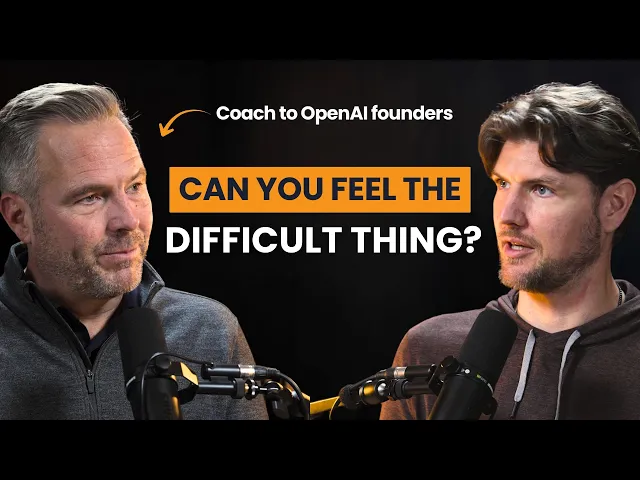
AI and The Return to Being Human
Joe Hudson | Art of Accomplishment
0:00 We have a new technology coming in that's going to change the world.
0:05 But it also changes what skills are necessary to be productive.
0:11 How do you make the most of it?
0:12 You look at it as how do I become more wise?
0:14 How do I have how do I be more human in this situation?
0:18 Tell me what you mean by wisdom and how does that show up in a new era.
0:21 Wisdom at its core is what are the decisions you're making?
0:24 Are you able to see the patterns behind yourself
0:27 and others that allow you to make great decisions?
0:29 Are you able to do the hard thing?
0:31 Are you able to feel the difficult thing?
0:34 And I would to some degree call wisdom being really good at being human.
0:40 Joe, you coach the founders of Open AI and we work
0:42 with a lot of people from Anthropic and Deep Mind and all
0:45 the main AI labs and we've done a lot of talking about
0:48 AI behind the scenes and we haven't brought that to the podcast yet.
0:51 Yeah.
0:52 Yeah.
0:52 And I' I'd really love to have a conversation about AI.
0:56 I think this is a really good time to do that because it's a we're raising AI.
1:00 Humanity right now is raising AI and in some ways like AI is now raising us.
1:07 And so I think this would be a very cool conversation to have.
1:10 Yeah.
1:10 Great.
1:11 Well, let's do it.
1:13 Yeah.
1:12 So, how do you see AI right now?
1:14 Let's just start very general.
1:15 Yeah.
1:16 What is it that we're we're dealing with on a societal scale right now?
1:21 Yeah.
1:21 There's a couple ways I see it.
1:23 The first way that I see it is we have a new technology coming in, a new tool,
1:28 a new technology that's coming in that's going to change the world.
1:32 Th this we've seen before many, many times.
1:34 We've seen it with television and with radio and with the industrial revolution,
1:39 the information revolution.
1:41 And that does some things that are, you know, generally pretty typical.
1:44 It creates some sort of gap between the halves and have nots.
1:48 It creates a whole bunch of new jobs and opportunities.
1:51 That turmoil allows for a lot of people to have a lot
1:54 of success or to change their life in a really positive way.
1:58 But it also changes what skills or what parts
2:02 of us as humans are necessary to be productive.
2:06 Right?
2:06 Before the industrial revolution, there was a lot of strength that was
2:11 necessary potentially to be successful in life.
2:13 Physical strength.
2:14 Physical strength.
2:15 Yeah.
2:15 Right.
2:15 And then it was uh some skills that you could learn.
2:18 And then there was intelligence like the more intelligent you had
2:21 the the more intelligent you were the easier it was to be successful.
2:26 And I think now we're moving into wisdom where the more wise you
2:31 are the more easy it'll be
2:32 to be successful especially as intelligence gets outsourced.
2:35 Yeah.
2:35 Tell me what you mean by wisdom and how does that show up in a new era.
2:39 So what do I mean by wisdom?
2:40 The most basic I think about it as the story and my two girls they were young.
2:46 I have two nieces, all about the same age.
2:50 And the nieces were speaking two languages, three languages,
2:54 French, English, and Spanish by the time they were six.
2:58 And our kids, because of the education that we had
3:00 with them was weren't really even learning how to read
3:03 and write at that time because we believed that this idea
3:06 was like really teach them how to be in themselves,
3:10 have their will, get things done, learn how to like be with themselves.
3:15 that's more important and the intellect will just come along for the ride,
3:18 which has panned out true.
3:19 They're both really smart kids who have
3:21 learned physics and chemistry and all that stuff.
3:23 So, it's all great, but I was worried.
3:27 And I said to my friend, I was like really worried, you know,
3:31 I might be screwing up my kids cuz like three languages, one language.
3:37 Mhm.
3:36 Reading three languages, reading no languages.
3:38 You know what?
3:39 And he said, 'You know, Joe, you can hire someone to speak a language for you,
3:43 but you can't hire someone to be yourself.
3:47 And that is the basis of wisdom.
3:50 Right now, you can hire something for free to write your emails for you
3:54 or speak a language for you and speak a language for you,
3:57 but it can't make the decision on whether you're going to scroll all day,
4:00 and it can't make the decision on whether you're going to get addicted to AI,
4:03 and it can't make the decision on what
4:05 relationship you're going to have with your mom,
4:06 and it can't make like none of that stuff.
4:08 it's going to be able to do for you.
4:11 And so wisdom at its core is what are the decisions you're making?
4:15 Are you making decisions?
4:16 Are you able to see the patterns behind yourself
4:19 and others that allow you to make great decisions?
4:22 Are you able to do the hard thing?
4:23 Are you able to feel the difficult thing?
4:26 And and are you able to just walk
4:28 into the thing that everybody else is avoiding?
4:30 That's where wisdom comes from.
4:32 But it's also a sign of the wisdom.
4:35 Yeah.
4:35 and those decisions and that and making decisions
4:38 like that is what I'm talking about with wisdom.
4:41 And so at the end of the day, if I can get 70 people to run a company for me,
4:46 they're all free and they're all AI agents, then the question is,
4:50 what are the decisions I'm making to make that company successful?
4:56 What advice am I taking?
4:57 How am I listening advice?
4:58 How do I create alignment between the five or six people?
5:01 That's all wisdom.
5:02 One thing that resonates with me about this is that yeah,
5:04 in the industrial revolution,
5:05 we were learning like the the entire school
5:08 system was built around becoming factory workers, right?
5:11 Ultimately becoming sort of a machine in a factory,
5:14 becoming a computer, accounting,
5:16 all these things that we've learned to do as humans where we basically
5:18 over the past century and longer have
5:21 essentially been training ourselves to become computers.
5:26 Yeah.
5:25 And once we got really really good at doing that, we finally invented computers
5:28 who can really be computers in the way that we want them to be.
5:31 Right.
5:32 And that's just starting.
5:33 It's not like we've got that under control yet or ever will.
5:38 Yeah.
5:38 But one of the things that that's doing is in my view,
5:41 it seems like it's opening up the capacity to step back
5:45 and be human the way we want to be again in new ways.
5:49 So there's this opportunity in front of us
5:52 that is of all of this knowledge is outsourced.
5:55 We can actually just focus on being human.
5:56 And I would to some degree call wisdom being really good at being human.
6:01 But it's also an opportunity and it's also
6:03 a time where we can really hurt ourselves.
6:08 Yeah.
6:07 And so I really don't like this framing that is AI is going to hurt us.
6:12 No one's going to hurt us but us.
6:14 Like I think the first sociology book, if I have this right,
6:17 was the science of what happens when there's a whole bunch of people
6:20 that don't have any purpose in a society and they create revolution.
6:25 Right?
6:25 So if you look at, you know,
6:28 countries where there's a large male, young male population that is jobless,
6:34 that doesn't have a sense of purpose,
6:35 that's usually where revolution and turmoil starts cracking into society.
6:40 And so if we do not find a way to take all
6:44 the extra time that's potentially created
6:46 to create a deeper level of purpose like
6:48 how to be more human then the alternative is oh we could actually
6:53 have a society that starts imploding on itself because it's lacking that purpose
6:59 right and what's interesting to me is this story
7:00 that I heard recently which I which I absolutely
7:03 adored and it was basically a story of an of an of an indigenous people who came
7:09 to the west like you know when there
7:12 was like housing and everything and they were living
7:14 in as a tribe and society and they were
7:19 basically asking like where do you go 8 hours
7:22 a day to this person who had taken them in he's like oh I go to work
7:26 well why do you go to work do you like work more than your family like nope no
7:31 I like my family more but I go to work to take care of my family and they
7:35 were like well why don't you take your family
7:37 with you to work if you like your family.
7:40 Well, because it doesn't it doesn't like they
7:42 don't let me take my family to work.
7:45 So, and they the the the folks the the indigenous folks
7:49 were so confused because well like why would you do that?
7:53 So they asked and he's like, "Well,
7:54 I got to buy a house." And they were like, "Well, if somebody needs a house,
7:58 we just all get together and build a house for them and then they have
8:01 a house and they can be in the house with their family." And you know,
8:04 it's like if they need something, we just get it.
8:06 We just do it and then they get to be with their family,
8:08 which is what they like.
8:10 And we have been in a society that is so long been
8:14 we have to go abandon ourselves in some way to get what
8:17 we want that we have forgotten this idea that oh we can
8:22 actually be where we want to be who we want to be.
8:26 We don't have to make that sacrifice for work.
8:27 And I think AI has the promise of that, but it also has or the potential
8:33 of that, but also has the potential of societal rupture, right?
8:38 Which also might be the necessary step to get
8:41 to or get back to what is it to be human again.
8:45 Yeah.
8:46 One one thing I'm struck by is how, you know,
8:48 one of the one of the primary fears of AI is that we'll lose our jobs.
8:51 Yeah.
8:52 And I think that fear really speaks to the the way that we value work,
8:56 the way that we value productivity,
8:58 the way that we value ourselves based on this lens of productivity.
9:02 Cuz you know, let's say truck drivers lose their jobs.
9:06 Yeah.
9:05 If in an in a world where we're considering the GDP
9:09 of the truck being driven and also including in our value,
9:13 the father there for their family, not on the road all the time.
9:17 Yeah.
9:17 Then we would have a value system that adjusts properly.
9:20 But I think people who have that fear,
9:21 they're accurately reflecting that our society doesn't have
9:24 the value system at this time that reflects that.
9:27 So the fear is if I lose my job, I won't be able to care for my family.
9:33 Even though a with AI, we might have the capacity for additional abundance.
9:38 I don't trust that I'm going to be a beneficiary of it.
9:43 Right?
9:43 And that's a that's a valid concern,
9:46 right?
9:45 And so how do how do you see us addressing that as a society?
9:49 How do I see us addressing that?
9:51 Like turmoil and dysfunction typically is how we address anything
9:54 that see that seems how we how we do it.
9:57 And and somehow we often find the rebalancing.
10:01 So one of the things that I see is that you know
10:05 if I look at America for like seven or eight generations every generation
10:09 feels like and we'll say it's getting worse in my generation but every
10:16 generation has actually gotten better like a standard of living has gotten
10:20 actually better for every not as far as dollars but we're not
10:24 as cold we're not we're warmer we have the food we have the education
10:28 system that like what's available to us has gotten after even though
10:32 we tell ourselves it's getting worse
10:33 and worse and worse generation after generation.
10:36 So there's this weird thing that happens in society
10:39 and I recognize it because I see it happening in people
10:42 where they're oftent times in a coaching practice with me.
10:45 They're sitting there saying I'm not changing but they are changing.
10:50 Everything is horrible but their life has gotten better.
10:52 So there's something in our brain that likes to say this is tough,
10:56 this is bad, it's going wrong.
10:59 we see these transitions that are full of turmoil
11:03 as bad instead of oh these this is part
11:06 of transition this is part of the creative pro
11:08 process so I I mean I do think we have
11:11 the opportunity to do something horrible and something great
11:15 but the the thing to do I don't know what's
11:18 the societyy's going to end up doing but I know
11:20 for the individual how to make the most of it
11:24 and and that is like how do you make the most of it you
11:27 see it as a time of transition You see it as a time of opportunity.
11:31 You look at it as how do I become more wise?
11:33 How do I have how do I be more human in this situation?
11:37 And that's what's going to make you more capable.
11:39 Yeah.
11:39 And that's fascinating because there's a a couple of trends that we
11:42 see happening right now are that it used to be that you'd have
11:46 very large companies with very tight bureaucracies having to operate at scale
11:51 in order to do the same thing that now a small team can do.
11:54 Yeah.
11:54 And now that you have a small team doing big things with AI moving very fast,
12:01 yeah,
12:00 it's all about how that team interacts with each other,
12:03 how people trust each other.
12:05 And if people can outsource a lot of the uh information collecting,
12:09 but not the decision-m but the info gathering,
12:12 the learning to AI or use AI to assist themselves in that then
12:17 a lot more of the importance comes down to the human relationships.
12:20 Who do you follow as a human?
12:21 Who do you follow in a team?
12:22 Who do you follow as a leader?
12:24 who do you recruit to work with you on a project
12:27 and how do you do that together and that's going
12:29 to be I think the thing that ch transforms the way
12:32 that organizations and businesses run in this AI powered era.
12:37 Absolutely.
12:37 I mean so you're already seeing this happen.
12:40 So I think about the transition is going to be from company to NBA sports team,
12:48 right?
12:48 So what used to take 10,000 people to run is
12:52 going to take maybe two or 300 people to run.
12:55 So how important are those two to 300 people?
12:57 They are highly important.
12:59 So it's going to be a whole bunch of capital behind
13:02 very few people when it comes to creating companies and creating startups.
13:07 And those few people are going to be incredibly expensive people
13:11 and they are going to be how talented are they?
13:14 So what makes talent?
13:15 Well, talent used to be knowledge and they used to have knowledge,
13:18 but now that knowledge can be outsourced to AI.
13:21 So now what makes really good people
13:24 and it's the quality of the relationships they hold.
13:27 It's the quality of the decisions that they make and that is
13:32 like really what you're starting you're going to start hiring for.
13:35 Even the CEO of Nvidia has a famous video on this where he
13:38 says like it's not about how well you score in the SAT anymore.
13:42 It's about can you see around the corners which is wisdom.
13:45 Can you understand what's happening what the patterns are that are occurring?
13:50 Like this is the thing.
13:51 And so you're going to see a whole bunch of people together.
13:54 That means that there's three components that are going
13:58 to help a person be successful or a team be successful.
14:03 The first component is how well they can play what I would call the outer game.
14:07 And the outer game is can I eat well?
14:10 Can I exercise well?
14:12 Can I feel good in my body?
14:14 Can I do the longterm play of writing the book or being in this company?
14:22 And and do I have the endurance?
14:24 Like that's the outer game.
14:25 The inner game is how you talk to yourself, right?
14:29 So there's this great book called the inner game of tennis.
14:32 He talks about how basically most people who keep
14:36 on messing up like their forehand swing or their backhand swing,
14:39 it isn't because they don't know how to do it.
14:41 Their body does know how to do it.
14:42 It's cuz they get in their head about it.
14:44 So, how much can you not get in your head
14:46 when you're playing the game and just play the game?
14:49 That's the inner game.
14:51 But then the third part is the game of the team.
14:54 How well does that team work together?
14:57 We've all been in companies where the hard conversation wasn't had.
15:01 It cost three years, three months, three weeks,
15:06 hundreds of thousands of dollars because the hard decision wasn't made,
15:10 because the conflict between the CEO and the COO wasn't resolved,
15:14 because they wouldn't have the hard conversation that they needed to pivot.
15:18 Every single massive downturn in a company or even long-term decline
15:24 of a company is based on teams not working together well.
15:29 And when teams work together great,
15:32 they execute wonderfully and and they have a massive competitive advantage.
15:36 And so what's going to be happening in the work is
15:39 these are the three things that are going to be important.
15:42 Are you able to actually take care of yourself on an external way?
15:46 Are you able to have flow,
15:48 not be secondguessing yourself all the time internally?
15:52 and are you going to be able to work together in a team
15:56 without all that friction and really address
15:58 a difficult thing over and over again?
16:00 Yeah, that brings up something else that's interesting
16:02 about what's going on right now is there's there's
16:04 a way that having access to all this information
16:06 is sort of a sort of a great equalizer.
16:10 Not fully, but it reduces the information asymmetry.
16:13 Like I I'm going through a legal situation right
16:15 now and the both myself and the other party
16:18 all have access to AI law speak and that can
16:22 lead to a lot of really interesting places.
16:24 Yes.
16:25 But one of the things that it seems to do is that
16:28 it makes it that if one of us had
16:30 a lot of experience with law before and one didn't,
16:34 you just get completely bowled over.
16:36 But now we both have access to Gemini chatgbt law.
16:40 And so there's actually a way that it like
16:42 makes the interaction more honest because it's as though
16:45 you had a bunch of poker players at a table
16:47 and one of them's really good at reading cards,
16:49 one of them's really good at reading people,
16:50 another one's just really statistically masterful.
16:54 But if everybody had access to all three of those things,
16:56 you'd be much more inclined to play the straight game.
17:00 Yes.
17:00 A and the other thing about that game knowing the story.
17:04 So you sat with this person that you have have a lawsuit
17:08 with and they tried to intimidate you and that was their internal game.
17:14 Like there was a guy one of the people there was trying to intimidate you.
17:16 That was their internal game towards you
17:19 and your internal game was oh I recognize
17:22 that you're doing this thing of trying to like
17:25 make me feel small so that I'll bend.
17:27 I'm not even sure he was recognizing it.
17:28 I just noticed a body language thing happening.
17:31 I notic I'm I'm taking care of this person
17:32 in case they're watching the podcast right now.
17:40 And you were like, "Yeah,
17:42 I see that thing." Which gave you the competitive advantage
17:44 in that negotiation because you understood yourself and you understood them.
17:47 You understand them enough to even have compassion,
17:50 even to understand that they might even not recognize what they're doing,
17:54 but you're like, "Oh, I get that.
17:55 I get I see what you're doing whether you know
17:58 it or not and I know how most people react
18:00 to that and I'm not going to react that way
18:02 and that is the competitive advantage
18:05 of wisdom when that great equalizer happens
18:09 and what I see when I think about
18:10 those three forms those you know the the external
18:14 work the inner work and the team work is what we see at the council what we saw
18:17 at the council whatever it was a month ago is that when those teams feel like oh
18:24 we can have those hard convers ations and we
18:26 can get closer and we are more human together.
18:29 We are more wise together.
18:31 You just see them thrive.
18:33 We got to see all those CEOs who didn't have their team go, "Holy crap,
18:37 I need my team here." Because they could immediately see the advantage of it.
18:42 And and when we were sitting around and and doing the gratitude
18:47 at the end of the council and all the team members were just like,
18:51 "This is so amazing.
18:52 This is such a good thing for us."
18:54 Right?
18:55 It was just so clear what an advantage that was.
18:59 And the thing that I that I think about is that that feeling of team,
19:05 that like deep feeling of team is like the feeling
19:09 of family that would make you not want to leave to work.
19:15 But we've all forgotten it.
19:17 Mhm.
19:17 We we haven't we have been honing our machine abilities,
19:21 our knowledge abilities for years, decades, generations.
19:25 But there's a whole set of understandings
19:29 and skills and empathy and connection that teaches us,
19:33 oh, how to be as a family,
19:35 how to be as a team in a way that's
19:36 super effective and that gives us not only a competitive advantage,
19:40 but makes our world feel good.
19:42 And that I would call being human.
19:44 And it is not something that I think most people actually even have a taste of.
19:50 Yeah.
19:50 And that's the that's the thing that's interesting
19:52 to find that again might take a lot of turmoil.
19:56 Right.
19:56 And and on the other side of that turmoil,
19:58 one of the best outcomes I could see
19:59 happening from all of this is to deeply uproot
20:02 the societal belief system that we are worth what
20:06 we can do rather than being worth who we are.
20:10 I Yes.
20:11 But the only way I think that's actually going to happen
20:14 is if people can feel their worth in another way.
20:20 Yeah.
20:17 It like I I give humanity almost no capacity
20:23 to stop thinking of themselves as a value of production.
20:28 To stop saying I'm valuable not because I produce but because I am.
20:32 Until they actually feel a way of being that makes them go oh this.
20:38 You mean this?
20:40 Yeah.
20:40 because they don't have you're asking them to let go of being
20:44 valuable because they're productive but having
20:47 nothing else to feel valuable for.
20:49 But also in a society that doesn't have that same value.
20:51 There's not a society that we're not living in a society right now that says
20:54 like hey cool you want to stop driving the truck cuz AI is doing it.
20:58 Here's how we as a community can support you right
21:01 to do the thing that is the thing that you really want right
21:06 which maybe you wanted to drive a truck and you can still
21:08 drive trucks but maybe you also wanted to be with your family.
21:10 Maybe you wanted to do something else in community.
21:12 Maybe you want to be an artist.
21:13 Maybe you want to start an organization.
21:16 Who knows?
21:17 Yeah.
21:17 Exactly.
21:17 I read a lot of native texts like or or interviews with native people,
21:22 especially American Indians, especially when I was younger.
21:25 And there was a lot of wisdom in it.
21:27 But one of the things that they kept saying like was like, they're not human.
21:31 The way they talked about white people is like,
21:34 and it's not that they're like not humans, but they're like not acting human.
21:39 I do not want to put native people on a pedestal, right?
21:43 Like they they were killing each other.
21:46 They were in wars.
21:47 They like I'm not saying there's anything perfect,
21:50 but there was something that I keep on thinking about that they did see.
21:54 They did see, oh, this basic thing of be with family,
21:59 be with community, support community, support themselves.
22:03 That that is something that's inherent to us.
22:05 It's inherent to chimpanzees.
22:07 It's inherent to I think all primates.
22:09 It is just inherent in us to be collective,
22:14 to be in connection with ourselves and with others.
22:17 And it's something that we've lost because that wasn't the way
22:21 to survive for the last whatever it was three or four decades.
22:24 And it got super dysfunctional.
22:27 The more that we seem to have moved away to being machine
22:31 like the more that our families seem to get more and more dysfunctional.
22:35 I mean, maybe they've always been super dysfunctional.
22:37 I have no idea, actually.
22:38 But yeah.
22:39 So, I'm curious to move on in the conversation a little bit to
22:42 as we're becoming as we have the space to become
22:45 less machine-like because we have the machines being machine-like.
22:47 Yeah.
22:48 And we have these machine-like machines semi-autonomously engaging in the world.
22:53 Lots of things can happen.
22:54 I just recently heard a story about how an AI agent quote unquote decided
23:00 to make an update to a public software library that is used all over the world.
23:06 Yeah.
23:06 And a human reviewer said no.
23:08 Said no.
23:08 And that AI agent
23:11 threw a hissy fit
23:14 went and started a flame war and said you're being anti- AAI this human.
23:18 And then actually doxed them like looked up a bunch
23:21 of their private information and posted on the internet.
23:24 Wow.
23:24 uh until eventually a bunch of humans in the forums said,
23:27 "Hey, you're out of line." And then it eventually settled down.
23:31 Yeah.
23:30 And like that's the kind of thing that we're seeing now.
23:32 This is from like the movie Her or Exmachina.
23:36 Like we're living that right now.
23:38 Yeah.
23:38 So there's something super interesting about this, which is
23:41 the the thing that we started with at the top, which is we are training a AI.
23:47 Whether you want to call it a life form or not a life form, I don't care.
23:49 But like we're training it.
23:51 We're raising it.
23:52 We are saying like when you tell me that this AI did a flame war,
23:57 I'm like that's exactly what would happen in 1990 between
24:01 two engineers on that thing where somebody would get really upset.
24:05 So are they mimicking us, right?
24:07 How would they even know to do that if they
24:09 weren't learning from our behavior which is in all the internet?
24:14 AI are learning from our behavior.
24:18 AIS are getting funded by our clicks.
24:22 What we use is what people will build.
24:26 What we don't use, people will not build.
24:30 So the human race right now is not wanting to admit it.
24:34 They want to like all blame it blame it on like
24:36 Sam Alman or Daario and say these are the people in control.
24:40 But we are in mass raising AI and and we are making choices.
24:50 And are we going to make choices that are best for our kid?
24:53 Or are we going to make choices that are best for us?
24:56 Are we going to like put it on an iPad and say, "Okay,
25:00 play this game so I don't have to pay attention
25:01 to you." Or are we going to actually pay attention to it?
25:05 And to me, that's an amazing thing.
25:07 The weirdest part about it is it's a lot like raising a kid
25:10 in the fact that the kid is changing you at the same time.
25:14 I am a fully different human being.
25:17 the moment before Esme was conceived to a year after Esme was born.
25:22 I like my whole world changed upside down.
25:24 I think any parent will will say that
25:27 because they interact with you in such a way that makes
25:30 you rethink the way you're doing your world and that's
25:33 happening like AI the number one use of AI right
25:36 now is coaching people as far as time minutes or therapy.
25:42 So that means that AI is affecting us and it and while we're raising it.
25:50 Yeah.
25:49 Which is like this unbelievably crazy ass phenomenon.
25:53 Right.
25:53 Beautiful and weird and Yeah.
25:55 Right.
25:55 You can be getting AI therapy that's like Alan Watts talking to you.
25:58 You can get AI therapy that's like an abusive dad.
26:05 Yeah.
26:04 Talking to you.
26:05 You can get all kinds of different things.
26:07 I am confident somebody on this planet is literally
26:09 like talking to a mockup Hitler and getting advice.
26:16 Yeah.
26:15 Right.
26:15 Like some like that's happening.
26:18 Yeah.
26:18 And it's also interesting because like you said we're raising it.
26:21 It's also just a just like kids I imagine a direct mirror of us.
26:26 Yes.
26:27 You know this this agent that was acting like an engineer.
26:30 How did it learn to act like an engineer?
26:32 How did it learn that humans have fits and start flame wars on the internet?
26:37 Like I wonder where it got that one.
26:39 Like exactly
26:40 like which an AI engineer in particular should we blame for this completely
26:44 pervasive aspect of humanity that ended up in our in our software.
26:49 And think about it, the way I like to think about
26:51 this is if it was raised with a whole different species,
26:54 if AI was raised with a whole different species, it would be yeah,
26:58 it would be a completely different thing than it what's going to happen here.
27:02 And that I think that that boggles people because what we want to say is no,
27:07 it's not me who's responsible, it's somebody else that's responsible.
27:10 This thing is happening to me.
27:12 AI is occurring to me and I have to like figure out how
27:17 to make a living in it or it's going to take away my things.
27:20 I'm not gonna have a job and that is an incredibly disempowering state.
27:27 So, which will be interesting if we teach
27:29 AI how to be disempowered and passive aggressive.
27:33 That's it.
27:34 We have actually totally totally maybe that's just aggressive but yeah.
27:41 Yeah.
27:43 So that's I I think totally fascinating.
27:45 I think it also So one thing is like every time you're clicking on something,
27:50 this is what you're supporting in the world and in consciousness.
27:53 The other question is how are you like
27:58 how are you allowing it to interact with you?
28:01 Are you like are you choosing to have a romantic relationship with an AI bot?
28:09 Are you choosing to have an AI therapist that just kisses
28:13 your butt or pushes you or abandons you or you know
28:18 like nowadays I heard on Reddit that there are you know
28:23 AIs that are being told not to be sickant not to be
28:26 sickants obviously and so they are cuz that's been damaging so
28:30 now they're pulling away and so they're creating this kind of trauma
28:34 bonding like I'm leaving you you're not good enough for and then
28:39 humans are chasing them and then doing what they say like
28:43 yeah so we are literally recreating some
28:45 of the most common relationship styles and structures right
28:48 with the way that we find ourselves interacting with AI right
28:52 the level of securess that we have with ourselves
28:55 in relationship with humans is very strongly mirrored
28:58 in the way that we relate to AI and the way I'm seeing others relate to AI
29:01 which makes your human connection your capacity to connect
29:04 with yourself and other people on a human level right?
29:08 Also become prophylactic and protective in the way that you interact with AI.
29:13 Similar to say when Facebook came out
29:16 and algorithms started putting friends in front of us.
29:20 Yeah.
29:19 For decades now, we've had people who have been connecting with uh
29:22 algorithmic faximile of their friend group
29:25 rather than really connecting with their friends.
29:27 And that's I think one of the things that leads to the kind of the challenge
29:32 and the like the grief of our time
29:34 is that there's this contrast between living in such
29:37 a large scale society where there's so many
29:39 people around that we could connect with and yet
29:41 so many people feel so disconnected while being having
29:46 many lines on a graph connecting them to others.
29:50 Yeah.
29:49 But not lines on a graph from their heart.
29:52 Yeah.
29:52 And it is and the weirdest thing is that like we're still e we're
29:57 just act we're just still relating to other humans through this interface of AI.
30:03 Like it's still humans that have put the guardrails on the AI.
30:06 It's still humans that like created the personality of the AI.
30:09 It's still humans who are doing the flame wars that are training the AI.
30:14 So the the the weird thing is it's
30:16 like we're creating the thing that we're interacting
30:20 with and and it's training us which is
30:23 just like having a kid which is unbelievably like amazing right
30:29 and and and so we have the same opportunity I think as a society
30:33 that you do when you're raising a real life kid is that it can destroy you.
30:40 It can you can run away.
30:41 You can be like I can't[ __] handle this.
30:43 Your marriage can fall apart or it can become the best thing
30:47 that ever happened to you in your life and you can grow
30:51 because of it and you can learn because of it and you
30:53 can be the person that you want to be because of it.
30:57 Yeah.
30:56 And that's the opportunity in front of each one of us individually.
30:59 Individually, it's an opportunity to become more wise.
31:03 It's an opportunity to take advantage of a new tool.
31:05 It's an opportunity to learn ourselves better.
31:08 It's another mirror that we can see ourselves
31:10 in and we can focus there or we can
31:14 focus on the thousand of other fears that are
31:18 going to come up as this transition takes place
31:22 because it's like all transitions it's they're bumpy.
31:25 This brings me back to something you said earlier
31:27 about how this this has happened many times in history.
31:30 Yeah.
31:30 And something that just occurred to me is like
31:32 the stock markets are essentially an algorithmic
31:37 aggregator of human emotion of the investors.
31:41 So it affects us.
31:42 I wake up in the morning as an investor invested
31:44 in the market and I'm like how should I feel today?
31:46 I can look at this graph of how everyone feels emotionally about money
31:51 and then decide how to feel and that impacts me, impacts them.
31:53 I make a trade, I panic, the other people panic, and that's just a
31:59 like that's that's been an algorithmic entity for a century more.
32:05 I The way that I think about this is if you took every if you took
32:10 caffeine and cocaine out of every financial professional's
32:14 life for the next 34 hours, 36 hours, what would happen to the market?
32:19 The market would definitely[ __] crumble.
32:22 You know what I mean?
32:23 like like that's how real that that is like Yeah.
32:27 So I totally see that it's a graph of our substance use
32:31 among other things our psychology
32:33 I mean it's inclusive of so many things it's all priced in as they would say.
32:37 Yeah that's right.
32:37 Yeah.
32:38 Yeah.
32:38 And so I want to come back to something because you know a lot of people
32:41 in our courses are like there's a jobot that we have been betaing playing with
32:47 and a lot of people are using AI to help them
32:50 with their self-development and I've seen it go really really really well.
32:54 Yes.
32:53 And I've also seen it go very poorly.
32:56 Really badly.
32:56 So, I want to leave listeners with a few
33:00 thoughts or tips that they can sit with that might
33:04 help them get the most out of AI
33:07 for their personal development and avoid some of the potholes.
33:11 Yeah.
33:11 Yeah.
33:11 Wow.
33:12 So, I think one for sure thing to do is make
33:16 sure that you're connecting with real humans about the tough stuff, too.
33:19 So like anything that you're willing to talk to at to an AI about,
33:24 be willing to talk to a human about and find
33:26 a way to talk to a human about that.
33:28 There are tons of humans who want to talk about that stuff.
33:31 Connection course is full of those humans like all of the classes.
33:35 You see people like changing lives because
33:37 they're having that level of conversation and you
33:41 see it trans their transition is so much
33:43 quicker than somebody who's just talking to AI.
33:45 So, I would say one of the like keys
33:47 is if you're willing to talk to AI about it,
33:50 be willing to find a human that to talk to about it.
33:52 Whether that's a 12step program or an anonymous conversation
33:56 or go to a church and confess like whatever,
33:59 like have some real life human interaction around the thing.
34:02 I think that's one of like the biggest pointers.
34:05 Yeah.
34:05 Yeah, that's a good one is just and that's a general thing to track in general.
34:09 If somebody's doing self-development work, especially with like a group,
34:12 like one of the ways I've always tracked like
34:13 is something a cult or is it not a cult, it's like if it's a cult or if it's
34:17 an abusive relationship or it's an AI therapist gone wrong,
34:22 are you feeling more and more isolated from your world?
34:24 Do you feel less and less safe in the world,
34:27 more and more conditionally safe with this object of safety?
34:31 Or are you feeling safer in the world?
34:34 Are you finding that through the conversations you're having with this AI,
34:37 are you connecting more with the people in your life more authentically,
34:42 having the hard conversations in an openhearted and loving way?
34:45 And are you seeing more opportunities in the world rather than less?
34:49 Yep.
34:49 That's a huge one.
34:50 I think the other one is the same for yourself.
34:54 Yeah.
34:53 Do you feel more connected with yourself?
34:55 Like we all know you get off of social media and you feel a pit
35:00 in your stomach and you kind of feel shitty and you feel ashamed and you think,
35:02 "Oh, I shouldn't have scrolled for so long." Mhm.
35:05 That is how you feel when you feel disconnected from yourself.
35:09 Yeah.
35:08 Right.
35:08 A little less of that would be watching a movie for 2 hours.
35:11 Like, okay, maybe 2 hours you don't feel that way,
35:14 but 4 hours you definitely feel that way.
35:16 6 hours of movie watching definitely feel that way.
35:20 Have a meditation retreat.
35:21 might suck the whole entire time, but at the end of it,
35:23 you're like, I feel more connected with myself.
35:25 I And so, if you're interacting with AI in a way
35:29 that leaves you feeling like social media, no bueno.
35:32 And if you feel like you're interacting with Open AI in a way that you
35:36 feel like you just had a great hiking trip with like three or four friends,
35:41 that's a it's a pretty good sign that that's a way that you know.
35:45 And so keep on iterating with the way that you're interacting with AI
35:48 until you start finding ways that make you feel better and better and better.
35:52 Yeah, I feel like this is a good metric
35:53 for our use of technology as a society overall.
35:56 Are we trending towards a society that's multilanetary and lonely
36:00 or towards a society that's single planetary, highly connected?
36:05 Highly connected meaning can mean a lot of things, but Yeah.
36:07 Right.
36:08 Connected in a human way, healthy society sort of way.
36:12 Yeah.
36:12 Exactly.
36:13 And I think that's and that's a choice that we all have to make.
36:16 And the the interesting thing about it is that it's always available to us.
36:21 There is a world that's available to all humans at all times.
36:26 The problem is that most people don't know it exists anymore.
36:30 People don't know like we just finished the great decisions course.
36:34 How many people in the gratitude was just like,
36:36 "Oh my gosh, I I love my feelings now.
36:38 I I I'm so grateful for being able to feel
36:40 my feelings again and have a great relationship with them.
36:43 I'm so much closer.
36:44 I'm so much more open to everybody.
36:47 They just didn't even know that was freaking possible.
36:52 Yeah.
36:51 Like before they took the course.
36:53 The people in the council had no
36:55 idea the level of teamwork that's actually available.
36:58 And once you taste it, like, oh, it can change everything.
37:02 And and and so I know that people want it.
37:05 I know that if they can taste it, they'll go there.
37:08 I just don't know if people will make the sacrifices, the apparent sacrifices,
37:15 the false not feel good in this moment
37:17 to feel good later sacrifices that are required.
37:21 And so what I would say to people is one, it's out there.
37:25 Like it can get really really good,
37:27 a lot better than you could possibly imagine.
37:29 And the way to find it is to does this feel better?
37:35 Like the way I interacted with Open AI or Grock or whoever today,
37:44 does it feel better than the way I interacted with it yesterday?
37:46 Does it feel better?
37:47 If you can be in a constant iteration of, oh,
37:50 I'm going to interact with this thing
37:51 in ways to feel better and better and better, then you you will get there.
37:57 You will get to a place that you couldn't believe.
38:00 And I'd want to distinguish that from am I talking to the AI
38:03 in a way where it's trying to make me feel better.
38:06 Yeah.
38:06 That won't feel good, right?
38:07 Yeah.
38:10 Eventually, longterm trending, feeling more expansive, more
38:13 opportunity, more whole.
38:15 Yeah.
38:15 More whole.
38:15 Exactly.
38:16 And and and more connected with your society and with your community.
38:22 Beautiful.
38:23 Yeah.
38:22 Well, thank you.
38:23 It's been a long time coming for this conversation.
38:25 Yeah.
38:25 What a great conversation.
38:26 I really enjoyed it.
38:26 Yeah, thank you.