Why English is full of silent letters
RobWords
0:00 It is perfectly normal for a language to have silent letters.
0:03 But with English… It’s just got way out of hand.
0:07 Without doubt.
0:09 It’s been said that every single letter
0:11 of the alphabet can be silent in English.
0:14 So let’s put that to the test and find out how our language ended up this way.
0:20 Welcome to another RobWords.
0:24 English does have an extraordinary number of words with silent letters.
0:27 I mean, just look at them.
0:29 But for each of them, there is an explanation.
0:33 Some of these explanations are historically fascinating.
0:36 Some of them offer extraordinary insights into the ways in which we speak.
0:41 And some of them… are just really irritating.
0:44 I think you’re going to agree.
0:46 So, let’s see if indeed every letter of the alphabet can be
0:50 silent in English Because I must admit I’m a little bit skeptical.
0:54 Just keep an eye on this up here as we tick them
0:57 off and we’ll see if by the end there are any letters left.
1:01 So where to start?
1:02 Well, I reckon the default assumption when we see a silent letter
1:05 in a word is that at some point that letter must have been pronounced.
1:09 At one point people were saying “recei-p-t” and “de-b-t”.
1:13 Of course they were.
1:14 We just got lazy over time and stopped pronouncing them.
1:18 So what if I were to tell you that the P
1:22 in receipt and B in debt were never pronounced?
1:25 Because they weren’t.
1:27 This is how the word debt was spelled when
1:30 we borrowed it from French around 700 years ago.
1:32 In fact, it’s still spelt like that in French now, and look.
1:36 No B.
1:37 Now see how its spelling varied over the centuries afterwards.
1:41 Still no B through the 1300s, all throughout the 1400s, and the 1500s until oop!
1:47 What’s this?
1:48 Where did that come from?
1:51 Suddenly, in the middle of the 1500s a B appears.
1:56 What?
1:57 Why?
1:57 Well something else is happening at precisely this time.
2:01 The Renaissance.
2:03 The Renaissance in England sees scholars and the like
2:06 taking a sudden interest in ancient Greece and Rome.
2:09 It’s called the renaissance because it’s like a “rebirth” of classical culture.
2:13 One of the forms this takes for writers is an interest
2:16 in the Greek and particularly Latin origins of English words.
2:21 Some of these writers noticed, for example,
2:23 that the word “debt” most likely came from the Latin dēbitum, meaning “owed”.
2:29 And so, in a nod to debt’s classical roots,
2:32 and to show off that they were aware of them,
2:34 they started to spell debt with a B.
2:38 A pointless, self-congratulatory move that users of English like
2:42 you and me are still having to deal with.
2:45 But it gets worse.
2:46 The renaissance scholars did almost exactly the same thing
2:49 with the word “doubt” and they introduced that pretentious P in “receipt”.
2:53 They put a never-to-be-pronounced B in plumber, a mute C to indict,
2:58 a ludicrous L in salmon, and a stupidly silent S in isle.
3:04 All additional letters that hadn’t been present
3:06 in the words as long as they’d been in English.
3:09 That last one, isle,
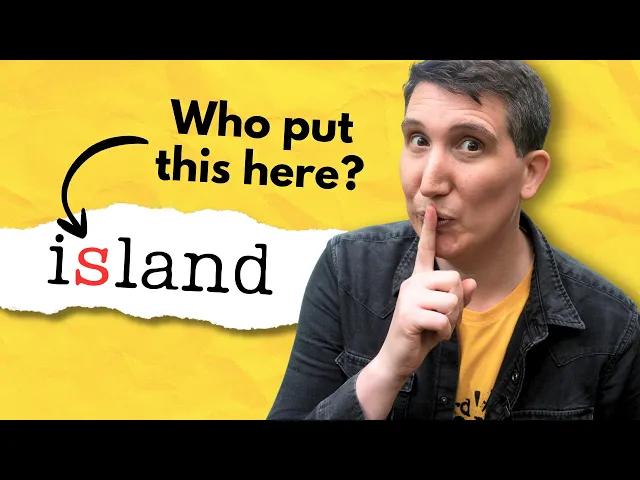
3:11 had the knock-on effect of also introducing an S into the word: island.
3:15 because writers understandably thought the words were related,
3:18 which funnily enough, they’re not.
3:20 One of them is Germanic and the other one is Romance.
3:23 And bonus balls-up: this is all also responsible
3:26 for the S in the other kind of “aisle”, added to reflect “isle” too.
3:30 Also amazing is the fact that we’ve started to pronounce
3:33 some of the letters added during this silent revolution.
3:37 The word “perfect” didn’t have a C in it before the Renaissance.
3:41 And there was no L in fault, either.
3:44 But those fancy Renaissance writers shoehorned them
3:47 in and now we’re sounding them out.
3:50 So that is one of the more irritating
3:52 episodes in the story of silent letters in English.
3:55 It’s annoying because they don’t need to be there.
3:58 But it is not the only instance of deliberate insertion of inessential letters.
4:04 Another had occurred slightly earlier, actually,
4:06 when the first printing presses arrived in England.
4:10 I’ve told this story before but it bears repeating.
4:12 The fella who opened the first presses in England, William Caxton,
4:15 had to hire folk from continental Europe to help him with the things,
4:18 because the Europeans were the only ones with the expertise.
4:21 Unfortunately, the foreign printers that came over to Britain
4:24 had their own ideas about how English should, could and would be spelt.
4:29 For example, they thought that “could” should have an L
4:32 in it to match with the Ls in should and would,
4:36 despite “can’ being distinctly L-less.
4:40 So in some early printed books “could” appeared with an L.
4:44 And it stuck.
4:45 They also thought “thum”,
4:47 “crum” and “lim” should have silent Bs at the end of them,
4:50 like “comb”, “lamb” and “womb” already did.
4:54 So now they do.
4:55 And, consistent in their obsession with consistency,
4:58 they added a W to one of the meanings
5:01 of “hole” to match it up with “who”, “what” and “why”.
5:05 Although, actually that one’s kind of useful, isn’t it?
5:08 Oh, and they threw a spectral H into ghost because they had one in Flemish.
5:14 So again, we have a load of words
5:16 with letters in them that have never been pronounced.
5:20 They sit there.
5:21 A silent threat to anyone attempting to master English spelling.
5:25 But do you know where else there are silent threats?
5:28 The internet.
5:29 But luckily NordVPN, who’ve sponsored this video, are here to keep you safe.
5:34 NordVPN enables you to change your online location so you
5:37 can surf the net comfortably reassured that you’re not being tracked.
5:41 This is particularly helpful too, if like me,
5:43 you’re often using unsecured public wifi like in a café or wherever.
5:47 But of course, the extra big bonus
5:49 of websites thinking you’re visiting from somewhere else,
5:51 is that they’ll allow you to access things
5:54 that aren’t normally available in your actual location.
5:56 This includes being able to watch
5:58 streaming content that’s geoblocked where you are.
6:01 But NordVPN- despite the name- is much more than just a VPN.
6:06 It’s a complete online security package.
6:08 Its brilliant Threat Protection Pro feature will
6:10 scan any files you download for malware,
6:13 direct you away from websites known for scamming people,
6:15 and block irritating or harmful pop-ups.
6:18 I have NordVPN switched on all the time and I can protect
6:22 my whole family with it by having it on up to 10 devices.
6:25 If you want to do the same,
6:27 use my special link nordvpn.com/robwordsvpn- I’ll put it in the description-
6:31 and you’ll get an exclusive deal with four extra months for free.
6:35 There is a 30-day money-back guarantee too, so it really is risk-free as well.
6:40 Go to nordvpn.com/robwordsvpn and give it a go.
6:45 Now, a lot of the time,
6:47 that instinctive assumption that a silent letter in a word
6:50 was at some point in times-gone-by sounded out is correct.
6:54 Knock knock.
6:55 Who’s there?
6:56 Silent K.
6:57 In all of these words here.
6:59 Silent now, but not in the past.
7:02 It’s thought we stopped pronouncing the K
7:04 gradually over the centuries, funnily enough,
7:06 around the time when Renaissance scholars
7:07 were adding in those other silent letters.
7:10 But before that– for example,
7:11 in Geoffrey Chaucer’s day– the K was being proudly enunciated.
7:14 His knight’s tale would have been introduced with “A knyght ther was,
7:18 and that a worthy man”.
7:20 But if you go back further still to Old
7:23 English being spoken over a thousand years ago,
7:26 all of these words appear– although not with a K, but with C.
7:31 A C that was sounded out.
7:34 The C wouldn’t have been there if it wasn’t because
7:36 these arrangements of Latin lettering
7:38 were supposed to represent Anglo-Saxon speech.
7:41 An Anglo-Saxon called a knife a cnif, a knot a cnotta and his knee his cnéo.
7:48 In Dutch and German, a knee is a “k-nee” to this day.
7:53 And you can just copy and paste everything I said
7:55 about silent K words over to these silent G words, too.
7:59 We once had g’nawing, g’nats and g’nomes.
8:03 Now, one word you could use to explain
8:05 the loss of these kuh and guh sounds is “laziness”.
8:09 The transitions to the Ns were kind of awkward, so we stopped doing them.
8:13 But another, more technical word to explain it is “phonotactics”.
8:19 Phonotactics dictate which sounds are allowed
8:21 to appear together in any given language.
8:24 For example, in English we can begin a word
8:27 with a “sp” sound combining an S and a P,
8:30 but we can’t begin it with a “hp” sound combining an H and a P.
8:35 However, phonotactics- these rules about the sounds
8:37 of a language- can change over time.
8:40 And that’s what’s happened with English.
8:42 KN and GN sounds were once on the right side of the law,
8:47 welcome at the start of English words.
8:49 But now the law’s changed and they’re not.
8:53 Phonotactics are responsible for many more silent letters in English.
8:57 Especially in words that we have imported from other languages.
9:00 Different languages have different rules and when
9:03 a borrowed word doesn’t fit with our sound laws,
9:06 we have to change that word to make it fit.
9:09 In ancient Greek it was perfectly legitimate to start a word with a “ps” sound.
9:13 But in English, it ain’t.
9:15 So we pretend the p isn’t there when
9:18 we pronounce Greek-derived words like “psychology” and “psalm”.
9:21 Ditto with “pt” words like “pterodactyl”.
9:25 However, the rules of English only say
9:27 that you can’t start a word with these sounds.
9:30 The “pter” at the start of pterodactyl- meaning “wing”- is
9:34 the same as the “pter” at the end of helicopter, meaning “wing”.
9:38 But because the “pt” is in the middle of that word, we can pronounce it.
9:43 Helicopter.
9:44 The same goes with words like “mnemonic”.
9:47 You can’t kick off an English word with “muh-nuh”.
9:50 You just can’t.
9:51 So we skip the M.
9:53 However, in other words, like” insomnia”, that “muh-nuh” sound is A-okay.
10:00 Or M-okay.
10:02 We have rules on how words can end, too.
10:04 No English term can climax with “mn” either, so in the case of “autumn”...
10:12 Good timing, tree.
10:13 So in the case of the word “autumn”, we drop that ungainly N.
10:17 Yet, with “autumnal”, both letters get their time to shine.
10:22 By the way, Chaucer used to spell autumn with a P in it too,
10:27 which is definitely just silly.
10:28 You can’t just P anywhere, Geoffrey.
10:30 Autumn of course isn’t a Greek word, by the way.
10:33 It’s from French– as are so very many of our English words.
10:36 Around a third of them, in fact.
10:38 Thanks William the Conqueror.
10:40 Another way you end up importing silent letters from other languages
10:43 is by borrowing words that already had silent letters in them.
10:47 Benign or malign, the French deigned to assign silent Gs
10:51 to words like reign and we’ve aligned with their design.
10:55 Most of those words were descended from Latin words where the G was pronounced.
11:00 Although, ironically, the silent G in “foreign” is a home-grown invention.
11:07 It was added by English writers inspired by the spelling of “sovereign”.
11:12 We can thank the French for the fact we can cross
11:13 off some of the trickier letters from our silent letter alphabet.
11:17 Borrowed terms like “faux pas” and “choux pastry” give our language its silent
11:23 Xs and we can casually discard Z with a “laissez-faire” “rendezvous” “chez” moi.
11:29 We can also thank French for words like ballet that allow us to cross off T too.
11:34 Although, listen: I hasten to add that “listen” and “hasten” have silent Ts too,
11:40 letters dropped as a result of centuries of accumulated laziness.
11:44 There’s no reason not to pronounce those Ts.
11:46 We still say “listed” and “hasty”.
11:48 But sometimes letters disappear for nothing more than convenience’s sake.
11:52 Take the silent Ds in “handkerchief” and “handsome”.
11:56 Although some people might pronounce the latter of those, just
12:00 like they might with the D in “sandwich”, although others definitely don’t.
12:05 Perhaps you saw Michael McIntyre’s recent,
12:07 brilliant reimagining of what English would sound
12:09 like if we did pronounce our silent letters.
12:12 “The sandwich shop is half a hour
12:16 away.” “It’s a waste of everybody’s time.” Although,
12:19 weirdly, I think I sometimes pronounce it “samwidge” as if there’s an M in it.
12:23 What’s that about?
12:25 Maybe you do too.
12:26 Try it.
12:27 Samwidge.
12:27 Samwidge.
12:29 Actually, all this raises a good point that I should have mentioned earlier:
12:32 what might be silent to one English speaker may be loud and proud to another.
12:37 So far as I’m concerned the Ls in “palm” and “folk” are silent.
12:42 You need them, because otherwise you’d have “pam” and “fok”,
12:45 but there’s no “luh” sound when I say them.
12:49 That was lost in most British varieties of English centuries ago.
12:53 But some people, particularly in the US, do pronounce those Ls.
12:58 And there are two parallel reasons for that.
13:02 Some folk retained the Ls because their dialect crossed
13:05 the Atlantic before the Brits decided to drop those Ls.
13:08 And other people are pronouncing them simply because they’re in the spelling,
13:13 unaware that they’re usually mute.
13:15 They’re essentially reintroducing them.
13:18 Good for them.
13:20 This kind of tomato-tomato difference between varieties of English
13:24 also governs the overall resonance of the letter R.
13:28 Some accents are overflowing with silent Rs, like mine.
13:32 I don’t pronounce the R in “over”, there’s no “ruh” sound.
13:37 Nor at the end of “paper” or “centre” or even in my own bloomin’ name:
13:42 To me, the second R in Robert is silent.
13:46 Robuht That’s because my accent is what’s called “non-rhotic”.
13:52 In “rhotic” accents though, like a lot of Americans have,
13:57 the Rs are not silent: Roberrt’s paperr coasterr.
14:01 You see?
14:02 For people with those English accents we have
14:04 to look a lot harder for silent Rs.
14:06 The folk at America’s Merriam-Webster dictionary propose “forecastle”-
14:10 part of a ship pronounced with typical nautical efficiency.
14:15 Or “February”.
14:17 Although a bet some people would challenge that second example.
14:20 I actually had to go out of my way there not to say “feb-roo-ary”.
14:23 Because I would say “feb-roo-ary” But people
14:26 definitely do say “feb-yoo-ree” so that’ll do.
14:28 Another letter that has the Merriam-Webster folk somewhat clutching
14:31 at straws in this, by the way excellent, article is F.
14:36 They put forward “fifth” as a word
14:38 with a silent F and I think they’re probably right.
14:41 Even the most precise among us who do say
14:44 “fif-th”– I think I do most of the time–
14:47 Still probably do find ourselves resorting to “fith”
14:50 when time and effort are of the essence.
14:53 Merriam-Webster actually gives that as one
14:55 of the legit pronunciations of the word.
14:57 [Robot voice]“Fifth” As do the folk at Oxford,
15:00 who’ve pop the second F in brackets to show that it is “optional”.
15:04 If fifth doesn’t satisfy the F out of you, what about the word “halfpenny”,
15:09 where the letter is definitely dropped even if it’s spelt like that.
15:14 But F is a tricky customer as are all of our remaining consonants above.
15:20 We’ll try to silence those shortly,
15:22 but first observe that all of our vowels still remain too.
15:27 So can each of those be mute?
15:30 Yes.
15:32 Take A out of “dead” and you’re still “ded”.
15:35 Filter out the Es from “sieve” and it’s still a “siv”.
15:38 When is I silent?
15:39 I be silent when I is in “business”.
15:42 Although weirdly the I in business seems to have stolen the U’s job instead.
15:47 Bizzness.
15:48 And business really does come from the idea of busy-ness, by the way.
15:52 And O and U can both be accounted for in the same notorious cluster:
15:56 the highly versatile word-ending OUGH.
16:00 We ignore the O in “enough”, but skip the U in “cough”.
16:05 English can be really silly.
16:09 So that is all five of those vowels swiftly dealt with.
16:12 They can all be silent in English.
16:15 A big reason why a lot of vowel sounds don’t
16:18 resemble their spellings is of course the famous Great Vowel Shift,
16:21 which saw the pronunciation of English long vowels change
16:25 pretty dramatically over just a couple of hundred years.
16:28 and their spelling simply didn’t always keep up.
16:31 I did a big video about that and I will leave a link below.
16:35 It’s a goody.
16:36 But now we’re left with the really tricky letters.
16:39 Now, to me, it makes sense to look at Y next,
16:43 it being a sort of part-time vowel.
16:45 Which English words have a silent Y.
16:52 Let’s see what the clever folk at Merriam-Webster went with.
16:56 “Beyond”?
16:57 So their logic is that if you take the Y out, you still get “be ond”.
17:04 But hold on– I definitely here a “yuh” sound in beyond.
17:09 Beyond.
17:10 It’s related to “yonder”, isn’t it?
17:12 Be-yond.
17:13 That Y might be superfluous, but it isn’t silent.
17:18 It’s only in “be ond’ because of the way English
17:22 speakers insert “yuh” sounds as they transition between certain vowel sounds.
17:26 “Be yond” It’s called the “intrusive Y”,
17:29 which sounds much spookier than it actually is.
17:32 So which words really do have a silent Y?
17:36 “Martyr” maybe?
17:38 Martyr.
17:40 There’s no obvious “yuh” sound in there,
17:42 but you do need it because you can’t just end a word with TR.
17:48 We’re back to phonotactics again.
17:50 I think martyr’s a maybe.
17:52 “Says” perhaps?
17:53 You definitely don’t pronounce the Y.
17:56 Not unless you’re being excessively precise, saying “say-s”.
17:59 But if you take it away you get “sas”, not “ses”.
18:06 So another maybe there, I reckon.
18:08 What about “they’re”?
18:11 I like to think I pronounce it “they-r” but I bet I
18:14 and a lot of people end up pronouncing it sometimes the same as these words.
18:19 Hence the common confusion between the three of them.
18:22 But is “they’re” really a word?
18:26 It’s more a smooshing together of two, isn’t it?
18:29 Gah.
18:30 At this rate we haven’t got a prayer of finding one… Hold on a second!
18:35 “Prayer” Prayer!
18:38 I mean, I guess some people pronounce it
18:41 “pray-er” but I bet they’re in the minority.
18:44 No, I think that’s it.
18:46 I’m having it.
18:47 Cross Y off that list.
18:48 “Prayer” is a word with a silent Y in it.
18:52 Okay, I’ve had a good old think, and a good old Google,
18:55 about J already and man, this one is tricky.
19:00 Not just because there appears to be only one silent J in the English language,
19:06 but because it's a word that I’m not even sure that I’m
19:09 allowed to utter without incurring the wrath of the YouTube gods.
19:15 Let’s risk it.
19:16 The word is “marijuana”.
19:19 Now obviously, in its native Spanish,
19:22 that J would be making a charismatic “huh” sound.
19:26 But in English it isn’t really doing anything.
19:30 Take it away and you get “mari uana”.
19:33 It certainly isn’t making its usual “juh” sound, or its occasional “yuh” sound.
19:39 So I reckon that does count.
19:42 Let’s chalk off J too.
19:44 Now, next in the queue is Q.
19:46 A letter that, let’s face it, we don’t really need.
19:50 But is it ever silent?
19:52 Well… how about in “racquet”?
19:56 Take it away, along with its parasitic U and you still get “rac-et”.
20:02 That’ll do, won’t it?
20:03 I know in the US “racquet” is now spelt like that, but so
20:07 far as I know you still spell the sport “racquetball” like that.
20:11 But if that still doesn’t satisfy you,
20:13 I offer up the word “lacquer” for the same reasons mentioned above.
20:17 So there we go: 25 out of 26 letters crossed off.
20:21 We’re close to knowing whether or not every letter
20:25 of the alphabet can indeed be silent in English.
20:29 It all comes down to V.
20:31 Well I have put every cell in my body into trying to find a word with a mute V,
20:37 and man, it is hard.
20:40 Merriam-Webster proposes “ne’er”, as in the poetic contraction of “never”.
20:46 But if you ever write ne’er, you do not write the V.
20:50 You pop an apostrophe there instead.
20:52 So the V is less silent, more completely absent.
20:56 Ditto with “e’er” and “o’er”.
20:59 And I guess you could throw “gimme” in the mix as well, for “give me”.
21:03 But it seems that we just can’t bring
21:06 ourselves to write a V where there isn’t one.
21:09 So that’s it.
21:10 I think V is the one letter in English that is ne’er silent.
21:15 Or, at least, I did conclude that.
21:17 But then, last night, while looking up whether this village in Devon is really
21:23 pronounced “woolzery”– it is by the way– I had a brainwave:
21:27 surely there’s a placename in England with a silent V in it.
21:32 If this can be pronounced “chumley”,
21:34 surely the inhabitants of somewhere else are
21:37 smuggling a cheeky V under the radar too.
21:39 Well, they are.
21:42 My enormous thanks to the people of this small village
21:44 in the English county of Norfolk for pronouncing their home “Raningum”.
21:50 Some people definitely pronounce it “Raveningham” too, but look.
21:53 Here’s that pronunciation confirmed in a 1990 BBC pronunciation dictionary.
22:00 This is “Raningum” Hall.
22:02 So are we allowing that?
22:04 Placenames are words, and this one’s in England.
22:07 So doesn’t that make it an English word?
22:09 I’m having it.
22:10 I’m doing it.
22:11 I’m crossing off that V.
22:12 And if one isn’t enough for you, how about the town of “Mul-guy” up in Scotland.
22:17 The name has its roots in Scottish Gaelic, but we call it that in English.
22:22 So that’s it!
22:23 Every letter can be silent somewhere in English.
22:27 Fight me in the comments if you disagree.
22:30 I’d also love to see your favourite
22:32 outrageous examples of the overuse of silent letters.
22:35 If you’ve enjoyed this video,
22:37 please do subscribe and click like to let the YouTube machines know.
22:40 And I think you should watch this video next.
22:44 For now, I’ll now leave you in silence.
22:50 [mystical noise]