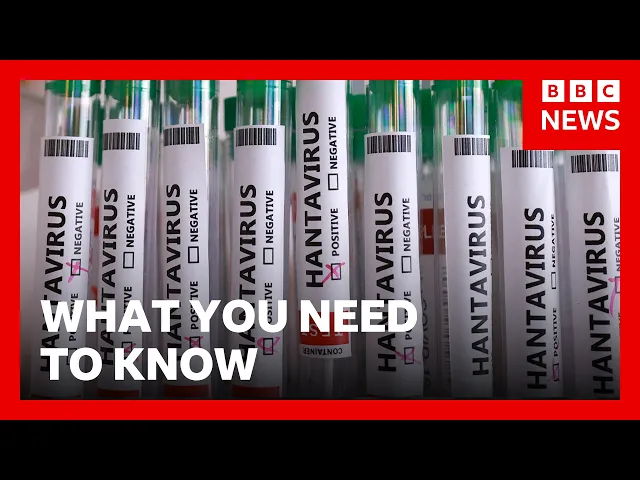
What you need to know about Hantavirus | BBC News
BBC News
0:05 You're with BBC News.
0:07 As the cruise ship, the MV Hondius makes its
0:10 way to the Canary Islands and in particular to Tenneref.
0:15 We are going to be talking about the Hunter virus
0:18 which is at the center of this outbreak on board.
0:21 And a lot of people are asking us here across BBC platforms, what is this virus?
0:26 How does it spread?
0:28 How worried should we be that it might reach us here in the UK?
0:32 Well, we're joined by our health editor, Hugh Py.
0:34 We're also going to be speaking in a moment to consultant verologist
0:37 at Adam Brooks Hospital and host of the Naked Scientist podcast, Dr.
0:42 Chris Smith.
0:44 Hugh, first of all, we're getting lots
0:46 of questions from people who are understandably,
0:48 possibly a little, you know, worried.
0:50 Uh, break down for us what is antivirus first of all.
0:53 Well, Martin, there are several groups of the virus,
0:56 but the most important subgroups, one is found principally in Europe and Asia,
1:02 and there can be as many as 100,000 cases a year,
1:06 but that's still relatively uncommon if you
1:08 look at the population of those continents.
1:10 Uh, but it's not as serious as the one we're talking about here,
1:14 which is seen in North and South America with a higher fatality rate.
1:19 It can be really quite serious.
1:20 So let's take a look at some of the symptoms
1:22 and other things that we do know about hivirus.
1:28 Flu-l like symptoms can lead to severe lung disease which
1:32 really can get pretty unpleasant and even fatal in some cases.
1:36 Then when it comes to the incubation period that's the potential
1:41 for the virus to be in in a body and then get progressively worse.
1:47 It can be up to eight weeks before somebody becomes symptomatic.
1:51 And the issue there is how much do you
1:54 have to quarantine if you're potentially exposed to the virus?
1:57 Well, that's why they've come up with something of around six weeks.
2:02 And the particular type of virus we're talking about here is the Andes virus,
2:07 one of the havirus family.
2:10 And that is seen principally in Argentina,
2:13 which of course is where the cruise ship began its voyage.
2:16 So Hugh, another question that people are putting
2:19 to us is how does hunter virus spread?
2:23 Well, mainly through contact with rodents.
2:26 That's what it's always been associated with.
2:29 Rodents droppings and then somebody getting quite close to it and inhaling
2:34 viral particles which have come in vapor from rodents and and so on.
2:39 But there is very rare humanto human transmission.
2:42 And that's what we're seeing here with this Andes this Andes virus.
2:46 And there was one previous episode a few years ago with somebody
2:50 becoming infected by rodents and then passing it on to other humans.
2:54 But that's one of the very few times this has happened.
2:58 And that's why virus experts are really interested to try
3:01 and work out how it was transmitted on the cruise ship.
3:05 What's the treatment?
3:06 There really isn't a specific treatment at all,
3:09 but if it's caught early and somebody
3:12 can be given something to relieve their symptoms,
3:15 better hydration, maybe oxygen and other types of treatment
3:19 for some sort of other viral infection that might help,
3:22 but nothing specific for hivirus.
3:25 Is this virus in the UK?
3:28 potentially yes as the Europe and Asia subgroup.
3:32 So we're not talking about that but it can be found and and it can
3:36 be caught from rodents but doesn't tend
3:38 to result in something serious for the patient.
3:41 Stay with us you if you would.
3:44 People have been asking if this uh virus could be
3:48 the start of another pandemic like we saw with COVID.
3:53 But on Thursday, the World Health Organization issued this reassurance.
3:58 This is not corona virus.
4:00 Uh this is a very different virus.
4:03 We know this virus.
4:04 Hunter viruses have been around for quite a while.
4:07 There's a lot of detail that we know.
4:08 I am going to ask NI to come in and say this, but I want to be unequivocal here.
4:12 This is not SARS KV2.
4:13 This is not the start of a COVID pandemic.
4:15 This is an outbreak that we see on a ship.
4:18 There's a confined area.
4:19 We have five confirmed cases so far.
4:22 We completely understand why these questions are coming and we
4:26 are trying to provide all of the information that we can.
4:28 That's why we're having a press conference
4:30 here to give accurate information and we're
4:32 grateful for all of those who out there who are asking these types of questions.
4:36 But this is not the same situation we were in six years ago.
4:40 The World Health Organization speaking on Thursday.
4:43 Let's bring in Dr.
4:44 Chris Smith.
4:46 Chris, good to have you with us.
4:47 How is how is Hello.
4:49 How is this virus different from co?
4:53 It's a completely different family of viruses.
4:55 And although they both spread and they
4:57 cause serious disease under certain circumstances,
5:00 they have totally different reservoirs.
5:02 In other words, this this virus is an animal virus.
5:06 It's never a human virus.
5:07 CO 19 is now a human virus and it spreads
5:11 very well between humans but doesn't make us very unwell anymore.
5:14 This virus is quite different.
5:16 It's quite distinct and has a quite
5:18 unique geography to it in this particular form.
5:21 And that's why it has a higher mortality rate,
5:25 but also is easier to control because
5:27 it doesn't spread very well between humans.
5:29 And we also know what the likely risk factors
5:31 are that will lead to a person picking it up.
5:34 COVID mutated and we got used to hearing
5:36 about all the different variants that were emerging.
5:39 It was pretty transmissible at times, wasn't it?
5:42 So, what's to stop that happening with virus?
5:46 Because this is naturally an infection of, as Hugh was saying,
5:50 rodents, chiefly mice in some cases,
5:52 rats in other cases, this particular subvariant is probably carried by a rat.
5:58 This is not well adapted to humans.
6:00 And that's why when it does very infrequently jump the species barrier and get
6:05 into people and the efficiency with which it does that we think is
6:08 single numbers of percent if at all then it being very ill adapted
6:13 to us tends to make us very unwell but doesn't make us very infectious.
6:18 It also changes or mutates only very slowly.
6:22 So the likelihood of this evolving into something from this cruise ship
6:26 outbreak into something that can spread
6:28 efficiently between humans is really low.
6:31 Now the best evidence that that's the case is
6:33 that we've documented this particular family of viruses over many decades.
6:37 And there have been many outbreaks including ongoing outbreaks in South America.
6:42 And people do periodically get this but they don't turn it into a form
6:46 that then runs away like a mine train and starts to spread out of control.
6:50 So we don't think that that's a very likely outcome in this circumstance.
6:54 The UK Health Security Agency is tracking people who may
6:58 have come into contact with those on board the MV Hondius.
7:02 How does that tracking work?
7:03 We we all remember the um track and trace from the pandemic.
7:08 The normal way to manage a situation like
7:11 this is that we regard the people who have been exposed as at risk but not yet
7:18 a risk because until they're symptomatic they're probably not infectious.
7:23 And I say probably because obviously we do have limited
7:25 experience with this particular virus and every case is an exception.
7:28 You never say never medicine but a really good rule of thumb with any
7:32 kind of infection like this is
7:33 usually people are infectious when they're symptomatic.
7:36 So the best management is to give people all the information,
7:41 ask them to selfisolate for a period of time
7:43 that coincides with the incubation period for this.
7:46 We know what that is with these these viruses.
7:48 It can be quite long as Hugh was saying,
7:50 it can be up to 8 weeks in certain circumstances.
7:53 So the UK HSA have settled on 45 days at the moment as the time to monitor.
7:58 People during that time will be asked
8:00 to look out for certain symptoms and report those.
8:03 They'll also be monitoring their temperature and if they do have
8:06 anything untoward having reported that they'll be tested and followed up.
8:10 Samples will be processed looking for evidence of the virus.
8:12 We're actually using PCR tests like we did for COVID.
8:15 We'll look for the genetic material of the virus and if we find it,
8:19 we can then escalate the isolation in a in appropriate facilities.
8:23 We've got eight different facilities around the country which
8:26 can handle high consequence infectious diseases like this one.
8:30 And those people can then be properly isolated and and offered not just
8:34 therefore safe uh isolation but also escalation
8:38 of any medical care if that's needed.
8:41 Dr.
8:42 Chris Smith, consultant biologist at Adam Brooks Hospital.
8:45 Thank you very much.
8:46 Hugh, how can Hirus be prevented?
8:50 Well, I think as we've been hearing from Chris,
8:54 a lot of it is to do with the public health response with the contact tracing.
8:58 In other words, if you can get to the people who might have
9:02 come in contact with somebody with the virus and get them to selfisolate,
9:07 then you nip it in the bug.
9:09 Now, bud, now there is quite a big international effort going on now
9:13 because some of the passengers left the cruise ship in the island of Selina,
9:18 about 30 of them, and then went their separate ways.
9:21 So, there's an attempt being made to find other passengers who
9:24 are sitting very close to them on the flight and so on.
9:26 And we know two Britons are selfisolating back
9:29 in the UK because they came home early.
9:32 They didn't even know there'd been a virus,
9:34 but they reported themselves and just out of a cautious principle,
9:38 they are selfisolating.
9:40 But it's being emphasized that the human spread requires prolonged contact
9:46 and there for example sharing a cabin or that sort of thing.
9:49 So as somebody put it to me yesterday,
9:51 it's got to be someone sitting next to you on a flight, not the whole airplane.
9:55 Hugh, thank you very much.
9:57 Well, it's been difficult to speak to passengers who
10:00 are on board this cruise ship, the MV Aondius,
10:03 but we wanted to get a feeling of what it's like
10:05 to be on board a ship like this when an outbreak happens.
10:08 You know, how much freedom do you have?
10:10 Can you leave your cabin?
10:11 You how much information is given to you?
10:15 Well, David and Sally Abel were on board
10:18 the luxury cruise ship the Diamond Princess in February 2020,
10:22 which was forced to quarantine off the coast of Japan for two
10:25 weeks due to a COVID 19 outbreak which infected hundreds of passengers.
10:31 And they've been saying how this incident
10:33 brings back memories of their experience.
10:37 Yes, it is a little I really feel for them.
10:40 Um, obviously there are not as many passengers on there as we had.
10:45 It's the uh being closed in the cabin all the time and not
10:50 knowing what's going on and you know people people did panic a little.
10:55 So David, what sort of precautions were taken?
10:58 What were you allowed to do?
11:00 Where were you allowed to go?
11:02 Well, for the first couple of days, we were allowed outside of the cabin,
11:07 but once the Japanese health authorities really got involved uh on the ship,
11:15 we were restricted to the cabin.
11:17 Um, our food was brought to us.
11:21 We couldn't have access to anywhere else on the ship at all.
11:25 and the precautions.
11:28 It was handwashing that was the most important part uh
11:32 to try to keep the personal hygiene as good as possible,
11:37 but that still didn't prevent people from going down with CO.
11:43 David, how well informed did you feel that you were kept by the crew on board?
11:47 It was very early stages in the pandemic
11:50 and not a lot was known about this uh virus.
11:54 Well, the Japanese health authority really took control to the extent where
12:01 the captain wasn't permitted to let the passengers know fully what was going on.
12:07 So, I got all my information
12:10 from the internet directly with the Japanese Health Authority
12:15 and I presented that um on my daily
12:20 videos and sometimes two or three videos went out
12:23 a day and then they had no alternative
12:27 but the captain started to give us updated information
12:32 and uh yeah it was very difficult because
12:35 as you say nobody knew knew what this was.
12:39 There was no handbook to say how you deal with it.
12:43 Um, it was a fearful situation to be in.
12:48 So, Sally, David was busy doing research.
12:50 He was busy making these blogs as and I'm sure
12:55 that that uh filled quite a lot of your time, David.
12:58 But, Sally, how did you cope with being in this the cabin all these hours?
13:03 I obviously um joined him when he actually did his filming,
13:09 but um I slept a lot and I think that was my way of coping.
13:14 I would just say to him,
13:15 I'm I'm going to lay on the bed for half an hour and 3 hours later I'd wake up.
13:21 So, um I did sleep a lot and I watched an awful lot of TV.
13:25 Your advice be to then to people who are on this vessel, the MV Honduras?
13:31 We had a statement from a French couple to the BBC
13:34 saying that it does feel that it's under control.
13:38 Stay calm.
13:39 Yeah, stay stay calm and and and don't, you know, just try and and chill out.
13:44 I know it's hard.
13:46 you do worry, but um there's nothing else you can do
13:50 except for taking every pro precaution you possibly can.
13:57 David Sally, good advice and thank you very much for talking to us.
14:02 Well, the cruise ship set off at the very beginning of April on its
14:06 voyage from Argentina and made its way to the archipelago nation of Cape Verde,
14:12 just off the coast of West Africa.
14:15 and it was anchored there for 3 days,
14:17 but it's now making its way further north to the Canary Islands
14:22 and we're expecting it to arrive at in Tenneref at the weekend.
14:27 And Guy Hedgeko is on the island.
14:30 Here in Tenneref, people are awaiting the arrival of the Hondius uh cruise ship
14:35 at the weekend and there is a certain
14:37 amount of unease among the local population.
14:39 There are many people here who are concerned because
14:43 they believe that the the arrival of the boat
14:45 with those nearly 150 passengers on board uh could pose a a health risk to them.
14:52 Uh and they're concerned about the the safety measures uh that are in in place
14:57 when when the boat is received or not in place when the boat arrives.
15:01 Now the government, the central government has insisted
15:04 that there will be uh very tight uh safety
15:07 measures in place to make sure that the the virus
15:11 does not spread to the local population.
15:13 Um has said for example that the boat is not going
15:16 to dock in the port but rather it's going to anchor
15:19 out to sea and then the passengers will be brought uh
15:22 by smaller boats to the island from where they'll be repatriated.
15:27 Guy Hedgeko reporting from Tenneref and we will
15:30 continue to monitor this story across BBC News.