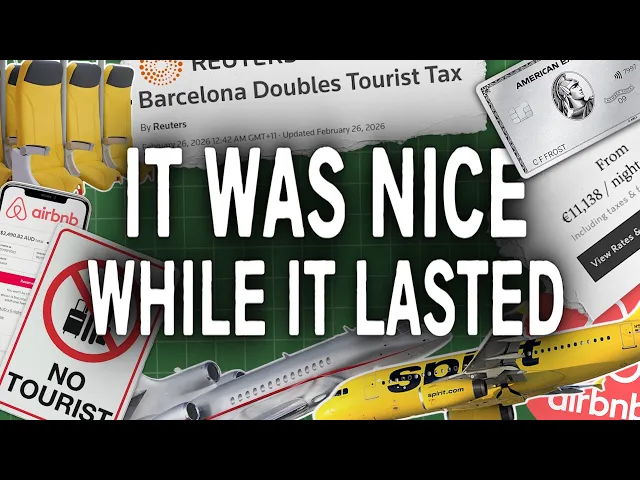
The End Of Budget Tourism
How Money Works
0:00 After declaring bankruptcy in 2024 and then again in 2025,
0:04 2026 finally finished things off as Spirit
0:07 Airlines shut down entirely about 3 weeks ago.
0:09 Now following their failure to secure a lastminute government bailout.
0:13 Now this particular business closure wasn't exactly shocking
0:16 to anybody that had actually been following the company.
0:19 But the end of this otherwise unremarkable
0:21 lowcost carrier might be both the indication
0:24 of and the cause of a wider reversal across the entire travel industry.
0:29 The last three decades in particular have been
0:31 the golden age of budget tourism with most significant
0:34 travel related expenses like airfares and accommodation lagging behind
0:38 overall inflation to become significantly cheaper in real terms.
0:41 For a lot of people,
0:42 this was a very real lifestyle reprieve
0:44 to offset a lot of other financial challenges.
0:47 Sure, they may never be able to afford a home,
0:49 and their career may be increasingly precarious compared to their parents,
0:53 but even a basic income potentially mixed
0:56 in with a little bit of new age consumer debt could
0:58 let people see the world in a way that was
1:00 genuinely reserved for the jetet just a generation before.
1:04 According to the booking company going,
1:05 this time last year was the second cheapest month on record for airfares,
1:10 which they noted in the report was unlikely
1:12 to change unless there were any major shocks in 2026.
1:16 So, um, yeah.
1:18 Anyway, the reality today is there are several
1:21 headwinds that are all pushing back against the trend
1:23 of budget friendly travel and increased fuel costs
1:26 are just one small part of the puzzle.
1:28 The closure of Spirit may be equally the result
1:31 of their own poor practices mixed in with unfavorable market conditions.
1:35 But no matter where the finger is eventually
1:37 pointed without their lowcost seats in the market,
1:39 regular airlines have much less pressure to be competitive on their prices,
1:44 which is a dynamic playing out in far
1:46 more places than just this one specific example.
1:49 Travel related expenses are up by 20% year-over-year.
1:52 And this was already happening before we
1:55 started making a uh distraction in Iran.
2:00 Drivers nationwide [music] are fretting over increasing gas prices.
2:03 And now airlines say they are feeling the pinch.
2:05 Delta CEO said that jet fuel prices have increased
2:08 dramatically [music] since the war in Iran broke out.
2:11 More hotels are charging $1,000 [music] or more a night.
2:15 Daniel Jacobs with True Loan Mortgage saying while inflation is on the decline.
2:19 Hotels and Airbnb prices are skyrocketing.
2:22 The shutdown was abrupt to [music] many passengers,
2:24 but this was really years in the making.
2:26 Spirit was in bankruptcy.
2:27 It had filed for bankruptcy twice within one year.
2:31 Okay, so travel has been getting more expensive across the board
2:34 and the easy explanation is that well
2:36 everything is getting more expensive in 2026.
2:39 Now fuel prices are something that is clearly worth addressing.
2:42 But even before the conflict in Iran,
2:44 travel related costs were already increasing
2:47 and they were increasing faster than overall inflation after an otherwise long
2:51 period of pretty consistently getting more affordable.
2:53 Now, even though it would probably make for a much more compelling video,
2:57 there is not a single silver bullet that explains why this has been happening.
3:01 Instead, there are a few headwinds that all
3:03 need to be considered independently and collectively.
3:05 And then, of course, they will make a lot more sense when
3:08 we sprinkle the oil prices back into the equation.
3:11 Okay, so the first big factor is that the travel
3:13 industry has been stratifying itself for a long time now.
3:17 But the last few years in particular have taken it to such
3:19 an extreme that it is having a meaningful impact on budget travelers.
3:23 The most obvious example of this is what happened to airline cabins.
3:27 The standard for most of the last
3:29 30 years has been economy for budgetconscious tourists,
3:32 business for well mostly business people who didn't need
3:36 to pay out of their own dime and whose
3:38 companies were happy to pay for them to arrive
3:40 at a destination more ready to get work done.
3:42 And ultimately some airlines that offered first for very wealthy travelers who
3:46 wanted a luxurious experience above and beyond just the comfort of business.
3:50 With just a pinch of dynamic pricing and good old hidden fees,
3:54 this model captured an overwhelming share of the market and aviation spend.
3:58 Today, the average international flight has something closer
4:01 to six individual classes you can choose from.
4:04 budget airlines, regular economy, premium economy, business class, first class,
4:08 high-end first class suites like those offered by Singapore or Cutter Airlines,
4:12 and then increasingly the private jet market sitting
4:14 on top of all of that through services like NetJets,
4:17 Vista Jet, and uh Linus' creative accounting.
4:21 In just a perfect encapsulation of this issue,
4:23 private jet charter companies have been struggling to keep up
4:25 with demand at the same time as budget airlines are closing down.
4:29 The same thing is happening across hotels, cruises, restaurants,
4:32 and basically every travel experience that can be sliced into a class system.
4:36 Cruise ships are potentially an even more extreme version of this.
4:40 Cruises were initially pitched as one of the most cost-effective ways
4:43 to take a vacation because the food and the cabin were all inclusive.
4:47 So, your total spend was basically locked in from the moment you booked.
4:50 Today, the fastest growing segment of the cruise market is ultra
4:54 premium yachts co-branded with high-end hotels
4:56 like Four Seasons, Ritz Carlton, St.
4:58 Regis and Aman with cabins that can run up
5:01 to a quarter of a million dollars per week.
5:04 Investment into this end of the market has been enormous,
5:07 largely driven by private equity firms who have
5:10 clocked which way the K-shaped economy has been bending.
5:13 Now, I think it's probably worth mentioning that this does
5:15 not mean that they are immune from their own initification.
5:18 Some of the initial reviews of these ultra
5:20 high-end cruise ships have been hilariously bad.
5:24 Left some uh toenail on the floor.
5:28 I definitely did not clip my toenails since I've been in this room.
5:32 So, the only assumption is that's someone else's.
5:35 Anyway, all of this by itself shouldn't
5:37 really be a problem for budget travelers.
5:39 If the top half of the K wants to spend more
5:42 on increasingly ridiculous accommodations while most
5:45 people enjoy budget prices for budget service, well, let them eat molded cake.
5:50 If anything, the rise of budget airlines has been one
5:53 of the great consumer wins of the last 30 years.
5:55 An aggressive lowcost competition has dragged
5:58 regular economy prices down with it.
6:00 The problem is that the low end of this market is now under enormous pressure.
6:05 And as those budget options dry up,
6:07 the dynamics of the whole market start to change.
6:10 The clearest example of this is Spirit.
6:12 With Spirit gone from the market,
6:14 regular airlines that used to compete with their fairs on the same
6:16 routes suddenly have much less pressure to keep their own prices low.
6:20 They don't even have to do anything sinister to take advantage of this.
6:24 They just simply don't have to discount as aggressively as they used to.
6:27 On the other end, major carriers are also figuring out that they
6:30 can make a lot more money per square foot of cabin
6:33 by ripping out rows of economy seats and replacing them with premium
6:36 economy or business class seats with relative
6:38 confidence they will be filled consistently.
6:40 Lufthansza has been openly bragging that premium
6:43 economy generates around 33% more revenue
6:45 per square foot than regular economy and about 6% more than full business class.
6:51 For a business just trying to maximize revenue,
6:53 why sell 10 economy seats to budget travelers
6:56 when you could sell four premium economy seats
6:58 for more money to people whose portfolios have
7:00 done very well over the last few years?
7:03 The demand for those premium seats is genuinely there.
7:05 So, they would be kind of dumb not to displace the budget travelers.
7:09 Oh, and even airlines that do want to add
7:12 more economy capacity kind of can't right now.
7:15 The aircraft production pipeline is a complete mess.
7:18 As of April 2026, Boeing and Airbus are
7:21 sitting on a combined backlog of more than 12,000
7:24 narrowbody planes with Airbus' backlog alone representing roughly
7:28 10 years of production at current delivery [music] rates.
7:30 Engine supply has become the binding constraint
7:33 on the entire global narrow body market.
7:35 [music] with leap engines from CFM International which power both the A320 Neo
7:39 and the 737 Max effectively setting the upper limit on how many new planes
7:44 anyone can put in the air [music] which means even if a lowcost
7:47 carrier wanted to step into Spirit's empty
7:49 routes tomorrow with brand new fuel efficient
7:51 planes those planes are not available possibly for years all of this to say
7:56 that just as something like Spirit Airlines dragged down costs on the routes
8:00 they flew from the budget end of the market the draw of premium
8:03 seats is pulling prices up as more space gets allocated to higher revenue seats.
8:08 So when Spirit exited the market,
8:10 the only remaining forces are all in one direction.
8:13 Now to be fair, a lot of former Spirit planes
8:15 will be de yellowed and released out there to other airlines,
8:18 but those are unlikely to be focused on the bottom end of the market.
8:22 With such constrained supply, the existing fleet gets allocated to whichever
8:26 routes and cabin configurations maximize revenue,
8:28 and right now that is just serving
8:30 the creamiest markets of premium economy and business class.
8:34 It's not great, but this alone is far from the biggest
8:37 reason why your next vacation may be in the metaverse.
8:40 [music] So, it's time to learn how money works to find
8:42 out if the golden age of cheap travel really is over.
8:46 This video is sponsored by ODO.
8:48 ODU is the all-in-one business management platform that pulls sales,
8:51 accounting, inventory, manufacturing, e-commerce,
8:54 and CRM into a single connected system instead of forcing you
8:57 to juggle five different tools that do not talk to each other.
9:00 What makes ODU work is how seamlessly it ties everything together.
9:04 You only install the apps you actually need and they share data automatically.
9:08 A sale in your storefront updates inventory and accounting in real time,
9:11 so you don't have to manually update your different
9:14 systems and you get to stay more organized.
9:16 We use ODO ourselves.
9:18 Our How many Works library runs entirely on ODO,
9:20 and having everything in one dashboard has made the day-to-day so much smoother.
9:25 It is also intuitive and highly customizable,
9:28 which makes it a good fit for small
9:29 to medium-sized businesses that have limited technical
9:32 experience and want software that adapts to how
9:34 they work instead of the other way around.
9:36 And because ODU automates the routine stuff,
9:39 invoicing, restock alerts, follow-up,
9:41 you spend less time doing admin or stitching
9:43 tools together and more time actually running your business.
9:46 If you want to see how ODU can streamline your own business,
9:49 you can book a free meeting with an ODO
9:51 expert or try the full platform [music] for free
9:53 for 15 days with no credit card required
9:55 or even keep a single app for free for life.
9:58 Check it out using the link in my description.
10:02 Okay, the second major factor is what Airbnb has
10:04 done to the accommodation market when you actually arrive.
10:08 When Airbnb first showed up about 15 years ago, it was sold as a lowcost,
10:12 no frills alternative to a hotel,
10:14 often with the host actually living in the property alongside the guests.
10:17 Of course, over time,
10:18 it too became premium focused with most properties being rented out
10:22 without the host actually cohabitating or really even being present at all.
10:27 Landlords figured out that displacing their tenants to convert their properties
10:30 into pseudo hotels gave them a slightly higher rental yield,
10:34 and that's all they really needed to know.
10:36 Now eventually cities started cracking down
10:38 on this as housing and tourist hotspots
10:40 became catastrophically unaffordable for the people
10:43 who would actually be supporting the tourists.
10:45 And as this happened, Airbnb itself started leaning into quality listings.
10:50 So the cheap end of the platform basically evaporated.
10:53 Airbnb's own Q4 2025 results show they removed 550,000
10:58 low-quality listings between 2023 and the end of 2025
11:02 and that listings flagged as guest favorites now accounted
11:05 for nearly half of all bookings on the platform.
11:08 What that means is that the accommodations
11:10 that survived this cleanup were largely already operating
11:12 like hotels while everything else got pressured
11:14 to either move upscale or go out of business.
11:17 Now, we covered the Airbnb bust on this channel a couple of years ago,
11:21 but what we didn't mention was the impact that this platform had on host,
11:25 which used to be the bedrock of really affordable international travel.
11:29 During the golden years, where VC subsidized just about everything,
11:32 a lot of backpackers opted to split a whole Airbnb between
11:35 a group of friends over sharing a hostile dorm with strangers.
11:39 And then co pretty much finished off whatever demand was
11:41 left for this kind of cheap and cheerful shared accommodation.
11:45 The cumulative result is that the budget end
11:47 of the global accommodation market has basically been hollowed out.
11:50 New York is probably the cleanest case study of this.
11:53 NYC enforced local law 18 in 2023 to crack down on short-term rentals,
11:58 and the results have been kind of remarkable.
12:01 Airbnb listings citywide dropped from around
12:03 38,500 to roughly 5,000, a 92% decline.
12:08 Outer Burough listings, Brooklyn, Queens,
12:10 and the Bronx dropped from around 17,000 to about 1,400 over the same window.
12:16 The 12-month average nightly rate for a hotel room
12:18 in New York City has hit a record $320,
12:22 with hotel prices in the city up 12.6% over the last 2 years,
12:26 which is more than triple the national rate of hotel price increases.
12:30 Now, hopefully it should go without saying
12:31 that the need for people to be able to afford
12:33 to live in their own city should outweigh
12:35 the need for tourists to enjoy a cheap hotel room.
12:38 But unfortunately, the damage was largely already done.
12:41 And none of this made New York more livable to live in.
12:45 What did change was who got to visit the city.
12:48 The neighborhoods that used to host the cheaper Airbnb capacity,
12:51 places like Crown Heights, Atoria, and the South Bronx,
12:54 reportedly saw drops of up to 70% in foot traffic,
12:57 which has hit the local restaurants
12:58 and small businesses that depend on tourist spending.
13:01 So that crackdown effectively just routed
13:04 budget travelers out of the city entirely,
13:06 while higher spenders who could afford a Manhattan hotel kept coming.
13:09 And while New York is the most extreme example,
13:12 the same logic is playing out at the city level
13:14 across most of the major tourist destinations in Europe, too.
13:18 Venice now charges day visitors between 5 and€10 to enter the city on peak days,
13:22 with the higher rate kicking in if you book closer to the date.
13:25 Over 720,000 day visitors paid the fee between April and July 2025 alone.
13:31 Barcelona has bumped its tourist tax to €4 a night
13:35 and the total nightly tax on a higherend hotel can
13:37 approach €15 once city and regional fees stack up
13:41 and Amsterdam is capping cruise traffic to 100 ships in 2026,
13:46 down from €190 before banning them outright by 2035.
13:51 Now, individually, none of these fees are
13:53 devastating even to the most budgetconscious backpacker,
13:56 but they do raise the bar in such a way
13:58 that they can have knock-on impacts across an entire city.
14:01 If you are visiting Venice for the day
14:03 with a backpack full of borrowed condiments for sustenance,
14:06 a couple extra euros a day is a consideration.
14:08 Hypothetically, of course, I've never done this.
14:11 But anyway, if you are spending three nights in the Aman,
14:14 the fee is a rounding error.
14:16 This gradually means that fewer budget and more
14:19 high-end travelers will accumulate in these centers,
14:22 which means hotels and restaurants will
14:23 naturally start accommodating to higher-end clientele,
14:26 which gradually just makes the entire city a more expensive destination.
14:31 Now, to play devil's advocate a bit here,
14:33 to a lot of city centers that have been somewhat overrun by revenge travelers,
14:37 this is kind of the [music] point.
14:39 One wealthy couple who spends 30 grand on a week
14:41 in the city is providing just as much
14:43 economic value as a thousand backpackers spending 30 bucks
14:46 each while creating far less disturbance to the locals.
14:50 Then of course the third factor is the one
14:52 that gets most of the headlines and that is oil.
14:56 Yeah.
14:56 Okay.
14:57 This one is fairly obvious so I will just get to the point.
15:01 Jet fuel prices have roughly doubled since the start of the war in Iran
15:05 with North American jet fuel up around 95%
15:08 from about $2.50 a gallon to around $4.56.
15:12 The International Energy Agency has actually
15:15 called the disruption through the Strait
15:16 of Hermuz the largest supply disruption in the history of the global oil market.
15:21 The relevant thing for our purposes is how those costs get distributed.
15:25 The marginal cost of fuel in a $10,000
15:27 business class seat might be an extra $500.
15:31 Not nothing, but the kind of customer paying 10 grand
15:33 for a flatbed is not going to notice the difference.
15:36 A $700 budget airline ticket getting hit with a $100
15:40 fuel search charge is statistically a much bigger deal.
15:43 And the carriers are pretty open about this.
15:46 Spirit literally cited jet fuel doubling in 2 months as a major
15:49 reason why they couldn't make their March restructuring plan work.
15:52 And they pointed to fuel cost explicitly
15:54 when they shut down operations earlier this month.
15:57 So you can see how the oil shock just
15:59 gets layered on top of the existing premiumization problem.
16:02 Premium airlines and premium routes can absorb a fuel spike
16:06 where thin margin budget carriers on already cheap routes just can't.
16:10 The fourth and final headwind doesn't get
16:13 talked about much in the travel context, but it does a lot of the heavy lifting,
16:17 and that is what is happening to the US dollar.
16:20 For most of the last decade, Americans have been able to lean on a strong
16:23 dollar to get genuinely cheap overseas vacations.
16:26 That was especially true in places like Japan,
16:28 where a weakening yen meant an American
16:30 on a basic salary could spend a week living large,
16:33 effectively subsidized by the petro dollar.
16:36 The problem is that when you flood
16:37 a destination with relatively wealthy dollar tourists,
16:40 hotels and airlines slowly adjust their prices
16:42 upwards to capture all that demand.
16:44 A Tokyo hotel in 2026 is not the same bargain it was in 2022.
16:50 And now the dynamic is going the other way.
16:52 The US dollar index has been trading around 97 to 99 through May 2026,
16:57 well off its record peaks.
16:59 And Cambridge Currencies is currently forecasting it to drift down
17:02 towards 90 to 96 by the back end of the year.
17:05 The Federal Reserve's own research on exchange rate
17:07 elasticities of international tourism makes this pretty intuitive.
17:11 When the dollar weakens,
17:12 American outbound travel just gets more expensive in real terms,
17:15 even when the local currency prices on the destination haven't moved at all.
17:20 And once again, this hits different parts of the market very differently.
17:24 People earning a salary can simply afford
17:26 less vacation for the same dollar amount,
17:28 even if the foreign prices haven't moved.
17:31 And anyone who needs to top up their trip with a personal loan is
17:34 doing so at an interest rate pretty much double what they were 4 years ago.
17:38 People who are already wealthier in asset terms,
17:40 like stock portfolios and property,
17:42 have largely had any dollar weakness offset by their asset gains.
17:45 and the strong stock market has actually made
17:47 them more comfortable spending on travel, not less.
17:50 Now, I just want to quickly mention
17:52 that a smaller channel by the name of Analyzing
17:54 Finance with Nick actually made a great video on this dynamic a few weeks ago.
17:58 He is very straight to the point, but he has done a lot of good deep
18:01 dives on different topics and is definitely worth checking out.
18:05 Now, in real terms, travel is still cheaper than it was 20 years ago.
18:08 And again, just for a bit of perspective,
18:11 June 2025 was the second cheapest month for airfares on record.
18:14 But there is no hard and fast rule that says this has to remain true.
18:18 And for what it's worth,
18:19 cheap travel was kind of the one consolation prize for a generation that mostly
18:23 missed out on the other big consumer wins of the last 50 years.
18:27 They might not have got the same shot at home ownership their parents did.
18:31 Their careers are more precurious.
18:33 Their student debt is heavier in real terms.
18:35 and they have lived through three major recessions.
18:37 But the one consolation prize they did get,
18:40 being able to fly anywhere for cheap, is now potentially also drying up.
18:45 But from the market's point of view, this is all working exactly as intended.
18:49 And if you want further proof of that, go and watch
18:51 this video next to find out how the future became someone else's problem.
18:55 And don't forget to like and subscribe to keep on learning how money works.