Noodle Pudding? - Food That Time Forgot
Townsends
0:00 I always find it interesting when we
0:01 have such a popular food [music] product today
0:05 that we have literally almost infinite choices
0:08 in and in the 18th century it was just introduced.
0:11 [music] Maybe there's a single solitary variety.
0:15 Today we're looking at pasta and the first kind
0:18 of pasta that gets introduced into English cookery and American cookery.
0:23 We're talking about vermicelli and I think
0:25 this is hilarious because today if you go
0:28 in the grocery store there's literally like 30 to 40 feet of pasta shelf, right?
0:34 There are a half a dozen brands, there are a million kinds of shapes.
0:38 They even make pasta out of mushrooms and out of like chickpeas and beans.
0:43 It's weird.
0:44 But almost none of them are labeled vermicelli,
0:48 which is the only kind you find in the 18th century.
0:51 So where do we get started with vermicelli?
0:53 [music] It's pasta coming from Italy.
0:56 We don't see it really in English
0:58 cookery even mentioned until [music] there's a dictionary
1:02 in about the year 1600 when they tell us about this idea of vermicelli.
1:08 I don't think it's actually in English cookery yet at all.
1:11 The first time we see it in cookbooks is in [music] Sir Kenelm
1:14 Digby's book and that's about 1669 and we have a reference to using vermicelli.
1:22 It also shows up in an early 18th century cookbook about I think 1717.
1:28 Again, they use it in a soup.
1:30 It's very simple and both of these books, The Closet Opened by Digby [music]
1:35 and this court cookery book, they are very very high-end cooking.
1:40 [music] And they're cooking French dishes or Italian dishes and that's why
1:43 we get this vermicelli being sort of [music] brought into English cookery.
1:49 I don't think it really hits the mainstream until we get to see
1:53 Eliza Smith's The Complete Housewife and that's about 1735 or so and 1740.
2:01 Early on she uses it in a soup and I think in an asparagus soup,
2:05 but then later on like I think it's in the 1740 [music] edition or so,
2:10 she uses it as a vermicelli pudding.
2:14 And that's what we're going to be making today.
2:15 First we're going to make vermicelli and then
2:18 we're going to make this amazing just killer pudding.
2:22 And I remember this pudding.
2:23 We did an episode 11 years ago on this pudding.
2:27 [music] I still remember the flavor of it and I haven't cooked it since.
2:30 So, you know it's good.
2:31 So, this vermicelli recipe alone is very easy.
2:35 It's very interesting because this vermicelli recipe doesn't happen
2:39 when Eliza Smith cooks it or these other cooks.
2:44 [music] It happens when Hannah Glass comes in another decade or so later.
2:47 And [music] Hannah Glass says, "Well,
2:50 actually this is probably after she sold her cookbook." So,
2:53 whoever updated her cookbook, we don't know who it is,
2:56 but they give us a vermicelli recipe and they say,
2:59 "You know it's better if you make it yourself because
3:02 the stuff you buy at the store that's imported, it's stale.
3:05 It doesn't taste good." [music] So,
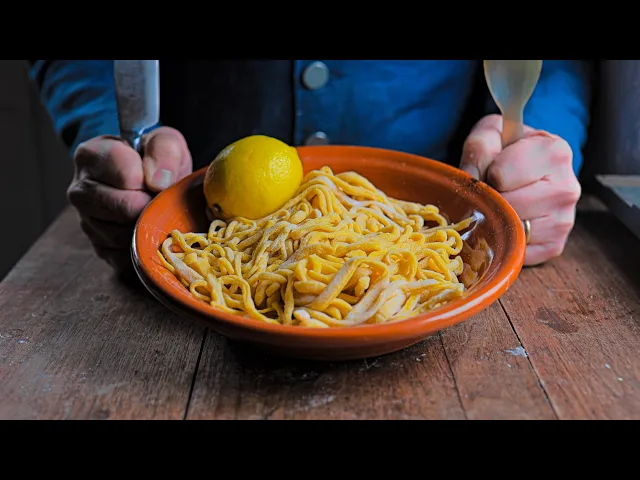
3:07 they give us this recipe for the ultra simple, basically an egg noodle.
3:12 All we need are flour and egg yolks.
3:15 That's what we're going to be doing.
3:17 Right now, let's make some vermicelli.
3:18 Here's Hannah Glass's 1765 edition and let's read this recipe.
3:22 It's not huge and interestingly enough it could
3:26 be a much shorter, but here we go.
3:27 Mix the yolks of eggs and flour together
3:30 into a pretty stiff paste [music] so as you
3:33 can work it up cleverly and roll it as thin as possibly you can roll the paste,
3:39 let it dry in the sun.
3:40 When it is quite dry with a very sharp knife,
3:44 cut it as thin as possible and keep it in a dry place.
3:47 It will run up like a little worms as vermicelli does.
3:52 Though the best way is to run it
3:54 through a coarse sieve whilst the paste is soft.
3:58 If you want some to be made in haste, dry it by the fire and cut it small.
4:03 It will dry by the fire in a quarter of an hour.
4:06 This far exceeds what comes from abroad being [music] fresher.
4:11 This whole recipe is just wrong.
4:13 It is wrong.
4:14 I don't know why the directions are like this and I'm not
4:17 sure whether the person who wrote it actually had actually done it.
4:21 Because these are egg noodles.
4:23 All you really need to do is yes, make it up into the stiff paste [music]
4:27 and of course they don't give us any ratios at all.
4:29 You know, it's just like, "Well,
4:30 take some yolks and some flour and just make it." Okay, well,
4:34 we're going to do that and then roll it out as thin
4:37 as possible and then dry it [music] and then cut it.
4:39 I don't get that.
4:40 I don't I don't know how you dry it and then you cut it.
4:44 And then they're like, "Oh,
4:46 maybe you could make it by squeezing it through a sieve." Well,
4:50 I tried that and that is impossible.
4:52 It will not work like that.
4:54 Or at least I certainly couldn't [music] make it work.
4:56 No matter how soft the paste was, I could not get it to squeeze through
4:59 something into little worms and make the right thing.
5:02 When I prepared this, I used about a pound of flour, which is way too much.
5:06 We only need 5 oz of noodles for our recipe.
5:11 So, let's not make a whole pound of it.
5:13 Well, I'm going to start off with 8 oz of flour
5:16 here and my guess is we'll need about eight egg yolks.
5:21 It depends on how big your eggs are and how big the egg yolks are.
5:25 So, we're going to mix this up into the firm paste that she talks about.
5:28 Actually, this is fairly soft, but that's all right.
5:31 It's not going to make any real difference how stiff it is.
5:34 The fun part about a recipe like this is is so utterly
5:38 simple that is is a great [music] recipe to do with kids.
5:42 A lot of times kids want to get in there and do some
5:44 cooking and [music] making these noodles very fun and very easy to do,
5:51 and it makes a fun dish when you get done with it.
5:54 They have an interesting look to them.
5:56 It's fun they can make different shapes if they really want to.
5:59 So, I really suggest it.
6:01 I was [music] at Kalamazoo just the other day,
6:03 had a lot of different viewers come in, shake my hand, talk to me,
6:07 and multiple different families,
6:09 [music] and watching the kids interact with the videos
6:13 and be interested in cooking is always fascinating to me.
6:16 So, I really encourage you to get the kids in on a project like this.
6:19 It's a lot of fun.
6:21 I rolled this out pretty thin, and [music] now it's time to to cut this up.
6:25 Yes, this takes a while, but making food should take some time.
6:29 [music] We should take time and have fun making our food, have fun eating it.
6:33 The directions call for using a knife.
6:36 Now, if you're doing this with kids, I would suggest using a pizza cutter.
6:41 It's actually much easier than using a knife like these directions
6:45 but they didn't have pizza cutters in the 18th century,
6:47 so we're going to do it the old-fashioned way.
6:49 Since we don't need to use these in big long strips,
6:51 vermicelli's don't need to be very long.
6:53 We can just kind of bunch them onto our baking sheet.
6:57 You could try drying these in the sun.
6:59 I did mine in the oven like the directions say,
7:02 [music] and just put your oven at about 200,
7:05 and just leave them in there for about an hour.
7:07 They won't bake, they'll just dry out, and that's all we're looking for.
7:10 When you do bunch them up though like this, they will once you take them out,
7:15 they'll kind of break
7:18 [music]
7:17 into little pieces.
7:18 That's fine, works just fine.
7:21 My vermicelli is out of the oven,
7:24 and I've kind of broke it up into usable pieces here.
7:27 Now, we're going to use it in a classic recipe for the time [music] period.
7:33 One that isn't classic for us today.
7:35 Now, they did use this in soups and other ways,
7:38 mostly in soups, [music] but this vermicelli pudding is tremendous.
7:43 And it shows up again in the middle of the 18th century.
7:48 This version of it is in the Universal Cook by John Townson.
7:53 Not related, apparently, but maybe.
7:56 Maybe.
7:56 Here we go.
7:57 A vermicelli pudding.
7:59 Boil 5 oz of vermicelli in a quart of milk till it is tender
8:04 with a blade of mace and the rind of lemon or Seville orange or Seville orange.
8:11 Sweeten it to [music] your taste and add the yolks
8:13 of six or eight eggs and the whites of but of four.
8:19 In other words, you want to have twice as many yolks as you have just full eggs.
8:24 Have the dish ready covered with a paste just before you set it in your oven,
8:29 stir in a half a pound of melted butter, and a little salt does it.
8:35 If you have no peels, you can use a little orange flower water.
8:40 Again, very simple.
8:41 I've got some milk starting to heat up.
8:44 You have to be really careful.
8:45 He actually says to boil it in [music] milk.
8:49 We aren't going to boil it in milk.
8:51 Having milk continuously boil is not easy.
8:54 It'll burn, it'll scald, it'll taste bad.
8:56 We're not going to do that.
8:57 We're going to bring this milk [music] up
8:58 to temperature not to a very light simmer,
9:03 and then we're going to put in our 5 oz of vermicelli,
9:05 [music] and we're going to let it kind of steep and simmer.
9:08 We're not going to boil it.
9:10 I also added here some lemon zest and [music] a little bit of mace.
9:15 Yes, like all the 18th century recipes, this has a version of nutmeg in it.
9:20 Mace is the outer covering of the nutmeg.
9:23 [music] It has a a little more bit
9:26 more gentle flavor than a typical nutmeg does.
9:29 If you don't have mace, just grind a little nutmeg in there.
9:33 As the recipe calls for, sweeten to taste.
9:35 I'm going to add maybe a half a cup of sugar to this.
9:40 It really depends on how much sweetness you want.
9:42 Our pudding is made in a pie crust.
9:45 So, let's make some pie [music] crust.
9:47 This is super simple and easy to do.
9:50 It doesn't have to be perfect.
9:51 It doesn't have to look like a store crust.
9:53 You can do this at home.
9:55 Let's do a 3 2 1 [music] recipe on this.
9:59 The ratio is three of flour, two of butter, and one of water.
10:05 Super easy to remember.
10:06 This pie crust does not need to be huge.
10:08 We just need one.
10:09 So, we've got 12 oz of flour.
10:12 I've got 8 oz of butter and about [music] 4 oz of water.
10:16 We take the flour in our bowl.
10:18 Let's add our butter and we want to rub this in.
10:24 [music] You're trying to get the cold butter to mix with the flour [music]
10:27 in as gentle a means as possible.
10:29 You don't want the butter to heat up.
10:31 So, I'm just grabbing this for a second and rubbing it in.
10:34 You can use other modern tools to get that done in a little easier manner.
10:39 But in the 18th century, you would rub [music] this butter in.
10:42 Once it's fully in there and crumbly, we can add in our 4 oz of water or so.
10:48 You can [music and clears throat] kind of sneak up on this.
10:49 So, try 2 oz of water, then to 3,
10:51 then to 4 until you get it into your pie crust stiffness.
10:57 Our pie crust is ready.
10:58 And the milk with the noodles, with the vermicelli, has cooked long enough.
11:04 Now, it's time to start to put this all
11:06 together so we can put it in the pie crust.
11:09 Now, the recipe here calls for the yolks of six
11:13 or eight eggs along with [music] like four whites.
11:16 So, we're going to go ahead and crack up some eggs here.
11:19 I'm going to put in four full eggs and add another four yolks.
11:25 And then, we can stir that into our our milk mixture.
11:29 Make sure the milk mixture is not too hot
11:32 or you will scramble your eggs and you don't want that.
11:35 We can temper this a little bit if we want and then mix them all together.
11:39 And once that's all together, we can pour into our pie crust.
11:43 Now, once it's in the pie crust,
11:45 interestingly, this recipe says at the very end,
11:48 just before you put it in the oven, add a half a pound of butter to this.
11:54 So, I think I'm going to mix in our melted
11:57 butter just before we pour it into our pie crust.
11:59 We don't want to mess up our pie crust.
12:01 So, then we can pour it into our pie crust.
12:03 After that, it's ready to go in the oven and this will take
12:08 approximately an hour to an hour and 15 minutes in your oven at 350°.
12:15 Our vermicelli pudding is out of the oven and I let this cool overnight.
12:20 It's set up really firmly.
12:22 That was the thing I worried about most.
12:23 When you put something like this in the oven,
12:25 you're worried that if it doesn't cook all the way,
12:27 it's going to stay liquidy and what that didn't happen at all.
12:31 In fact, I left mine in for an hour and 15 minutes just in case,
12:34 but it firmed up perfectly.
12:37 It came out in a nice beautiful looking slice here.
12:39 It smells tremendous, just like I remembered.
12:43 So, we can give this a try and we're going to take off a little bit here.
12:49 And you can tell it I mean, it really holds together really well.
12:52 Whoop.
12:56 Mhm.
12:57 Great flavors.
12:57 [music] We got a little bit of that mace in there.
13:00 I'm going to put a little bit more in and maybe even put some nutmeg on it.
13:04 It's got the right kind of a lemony flavor to it and of course,
13:08 it's wonderful and sweet and it has
13:10 all those wonderful textures of our vermicelli noodles.
13:14 So, this one turns out great.
13:16 I highly recommend it.
13:18 You might want to taste that batter even though it's
13:21 uncooked about whether or not you get enough sugar in it.
13:24 That's really the test.
13:26 They give us the you know, put as much as you want in it.
13:30 I probably could have put a little bit more in this one.
13:32 It would have been perfect.
13:33 If you're interested in more about pasta in the 18th century,
13:37 we have a whole episode where we make a pasta
13:39 press and we make some amazing pasta pieces in there.
13:43 So, make sure to check out this episode.