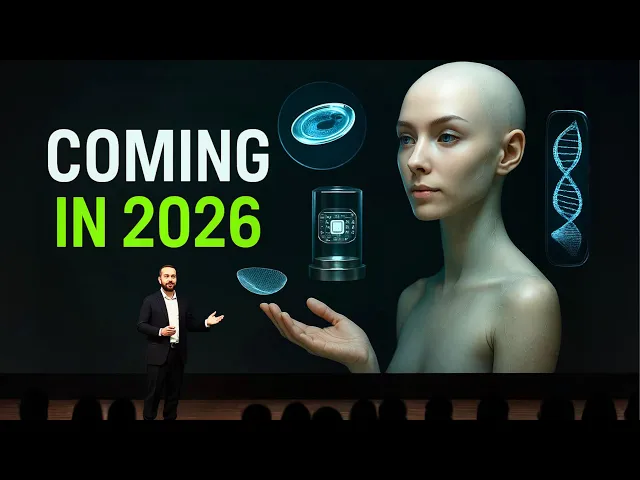
Top 17 New Technology Trends That Will Define 2026
AI Uncovered
0:00 By 2026, AI could automate up to 70% of everyday work tasks.
0:05 In this video, I'm sharing 17 new technology trends that will shape 2026.
0:11 From brain controlled devices to walking robots and how
0:15 they're already starting to change the way we live.
0:18 Let's dive in.
0:19 Number 17, low code, no code development.
0:23 You ever feel like building an app or tool is only for engineers?
0:27 Well, as you can already tell, that's not the case anymore.
0:31 By 2026, it's expected that over 75% of new
0:35 apps will be built using lowode or no code platforms.
0:39 That's stuff like Glide, Bubble,
0:41 and Microsoft Power Apps where you just drag, drop, and hit publish.
0:46 Even OpenAI is letting people build their own
0:48 AI tools with zero code using those custom GPTs.
0:53 and Google's app sheet businesses are
0:55 automating full workflows without hiring devs.
0:59 Number 16, AI crafted experience in extended reality.
1:04 VR isn't just headsets and games anymore.
1:06 It's getting smart, like actually thinking for itself smart.
1:10 In 2026, we'll see more of these AI powered XR
1:15 or extended reality spaces that generate themselves based on what you're doing.
1:21 Nvidia is already doing this with real-time
1:23 characters that hold full-on conversations.
1:26 Meta's pumping billions into avatars that don't just look better,
1:30 they react, they improvise.
1:32 And at CES, virtual shops were adapting
1:35 their layout depending on how people moved around.
1:39 Number 15, smart infrastructure and lo 2.0.
1:43 All right, let's zoom out a bit.
1:45 Literally, by 2026, there will be over 30 billion IoT devices.
1:50 We're talking traffic lights that adjust in real time based on congestion,
1:54 which is already a thing in Singapore.
1:57 Warehouses using AWS and Verizon to track a quick inventory without human input.
2:03 And in South Korea, they got smart poles that do
2:06 everything from air quality monitoring to charging your phone.
2:10 Number 14, privacy first AI and local processing.
2:15 Apple's new chips can now handle AI tasks directly on your device.
2:20 No cloud, no upload, just fast private processing.
2:24 And Meta's Llama 3 models, you can run them locally, too.
2:28 Intel's Meteor Lake chips are designed to do
2:31 this out of the box with built-in AI accelerators.
2:35 With pressure building from Europe's GDPR and California's CCPA,
2:40 AI is learning how to stay offline and keep your data to itself.
2:45 Number 13, workflow automation at scale.
2:49 Tools like Service Now, UiPath, and Zapier are helping companies automate
2:55 full workflows from hiring to invoicing.
2:58 No human hands needed.
3:00 Service Now actually reported up to 65% reduction
3:04 in repetitive work thanks to automation in large companies.
3:08 Amazon's warehouses already use predictive
3:11 analytics to coordinate people and robots.
3:13 So yeah, we're not just talking about automating tasks anymore.
3:18 Whole processes are running on their own and it's happening fast.
3:22 Number 12, AI enhanced robotics in retail and logistics.
3:27 Agility Robotics started deploying its digital
3:29 robot at Amazon warehouses in 2024.
3:33 Walmart, they're using autonomous shelf scanners in over a thousand stores.
3:37 And if you're on a college campus,
3:39 chances are you've seen one of those Starship or Kiwi bots delivering food.
3:44 These bots aren't remote controlled.
3:46 They're using AI vision, realtime mapping,
3:49 and they're getting smarter every week, especially with worker shortages.
3:53 These robots are here to stay.
3:55 Number 11, AI native operating systems.
3:59 So, you know how your phone suggests texts or autocorrects on the fly?
4:03 In 2026, that kind of AI won't just be in apps.
4:07 It's getting baked directly into operating systems.
4:10 Microsoft's already testing C-Pilot inside Windows 11,
4:14 where you can literally ask your desktop to summarize files,
4:18 rewrite emails, or generate images without switching tabs.
4:22 Apple's expected to announce more AI native features in MacOSS and iOS,
4:27 too, running on device with their new neural engines.
4:31 It's not just smarter apps anymore.
4:33 It's your entire system thinking with you step by step.
4:37 Number 10, wearables that know you better than you do.
4:42 Wearables aren't just step counters anymore.
4:44 They're turning into 24/7 health monitors that can track stress,
4:48 blood oxygen, and even early illness.
4:51 Aura and Whoop are already giving athletes
4:53 and everyday users recovery scores and sleep cycles.
4:57 Now, new models are adding blood sugar tracking without finger pricks,
5:01 and companies like Mavano are working on continuous blood pressure wearables.
5:06 Some smart rings even detect changes in skin temperature before you get sick.
5:11 And the best part, a lot of these devices now feed
5:14 data to AI that gives you personalized nudges, not just numbers.
5:18 Number nine, quantum computing nears utility.
5:22 Quantum computing has always sounded like sci-fi,
5:25 but 2026 might be the year it starts showing up in real workflows.
5:29 IBM hit a,000 quibbits in 2023 and plans to debut a 1386 Quibbit chip this year.
5:37 They're also developing error corrected systems
5:40 that are getting closer to doing something useful
5:42 like simulating molecules for new drugs or optimizing
5:46 supply chains way faster than classical computers.
5:50 Companies like Google, ION Q, and Regetti are right there in the race, too.
5:55 It's still early days,
5:56 but the demos are getting real and the pace is quickening.
6:01 Number eight, AR glasses replace screens.
6:05 We've been talking about AR glasses for a decade,
6:08 but now they're finally closing in on actual usefulness.
6:12 Apple's Vision Pro got the ball rolling, and now companies like Meta,
6:16 XR Real, and Samsung are working on lightweight glasses with realtime overlays.
6:21 Things like live captions, navigation arrows,
6:24 and even translated subtitles floating in front of you.
6:27 By 2026, you might not need to pull out
6:30 your phone to reply to a text or check directions.
6:33 And with AI handling context,
6:36 these glasses could know what info you want before you ask.
6:40 Number seven, AI and healthc care gets personal.
6:44 In 2024, Google Deep Mind announced its AI model
6:48 could detect 21 types of diseases from retinal scans,
6:51 sometimes earlier than humans could.
6:53 In the US, hospitals are starting to use AI to analyze patient
6:58 data and spot signs of sepsis or cardiac risk hours before symptoms show.
7:03 We're also seeing AI used in cancer treatment planning,
7:07 personalizing chemo regimens based on your genetic makeup.
7:12 Number six, Edge AI chips everywhere.
7:15 Chances are the next phone or laptop you buy will have an AI chip built in.
7:20 In 2026, Edge AI means realtime smarts right on your device.
7:26 No cloud, no lag.
7:28 Apple's A17 Pro and M4 chips already do this, handling language translation,
7:35 image editing, and voice recognition instantly.
7:38 Qualcomm Snapdragon X Elite is bringing that same firepower to Windows laptops.
7:44 And Intel's Meteor Lake chips come with MPUs,
7:48 neural processing units that let you run AI tasks with almost no power drain.
7:53 It's turning every device you own into its own little brain.
7:58 Number five, AI powered home assistants.
8:01 Smart speakers used to just play music, but now they're walking around.
8:06 Amazon's Astro, first introduced as a home robot in 2021,
8:10 is quietly getting smarter.
8:12 It's already being used for home patrol, elder care,
8:15 and voice command delivery inside homes and offices.
8:19 Apple's rumored to be working on its own tabletop robot,
8:22 internally dubbed J595, that could swivel and track users during FaceTime calls.
8:29 Meanwhile, in China, humanoid showroom assistants are already
8:33 helping customers and handing out brochures.
8:36 These assistants are moving past the voiceonly stage,
8:39 adding screens, wheels, arms, and in some cases, facial expressions.
8:45 Number four, humanoid robots go commercial.
8:49 We're now at the point where
8:50 humanoid robots aren't just walking, they're working.
8:54 In 2024, Figure AI signed a partnership with BMW to bring its bipedal robot,
9:00 Figure01, into automotive manufacturing.
9:04 Agility Robotics is deploying Digit in logistics environments,
9:08 and Tesla's Optimus is already doing basic
9:11 factory tasks like folding laundry and sorting parts.
9:14 What's changed?
9:15 These robots can now walk, lift,
9:18 and perform repetitive tasks with just enough dexterity to be useful.
9:22 And more importantly, they're becoming cheap enough to scale.
9:25 Some models are expected to cost less than a small car by 2026.
9:30 Number three, AI agents that work for you.
9:34 This one's moving fast.
9:36 AI agents aren't just responding to prompts anymore.
9:39 They're handling full tasks from start to finish.
9:42 Take Devon, an AI software engineer demoed by Cognition Labs in 2024.
9:47 It can build a full website, debug code, and deploy it live all autonomously.
9:53 Auto GPT and similar tools can already chain tasks together,
9:58 plan an itinerary, book reservations, and send you a summary.
10:02 In companies, these agents are being trained to onboard employees,
10:06 manage data, or respond to clients automatically.
10:09 Instead of just chatting with AI, you're starting to delegate to it.
10:13 Number two, generative AI becomes default.
10:17 In 2026, most of what you read, hear,
10:21 or watch will have been touched, if not created, by generative AI.
10:26 Open AAI, Google, and Anthropic are pushing the limits
10:30 of large multimodal models like GPT5 and Gemini Ultra,
10:35 capable of handling text, images, video,
10:39 and even audio in a single conversation.
10:42 Adobe's Firefly and Runway ML are powering commercial video editing,
10:47 while 11 Labs let you clone voices and generate speech in seconds.
10:52 This isn't just a trend, it's a shift in how content gets made.
10:55 Whether you're writing an article or producing a podcast,
10:59 AI is now part of the process.
11:02 Number one, the rise of brain computer interfaces.
11:06 And here it is, the wildest one.
11:08 Brain computer interfaces or BCIs are starting
11:12 to move from the lab to the real world.
11:15 In early 2024, Neurolink confirmed it had implanted its first chip in a human,
11:21 allowing them to control a computer cursor just by thinking.
11:25 Meanwhile, companies like Synchron and Precision
11:28 Neuroscience are developing less invasive
11:31 devices that can restore mobility or communication for people with paralysis.
11:36 In clinical trials, stroke patients have used BCIS
11:40 to regain control of limbs or send messages through thought.
11:44 We're still in early days,
11:45 but the implications are massive, and they're no longer theoretical.
11:50 That wraps the full countdown.
11:52 17 gamechanging trends that aren't coming someday, they're unfolding right now.
11:57 If you've made it this far,
11:59 let us know what you think in the comment section below.
12:01 For more interesting topics,
12:03 make sure to watch the recommended video that you see on the screen right now.
12:07 Thanks for watching.