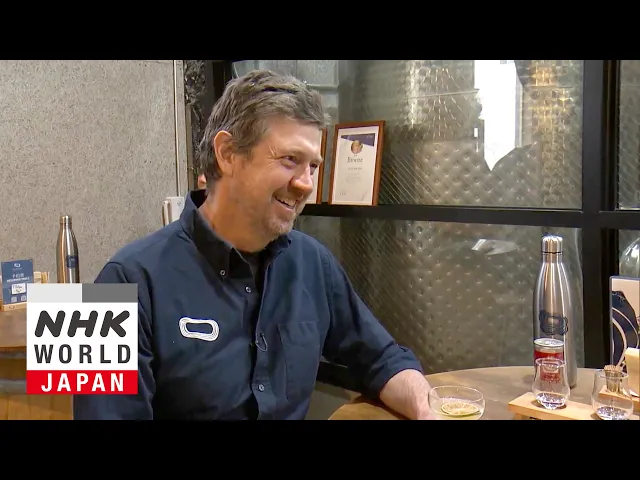
Japanophiles: Phillip Richards - Japanology Plus
NHK WORLD-JAPAN
0:15 Nozawa Onsen in Nagano is one of Japan's best known hot spring resort.
0:22 This village of 3,000 people is hugely popular,
0:25 attracting around 30,000 visitors from abroad each ski season.
0:31 Today's guest, Philip Richards,
0:33 is one of those captivated by the charms of Nozawa Onsen.
0:39 Philip became the first foreigner
0:41 to participate in the renowned Dosojin Festival,
0:45 a celebrated fire festival traditionally restricted to villages.
0:51 In other words, he has been recognized
0:53 by the Nozawa Onsen villagers as one of their own.
0:58 Philip set up a gin and whiskey
1:00 distillery that uses local ingredients with the goal
1:05 of producing world-class spirits in Nozawa Onsen
1:08 and creating a new destination for visitors.
1:12 He was motivated by a desire to give something back to his adopted home.
1:21 Today, we see how Philip Richards is putting down roots
1:25 in Nozawa Onsen and explore what makes this small community so appealing.
1:39 Hello and welcome to Japanology Plus.
1:40 I'm Peter Barakan.
1:42 Today, we present one of our Japanophile profiles.
1:46 I'm in one of Japan's best known hot spring resorts, Nozawa Onsen,
1:50 which is up in the mountains of Nagano Prefecture,
1:52 about a couple of hours out of Tokyo on a shinkansen train.
1:56 Behind me, you'll see the steam coming off
1:59 the hot spring waters, which is quite hot.
2:02 It's about 90°C.
2:04 And the local people come here to cook
2:07 their vegetables and boil eggs in the water.
2:10 My guest today is an Australian who's made his home here in Nozawa,
2:14 and I'm off to meet him now.
2:22 January is the busiest month of the year for the village.
2:26 It's when residents get together to stage the famous Dosojin Festival.
2:35 Peter has come to meet Philip on the day of the festival itself.
2:46 Welcome to the distillery.
2:49 Hello.
2:49 Nice to meet you.
2:50 you.
2:50 I'm Philip.
2:52 Peter.
2:52 Peter.
2:53 A pleasure.
2:54 Welcome to Nozawa Onsen Distillery.
2:56 It looks very new.
2:58 How new is it?
2:59 Uh we just opened in 2022 in December.
3:03 So, oh we're basically just over 3 years.
3:06 Okay.
3:06 So, we're going to have a walk around?
3:08 Yeah.
3:09 It's a It's a pretty uh small distillery.
3:12 Here are Here are our stills.
3:14 Oh, wow.
3:14 Yeah, they were imported from Southern Germany.
3:18 They're They're coal stills,
3:20 and that's where the That's where the magic happens.
3:22 Okay.
3:23 When I was growing up, gin was always associated with juniper berries.
3:29 Sure.
3:29 Is Is that still the case?
3:31 Yeah, well the the actual definition of a gin is
3:34 is a spirit where where the main flavor is juniper berries.
3:37 Yeah.
3:38 After that, it's really, you know, completely free what you do with it.
3:42 Really?
3:42 So, so in in some sense, because there's so much freedom, it's actually,
3:46 you know, difficult to make, you know, a really good gin cuz it you know,
3:49 it requires a a of you know,
3:51 a lot of trial and error to get you know, to get really good balance and things.
3:55 Okay.
3:56 The thing why I think you know,
3:57 gin's popular and and and why we decided to make it,
4:01 it's a really good spirit for you know, showcasing local botanicals and flavors.
4:07 Oh, okay.
4:08 So, you're making gin that's unique to Nozawa.
4:12 That's right.
4:13 For as as much as possible we we try tried to use you know,
4:16 botanicals that that we you know, we get up you know, in the forest
4:19 of of from the local farms and things like that.
4:22 So, we really just want to express you know,
4:24 the beauty of Nozawa Onsen through our spirits.
4:27 Okay.
4:29 Philip Richards is representative director
4:31 of this gin and whiskey distillery which he
4:35 established in 2022 on the site of a former canning factory in the village.
4:45 At the far end of the distillery is a bar area.
4:52 This bar counter was repurposed from equipment
4:56 that was used in the old canning factory.
5:00 Peter decides to try a cocktail made with gin from the distillery.
5:07 Thanks very much.
5:08 Here you go.
5:08 It's very nice.
5:09 The world's finest gimlet.
5:12 All right.
5:12 Pleasure to meet you.
5:14 Cheers.
5:14 Thanks for coming to Nozawa Onsen.
5:23 Ooh.
5:24 That's good.
5:26 Mhm.
5:27 These are great.
5:28 Really good.
5:29 So, these are your four main types of gin, are they?
5:33 So, these are our our our signature gins.
5:37 Nozawa gin which is in in the gimlet Uh-huh.
5:39 to express the uh the the aromas of the forest of Nozawa.
5:51 Mhm.
5:53 Interesting yet.
5:56 It does have the aroma of citrus a little bit, doesn't it?
6:00 Yes.
6:00 Interesting.
6:01 It's got quite a bit of citrus in it then.
6:03 Yeah, it's meant to evoke memories of of being up
6:06 in the up in the forests of New Zealand and Okay.
6:09 whether it's skiing down through the forest
6:11 or whether it's whether it's in summer.
6:14 Mhm.
6:15 There is also a gin with a sharp sansho pepper flavor.
6:19 And another with the sweet fragrance of cherry tree leaves.
6:24 Altogether there are four main types of gin.
6:28 These craft gins went on sale in December 2022.
6:33 In April 2023 at the annual San Francisco World Spirits Competition,
6:39 all four of these gins were awarded gold medals
6:43 out of roughly 6,000 entries from around the world.
6:48 Gin is made from a distilled spirit based on grains,
6:52 grapes, or similar ingredients,
6:55 which is flavored with botanicals such as juniper berries,
6:58 lemon zest, or ginger, and then distilled again.
7:05 Are you the one that chooses all the ingredients?
7:08 No, well that luckily enough we have a proper professional to do that.
7:11 I'm only in charge of testing.
7:16 So, do you actually have any of these ingredients on the premises here?
7:20 Absolutely.
7:21 We are making gin every day.
7:23 Would you like to come and have a look at the back?
7:24 Absolutely, yes.
7:25 I'm curious to know what they look like.
7:27 All right, let's go.
7:28 Okay.
7:34 Come on in.
7:34 Okay, thank you.
7:36 Mhm.
7:39 This is also our other gin still.
7:41 Oh, okay.
7:42 You actually make it really every day?
7:44 Every day, yes.
7:46 I'm making uh one batch of gin and one barrel worth of whiskey a day, basically.
7:52 Wow.
7:54 Looks super clean, too.
7:57 Right here is some of the ingredients.
7:59 This is the main one, gin juniper.
8:01 You know, I don't think I've ever seen a juniper berry.
8:09 All right.
8:11 So, that's what they look like.
8:12 Yeah.
8:12 You you can smell them.
8:13 They give a quite a nice aroma.
8:15 Oh, yes.
8:17 Again, I wouldn't know what to compare it
8:19 with, but it is a pleasant aroma, definitely.
8:22 Ah, some kuromoji picked from uh the local forest.
8:27 From the forest and then and then we put it through a chipper.
8:31 Okay.
8:32 It's a lovely This one's also got a lovely aroma.
8:35 Oh, yes.
8:36 That has a very kind of fresh Mhm.
8:38 foresty feel to it, doesn't it?
8:41 Yeah.
8:42 So, that's probably what gives the foresty the foresty sort of aroma.
8:47 Okay.
8:47 It's one of its origin.
8:48 Ah.
8:50 Oh, and here's the kakidoushi.
8:53 Oh, that's got a lovely aroma.
8:56 Mhm.
8:58 In spring and summer, ingredients such as kuromoji and kakidoushi are
9:03 harvested from the forests of Nozawa Onsen.
9:08 Kuromoji, a fragrant wood, is traditionally used in tea and bath products.
9:16 Kakidoushi also has a pleasant smell and is popular as a herbal tea.
9:24 Yeah, hard hard to believe it's just a like a weed growing up Yeah, really.
9:28 in the forest.
9:28 It really is is everywhere.
9:31 To get this much of it takes takes a a lot of work.
9:35 Oh, really?
9:36 Yeah, it's you you pull the vines,
9:38 then from each vine we pull off the leaves one by one, and then wash them,
9:43 and then there are four people a whole day's work might be you know,
9:46 a pile like this or something.
9:48 really?
9:49 Yeah, it's quite It's quite labor-intensive to do,
9:52 but but but very much worth it.
9:53 Okay.
9:55 Actually, what led you to set up a distillery here in the first place?
10:00 And as long as it has always wonderful water.
10:04 This is It's very soft spring water.
10:08 Oh, right.
10:08 It comes from the from the melted snow water.
10:13 And the mountains here are covered in buna trees.
10:17 Buna trees leave you know, a carpet of leaf you know,
10:20 around the forest floor, which acts for a first filter of the snow melt.
10:25 And then And that passes into the mountain,
10:28 and and they say it takes around 30 years to 50
10:31 years to come out of the spring just above the distillery.
10:35 Which just gives a just a real delicious soft-tasting water.
10:42 Yeah, perfect for spirits.
10:43 Takes that long for the snow melt to actually
10:45 come back out of the out of the ground.
10:47 So they say.
10:52 I haven't been around long enough to verify that one.
10:59 The two head for a place where they can drink some of the spring water.
11:06 And here's the Here's the magic spring water.
11:08 Oh, this is the spring.
11:12 it.
11:11 But quite unassuming.
11:13 A little less less romantic than I was expecting.
11:18 Please go ahead and have a have a try.
11:20 Oh, they even provide a little cup.
11:23 Okay.
11:27 Yeah, tastes like water.
11:29 Yeah, amazing, hey?
11:32 Goes well with the gimlet.
11:35 Yeah, it does feel soft, I must say.
11:38 Yeah, it's nice.
11:39 So, we we come up here every morning and and fill up probably 100 L.
11:44 Oh, really?
11:45 Or something like that.
11:45 100 L Yeah, oh, for the distillery.
11:47 For the distillery.
11:48 All right.
11:50 Next, they ride a gondola up the ski slope
11:54 to view the forest where the botanicals are harvested.
12:06 So, these these are all cedar trees here.
12:08 But uh Right.
12:09 We use the uh but the leaves and the nuts from the cedar tree.
12:13 Mhm.
12:14 And then there's also and there's also at the base
12:16 of the trees is where we pick the uh kakidouchi.
12:20 Oh, the base of the cedar trees, that's where you find them.
12:23 Yeah.
12:24 It's all all around, just just basically both sides.
12:27 These are all uh roads through the forest.
12:29 Okay.
12:29 And so on.
12:31 Uh-huh.
12:31 Yeah, basically on the side of the road.
12:34 All right.
12:35 The gondola has arrived at the summit.
12:40 Oh, oh, it's a bit it's a wee chilly, as they say.
12:49 Ooh, it is a wee chilly out today.
12:55 Philip Richards was born in Melbourne, Australia in 1973.
13:03 What was your first contact with Japan?
13:07 Actually, came here pretty much on a whim.
13:10 Had studied a little bit of Japanese language at at high school.
13:15 I was in high school during the bubble area and you know, you think, you know,
13:19 at the time, you know,
13:20 it looked like Japan was set to rule the world and you know,
13:23 if you didn't know Japanese, you know, you were you know,
13:26 perhaps you wouldn't be able to you know, do business or whatever.
13:29 So it was really that kind of area.
13:31 I didn't I didn't have that much interest in it to to be honest at the time.
13:36 Okay, it was just something to do at school.
13:37 It was just something that yeah, we had to we had to take French and Japanese.
13:41 Okay.
13:42 Both and so it's so I did have you know, a small connection to Japan.
13:48 He went to university in Melbourne,
13:50 then came to Japan for the first time at the age of 19.
13:56 After first university,
13:58 a lot of Australians go backpacking usually in Europe or or America.
14:02 Uh-huh.
14:02 And uh I wanted to go somewhere too, but I guess it's my personality I just
14:06 wanted to go somewhere different to everyone else.
14:08 So it was really on a whim that I chose Japan and then yeah,
14:12 as I say, the rest is history.
14:13 So you you did a backpacking holiday Yeah.
14:16 when you were in college.
14:17 Yeah, I took a working holiday visa and uh it's just somehow I ended up
14:21 in Mie Mie Prefecture working in a uh quite a nice hotel in uh in Toba City.
14:27 In Toba?
14:28 Oh, okay.
14:29 So I worked in a bar there.
14:30 So that was that again might have been my first
14:32 contact with alcohol although that not completely true either.
14:37 So this working holiday was for for a year?
14:39 For a year.
14:40 Oh, okay.
14:41 Yeah, 19 years old and uh and then yeah,
14:45 I guess I really fell in love with with with Japan.
14:48 Uh-huh.
14:49 And it's it's the exact reason I still have you know,
14:52 I have a little trouble putting my exactly my finger on it,
14:55 but I seem to have some kind of affinity
14:57 to the to the people and and the culture.
15:00 Mhm.
15:03 He returned home to study economics and Japanese at university in Melbourne.
15:08 Then took a job with a Japanese bank.
15:13 Uh tried to get a job in Tokyo,
15:14 but I ended up actually getting a job at a Japanese bank in Sydney.
15:18 But yeah, as it turned out a few years later
15:20 I I transferred and uh ended up working for next, an Australian bank in Tokyo.
15:27 Ah.
15:27 It was there.
15:28 Right there in in Nihonbashi.
15:31 And uh and from there, yeah,
15:33 basically spent 18 years working in various different banks in in Tokyo.
15:38 Oh, really?
15:39 With a small break uh to work in Hong Kong and Singapore also along the way.
15:45 Mhm.
15:46 So, it was yeah, mostly trading foreign exchange.
15:49 Which was which was all a lot of fun back in those days.
15:53 Was it?
15:54 Yeah, back in we call it the the halcyon days of foreign exchange.
15:58 It was uh it was back before it
16:00 was taken over by computers and everything like that.
16:03 It was still when you know, an individual trader could could, you know,
16:08 take on a big position, have an idea, and and make a lot of money.
16:13 So, Okay.
16:14 And then, you know, along came the great financial crisis and uh Oh, 2008?
16:21 2008, and so Was that when you quit?
16:26 No, kept on for a few more years after then.
16:28 I I did quit uh once in 2011.
16:34 Which just happened to be and I had a house
16:37 up here in Nozawa, so I moved up here.
16:40 Oh, you already had a place up here by then?
16:42 That's right.
16:43 Uh-huh.
16:43 Nozawa is famous for being a ski resort as well.
16:47 For you yourself, was that that one of the reasons why you first came here?
16:52 I The first time I discovered it was for the skiing.
16:54 It was.
16:55 Yeah, and this was back in '98, just after the Nagano Winter Olympics.
17:00 Oh, right.
17:02 Philip first came to Nozawa Onsen to ski,
17:05 but soon fell in love with the village.
17:09 Then in 2014, he married a Japanese woman, and together they started a family.
17:18 In 2020, he came to live in Nozawa Onsen.
17:24 Philip has brought Peter to one of his favorite izakayas.
17:32 I see right in front of me that row of bottles there.
17:35 I very recognizable.
17:37 Ah.
17:38 Four varieties of gin up there on the on the shelf.
17:41 Most of the restaurants and bars in town too.
17:44 Yeah, they've been very big supporters.
17:46 Oh, right.
17:46 of our gin, so yeah.
17:48 Oh, that's good.
17:48 Yeah, we're super super thankful for that and uh Right.
17:53 Yeah.
17:52 The manager here, too.
17:53 He's he's he's wonderful.
17:55 Yeah.
17:56 Oh, Richard is a wonderful Very gingerly.
18:36 Very good.
18:36 Cheers.
18:37 Cheers.
18:44 Oh.
18:45 Oh, it's quite fruity.
18:47 Mhm.
18:47 Very nice.
18:48 What was it that appealed to you about
18:51 Nozawa Onsen as a place to potentially live in?
18:56 I mean, first came here for the skiing and it's Right.
18:59 It's actually not a ski resort Nozawa Onsen.
19:01 It's it's actually It's a hot spring.
19:03 It's an old village.
19:04 It's an old hot springs village which just happened to have
19:06 a great mountain behind it that they put a ski resort on.
19:10 Ah.
19:10 there's So, you know, you've got an old town with history, culture.
19:17 After quitting uh banking once when I was uh I think it just happened to be 42.
19:23 I was uh I was drinking with a few locals
19:26 in in one of the uh izakayas, and they asked,
19:29 "How old are you feeling at 42?" And And 42 is
19:33 uh it happens to be the year that that the men,
19:37 you know, take charge of of the festival.
19:39 So, they said, "Oh, you really should, you know, participate,
19:42 you know." Without understanding that 42 is never actually And 42
19:46 being the year of kind of bad luck, as it were?
19:51 Yeah, potential bad luck.
19:52 Potential bad luck.
19:54 So, so by participating in it, I think it's supposed to ward off the I mean,
19:58 one phrase is warding off, you know, you know, your potential bad luck there.
20:03 Okay.
20:04 That year, so.
20:09 The Dosojin fire festival is about 300 years old and has
20:13 been designated as an important intangible folk cultural property of Japan.
20:20 By taking part in this festival, men at an age traditionally considered
20:24 unlucky attempt to rid themselves of misfortune.
20:29 They defend the temporary shrine from villagers who attack it with torches.
20:37 Finally, the temporary shrine is set on fire,
20:41 marking the climax of the festival.
20:45 At the age of 42, Philip was introduced to Takeo,
20:49 who was one of the leaders of that year's men of unlucky ages.
20:56 Takeo now works at Philip's distillery.
21:08 That's how Philip became foreigner to take part in the Dosojin Festival.
21:17 What I really came to love about Nozawa
21:21 and and I think participating in the festival was
21:26 was was also a big part of this is a real sense of community that I feel here.
21:32 I spent almost 20 years living in in Tokyo
21:35 which is one of the funnest times of my life.
21:38 But you you you don't actually get to know the neighbors.
21:40 Right.
21:40 Right.
21:41 I don't know.
21:41 Something just felt like something was a little bit missing which uh Mhm.
21:45 which which you could find here.
21:47 There's uh participating in the festival or uh you know,
21:52 cleaning the onsen baths together during snow clearing as a group.
21:57 And there's there's kind of a you know
21:58 So you get involved in all those things as well.
22:01 Yeah.
22:01 Oh.
22:01 Which which which which are really And is that typical?
22:05 I mean, will most of the residents be doing those sort of things?
22:08 Yeah.
22:08 Yeah.
22:09 Okay.
22:09 And the the name of the festival residents be doing those sort of things.
23:02 Yeah.
23:02 Yeah.
23:04 Okay.
23:03 And the the name of the festival is the Dosojin Dosojin Dosojin Himatsuri
23:11 So the the gin in that is kami god or That's That's right.
23:18 deity That's right.
23:20 Okay.
23:21 But it sounds like gin.
23:22 So yes.
23:23 So we've actually made a product to celebrate the festival,
23:26 which is a play on on the words in Dosojin.
23:29 Okay.
23:30 So we actually use the burnt logs in that gin.
23:34 We go down the morning afterwards and we
23:36 actually receive a bit of the sacred burnt log.
23:39 Wow.
23:40 We're really taking that name.
23:42 So So you know, in return for using that name, you know,
23:45 we we use a bit of the proceeds of the sales for each bottle,
23:48 which is to to donate back to the Ah.
23:50 to the festival.
23:51 Ah.
23:52 Mhm.
23:52 Okay.
23:55 That evening, the two go to see the highlight of the Dosojin Festival.
24:00 The fire battle.
24:03 All right, it's starting to rain again.
24:21 The village has a population of around 3,000,
24:25 but over 6,000 people come to see the festival.
24:32 The fire battle is about to start.
24:36 This year, 40 men at the unlucky ages of 42 and 25 are guarding the shrine.
24:51 The 25-year-olds defend the lower section,
24:55 and the 42-year-olds climb on top and sing to encourage them.
25:16 When the shrine is completely burned, the village's biggest festival is over.
25:25 That really was quite intense.
25:27 I mean, there's people at the the bottom of the structure there.
25:31 They're the 25-year-olds, right?
25:33 They're getting showered with sparks from these torches.
25:37 That's got to be I mean, it's smoky and everything.
25:40 It They're going to have a few scars on their face tomorrow morning.
25:44 I can imagine.
25:45 Yeah.
25:45 Sorry, man.
25:46 But, they say that any injury in the festival definitely heals in 3 days.
25:52 Well, for their sake, I certainly hope it does.
25:55 That's all.
25:58 Well, with these Japanophile programs, the last question is always the same one.
26:02 What is Japan to you?
26:04 People still care for other people.
26:06 You know, it's kind of like Is it Is
26:08 that kind of feeling that really I don't know.
26:11 It's kind of a little bit of heartwarming in It's not all about the self,
26:16 but it's also about you and community and other people.
26:18 Right.
26:19 I think I really connected with that kind of feeling.
26:21 But, for me, it's home.
26:23 It's home now.
26:23 I'll always be Australian.
26:24 I love it.
26:25 Australia.
26:26 Proud to be an Australian, but but this is home now.
26:29 This is where our family and friends are.
26:31 So, yeah.
26:32 Yeah.
26:34 Thanks a lot.
26:36 That's been Cheers.
26:37 actually a pleasure.
26:43 The next morning, Philip returns to the site of the festival.
26:59 He praises the men who took part in last night's fire battle.
27:07 Philip will receive the remnants of the central pillar
27:11 made of beech wood that held up the temporary shrine.
27:15 These will later be used for Nozawa Onsen's famous gin
27:20 which will make its way all across Japan and the world.