1989: Teenage Life in Hungary | Scene | BBC Archive
BBC Archive
0:07 Hello BBC traffic.
0:08 It's Nick Thorpe here in Budapest.
0:10 I've got a piece for radio newsreels.
0:14 Okay.
0:18 I'm the BBC correspondent in Hungary.
0:20 I'm dismantling the phone in order to send my report through to London.
0:25 It's on youth in Hungary.
0:27 I'm 28.
0:28 I've been here 2 years.
0:30 I came here to work because I visited once as a tourist and liked it.
0:35 Budapest, it's a beautiful city.
0:37 Pest on one side of the river Danube, Buda on the other.
0:41 Hungary is a communist country in Eastern Europe.
0:53 Hungarians are quite rough on one another, but kind to strangers.
0:58 They work very hard.
0:59 Some have two or three jobs and work 12 or more hours a day.
1:03 2 million of Hungary's 10 million inhabitants live here.
1:07 The center is small enough to bump into people you know.
1:11 Young people in Hungary are not afraid of hunger,
1:14 of war, or of invasion as their parents were.
1:18 Some of them are worried about ever finding
1:20 a place to live away from their parents,
1:22 about finding enough money to buy the things which crowd the shelves.
1:27 They get married quite young.
1:29 19, 20, 21.
1:31 They like it here, but most of them
1:33 wouldn't mind a chance to visit somewhere else.
1:36 Just for a holiday.
1:37 Then come back.
1:39 It's a small country, a socialist country, surrounded by other countries.
1:44 Five of them.
1:45 Quite claustrophobic.
1:47 They're proud to be Hungarian and wish more people knew what that meant.
1:53 I think young people here have the same zest for life as in England.
2:03 I don't know how English kids live.
2:05 I would like to live as well as they do.
2:09 What's good for us should be good for them and we should be friends.
2:15 There are red stars on the roofs of many buildings, a symbol of communist rule.
2:20 They're not taking this one down, just cleaning it.
2:24 This monument commemorates the Soviet liberation of the city
2:27 from the Nazis at the end of the Second World War.
2:30 Hungary has had a difficult history, a lot of it under foreign domination.
2:34 Nowadays, their feet are in the East, but they're leaning to the West.
2:38 A lot of buildings still have bullet holes from the war,
2:41 but many will be from 1956 when the people
2:44 rose up against the harshness of the Russian-dominated dictatorship.
2:48 You can still feel sadness in some of the streets,
2:51 a feeling that people died here.
2:53 Many young people were involved in the fighting.
2:58 [music] Things are much freer now.
3:05 It's a freedom that's released a lot of energy.
3:10 [music] [music] [music] [music] Mitch What's your name and what do you do?
3:38 My name is Peter Csizmadia.
3:40 I'm an apprentice.
3:41 I'm hoping to be an electronic engineer.
3:47 I'm an apprentice toolmaker.
3:50 What's your name?
3:53 And uh what do you do in your free time?
3:58 Well, I go mountain climbing and take country walks.
4:02 I go to discos and have a good time.
4:08 I dance.
4:09 I enjoy myself.
4:11 I also deal with girlfriends.
4:15 If you had one wish, what would it be?
4:19 One, only one.
4:24 First, to pass my exams.
4:26 Only a miracle could help me.
4:34 To have a good car.
4:37 And you?
4:40 I'd prefer to have money and do well with my studies.
4:44 Nothing else.
4:47 I'm Julia Katona.
4:49 I'm 16 and go to grammar school.
4:52 And what do you do in your spare time?
4:56 Loads of things.
4:57 I ride a motorbike, go bodybuilding, do different sports.
5:05 I come here on Saturday nights and go to other clubs other nights.
5:08 I go to special clubs that play Duran Duran and Depeche Mode records.
5:16 If you had one wish, what would it be?
5:22 A Martin out of Depeche Mode.
5:24 To meet Martin out of Depeche Mode.
5:27 It could never happen, but if they come back to Hungary,
5:29 perhaps it will come true.
5:36 I'm Zoltan Kovacs, 19, and I work.
5:40 What do you do in your spare time?
5:43 In winter, I go ice skating.
5:45 In summer, I go sailing.
5:51 Most of the housing estates in Budapest are on the edge of the city center.
5:56 Laszlo lives here.
6:00 My name is Laszlo Dauda.
6:02 I've just turned 18.
6:03 I left school this year.
6:07 I live in Budapest in the 9th district, Ferencvaros.
6:12 It's a fairly good district.
6:13 I like it.
6:14 It's the home of my favorite football team, Fradi.
6:26 Housing, or rather the lack of it,
6:28 is one of the biggest problems facing young people in the capital.
6:32 You grow up with your parents, get married,
6:34 and often carry on living in the same flat
6:36 as them even when you have children of your own.
6:40 There are some stories of couples
6:41 getting divorced and carrying on living together,
6:44 everyone getting on each other's nerves,
6:46 simply because there was nowhere else to go.
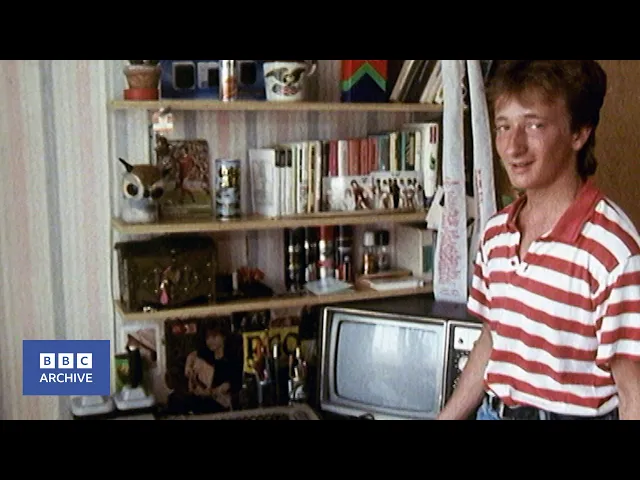
6:56 This is the living room.
6:58 It's also a bedroom.
7:00 I usually share it with my brother.
7:02 He's in the army now, so I've got it to myself.
7:06 This is my empire.
7:11 I keep all my things here.
7:13 When I was at school, I used to study here and the desk was full of books.
7:17 Now, that's all over.
7:22 We've put the computer here.
7:24 It's my favorite.
7:30 These are my English books.
7:32 I did English at school.
7:36 This jug, my dad brought it back from the States.
7:39 My aunt lives over there.
7:43 This is my treasure chest.
7:45 It's strictly private.
7:56 When my friends come around, we play computer games.
8:07 I also forgot to show you my autograph photos of Ergo, my favorite pop group.
8:16 How do the English imagine Hungary?
8:21 Well, I imagine they might think Hungary is
8:24 a country of horse riding and goulash parties.
8:33 I don't know.
8:36 Hungary is famous for its horsemen, but that was a long time ago.
8:40 Nowadays, we have cars, tower blocks, and cities.
8:52 Laszlo meets up with friends in Hungary's most Westernized street, Vaci Utca.
8:58 Many Western-style goods are on sale.
9:01 Even if you can't afford them, you can always dream.
9:09 The first McDonald's has recently opened and more than
9:12 7,000 people queue up to eat here every day.
9:16 This might look like Britain, but there are big differences.
9:19 All boys have to do 18 months military service.
9:23 That's where Laszlo's brother is now.
9:26 You have to learn Russian at school for 8 years,
9:28 but because Russia is still seen as big brother,
9:31 many are proud if they can't even ask for a glass of water in that language.
9:36 Let alone a milkshake.
9:42 [music] Cars are hard to come by.
9:49 This one's borrowed from the parents of a friend.
9:53 To get a new car, you have to sign on a a list and for a good car,
9:57 you can wait as long as 5 years.
10:02 [music] [music] [music] We're going over the Chain Bridge now.
10:20 It's the oldest bridge in Budapest.
10:22 It's very beautiful.
10:23 I hope you like it, too.
10:38 [singing] [music] [music] [music and singing] [music]
11:04 Public transport in Budapest is excellent.
11:06 It doesn't cost much, and you rarely have to wait more than 2 minutes for a bus,
11:10 tram, or underground train.
11:17 Transport, cheap food,
11:18 and housing are some of the benefits socialism has tried to provide.
11:22 Until recently, everyone had a job in Hungary,
11:25 but now unemployment is beginning, and prices are going up.
11:29 I'm on my way to see Gabriella, who still has one more year to go at school.
11:39 I'm Gabriella Astalos.
11:40 I'll be 17 in September.
11:43 I'm at a secondary school for trade and commerce.
11:47 I've got one more year until I take my final exams.
11:55 I live in a fairly new estate in Pest.
11:58 It's got good facilities, two supermarkets,
12:01 kindergarten, nursery, school, and a chemist.
12:05 So, you can buy almost anything locally.
12:11 We have several playgrounds.
12:13 It's nice.
12:14 I like living here.
12:21 Do you feel mobile?
12:25 Well, I feel free to go wherever I like, provided I have my parents' permission.
12:30 There are no other restrictions.
12:36 Who do you live with?
12:37 Do you have much space, and how do you get on?
12:43 I live with my mother, my stepfather, and my younger sister.
12:51 My sister and I each have a small room with a bed, a table, some cupboards.
12:56 There's very little space, but still, we get on well.
13:05 What does socialism mean to you, or to young people in general?
13:14 With socialism, I think there is greater equality than in capitalist countries.
13:21 Here, more people have the essentials, a home, maybe a car,
13:26 a small weekend house, the things one needs for day-to-day living.
13:33 And there are fewer people who are very poor, and fewer who are very rich.
13:46 If you had the chance to leave Hungary for the West, would you go?
13:51 Would you return, and why?
13:58 No, I'd never leave.
13:59 I'm familiar with the customs and expectations in this country.
14:03 I know its history.
14:04 I've got a lot of friends here, and I couldn't live anywhere strange.
14:15 This summer camp is one of many organized
14:17 by the Young Communist League, or KISZ for short.
14:22 KISZ runs most activities for young people throughout Hungary.
14:31 This particular camp, which Gabriella is attending,
14:34 is for anyone interested in becoming a journalist.
14:40 You used to have to belong to KISZ, but nowadays, only 30% do.
14:48 [music] Young people are openly critical of the system,
14:50 and KISZ finds it difficult to persuade them that the East
14:53 has more to offer than the temptations of the West.
15:03 Gabi making an interview about love life in the camp.
15:07 Tell me about camp love.
15:10 It's a wonderful thing, love.
15:12 I know because I'm very much in love.
15:15 I work better.
15:16 I see everything through rose-colored glasses.
15:20 It makes me feel easier about everything.
15:26 And when camp is over, It depends on the person.
15:38 I record interviews, write scripts, then I edit them myself,
15:43 and go into the studio and mix music with the voices.
15:46 The finished programs are broadcast three times a day on the camp radio station.
16:02 The problem with Western things is that we accept everything.
16:07 Whatever comes from the West, we assume it's good.
16:10 Adidas, for example, is really good,
16:13 but horror films and pornography are really bad.
16:17 We should be much more selective.
16:19 Accept the good things, and reject the bad.
16:25 [music] [singing] [music] Criticism of the Young Communist League led
16:34 some students to set up an unofficial group,
16:36 FIDESZ, the Federation of Democratic Youth.
16:39 At first, the police tried to stop them, but they seem to be surviving.
16:45 Outside the headquarters of the Young Communists, Jozsef,
16:48 one of the leaders of the new group,
16:50 which doesn't even have a desk, told me what they want.
16:53 We want a a Hungary where there is no
16:56 a a control from uh from the top of every citizen.
17:01 We want to free citizens who can use their things as as they want,
17:06 so and live in in freedom, and can organize, can uh publish newspapers,
17:13 uh can do what they uh what they want.
17:16 And without any special ideological constraints and and control.
17:21 The freedom to everyone to think WHAT HE WANTS.
17:53 [music] [music] [music] WHAT ARE YOUR SONGS ABOUT, AND ARE THEY POLITICAL?
18:15 Our songs are mainly about feelings.
18:18 If they are political, it's because it's a part of our lives.
18:26 Is your music optimistic?
18:31 No, our lyrics are pessimistic.
18:34 I think they reflect how young people feel at the end of the '80s.
18:49 [music] In the south of Hungary is the village of Martonfa in the Mecsek Hills.
19:10 More than half the population of Hungary still live in villages like this one.
19:22 My name is Laszlo.
19:26 There are five in our family.
19:28 My mother works on a cooperative farm.
19:30 My father has his own farm.
19:35 [snorts] I have two brothers, Sandor, a lathe operator,
19:38 and Karoly, a fully trained butcher.
19:47 There are still a small number of villages
19:49 which don't have drinking water on tap.
19:52 Martonfa is one of them.
19:56 Although their father is the only one in the family who is a full-time farmer,
20:00 the boys have plenty to do helping him when their own day at work is over.
20:09 There are three kinds of farm in Hungary.
20:11 The big state-owned farms,
20:12 mainly growing grain or other large-scale crops, then the cooperatives,
20:17 smaller groups of local people working together,
20:20 and private farms like Laszlo's family,
20:22 growing vegetables, vines, and keeping a few animals.
20:33 As in the West, many young people are leaving the countryside for the towns,
20:37 but in Hungary, it's the girls who tend to leave first.
20:42 Edit, Laszlo's fiance, is staying.
20:48 My name is Edit Aranyi.
20:50 I am 17 and live in Sörény.
20:54 I like coming to Martonfa because my fiance
20:56 and his family live here and we get on well together.
21:04 We haven't decided on the exact date for the wedding.
21:07 All being well, it will be next year
21:09 unless Laszlo has to start his military service.
21:16 Edit, what are the disadvantages of village life?
21:25 The disadvantages of village life are that your neighbor finds
21:28 out what is happening in your family before you do.
21:37 For example, if someone dies, the neighbors know about it before the relatives.
21:47 The fact that you came in a TV van,
21:50 the already knew you had arrived long before we did.
22:08 It's the old women.
22:09 They are the worst.
22:10 They hear something, then they change the story and the gossip starts.
22:18 Let's say I am going to market to do some shopping.
22:21 The woman next door tells her neighbor that I
22:23 have gone to the market to meet a man.
22:35 [snorts] I'm leaving now.
22:51 The hospitality of the Hungarians is one
22:54 of the strongest impressions I'll take away with me.
22:58 In the two years I've been here, the country has changed a lot.
23:02 A growing hunger for goods from America and Japan,
23:05 but at the same time, a growing sense of a long suppressed national identity.
23:15 Young Hungarians are not queuing up to leave, though they'd like to travel.
23:20 So, what does the future hold in store for them?
23:23 A political system giving them greater freedom than they used to have,
23:27 but probably never quite as much as quickly as they'd like.
23:31 A country which is as much a part of Europe
23:34 and as important in its own way as Britain.
23:40 This is Nick Thorpe for the BBC in Budapest.