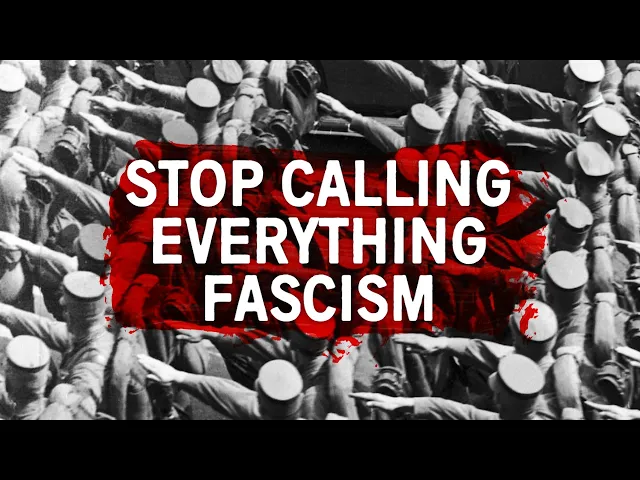
WTF Actually is Fascism?
How Business Worked
0:00 steeped in some of the darkest periods of history,
0:03 broadly misunderstood and used as an insult directed at well
0:07 just about anybody who might have a different political opinion.
0:11 Fascism.
0:11 Fascist.
0:12 Fascist.
0:12 Fascist.
0:13 She's a Marxist, communist, fascist, socialist.
0:16 You keep using the word.
0:18 I don't think it means what you think it means.
0:21 Fascism is a word as misunderstood as it is misused.
0:25 Now, these hyperbolic politicians could almost
0:27 be forgiven for not really knowing what they are talking about because
0:32 nobody really knows what they're talking about.
0:35 George Orwell once wrote, "The word fascism has no meaning except in so far
0:40 as it signifies something not desirable." He and Kershaw has
0:43 dedicated his life to being one of the world's pre-eminent
0:46 researchers on the social history of Germany in the 20th century.
0:50 And even he said that defining fascism is
0:53 like trying to staple jelly to the wall.
0:55 A hard andf fast definition never existed in the first place.
0:59 And even if it did, it has changed
1:02 over time from an idealistic but ultimately flawed
1:04 movement coming out of a continent going through
1:07 some radical change into what it is today,
1:09 which is just a bad thing that we really shouldn't do again.
1:13 For most people, that may be all they need to know.
1:17 But it does raise some uncomfortable
1:19 questions like has fascism just been rebranded?
1:22 One of the reasons why just recklessly throwing the fascist
1:25 label on anything with even a hint of authority
1:28 is so dangerous is because for every characteristic
1:30 that aligns with something like Nazi Germany or Mussolini's Italy,
1:34 there will be a characteristic that doesn't.
1:37 Just because something isn't strictly in line with the most prominent
1:41 historical examples of fascism does not mean that it isn't fascism.
1:45 And just because something isn't strictly fascism doesn't mean that it's safe.
1:49 But okay then, what are some signs and symptoms you should ask
1:53 your doctor about if you suspect you
1:55 may have fascism developing in your country?
1:58 And well, if fascism really is so bad,
2:01 why the do Americans have Mussolini's universal symbol
2:05 of fascism hanging up in front of Congress?
2:09 In this day and age, if somebody calls you a fascist,
2:12 that's probably not a good thing.
2:14 But before some incidents in the midentth century,
2:16 it was just a political movement like any other.
2:20 Today, no serious political party
2:22 would voluntarily brand themselves as fascists.
2:24 But across Europe and North America back then, they were quite popular.
2:28 In many ways, it was broadly considered less controversial than
2:32 a lot of other types of politics at the time,
2:35 especially socialist communism, which was also on the rise.
2:39 Fascism was just branding.
2:40 The Democrats align themselves with democracy.
2:43 The Republicans with the Republic.
2:46 Labor parties across the world use their name to signify their alignment
2:50 with workers and communist socialist parties with the ideas of socialism.
2:54 So then what about fascism?
2:56 The ethmology of the word comes from the Latin
2:59 fasces which is simply a bundle of sticks.
3:02 The idea is that a single stick is easy to break
3:06 but a bundle of sticks all aligned with one another is remarkably strong.
3:10 This simple little metaphor goes all the way back to Rome,
3:14 which used a fast case with an axe
3:16 to signify the state's power to punish its subjects.
3:20 These are the exact same symbols that are displayed in front of Congress.
3:24 And if you look closely enough, on the legs of Abraham Lincoln's memorial,
3:28 the bundle of sticks has been a cultural icon throughout history.
3:33 It was everywhere because it was a powerful,
3:35 tangible demonstration of the benefits of unity.
3:38 Obviously, this was something that governments
3:40 throughout history wanted to encourage.
3:42 Bundles of sticks for a long time were surprisingly important.
3:46 They were the primary source of fuel for cooking and heat,
3:49 so modern words stemming from them show up in more places than you might expect.
3:53 Since this video is well and truly going to get demonetized anyway,
3:57 a not so fun bonus fact for you is that the slur directed towards
4:01 gay men also traces its origins back to these bundles of sticks as well.
4:06 He's right.
4:07 Individually, we are weak like a single twig,
4:10 but as a bundle, we form a mighty fat.
4:14 Anyway, the point is that in 1919, when Bonito Mussolini reformed the fasciso,
4:20 which would later go on to become the National Fascist Party of Italy,
4:23 the word itself and its iconography didn't have
4:27 the um uh branding problem that it does today.
4:30 The idea of strength through unity was appealing to a lot of people in Europe,
4:34 which at the time was living through the aftermath of the Great War.
4:39 Long-standing empires had fallen, and in the power vacuum,
4:42 a lot of ideas were being thrown around about the best way
4:47 to reorganize society to bring back some kind of perceived glory days.
4:51 Outside of the title they had given themselves as fascists,
4:55 there still wasn't any hard and fast defining
4:58 characteristics of the movement because one of the most
5:01 important things you need to remember is
5:03 that these guys were figuring it all out as well.
5:06 There wasn't some seminal text on exactly what fascism
5:10 was like the communist manifesto was to well communism.
5:14 Some point to the writings of George S.
5:17 Sorell as the equivalent of a Marxist figure for fascism.
5:20 He wrote a lot about individual service to a collective mission.
5:24 But to be fair, his work also inspired communists and even anarchists,
5:28 so the fascists don't get to claim him exclusively.
5:31 The definition would later emerge from their choices and how they
5:35 handled power rather than the choices being defined by a definitive idea.
5:39 Before Mussolini formed the Fascist Party, he was actually a member of Italy's
5:44 Socialist Party and not a lowly member either.
5:47 His writing skills let him climb the ranks
5:50 and direct the publication of the party newspaper,
5:53 significantly increasing its readership,
5:54 but he didn't always see eye to eye with other leaders.
5:59 Mussolini liked the idea of the masses being
6:01 a revolutionary force to reset the national order,
6:03 but he wasn't such a big fan of the other big ideas that came with socialism,
6:09 mainly egalitarianism.
6:10 Part of the reason why defining political ideologies can get so complicated is
6:15 ironically because we try so hard
6:17 to simplify them into neat little left-right spectrums.
6:20 The socialists and the communists are identified
6:23 as far-left ideologies and the fascists as far right.
6:26 But what does that even mean?
6:28 It just raises more questions than it answers.
6:31 Especially since whether they would like to admit it or not,
6:34 these two groups have a lot in common.
6:36 But politics is complicated and messy at the best of times.
6:40 and the early 19th century was complicated and messy.
6:43 On top of that, politics is the combination of multiple characteristics.
6:46 So, I present to you that a better way to think
6:49 about this is to take inspiration from role- playing games.
6:53 Every political ideology has a unique combination of stats,
6:56 and it's up to you to decide which character you want to pick.
6:59 Back in Italy, Mussolini was going to be presented with an opportunity
7:03 to align his own skill points to build a movement from scratch.
7:06 After the start of the first world war,
7:09 he was expelled from the socialist party because he supported
7:12 the conflict as a catalyst to bring about revolutionary change.
7:16 However, the party officially condemned the war
7:19 as an intervention into another state's self-determination.
7:21 Now, maybe he was just a bit salty about being kicked out of the club,
7:27 but he would take some of the ideas of socialism,
7:30 combine it with some other ideas from his favorite thinkers at the time,
7:33 and use it to create a new type of politics.
7:36 Oh, and uh if you are currently furiously typing in the comments
7:39 section about how wrong the characteristics of socialism are, congratulations.
7:43 You have unlocked a new challenge in this whole game.
7:47 How these political ideologies exist in theory was
7:51 very often different to how they existed in reality.
7:54 Mussolini wasn't alone in figuring this all out.
7:57 Across much of Europe and the rest of the world,
8:00 there were similar people with similar ideas slowly gaining popularity.
8:05 Yes, including a certain failed artist.
8:08 This background is very important because it clearly highlights two things.
8:12 The first is that while the socialist
8:15 and fascists eventually became sworn enemies of one another,
8:18 a lot of their early membership had a lot
8:21 of overlap brought together by the second important thing,
8:23 which is that both of them were defined by the need
8:27 for a new powerful state brought about through revolutionary change.
8:31 Where they differed was what would happen once they had achieved that change.
8:35 So, it's time to learn how history works to find out what
8:39 fascism really was and why it's so widely misused as a generic insult.
8:44 This video was made possible by Plaude.
8:47 Understanding history isn't just about dates and events.
8:51 It's about noticing patterns and remembering the conversations that shaped them.
8:55 When I'm doing research or watching long interviews,
8:58 capturing insights in real time makes a huge difference.
9:02 Plaude builds intelligent audio tools that take the mental
9:06 load off your plate so you can focus on thinking, talking, and being present.
9:12 The Plaude Note is their sleekst recorder.
9:15 It's the size of a credit card, lives right on your phone,
9:19 and lets you capture meetings, calls, or interviews with a single press.
9:23 It transcribes into 112 languages and tags speakers automatically.
9:27 Then the app turns it into structured notes,
9:31 highlighting key takeaways and action items.
9:34 With the built-in Ask AI feature, you can search across your recordings,
9:40 extract action items, key takeaways, or even ask questions about what was said.
9:45 Like having chat GPT, but powered by your own conversations.
9:49 It delivers highly accurate results,
9:51 whether you're reviewing past meetings or digging
9:53 up insights for your next big idea.
9:56 I've been using it for quick debriefs after
9:58 calls and even for jotting down ideas mid-commute.
10:01 I hit record, talk for a minute,
10:03 and later there's a full breakdown waiting for me.
10:07 No battery drain, no phone storage eaten up,
10:11 and nothing slips through the cracks.
10:12 You can check it out and get yours using the link in the description.
10:17 One of the clearer defining features
10:19 of fascism is how it handles individual equality.
10:23 Liberal democracies like the United States were quite literally
10:26 founded on the idea that all men are created equal.
10:29 Now again, the idealistic notions of the founding
10:33 fathers didn't always line up with reality.
10:35 The abolition of slavery and women's suffrage took a while to get sorted out,
10:39 but you know, they had spirit.
10:41 Even today, liberal democracies are clearly not always perfect.
10:45 But they do at least strive to create
10:47 a system where everybody has an equal opportunity to life,
10:50 liberty, and the pursuit of happiness.
10:53 Communists in the idealized utopia that they
10:56 were working towards took this a step further.
10:59 They generally acknowledged that people were not actually created equal
11:02 and that different people would have different abilities and different needs.
11:06 Equality was a desirable outcome to be worked towards, not an assumption.
11:11 Fascism went the other way.
11:13 People were not created equal,
11:15 and it was unnatural to assume that they were or should be treated as such.
11:19 People who were perceived as the fittest, best,
11:22 and brightest should be elevated in society
11:25 to where they could do the most good.
11:26 Those who were weak should minimize how much
11:28 of a drag they were on that greater good.
11:31 This clearly has elements of Darwinism
11:33 whereby encouraging the elevation and survival
11:35 of the fittest should make the herd or the state more competitive.
11:40 Fascism identified heavily with competitive sports
11:43 and also in more subtle ways like
11:45 elevating people who excelled in their professional
11:48 discipline into positions of state leadership.
11:51 In retrospect, this does seem to be
11:53 at odds with the whole bundle of sticks metaphor.
11:56 But according to fascism, some sticks are bigger and stronger than others.
12:00 and a big bundle of big sticks was the solution to all of society's problems.
12:05 I really hate to say it, but during the mid 19th century,
12:10 fascists were kind of the original alpha bros.
12:12 Everybody was assigned a rank and value was
12:15 determined on where they sat in that hierarchy.
12:19 How societal rankings were tiered did vary regime by regime.
12:23 In Nazi Germany, it was infamously based on a perceived master race
12:26 at the top and at the bottom were the people holding society back.
12:30 People who were either physically weak or disabled,
12:33 people with subversive political leanings or other
12:36 races that were enemies of the state.
12:39 In Italy, how that rank was determined wasn't as direct as someone's race.
12:43 There was still an emphasis on machismo,
12:45 but Mussolini famously mocked Hitler's ideas about racial purity.
12:49 One common group that was elevated in all of these regimes,
12:53 though, was the youth.
12:55 Young people are generally the most fit and able-bodied,
12:58 which aligns with the vision of a strong,
13:00 healthy state made up of strong, healthy people.
13:03 It also probably didn't hurt that young people are generally more
13:06 impressionable and agreeable with the idea that they are the best
13:10 and that society would be better if everybody else got
13:12 out of the way to let them just do their thing.
13:16 This messaging was especially appealing to young men, in particular,
13:19 those who felt like they had not achieved what they wanted
13:22 in life because certain elements in society were holding them back.
13:27 This youthful trait was not so subtly exploited by groups
13:31 of feeble old men who made up the leadership of these regimes.
13:35 Now, to be fair, life for a lot of young
13:38 people during the interwar period in Europe was not easy.
13:41 Germany in particular was crippled by an unsustainable
13:44 national debt in the form of war reparations,
13:47 high youth unemployment, and inflation resetting savings.
13:50 Achieving life's milestones was almost impossible for young people.
13:54 At the same time, the VHimar Republic
13:56 was quite progressive in the fields of art, science, and social freedoms.
14:00 This extended to things like women's rights and gay rights,
14:03 as well as a very open culture towards
14:06 new ideas that challenged tradition in profound ways.
14:09 groups that had in the past been
14:11 repressed were given opportunities they weren't before,
14:13 occasionally displacing less deserving but more entitled people in the process.
14:17 For a lot of disenfranchised young people,
14:20 it was an easier pill to swallow that these degenerate
14:23 new elements had corrupted society and conspired to work against them.
14:27 So resetting the social order to how it ought to be
14:31 should bring back prosperity to those most deserving of it.
14:34 when the counterargument was a detailed
14:38 analysis of global macroeconomic conditions
14:40 and the acknowledgement that they had just lost the biggest war in history.
14:45 Uh yeah, the first guy's story sounded a lot easier to go along with.
14:49 Naturally, this created a system where inequality
14:51 wasn't just a byproduct of the system, it was the heart of it.
14:56 Having someone to blame for all of the problems in the world
14:59 is part of the reason why many consider fascism to be ultimately unsustainable.
15:02 you eventually run out of people to blame at the bottom.
15:06 So, the masses attention turns to the top.
15:08 Now, it's important to emphasize that even the people at the top
15:12 of this manufactured hierarchy weren't exactly living their best life.
15:16 The philosophy behind elevating these people was not
15:19 necessarily so that they could live a charmed life.
15:21 It was so they could serve the state.
15:24 Another core tenant of fascism is that the needs
15:27 of the individual were always beneath the needs of the state.
15:30 The state was seen as a truly exceptional entity,
15:34 clearly superior to any other state in the world.
15:36 For the people at the top of the hierarchy,
15:39 that meant dedicated service, either militarily or in their profession.
15:42 One of the only ways people could define themselves or flex on their peers,
15:47 was by service and recognition of the state.
15:50 Even within the chosen people, rank was everything.
15:53 For the people at the bottom, putting the needs of the state ahead of their own
15:58 often just meant getting out of the way, or of course much, much worse.
16:03 For women, this duty to the state was arguably even more strict.
16:08 Fascist regimes pushed for traditional gender roles to such
16:10 an extreme that it often came at their own peril.
16:13 The German war effort was at a significant
16:16 disadvantage on the home front because
16:17 they were hesitant to let women work in the factories like the Allied forces.
16:22 For a while, the Germans could make up the difference with forced labor,
16:25 but there were still some roles that could only be done by, well,
16:30 let's just say uh self-motivated workers.
16:33 These ultra traditional roles combined with the idea that the fit, strong,
16:38 chosen people should outreed the less desirable elements
16:41 of society led to an almost obsessive focus on natalism.
16:46 In Nazi Germany, monetary bonuses were given to families for having children.
16:50 Women who had more than four children were awarded
16:53 with the cross of honor of the German mother,
16:56 a militarystyle decoration presented for service to the state.
17:00 The male equivalent of being a good mother was being a good soldier.
17:05 Militarism encompassed everything that fascism strived to be.
17:09 Aggressive, structured, hierarchal, and powerful.
17:12 The military was a tool intertwined with the society
17:15 and it was something that leaders were very proud of.
17:18 Often taking direct control above and beyond the levels of a typical politician.
17:24 Projecting military strength onto other weaker states
17:26 was seen as the natural order of things.
17:29 So of course the military was used liberally within
17:33 the state to keep all the twigs in line.
17:36 This is another place where comparisons to authoritarian
17:39 communist states can become a little bit confusing.
17:42 In theory, Marxist Leninist socialist states were not imperialistic.
17:46 In fact, they were built on the idea that workers should rise up to overthrow
17:51 their oppressors and that it doesn't really work
17:54 if they are the ones doing the oppressing.
17:56 They still acknowledged that a military was a tool for defense,
17:59 but it certainly wasn't meant to be an a grandized feature of the state.
18:04 In practice, authoritarian leaders of all flavors like the military
18:07 because it's a tool for holding on to power.
18:10 Fascist states just have it as a core tenant of their political philosophy,
18:14 whereas this kind of stuff is technically
18:16 out of line in an ideal communist nation.
18:19 Of course, the military couldn't handle every function of the state,
18:22 which brings us to the final piece of the puzzle, the fascist economy.
18:27 Using an extremely basic but ultimately flawed
18:31 left-right political spectrum would suggest that political
18:35 ideologies on the right should be pro-f
18:38 free markets and anti-government intervention in commerce.
18:41 Fascism again shows why trying to simplify these things
18:45 only makes them more confusing because nothing fits neatly.
18:49 Economic freedom in a fascist state is not as limited
18:53 as it is in something like a communist nation.
18:56 people as long as they were the right people could own businesses,
19:00 save money, invest profits, and speculate to become rich and poor.
19:04 As already mentioned,
19:05 welfare was limited because only the strongest and smartest should survive.
19:09 However, all of this was only allowed to happen if
19:13 it did not interfere with the authority of the state.
19:16 Company managers and owners of major
19:18 industries were routinely stripped of their business
19:21 so that control could be given to someone considered more worthy.
19:26 In ideal circumstances, this was done so that something like an engineering firm
19:30 could be managed by an engineer rather than a career businessman.
19:33 In practice, it was often done to take assets
19:37 from underclasses and give it to a well-connected party member.
19:40 Adolf Rosenberger was a prominent financier who was also one
19:44 of the original founders of both the Porsche company and the auto union,
19:48 later known as Audi.
19:50 After Hitler came to power,
19:52 these firms were put under the control of engineers instead of financiers,
19:56 which almost sounds good in theory,
19:58 except that the true motivation was more likely because Rosenberg was a Jew.
20:03 Industrialists who did tow the party line were
20:07 thoroughly integrated into the state and the military,
20:10 often making their business indistinguishable from government organizations.
20:13 Now, in the interest of fairness,
20:16 the most historically significant fascist regimes spent most
20:19 of their existence in a total war economy.
20:21 Back then, even the Americans had a high level of government
20:25 intervention in private industry with factories
20:28 being commandeered for the war effort.
20:29 But despite that, it was pretty clear that people had economic freedoms
20:33 in the sense that they were free to be rewarded by their leaders.
20:37 So if you happen to see the signs and symptoms of crony capitalism,
20:42 reverence of militarism, strongman leadership,
20:45 appeals to a young base that feels disenfranchised because they think
20:48 major problems can only be solved by getting rid of undesirabs,
20:51 reversing freedoms that have gone too far,
20:54 and encouraging a return to traditional family values,
20:56 including having lots of kids, you might want to get that checked out.
21:00 Now, if you were interested in the story of that long-forgotten Porsche founder,
21:04 watch this next video to learn about the troubled
21:07 history of one of the world's most revered automakers.
21:09 And don't forget to like and subscribe to keep on learning how history works.