5 Unexplainable Mysteries Explained by Science
SciShow
0:00 Thanks to Skillshare for sponsoring this episode— and this whole week!
0:04 of SciShow.
0:08 INTRO] To the frustration of scientists everywhere,
0:17 things in this world sometimes just don’t make any sense.
0:21 But for the rest of us, that can be kind of amazing.
0:24 Imagining what could cause unexplained phenomena— like weird lights in the sky,
0:28 or sightings of mythical creatures— can be a lot of fun.
0:32 Just ask half the forums on the Internet.
0:34 But it’s also good to remember that the world doesn’t
0:36 have to be shrouded in mystery for it to be fascinating.
0:39 Exploration can be just as cool as speculation.
0:42 So to that end, here are six mysteries— from the Easter
0:46 Island statues to will-o’-the-wisps— that scientists have managed to solve.
0:50 We’ve talked about all kinds of weird weather here on SciShow,
0:53 but this might be one of the best and most horrifying stories yet.
0:58 Imagine it’s March 1876, and you’re living in Bath County, Kentucky.
1:02 You’re outside on a beautiful,
1:05 perfectly clear spring day when the unthinkable happens:
1:09 It starts to rain chunks of meat.
1:11 Some of them are small— about 5 by 5
1:13 centimeters— but others are as big as your hand.
1:15 And soon, your yard is covered in the stuff.
1:19 I wish I could say this wasn’t a true story, but yeah,
1:22 this 19th-century version of “Cloudy
1:23 with a Chance of Meatballs” actually happened.
1:26 According to the New York Times,
1:27 two guys even tasted the meat rain— because they just had
1:30 to be curious— and decided it was either mutton or venison.
1:34 This event came to be called the Kentucky Meat Shower,
1:37 and it baffled people for decades.
1:38 Originally, one person thought the culprit was something called nostoc— which we
1:42 now know is a kind of bacteria covered in a jelly-like membrane.
1:46 And when it rains, that membrane swells up.
1:49 Except, it wasn’t raining when the meat shower happened,
1:52 so that idea was tossed out the window.
1:55 Eventually, though, scientists did figure it
1:58 out after studying some preserved samples.
2:00 They found that the meat was meat— specifically,
2:06 a mixture of animal lung tissue, muscle, and cartilage.
2:10 And later in 1876, the chemistry professor L.D.
2:13 Kastenbine discovered where it came from: synchronized,
2:17 projectile vomiting vultures.
2:19 This story is amazing.
2:21 There are two species of vulture native of Kentucky,
2:24 and their eating habits totally explained the shower.
2:28 For one, vultures aren’t picky eaters,
2:29 which is why there were various kinds of tissue,
2:32 and why the meat pieces were all different sizes.
2:34 But more importantly, vultures are also frequent vomiters.
2:38 Vultures are known to eat huge meals,
2:40 and if they’re disturbed before they have time to digest all that food,
2:43 they sometimes throw it up to make themselves lighter and make escape easier.
2:53 So Kastenbine concluded that, on that day in Kentucky,
2:55 a group of vultures just happened to be flying overhead,
2:59 and all puked at the same time.
3:01 It’s possible that this has even happened in other places,
3:04 too, but cases haven’t been well-documented.
3:06 Either way, yeah, it’s a little gross.
3:09 But it’s the Kentucky Meat Shower,
3:11 there was never going to be a not gross explanation Easter
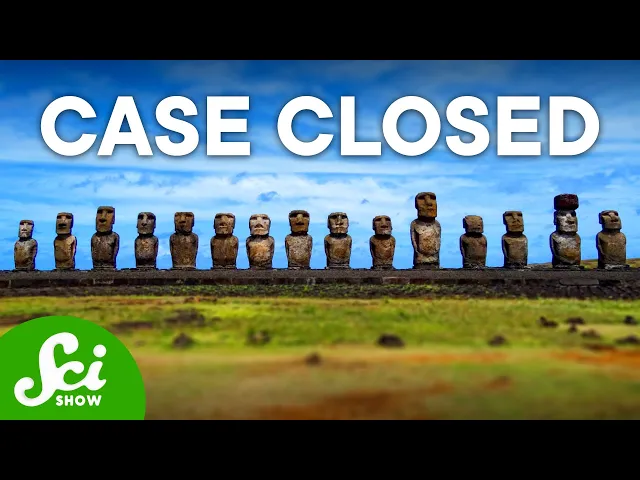
3:14 Island in the southeast Pacific is famous for its giant statues.
3:17 They’re called moai,
3:18 and they were built at least 400 years ago by the Rapa Nui people of Polynesia.
3:24 But here’s a lesser-known fact: Those statues used to have little, reddish hats.
3:27 Okay, maybe “little” is an understatement.
3:30 The hats were about two meters across and weighed up to 12 metric tons.
3:33 And until 2018, it was pretty unclear how
3:36 the Rapa Nui managed to put them on the statues.
3:40 After all, the moai are some 10 meters tall, and the hats were really heavy.
3:45 Also, it was hundreds of years ago.
3:47 Cranes were a little on the scarce side.
3:50 But using modeling, a team finally figured it out.
3:53 In a 2018 paper published in the Journal of Archeological Science,
3:57 researchers discovered that the Rapa Nui
3:59 likely used a technique called parbuckling.
4:01 First, they would have carved the stones into cylinders.
4:05 This red rock is actually found on the other side of Easter Island,
4:09 so making a cylinder out of it allowed them
4:11 to roll it over to where the moai were.
4:13 Then, they built a ramp leading up to a statue’s head.
4:16 They tied a rope around the cylinder,
4:18 and then a team of probably 15 people hauled it
4:21 up the ramp and put it on top of the statue.
4:25 After that, the hat was carved into its final shape.
4:28 It sounds like figuring that out would have been easy,
4:31 since it’s all based on simple machines
4:32 you might have learned about in elementary school.
4:35 But discovering this required building 3D models
4:37 of about 50 statues and 13 cylinders,
4:40 as well as making all kinds of calculations about the weight
4:43 of the rocks and the strength of the average ancient Polynesian.
4:46 Today, you probably won’t see many of these hats still on their moai,
4:50 since weather and erosion have knocked most of them off.
4:53 But at least they’re no longer a mystery.
4:55 Scientists can’t tell us how to predict an earthquake,
4:58 since there are so many variables to keep track of.
5:01 But they can tell why before and during ‘quakes,
5:04 people have sometimes reported seeing mysterious lights in the sky.
5:08 They’re called earthquake lights, and they can take all kinds of forms,
5:12 from blue flames to lightning that shoots out of the ground.
5:15 People have recorded seeing them as far back as the 1600s,
5:18 and they’ve been observed up to weeks before major
5:22 earthquakes and up to 160 kilometers from the epicenter.
5:25 Unsurprisingly, some people blamed these lights on UFOs.
5:28 Others thought they were caused by disruptions in the Earth’s magnetic field.
5:32 But the real answer came in 2014,
5:35 in a paper published in Seismological Research Letters.
5:39 In it, the authors investigated data from 65
5:42 earthquakes where people had reported seeing lights.
5:45 And they found that, most likely,
5:47 the culprit was electrical activity in certain types of rocks,
5:51 especially volcanic ones.
5:52 The team discovered that, when you put a lot of stress on these rocks,
5:55 they can release electric charge.
5:57 The pressure causes the chemical bonds between
6:00 certain compounds in the rocks to break, which releases charged oxygen atoms.
6:04 If enough bonds are broken at once— like before or during a big
6:08 earthquake— a bunch of those charged atoms can rush up to the surface,
6:12 usually at a fault, where two sheets of rock meet.
6:15 Then, when they burst above-ground,
6:17 they can ionize the air, giving /air molecules/ electric charge.
6:21 And that ultimately creates the various flashes of light.
6:24 The conditions that cause these are pretty specific,
6:26 which explains why earthquake lights are only seen in about 0.5% of earthquakes.
6:30 And the team also mentioned that this phenomenon
6:33 can explain other things detected before quakes,
6:36 like low-frequency radio emissions.
6:38 Unfortunately, understanding earthquake lights probably
6:40 won’t help us predict ‘quakes,
6:42 since they’re so rare and since people usually don’t report them.
6:46 But hey… take that, UFOs!
6:50 With average summer temperatures around 45°C,
6:53 California’s Death Valley probably isn’t a place you’d want to sit for very
6:57 long— unless you’re trying to solve the mystery of the Sailing Stones.
7:01 These are rocks that sit in one of the valley’s dry lake beds,
7:05 called the Racetrack.
7:06 They can weigh up to 320 kilograms, and they seem to move… by themselves.
7:11 Of course, they don’t move very much.
7:15 Some can sit in the same spot for decades.
7:17 But they usually leave long streaks behind them as they travel,
7:20 and that shows us that some of these rocks have moved more than 450 meters.
7:24 For years, people couldn’t figure out what was going on.
7:30 Explanations ranged from hurricane-force winds to films of algae.
7:34 And to make matters worse, no one had actually seen a rock move.
7:39 That is, until a few years ago.
7:43 In 2011, a team of researchers tried to solve the mystery of the Sailing Stones
7:46 by sticking GPS sensors on them and then…
7:50 just kind of waiting for something to happen.
7:52 Since the rocks move so infrequently,
7:53 one of the paper’s authors expected this to be,
7:55 quote, “the most boring experiment ever”.
7:58 Two years into the project,
8:00 a couple of the scientists showed up at the Racetrack to make observations,
8:04 only to discover the lake bed covered in a thin layer of water.
8:09 And then, to their amazement… they saw some of the rocks move.
8:12 They eventually published their paper— and the solution
8:15 to the mystery— in PLOS One.
8:17 According to the team,
8:19 the Sailing Stones only move under specific circumstances.
8:21 First, the Racetrack has to fill with water,
8:24 deep enough to form floating sheets of ice,
8:28 but shallow enough not to cover the Stones.
8:30 At night, the surface of the water has to freeze.
8:33 Then, in the morning, the ice has to break up into floating panels.
8:36 Under the right conditions,
8:38 the wind will push those panels of ice across the surface of the water,
8:42 and the ice will push the Sailing Stones.
8:45 It sounds impossible,
8:46 but it makes more sense if you realize that the Stones aren’t sailing very fast.
8:50 At most, they move 2 to 6 meters per minute—
8:53 which you might not notice if you weren’t looking closely.
8:56 But over the years, that can add up,
8:59 creating those famous, long tracks across the ground.
9:02 There is one more mystery that remains, though:
9:04 Researchers aren’t positive this method also applies
9:06 to the biggest rocks in Death Valley.
9:09 So there’s still one more thing to be solved.
9:12 With so much of the ocean being unexplored,
9:14 it makes sense that there’s a lot we don’t understand about it.
9:18 And whenever we discover something we can’t explain,
9:20 people are pretty quick to get out their sea monster T-shirts.
9:22 That’s what happened when we heard the Bloop in 1997.
9:27 Yes, that is the official term.
9:30 Because it sounds like… well, a bloop.
9:33 The sound was recorded off the coast of South America,
9:36 while researchers were looking for underwater volcanoes, and it was really loud.
9:41 It was captured by microphones more than 4800 kilometers apart,
9:44 making it way too big for something like a ship or a whale.
9:49 It also didn’t help that NOAA at one point announced that the sound was, quote,
9:53 “possibly biological.” But in 2005, nearly a decade later,
9:58 scientists found that it definitely wasn’t.
10:00 As they recorded more sounds in the ocean, especially ones near Antarctica,
10:05 they concluded that the Bloop was probably an icequake.
10:08 That’s where a huge chunk of ice cracks off a glacier.
10:12 It makes a ton of noise, and audio recordings taken over several years
10:16 show that they sound just like the Bloop.
10:19 No sea monsters required.
10:21 Finally, will-o'-the-wisps.
10:23 You can find stories about them— or something
10:25 similar— in folklore from around the world,
10:27 and you may have even seen them yourself if
10:29 you spend a lot of time in marshes or swamps.
10:32 Hey, I don't know your hobbies.
10:35 They're blue-ish lights that drift over these kinds of landscapes,
10:39 and if you get too close to one— like Merida in Brave— it will disappear.
10:43 According to many legends,
10:44 they're some kind of spirit or creature out to mislead curious travelers.
10:49 But in reality, the explanation for these lights...
10:52 well, actually, it's almost as strange.
10:54 Because will-o’-the-wisps are probably caused by spontaneous combustion.
10:59 Not spontaneous human combustion, though— that almost definitely isn’t a thing.
11:03 Just the regular kind,
11:05 where something bursts into flame without an obvious source.
11:08 In this case, the lights are likely caused
11:10 by certain mixtures of gas reacting with atmospheric oxygen.
11:14 These mixtures consist of things like methane,
11:16 carbon dioxide, and, most notably,
11:18 compounds containing phosphine— like one called diphosphane,
11:21 which is known to ignite in the presence of oxygen.
11:24 Various studies have shown that these gases can be produced in marshes, swamps,
11:29 and cemeteries, likely by bacteria living
11:31 in the soil and breaking down organic matter.
11:34 And when bubbles of that gas make it up to the surface,
11:37 poof— you have a will-o'-the-wisp.
11:38 It is worth noting that there are other
11:41 hypotheses suggesting these lights might not be actual fires,
11:44 but just clouds of glowing gas.
11:46 An experiment published in 1980, for example,
11:48 showed that you get a sort of glowing
11:50 green cloud if you mix crude phosphine and methane.
11:54 But either way, the general mechanism of "swamp
11:57 gas+ air" does seem to explain what's going on.
12:01 Since these reactions are pretty short-lived,
12:02 it even explains why these lights seem to disappear if you approach them.
12:06 Also, researchers have pointed out
12:08 that some phosphine derivatives are super toxic.
12:11 So if dangerous gas clouds kept popping up in local swamps,
12:14 that might have made people especially eager to stay away.
12:18 Everybody loves a good mystery,
12:19 but the stories about how we solve mysteries are pretty fascinating, too.
12:25 After all, it takes a lot of curiosity and wonder to become
12:29 a professional scientist and say “You know what I want to study?
12:32 The Bloop.
12:33 Or will-o’-the-wisps.” Thanks for being curious, scientists.
12:38 For centuries, people have been telling
12:40 amazing stories about phenomena like this.
12:42 And even though scientists can explain how some of them happen,
12:45 that doesn't make the stories themselves any less worthwhile.
12:48 Which is why I'm glad that Skillshare has so many classes on storytelling.
12:53 Skillshare is actually sponsoring this whole week’s worth of videos,
12:56 so every day this week,
12:58 we’ll be highlighting one of their more than 20,000 classes.
13:01 They’re seriously a great way to learn new skills,
13:04 brush up on techniques, or discover totally new hobbies.
13:07 Like, there's one class called called Storytelling 101
13:09 that teaches you everything you need to know about storytelling,
13:13 whether you write about science or the supernatural.
13:26 It's by the author Daniel José Older,
13:30 and besides teaching you some major themes,
13:34 he also gives you prompts, tips, and follow-up classes to check out.
13:47 Skillshare also has thousands of other classes on things like art,
13:51 music, cooking, and tech.
13:52 And right now, they're offering SciShow viewers two
13:55 months of unlimited access to every class for free!
13:58 So, like, I know what I'm doing for the rest of the day.
14:01 If you want to join me, you can follow the link in the description.
14:04 outro]