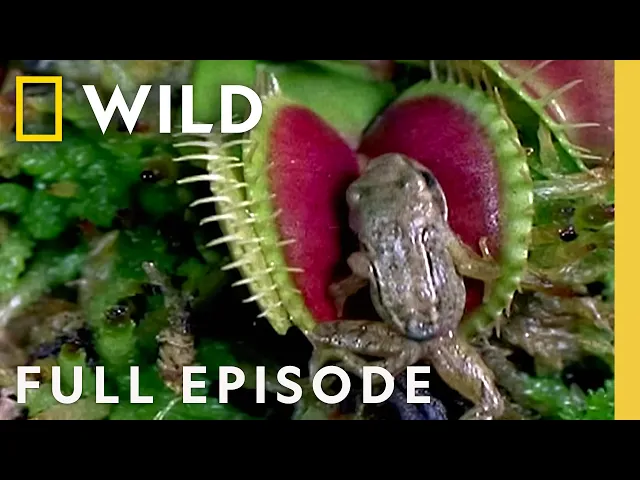
Fangs of Fury (Full Episode) | World's Deadliest Compilation | Nat Geo Animals
Nat Geo Animals
0:02 (snarls) When it comes to killer weapons,
0:06 these predators are armed to the teeth.
0:11 From hungry Goliaths to tiny terrors,
0:17 razor-sharp fangs and bone-crushing jaws take a bite out of the competition.
0:27 (yipping) (music) (music) When you're this big,
0:43 it's one bite, and then goodnight.
0:53 A typical day in the life of a hippo may not be what you'd expect.
0:58 For a giant that weighs as much as a car, they are surprisingly peaceful.
1:03 (grunting) They're vegetarians.
1:07 They like to play in the mud.
1:10 They kindly coexist with birds.
1:13 (music) And they spend about 16 hours of every day in the water,
1:20 most of it just chilling.
1:25 A watering hole on the African savanna is a serene hippo oasis,
1:31 unless something or someone sets him off.
1:38 Males are dangerously territorial,
1:41 especially when it comes to defending a watering hole.
1:45 In Zambia, this male hippo is enjoying a quiet
1:50 swim when an uninvited guest appears to challenge his domain.
1:57 Detecting the threat, this 8,000-pound gentle giant unleashes his jaws of hell.
2:04 (bellowing) (bellowing) Able to open their mouths up to 150 degrees,
2:17 a hippo has one of the most powerful bites of any land mammal.
2:22 (bellowing) (bellowing) (bellowing) So it's safe to say,
2:41 what hippo smashes, stays smashed.
2:48 Bottom line, keep the peace.
2:51 Don't mess with a hippo.
2:54 (music) Big cats are proven killers,
3:00 and most use the same technique: a bite to the throat.
3:09 It can be a slow and messy affair.
3:13 Much too slow for one cat.
3:17 The jaguar doesn't go for the throat.
3:20 It goes for the brain, delivering instant death with just one power-packed bite.
3:31 The secret to the jaguar's head-splitting talent is its massive canines,
3:37 long and sharp enough to pierce the prey's brain
3:40 case and turn out the lights in a heartbeat.
3:46 Found silently stalking through Central and South America,
3:50 jaguars measure up to eight feet from nose to tail, and weigh up to 250 pounds.
3:56 (growl) They have no fear of water,
4:01 and are powerful enough to crack a turtle shell.
4:06 But despite their imposing bulk, they're masters of the stealthy speed kill.
4:14 The jaguar's patterned coat blends into the shadows
4:17 of the jungle as it prepares to strike.
4:21 Today, it eyes the thick skull of the peccary.
4:29 (growl) (squealing) Then, with a quick bite...
4:35 (squealing) (crunch) ...it's game over.
4:42 Their cousins in Africa and Asia may get all the fame,
4:45 but when it comes to the art of the death chomp,
4:49 jaguars are the real kings of the jungle.
4:51 (growling) It's an apex predator, with a mouth of epic proportions.
5:04 (music) The saltwater crocodile, owner of the strongest bite on Earth!
5:18 The croc's jaws can crush down with 3,700 pounds of force.
5:24 With that power, it can make a meal out of anything it wants:
5:29 sea turtles, boars, even sharks!
5:35 (crunch) Ranging from Southern Asia to Australia,
5:40 these notorious ambush killers are the largest crocodiles in the world,
5:45 easily growing to 20 feet in length.
5:49 In fact, the monster memorialized by this statue
5:52 was reported to be over 28 feet long!
5:56 That's big enough to make mincemeat of a one-ton water buffalo.
6:03 (growling) Salties are long-distance swimmers.
6:09 When driven by the need to feed,
6:11 they'll migrate hundreds of miles out into open ocean.
6:16 They're usually solitary, but one thing that can bring them together: food.
6:26 And sometimes that unending group hunger leads
6:29 to some pretty gruesome meals, like human beings!
6:36 In 1945, during the Battle of Ramree Island,
6:40 over 1,000 Japanese troops fled into a swamp.
6:44 (gunfire) Allied forces surrounded them, but the Japanese refused to surrender.
6:53 Saltwater crocodiles did the rest.
6:57 As few as 20 Japanese soldiers survived the onslaught.
7:04 There's stiff competition for the title of world's most voracious reptile.
7:11 But that's just the kind of challenge
7:13 the saltwater crocodile can sink its teeth into.
7:23 Large and in charge.
7:28 That's the trademark of this Arctic king.
7:34 This solitary emperor holds the crown for the world's largest land carnivore.
7:39 His kingdom is the vast Arctic north,
7:42 a remote and harsh region where every day is an epic struggle for existence.
7:48 To survive, the polar bear must be skilled in both smarts and strategy.
7:55 He is equipped with perhaps nature's most effective fur coat,
8:01 with an inner layer that retains heat
8:03 and an outer layer that repels water and ice.
8:09 It also allows this top predator to travel thousands
8:12 of miles while reflecting light and blending into its surroundings.
8:17 (music) But even a king has his issues.
8:27 His world is made of ice, so it's constantly shifting or melting.
8:36 And that's where his paws come into play.
8:40 They're broad so he can keep his balance,
8:43 covered in fur, and equipped with claws to grip the ice.
8:50 And when the ice ends, the paws are partially webbed,
8:54 so they can double as oars while he swims, over 60 miles at a time.
9:05 But to do so, he must consume over four pounds of fat daily.
9:10 And he's got powerful jaws to seal the deal.
9:15 Thinking he's safe, this seal pops his head up for some air.
9:20 Little does he know, a polar bear is taking inventory.
9:25 (music) (music) The end result?
9:38 A dead seal, and a bloody, but sated king.
9:43 (music) They stalk, crawl, and wait.
9:54 Stealth assassins know the power of patience.
10:02 (music) White flowers: fragrant symbols of innocence.
10:10 What could possibly be deadly about these bountiful blossoms?
10:14 (music) There she is, the crab spider,
10:23 and she's waging a war of delicate destruction.
10:29 While other spiders spin a web to hunt,
10:33 disguise and surprise is this deadly predator's MO.
10:38 (music) She hides in plain sight, waiting, mobilizing.
10:49 (music) The ambush is laser precise, a quick grab with the legs,
11:01 then the spider bites, paralyzes, and sucks the butterfly dry.
11:09 But not every flower is white.
11:15 So when some crab spiders can't find
11:17 a white flower to help them hunt, they adjust.
11:21 It takes a few days, but a girl's gotta eat.
11:26 Time to go undercover.
11:32 Two cell layers play an important role.
11:37 When the upper layer is clear, the spider appears white.
11:42 But when she sees a yellow flower,
11:44 she creates a yellow pigment in the upper layer.
11:48 The lower layer, acting as a mirror,
11:51 reflects light through the yellow pigment making her appear yellow.
12:04 Now hidden, this color-shifting transformer just has
12:08 to sit and wait for her prey to come.
12:12 (buzzing) (buzzing) (music) Why weave a web
12:33 when you can simply change your color?
12:40 On the African plains,
12:42 it's already hard enough to avoid getting killed by the big cats.
12:48 They're fast, hungry and aggressive.
12:53 But this guy takes hunting to the next level.
12:57 He attacks from above.
13:04 (growl) Leopards are experts of the ambush attack,
13:12 climbing a tree and camouflaging themselves within the foliage.
13:20 In fact, for the leopard, the tree is his castle.
13:24 It's where he sleeps.
13:28 It's where he gets his exercise.
13:35 And it's where he sits silently scoping for prey.
13:39 Using his curved ears to capture five times more sound waves than a human,
13:45 they alert him to even the smallest sounds.
13:48 (grunt) And this leopard hears something...
13:54 an impala.
14:00 (growl) (purring) Quiet and calculating, his soft paws muffle his movements.
14:10 And really, it's not quite fair,
14:13 because this guy has no idea he's supposed to look up.
14:21 (purring) (growling) The kill comes with a strong bite to the neck.
14:42 To protect his meal, the leopard drags the impala back to his tree perch...
14:50 (music) ...where he will feast on it for days.
14:58 (music) (music) One of Brazil's wild residents
15:12 is legendary for its bizarre feeding habits.
15:16 A creature whose very name sends a shiver down the spine.
15:22 The vampire bat.
15:25 The only mammal on Earth to dine exclusively on blood.
15:30 It doesn't land directly on its victim,
15:33 but touches down nearby and silently creeps towards it.
15:40 The tiny vampire uses heat sensors on its nose to zero
15:46 in on where warm blood is close to the skin's surface.
15:51 Unlike Hollywood vampires, the bats don't suck up blood through hollow fangs.
15:58 They use razor-sharp canine teeth to slice open the skin,
16:02 then lap up the flowing blood with their tongues.
16:06 (music) A powerful anticoagulant keeps it flowing until the vampire is full.
16:17 (music) A 2-ounce bat can double their weight in one bloody meal.
16:27 Vampire bats are the only bat on Earth
16:29 that can take off directly from the ground.
16:36 Back in its lair, a surprising side of these nightmarish animals is revealed.
16:45 They share their gory meals with family and friends.
16:53 Its bite may not kill, but the vampire bat is always out for blood.
17:02 (music) Many top hunters look the part,
17:11 but it's hard to picture some as ruthless killers.
17:18 On land, the leopard seal's looks are deceiving.
17:23 In the water, this is one of the Antarctic's deadliest hunters.
17:28 But on the beach, an adult seal can barely roll over,
17:32 let alone pose a serious threat.
17:40 For the penguins, this leopard seal is little more
17:43 than a speed bump on their path to the water...
17:46 albeit a large speed bump, at 10 feet and 1,000 pounds.
17:55 But when the seal drops into the water, it's transformed.
18:01 With a streamlined body and powerful flippers,
18:04 it can reach speeds of 14 miles per hour, and turn on a dime.
18:12 (music) You might not even notice its
18:19 most terrifying feature until it opens its mouth: sharp, one-inch canines.
18:31 The seals' tactics are pretty simple.
18:36 Swim along the edge of a penguin colony, staying underwater and out of sight.
18:44 And there's nothing complicated about the kill, either.
18:47 (music) It grabs a penguin by the feet
18:55 and repeatedly beats it against the surface.
19:00 The seal literally smashes it to pieces.
19:02 (music) Then it can eat the flesh and the fatty parts,
19:10 letting the rest float away.
19:15 Leopard seals are the Antarctic's version of Jaws with an appetite to match.
19:21 (music) Blink, and you'll miss it.
19:27 Speed eaters bring new meaning to the phrase 'grab a quick
19:31 bite.' (music) In the swamps and rivers of the American South,
19:44 there's a creature that sits very still,
19:48 appearing to live its life at a very, very slow pace.
19:52 But don't be fooled.
19:54 It's got hair-trigger jaws.
19:58 The alligator snapping turtle has a taste for food so fresh,
20:02 even the fish don't know they're dead yet.
20:06 Growing up to a colossal 220 pounds,
20:10 a snapper will spend almost its whole life underwater,
20:13 surfacing only to breath every 40 to 50 minutes.
20:18 At night, it'll root around in the muck,
20:20 searching for plants and carrion to gnaw on.
20:26 But during the day, it's all about the ambush.
20:31 Alligator snappers even have a built-in lure,
20:34 a small bit of flesh that looks like a wiggling worm in its mouth.
20:39 The fish, oblivious to the big, motionless monster, find the bait irresistible.
20:46 And in an instant, hooked jaws either catch the prey whole, or skewer it.
20:56 So it's easy to see why researchers
20:58 and fishermen have learned to respect these jaws.
21:02 Because with a bite this fast, catching a meal is a snap.
21:13 Cheetah, peregrine falcon— these are some
21:17 of the fastest-moving animals on Earth.
21:21 But there's a creature with no legs or wings that is still lightning fast,
21:26 in more ways than one: the black mamba.
21:31 Sneaky, slithering, and reaching up to 14 feet, the mamba is quick,
21:38 able to travel more than 12 miles per hour,
21:41 making him the fastest venomous snake in Africa.
21:45 But the mamba mostly uses that speed to protect itself from a threat.
21:50 To perform his lethal kills, he relies on a completely different type of speed.
21:55 (hiss) (squeaking) It starts with his quick-moving tongue,
22:08 a rapid little appendage which he flicks to detect the scent of prey.
22:13 When he's in range, he stops and waits
22:15 for the rat with poor vision to mistakenly come to him.
22:21 And that's when another speedy skill enters the equation: his strike.
22:30 Which happens in a split second.
22:34 (music) (music) But this warrior's real lethal power
22:49 comes from something his victims can't even see: his swift-acting venom.
22:56 This neurotoxin rapidly paralyzes and kills.
23:00 Humans can die in 20 minutes.
23:03 Sweet baby chicks, much, much faster.
23:09 (chirping) (music) (music) (music) Anything that wants to take
23:34 on a black mamba must either have a death wish, or be really, really fast.
23:43 Meet the mongoose, a mammal from the family
23:48 Herpestidae that makes the mamba look like a chump.
23:52 (hissing) (music) (hissing) (crunch) The darting mongoose
24:06 dodges every one of the serpent's strikes.
24:08 (music) (music) And when the moment is perfect,
24:21 it scores the kill in less than two seconds.
24:24 (music) Ranging from Africa to southern Asia,
24:33 mongooses will feed on just about any meat.
24:37 But it's a taste for snake that makes them notorious.
24:42 A cobra nest.
24:45 Delicious.
24:46 (music) Of course, the grown-ups are the ones that pose a challenge.
24:57 India.
24:59 Home of a dreaded killer.
25:05 The spectacled cobra.
25:09 They're highly venomous and blindingly quick.
25:13 Just the way the Indian gray mongoose likes them.
25:18 Cobra venom is ineffective on mongooses,
25:21 but a bite could still create a lethal infection.
25:26 Trapped, the snake goes on the offensive.
25:29 (hissing) The furry speed demon has perfect reflexes,
25:37 matching the hooded cobra's every move.
25:39 (hissing) Then, with a fatal bite, the dance is over.
25:48 And just to make sure...
25:50 (music) Dinner is served.
26:01 We've seen how quickly some members of the animal kingdom make their kills.
26:06 But the plant kingdom has a fast-killing carnivore of its own.
26:19 Enter the Venus flytrap.
26:22 Actually, don't enter it, because you'll probably never get out.
26:29 (crunch) It may seem like a real-life swamp monster,
26:36 but it's actually a plant indigenous to North America,
26:40 where poor soil conditions have stirred its carnivorous cravings.
26:47 When an insect triggers the tiny hairs in a flytrap's maw,
26:51 it snaps shut in a startling tenth of a second.
26:56 Struggling to escape only tightens the trap,
27:00 where enzymes digest the imprisoned prey over the next 10 days.
27:07 And while bugs may be the usual quarry,
27:09 Venus flytraps have been known to go for larger game.
27:13 (music) Usually, their eyes are bigger than their stomachs.
27:22 But sometimes, the eyes have it.
27:29 So watch out, animal kingdom.
27:31 (crunch) When it comes to split-second killers,
27:36 the high-velocity Venus flytrap is nipping at your heels.
27:45 (music) This creature sees the world differently.
27:56 To him, this forest is not a realm of give and take.
28:01 No compromise.
28:03 No bargaining.
28:05 The chameleon is like a terminator of the reptile kingdom.
28:10 And woe be to any insect that gets in its way.
28:18 As he hunts, he crawls and creeps, careful not to disturb any unsuspecting prey.
28:28 As he continues, he changes color,
28:31 adjusting to the temperature and communicating his mood.
28:37 Capable of seeing up to 180 degrees in any direction, he doesn't miss a beat...
28:44 or a cricket.
28:46 He doesn't need to be close.
28:48 In fact, it's better if he's not.
28:53 And then, the chameleon unleashes a tongue from hell.
29:02 It shoots out, and in mere milliseconds, doubles the length of his body.
29:08 Accelerating from 0 to 20 feet per second, the chameleon annihilates prey.
29:17 Hasta la vista, insects.
29:26 Lurking in the depths of this Irish lake
29:29 is a creature notorious for its super-fast death chomp.
29:33 A real-life water monster, the northern pike.
29:39 It's named for its resemblance to the deadly medieval weapon,
29:44 because this is one deadly fish.
29:50 The pike hunts with shocking speed.
29:58 And a mouth full of needle-sharp teeth,
30:01 which keep it at the top of the freshwater food chain.
30:05 In areas where it's an invasive species,
30:08 the northern pike eats so much, it tends to decimate the ecosystem.
30:15 But it doesn't just feed on fish.
30:17 This gilled gobbler likes surf...
30:22 and turf.
30:25 Before this vole knows what's what...
30:31 It's fish food.
30:33 But the pike's hunger doesn't end there.
30:38 It's even developed a taste for tender, young waterfowl.
30:41 (music) (music) (music) This little duckling never stood a chance,
30:59 taken down with just one bite.
31:04 But what really gives the pike its gluttonous
31:07 reputation is its habit of stuffing its face.
31:12 Unlike the piranha, it prefers to swallow prey whole using
31:16 its highly acidic stomach juices to digest large meals quickly,
31:21 so it can eat again.
31:24 But it's a method that can backfire.
31:27 Pike sometimes bite off more than they can chew,
31:31 choking to death on their oversized snacks.
31:35 The northern pike, a fish infamous for its 'see food' diet...
31:45 ...because it eats just about everything it sees.
31:54 What's scarier than a mouth full of teeth?
31:57 Try a mob of hungry mouths headed straight for you.
32:08 (music) Of all the group hunters on Earth, these are among the biggest.
32:21 (music) On the African savanna, lions sit at the top of the food chain.
32:32 (music) Females do most of the hunting, while males rest and protect territory.
32:44 (music) Lions rely on teamwork to survive.
32:55 They will take on prey more than twice their size.
33:00 A full-grown zebra can weigh more than half a ton.
33:05 (music) One kick from those hooves can break a lion's jaw.
33:14 (music) Lions are sprinters, not marathoners.
33:24 They can hit 34 miles an hour, but only for a few seconds.
33:29 (music) (roar) So they team up, approaching their prey from different angles.
33:45 Zebras learn to keep their distance,
33:48 but one zebra is about to violate the first rule of the safari:
33:55 Always stay with the group.
33:57 (music) (music) (music) She'll go for the typical deathblow:
34:16 a bite to the neck, crushing the windpipe...
34:23 ...while the team surrounds their prey.
34:27 (growling) (music) Of all the world's cats,
34:39 lions are the only ones that are social, especially at dinnertime.
34:45 After a kill is made, males always eat first, then the females.
34:54 What's left goes to the cubs.
34:59 Often not enough.
35:02 One reason most will not survive into adulthood.
35:08 But even Africa's biggest cats need to watch their backs.
35:13 (hyenas yipping) Someone out there wants to mooch their meal.
35:22 Few creatures would dare confront a proud lioness.
35:27 But few creatures are as bold as a pack of hyenas.
35:31 (growling) (yipping) (yipping) (yipping) Like a humble house cat,
35:53 the lioness takes refuge in a tree, proof that a whole pack trumps one queen.
36:04 Hyenas are good thieves, but they're also efficient hunters...
36:09 among the most prolific predators in Africa.
36:14 Today, on the open plains of the Serengeti, their strategy is simple.
36:22 Form a semicircle around this herd of wildebeests and pick off stragglers.
36:28 (music) (music) (yipping) (squealing) Lions
36:47 kill their prey before consuming them, but hyenas eat their prey alive.
36:53 With powerful jaws and a cast-iron stomach, they can crush and digest bone.
37:00 The calcium from within the bone turns the hyena's feces white.
37:07 (bellows) (yipping) And they're the only carnivore that eats hides.
37:15 Only hair and horns go to waste.
37:19 They can eat up to one fifth their weight in one sitting.
37:23 And they can eat rotten flesh, so leftovers are buried for later.
37:30 Out here, hyenas are one mob that grazers
37:33 and carnivores alike don't want to run into.
37:39 They may look bite-sized, but these ruthless fighters munch above their weight.
37:54 It has the fastest-moving jaws on Earth,
37:57 exerting a force hundreds of times its own body weight.
38:01 No, not this guy.
38:04 This guy.
38:06 The aptly named trap-jaw ant.
38:09 It's armed with supersized mandibles that lock in ready position at 180 degrees.
38:15 The instant any of the sensory hairs are touched...
38:20 Remind you of anything?
38:24 The jaws snap shut in 130 microseconds.
38:28 That's an insanely fast 140 miles an hour,
38:33 the quickest predatory appendages in the animal kingdom.
38:37 And they reach a peak force 300 times the ant's own body weight.
38:43 Compare that to the relative bite force of a great white shark,
38:47 which barely even approaches its own weight.
38:52 The trap-jaw ant's amazing power and speed is ideal for dealing death quickly,
38:58 be it to prey, or even other trap-jaw ants.
39:03 Now imagine if they were as big as them!
39:08 (scream) (glass shattering) Besides being oversized scissors on six legs,
39:18 these ants have developed another ingenious use for their jaws.
39:27 When a trap-jaw ant feels threatened,
39:29 it can snap its mandibles on the ground or a nearby object,
39:32 and propel itself out of harm's way.
39:36 It's like having an ejector seat built onto its face.
39:40 One that can vault it vertically six times its body length.
39:45 This trap-jaw ant is being bullied by two of its own kind.
39:49 But thanks to its giant spring-loaded mandibles, escape is a snap.
39:54 Five ants are bearing down on this lone wolf.
39:58 But like a little Evel Knievel,
40:00 it makes a jaw-dropping backwards jump to freedom.
40:05 Of course, it's also been known to backfire.
40:12 This ant tries to take a chunk out of a grubworm,
40:15 but accidentally launches itself out of biting range.
40:19 Just a momentary inconvenience for the mighty trap-jaw ant.
40:24 Speedy escapes and super quick kills.
40:30 This is one hair-trigger predator we can all
40:32 be happy isn't nearly as big as its bite.
40:35 (scream) In Africa, instead of quick, another arthropod goes for quantity.
40:49 African driver ants,
40:52 feared by humans and every other resident of this tropical forest,
40:59 because together, they're not a collection of tiny insects,
41:03 they're a single coordinated super-predator.
41:08 They overwhelm their victims with sheer numbers, cut them to pieces,
41:12 and take them back to feed the colony.
41:17 Scouts fan out ahead, looking for more.
41:22 Today, they've struck the jackpot: a forest termite mound.
41:29 (music) A scouting party breaches
41:34 the fortress walls and infiltrates the tunnels.
41:38 Then, the army launches a full-scale invasion.
41:43 Deep inside the mound lives another army dominated by a giant, bloated queen.
41:51 (music) Huge soldier termites guard the tunnels.
42:00 They are the first to spot the invaders.
42:04 They bang their heads on the ground to warn them off,
42:06 but the ants are relentless.
42:09 (music) (music) The tunnel guards are overrun.
42:21 (music) In the queen's chamber,
42:30 her guards desperately barricade the entrance and attempt
42:33 to move her huge bulk to safety.
42:38 The fighting is savage as the two armies go jaw-to-jaw.
42:42 (music) Casualties mount on both sides.
42:53 The ants are pushed back,
42:56 then mount a second wave, pushing deeper into the fortress.
43:00 (music) (music) Termite reinforcements arrive from below.
43:13 For once, the driver ant army is outnumbered.
43:19 Those that are still alive retreat from the underground battlefield,
43:26 leaving behind the dead and dying.
43:31 The immense driver ant army has been defeated.
43:35 Strength in numbers has saved the termite queen and her loyal subjects.
43:40 (music) Until the next siege of their natural fortress.
43:48 (music) If you find yourself looking down one of these murderous maws,
44:01 say goodbye, because it's probably the last thing you'll ever see.
44:06 (music)