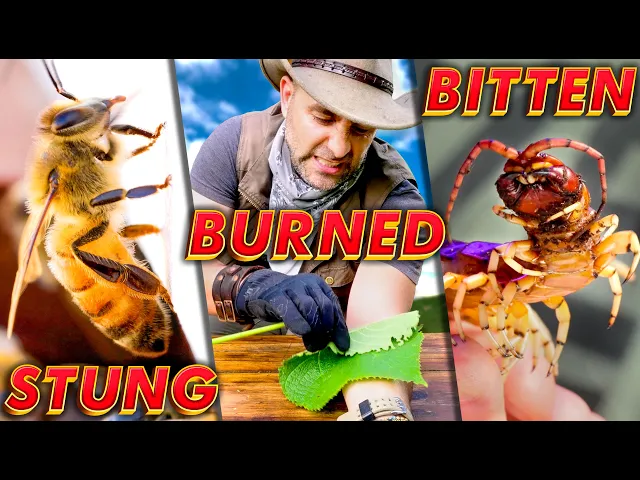
Dangerous Killer Bees, Spiky Plants, & Giant Centipedes | A Triple Threat for Coyote!
Brave Wilderness Top Videos
0:01 Whoa, that's a lot of bees right there.
0:07 And what I'm creating is a little bit of space.
0:09 Be space so I can get into the center frame
0:13 and determine what the health of the colony looks like.
0:16 Ow.
0:17 Ow.
0:18 Stung.
0:18 Stung.
0:18 Stung.
0:18 Stung.
0:19 Ow.
0:22 Killer bees.
0:24 It's a term that swarmed the United States in the early 90s,
0:28 blanketing the nation with a fear that being covered and stung
0:31 to death by Africanized honeybees was a possible and very painful doom.
0:37 And while people do die from bee
0:39 stinks every year due to rare allergic reactions,
0:43 the term killer bee is nothing more than an overly hyped media headline.
0:49 Early morning, the deserts of Arizona.
0:53 Today we are out in a bey yard getting ready to check some hives to determine
0:59 if they have been reprogrammed from angry Africanized
1:02 killer bees and into a more docile stock.
1:05 You would never want to approach a colony of bees in the wild.
1:09 So today I will be working alongside my good friend,
1:12 honeybee farmer and conservationist Chris Brenton.
1:17 This guy knows bees.
1:21 Chris has dedicated his life to honeybee conservation by safely capturing
1:26 aggressive Africanized colonies and genetically
1:29 reprogramming them into calm European colonies.
1:34 The easiest way to explain it is that he removes the angry
1:38 Africanized queen from the hive and replaces her with a friendly European queen.
1:44 Eventually, the friendly queen's genetics are passed on.
1:48 The colony becomes docile and ultimately safer for a honey farmer to work with.
1:54 This process takes time, but it's incredibly effective.
2:00 Today, Chris has tasked me with analyzing the aggression level
2:03 of an Africanized bee colony that was
2:06 recently discovered in a residential neighborhood.
2:09 Instead of exterminating the colony,
2:12 Chris moved it to one of his controlled bee yards
2:14 and swapped the queens so the genetic reprogramming process could begin.
2:20 Has the genetic reprogramming process worked?
2:23 We're about to find out.
2:26 Now, this Box here is unique and that this was
2:29 an Africanized colony that's been brought into the bey yard.
2:32 And what Chris has done is replace the queen.
2:35 Remember, at one point this was considered Africanized killer bees,
2:39 which are incredibly aggressive if provoked.
2:43 All right, here we go.
2:44 So, the first thing is to gently pry open the lid,
2:49 and that is to crack the seal between the wax and the frames.
2:56 Whoa, that's a lot of bees right there.
3:02 So far, so good.
3:03 They seem to be pretty calm.
3:06 I want to create myself a little bit of space
3:10 by separating out this first frame from the others.
3:15 Then, as Chris had instructed me, I want to get down to about the sixth frame.
3:21 That's right in the center of the colony.
3:24 All right, coming straight up.
3:28 There we go.
3:29 Wow, look at that.
3:32 That is a very heavy frame of comb and bees.
3:38 And as you can see, we're starting to get pretty swarmmy here.
3:42 I'm going to set this frame off to the side.
3:45 Before we get any further,
3:47 it's important that we understand what a killer bee is.
3:52 Technically, they are swarms of European bees
3:54 who interbred with invasive East African land bees.
3:59 This breeding created aggressive swarms of what
4:02 are now known as Africanized bees.
4:06 Visually, there's very little difference between these bee types.
4:10 The danger is that Africanized bees are far
4:13 more aggressive and react faster to perceived threats.
4:18 The sting of a killer or Africanized bee
4:21 isn't more potent than that of a European bee.
4:24 But because they attack in greater numbers,
4:27 this equates to more stings and the chance of death.
4:31 Hence the nickname killer bee.
4:35 Really careful here.
4:36 Don't want to squish anybody.
4:39 Middle frame is coming up.
4:42 Ow.
4:42 Whoa.
4:42 Whoa.
4:43 Whoa.
4:43 Whoa.
4:43 Whoa.
4:43 Ow.
4:43 Stung.
4:44 Stung.
4:44 Stung.
4:44 Stung.
4:45 Ow.
4:46 Oh boy.
4:47 I I my glove has gotten peeled back.
4:50 Okay.
4:50 That's one of the dangerous elements of beekeeping is you always got
4:54 to be careful the bees getting up and underneath the gloves and your suit.
4:59 Yowsers.
5:00 Yep.
5:01 Got to love honey bee stings.
5:02 Okay.
5:03 Ah, wow.
5:04 Honey bee stings more potent than you would think.
5:07 Okay.
5:08 Let me uh bring out this frame.
5:12 All right.
5:12 Here we go.
5:13 Middle frame coming up.
5:16 Woo!
5:16 Look at that.
5:18 That is a lot of bees right there.
5:21 Let me check one more frame back.
5:29 All right, next frame coming up.
5:32 That is a lot of healthy looking bees right there.
5:36 At this point, we are pretty much stuck right in a swarm of bees.
5:42 Now, if I were to gauge the level of aggression that is happening right here,
5:47 I'd say it's somewhere right in between.
5:49 Not necessarily as aggressive as you would imagine a swarm of killer bees to be,
5:54 which tells me that this queen is doing her job.
5:57 She is successfully reprogramming a lot of this colony into being more docile.
6:03 Now, I was stung once in the process, but really that was sort of my own fault.
6:08 My be suit came peeled back from my gloves and I was inadvertently stung,
6:12 but I'm not getting attacked to the point where the bees
6:16 are latching on to me and inflicting a bunch of stings.
6:19 So, that is actually a really, really good thing.
6:22 That means that this colony is on its way
6:26 to being genetically reprogrammed and will ultimately be a more friendly,
6:31 docile stock of bees for producing honey.
6:36 All right, I would say the colony looks healthy.
6:40 So, now it's a matter of getting the frames
6:41 back into place and closing up the box.
6:47 It's definitely intimidating to be surrounded by this many bees.
6:51 That's without question.
6:52 But when you think about it,
6:54 beekeepers are doing this every single day to help with the production of honey.
7:00 And you're going to get stung every once in a while.
7:03 It's inevitable.
7:04 Okay, so now that we've got the frames back in place,
7:09 I want to make sure that they are balanced and even,
7:13 I want to gently move the bees away from the edge of the box.
7:19 Make sure they're all kind of tucked back down in there.
7:22 I don't want anybody to get squished.
7:24 And last but not least, we put the lid back on.
7:28 You want to do it at a little bit of an angle so
7:31 that you can kind of push any last bees out of the way.
7:35 Really gently.
7:37 And voila.
7:39 There we go.
7:40 It's important to remember that all bees are going to defend their colony.
7:44 Out in the wild, if there were to be a bear that comes
7:46 into the environment and tries to break into a hive to get honey,
7:51 the bees sting as a natural defense to ward off anything
7:54 that's either after their queen or after their production of honey.
7:58 So, it's not abnormal for the bees to be swarming around me.
8:02 The good sign is that the bees are not aggressively attacking.
8:07 And that's a day in the life of a beekeeper.
8:10 Now, it's time to treat that sting.
8:15 During the summer months,
8:17 stings most commonly occur when humans accidentally step
8:20 on a honeybee that is pollinating a flowering plant.
8:24 Now, before we get to treating the sting, here are a few things you should know.
8:29 First is that only female bees can sting.
8:32 Now, it's obvious the stinger is very sharp,
8:35 but did you know that unlike wasps and hornets, honeybee stingers are barbed?
8:40 And as a result, they become lodged in their victim's skin,
8:43 which can allow for a larger dose of venom.
8:47 The venom itself is made up of mostly water and the following proteins.
8:52 Simply put, it's a chemical cocktail that causes pain, swelling, itching,
8:57 and an extreme level of discomfort that could be thought of as nature's
9:01 way to teach you a lesson that you will never forget.
9:05 The threat of being swarmed and stung to death by killer
9:08 bees is not something you need to worry about this summer.
9:12 And if it makes you feel even better, to date,
9:15 Chris has captured thousands of aggressive killer bee swarms.
9:18 And once introduced to a docile European queen,
9:21 every single colony has been successfully reprogrammed.
9:26 It's important to remember that honeybees are not out to get you.
9:30 They simply want to be left alone to do their job pollinating our planet,
9:34 which ultimately helps in the production of many foods we eat.
9:39 Yet, accidental stings do happen.
9:41 So, if you find yourself facing the uncomfortably potent venom of a honeybee,
9:46 just remember, be brave and stay calm because the first aid is quick and simple.
9:53 I'm Coyote Peterson and I'm about to enter the nettle zone with the Gimpy Gimpy.
10:02 Look at all the bumps forming on my arm.
10:04 Oh my gosh, man.
10:06 That is nasty looking.
10:16 The Cape York Peninsula is considered one of Australia's final frontiers.
10:21 It's a wilderness paradise.
10:22 And while we love filming its unique species,
10:24 today we're actually looking for its most
10:27 notorious plant known as the gimpy gimpy,
10:30 it supposedly has the world's most painful plant sting.
10:33 Today, I'm meeting up with my good friend Ryan.
10:35 He says he's got gimpy gimpies on his land,
10:38 and he knows that because he's been stung by it before.
10:41 My goal is going to be to not only find this plant,
10:43 but clip a leaf and ultimately place it on my forearm
10:46 to determine just how painful this sting really is.
10:58 Kevin is our official gimpy gimpy scouting dog.
11:03 He's got a nose for danger this one.
11:11 This is it.
11:12 That's it.
11:15 Way back there.
11:17 Kevin, what do you think about gimpy gimpy leaves?
11:20 Is this something that a dog would ever want to mess with?
11:23 Not so much.
11:27 Now, Ryan, you've been stung by the Gimpy Gimpy before.
11:32 Tell us a little bit about your experience.
11:34 Indeed, I just had it brush my fingers as I was
11:36 swinging a machete and pain stayed with me for about 3 months.
11:39 Wow.
11:41 Yeah.
11:40 So, I may be in for some serious pain today
11:43 given what the Gimpy Gimpy is going to do to me.
11:45 Now, what I want to do is extract the right size leaf.
11:48 You could see some of these leaves are massive.
11:50 I mean, bigger than a human head.
11:52 So, I could see how if you had an accident out there clearing
11:55 bush trails or if you slipped and fell into one of these plants,
11:58 it's going to be endgame for you.
12:00 But for me, I'm looking to get a leaf
12:01 that's just the right size to fit on my forearm.
12:04 It seems like I'll have no trouble picking the leaf of my choice.
12:07 So, I got a couple things I'm going to use.
12:09 I'm going to be wearing sunglasses and wearing protective gloves.
12:12 I also have with me a couple of plastic bags and we'll be in good shape.
12:18 Are you going to follow in with me just a short ways?
12:20 Are you going to film from here?
12:21 I'm going to film from here.
12:23 Okay.
12:23 Probably smart, right?
12:24 I'm wearing shorts as well.
12:25 Yeah.
12:25 Okay.
12:25 I'm actually going to put bandana over my face,
12:27 too, just so that nothing breathes into my nose.
12:31 The bandana, the glasses, the hat, the gloves.
12:34 Hopefully, this will protect me.
12:35 I don't want to get nettled before the right timing.
12:50 Okay, I'm right underneath the tree now.
12:54 I got a great leaf right there.
13:01 There it is.
13:02 That's the gimpy gimpy leaf right there.
13:04 All right, let's get out of the underbrush here.
13:06 It's time to get this experiment underway.
13:15 Sample number one secured.
13:18 It is a very unassuming looking leaf, I have to admit.
13:23 On the underside, you can see all those veins that run through.
13:26 And what you can't see with the naked eye are these very small nettles,
13:31 much smaller than the nettles of the giant stinging tree leaf.
13:37 You got those jagged edges around the outer rim.
13:40 And if you hold it up like this, it's almost heart-shaped.
13:44 But there's no love that comes from this leaf, only pain.
13:48 Now, I've read many stories about
13:50 the gimpy gimpy in preparation for this episode.
13:53 Honestly, this is the most fabled plant, I think, on the face of the planet.
13:57 There are stories that date back all the way
13:59 to the mid 1800s of early explorers running into this plant,
14:03 the pain being so bad that they wanted to cut
14:06 off their body part that was inflicted by those nettles.
14:09 I read a couple of cases where people's horses ran into the nettles
14:12 and the horses ended up dying within a matter of hours.
14:16 Now, what I want to do next is give you
14:18 guys an up close look at what are called the tricoms.
14:21 That's what's actually harboring that neurotoxic venom.
14:25 When you really break it down,
14:26 those tricoms are little hypodermic needles, almost like snake fangs.
14:31 And the second they touch my skin and the tip breaks off,
14:35 that venom is going to slowly be working its way into my system.
14:38 Now, for context and for safety, we do have a full first aid kit with us.
14:44 We also have an epinephrine pen.
14:46 There have been multiple cases of people being
14:48 nettled by this plant who've gone into cardiac arrest,
14:52 so we want to be extra careful.
14:53 I don't think it's going to be that bad for me, but you never know.
14:57 Certainly in Australia, this is biological landmine number 101.
15:00 And there is an indigenous people's remedy for how to remove
15:05 those nettles if you find yourself in worst case scenario.
15:08 I'm going to show you how to do that.
15:09 But first, we actually have to get the nettles into my skin.
15:13 Oh, I can feel myself really wanting to drag this one out.
15:16 I'm told this is going to be one
15:18 of the most painful experiences I have ever been through.
15:21 Bullet ant, execution wasp, giant hornet,
15:24 hand in a box full of angry yellow jackets.
15:27 If this surpasses the yellow jackets,
15:29 it's about to be the worst pain day I have ever gone through.
15:34 And it's amazing that this is quite possibly going to come from a leaf.
15:38 We think of it being animals on our planet.
15:40 They're the things that are going to be the most dangerous biological landmines.
15:44 You never think about it actually being something like a plant.
15:50 Now, to induce the nettling,
15:53 all I'm going to do is basically brush the leaf up against my skin.
15:57 Think about it.
15:57 If you're out there exploring in the wilderness and you
15:59 brush into one of these, you're going to feel it.
16:02 So, I don't need to go over the top.
16:04 Over the top would be slapping it up against my face,
16:07 rubbing it all over my body.
16:08 But I can tell you this much.
16:09 If this is going to put me in pain for several hours, if not possibly weeks,
16:14 I think I'm just going to take a test drive with the Gimpy Gimpy.
16:18 From what everybody tells me, it's going to be one wild ride.
16:22 I'm going to move this off the table, take off this glove.
16:28 My poor forearm.
16:29 It's taken a lot of beatings on this trip to Australia.
16:33 You may see a red dot in the center of my forearm right now.
16:37 That's actually still a sting left over from the bulldog ant.
16:41 So, we're just going to add uh a little poison on top of the paint as it is.
16:46 Okay, here we go.
16:48 I'm Coyote Peterson and I'm about to enter the nettle zone with the Gimpy Gimpy.
16:55 One, two, three.
17:06 Okay.
17:07 Oh jeez.
17:08 Oh god, that's very bad.
17:09 Very quick.
17:10 Oh my god.
17:11 Very bad.
17:12 Very quick.
17:15 Oh wow.
17:16 Okay, so Oh yeah.
17:19 Oh mackerel.
17:20 So what I did Oh jeez.
17:21 Yeah.
17:22 Wow.
17:22 Okay.
17:22 It's very very bad.
17:24 I rolled the leaf like this because at first I was like,
17:26 I'm really not feeling anything.
17:28 It takes those tricoms just the slightest opportunity of digging into your skin.
17:33 This is like taking the volume in your car stereo and cranking it to 100.
17:38 It only goes to 10 right now.
17:40 It's on its way to 100.
17:41 Holy cow.
17:45 Yep.
17:45 This is worse than the giant sign tree, that's for sure.
17:47 Now, I'm not going to put this on par by any
17:49 means with a hand in a box of yellow jackets.
17:52 Not yet.
17:52 We're not there yet, but I can definitely feel that it is building.
17:56 Holy cow.
17:56 All right.
17:57 You can see where the redness is starting to set in there.
18:03 I just trying to sit here.
18:04 I really want to get up.
18:05 I really want to get up and move around.
18:07 The sweat's getting in my eyes now.
18:09 I got to get these glove off.
18:15 Okay, let me get some composure here.
18:17 Holy cow.
18:18 Holy cow.
18:18 So on fire and being electrocuted at the same
18:21 point is exactly what this feels like.
18:24 I've only been electrocuted once.
18:25 That's when I accidentally got my finger
18:26 in between those two prongs in electrical socket.
18:29 And boy does that send a jolt up your body.
18:31 But if I'm going to compare this to an insect sting,
18:35 I would say that we are definitely at bulletin ant level at this point.
18:38 And it is continuing to build.
18:41 Now when you think about it building and getting worse,
18:44 I'm about a minute and a half in.
18:46 And if it's only going to get worse in the next 20 to 30 minutes,
18:49 I I'm really a little bit nervous as to where that's going to possibly go.
18:52 And I might have overdone it.
18:53 I might have Maybe I should have just touched it to my arm and not rolled it.
18:56 Oh man, this is a bad idea.
18:58 Oh my.
19:01 Ah, look at all the bumps forming on my arm.
19:03 Can you see that with that camera?
19:05 All through there.
19:07 Look at that.
19:07 Bump, bump, bump, bump, bump, bump, bump.
19:09 I'm going to just I'm just going to go ahead
19:10 and count this because those are the tricoms that penetrated the surface.
19:15 I'm seeing 1 2 3 4 5 6 7 8 9 10 11 12 13 14 15 16 17
19:20 18 19 20 21 22 23 24 25 26 27 28 29 30 31 32 Probably close to 50.
19:30 Hot seat right here, ladies and gentlemen.
19:33 Jesus, it's really getting bad.
19:37 Yeah.
19:40 Oh my gosh.
19:44 Holy cow.
19:44 Can you see that on your on your camera, Mario?
19:47 Yeah.
19:47 If you keep it like that, dude, that is ridiculous.
19:51 Oh god.
19:52 Don't puke on us.
19:53 Don't puke on us.
19:54 Oh, my stomach's getting a little queasy.
19:58 I can understand just from a few minutes in with the pain
20:02 why some people have called this the suicide plant.
20:06 I imagine this being on my face, my neck, my mouth.
20:10 If you had fallen face first into one of these plants
20:13 and you were going through this kind of agony everywhere.
20:17 This is this is this is bad.
20:19 This is bad.
20:20 This is another one of those oh play stupid games win stupid prizes.
20:23 I know you guys are all right in the comments section below.
20:25 Coyote, what did you think you were getting yourself into?
20:27 Well, I knew what I was getting myself into.
20:29 Had to determine exactly how bad it was going to be without question.
20:32 This is way worse than the giant stinging tree leaf.
20:40 Shimies.
20:41 Wow.
20:42 Holy heat zone, man.
20:44 This is like This is like serious searing fire right now.
20:49 Holy cow.
20:49 No, this is serious.
20:50 Something's going on here.
20:52 I can actually feel it feels like it's crawling into my skin.
20:57 So, similar to a jellyfish, the nataphors on a jellyfish.
21:01 And the way once they penetrate your upper
21:03 epidermis layer and start to get in there,
21:06 they're working their way in.
21:07 And those tricoms are slowly releasing small bursts of neurotoxic venom.
21:12 So every time they set off almost like a landmine,
21:15 I'm feeling that jolt of burning electricity going
21:19 up and down like Got that shot yet?
21:21 That's a good angle right there.
21:22 Yeah, I bet it is.
21:24 Hold steady to start pouring down rain.
21:26 It's going to rain.
21:29 Yeah.
21:29 We're trying to get this scene all roped in before the storm comes in.
21:32 Now, it's important to note that we're going to have to gauge out
21:35 the pacing of this over the course of the next 20 to 30 minutes.
21:39 So, we've got rain coming in.
21:40 The next piece is the the next piece of the scene may be up under an overhang.
21:45 But the good news is we've got the tricoms in the venom's taking effect.
21:52 And I'm going to try to use the local remedy for removing some of those nettles.
21:57 But I'm going to let it set in so I can
21:59 feel the full effect of the venom before we do that.
22:01 All right.
22:01 I'm getting up.
22:02 I got to move.
22:02 Holy crap.
22:03 Ah.
22:05 Woo.
22:11 He was right about play stupid games, win stupid prizes.
22:14 So, he wanted to take on this journey and we would been here to capture it.
22:22 Ah, torrential downpour.
22:25 Nothing like filming ah a nettled episode in the middle of an oncoming storm.
22:30 Oh.
22:32 My remedy.
22:32 My remedy.
22:35 Ah.
22:36 Oh, the water definitely makes it worse.
22:40 Jeez, man.
22:43 That is nasty looking.
22:46 My whole left side is like oh so uncomfortable.
22:50 All the way up my arm into my shoulder and into my chest and my lymph nodes.
22:58 Ah, that is the face of a man who is exemplifying true regret.
23:08 My arm is on fire right now.
23:11 And it's not just my arm.
23:12 It's my lymph nodes underneath my armpit and in my groin.
23:16 It's so uncomfortable.
23:18 That's my body's lymphatic system basically saying,
23:20 "We've got invaders in the body.
23:23 We got to get rid of them." Now, there is a remedy that indigenous people,
23:28 the Aboriginal people will use to help remove
23:32 the nettles from any stinging plant in Australia.
23:37 I'm going to try this remedy.
23:39 I'm looking for anything right now that could possibly provide me relief.
23:43 I am 30 minutes in.
23:46 Mentally, I am zapped.
23:47 My lymph nodes are screaming in pain.
23:49 My arm is on fire.
23:51 it might as well have gotten burnt in a furnace.
23:55 So, let's let's try to let's try to do this.
23:57 Um, if you are out in the wild and you find that you
24:02 have run into a gimpy gimpy or you've run into a giant stinging tree,
24:07 all you need is a small container.
24:09 You can use a water bottle.
24:10 You could use anything.
24:11 And a little bit of dirt.
24:13 You want some dirt that's going to be thick and that's ultimately going
24:16 to turn into a thick mud that you can cake onto the skin.
24:21 You want it to be the consistency of a very hearty milkshake.
24:26 Now, as that dirt begins to dry, as the mud dries,
24:30 it is going to suck moisture and grip on to the nettles.
24:35 And then you should be able to peel or rub
24:38 that off and hopefully take the majority of the nettles with you.
24:41 So, if you're out there in the wild finding anything with a flat,
24:45 straight edge, I found the shell earlier.
24:48 This will work perfectly to scrape the mud at an angle.
24:51 You don't want to dig in.
24:52 You want to go at an angle against the mud, the skin,
24:56 and hopefully that will help to push out some of the nettles.
24:59 So, here we go.
25:02 Look at that.
25:03 Just bulldozing it away.
25:07 It's still very, very sensitive.
25:10 Oh, it does feel like it may be getting some of those nettles out, though.
25:14 Oh, man.
25:15 My arm hurts so bad.
25:17 The whole arm is almost numb at this point.
25:20 And as the mud was drying,
25:22 I could actually feel that it was tightening down on the skin,
25:26 which did provide, strangely enough, a little bit of relief.
25:31 And the good thing about the mud is that it's also going to suck
25:35 out a little bit of that toxin from the upper level of the skin.
25:41 All right.
25:43 Now, everything that I've read has said
25:45 that water immediately turns to searing pain.
25:49 That's because the nerve endings that are being affected by the neurotoxin
25:53 are still screaming and cold or heat will just increase that intensity.
25:58 But I'm going to go for it.
25:59 Here we go.
26:03 YEP.
26:04 OH, WOW.
26:04 JEEZ.
26:05 YEAH.
26:05 YEAH.
26:05 YEAH.
26:05 OKAY.
26:06 I want to get that off.
26:06 Want to get that off.
26:08 Yeah.
26:10 The water burns like crazy.
26:18 Okay, there are definitely probably still tricoms
26:20 in there if it's hurting that bad.
26:26 Okay, get off of there water.
26:28 Woo, man.
26:32 Immediate water contact equals searing pain.
26:36 But now that I've squeegeeed off some of that water,
26:41 I am feeling a bit of relief.
26:46 Now, as a secondary effort,
26:48 if you find yourself out in the wild and this is your immediate solution,
26:52 getting to a store to use something like wax strips
26:55 is going to be your best remedy in a nettling.
26:59 Whether that is from the giant stinging leaf or from Gimpy Gimpy,
27:03 we know because I use wax strips with the giant stinging leaf.
27:07 And I do have some wax strips with me that I
27:09 will eventually try if the paint here doesn't begin to subside.
27:14 Oh jeez.
27:17 Oh, that's so painful.
27:19 It is insane how many of those were still in my skin.
27:23 And I can tell the difference between hairs and tricoms
27:26 because my hair is dark colored and the tricoms are clear.
27:30 And under a macro lens,
27:32 they look like little tiny snake fangs that inject a lot of neurotoxic venom.
27:41 It has now been 24 hours since I took on the sting of the gimpy gimpy.
27:46 It's fair to say last night I had the second worst sleep experience in my life.
27:52 Next to sticking my hand into a box of Angry Ella jackets,
27:55 the gimpy gimpy put me in some serious pain.
27:58 Today, I'm doing all right.
28:00 I used another wax strip this morning,
28:02 still feeling electrical shock impulses running up and down my forearm.
28:06 And I would say that I can officially rank the Gimpy Gimpy
28:09 as being the number one most painful plant sting in the world.
28:14 Is there a plant sting that's ever going to outdo it?
28:16 I guess we'll have to wait and find out.
28:18 I'm Coyote Peterson.
28:20 Be brave.
28:21 Stay wild.
28:23 We'll see you on the next adventure.
28:27 It has been nearly 4 months since
28:29 my wild ride with Australia's notorious suicide plant.
28:33 And when it comes to long-term effects, all of the warnings are legit.
28:38 My forearm experiences random, unprovoked flare-ups of itchiness.
28:43 And if I put anything refrigerator level cold to my skin in the nettled area,
28:48 it feels like I'm being shocked with icy lightning bolts.
28:52 Fun times.
28:54 But this is why I do what I do.
28:56 So that we can all see how powerful nature is and why
28:58 you want to do your best to respect it from a safe distance.
29:02 I'm Coyote Peterson and I'm about to enter
29:05 the bite zone with the giant Asian centipede.
29:10 Here we go.
29:13 Ah, the
29:17 Hi, I'm Coyote Peterson and today I'm going to be
29:20 bitten by one of the world's most venomous centipede species.
29:24 Now, there are four good reasons as to why
29:26 I'm going to perform this extreme experiment.
29:29 First is to measure how my body will react to this bite using medical equipment.
29:34 Second is to determine if this bite will
29:36 rank as my most painful experience to date.
29:39 Third is to show you what a doctor would do to treat this type of bite.
29:43 And last, but certainly not least,
29:45 is to raise awareness and financial support for Save the Horns,
29:48 our black rhino conservation initiative.
29:51 Now, before we get into paying for conservation gain,
29:54 first I want to introduce today's special guest, Dr.
29:57 Jordan Wagner.
29:58 He's a certified trained physician,
29:59 but to his millions of followers, he's known as Dr.
30:03 ER.
30:04 What's up, Doc?
30:05 Hey, what's happening, Coyote?
30:06 Much, man.
30:06 How are you?
30:07 I'm good.
30:08 Uh, ready for a centipede bite?
30:09 Uh, I hope you're ready.
30:10 I'm getting ready for making sure that you
30:13 don't have an emergency that we need to handle.
30:15 In order to fully understand what my body will be
30:17 going through during the bite and its immediate after effect, Dr.
30:21 Jordan first needs to create what's called a baseline,
30:24 which includes my resting heart rate, blood pressure, and temperature.
30:28 My numbers were a bit on the high side,
30:31 but the doc noted that to be normal given
30:33 the mental wherewithal of the bite I'm about to take.
30:36 With my biometrics recorded,
30:38 the next step is to fit me with 11 sticky electrodes,
30:41 which will be attached to the life pack 12,
30:44 a device that will provide a visual representation for my baseline
30:47 stats and how they fluctuate during my interaction with the centipede.
30:52 Now, feeling like a bionic man,
30:54 it's time to introduce the good doctor to the world's largest centipede species.
31:01 Here we go.
31:03 That wow is the giant jungle centipede.
31:09 That is big.
31:10 That is huge.
31:11 But is that the head?
31:13 What am I looking at?
31:14 Well, that's a great question.
31:16 So, this centipede species and almost all
31:19 centipede species have something called defensive mimicry.
31:23 The back end looks like the front end.
31:26 Or is it the back end looks like the front end?
31:30 Wow.
31:30 Okay.
31:31 Okay.
31:31 So, it's a it's a mechanism to trick its pre predators.
31:34 Predators.
31:35 Right.
31:35 So, if I was a coyote that was looking
31:38 for a meal and I came in to bite this side thinking
31:40 I was getting the head because crushing the head or getting
31:43 the neck is what's going to kill a potential prey item.
31:48 Unfortunately, you've bitten its butt and then it
31:50 has the opportunity to swing around and bite
31:53 you with those forciples which are what
31:56 the biting mechanism on a centipede is called.
31:58 Now, those are Look at that.
31:59 It's turning up in the air though.
32:01 There those forciples are modified appendages.
32:04 So over time and these creatures have
32:06 been evolving for millions of years over time.
32:10 They evolved to have these appendages that have turned into a biting mechanism.
32:17 It's a little close to my finger there.
32:19 So what we're going to attempt to do now is freehandle this centipede.
32:25 Now, as I was starting to say,
32:26 the venom from the species is very similar to the giant desert centipede,
32:31 which I had been bitten by before.
32:33 I got to actually pin down its head to do this.
32:37 Oh jeez.
32:37 Look how fast.
32:38 See how fast it is?
32:43 There's the commitment.
32:45 Look at those fangs.
32:47 My goodness.
32:48 Okay, here we go.
33:06 Cut the C cut the cameras.
33:07 Cut the cameras.
33:08 So, I made the choice to not be bitten by this species.
33:12 Instead, we're going to be bitten by a species that is much more potent,
33:17 an oldworld centipede.
33:20 But this one specifically, we consider a centipede ambassador.
33:24 Okay?
33:24 Do you notice how calm it is?
33:27 This is not something you could normally do with a centipede.
33:31 It is chill.
33:32 It is relaxed.
33:33 And at the moment, it is just enjoying crawling on my arm.
33:37 Look how sluggish it is.
33:39 Just curiously looking around, looking for its next spot to walk.
33:43 Now, I got to ask you this question,
33:46 and I would only ask you this if I felt comfortable.
33:49 Do you think you would be able to freehandle this centipede?
33:52 I know you didn't expect this coming in here today,
33:55 but I am confident that your odds of being bitten are like only one out of five.
34:01 Got it.
34:01 Which is not bad.
34:02 One out of five.
34:03 That's like 20%.
34:04 I mean, maybe it's like two out of four.
34:06 You know, the numbers going the wrong direction.
34:08 I think you're going to be okay.
34:10 I know I'm putting you on the spot,
34:11 but I figured that would make this episode so much better.
34:14 I mean, if you can let it crawl on me, sure.
34:18 Just trust me.
34:18 So, put your arm straight out.
34:20 Let me ask cameras.
34:21 Is camera looking okay there?
34:22 Oh my god.
34:23 All right.
34:23 So, this is Dr.
34:25 Eer about to freehandle the world's largest centipede species.
34:31 Let me get her to walk.
34:32 Oh, she likes me.
34:33 She likes you better than me.
34:34 We're going to try this.
34:35 Just like this.
34:37 There we go.
34:38 There.
34:38 Oh my gosh.
34:38 There we go.
34:39 Oh, she doesn't want to come off my hand.
34:42 Okay.
34:42 I don't know.
34:42 Maybe she just senses your nerves.
34:45 Maybe.
34:45 There we go.
34:45 There we go.
34:46 There we go.
34:46 Just stay still.
34:47 There you go.
34:47 Turn your arm a little bit.
34:48 Don't worry, I'll get her if she moves or decides to drop.
34:51 Whatever you do, don't move.
34:52 They can definitely sense fear.
34:54 And if it goes up your sleeve,
34:55 just let it happen cuz it'll be super entertaining.
34:58 I'm just Oh, she's going right towards your face.
35:01 Okay, you could do whatever you need to do.
35:03 Look at the way that the bodies move.
35:05 Now, centipedes have segmented bodies and they're armed with this exoskeleton.
35:09 Exoskeleton.
35:10 No, Jordan.
35:11 What's so cool about this is that the exoskeleton is almost indestructible.
35:15 Are you kidding me?
35:16 Oh, it's going up the side of your head.
35:18 This could not be any better.
35:20 Okay, great.
35:21 I'm going to bring her back.
35:23 Yeah, you can take control of your head.
35:25 Get out of here.
35:26 No, I'll bring her this way.
35:27 Oh my gosh.
35:29 I got my watch on to see what my heart rate's doing.
35:31 Do you think your heart rate went up there?
35:32 I don't know.
35:33 We're going to see.
35:34 So, for context, had this centipede decided to bite you,
35:36 which I was confident that it would, you would be in a world of pain.
35:39 And that venom is very similar to the venom of the giant desert centipede.
35:43 Got it.
35:44 Centipede venom is not well researched.
35:48 Okay.
35:48 Yes.
35:49 What are we doing on this?
35:50 I apologize.
35:50 I'm going right back into my centipede facts.
35:52 Let me let you breathe for a second.
35:54 You doing okay?
35:55 I'm all right.
35:56 I'm okay.
35:57 See, what you guys didn't realize is that he
35:59 had no idea that this was going to be happening.
36:02 That was fantastic.
36:03 Most people would have been like, "There's no way.
36:05 You could have walked right off of this set
36:07 and back to California and I would have just been
36:09 left here by myself and then who would save me
36:11 if the other centipede bite goes bad?" That is true.
36:13 You know, it wasn't so bad.
36:14 It was getting used to the legs moving
36:17 and that unique intensity, but it was light.
36:20 I just started going to my neck.
36:21 I was worried about my jugular.
36:23 Yeah, that's not the spy you'd want to get bitten.
36:25 But what I was starting to say about the venom
36:27 specifically is that not a lot is known about centipede venom.
36:31 But we do know that there are two specific properties that are incredibly bad.
36:37 Yes.
36:36 And what aspects are those?
36:37 So we have a neurotoxin and a cardio/myiotoxin.
36:42 The neurotoxin basically interferes with the ion
36:46 channels leading to the information on your nerves.
36:49 So you can experience horrible pain paralysis.
36:54 You can get numbness.
36:55 Okay, that is the neurotoxin working.
36:58 On top of that, you have this cardioype
37:01 toxin that will increase your heart rate, which could cause cardiac arhythmias,
37:06 meaning your heart starts going high beats,
37:10 abnormal beats coming from the wrong areas of the heart.
37:13 And that's when we might need to shock somebody out of an abnormal rhythm.
37:16 And that's why we have this machine,
37:18 right?
37:18 All right.
37:19 So, I'm going to hand this big,
37:22 beautiful creeper back off over here to Mario off camera.
37:31 pretty successful.
37:32 Yeah, we managed to handle the world's largest centipede species.
37:36 Crawled up your neck and nobody was bitten.
37:39 But that's not why you guys showed up.
37:42 You showed up, you clicked on that thumbnail because you
37:45 want to see me bitten by a very creepy looking creature.
37:50 And that's where we are headed next.
37:52 So, let's go ahead and bring in the container here.
37:55 Now, I want to explain to everybody that the next few
37:58 minutes that you are going to see here may be pretty intense.
38:02 Mario, go ahead and uh let's hand this guy in here.
38:06 Oh, it doesn't look so bad.
38:07 Uh, this is, trust me, it's going to be bad.
38:11 Let me turn it like this for the cameras.
38:13 So, this is the giant Asian cherry centipede.
38:18 Now, this is what will be considered an oldworld species.
38:22 So, because it's oldworld,
38:24 the venom component is quite a bit different than the venom from New World.
38:29 Now, I have been told that without question,
38:32 this bite is going to put me in the most painful situation I have ever been in.
38:37 Top three most painful are putting my hand into a box with 200 yellow jackets,
38:41 the bite from a giant desert centipede, and the gimpy gimpy leaf.
38:46 Wow.
38:46 So, this may take the new top tier level
38:51 of pain when it comes to Coyote Peterson and discomfort.
38:54 We're going to get it out of the clear plastic capsule.
38:58 It's going to go into this container.
39:01 You should be good.
39:02 We are not going to let this one walk on your neck.
39:05 And I'm going to gently Wow.
39:09 get it under control.
39:11 I was just looking over here at the monitor
39:13 to see if there's much change in my heart rate.
39:15 And uh a little bit a little bit a little bit little bit.
39:20 Okay.
39:20 Centipede is coming out of the container.
39:24 All right.
39:24 Now to do this, I'm going to place it in like this.
39:27 Gently take off the bottom.
39:32 That's a nice way.
39:33 Okay, there it is.
39:35 Please, please, please don't be able to climb out of there.
39:37 We did not test this earlier, just so you guys know.
39:39 Okay,
39:40 look at the activity.
39:41 And you can see how it's using its antenna and all
39:44 these little sensory organs up front to figure out where am I going.
39:47 And one thing that I notice about centipedes is that they're rather intelligent.
39:51 They're always investigating their environment and they notice light.
39:54 They notice notice shadows.
39:56 They notice movement.
39:56 You can tell that my speech pattern is beginning
39:58 to change because I'm getting a little bit nervous.
40:00 Look at my look at my heart rate.
40:01 It is it is definitely going up.
40:03 Like this is the moment of no turning back.
40:07 Don't you don't you climb out of here.
40:09 This centipede gets out of here during the making of this episode.
40:11 It's going.
40:11 It's going to be running.
40:12 So, all right.
40:13 Here's what I need to do.
40:14 I need to very gently I'm going to kind of have to stand up a little bit.
40:18 What I need to do is gently pin the centipede's head
40:22 down so that I can get it right behind its head.
40:25 And then the foripules are where the bite is going to come from.
40:28 So, once I get the centipede under control, then we'll be in good shape.
40:32 So, I'm not going to talk for a minute.
40:33 I'm going to just try to get this done without
40:35 talking so that we can have the animal under control.
40:38 And then we are are getting into things.
40:42 You see how fast it is?
40:45 Wow.
40:44 In case anybody's wondering, is this possibly hurting the myriod?
40:47 It's not.
40:48 Their exoskeletons are like armor plating.
40:50 So, it's really about getting it pinned with this hand.
40:53 And then I've got to I need to be able to pick it up with this one.
40:56 So, that's where this just gets a little bit difficult.
41:00 Where's my heart rate?
41:01 Wow.
41:01 You're actually doing really good.
41:02 You're 126.
41:04 You've actually calmed down.
41:05 That is probably the most difficult part about this entire situation.
41:10 So, keep that there because we may need to pull the top off of that.
41:17 I probably squinched it down.
41:18 Here we go.
41:19 Just in case we need to get the centipede contained.
41:22 Okay, so I'm going to hold Wow, they are so incredibly strong.
41:27 So if I turn it like this and hold really still,
41:30 Mario can zoom in on those forceules
41:32 and that is what is going to inflict the bite.
41:35 Venom filled.
41:37 This is going to be bad.
41:39 So because I don't want to hold the centipede in this position for too long,
41:42 we're going to get right into it.
41:44 Heart rate rising.
41:46 Yep.
41:46 So forearm's going to be here.
41:47 Now Doc, I don't want to get bit in an area with a vein.
41:50 Correct.
41:50 You do not want direct inoculation into your vein.
41:53 So there are two areas right in the middle above and below that main vein.
41:56 Give me a target spot.
41:57 So, we have this spot right here or right here.
42:02 Guys, please hit that donate button.
42:04 This is for all of those rhinos out there.
42:07 Heart rate rising.
42:09 Every single dollar counts.
42:11 I am literally willing to push it
42:13 this far to bring awareness for rhino conservation.
42:17 If we do not protect these animals,
42:18 they are going to go effectively extinct in the next decade.
42:22 This is completely worth it.
42:24 I'm Coyote Peterson and I'm about to enter
42:26 the bite zone with the giant Asian centipede.
42:33 One, two, three.
42:38 Here we go.
42:43 He's got me with one thing.
42:48 Ah, he's got both.
42:51 Okay, you got that shot.
42:52 I don't think I can let him stay much longer than that.
42:57 How we doing on a chop?
42:58 You good?
42:58 Good.
42:58 Good.
42:58 Good.
43:01 Oh, okay.
43:03 Let me in there.
43:03 Yep.
43:04 Oh, look at that.
43:05 Okay, you got that bite.
43:07 Breathe.
43:09 Breathe.
43:10 Breathe.
43:10 Breathe.
43:13 Tell me what you're feeling.
43:17 It's searing pain.
43:19 Oh my gosh.
43:21 That is instantaneous.
43:24 Oh, sharp stabbing, pressure burning.
43:28 Tell everybody what you what you feel.
43:29 Okay, so Oh, wow.
43:31 Hold on one second.
43:32 Okay, so yes, the pain is is bad.
43:35 It is getting worse, but I'm feeling an incredible numbness in my arm right now.
43:40 It is pain, but it almost feels like a state of paralysis.
43:43 Right.
43:44 Which is that neurotoxin starting to take effect.
43:46 And you can already see the redness around the area.
43:49 Yeah.
43:49 And some swelling.
43:50 Oh, holy mackerel.
43:53 Wow.
43:53 Wow.
43:54 So, it's a paralysis but pain.
43:58 Hold on.
43:58 Just give me a second.
43:59 Give me a second.
44:00 Give me a second.
44:02 So, we always ask patients when they come
44:03 to the emergency department on a pain scale 1 to 10.
44:06 10 being the worst, one being not so bad.
44:10 You have your own you have your own pain scale
44:13 cuz you're you're an individual that understands his own pain.
44:16 Where does that rank for you right now knowing
44:19 that it may get worse or it might get better?
44:21 This is I would call it a five out of 10 at the moment.
44:25 But here's the thing.
44:25 We are hot.
44:26 What are we a minute and a half in?
44:29 A minute and a half in.
44:30 And one of the things that I learned with the giant desert sun.
44:33 Sorry guys, I Wow.
44:34 Holy cow.
44:34 I'm like super lightheaded.
44:35 Yeah, that seems like a bigger bigger response and wheel than you had
44:40 on your first one in the sense of I already see some black and blues.
44:44 I see some blood there.
44:45 We're letting it be because this is what Look at my arm is twitching.
44:48 You're doing for science.
44:48 Exactly.
44:49 You got muscle spasm, dude.
44:51 I am not doing that.
44:52 That is my arm is spazzing out right now.
44:54 And one of the things that I have seen
44:56 uh and let me know if I start getting flushed.
44:58 Like I feel like I'm talking in a in tunnel vision right now.
45:01 Um um is when they attack rodents like mice,
45:06 they need to subdue something very very very quickly.
45:09 And I've seen mice like look at my arm.
45:11 It's convulsing.
45:12 Yeah, you can even see the back here is convulsing as well.
45:14 So that is just your all the ion channels
45:17 are just getting kind of played with by this neurotoxin.
45:20 Holy mug.
45:21 Oh yeah.
45:22 Okay.
45:22 We're at about a six.
45:24 We're at about a six with the pain.
45:26 Hon man.
45:27 It's tough to tell where this is going.
45:28 And that's where I'm like I don't want to get too confident
45:30 to feel like this isn't as bad as the giant desert centipede.
45:35 I don't think initially it it is.
45:38 But it's hard to tell because it's only been a few
45:41 seconds and my arm is like doing something crazy weird right now, right?
45:44 And not all the not all the toxins
45:46 have probably actually started to take effect yet.
45:48 Oh, look at the wealth that's Oh, yeah.
45:50 There's a good wealth around there.
45:51 That's crazy.
45:52 So, we worry also about anaphilaxis.
45:54 And that's why I have the epipen here.
45:56 How how long before we know if like
45:57 something really bad is happening in my body?
45:59 It could happen like right right now or it could be delayed.
46:03 Okay.
46:04 So,
46:05 that's pretty wild.
46:06 There's muscles.
46:08 Um, and we're also looking at like
46:11 can somebody give me a drink real quick?
46:12 He's getting dry mouth, which is normal in this experience.
46:16 Could be related to heart rate, blood pressure,
46:19 as well as his sympathetic nervous system going into overdrive.
46:22 Thank you.
46:22 Thank you.
46:23 Thank you.
46:24 So, if as coyote's drinking and focusing,
46:26 if this were to actually happen to somebody outside and like what do you do?
46:30 You want to clean the wound, get to an area of safety, get to the hospital,
46:34 and then what could I do as an ER doctor treatment wise for you,
46:37 which we're holding off at the moment
46:38 in the name of science until you tell me otherwise.
46:41 Yeah.
46:42 My goal is to ride this out as long as as possible.
46:45 And right now, right now, I'm doing okay.
46:47 Do we want the centipede off the table?
46:49 Okay, go ahead.
46:49 You can you can take it.
46:50 I mean, that's getting close to me, so I'm I'm happy to let that go.
46:54 And so besides pain management, okay,
46:56 anti-inflammatories, some strong pain medicine, IV fluids, man.
47:01 We're going to put you on a cardiac monitor,
47:02 which we have here to monitor your blood pressure,
47:05 your heart rate, and to see how you're doing.
47:08 All right.
47:08 So, the next thing that we wanted to do Oh, you want to take my blood pressure?
47:11 I want to see how you're doing.
47:12 Okay, why not?
47:15 Oh, man.
47:15 My like calf muscles are feeling awkward, too.
47:17 Like that's is that is that just like my body's
47:20 reaction?
47:21 Oh.
47:22 Oh wow.
47:24 H no no no no big like don't feel anything
47:26 in your throat no tongue swelling those are the big things we
47:29 worry about for anaphilaxis right and then the other things we
47:32 worry about from a neurotoxin also is your nausea your vomiting
47:37 you know no diarrhea thank goodness
47:40 dude this is wow I got to say one of the strangest
47:42 things that I've experienced is my calf muscles are are cramping up
47:47 like I've been playing basketball for hours like I'm
47:49 like like feel like locked in place right now.
47:51 Yeah, those are your muscle spasming.
47:53 Multiple different reasons.
47:54 Holy cow.
47:55 Like, dude, it is getting it is definitely getting worse.
47:58 It is unquestionably getting worse.
48:01 You could see his agitation and the fact that he wants
48:03 to get up and move around like he would normally do,
48:06 but he's doing his best to sit in the chair here.
48:08 Um, let's do this real quick cuz I just touched my arm.
48:11 Uh, poke around here like feel how taut that is getting.
48:15 Yeah.
48:16 So, this is what we call induration.
48:17 And it's a medical term basically saying that
48:21 God your your cold fingertips doc that hurts.
48:25 The cold hurts.
48:26 I apologize.
48:27 Wow.
48:27 Do Do it again though.
48:28 Do it again.
48:28 The lemon.
48:29 Oh wow.
48:30 Yeah.
48:30 Yeah.
48:30 Yeah.
48:31 Your arms nice and warm and my hands are
48:32 Yeah.
48:32 cold definitely affects it.
48:34 Wow.
48:35 Holy cow.
48:36 This I feel like I'm going to wake up tomorrow morning
48:38 or not sleep at all tonight and this is all going
48:40 to have felt like a complete hallucination between the lights and everything
48:44 that we like I am so out of it right now.
48:46 I'm like, I don't even know what I'm going through.
48:48 Right.
48:48 So, his pupils are a little bit dilated.
48:49 That's just related to the sympathetic overdrive of your system,
48:52 your fight orflight response, which is normal.
48:54 So, while centipede venom is not well known,
48:59 centipede venom is very unlikely to kill you
49:03 unless your body has a negative allergic reaction.
49:07 And all of a sudden,
49:08 as I said that, it felt like a volume cranker just went up one more notch.
49:13 And that's what I've experienced with a number of different venoms is like
49:16 there's the initial hit and then there are these waves that start to build.
49:20 And with centipede venom specifically, that neurotoxic element,
49:24 that's what begins to wear you down mentally.
49:28 Man, look at the ooze that's coming out of my arm.
49:30 Yeah.
49:30 So, you're getting different inflammatory markers that are just going in.
49:33 You know, your your cytoines are popping, your interlucans,
49:36 and everything's just like trying to help and attack it.
49:38 Yeah.
49:38 Yeah, but you're also having a localized histamine
49:41 reaction that's making you swell up more.
49:44 And that is my body essentially sending its
49:46 defenders to the sight of the venom to say, "Uh-oh, foreign invader.
49:51 Stop them where they are." Correct.
49:53 Okay.
49:53 Well, we learned a lot.
49:55 Yep.
49:55 A whole lot when it comes to centipedes.
49:58 Why this is an animal you want to admire from a safe distance.
50:01 And in answering the questions that we set up earlier,
50:04 what we ultimately learned is that we can hook
50:05 my body up to a machine to see how it reacts,
50:08 we can take a look at what happens when
50:11 a venomous bite happens and how you would treat it.
50:14 And when it comes to ranking it as being
50:15 the most painful experience I've ever been through,
50:18 if I'm completely honest, we're not there yet.
50:21 But I have many hours to still go.
50:23 However, I will say that as an individual bite,
50:26 this is one of the most extreme things I have ever done.
50:29 And in this situation where we got to film
50:31 it together for that I feel incredibly lucky.
50:34 Great.
50:34 That was awesome.
50:35 Sorry you're going through all this pain.
50:37 Well, you know, all a part of entertainment
50:39 and raising awareness for conservation and our planet species.
50:42 But Dr.
50:42 Jordan, thank you so much for being here tonight with us.
50:46 Um guys, check out the comment section and about section below.
50:50 Remember, you can continue donating to Save the Horns.
50:53 Just click on that donate button or go to savethehorns.com.
50:56 Remember, all of the new Brave Wilderness merch at shopbraveworlderness.com.
51:00 Those proceeds also go towards the rhinos.
51:03 And check out Dr.
51:04 Eer's YouTube page.
51:06 Endless hours of entertaining reactions.
51:08 I hope so.
51:09 And you get to learn a little, too.
51:10 Absolutely.
51:10 Well, that's what it's all about.
51:12 Entertainment and education.
51:13 I'm Coyote Peterson.
51:15 I'm Dr.
51:15 Er.
51:16 Be brave.
51:16 Stay wild.
51:17 We'll see you on the next adventure.
51:19 Woo!
51:19 We did it.
51:22 Post bite.
51:23 Once the venom had really set in, Dr.
51:25 Jordan applied an anti-inflammatory shot and a healthy
51:28 dose of lidocaine to alleviate swelling and pain,
51:32 which worked temporarily for about 2 hours
51:34 until the pain returned in full force.
51:38 For nearly 30 hours,
51:39 I battled a state of discomfort that included waves of intense pain,
51:43 a sleepless night, and a renewed sense
51:45 of respect for the potency of centipede venom.
51:49 Completing this challenge was a mountain that had to be climbed.
51:52 And from its summit,
51:53 I see a bright future for critically endangered black rhinos.
51:57 Please consider donating to Save the Horns.
51:59 Your support is literally keeping the 25 rhinos
52:02 we're sponsoring protected against the wrath of merciless poachers.
52:07 Together, we can change the future for these vanishing giants.
52:21 These snakes scare me.
52:24 These guys are renowned for just going crazy.
52:36 Today, we're going to be milking
52:38 five of Australia's most dangerous snake species.
52:41 And in doing so, we're going to calculate how many humans that venom yield
52:44 could kill and in the end explain to you exactly how antivenenom is created.
52:57 I will be working alongside Billy Colette.
53:00 He's a Jedi master in the universe of reptiles and to date has
53:04 milked the venom from all of Australia's
53:06 most dangerous snakes hundreds of times.
53:11 Billy, before we get into the intensity of milking snakes today,
53:14 and I have to note to the audience,
53:17 it is palpable how dangerous this room feels.
53:20 Every one of these containers filled with a snake that can kill you.
53:23 But I want to talk real quickly about the difference
53:25 between dangerous and deadly and how with Australian snakes,
53:28 it all combines together.
53:30 Yeah, there's a there's a big argument there, I think.
53:32 But when it comes to deadly and dangerous,
53:34 we look at dangerous are the ones that kill
53:36 the most people and then deadly being the most toxic.
53:39 So up here we've got Australia's most toxic snakes, right?
53:43 A lot of times the dangerous versus deadly breaks down
53:46 to where a snake is located in its proximity to humans.
53:49 How often you will come across a snake
53:51 versus how infrequent you could come across it.
53:54 Correct.
53:54 Yeah.
53:54 Yeah.
53:55 So at the moment, Australia's most dangerous snake is the eastern brown.
53:59 It's not the most toxic.
54:00 It's number two in the world, but it bites the most people.
54:04 Wow.
54:04 Okay.
54:05 So that's because of its proximity to humans.
54:07 when it comes to the actual most deadly snake in Australia.
54:11 Which species would that be?
54:12 That's the inland Taipan and that's the most toxic snake on planet Earth.
54:16 Okay, the first one we're going to be taking a look at is the king brown.
54:19 This thing is a giant, the mulga as it's commonly known.
54:23 What do we need to know about the snake?
54:25 They've got the biggest venom of any venomous snake on the planet.
54:27 What they lack in toxidity,
54:28 they make up for in volume and it's just an overwhelming effect on your system.
54:31 And you imagine one of our really big king grounds
54:34 can pump out in excess of 800 mg in a bite.
54:41 You can see straight away massive venom glands on this fella.
54:50 That is such a big snake.
54:52 Okay.
54:55 Yep.
55:00 Here we go.
55:00 King Brown, the mulga.
55:02 Let's milk it.
55:08 Oh, wow.
55:10 Dang, that's a lot of venom.
55:13 So, it's still going.
55:16 His glands are still They're probably still 80% full.
55:19 So, he's able to control in a sense
55:21 the amount of venom that he's choosing to give.
55:24 And look at that.
55:25 Just locked in place.
55:26 He won't he will not let go of that.
55:27 There we have it.
55:27 The King Brown officially milked.
55:29 That's one out of five.
55:31 And that is an intimidating snake right there.
55:44 Okay, Billy.
55:44 King Brown is down.
55:46 And next up on our list of venomous danger noodles is the death adder.
55:52 The thing I find interesting about death adders is they've
55:54 got the fastest strike of any snake on the planet.
55:57 Really?
55:57 I did not know that.
55:58 Yeah, it's it you can't even see it.
56:01 Wow.
56:01 Out of all the snakes I restrain,
56:03 these guys make me the most nervous because
56:06 a their strike and their bottom jaw is extremely flexible
56:10 like the vipers and they get their fangs out
56:12 the side of them and work them towards your fingers.
56:14 So, I use a three-point grip like I do with all my snakes and I just
56:18 keep that the front of that head as far away from my fingers as I possibly can.
56:23 You guys ready?
56:24 milking the death at her.
56:28 Oh jeez.
56:30 I jump every time.
56:31 It made me jump.
56:32 You didn't warn me about that.
56:34 You can see just with that leap to grab onto the vial,
56:38 the speed, even with your hand controlling it was fast.
56:42 So, what sort of prey species are these snakes
56:44 specializing in using codual luring like that with the tail?
56:47 I imagine they're drawing in little mammals, maybe birds,
56:50 in particular, small birds.
56:52 Um yeah, they they love to eat skinks and geckos.
56:54 It's the only elapid, short, thick bodied elapid
56:58 that sits still on the ground and relies
57:00 on camouflage and that ambush attack, you know.
57:03 Pretty cool.
57:04 So, I wouldn't mind letting go of the head of this fell.
57:07 Yeah, let's let's put back.
57:10 So, yeah, with these guys, the strike is is faster than the eye.
57:14 So, I've actually got to wait for him to pull away from me before I can
57:18 let go because I literally wouldn't be able
57:21 to get my hand out of there fast enough.
57:23 Right.
57:23 So, you want his body.
57:25 I I need I need him to reverse like he's doing before I can actually let go.
57:31 All right.
57:32 Billy's faster than the death adder.
57:34 I like that.
57:35 Two snakes down.
57:36 Successfully milked.
57:38 Next up is the tiger snake.
57:40 This is my favorite snake in Australia.
57:42 Wait until you guys get a look at this reptile.
57:47 Wild thing with tiger snakes, they turn your blood into jelly.
57:51 I did not know this.
57:52 Your blood turns to jelly.
57:53 So it coagulates it together.
57:55 It coagulates and then it it can't actually move around your body anymore.
57:57 So that's what can kill you if you don't
57:59 use first a with this with any of our species.
58:02 But yeah.
58:02 Okay.
58:02 So don't want to get bit by this one.
58:04 Same deal when we get him onto the pin pad.
58:06 I'll grab the head.
58:07 You come in body and then block that cloer.
58:09 Okay.
58:10 Oh wow.
58:10 Oh, that snake is beautiful.
58:13 Yep.
58:13 You're good.
58:16 Wow.
58:16 Pretty strongbodied snake.
58:18 Yeah, they are very thick.
58:20 Wa.
58:22 All right.
58:23 The tiger snake.
58:24 Let's do it.
58:27 Oh, yeah.
58:28 Look at that.
58:29 There we go.
58:29 So, you can see it funneling out of that left hand fang there.
58:33 Also a clear venom.
58:35 Yep.
58:35 Now, like the king brown, is this a snake that's going to bite and hold on?
58:39 Unlikely.
58:40 unlikely.
58:41 More of a a bite and let go and then try and get away
58:44 unless it's grabbed a prey, you know,
58:46 a lizard or a frog or a little bird or something.
58:48 And where are these snakes typically found?
58:50 I mean, is this a species that humans are likely to run into?
58:54 Not as much as they used to.
58:55 They used to be very common along the east coast,
58:57 but with with urban development and so on and their habitat cleared,
59:00 they're not as common, but some areas they are, especially the colder,
59:03 more alpine sort of areas and even islands off
59:06 South Australia and Victoria and Tasmania and so on.
59:08 And he should let go pretty easy.
59:10 Whoa.
59:12 And that's actually a pretty good yield.
59:14 Um, what I'll do is I'll swap you.
59:17 Okay.
59:17 That got it.
59:18 Don't drink it.
59:19 Yeah.
59:19 I will do my best not to.
59:20 Very tempting.
59:21 And I'll take this and tiger snake.
59:25 I'll take him back to the So far successfully accomplished.
59:37 Okay, that is three venom vials successfully accomplished.
59:42 See what we're going to milk next.
59:45 So,
59:44 yeah, Billy, what are you thinking?
59:46 I'm just warming up here and picking I think I'm going to go with Keith.
59:50 Like all the taipans here are pretty jumpy
59:53 and it's name is Keith.
59:54 Keith.
59:55 Yeah.
59:57 Okay.
59:56 So, he's not as reactive usually.
1:00:00 Okay.
59:59 Um he's a little bit more behaved so I wouldn't mind using him.
1:00:02 Now, anything we need to know cuz these are very fast snakes.
1:00:04 Correct.
1:00:05 So, before antivenenom was available,
1:00:07 this species had 100% kill rate when they bit someone in Australia.
1:00:11 Okay.
1:00:11 So, now that antivenenom is created, that's not necessarily the case.
1:00:15 So, what you're saying is that if you
1:00:16 were ever to be bitten by a coastal taipan,
1:00:19 it is a 100% death sentence unless you receive antivenenom treatment.
1:00:24 Yep.
1:00:24 Yep.
1:00:24 So, you know, normally as our snakes get more toxic,
1:00:28 the venom yields get smaller.
1:00:30 Not with these guys.
1:00:31 Okay.
1:00:31 and their fangs.
1:00:32 They've got the biggest fang of any of our Australian
1:00:34 venomous snakes and one of the largest venom yields.
1:00:37 Okay, so we are lining up now with a fast snake,
1:00:40 a smart snake, large fangs, large venom yield, and very flighty.
1:00:45 Very flighty.
1:00:46 I'm going to step over here out of the way and let you do what it is you do.
1:00:49 Uh, all right.
1:00:50 Here we go.
1:00:50 The coastal taipan is coming out of its enclosure.
1:00:55 This is one of the the most dangerous
1:00:58 situations we're going to possibly face here today.
1:01:02 Look at that snake.
1:01:06 Just get him into that right position.
1:01:11 All right.
1:01:11 You ready to jump on that tail?
1:01:12 Yeah.
1:01:12 Yeah.
1:01:12 You good?
1:01:15 Yep.
1:01:16 Okay.
1:01:17 That is a very intimidating snake.
1:01:19 That's for certain.
1:01:20 Look at the size of its head.
1:01:22 Long head.
1:01:24 Goodness.
1:01:23 Big eyes.
1:01:24 They're very focused.
1:01:25 They're very in tune.
1:01:26 They're very smart.
1:01:27 These snakes scare me.
1:01:29 Okay, out of any of our Australian snakes, these guys scare me the most.
1:01:32 And I imagine he'll be pretty willing to bite this.
1:01:37 And you can see that initial huge yield.
1:01:41 That is massive.
1:01:43 And look at the fangs.
1:01:45 Jeez.
1:01:46 Right.
1:01:46 and with the venom itself.
1:01:49 So, you know how the tiger snake causes your blood to clot?
1:01:52 This guy does the complete opposite and your blood thins out
1:01:55 to the point where you bleed out of every orifice out of your gums,
1:01:58 your eyes, and you know, downstairs just bleeding.
1:02:01 Yeah.
1:02:02 So, you're like internally hemorrhaging if you get bitten by this.
1:02:04 Internally hemorrhaging and then it paralyzes your diaphragm.
1:02:07 So, your heart and lungs can't work
1:02:09 and essentially you'll choke to death on your own blood.
1:02:11 Literally, you just die.
1:02:12 Yeah.
1:02:13 Wow.
1:02:13 Okay.
1:02:13 That sounds like a horrible way to go.
1:02:15 But thankfully the antivenenom is fantastic and the first aid is just as good.
1:02:19 So okay, how how fast does something like that set
1:02:22 in when it comes to your blood thinning out?
1:02:24 I mean, how much time would you estimate you
1:02:25 have if you're bitten by one of these snakes?
1:02:27 If you were to get bitten by one and do first aid straight away,
1:02:31 it'd be hours usually before you had any
1:02:33 symptoms cuz that's how effective those bandages are.
1:02:35 But without a bandage, I reckon based off studies that I know,
1:02:39 you're looking at about half an hour.
1:02:40 You'd be vomiting, blood, you'd be you'd be passing out.
1:02:44 You you'd be in a very bad way.
1:02:46 So, a bite from the snake and within 30 minutes you were going downhill quickly.
1:02:51 Yep.
1:02:53 Wow.
1:02:51 Breaking out in sweats and just in a very bad place.
1:02:56 Yeah.
1:02:56 Not a snake you ever want to tangle with.
1:02:58 Okay.
1:02:58 I imagine you probably want to get this guy back.
1:03:01 Wa!
1:03:02 Look at the inside of the mouth.
1:03:05 Yep.
1:03:04 He's looking at us.
1:03:05 I mean business.
1:03:06 Hundreds of teeth in there across that bottom
1:03:08 jaw and the top jaw for securing rodents.
1:03:10 You know, that's what they feed on.
1:03:12 and those massive fangs.
1:03:15 So, I'll grab that tail.
1:03:16 Grab that.
1:03:27 Well done.
1:03:31 That That was intense.
1:03:32 And it's not even the most intense snake
1:03:35 that we're going to milk today, but wow.
1:03:36 I mean, I'm I'm sweating bullets.
1:03:38 I can't even imagine how you're feeling right now, Billy.
1:03:40 I know this is a part of everyday life, but for us getting to milk these snakes
1:03:44 and see them up close like that, it's intense.
1:03:48 So, Billy, we have now successfully milked four snakes.
1:03:52 And it's hard to describe how intense this scenario is.
1:03:56 Getting through four of them, my heart rate is like through the roof.
1:03:59 And there will be days where you're milking several hundred snakes at a time.
1:04:02 Correct.
1:04:03 Yeah.
1:04:03 It's it's heart pumping stuff,
1:04:05 but like the thing I find is I just can't lose focus.
1:04:09 M
1:04:09 and if I'm having an off day,
1:04:11 I have to call it cuz there's no point taking the risk with these things,
1:04:15 especially those tipans.
1:04:16 And as you'll see very soon, the eastern browns are just so jumpy.
1:04:20 We're about to milk the eastern brown,
1:04:22 which is the most dangerous snake species
1:04:24 that we're going to interact with today,
1:04:26 arguably the most dangerous snake species in Australia.
1:04:30 If the worst case scenario were to happen, if you were to be bitten,
1:04:33 what is the protocol that you would go through to save your life?
1:04:36 We have a drill and we can go through that drill if you want.
1:04:39 You can be our victim.
1:04:40 Yeah, I I'll play the not bitten by, but the what if bitten by victim.
1:04:44 Um, yeah, let's let's do it.
1:04:46 Let's test out a snake drill.
1:04:47 Where do we start?
1:04:48 Go out here with a snake bandage.
1:04:50 Okay, Billy, let's set up the scenario.
1:04:52 A bite is most likely going to happen right
1:04:54 in this vicinity if the snake's head wasn't pinned correctly.
1:04:58 So, assuming I was trying to make my move.
1:05:01 Bitten.
1:05:02 Got bit.
1:05:03 Okay, mate.
1:05:03 Just move away from the snake.
1:05:04 Come up this way.
1:05:05 Very quietly and calm.
1:05:07 Straight on.
1:05:08 Oh, that was bad.
1:05:09 Take that jewelry off for me in that sweatb band.
1:05:12 Going to get a bandage for you.
1:05:15 We're going to go three times over your bite side.
1:05:18 It's important to try and get those rectangles into squares on these type
1:05:22 of bandages because this is actually slowing
1:05:24 down your lymphatic system movement in this limb,
1:05:28 which is what the venom's actually traveling through.
1:05:29 So, it's not in your blood system yet.
1:05:31 Okay.
1:05:31 Really important you keep that limb straight.
1:05:34 Okay, I'm going to deal with this snake.
1:05:37 So, we've got the snake.
1:05:38 He's back in the cage.
1:05:40 I'm going to grab the wheelchair and at the same time,
1:05:42 I'm going to contact reception.
1:05:44 Billy to reception.
1:05:46 Coyote has been bitten by a tiger snake.
1:05:51 He's got his bandage on and I'm just transferring to wheelchair now.
1:05:56 The time is 11:09.
1:05:58 Can you please advise Gossip Ed that we are on our way?
1:06:02 I'm grabbing the antivenenom.
1:06:04 How you feeling, mate?
1:06:05 Oh, Billy, I'm scared and it hurts.
1:06:08 Let me know if you start to feel nauseous or blurry vision,
1:06:11 if you get a funny taste in your mouth, any of that.
1:06:14 We got to document any of those symptoms.
1:06:17 Oh man, I cannot believe that just happened.
1:06:19 That got us out here in 2 minutes and we'll be at Gossford in under 10.
1:06:22 Okay, well that was pretty efficient between bite, wrap,
1:06:27 wheelchair out to the vehicle that would take me to the medical facility.
1:06:30 Less than two minutes and I'd be having help in under 15 minutes.
1:06:34 Now we need to head back inside and get ready
1:06:36 to milk the most dangerous snake in all of Australia,
1:06:39 the one and only eastern brown.
1:06:42 All right, now this is a pretty goodized snake.
1:06:45 Correct.
1:06:46 Big.
1:06:46 Yeah.
1:06:46 One of the one of the biggest, one of the fastest,
1:06:48 one of the most ornery here in Australia and the one
1:06:50 that's responsible for biting pretty much more people than any other species.
1:06:55 Yeah.
1:06:55 Yeah.
1:06:55 Absolutely.
1:06:56 So, the eastern brown is now responsible
1:06:58 for 65% of snake bite deaths in Australia.
1:07:02 Wow.
1:07:01 This snake is jumpy.
1:07:03 So, I am going to need a bit of space
1:07:04 and please don't come in until I've I've got him proper secure
1:07:09 and then I'll I'll call you in obviously.
1:07:11 But yeah, I just need space.
1:07:13 He's big.
1:07:13 He's over six foot, very jumpy.
1:07:15 Okay.
1:07:16 And um he's he's a wild boy.
1:07:18 Okay.
1:07:18 He's your brown snake coming out of its enclosure.
1:07:28 Oo, that is a big snake.
1:07:30 Oh boy.
1:07:31 Yeah, I know.
1:07:31 He does not look real happy, does he?
1:07:35 Okay, we'll get him over here.
1:07:37 See him flatten out there.
1:07:39 Uhhuh.
1:07:41 Strike.
1:07:41 Whoa.
1:07:41 Oh yeah, he is really quick.
1:07:44 These guys are renowned for just going crazy.
1:07:50 Not calculated though, like a taan.
1:07:52 They're just consistent with it.
1:07:54 Um and it's what they use to bluff um predators away.
1:07:58 And obviously he would look at me as a predator.
1:08:00 Um which is why he's acting like that.
1:08:02 Also, it's interesting the way he curls his body into Oo, that was close.
1:08:07 See what I mean?
1:08:07 That sort of stuff.
1:08:09 Straight up at your face.
1:08:13 You okay?
1:08:13 You good?
1:08:15 Yeah.
1:08:14 That was intense.
1:08:15 Okay, I think we got to get him under control at this point.
1:08:19 And he isn't even one of our jumpiest snakes.
1:08:37 All right.
1:08:37 Okay.
1:08:38 You good?
1:08:39 Oh, good.
1:08:40 Okay.
1:08:44 This is without question the strongest snake that we have held on to today.
1:08:47 Unbelievably strong.
1:08:50 Okay.
1:08:50 You good?
1:08:51 Yeah, man.
1:08:51 All right.
1:08:53 Get him on here.
1:08:56 All right.
1:08:56 So, you can see tiny yields.
1:09:00 Yeah.
1:09:01 But unbelievably toxic.
1:09:03 And how's how they act?
1:09:05 Like __] They just go nuts.
1:09:08 And for the handler, you got to be confident in yourself,
1:09:12 like reaction speed, not to let go, what you're doing, your next movement.
1:09:17 And and like I said, he's not even the craziest.
1:09:19 He's one of the quietest easterns we've got.
1:09:21 I mean, that was probably the most intense,
1:09:23 fastest move I've ever seen a human make, which I'm sure we caught on camera.
1:09:27 I mean, he was all the way up by your face when he swung his body up.
1:09:31 That was insanity.
1:09:32 He came mouth open at my face like these things do not muck around.
1:09:38 Okay.
1:09:38 All right, guys.
1:09:38 We're going to get the snake back in.
1:09:40 That was a very, very, very intense moment.
1:09:43 You got him?
1:09:46 Yep.
1:09:46 Okay, nice.
1:09:55 Man, that that was so close.
1:10:01 I bet your heart's racing right now, isn't it?
1:10:03 I don't really get the adrenaline dump from that anymore.
1:10:06 My heart's racing for you.
1:10:07 How about that?
1:10:08 It I know that sounds stupid, but cuz I'm so used to it.
1:10:11 I'm so programmed.
1:10:12 It's not that I'm not scared or anything.
1:10:13 It's not that.
1:10:14 It's just Yeah.
1:10:15 It's just part of the job with with these guys.
1:10:17 Now that we've got our venom lined up,
1:10:19 the next thing I want to do is sit back and take a look
1:10:22 and try to calculate how many people this venom yield added up would kill.
1:10:35 Billy, I would say that this lineup of shots here before
1:10:38 us is arguably the most deadly five shot lineup in history.
1:10:43 100% right.
1:10:44 So, what we want to do now is go through each one of these venom
1:10:48 yields and I'm going to write down
1:10:49 your estimate of how many people this would kill.
1:10:52 So, this part of the episode is us
1:10:54 figuring out just how deadly this concoction really is.
1:10:58 So, we're going to start with the King Brown.
1:11:01 How many people would you guess that that venom
1:11:03 is capable of killing this yield right here?
1:11:06 I would confidently say that would kill about 40 grown men.
1:11:10 Moving to our second vial here.
1:11:11 That is the death adder.
1:11:13 What is your guess, Billy?
1:11:14 How many dead people?
1:11:17 50.
1:11:17 Our third vial belongs to my favorite Australian snake, the tiger snake.
1:11:21 I'd comfortably say 65 with that.
1:11:25 65 tombstones.
1:11:26 Our fourth vial is the ever so frisky coastal Thai pan.
1:11:31 Good size yield.
1:11:33 This is a very dangerous glass in front of us and I'd say in excess of 150,
1:11:39 probably more closer to 200 people.
1:11:42 Wow.
1:11:42 All right, I'm rounding up.
1:11:43 We're going 200 corpses coming off of that shot glass.
1:11:48 And last but not least, one of the craziest snake experiences I've ever seen.
1:11:52 Your interaction with the eastern brown.
1:11:55 A pretty small yield, but pretty toxic.
1:11:58 That's a big yield for a brown snake.
1:12:00 Oh, that's big.
1:12:01 Yeah.
1:12:02 Okay.
1:12:01 That's a really big yield for a brown snake.
1:12:03 And And that'll be 100 people.
1:12:05 100 people.
1:12:06 Okay.
1:12:07 40+ 50+ 65+ 200+ 100.
1:12:17 That is bonkers.
1:12:19 So, how much antivenenom could be created
1:12:22 from this venom yield that we have here?
1:12:24 Not much.
1:12:25 So you need about 30 of each to create one boil.
1:12:29 Okay.
1:12:29 Yeah.
1:12:30 Now the work that's being done here at Australian Reptile Park,
1:12:33 this is the only place on the continent where
1:12:35 people are milking snakes and creating this life-saving antivenenom.
1:12:39 Without that antivenenom,
1:12:40 people that are bitten by these snakes every year would not be able to survive.
1:12:43 They say not all heroes wear capes.
1:12:45 This guy doesn't wear a cape, but honestly, he should have one.
1:12:48 It's impressive the work you guys are doing here.
1:12:50 And one last thing that I want to answer for everybody out there watching,
1:12:54 how is antivenenom made?
1:12:56 It's a crazy process, but in a in a quick sum, we milk these five species.
1:13:01 We then freeze dry the venom.
1:13:02 We send it to a lab in Victoria.
1:13:04 They rehydrate it, small amounts, inject it into horses.
1:13:07 So there's ta horses, blacknake horses, death horses, so on.
1:13:11 Different horses designated for different types of venom.
1:13:13 Yep.
1:13:14 Okay.
1:13:14 And they get a tiny injection once a week for about 6 months.
1:13:17 Their immune systems are so strong they don't
1:13:19 even pick up on the effects of that venom.
1:13:20 I've been down there.
1:13:21 They're walking around eating grass on horse stuff.
1:13:24 Yeah.
1:13:23 At the end of the invenimation period, that six months mark,
1:13:26 they bring the horses in individually into a lab.
1:13:28 They hook them up to the blood machine and they
1:13:31 draw a liter of blood out of them at a time.
1:13:33 They run it in a centriuge.
1:13:35 During the invenimation process,
1:13:37 their immune system start to produce venom resistant plasma.
1:13:42 So they remove that out of the blood system.
1:13:44 Everything else goes back to the horse.
1:13:45 horse is fine.
1:13:47 That venom resistant plasma is antivenenom.
1:13:49 They add some proteins to it so the human body is more likely to accept it.
1:13:52 And uh yeah, essentially we take on a horse's
1:13:55 immune system and our antivenenom in Australia,
1:13:58 it's the best quality in the world and it's free.
1:14:01 So we're one of the very few countries worldwide that does that.
1:14:03 And here at the Australian Rep Park,
1:14:05 we are the sole supplier for terrestrial snake venom for that program.
1:14:09 Very cool.
1:14:10 Well, Billy, this has been unbelievably educational.
1:14:13 It was amazing to watch you work.
1:14:15 Thank you for having us as a part of your day.
1:14:18 Check out australian reptilepark.com if you want to ever come here
1:14:21 and visit or just learn more about the work that they do.
1:14:24 I'm Coyote Peterson.
1:14:25 Be brave.
1:14:26 Stay wild.
1:14:27 We'll see you on the next adventure.
1:14:32 It doesn't take a genius to recognize how staggering
1:14:36 the mathematical death toll is behind today's venom experiment.
1:14:40 And now knowing this, I hope you can appreciate why it's so
1:14:43 important to avoid interactions of any
1:14:45 type with Australia's venomous snake species.
1:14:49 Every year, thousands of people are bitten.
1:14:51 And every year, thousands of people are
1:14:54 saved due to the creation of antivenenom.
1:14:57 And while milking these reptiles has its inherent dangers,
1:15:00 Billy is a seasoned professional who knows the risk,
1:15:03 yet remains dedicated to his mission.
1:15:06 But seriously, I saw Billy's life flash before my own eyes.
1:15:09 So, one more time, let's take a look at that shot.
1:15:12 Oh, it's crazy.
1:15:14 I mean, look how close that snake was to biting his face.
1:15:17 Standing ovation.
1:15:19 Billy is faster than the brown snake.
1:15:23 And so, I was on oxygen just as they got to the hospital.
1:15:26 They ran out of oxygen.
1:15:27 I died.
1:15:28 Hold on.
1:15:28 You died?
1:15:29 I died.
1:15:31 Is this your first time encountering a venomous snake since the bite incident?
1:15:35 Yes.
1:15:35 Just don't point it this way.
1:15:37 Oh, look at that.
1:15:38 He's yawned right at me.
1:15:46 I'm on Australia's Sunshine Coast and I'll be interviewing Leela,
1:15:50 a woman who knows firsthand the dangers of interacting with a venomous snake.
1:15:54 She's a bite victim survivor who nearly lost her life.
1:15:57 And today she's going to be sharing her incredible story.
1:16:01 Now, what Leela doesn't know is that we're also going to be
1:16:03 getting her face to face with a deadly snake whose venom,
1:16:06 believe it or not, ultimately saved her life.
1:16:11 For you, this all began in 1974,
1:16:14 the day it all happened when you were bitten by a venomous snake.
1:16:18 Can you take us back to that morning when you were heading out to the barn,
1:16:22 you had farm animals,
1:16:23 and you were you were barefoot like a lot of people in Australia,
1:16:26 walk around barefoot, and you found yourself in the worst case scenario.
1:16:29 take us to that morning and tell us the story.
1:16:32 Well, it happened in the afternoon, late afternoon,
1:16:35 almost on dark and I had a goat and I was putting the goat under the house.
1:16:40 I mean, what goat wouldn't want to live underneath a house?
1:16:43 So, yeah, I was happily putting her under the house.
1:16:46 I had a baby and a 2-year-old inside
1:16:49 and I felt this like a pins and needles feeling,
1:16:52 like pins and needles in my foot.
1:16:55 And so I went inside and I thought straight away
1:16:58 that I definitely had been bitten by a snake or a spider.
1:17:02 I wasn't sure what.
1:17:04 Um the poison immediately went straight up to my head really.
1:17:09 So I got a migraine headache.
1:17:11 I've never had a migraine headache in my life.
1:17:14 So I had this migraine headache and straight away it started to vomit.
1:17:17 So I got the bucket and I'm leaning over the bucket vomiting and thinking,
1:17:21 "Oh god, I need help.
1:17:22 I need help." So, I put my baby and my 2-year-old and myself in the car
1:17:27 with the bucket so I could keep vomiting in the bucket and go to the neighbors.
1:17:31 And then the neighbor takes me straight to the Southport Hospital.
1:17:35 And at the Southport Hospital,
1:17:37 the doctor thought I was reckon I was a hippie and I
1:17:41 was on drugs and I didn't know what I was talking about.
1:17:43 That's an unfair judgment.
1:17:45 Very unfair.
1:17:46 And um gave me a blood test and left me all night with no antibbody, no nothing.
1:17:51 And um I was yelling out for help because I was getting feverish and I
1:17:58 knew they weren't doing anything for me and I was screaming out for help.
1:18:00 I want my acupuncturist to come to the hospital.
1:18:03 An acupuncturist in the 70s.
1:18:06 Yeah.
1:18:06 And the acupuncturist actually made it up to the hospital.
1:18:09 He heard somehow on the grapevine.
1:18:12 Certainly no text messages back then.
1:18:14 No.
1:18:14 No mobile phones back then.
1:18:16 He came up to the hospital and he felt cuz acupuncturists they go on your pulse.
1:18:21 Everything's on your pulse.
1:18:22 He felt my pulse and he felt every muscle fighting the venom.
1:18:30 Wow.
1:18:28 And the next morning I had fallen into a coma
1:18:33 and every muscle had collapsed and I couldn't breathe.
1:18:37 And so they found the venom in my blood test and then they gave
1:18:41 me the antivenenine but it wasn't I I I couldn't breathe at this stage.
1:18:45 So they had to put me into an ambulance and race me in Brisbane
1:18:50 which ky just as they got to the hospital they ran out of oxygen.
1:18:59 I died.
1:19:00 They raced me up.
1:19:02 Hold on.
1:19:02 You died.
1:19:03 I died.
1:19:03 My heart stopped beating.
1:19:04 They raced me up to intensive care and they got me going.
1:19:08 They got me breathing.
1:19:10 How did they get you breathing?
1:19:11 Did they have to put a tube down into They had to put tubes all over me
1:19:16 and in my mouth and they leave the tubes in your mouth
1:19:18 for 5 days and after 5 days they have
1:19:22 to do tracheotomy because uh it can get infected.
1:19:26 Yeah.
1:19:27 So they had to do a tracheotomy where they open
1:19:29 up your throat and they put a machine into your throat,
1:19:34 a tube and the machine is actually breathing
1:19:36 for you cuz you cannot breathe on your own.
1:19:39 So, a lot of the snakes in Australia have a a neurotoxic venom which
1:19:43 ultimately can cause your internal system to go
1:19:46 into a state of paralysis and collapse.
1:19:48 And it sounds like that's exactly Yeah.
1:19:49 And I had I had big hematomas in my groins which are big black bruises
1:19:56 which are hematas are internal bleeding.
1:19:59 So I had internal bleeding and um I was in the coma for 6 days.
1:20:07 Wow.
1:20:07 And uh then after that I regained my consciousness.
1:20:11 So the moment that you came back, let's call this day seven into your ordeal.
1:20:16 Do you remember waking up out of this coma?
1:20:19 I do.
1:20:20 I do.
1:20:21 And I remember thinking to myself, I'm this is a dream.
1:20:26 Really?
1:20:26 I'm I'm having a dream.
1:20:27 This can't be real.
1:20:28 This can't be real.
1:20:30 So once you'd woken up out of the coma,
1:20:32 like were you just kind of like a cucumber there in your bed?
1:20:34 Like at that point had your muscles had gained no control.
1:20:37 I had no strength.
1:20:38 I had no strength.
1:20:38 They they sat me up and I just fell back down again.
1:20:42 I had no strength at all.
1:20:44 I must have been so scary.
1:20:45 It was a slow a slow um process of my muscles building back up.
1:20:52 So you're in the coma.
1:20:54 Um you come out of it and I imagine your first question to the doctors would be,
1:20:58 "Do we know what kind of snake bit me?"
1:21:00 Do you know at this point which species it was?
1:21:03 I don't know if I knew at that point but David Fle
1:21:08 from Forna and Flora Reserve in Burley Heads who
1:21:12 had it for many many years on the Gold Coast he was an expert on snakes and he
1:21:18 diagnosed the snake as a rough scale snake.
1:21:21 Oo yeah.
1:21:21 No rough scaled snake.
1:21:22 I mean that aligns with the symptoms that you had from the venom.
1:21:26 Here's the thing about a rough scaled snake.
1:21:28 Very unassuming looking snake.
1:21:31 Small head, small mouth.
1:21:32 So, I could see if you got a bite from that snake.
1:21:34 Fast striking and very, very small things, but very potent venom.
1:21:41 So, Leela, after you get out of the hospital and you're back home,
1:21:45 between 1974 and now, do you have any longlasting symptoms?
1:21:49 You do?
1:21:50 Yes.
1:21:50 I don't have any reserves.
1:21:52 So, if I go downhill, I can't pull on any reserves.
1:21:55 I've just got to go to bed and go to sleep.
1:21:57 In fact, I've got to lay down at lunchtime every single day.
1:22:02 And I've got to recuperate because um
1:22:05 my nervous system is damaged from the snake venom.
1:22:09 Wow.
1:22:10 The snake venom affects your central nervous system and that's one
1:22:14 thing that's permanently damaged from the snake bite is my nervous system.
1:22:18 Gotcha.
1:22:18 Okay.
1:22:19 So a lot of people out there have a fear of snakes.
1:22:22 It's called a fedophobia.
1:22:24 So, I have to ask you, previously or now or after this experience,
1:22:30 were you afraid of snakes or are you now
1:22:32 afraid of snakes given that one nearly took you?
1:22:34 I'm not afraid of snakes.
1:22:35 No, because I love animals.
1:22:38 Mhm.
1:22:37 I love animals and I just happen to be in the wrong place at the wrong time.
1:22:43 Yeah.
1:22:42 And I respect snakes.
1:22:43 I respect all animals.
1:22:45 Mhm.
1:22:45 That's I mean, that's a fantastic message.
1:22:47 I think a lot of people would assume if somebody was
1:22:50 bitten by a snake and it nearly killed them that like snakes,
1:22:53 this is why I don't like them.
1:22:54 But you're right.
1:22:54 I mean, snakes are doing an amazing thing for the planet.
1:22:57 They are the control for all of the species that we
1:23:00 as humans usually try to have not get into our house.
1:23:03 All of the vermin species, the mice and different rodents.
1:23:07 I I believe that snakes will just want to really just get out of your road,
1:23:11 you know?
1:23:11 They just want to get on with their life.
1:23:13 They're not out there to kill you.
1:23:14 They're not out there to bite you.
1:23:16 Mhm.
1:23:16 Now, we have a little something extra lined up today.
1:23:20 I don't know if you were aware of this or not, but would you be comfortable?
1:23:26 We have We have We are in the vicinity of a snake.
1:23:30 Not a rough scaled snake, the tiger snake.
1:23:32 The snake that is actually responsible for providing
1:23:36 the venom that created antivenenom to save your life.
1:23:39 Would you be up for meeting a tiger snake?
1:23:42 I would I'd like to meet it.
1:23:43 I don't hold it.
1:23:44 It will be totally controlled.
1:23:46 And if you want, you'll even be able to pet its tail.
1:23:49 It's not a dog, I think.
1:23:50 You don't think you'll pet its tail?
1:23:51 You might when you see how pretty the snake is.
1:23:54 We'll cross that bridge before we get to it.
1:23:56 But you at least seeing the snake.
1:23:58 That's a huge step.
1:24:00 And saying that you're not afraid of snakes.
1:24:02 Most people had they been bitten by a snake would have immediately said,
1:24:05 "Whoa, whoa, whoa, hold on.
1:24:06 You're you've have you've got a snake here in the same vicinity as me." So,
1:24:10 I love that you immediately I saw your eyes light up.
1:24:13 You're like, "No, no, no.
1:24:14 I love snakes.
1:24:14 I would love to see what this snake is." So,
1:24:16 that is going to be the next piece of this episode,
1:24:19 getting Leela up close and personal with the very
1:24:22 snake species whose venom ultimately saved her life.
1:24:34 I'm a fighter, you know.
1:24:37 Yeah.
1:24:36 I I fought my way back, I reckon.
1:24:39 I'm here today cuz I'm a fighter.
1:24:48 Okay, Leela, we've got you in the room of snakes.
1:24:51 Now, I know you're not afraid of snakes.
1:24:53 We've already accomplished that.
1:24:55 But the tiger snake is going to be coming out here.
1:24:57 Lock is going to get it onto the floor.
1:25:00 We're back with plenty of distance.
1:25:01 We're going to get it inside of the tube.
1:25:03 And you'll see how that completely controls the snake's
1:25:05 head so it keeps us and the animal completely safe.
1:25:10 It's always a little nerve-wracking though anytime one
1:25:12 of these venomous snakes comes out of its enclosure.
1:25:16 See that?
1:25:17 So, now that the snake is in the tube, work it up just a little bit further.
1:25:22 Okay, cool.
1:25:23 Snake is under control.
1:25:27 And now we're going to move a little stool in for you to sit on.
1:25:32 Right.
1:25:32 Are you comfortable?
1:25:33 Yep.
1:25:34 Okay, cool.
1:25:34 Locky, we're good.
1:25:37 Okay, Leela.
1:25:39 Feeling okay?
1:25:41 Yeah.
1:25:41 Okay, there it is.
1:25:41 The tiger snake.
1:25:43 You can see why it's called the tiger snake.
1:25:45 That beautiful tiger pattern.
1:25:47 Now, they come in a variety of different colors.
1:25:50 This one specifically, I would say, is extra beautiful.
1:25:52 Kind of looks like the white Siberian tiger version.
1:25:55 Beautiful.
1:25:56 Um, Leela, is this your first time
1:25:58 encountering a venomous snake since the bite incident?
1:26:00 It is.
1:26:01 Wow.
1:26:01 That's a big step.
1:26:02 Here we are 50 years later and you're in the room with the very
1:26:06 animal whose toxic venom ultimately became the thing that saved your life.
1:26:12 Wow.
1:26:13 How are you feeling right now?
1:26:14 A little more nerve-wracking to be in a room
1:26:15 with snakes than it is on the forge.
1:26:17 Totally relaxed.
1:26:18 Okay.
1:26:19 Now, what are the odds?
1:26:21 Do you think that you are able to just gently pet the snake's back?
1:26:26 Do you think you could do that?
1:26:27 The back.
1:26:28 The back of it.
1:26:28 What about the tail?
1:26:29 You can touch the tail.
1:26:30 Yeah.
1:26:30 You want to pet the tail?
1:26:31 There you go.
1:26:32 Yep.
1:26:35 Pretty cool, huh?
1:26:37 Yeah.
1:26:37 Oh, yeah.
1:26:37 But nothing can hurt you.
1:26:39 See how the the snake's head obviously
1:26:41 completely contained with inside of that tube.
1:26:44 This is a rather secretive snake species.
1:26:47 So, unless you're in the right place at the right time to see this snake,
1:26:50 which as a team we are often looking to do,
1:26:53 but for anybody out there wanting to avoid snakes,
1:26:55 there's a good chance you'd be able to avoid this one.
1:26:59 Okay.
1:26:59 Yeah.
1:26:59 And when applicable,
1:27:00 milking the venom from this species is what is saving people that are bitten.
1:27:05 So, it's pretty cool that this snake and the the science
1:27:08 that's being done to save lives comes from such a cool animal.
1:27:13 Do you want to touch it on the back there?
1:27:15 Beyond the tail.
1:27:16 Oh, we're working beyond the tail at this point.
1:27:18 Pretty smooth, huh?
1:27:21 Yeah.
1:27:20 A lot of people think that snakes are slimy.
1:27:22 They certainly are not.
1:27:24 The scales are very dry, very sleek, and very powerful.
1:27:27 You can see how it's just slowly inching itself forward in the tube.
1:27:31 And I'm going to let it come up just a little bit more like this.
1:27:34 And I'm going to let the head just peek out
1:27:35 a tiny bit so the Mario can get that shot.
1:27:37 But don't worry, you're still going to be completely safe.
1:27:40 There we go.
1:27:41 Look at that.
1:27:42 Pretty cool to see.
1:27:44 See that?
1:27:45 Look at that.
1:27:46 He's like, I want to just keep going.
1:27:50 So, just don't put it point it this way.
1:27:52 Oh, look at that.
1:27:53 Yawned right at you.
1:27:55 That was basically him saying, "Hey, I know.
1:27:56 I'm starting to feel a bit nervous now.
1:27:59 Nice to meet you.
1:28:00 Nice to meet you." Starting to feel a little bit nervous now.
1:28:02 A little bit nervous now.
1:28:04 Yeah.
1:28:03 Okay.
1:28:04 Well, I think at this point what I would love
1:28:06 to do is show you the proper treatment for a snake bite.
1:28:10 Yes, this is like a good idea.
1:28:11 Probably a good idea to get it back into its enclosure at this point.
1:28:13 I think so.
1:28:14 All right, I'm going to hand the tiger.
1:28:15 Everybody back up just a little bit there.
1:28:17 Tiger's coming back over to Locky.
1:28:19 Let me know when you're comfortable.
1:28:22 Good.
1:28:22 Okay, got it.
1:28:23 And there we have it.
1:28:25 I petted it.
1:28:26 You did it.
1:28:27 You did.
1:28:27 That's a That's I petted it back.
1:28:29 I petted it back.
1:28:30 You ped.
1:28:30 Yeah.
1:28:31 You You see?
1:28:32 And up there you were like, "No, I'm not going to be able to pet it."
1:28:34 But then you saw You realize it's not that scary.
1:28:37 Can I give you a hug?
1:28:39 I'm so proud of you.
1:28:41 That was amazing.
1:28:42 Leela, we did it.
1:28:44 You told your story to the world.
1:28:46 You got face to face with a venomous snake and even touched it.
1:28:49 Not just the tail, but also the back.
1:28:51 I'm Coyote Peterson.
1:28:52 Be brave.
1:28:53 Stay wild.
1:28:54 We'll see you on the next adventure.
1:28:57 Look at how this is sitting up.
1:28:59 Yeah, I can see it moving.
1:29:00 You see it moving?
1:29:01 Oh, you think it's it is moving.
1:29:02 It's under the carpet.
1:29:03 There's something under there, man.
1:29:05 This is I'm sweating.
1:29:06 This is really tight quarters.
1:29:09 It's a brown snake.
1:29:10 Oh, it's a brown snake.
1:29:11 It's a brown snake.
1:29:12 Here we come.
1:29:13 Look at Yeah.
1:29:13 Yeah.
1:29:13 Yeah.
1:29:14 Yeah.
1:29:20 It's been a rainy morning, but we've got a call.
1:29:23 Locky, where are we headed?
1:29:25 We're headed out to the back of the Sunshine Coast
1:29:27 Hinterland to a house where we've just got a call.
1:29:30 They've seen a fairly large snake inside the house.
1:29:33 It's generally a pretty good area for brown snakes this one.
1:29:36 So, very, very likely could be a big brown snake.
1:29:39 Okay.
1:29:40 If we're finding the eastern brown snake,
1:29:42 we're talking about the second most venomous snake in the world.
1:29:45 Exactly.
1:29:45 Right.
1:29:45 So this is by far the most dangerous snake.
1:29:48 The reason for that they live around people.
1:29:50 They are responsible for the vast majority of deaths in this country each year.
1:29:54 What is it that you instructed the people at the house to do in this situation?
1:29:57 So generally the best thing that we ask people to do is to contain the snake.
1:30:02 If they close the doors, uh they put a towel underneath the door so
1:30:06 the the snake can't get from one room to the next,
1:30:08 we have an idea of where the snake's going to be.
1:30:10 We know it's still there and we can stay there until we find it.
1:30:14 This is it.
1:30:15 All right.
1:30:15 All right.
1:30:15 So, what's the typical protocol?
1:30:17 Um, grab the gear, get in there, find out where they saw it last,
1:30:20 and let's go for it.
1:30:21 Before it moves.
1:30:23 Okay.
1:30:27 Got your tubes.
1:30:28 I'll take this as well as backup.
1:30:30 All right.
1:30:31 Let's do it.
1:30:34 Knock knock.
1:30:38 Where'd you see it?
1:30:39 Down the hall.
1:30:40 Put a tail in front of the Perfect.
1:30:42 All right.
1:30:43 Pretty tight in here.
1:30:44 Yeah.
1:30:44 We'll go in.
1:30:44 We'll try and find it.
1:30:46 And then let's try and restrain it once we
1:30:47 get out here in a little more open space.
1:30:49 The great thing is that we know which room supposedly it's in.
1:30:53 Just check this before we go back past it.
1:30:57 Okay.
1:30:57 We don't want to go past the room and then have it pop out behind us.
1:31:00 Yeah, that's a good call.
1:31:03 So, this is the perfect thing that we want people to do.
1:31:06 Now, at least we've got a good idea that it's probably in this room.
1:31:10 Good.
1:31:11 Yep.
1:31:11 All right.
1:31:11 Go for it.
1:31:14 You can already see a few things have been knocked down by the looks of it.
1:31:18 Look at how this is sitting up.
1:31:20 Yeah, I can see it moving.
1:31:21 You see it moving?
1:31:22 Oh, you think it's It's moving.
1:31:23 It's under the car.
1:31:25 There's something under there.
1:31:26 All right.
1:31:26 What do you reckon?
1:31:27 Should we go for it?
1:31:27 Yeah.
1:31:28 Yeah.
1:31:28 Yeah.
1:31:28 Man, this is I'm sweating.
1:31:30 This is really tight quarters.
1:31:31 Oh, what's it going to be?
1:31:32 What's under the rug?
1:31:38 It's a brown snake.
1:31:39 Oh, it's a brown snake.
1:31:40 It's a brown snake.
1:31:41 Here we come.
1:31:41 Holy cow.
1:31:42 Oh, yeah.
1:31:42 Yeah.
1:31:42 Yeah.
1:31:42 Yeah.
1:31:43 Let's go for it, shall we?
1:31:44 Yeah.
1:31:44 Yeah.
1:31:44 All right.
1:31:44 I'm going to pull this back quickly.
1:31:47 Okay.
1:31:46 And then we'll see what we got.
1:31:49 There it is.
1:31:50 You can see he's already very much onto us.
1:31:53 He's pretty wired.
1:31:54 He's going.
1:31:54 I'm going to go for him.
1:31:58 He's hooked around this.
1:31:59 I'm going to All right.
1:32:02 I'm just going to back my way out.
1:32:04 You out of the way.
1:32:08 He's pretty good.
1:32:10 You got some tubes?
1:32:10 Yeah.
1:32:11 Yeah.
1:32:11 Yeah.
1:32:11 Yeah.
1:32:11 I'd say get it up against the wall there.
1:32:13 I'll try and walk him along the wall straight into the tube.
1:32:15 I think that'll suit well.
1:32:28 Yeah.
1:32:28 He goes right into that corner.
1:32:30 Other way.
1:32:34 All right, Ky.
1:32:34 Grab.
1:32:34 Grab.
1:32:35 Yep.
1:32:35 Well done.
1:32:36 Well done.
1:32:36 You got him.
1:32:37 Yep.
1:32:37 I got him.
1:32:38 Beautiful.
1:32:38 Okay.
1:32:39 All right.
1:32:40 Oh, great job.
1:32:44 Woo!
1:32:44 Tight spaces of brown.
1:32:46 Nicely done.
1:32:47 Holy mackerel.
1:32:48 Okay, let's uh let's move to this back porch here.
1:32:50 Got a little bit better lighting and uh
1:32:52 we'll take a better look at this eastern brown.
1:32:56 What a catch.
1:33:01 Anytime you hold on to a snake that is this venomous,
1:33:04 you just have to stop and remind yourself
1:33:06 that you're essentially holding on to a loaded gun.
1:33:09 Ladies and gentlemen, that is the eastern brown,
1:33:11 the second most venomous snake species in the world.
1:33:14 Now, this is a true brown snake, and they do get bigger than this.
1:33:18 And you can see the beautiful brown coloration on that snake's head right there.
1:33:21 It is very in tune with this situation.
1:33:23 Recognizes the cameras, recognizes me,
1:33:25 recognizes the fact that it's inside of a tube.
1:33:27 The reason for the tube is it keeps me safe,
1:33:30 keeps the snake safe, and of course, keeps the entire camera team safe.
1:33:33 is the best way for us to interact with the snake
1:33:35 and take a close look at some of its cool features.
1:33:38 You see flicking its tongue out there.
1:33:40 It's just sensing the environment.
1:33:42 We're in a residential area.
1:33:44 You may be saying to yourselves, coyote,
1:33:46 don't animals usually try to avoid human habitation.
1:33:50 Not the case with this snake.
1:33:51 In fact, the brown snake population has increased
1:33:55 since humans have moved into environments like this.
1:33:57 And the reason for that is that more humans mean more potential prey species.
1:34:02 This snake specializes in eating rodents.
1:34:04 Where you have humans, you're going to have food scraps.
1:34:07 Food scraps means more vermin.
1:34:09 So, this snake looks at a house like this that's low to the ground,
1:34:12 has stone floors, and it does not see a house.
1:34:15 It just sees a maze of potential prey opportunities.
1:34:19 Another reason people often encounter this snake is that it's a dial species.
1:34:23 Look at those big eyes.
1:34:24 These snakes have incredible eyesight.
1:34:27 And if the snake's moving around during the day hunting, at the same time,
1:34:30 humans are moving around doing their day-to-day activities,
1:34:33 you understand why encounters are much more frequent.
1:34:36 And these things are fast.
1:34:37 One of the fastest snake species here in Australia.
1:34:40 And the strike speed is uncanny.
1:34:42 You take one bite from the snake and you're dealing with a neurotoxic
1:34:45 venom that is almost certain to kill you if you do not receive antivenenom.
1:34:49 Just because the snake can be considered deadly,
1:34:52 it's more so considered dangerous, right?
1:34:54 because of the antivenenom production that is being done here in Australia,
1:34:57 very few people die from snake bites, specifically snake bites from the species.
1:35:01 But it's dangerous because of its close proximity to human habitation.
1:35:06 The more times you have humans around an area where there's going to be snakes,
1:35:09 the more chances you will have of bites occurring.
1:35:12 Whether it's on the feet, on the hands, or any part of your body,
1:35:15 if you are unfortunate enough to run into this snake and you receive a bite,
1:35:19 trust me, it's going to be a really bad day.
1:35:21 Now, in an instance where you were to come into your bathroom
1:35:23 and see a snake and you say to yourself, "Oh, no way, buddy.
1:35:26 This is my bathroom.
1:35:26 I'm going to have to eliminate you.
1:35:28 You try to kill a snake like this, it's
1:35:29 only going to increase your chances of being bitten.
1:35:32 So, the right thing to do is always call a local authority, somebody like Locky,
1:35:36 who can come in and safely remove the snake
1:35:38 and put it back out into the wild." Oh, buddy.
1:35:41 It's a good thing that we came across you first because we
1:35:43 are going to actually save you and move you to a much
1:35:46 more remote location where hopefully there'll be plenty of food sources
1:35:50 and uh you will not find yourself in any sort of danger.
1:35:53 But there you have it, the work that Australian Wildlife Encounters is doing
1:35:56 on a daily and weekly basis put to the test.
1:35:59 Quick, efficient, and the snake and the humans are walking away completely safe.
1:36:04 Last step is to get it into a bag
1:36:06 so we can transport it to a more wild location.
1:36:09 I'm Coyote Peterson.
1:36:10 Be brave.
1:36:12 Stay wild.
1:36:14 We'll see you on the next adventure.
1:36:15 All right, Lock, you want to come in with the bag?
1:36:17 Get him in here.
1:36:18 Bring this down low.
1:36:19 Get him in slowly.
1:36:20 Yep.
1:36:21 And then let him feed in.
1:36:22 Keep this bag high.
1:36:25 Go.
1:36:25 Woo.
1:36:25 Snake in the pan.
1:36:26 All right, let's get this tied up.
1:36:29 Yep.
1:36:32 Let's move him around.
1:36:34 That is like the ultimate snake that we could have possibly come across.
1:36:37 All right, we're going to get this snake into a wild
1:36:39 location and uh this little danger noodle is ready to go.
1:36:43 Snakes belong outside, not inside the house.
1:36:46 But if you find yourself in this terrifying situation,
1:36:49 make sure to contact Australian Wildlife Encounters
1:36:52 so they can safely relocate your resident serpent.
1:36:57 If you love animals,
1:36:58 make sure to search for the Brave Wilderness channel on YouTube so
1:37:01 you can join me and the crew on our next wild adventure.