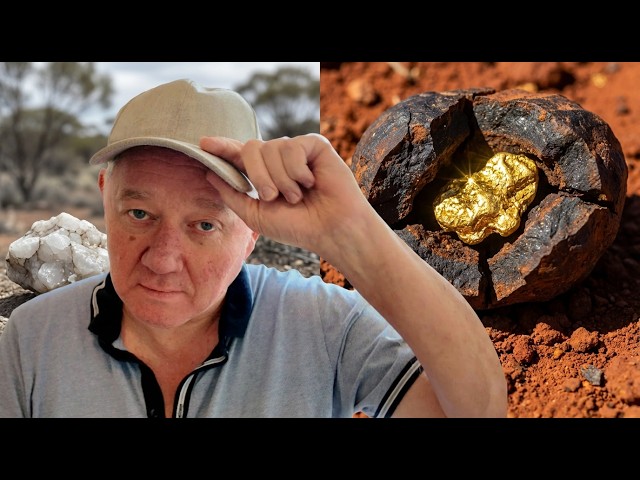
Don't just look for quartz. These Black Rocks Hide The Gold Nuggets!
Part Time Prospector
0:01 Hey guys, so glad we can catch up again.
0:04 It's been quite a long time.
0:06 I'm really keen to show you a technique to really turbocharge your
0:12 gold prospecting location, research workflow sounds all complicated and
0:19 corporate-y, but it's a couple of steps to go through, with every step
0:23 that you go through you are increasing your probability of finding more gold.
0:29 Gold has to form in the right environments.
0:32 here I'm talking about a different type of environment.
0:35 Historically, I personally is a content creator here on YouTube, have created
0:43 methodologies and techniques for you guys to follow, to look for gold
0:47 that occurs in quartz veins or in basically solid
0:51 rock, for one of a better word, primary gold deposits.
0:55 What I'm showing you today is gold that forms in secondary deposits.
1:01 This is Remobilize Gold.
1:04 And in some cases, be can become very rich, What I'm talking
1:10 about here is finding gold in.
1:15 The well-known regolithic soil type labeled as CZL.
1:20 this is Cenozoic Lateri tic soils.
1:24 These are pisolitic rich laterite soils, pisolites basically are
1:30 little round nodules of iron.
1:33 I've got a couple here.
1:34 This is one about this big.
1:36 They're only about the size of a pea, sometimes smaller, many times
1:39 smaller, sometimes quite round.
1:42 Very hard, dark brown to almost black, sometimes very black.
1:47 Sometimes with manganese stain.
1:49 If you break them open, you can see circular type structures inside
1:53 them as they've grown over time as.
1:55 More and more iron joins the outside of the, pisolite Sometimes they're
2:00 magnetic, sometimes they're not.
2:02 It depends on the iron concentration, and so they're labeled on maps as CZL.
2:09 Now, a way to find them, I call this up on Trilobyte.
2:14 And here's the well known mapping of trial of art.
2:18 I've put on the simple geology and you can see the different types of rocks.
2:26 And here is CZL.
2:28 But if you zoom out a bit, It is actually quite hard to find the
2:33 locations and so you have to zoom in a long way to find the CZL, and then
2:39 you have to pan about and try and remember where all the locations are.
2:44 Now, sure, you can drop a pin at each of the CZL locations, but the
2:49 technique, what I'm showing you here.
2:52 Trilobyte was never really designed to handle this work flow.
2:55 It's designed for a different type of process altogether.
2:59 I haven't seen many types of applications that can handle this
3:02 workflow, but I'm gonna present a tool at the end of this that can
3:09 potentially make it a lot easier for.
3:12 So ideally what you wanna do is you wanna find these cz ls.
3:16 And here's a good example.
3:17 One just here with the hopefully you can see the mouse.
3:20 So this is one right in the middle, Not all CZL carry gold.
3:25 So why would one CZL carry gold and not another?
3:30 If you've watched a couple of my videos, you will know that I love to
3:34 draw pictures to explain concepts.
3:36 What we wanna do is a picture of a highly stylized cross section through the ground.
3:43 we're gonna have a surface of the ground.
3:47 Okay, I'm along and let's pretend there's a bit of a hill here and we've got some
3:51 trees growing on top of the surface.
3:54 Now what we've also got here, and I'll use some blue in this one, is
3:58 we've got a fault zone, shear zone.
4:02 What do you like to call them?
4:04 Let's call it a, just call it a structure for this moment that let's
4:08 sit sits down here and it is going off towards the center of the earth.
4:15 It's got foliation and breaks in it, and inside this structure, we've
4:20 got a gold bearing lode coming up through there and maybe more than one.
4:27 Okay.
4:28 Going back to the black.
4:30 So over time, as you must probably see it in previous videos, what
4:34 happens here is, and I'm just gonna change the color to say a light blue.
4:38 In this case, what happens is the rain comes down, okay?
4:43 And it soaks into the rock and starts to weather the rock
4:48 down to a particular point.
4:50 And this point can be somewhere down about here.
4:54 Yeah, and obviously deeper in the flat country and shallowing up
4:59 considerably as we go in the hills.
5:02 So because this is a structure, this blue bit here is a quartz bearing structure
5:09 that is highly foliated, potentially with altered mineralization inside them.
5:15 The structure around the outside will actually dip down like this.
5:19 And so you'll end up with a trough or what appears to be like a trough
5:23 or a extended bit of the overburden going down inside here that allows
5:28 the water to pool inside here.
5:31 down here, this is the solid rock.
5:34 Okay?
5:35 Solid rock in here.
5:37 And this is this area out here is the basically non-solid rock.
5:43 And so as the winter which is our rainy season, the water table moves up.
5:48 It goes up and, drops in summer, obviously, as it d dries out.
5:53 So you've got this pumping process taking place, going up, down, up, down, up, down.
6:00 Now, as this is a regolithic profile, we are gonna have iron-rich
6:05 zones that are trapped inside you from alternating periods of.
6:12 Regular generation.
6:14 So in this case here, we could have had some CZL down here.
6:18 It might have been covered by some dirt coming down the hill.
6:22 We potentially got some more formed at the top again, and this is the
6:25 stuff that's showing up on the map.
6:28 What is happening underneath here is that the, groundwater
6:32 starts to circulate, okay?
6:36 As it gets pumped up and down, pumped up and down, pumped down.
6:39 As it rises up and down, and the quartz bearing gold starts to break
6:47 apart because it'll have iron.
6:49 Minerals in it.
6:50 The iron minerals start to corrode and rust basically, and chunks
6:54 of quarts start breaking apart.
6:55 Releasing the gold.
6:57 The gold can go into solution in the correct chemical environment.
7:02 So, we've got some water coming down the hill.
7:05 Flowing down, and that's adding to the flow cycle as it's happening inside this.
7:10 Now, if there is another structure up here, for example, and it could
7:14 just be a, like a leader vein,
7:16 Thin fault, maybe multiples of them, and one or two of them may
7:22 have a. Auriferous Reef in there.
7:24 Basically gold bearing could only be a few millimeters
7:27 thick, maybe a millimeter thick.
7:30 And again, it's starting to break away.
7:33 Some of it's turning into solution itself is moving down and this gold
7:38 in the solution suddenly finds these pisolitic rich layers and starts to
7:45 precipitate out Okay, so attaches to them around them, or between them.
7:52 Now some of these things are gonna have a combination of both mechanical gold,
7:58 that's run down the slope and broken free, just like you find in rivers
8:04 and in more wetter parts of the world.
8:09 And chemically precipitated gold taking place.
8:12 So it could be a combination of both.
8:14 So if you only grabbed one sample from a CZL layer and took it for a sample, it
8:20 could come back potentially as either.
8:23 now we know why gold is forming in the CZL, how do we find these
8:29 CZL layers that are the most prospective to search for this time
8:34 we are talking in plan view year.
8:37 So what we've got here is we've got a CZL in a plan, and we
8:44 might have another one out here.
8:46 And we've got some fault veins running through.
8:50 So we've got a fault vein that comes, a fault vein, a fault zone, let's
8:55 say a one that comes through here.
8:56 This is the highly stylized example.
9:00 It is don't look for an exact copy of this because you have to use
9:05 some artistic license, but I'm trying to keep it as simple as
9:09 possible so everyone can understand.
9:11 So straight away we've got CZL.
9:15 Okay, and let's, so let's CZL.
9:22 Okay.
9:24 Fault vein fault, zone.
9:26 Running through there and no fault zone out here.
9:29 what we'd like to see is a couple of locations on this fault zone of.
9:36 Old workings.
9:38 that shows us that this structure has carried gold in the past.
9:44 And there may be more locations that are gold bearing, but may not
9:50 be economic in the primary or, but could be economic in the secondary.
9:56 we now know we have a CZL, an Iron H zone.
10:00 We actually have a fault zone.
10:04 So looking promising at this front.
10:06 But over here we have CZL, but no fault zone.
10:10 And then to really add some fun to things.
10:15 Wouldn't it be cool if we actually had some, somebody
10:19 had taken some soil samples.
10:22 And these were, let's say, let's see if we can make some nice purple ones
10:27 anomalous in gold across the zone.
10:32 Now anomalous means basically means better than background,
10:38 so you have to look around.
10:39 So if these values are out here, or like 1, 5, 1.
10:46 Maybe six, and these are 20, 30, 15, 7.
10:54 You would have to say that this zone is anomalous.
10:58 Okay?
10:58 It's better than the background, which is these values out here.
11:03 So this is the key points to look for.
11:07 You wanna seize that L You wanna fault?
11:10 You wanna fault that, preferably.
11:12 Has a known goal producing zones on it.
11:15 And if, you can get some cell samples on top of it, happy days.
11:21 Now this fault zone doesn't have to run smack bank through the middle of it.
11:25 So workflow find CZL on map.
11:31 Sorry for the terrible handwriting.
11:34 I probably should have been a doctor in real life.
11:37 Okay.
11:38 Find the CZL, not on LIVE leases.
11:45 In other words, we want to find places where we can actually go to.
11:48 There's no point in identifying the perfect prime location, and then when you
11:52 get this right in the middle of a active mining list, there's no point in doing
11:56 that you can, so that's eliminate all the places we can't go, and it's this's also
12:03 references things like aboriginal land.
12:05 You're not allowed on national parks, et cetera, et cetera, et cetera.
12:08 Okay, three.
12:11 Where does CZL and faults occur?
12:16 Okay.
12:17 Key one form CCZL plus faults, plus gold deposits that are nearby.
12:30 Five, and this is the sort of cream on the cake if you can
12:34 get it, is all of the above
12:38 plus soil samples that are anomalous.
12:44 I hope I spelled that right.
12:46 And cam.
12:47 Doesn't look right, but I think there's an A in there somewhere.
12:50 I think that's supposed to be an A. So that's what we are looking for.
12:54 We wanna fund caid on the map that's not covered by live leases.
12:59 It has false in or near.
13:00 It has gold deposits around it and preferably has anomalous soil samples.
13:07 So if we go back to our example with the Trilobyte.
13:11 here we can see there is CZL.
13:14 There's a fault coming through here.
13:16 Now, unfortunately, I've had to reformat foot my phone and
13:19 I've lost some of my data.
13:20 But you can turn on the gold locations and you can try and find the those, zones and.
13:27 So let's see if I can turn some of these on.
13:30 Oops, now I have got them.
13:32 So there's the gold locations no overlays, gold deposits.
13:38 So there's some of the gold deposits and we are looking
13:42 now we've got a scroll around.
13:45 And look for CZL to see where they all line up.
13:50 Okay, so we're saying on, this structure down here, there's, and you could
13:56 say maybe the structure runs more like through here than across here.
14:00 There is gold over here.
14:02 There may be some gold, there's a structure, but doesn't
14:05 seem to be gold bearing.
14:07 But this could take a lot of time.
14:09 This can take a lot of time.
14:11 This is where I wanna show you the tool that is available.
14:15 I'll talk about it first and then I'll show you how you can get access to it.
14:20 this, is a tool that I've put together to aid this whole process and many, other
14:26 processes of finding gold and can, so we can go into the, geology, for example.
14:33 And we can turn on the mapping and we can zoom all the way in and you can
14:38 see we've got some CZL, some granites, blah, blah, blah, floating around.
14:44 Okay.
14:45 All very nice.
14:46 That if you drag across and drop on you, this shows the location of all the CZL.
14:55 Okay?
14:57 That does not occur on LA of Leases.
15:00 Okay?
15:01 That's why some of these things have got funny.
15:03 Sharp ves.
15:04 So that's a example that we can show you something here.
15:07 Let's go and turn on live releases.
15:10 And you can see how this has been truncated against the live leases.
15:14 So as I change the opacity of the live of leases, you can see that
15:20 none of these purple outlined polygons fall on live leases.
15:26 So these are all polygons that are potentially targets, goal targets.
15:33 Now, if we go into the, back, into the section, here we go on.
15:37 And under geology structures, faults and shears, we could turn
15:41 on the one at 500,000 K mapping.
15:45 And they have some nice faults in there.
15:48 And so you can see the faults that come in.
15:51 Now these are the major structures, so these are looking quite promising.
15:56 And then if we go back to gold and we turn on gold locations,
16:00 we can start to see those zones.
16:04 So there's some structures coming through here.
16:06 Nothing here looks super exciting to tell you the truth.
16:10 So let's zoom out a bit and there's a couple of interesting spots
16:15 now if I can try and find it.
16:16 Remember, look at this mess of intersections, of faults and CZL.
16:22 Now we can see these faults are coming up through here.
16:26 They splitting and weaving and changing direction.
16:30 But if you look underneath here, there's obviously some live
16:34 leases out here and some active leases, but these look not bad.
16:41 Okay.
16:42 What I've got here is also the, absolute latest soil sampling data
16:46 from the old Mers or now Department of Mines, petroleum and Exploration.
16:53 And we can put on the soil samples.
16:55 So if you zoom into the soil samples, you can actually see there's actually
17:00 a bit of an anomalous zone here.
17:02 And on this one here, you can actually see there's a CZL not covered by any loud
17:09 leases that may be covered by pending.
17:11 Let's have a look.
17:12 It's covered by pending, but that's all right.
17:14 Allow down there.
17:15 And there's some higher grades inside here.
17:17 So if we click on it, so first we have to choose the layer.
17:20 That you want to query and choose this, it'll say that there's a sample of 72 ppb.
17:26 Okay?
17:28 Pierre is another, what is that one?
17:31 68. And so there's definitely some sort of structure coming through here
17:38 running sub parallel to the structure.
17:41 Does that mean that's, that fault is definitely there?
17:45 No.
17:46 Could easily be running right through here.
17:48 It's their best interpretation from.
17:51 Coarse grain and mapping.
17:52 So there's a potential gold site to go and visit another one up here.
17:58 This area has been heavily sampled, but I doubt this has been sampled at all.
18:03 Could be worth a visit.
18:04 And there is some anomalous zones inside there.
18:07 This is looking, I thought it was interesting, but no it's not.
18:11 Okay.
18:12 So I'm not gonna go too much more on this, but it does show
18:16 you how you can actually sample.
18:20 So what you can do is with let's zoom in.
18:25 And I'm just gonna use this as an area, for example, of
18:27 some of the tools inside you.
18:29 So what you can do is you can actually change the opacity so
18:33 you can see what's underneath.
18:35 You can change the order of things.
18:38 So for example, at the moment, the CZL later I put in is at the
18:45 bottom of all the things I can grab this little hamburger type icon.
18:50 And drag it to the top.
18:51 Now you can see how that suddenly, that appeared on top here,
18:54 making it much easier to, see.
18:57 I can turn off layers at any particular time, and also got
19:02 access to things like geophysics.
19:05 So let's turn on the RTP geophysics But this is covering up my, the information.
19:11 So again, I can drag this thing to the top and I can drag, my CZL to the top.
19:20 Now I can see where does these things sit on top of each other,
19:23 and I can actually change.
19:25 And it's interesting how this anomalous zone through here okay, is actually quite
19:34 correlated with the geophysics underneath.
19:38 Okay.
19:39 So why doesn't this bit show up?
19:43 Change of direction, change of sampling.
19:46 Procedures, change a whole bunch of things.
19:49 And so it allows you to query into the data.
19:53 I'm gonna turn this geophysics off, turn source samples off that.
19:59 So if we go back and look at some of the data sets, I have to zoom out a bit.
20:04 Obviously we've got.
20:06 These are all the live leases.
20:07 If you zoom in, you get some information.
20:10 If I select the live lease, click anywhere in it.
20:13 I will get some information about the lease and who holds
20:17 it and et cetera, et cetera.
20:19 Okay.
20:20 One thing that you can do inside here is actually if you go to the the,
20:25 your account, you type in search.
20:29 And actually choose lease id, you can actually search for release.
20:33 So let's say we go M 63 13.
20:37 Okay, press enter, boom, there's the lease, and I've got whatever
20:43 information I had turned on about it.
20:46 So I can actually, it's put it as a separate layer, which means that
20:51 for any time I can choose one of the, little more buttons, click
20:56 that and I can actually download.
20:58 It has a Geo JCSV and then can take that Geo J and load it into trial
21:04 art or something else that takes geo Jason files, which is quite handy.
21:08 so let's turn off that one and let's turn off that one.
21:12 So we've got the live, we've got the pending same thing.
21:17 Soil samples across the place.
21:19 It shows black when zoomed out.
21:21 As you get in the data gets more and warm.
21:24 Okay.
21:24 We've got the D drill holes that are across the state.
21:27 And there's awful lot of them turning them off because we're starting
21:31 to become very noisy, well known gold locations across the state.
21:37 Mines and deposits.
21:40 And this is also, we've got, which there's some duplicates
21:44 with the abandoned mine project.
21:47 We've covered geophysics.
21:50 With this data set, there is the one to a million, one to a hundred
21:54 thousand scaled mosaic of all one to hundred thousand geological
22:00 mapping across the entire state.
22:03 Now, as you can see for GSWA geological survey, WA are also called.
22:09 And Joel Survey wa it's actually a, work in progress.
22:14 They haven't done the whole state, MS probably never will get to it,
22:18 Unfortunately, this is not a queryable data set, so you have to
22:22 understand what the symbols were.
22:24 It was never going to be a critical data set because it's only a Rasta image.
22:28 You have to find out the information around it.
22:32 There's the one to million, which is a much coser data set, but this
22:36 one is actually is queryable and you can actually query this one
22:40 and get some information out of it.
22:42 Then you go into the faults, which are really handy and they both want to, to.
22:48 500,000 scale mapping and the one to a hundred thousand scale
22:51 mapping, which can be considerably more depending on where you are.
22:55 So if I turn off, you can see the mass of faults, but this is pre predominantly
23:00 routed from the the 100,000 scale mapping.
23:05 There is towns sites that you can pop on to see for basically locations and
23:12 for getting permission to go to areas.
23:15 Now, member, you don't technically have to get permission to enter a pastoral
23:20 property, but it's always advisable to tell the pastoralist that you're gonna
23:27 be on black flag station, for example.
23:31 And where you're going to be.
23:34 And they can tell you if they're doing any sort of mustering in
23:37 the area or shooting, or stock control or whatever else like that.
23:41 And also, if anything happens, like there's a bushfire coming, they
23:44 know who's on their property and who they have to actually contact.
23:47 So that information there, unfortunately this data set is not queryable
23:53 as much as I would like it to be.
23:56 It is contains rudimentary information that's available from demur and
24:01 de herd as an ag department.
24:05 And so they don't give away the contact details.
24:07 If you want the contact details, you actually have to contact Demers
24:12 by phone and they will then you say, I want to contact Black Flag
24:16 Station to go on their property.
24:17 They will then give you the telephone number and contact person and then
24:22 use up to you to contact them.
24:23 So that's the best I can do on this front.
24:27 So if you want to use this website, go and visit gold prospecting wa.com.
24:36 Okay.
24:37 This will allow you in.
24:39 It is a Pay site.
24:40 It currently costs $10 a month.
24:42 Or $90 a year, you get a lot of information, all the information, and
24:47 I'm throwing even more information at as well as I find additional
24:51 information that's helpful.
24:53 what I have got on this thing is something that will, for the first.
24:57 15 or so people that sign up here, it is like she's 11 now.
25:02 I'll give you free access to this website for life as long as
25:07 you promise to give me a review.
25:08 But remember, it's limited to the first 11 people, and by the time you've seen this
25:13 probably is down to about one person left.
25:15 So pull out your name details and I'll get back to you with the details after that.
25:20 It's a paper.
25:21 I hope you guys enjoyed it.
25:23 If you do enjoy this video, we'd like to see you more like this.
25:26 Please give me a thumbs up and I'd love it if you could subscribe.
25:30 Thanks guys.
25:32 See you in the next video.