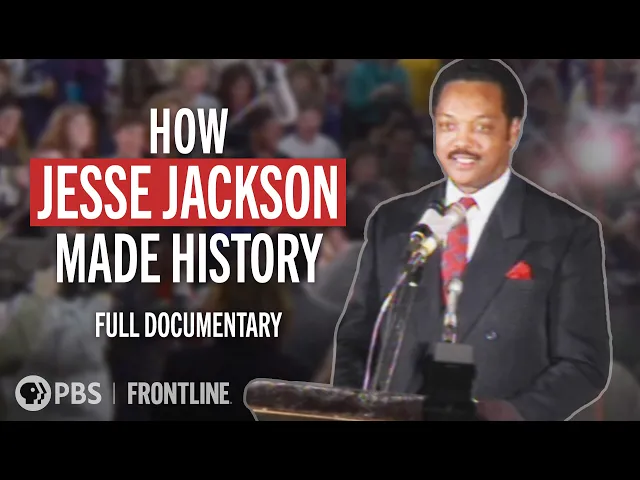
Inside Jesse Jackson’s 1988 Presidential Campaign| Running with Jesse (full documentary) | FRONTLINE
FRONTLINE PBS | Official
0:05 The big surprise of the 1988 presidential
0:07 race was the phenomenal campaign of Jesse Jackson.
0:10 WE THE PEOPLE CAN WIN.
0:12 Inside the campaign, it was hope and hype driving the Jackson caravan.
0:17 But in the end, Jesse lost.
0:19 Or did he?
0:20 I was amazed that America did as well to understand Jesse as they did.
0:25 But it never approached electability.
0:28 Somebody has to start it.
0:30 I don't think things this big and this important get lost.
0:34 Tonight on Frontline, Running With Jesse.
0:43 My name.
0:46 NOT ONE BORN WITH A SILVER SPOON IN HIS MOUTH.
0:50 WHO HAS HAD SHOVELS IN HIS HANDS.
0:54 My name.
0:57 BORN OF A TEENAGE MOTHER.
1:00 FATHERLESS CHILD.
1:03 MY NAME.
1:06 ONE OF THE FORGOTTEN CHILDREN, NOT ONE OF THE BEGOTTEN ONES.
1:12 MY NAME.
1:14 YARDS WITHOUT GRASS.
1:17 HOUSES WITHOUT INDOOR BATHROOMS.
1:19 MY NAME.
1:24 [applause] TIN TOP ROOF.
1:25 [cheering] MY NAME.
1:31 [cheering] MY NAME GOES IN NOMINATION.
1:33 EVERY FATHERLESS CHILD.
1:38 EVERY POOR PERSON.
1:41 [applause]
1:42 WHO HOLD THEIR HEADS HIGH.
1:47 [applause] SAY MY NAME IS HIS NAME.
1:50 THE MORNING AFTER THAT SPEECH,
1:52 our team from Frontline was in the crowd waiting for Jesse
1:55 Jackson to begin the final trip of his 1988 campaign.
2:01 There was an air of expectation,
2:03 even though technically it was too late for surprises.
2:12 It was now the week before the Democratic Convention.
2:16 Jackson did not have enough delegates
2:18 to become the Democratic candidate for president,
2:20 and he had pointedly not been chosen by Michael Dukakis as his running mate.
2:25 Yet he was still on center stage, and he was doing nothing to discourage rumors
2:31 that something dramatic would happen on this bus trip.
2:35 Others were taking a plane to the convention in Atlanta,
2:38 but in a conscious echo of the civil rights days,
2:41 Jackson was taking a bus all the way from Chicago.
2:48 Our team was in the caravan,
2:49 watching both the candidate and the people who covered it.
2:54 It was old-fashioned travel with newfangled technology.
2:59 We had now been covering Jackson's run
3:02 for the Democratic nomination for 6 months.
3:05 This last campaign trip became for us an emblem of the whole Jackson campaign,
3:10 a combination of hype and hope.
3:13 I think, quite frankly, it was a media coup for Reverend Jackson.
3:17 As far as I'm concerned,
3:18 it was Reverend Jackson at his best in terms of manipulating the media.
3:24 Uh here were most of us thinking that um
3:27 this was going to be a caravan of supporters,
3:30 that they were going to pick up buses along the way,
3:32 and there would be thousands and thousands
3:34 and thousands of Jackson people marching into Atlanta.
3:38 Well, it turned out it was Reverend
3:40 Jackson and four busloads of the national press.
3:45 By now, reporters Mike Frisby and Doreen
3:48 Carvajal were well aware of Jackson's media savvy.
3:52 It was all prop.
3:53 It was all staging and it was it was very very shrewd.
3:58 Um it helped him steal the thunder going into uh the convention.
4:05 The focus was on him, not on the the top candidate.
4:09 He had all these um reporters with nothing else to write about except him.
4:15 I mean we were it was like being a hostage on the bus.
4:20 Only a few members of the press could fit on Jackson's bus at a time.
4:24 The caravan stopped by the side of the interstate
4:27 to let reporters on and off the front bus.
4:32 Jackson's press secretary, Delmarie Caugh, tried to keep order.
4:35 I was told it was a bigger bus than this and that we
4:38 were going to have at least 10 people on it.
4:40 There's no room to even turn around on the bus.
4:42 Is there room for more people to stand here and not block the aisle?
4:44 We can still have a fire at least.
4:45 We're not even supposed to be standing stopping
4:47 here except that you all got off the buses.
4:50 We stopped.
4:51 This was vintage Jackson campaigning.
4:54 A kind of structured free form.
4:56 There was a schedule, a map, and a plan, but getting the schedule,
5:00 seeing the map, or learning the plan was the challenge.
5:06 Our turn on the front bus came when we
5:08 stopped 20 miles outside Atlanta to pick up extra passengers.
5:14 Waiting by the side of the road was CBS News
5:16 anchor Dan Rather escorted by Jackson's political adviser, Bert Lance.
5:29 New cops came in on a number one ship.
5:31 My folks came on a slave ship.
5:32 But same boat now and our destinies are bound.
5:38 If we were living in a royal blood arrangement maybe our ships would never meet.
5:43 In a democracy, our ships are not passing in the night.
5:46 Our ships are in the same dump.
5:49 That's the gentlest of all this democracy that you said that you said it.
5:53 And what's happening At the beginning of this campaign,
5:55 political analysts often dismissed Jackson as a protest
5:59 candidate who would appeal only to blacks.
6:02 But 7 million people, not just blacks, voted for him.
6:07 Jackson had never once been elected to political office.
6:10 Yet here he was entering Atlanta, the runner-up for the Democratic nomination.
6:18 The official nominating process had begun here in February at the Iowa caucuses.
6:29 In Iowa, politics is personal.
6:33 They say if a candidate doesn't come shake your hand,
6:36 then you don't vote for him.
6:44 Jesse Jackson, determined to run in all 50 states,
6:47 brought his small campaign to Iowa early.
6:51 He was not expected to do well.
6:53 He did not attract much national press.
6:56 We were just traveling around in a couple of vans.
6:59 One van was for the reporters.
7:03 Uh we were just this little band of survivors.
7:06 Uh Uh there were maybe four or five of us.
7:10 And um it was extremely cold then.
7:14 We were all bundled up in our, you know, thermals and things like that.
7:18 And we would uh chase him through the snow.
7:24 The population of Iowa is mostly rural, 97% white.
7:34 [applause] So the black preacher from Chicago was an event.
7:38 Some of them were there out of curiosity and they're of dazzled
7:42 by him and would go up to him and ask for autographs,
7:45 and you know, would try to hug him or hold him or touch him,
7:50 and uh um it was just a very innocent time.
7:54 Um people weren't paying as much attention to him.
7:57 The focus was almost the other candidates.
8:00 I was facing foreclosure, had gotten THE FORECLOSURE NOTICE,
8:05 AND in the spring of '85,
8:08 and got a hold of Jesse, and we got a telegram to our local banker.
8:14 He offered to come, sit down at A MEDIATION TABLE,
8:17 AND TRY to work this thing out between myself and my bankers.
8:21 And we wound up going through some reorganization, giving some things back,
8:25 but we still got every acre, and we're going to farm,
8:28 and we're going TO CONTINUE TO FARM.
8:32 [cheering] BUT WE COULDN'T HAVE DONE IT WITHOUT JESSE, AND WE NEEDED HIM.
8:38 JACKSON brought that farmer from nearby Missouri to speak
8:41 at a rally in the tiny town of Greenfield.
8:46 Most of the candidates had their Iowa
8:47 headquarters in Des Moines, the state capital.
8:50 Jackson put his in Greenfield to make
8:52 the point that this was a populist campaign, a campaign for ordinary people.
8:58 Jesse Jackson came to the church I attend in Greenfield,
9:02 and we thought maybe we'd have 50 people there.
9:05 So, we had a potluck and lemonade.
9:07 We got lemonade for 50 people, and hoped we wouldn't be embarrassed.
9:11 And the church was filled to overflowing.
9:13 There were almost a thousand people there.
9:15 And uh he spoke to us that night,
9:17 and talked about rural people joining forces with urban people,
9:22 and he said uh rural feeders and urban eaters.
9:27 [laughter] And that sort of caught everyone's attention.
9:31 Some presidents hang pictures on the wall of the White House.
9:34 I'm going to hang a map of Greenfield on the wall of THE WILD CARD.
9:38 [cheering] [applause]
9:40 MONTHS LATER, AFTER THE CONVENTION, Jackson still spoke fondly of Greenfield.
9:46 How can I ever forget the love in Greenfield, Iowa.
9:50 These people reached out and grew and got and got bigger than themselves.
9:55 Uh it was this whole trauma where people wrestled
9:57 with with race earnestly
10:01 but in a rather non-threatening non-confrontational way.
10:07 Where people would say, "Well, we like the Jesse Jackson message.
10:10 We like his courage.
10:12 We like the way he presents his argument.
10:15 We like his positions.
10:17 We like he's standing with us at the plant gate, the farm gate.
10:21 But they could not get across the butt to the therefore we will support him.
10:28 Jesse Jackson is our name.
10:30 You take a stool and he's going to be our next president.
10:35 In Iowa, Jackson won 10% of the delegates, finishing fourth in a field of eight.
10:42 I remember the stink that coming out of Iowa, moving toward New Hampshire.
10:46 Although we had run into double digits,
10:49 which was beyond what the projected expectation was.
10:53 Um we won network TV that week for 15 seconds.
10:59 Uh Dukakis, Simon, Gephardt between 22 and 24 minutes of network time.
11:04 So, we were dismissed.
11:08 A week later, in the New Hampshire primary,
11:11 Jackson did no better than he did in Iowa.
11:15 A distant fourth.
11:17 Once the campaign began, I was determined to see it to the end.
11:22 I knew if we survived Iowa, survived New Hampshire and got south,
11:28 we were going to change the the equation
11:30 because we would have uh a running chance
11:33 of people who would put their hopes
11:35 and their beliefs and their votes in the same direction.
11:39 Jackson was counting on the South.
11:43 For the first time, almost all the Southern
11:45 states were holding primaries on the same day.
11:48 Super Tuesday was devised by Southern Democrats to give
11:51 the South more clout in nominating a conservative Democrat for president.
11:56 Yet Jackson strategists saw Super Tuesday
11:59 as a golden opportunity for their candidate.
12:02 Yes, see mom, please.
12:05 Our joke was, let's not tell them what that really means for us.
12:11 Um we like the idea that they are organizing a Super Tuesday.
12:18 And you know, to the degree that they
12:20 think that it will make them more powerful,
12:22 it's all right because we really know what that means.
12:31 In the South, almost 20% of eligible voters are black.
12:35 Jackson's strategy depended on a large black voter turnout.
12:40 In March of 1988, at the United House of Prayer in Charlotte, North Carolina,
12:45 we saw something we had not seen a month
12:47 before in the chilly [music] towns of Iowa.
12:50 Instead of polite interest in the Jackson campaign, we saw enthusiasm.
13:03 Here, there was a feeling of homecoming
13:05 and the belief that this campaign could succeed.
13:10 [cheering] [cheering] The challenge for Jackson was to find a way
13:22 to compete in 20 states at once with no money.
13:27 By March, the campaign was already hundreds of thousands of dollars in debt.
13:32 For a strategy, Jackson turned to his campaign manager, Gerald Austin.
13:38 We decided that the best way to deal with Super
13:41 Tuesday is we never would have a million dollars for media.
13:47 But if we were able to get a large enough plane to take the media with us and go
13:52 to four or five or sometimes even six different
13:55 media markets in a day, that was our media.
13:58 The campaign picked 82 congressional districts
14:01 where they thought Jackson could win delegates,
14:03 and the candidate started running with the press
14:06 chasing behind to the beat of a campaign song.
14:09 Ready for another one?
14:10 I'm ready.
14:10 Let's go.
14:18 [music]
14:26 We would start [music] in Georgia, fly to Texas,
14:28 fly to Maryland, back to North Carolina, overnight in Alabama.
14:32 People would say, "Oh, where'd you just come from?" And I I would feel like
14:36 an idiot cuz I'd have to pause and think, "I can't remember." [music]
14:52 He'd get out there and he'd give that speech,
14:54 he'd [music] see the crowd, that was the elixir.
14:56 Boom.
14:57 You know, all of a sudden he turned on, he was magic.
15:01 And he'd get back on the bus and he'd look like the rest of us.
15:20 Yeah, the guy, the kids will Look at this, they got a Mexican spring dance.
15:23 Let's go.
15:24 I'm looking Look at them.
15:33 Brownsville, Texas.
15:35 One of many stops on the day before Super Tuesday.
15:38 The crowds were large and enthusiastic.
15:43 When Jackson ran for president in 1984, he talked about a rainbow coalition.
15:48 But most of his support came from blacks.
15:52 In this election, he was still getting
15:53 little help from [music] the white Democratic establishment.
15:57 One of the few nationally known Democrats to endorse
16:00 him was Texas Commissioner of Agriculture Jim Hightower.
16:04 He had learned from '84.
16:06 And I'm not I'm not trying to say here he was
16:08 more strident in '84 or or more black-oriented in in '84, though I think he was.
16:16 But I think more significant is that his his message
16:21 was clearly one of populism and and he wouldn't talk
16:24 to any audience without talking about the inclusive inclusiveness that is
16:28 needed within the Democratic Party and for for the country.
16:34 [applause] And new taxes.
16:35 I WANT THE WOMEN PRE-NATAL CARE.
16:37 AND IN HEAD START.
16:39 AND DAY CARE.
16:41 ON THE FRONT SIDE OF LIFE RATHER THAN JAIL CARE AND WELFARE ON THE BACK SIDE.
16:46 LET'S EDUCATE OUR CHILDREN AND GIVE OUR CHILDREN
16:50 [applause] [cheering] [cheering]
17:05 JACKSON!
17:07 [screaming] [cheering] GIVE ME MY JESSE!
17:17 GIVE ME MY JESSE.
17:19 GIVE ME MY JESSE.
17:23 THE ENDLESS RALLIES AND plane rides and practically
17:26 no sleep seemed to be paying off.
17:29 Polls were showing a burst of support for Jackson.
17:35 But in this campaign, Jackson had not received something he wanted very badly.
17:44 Martin Luther King Jr.
17:45 had been his mentor, but when Jackson ran for president in 1984,
17:50 he did not receive the endorsement of Coretta Scott King
17:53 or Andrew Young or other veteran leaders of the civil rights movement.
17:58 Keep the dream alive.
18:00 Let the quest This time most black elected officials did endorse Jackson.
18:07 But once again, his movement colleagues kept their distance.
18:13 We the people can win.
18:15 I didn't endorse anybody.
18:17 But I tried to work with everybody.
18:20 I even tried to work with some Republicans behind the scenes because I
18:23 think it's important that the issues affecting
18:28 this country are not just partisan issues.
18:31 Issue like South Africa, issue like drugs, issue like child care.
18:35 Those are not partisan issues.
18:37 I never harbored any uh bitterness or hostility.
18:41 Even toward those toward those who did not support because
18:44 I knew it would just be a matter of time.
18:47 You weren't hurt?
18:49 Not really.
18:50 Uh I was I was prepared.
18:52 It's like if you're running a football through the line of scrimmage.
18:56 You may get real hit real hard, but you're so focused on the goal line
19:01 and you're so conditioned to expect to be hit.
19:05 You're hit, but you're not hurt.
19:07 Even without that support,
19:08 Jackson got 91% of the record black vote on Super Tuesday.
19:12 Although he received only 7% of the white vote, he won the overall popular vote.
19:17 If we can RUN IN 20 STATES IN ONE DAY WITH A $100,000 BUDGET OH,
19:26 WE CATCH THEM STATE BY STATE
19:30 [cheering] AND DAY BY DAY.
19:31 THEY GOT HIGH-TECH.
19:34 WE GOT GRASSROOTS.
19:36 THEY GOT COMMERCIALS.
19:38 WE GOT A MESSAGE.
19:42 [cheering] THEY GOT A RICH CAMPAIGN AND LOOKING FOR A LEADER.
19:46 WE GOT A LEADER.
19:49 [cheering] WE CAN MAKE IT.
19:48 WE GOT LEADERSHIP.
19:50 WE GOT COURAGE.
19:51 WE GOT DIRECTION.
19:53 WE ARE EXTRAORDINARY AT THE PULPIT.
19:55 WE THE PEOPLE CAN WIN.
19:58 WE the people can win.
20:00 We the people can win.
20:02 WE THE PEOPLE CAN WIN.
20:04 WE THE PEOPLE CAN WIN.
20:07 WE THE PEOPLE CAN WIN.
20:09 WE THE PEOPLE CAN WIN.
20:11 THE DAY AFTER Super Tuesday, we followed Jackson home to Chicago.
20:21 [music]
20:33 It was in Chicago in the 1960s [music] that Jackson
20:36 first made his mark as a civil rights activist.
20:42 [music] [music] [singing] [music] People in Chicago know Jesse Jackson well.
21:08 He is not universally admired.
21:11 But on that day at Operation PUSH headquarters, he was among friends.
21:17 I WANT TO WRITE A HEADLINE.
21:20 JACKSON FEEDS HUNGRY.
21:25 JACKSON
21:28 [applause] SETS THE CAPTIVE FREE.
21:30 [cheering]
21:32 JACKSON INSPIRES CHILDREN.
21:33 JACKSON [screaming] BRINGS PEOPLE TOGETHER.
21:37 JACKSON [cheering] BUILDS.
21:39 JACKSON BRINGS PEACE.
21:42 I WANT TO MAKE A HEADLINE.
21:43 I WANT TO MAKE A HEADLINE.
21:45 THE one reason why Jesse is not as popular in Chicago as he is in the rest
21:49 of the country is that people here have known him too well for too long.
21:52 They remember the early, more brash, more arrogant Jesse Jackson,
21:56 and they look with a much more jaundiced eye when you start saying,
21:59 "Well, Jesse has changed.
22:01 He's He's He's He's He's more humble now."
22:04 Uh Chicagoans just have a hard time believing that.
22:07 Even though Jackson won the Super Tuesday popular vote,
22:11 Michael Dukakis was still ahead in the race for delegates.
22:16 Both Dukakis and Jackson saw the coming Illinois primary as crucial.
22:25 [music] Complicating the situation was the United
22:33 States Senator from Illinois, Paul Simon.
22:41 Simon did poorly in the early primaries.
22:44 He did not run on Super Tuesday, but resurrected his campaign in Illinois.
22:50 Jackson saw Simon as a spoiler.
22:56 He held on to run a a one-state
22:58 campaign propped up by the Democratic state party machinery.
23:04 As a in fact favorite son for the state.
23:09 And then he loved Illinois and with a fine effort lost again.
23:16 And rather than withdraw in an honorable way from the campaign
23:21 process which time since I came in number two,
23:24 I would have gotten 47 delegates he did
23:28 not quit the campaign and he suspended the campaign.
23:33 Uh I thought that that maneuvering was beneath the dignity
23:39 that Senator Simon and the fairness that he'd always projected.
23:45 I'm sure he feels that way, but Simon was playing practical politics and Jackson
23:51 is also now a very practical politician.
23:54 And the fact of the matter is is that the entrenched
23:58 political structure here is still mainly a white-dominated structure.
24:03 Those people on the Democratic Central Committee did not want Jesse Jackson.
24:07 They wanted to go as Paul Simon delegates
24:10 to the national convention and they weren't going to switch.
24:15 [cheering] [applause] Five days before the primary,
24:22 Simon and Jackson appeared together at a Democratic Unity Dinner.
24:26 There simply is is no better and more aggressive
24:30 and more sensitive senator in in Washington today than Paul Simon.
24:35 And [cheering]
24:38 [applause] And I intend to keep him there.
24:44 That's my real point.
24:47 [laughter] That's my real point.
24:51 He's so great, we need to keep him right there in that Senate.
24:54 When Jackson was not playing hardball politics,
24:57 he was often in a high school gym.
25:00 [cheering] He made a point of going to two or three high schools a week,
25:04 even though the students could not vote.
25:08 [cheering] At Naperville North High School near Chicago,
25:12 Jackson's presence electrified the students.
25:17 [cheering] These events seem to rejuvenate Jackson as well.
25:22 [cheering] [applause] On the day of the Illinois primary, though,
25:25 future voters were of no use to Jackson.
25:29 He needed people who could vote for him now.
25:33 He went to the Robert Taylor Homes,
25:35 a high-rise housing project, to get out the vote.
25:51 These were people he knew.
25:53 He hoped he could count on.
25:57 I'd I'd walk through that area many times before.
26:01 That was Harold Washington's ward, and he wasn't old enough, for example.
26:05 And when he ran for mayor, we campaigned together in that same area.
26:14 [cheering] Just as on Super Tuesday,
26:16 Jackson needed a record black turnout to put him over the top.
26:20 But the Jackson campaign worried that blacks here were not well organized,
26:24 and that voter registration rules might keep many away from the polls.
26:35 CALIFORNIA SHOWS THAT IF THE election were held today,
26:38 not one of the Democratic candidates could beat George Bush or Bob Dole.
26:43 Pat Island, Channel 5 Eyewitness News, Chicago.
26:47 Our campaign in Illinois is winning.
26:48 I feel very good about it.
26:50 Senator Simon won the Democratic primary in Illinois.
26:53 Jesse Jackson was a distant second.
26:55 Blacks did not vote in record numbers, and once again,
26:58 Jackson received just 7% of the white vote.
27:02 There was much to celebrate.
27:06 It seems that the people of this great
27:08 state has done well by its two favorite sons.
27:14 Tonight, they paid their respects to a sitting
27:19 senator who focused on on one state.
27:24 And they've done well by campaign as we focused on in every state,
27:31 every race, against all odds across this country.
27:37 [applause and cheering]
27:42 The next big hurdle was Michigan, another large industrial state.
27:47 Despite the Illinois loss, Jackson still led the Democrats in popular votes.
27:54 But many analysts felt he had reached his peak.
27:58 Key local and national Democrats began to endorse Dukakis.
28:03 Early statewide polls in Michigan predicted a sure Jackson defeat.
28:08 No one was caught more off guard by what
28:11 happened next than those of us who were covering Jackson.
28:15 Good evening.
28:16 Jesse Jackson's shocker landslide in yesterday's Michigan caucuses has
28:20 put the Democratic presidential fight in chaos again tonight.
28:24 The numbers tell the story with Jackson beating
28:26 Governor Michael Dukakis by roughly a two-to-one margin.
28:29 Jesse Jackson, the Democratic front-runner, today, that's the way it looks.
28:38 [music] NBC Nightly News.
28:40 The same media that's that said uh he shouldn't run.
28:45 Uh he never should have run.
28:48 Um, he can't do as well in '88 as he did in '84.
28:53 Uh, can a black run?
28:54 I mean, can a black win?
28:56 Is he electable?
28:58 That same meter came out of uh, out of Michigan in trauma.
29:03 For many in the party hierarchy, Jackson's surge is a mind-blower.
29:07 They dreaded that it would happen in Michigan, but it did happen.
29:11 I cannot wait to defeat George Bush in November.
29:15 [cheering] Jesse Jackson's victory in Michigan last weekend has
29:17 drastically changed the shape of the 1988 campaign.
29:21 Stunned party professionals are saying, sometimes unhappily,
29:24 he really might be the nominee.
29:27 Somebody's either got to beat Jesse Jackson at these rules,
29:31 or they've got to change the rules and say
29:33 it's the first white guy across the line who wins,
29:36 not just the first guy across the line.
29:37 I think that everybody was shocked.
29:40 Uh, people in Washington were apoplectic.
29:43 Uh, the the mood in this town was "Oh my god,
29:46 this guy could win the nomination." And it wasn't only in this town,
29:51 it was all over the country.
29:52 All of a sudden, Jesse Jackson won a significant state,
29:56 one he was not expected to win, and now he's a serious candidate.
30:04 In one week, headlines changed from what does Jesse want to can he win?
30:17 After Michigan, Jesse Jackson was ahead of all the other
30:20 Democrats in both the popular vote and in convention delegates.
30:25 He arrived in Wisconsin with polls predicting he might win again.
30:32 [applause] Those were really magical times for that for that campaign.
30:35 Some office holders are not leaders.
30:38 And some leaders are not office holders.
30:40 I'm a leader.
30:41 My experience has brought me He went to Wisconsin to this dairy farm.
30:46 Who's uh their population that he got in Watts
30:50 in LA when he um in the middle of the day?
30:55 And uh there was just this this this tension in the air what what's happening?
31:02 What's happening?
31:04 Can he do it?
31:05 I think you saw Reverend Jackson a little bolder.
31:08 Um I think you saw his supporters a little more spirited.
31:13 Um on the downside though, when Reverend Jackson gets bold,
31:18 uh sometimes it's not the best political thing to do.
31:22 Jackson was now under intense media scrutiny
31:25 and suddenly one of his bold moves backfired.
31:28 As long as he kept moving he was fine,
31:30 but when he paused after a rally in front of a union hall to take questions,
31:34 they were nearly all about this.
31:36 Panamanian General Noriega's letter in response to Jackson's
31:39 offer of help in arranging Noriega's exit.
31:42 The General offered to meet with Jackson,
31:43 but but Jackson today seemed to be backing out of the Noriega issue
31:47 in all directions as if he decided
31:49 it wasn't a good political opportunity after all.
31:51 Would he meet with Noriega?
31:53 I would not do that now.
31:55 I simply will appeal to members of the Congress to get more information.
31:59 I didn't I didn't know about it till after it was done.
32:01 Uh I think it was a mistake, but I don't think it was the mistake.
32:05 Um I think that it wasn't helpful.
32:08 Uh people especially reporters were out there
32:11 waiting for Jesse Jackson to make a mistake.
32:13 Uh he did.
32:14 That was a mistake.
32:16 But I think that the the reason we didn't
32:18 do well in Wisconsin was a combination of things.
32:20 That's our America AND THAT'S OUR CHALLENGE.
32:26 [cheering] NUMBER ONE, because we won in Michigan,
32:27 people were saying this guy could be president.
32:30 This guy could win this nomination.
32:32 I don't know that I want to vote for him.
32:34 When I I voting for him it was sort of a protest
32:36 cuz I like what he had to say, that was one thing.
32:38 But now I got to look at it a different way.
32:40 It's a different kind of vote.
32:44 Jackson lost in Wisconsin almost two to one.
32:47 For a brief week, he had momentum.
32:50 Win, Jesse, win.
32:51 Win, Jesse, win.
32:54 Now, the analysts were saying, to keep going, he must win the next primary.
32:59 And the next primary was in New York.
33:01 He believed, and I believe that he could win in the state of New York,
33:05 and then use that to go on and maybe win at the convention as well,
33:11 because he did win in a number of states,
33:14 took a lot of southern states, and some northern states, and came in second.
33:18 So, in a large number.
33:20 So, I perceived him as a very important candidate who had to be carefully
33:25 scrutinized like you would any first-rate candidate
33:29 running for the Democratic Party's highest nomination.
33:32 South Africa?
33:33 New York City Mayor Ed Koch is seldom hesitant about expressing his opinions.
33:37 He soon let the media know his views on Jesse Jackson.
33:40 But on the other hand, he's praising Arafat,
33:43 and he thinks maybe Jews and other supporters of Israel should vote for him.
33:47 They got to be crazy.
33:48 In the same way they would be crazy if they were black and voted
33:52 for someone who was praising Botha
33:55 and the racist supporters of the South African administration.
34:00 You understand what I'm saying?
34:02 He's got two standards.
34:04 They're not my standards, and so I have said that it's
34:08 very bad to contemplate having Jackson as president.
34:14 remember arriving at uh Newark Airport and walking by a newsstand
34:19 as I usually do when I come into a town,
34:20 just looking at the headline of the paper.
34:22 And you know, there's so many papers in New York,
34:24 but I I concentrated on Newsday.
34:27 It's the Long Island paper, and the headline was Jesse Jackson and the Jews.
34:32 I thought it was a new rock group.
34:34 And I thought to myself, I'm in for it here.
34:37 In 1984, Jackson had called New York City Jaime Town.
34:41 Newspapers carried pictures of him with PLO leader
34:43 Yasser Arafat and Black Muslim leader Louis Farrakhan.
34:47 In this campaign, people were still passionate on these subjects,
34:50 even if they didn't always have their facts straight.
34:53 What do you think of Jackson?
34:54 Not very much.
34:55 Why?
34:56 What?
34:57 Because he he he stands on all the wrong things.
34:59 He I was just telling these gentlemen here the same thing happens.
35:03 He he says that he won't deal with South African governments or South South
35:07 American governments because they're terrorists.
35:09 Yet he embraces and kisses Anwar Sadat of the PLO.
35:13 He loves the PLO.
35:13 He loves the PLO.
35:14 And they're admitted Anwar Sadat admitted on television
35:17 that he's in fact a terrorist a terrorist.
35:20 So where does he stand Mr.
35:22 Mr.
35:22 Jackson?
35:23 What is going to happen, you know?
35:25 I I like Reverend Jackson.
35:27 My problem was Farrakhan.
35:31 And I have not heard him cut himself loose from him yet.
35:34 And that was my problem.
35:35 Cuz I do like the man.
35:37 I think he's fantastic.
35:39 But his connection with Farrakhan frightens me.
35:53 New York was hell.
35:55 Uh it was a situation where uh obviously there were so many
35:59 death threats on Reverend Jackson's life
36:03 that the Secret Service was very uptight.
36:06 Um by uptight, I mean that uh they were super precautious.
36:10 It was difficult for reporters to get close to Reverend Jackson at those times.
36:15 Um everything was tense.
36:17 Every single day of that campaign was filled with tension.
36:26 This week with David Brinkley.
36:28 Well, I don't want to talk about black
36:30 Jewish confrontation cuz I don't think that's the issue.
36:33 I think the issue is who's good for America and I
36:35 want to talk about Jesse Jackson's character flaws, if I may.
36:39 Why do you think that Coretta Scott King and Hosea Williams
36:43 and Andy Young as of last week have not endorsed Reverend Jackson?
36:47 It is I think because when he was under stress and and Dr.
36:52 King was assassinated, he didn't tell the truth.
36:56 He said he cradled Dr.
36:58 King's head in his arms.
37:00 The last man to speak with him.
37:02 His shirt was bloody and he wore it for two days.
37:05 It wasn't truthful.
37:06 When under stress again, when he uttered the words Hymietown and I'm not
37:11 faulting him in this election as a result of that.
37:14 I'm faulting him for lying and saying he did not.
37:17 Do you want a president who under stress is not capable of telling the truth?
37:22 I never attacked him personally.
37:24 I always said that Jesse Jackson was one of the smartest,
37:27 if not the smartest candidate running and the most charismatic.
37:31 But I didn't agree with his philosophy.
37:34 It was personal.
37:36 And it was racial.
37:38 It was mean.
37:39 It was ugly.
37:41 It was unprovoked.
37:42 It was unnecessary.
37:44 It was the worst of leadership.
37:47 Was I doing my job when others were not?
37:50 Now, maybe I didn't do it as well as I could have and I plead guilty to that.
37:55 But if you're a lonely voice, you know,
37:57 and there's no one else talking, you sound loud.
38:00 You sound strident.
38:03 Two days before the New York primary,
38:04 Mayor Koch marched in the Israeli Independence Day
38:07 parade with his preferred candidate for president, Al Gore.
38:12 Michael Dukakis was also there.
38:14 Jesse Jackson was conspicuously absent.
38:23 At that moment in another part of town,
38:25 Jackson was leading a parade of his own across the Williamsburg Bridge,
38:30 which was closed for repairs.
38:34 He said he wanted to draw attention to the city's crumbling infrastructure.
38:40 But Jackson found it hard to get away
38:42 from accusations that he was simply avoiding the Jewish community.
38:47 The constant public challenges by the uh uh council of Jewish
38:52 leaders who kept challenging us to come meet with them.
38:56 In one sense, not so much to to dialogue
39:00 in that atmosphere and get a better understanding,
39:02 but it was a big political tug of war.
39:05 Is that why you didn't meet with them?
39:08 correct.
39:08 Uh the mayor led the charge with the religious
39:10 and uh and ethnic litmus test for support.
39:15 And it was a lot of fury in the air,
39:18 and I refused to bring our campaign down to that level,
39:22 and so I suffered it to be.
39:25 In other primaries, Jackson had often ventured into unfriendly voter territory.
39:29 In New York, he stuck closer to his constituency,
39:32 and as usual, he looked to future voters.
39:36 If I was old enough, I'd vote for him so many times.
39:41 Do you think that he can become president?
39:42 Yes.
39:43 Do you think he'd be a good president?
39:44 Yes, I'm putting all my WISHES TO HIM.
39:50 WHEN I WIN, THE CHILDREN WIN.
39:55 [cheering] WHEN I WIN, SENIORS WIN.
39:56 WHEN I WIN, JUSTICE WINS.
39:59 WHEN I WIN, HOPE WINS.
40:02 YOU MUST KEEP HOPE ALIVE.
40:05 KEEP HOPE KEEP HOPE VOTE.
40:12 VOTE.
40:14 VOTE.
40:17 [screaming] VOTE.
40:18 VOTE.
40:19 KEEP HOPE ALIVE.
40:21 KEEP HOPE ALIVE.
40:22 GO.
40:22 Jackson lost the New York primary decisively.
40:26 The next morning, as the campaign moved on to Pennsylvania,
40:29 the atmosphere was thick with disappointment.
40:33 Have your attention, please.
40:34 In approximately 3 minutes, we will arrive 30th Street Station, Philadelphia.
40:39 We ask that you check the seats to have all of your personal belongings.
40:45 For those of us covering Jackson, the campaign seemed to be on its last legs.
40:51 Wasted days and wasted Even campaign insiders were discouraged.
40:59 It's obvious to me that we were not going to win this nomination.
41:04 And we went into Pennsylvania,
41:05 which was going to be the worst big state
41:06 in the country for us because it was winner-take-all.
41:10 Uh and except for, you know, uh votes in Pittsburgh and Philadelphia area,
41:15 there's a vast wasteland there for us.
41:18 We were not filed in all the congressional districts.
41:22 And I think the campaign at that point went from a campaign to a crusade.
41:28 And basically fell back on a lot of what went on in 1984.
41:32 Became a movement.
41:34 The The campaign shifted dramatically for Jesse at that point.
41:37 As long as we were on the uh interstate,
41:41 on the thoroughfare, Jesse was managing a regular campaign.
41:45 When we went to Pennsylvania, we had to go to alternate route.
41:48 And he was not equipped emotionally for the alternate
41:51 route as he had been for the regular route.
41:55 After New York, Al Gore withdrew from the race.
41:59 But Jackson kept campaigning.
42:01 He sat still only long enough to get prepared for the next appearance.
42:05 This time, a debate with Dukakis in Pittsburgh.
42:13 You bring them home to steel.
42:15 in the sense that there's research for new uses of steel.
42:20 The Jackson staff continued publicly to campaign as usual.
42:24 Do me a favor.
42:25 I'll be right back.
42:26 Sorry.
42:27 Jackson had doubts.
42:29 He kept them to himself.
42:30 Knox is proud.
42:32 Many around me felt a sense of let down because of New York.
42:38 And I could not be down.
42:39 I I had to lift them up.
42:41 I had to I had to keep people moving
42:44 because once we left New York and and only Dukakis
42:48 and I remained I had to keep earning votes against
42:54 the media saying that we were going to inevitably lose.
42:57 If we did win, it would be a catastrophe with all that doomsday talk.
43:03 Now I knew I had to go from Pennsylvania to California.
43:06 And and we could not surrender.
43:10 And now forward and swing with him,
43:12 Governor Michael Dukakis, and then Reverend Jesse Jackson.
43:24 [cheering] It was a confusing time in the campaign.
43:35 The press kept reporting there was no way Jackson could win.
43:38 That Dukakis was the inevitable nominee.
43:41 Consumer advocate.
43:43 But Jackson kept trying to seize some advantage while his campaign seemed
43:47 to be disintegrating from within as key
43:50 staff members voiced their private doubts publicly.
43:55 And I uh pissed him off on more than one occasion by something I said.
43:59 Um most of the time it was uh the wrong thing to say.
44:03 Uh couple of times I thought I was right in what I said,
44:05 but his attitude was I shouldn't have been saying anything.
44:08 What I should have been doing was making sure the money was there,
44:10 doing the administrative part, and let the speaking be to him.
44:12 Jackson's response, which was correct,
44:14 was you can't get screwed by a reporter if you don't talk to him.
44:19 I know you will do it.
44:20 In the jargon of the 1988 campaign, Jackson was his own spin doctor.
44:26 He made a habit of calling reporters whose stories were not to his liking.
44:31 Hey Ben, how you doing?
44:33 Good.
44:33 Good.
44:33 Good.
44:35 Great.
44:36 Let me bring you a little clarity on this article yesterday.
44:39 First of all, our campaign is in high gear and driving
44:44 toward the uh June 7th with great hope of winning the nomination.
44:52 He don't screw around with small fry.
44:53 I mean, if he's got a problem with CNN, he calls Ted Turner.
44:57 Don't call the president of CNN, he calls Ted Turner.
45:00 He's got a problem with the Washington Post, he calls Ben Bradlee.
45:03 He don't And he's not shy about doing it.
45:05 So, my brother, I don't want the people back home to have any mixed signals.
45:09 Our campaign is in full gear.
45:13 Okay?
45:14 Cuz I I still think the article was a bit misleading.
45:23 Life can be quite miserable with people who uh on the plane learning their trade
45:32 at your expense and opinionating every day
45:36 and having such an impact upon your career,
45:38 your destiny, interpreting what you're doing.
45:42 If somebody writes something that he doesn't like, you know,
45:44 he has a he'll call you up to front of plane, you know.
45:48 What about this?
45:49 What about this?
45:51 Uh you know, you you'd see him.
45:53 I mean, he he's very good at that.
45:54 He's very good at intimidating people.
45:57 Um and a lot of people fell for it.
45:59 And they would allow themselves to be intimidated.
46:02 We will not did not have an antagonistic
46:04 relationship with the people on the plane, people who travel with us.
46:10 Basically because I did not watch very much television during the campaign.
46:15 I read very few articles about myself.
46:18 No way.
46:20 No way.
46:21 I mean, he he know he he read every chance he got.
46:25 We stand and stuff on the plane.
46:27 He you know, he read everything about him.
46:33 [cheering] [applause] At a get-out-the-vote rally in Canton, Ohio,
46:38 Jackson let his irritation with the press show.
46:43 [cheering and applause]
46:43 You talked to Jerry Austin and Willie Brown about not speaking up
46:46 so much about the direction of the campaign and letting you handle that?
46:50 We constantly have talked within our inner
46:53 circle about how to interpret where we are.
46:59 And so that's just standard operating procedure.
47:01 I choose as you raised it to bring clarity.
47:04 Number one, make this very clear.
47:07 We are running right through June 7th.
47:12 Write that down.
47:14 We're running hard in Ohio.
47:17 Write that down.
47:19 We are gaining popular votes and delegates in every campaign.
47:24 Write that down.
47:27 [applause] We intend to get our share delegates based on popular votes.
47:35 Write that down.
47:37 We intend to come out of California and New Jersey in search
47:41 of a management team and a running mate to confront Bush.
47:49 All right, that down.
47:51 That is authoritative, fresh, clear, without fear of contradiction.
47:57 Thank you very much.
48:00 [cheering] It was still a political campaign.
48:03 I mean, the logistics were all in place.
48:05 We still followed the same form, but um the the tension was gone.
48:13 Um there was just a certain looseness as we traveled.
48:16 A looseness in the sense of um people were more quick to make jokes.
48:21 Jackson was more quick to make jokes.
48:24 People began to study hand jive and hand
48:28 gestures that we became thing unto itself.
48:43 So, I do miss miss Mrs.
48:45 Reagan's Mrs.
48:46 Mrs.
48:47 Reagan's The one that you really created, what does this mean, Reverend Jackson?
49:02 It was just so a question of dexterity, flexibility.
49:08 Now, you put two like this.
49:10 Put these two together.
49:12 Put these two together and then and then separate them.
49:14 You got that?
49:17 There you go.
49:19 Put it out there.
49:19 Put it out there.
49:20 Come on, let's put it Reverend Jackson, what does it mean?
49:27 I guess, huh?
49:28 All right, put these put these together.
49:30 I can't do it.
49:34 [laughter] Of the dozen primaries in the last 6 weeks of the campaign,
49:42 Jackson won only the District of Columbia.
49:45 Dukakis won Indiana, Ohio, Nebraska, West Virginia, Oregon, Idaho, Montana,
49:51 New Jersey, New Mexico, Dakota, and the crucial state of California.
49:58 Yet, Jackson never stopped running.
50:00 He competed in every primary, and his name would be placed in nomination
50:04 at the Democratic National Convention in Atlanta.
50:10 But, what did that mean?
50:12 What had been accomplished by the Jackson campaign?
50:26 If Jesse Jackson had not run,
50:28 we really never would have known that there would have been so many
50:32 people of all colors and all economic backgrounds that would have voted for him.
50:38 Somebody has to start it, and someone has to build upon it.
50:42 I don't think things this big and this important get lost.
50:47 I think that you can only improve on it.
50:51 Jesse Jackson would go to the convention with 1,200 delegates,
50:55 three times as many as in 1984.
51:00 Yet, in none of his victories,
51:02 did Jackson ever come near a majority of the white vote.
51:08 [cheering] This is America.
51:09 And America is a 90% white country.
51:13 And not only is white in its skin color, it still thinks white,
51:16 and it couldn't I was amazed that America
51:20 did as well to understand Jesse as they did.
51:24 And I think it was a tremendous victory for lots of reasons.
51:29 But, it never approached election.
51:32 I mean, it never approached electability, either as president or vice president.
51:42 [cheering] We saw Jackson with black crowds and white crowds,
51:45 with friendly audiences and hostile ones.
51:49 In every situation, he was a magnet.
51:51 [screaming] He was the center of attention.
51:57 He's 47 years [music] of age.
51:59 He can run for president again in 20 years
52:01 and still be younger than when Ronald Reagan first ran.
52:04 Jesse Jackson has a constituency.
52:06 Uh he had it in 1984.
52:08 Mondale went on to oblivion, for Ferraro to oblivion.
52:12 Jesse Jackson still a major player.
52:15 Bozeman, Montana, the end of the campaign.
52:19 In 2 days, Jackson would lose the Montana primary.
52:23 Jesse, you doing me a favor?
52:25 Like my mom No.
52:27 I'm Ronald Reagan.
52:28 You become a big politician.
52:30 You deserve [laughter] I'm Ronald Reagan and I'm down out.
52:34 Stand and then you'll give me a little nose.
52:39 [laughter] Love you.
52:40 Love you.
52:41 Please in Washington.
52:42 Oh, yeah.
52:45 On a sunny day in Montana,
52:46 we saw one last time Jackson's ability to connect with all kinds of people.
52:54 For us, this was the end of the campaign.
52:57 But for Jesse Jackson, the campaign may never be over.
53:03 You have to have tough skin and a tender heart.
53:07 Don't shout too much when you win.
53:11 And don't cry too much when you lose.
53:13 You really have to be able to bounce back, take a position.
53:18 Uh yesterday was tough.
53:20 Made some mistakes, slipped up and fell.
53:23 But this day is the first day of the rest of my life.
53:26 Move on.
53:28 I love you, Jesse.
53:29 I love you, too.
53:30 Thank you, Jesse.
53:32 Love you, Jesse.
53:33 Thank you, Jesse.
53:42 [music] From the network of public stations, a presentation of KCTS Seattle,
53:46 WNET New York, WPBT Miami, WTVS Detroit, and WGBH Boston.
53:54 This is Frontline.
54:20 [music] [music]
54:59 Frontline is produced for the documentary consortium by WGBH Boston,
55:03 which is solely responsible for its content.
55:07 Funding for Frontline is provided by this station
55:11 and other public television stations nationwide,
55:14 and by the Corporation for Public Broadcasting.