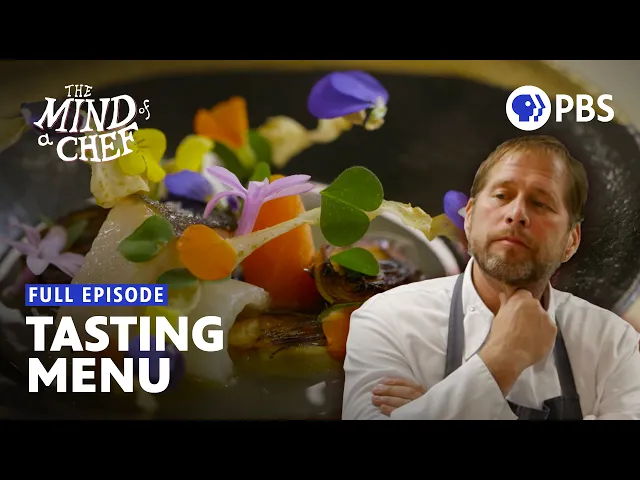
25 Bites in a Tasting Menu with David Kinch | Anthony Bourdain's The Mind of a Chef | Full Episode
PBS Food
0:01 Viewers like you make this program possible.
0:03 Support your local PBS station.
0:05 DAVID KINCH: When three things are on a plate,
0:07 there's symmetry between the three.
0:09 ANTHONY BOURDAIN: A tasting menu is a sequence
0:10 of carefully composed flavors and textures in optimal amounts...
0:15 intended to get from there to here.
0:19 The experience should be incremental, cumulative, balanced.
0:24 KINCH: Do the foies after the bonita!
0:26 BOURDAIN: Bound together by location, season...
0:29 KINCH: To me this is what gives it the flavor.
0:31 BOURDAIN: Ingredient.
0:32 25 bites.
0:35 They have to be perfect.
0:36 Better than perfect.
0:37 Together, they need to say something the diner didn't know they needed to hear.
0:44 Enter The Mind of a Chef.
0:45 KINCH: You can actually taste the sun.
0:46 I don't know how we're going to top that one.
0:49 This is the fun part in cooking.
0:50 Cheers.
1:03 (sniffing) KINCH: Part of the beauty
1:10 of the power of food is it creates memories.
1:14 Very important.
1:16 When a dish is set down in front of someone, what is a dish supposed to do?
1:20 Pique interest?
1:23 Surprise?
1:24 You can go in with really great expectations.
1:27 Our job is to understand what they are, and not only to meet but to exceed.
1:37 25 bites.
1:40 I would be lying if I didn't say that the progression
1:43 of a Japanese menu has a great influence on the Manresa menu.
1:48 Things start off with relatively unadorned, simple bites, pleasing to the eye.
1:55 The idea of bitterness early in a meal.
1:58 Something raw.
2:00 There's soup, perhaps something braised.
2:04 There's a diversity of courses, different tastes and textures being presented.
2:09 We want things to be three bites long.
2:11 One bite is the big surprise.
2:13 The second bite's kind of like a confirmation.
2:15 And the third bite is to finish it off and be ready to try the next sensation.
2:27 When someone comes in, the first thing they get are the petit fours,
2:30 an item most people associate with the very end of a meal.
2:34 We've actually had people say,
2:35 "There must be some sort of mistake." They look sweet but they are savory.
2:40 Red pepper, olives.
2:44 This period ends with a larger portion dish, perhaps a savory panna cotta.
2:49 Currently, we do salmon roe and peas.
2:52 Got transitional period,
2:53 just denotes that you're going to move into the savory part of the menu,
2:57 and the first dish of substance.
2:59 Into the vegetable garden,
3:01 and all its bitter elements to stimulate the appetite.
3:05 After that, a raw dish, fish or shellfish.
3:09 Simply presented.
3:10 I think something served raw, especially early, there is no place to hide.
3:16 You know, what you're really showcasing
3:18 is the pristine quality of the ingredient.
3:21 The beauty of it, the skill, is in the cuts.
3:28 This salad is very Californian,
3:30 almost Central American in its theme, with a chili and avocado.
3:34 The fish is Japanese style,
3:36 but I think once it all comes together, it's almost ceviche-like.
3:40 The first thing I'm going to do, prepare the cucumber for the salad.
3:43 So, bias cuts.
3:45 Attractive, bite-size pieces.
3:49 Cucumbers have a lot of water in them.
3:51 Salt is going to draw out the moisture.
3:54 A lot of that water is a little bit bitter tasting,
3:56 so I'll take out a little bit of the bitterness.
4:00 This is jalapeño, I mean, it's spicy,
4:02 but in the grand scheme of the pepper world, it's not that hot.
4:06 This is just going to add a little picante.
4:09 Get to the heart of the matter.
4:11 And this is where the fun part comes in.
4:18 Throw in a dash of rice vinegar, pinch of salt,
4:21 ahumado in extra-virgin olive oil that had tangerines thrown into the press.
4:27 Lot of bitterness in it because of the pith in the peel, but we like that.
4:32 You don't just mash it in.
4:33 Stir it, let it break down a little bit, we'll do some other things,
4:36 come back to it and keep stirring it,
4:38 until the avocado comes into this half-creamy, half-chunky state.
4:43 Now, sea bream.
4:44 Like a gentle snowstorm, the salt rains down out of the sky.
4:49 With a little cure for eight minutes.
4:52 Wash the fish.
4:54 It's made the skin just a little bit translucent,
4:56 gets rid of a little bit of the flabbiness.
5:00 Cut against the grain.
5:02 See how shiny that is?
5:03 Most of that is because of the quality of my left-handed blue steel,
5:07 and the confidence of the stroke.
5:09 Sushi guy can tell if it's been sliced confidently or not.
5:13 With some great citrus: Meyer lemon...
5:18 and one of my favorites of all, the wekiwa tangelo.
5:22 I like it so much I even just like saying it.
5:24 Acidity...
5:25 keeps things fresh and lively.
5:29 A couple drops each of both the wekiwa tangelo juice and the Meyer lemon juice.
5:38 The avocado is still chunky, but it's starting to get really shiny,
5:41 and it's coating everything really nicely.
5:43 It's the exact consistency that I've been patient and waiting for.
5:47 Lastly, some toasted black sesame seeds.
5:53 Plate the dish.
5:55 The raw onions have wilted.
5:59 My three pieces of fish.
6:02 Juiced cucumbers, marinated with jalapeño, mint, and basil.
6:08 My citrus segments, wekiwa, Meyer lemon.
6:14 Little balls of cucumber, pickled in rice vinegar and white wine.
6:19 Couple of drops of tangerine-flavored oil to pearl on the surface,
6:24 effectively making a vinaigrette.
6:28 Bachelor button flowers, tie the dish in with the blueness of the bowl.
6:32 Sea bream with spicy cucumber and avocado, citrus.
6:40 You have to start with something great to make something great.
6:48 FARMER: David, you got to come try this red shadow.
6:51 Smell the bottom.
6:52 KINCH: Okay, looks like a pear.
6:53 Oh!
6:54 FARMER: Vanilla flavor.
6:55 KINCH: Does it taste like vanilla?
6:57 No.
7:00 All right, let's go find the finger limes.
7:02 KINCH: Gene Lester is a cranky, cantankerous old guy.
7:05 ...There's some clementinas left...
7:07 KINCH: I wouldn't describe Gene as a farmer, he's like a fruit hobbyist.
7:10 This one is Yosemite Gold.
7:12 KINCH: He's just got these amazing trees.
7:15 First thing I asked Gene was if he had yuzu.
7:17 He says, "yes, I do, but I got many other things,
7:22 too." He's got a whole ridge, there's a whole ridge up there.
7:25 Each tree is a different fruit.
7:27 It's just amazing.
7:28 250 different kinds of acidity.
7:31 There it is.
7:32 This variety is a little bitter, sort of like a grapefruit.
7:36 KINCH: I think there's a little bit of vanilla in the flesh, too.
7:39 Could be.
7:40 KINCH: You could put vanilla with this.
7:41 You could.
7:41 KINCH: Spiny lobster.
7:43 We can go up there, and taste something and be really inspired by it.
7:48 Mmm!
7:49 And have it on the menu the next day.
7:52 Here we are at the finger limes.
7:53 KINCH: Look how many of them there are.
7:55 Looks like they, somebody scotch taped 'em on.
7:58 KINCH: I knew what a grapefruit was.
8:00 The grounders are probably the best...
8:01 KINCH: But this whole world just opened up walking around,
8:05 pulling things off trees and tasting it.
8:07 And him explaining...
8:08 Now you ready for this?
8:09 Caviar.
8:10 KINCH: You can eat the skin on this, and this one doesn't have seeds,
8:12 but this one has the best acid-to-sugar ratio,
8:14 but it's really difficult to peel,
8:15 so you're going to have to figure out a way to peel it,
8:18 you know, and just like boom, boom, boom, boom, boom.
8:20 It's better to cut down to the flesh and then tear.
8:24 KINCH: His love and passion for what he does
8:26 is a big guiding principle in what we do.
8:40 After that raw dish, we usually do a vegetable centric dish.
8:45 Something very delicate.
8:51 The chawanmushi, which is a Japanese-style custard that is steamed,
8:56 and a very light broth that has been infused with a spring garlic.
9:02 Very pungent, very aromatic.
9:04 Green garlic is an iconic California ingredient.
9:08 It is fresh garlic in the springtime, before it actually starts to bulb.
9:14 And I mince finely, mostly just the white.
9:17 The white tends to be more delicate and as I
9:21 cut this, it becomes very obvious to everyone around you,
9:24 that is in fact not a leek, but garlic, because of the smell.
9:29 Buerre noisette.
9:30 Add half the garlic.
9:32 We just want it to soften.
9:33 We're not going to put any color on the green garlic.
9:36 That would make it too strong.
9:38 Vegetable broth, classic mirepoix, has fennel in it.
9:43 The weird things I like to add to it is a pinch of sugar, and a star anise.
9:48 Just as it's coming to a simmer,
9:50 I'm going to add the last bit of the raw garlic,
9:53 hopefully adding some complexity from the two
9:55 different states of the garlic, softened and raw.
10:03 It's delicious.
10:05 Most "egg-cellent." I've strained the broth.
10:10 Put it on low.
10:11 I am not trying to incorporate air into it.
10:15 I'm going to add the eggs one at a time.
10:21 You can see that the custard is very, very light.
10:25 Shirodashi, white soy sauce that had
10:28 katsuobushi as part of the fermentation process.
10:31 One of our secret weapons here.
10:37 I'm going to just kiss the surface of each one to get rid of the air bubbles,
10:43 but not enough to cook it.
10:47 Time to steam the custards.
10:49 We're going to use broccoli to top the custard,
10:52 and all I'm trying to get are those little florets.
10:56 Basically just giving the broccoli a trim.
10:59 Supercuts.
11:14 Seaweed vinegar is going to add the acidic element to the dish,
11:17 along with a really good, strong dose of umami.
11:21 Sake.
11:23 Rice wine vinegar.
11:23 Sugar.
11:24 Soy sauce.
11:26 Little bit of water.
11:28 Simmer.
11:32 Bonito flakes...
11:35 Pretty.
11:37 And then three different kinds of seaweed: fresh nori, kombu,
11:42 and laitue de mer, sea lettuce, a very common dried seaweed on the Pacific.
11:51 And then I'll wrap it and let it cool 'till it's infused.
11:56 It's time to plate the custard.
11:59 Some fusion, it's completely cool.
12:04 Lovely smell, it's like a tisane.
12:07 We will strain this off.
12:08 Put it on very delicate, just a little bit sweet.
12:12 The stems from the broccoli, that have been blanched.
12:20 The fried florets from the broccoli, hiding the custard and the stems,
12:26 but you can see the little bits of the color poking out.
12:29 Some beautiful broccoli flowers, yet more broccoli to the dish,
12:33 and the color mimicking the color of the bowl.
12:38 Broccoli flowers do taste of the plant, of broccoli.
12:41 And this completes the dish:
12:43 green garlic custard with seaweed vinegar, broccoli.
12:52 Of course one eats with the eyes.
12:56 All five senses are involved.
12:58 The fifth sense, of course, being umami.
13:00 The sense that is an intangible, you can't quite put your finger on what it is,
13:05 that is the job of the chef making that happen.
13:07 Warm salmon with saffron and potato.
13:10 And now, the menu is advancing, now it's going from lighter to heavier.
13:16 A more substantial fish dish, sometimes it will involve grilling.
13:20 Much more centered on the protein than the previous dish.
13:27 After that, we do a rice dish, which is really the first sort of carbs, heavier.
13:36 This is a great time for us to introduce people to abalone.
13:39 Rice porridge has abalone and emulsified with chicken fat.
13:43 After this, we do red meat.
13:48 Lately we've been doing spring lamb.
14:03 What we're trying to project with Manresa is coastal California.
14:09 So we are, in a food sense,
14:11 a reflection not only of how it's made but where it's from.
14:18 Oh, my God, he's massive!
14:23 KINCH: The obvious answer would be that you use local products.
14:31 Or use a purveyor and a source that an area's famed for.
14:39 Monterey abalone.
14:42 Jo at Dirty Girl.
14:44 You know, Castroville artichokes.
14:46 So, people who've eaten artichokes all their life,
14:48 when they have it at the restaurant,
14:49 they realize the specialness of what they're tasting.
14:55 These are called negi onions.
14:56 It's a Japanese cultivar.
14:58 People will come to the garden and I'll show them something weird or different,
15:03 and they'll ask me, "Well, what does David do with it?" And I'll say,
15:07 "Anything he wants." KINCH:
15:13 We have this exclusive relationship with Love Apple Farms.
15:15 We work in collaboration with them.
15:18 And I'm always trying to pique his interest and add something new,
15:23 whether it's a new variety of tomato, a new variety of bean nobody else has.
15:27 KINCH: When I decided that I wanted to have a garden,
15:30 I thought that I was going to do this myself.
15:32 I don't know what I was thinking.
15:34 Cynthia Sandberg is a champion tomato grower.
15:36 She said, "Well, I'll do it." I said, "Well,
15:40 I'm not just talking about tomatoes." And she goes,
15:42 "Neither am I."- These are cape gooseberries, and the flavor is phenomenal.
15:46 It's got a really wonderful acid, sweet balance to it.
15:49 He can do a lot with this.
15:51 KINCH: She gave up life as a successful lawyer.
15:54 She dug up her lawn.
15:55 She dug up her swimming pool.
15:57 These are lychee tomatoes.
15:58 I got these from the gardener for Alain Passard in Paris,
16:02 and I didn't speak any French and he didn't speak any English,
16:04 but I could tell the seed was in the tomato family,
16:07 so I cultivated it the same way and it thrived.
16:11 David loves it.
16:13 KINCH: The stuff that grows at Love Apple has been fine-tuned over the years,
16:17 specifically for the needs of the restaurant.
16:20 We had the opportunity to plant different cultivars of the same vegetable,
16:23 so you can have a dish that is four different types of eggplant,
16:27 four different types of tomatoes.
16:28 The complexity of the dish is in the diversity of cultivars.
16:32 That was a great tool to have.
16:36 Sometimes I will come across something that I think is unique and unusual,
16:40 and I try to keep it a secret from him until we have it ready for him to taste.
16:45 He'll go, "that's fabulous, give me 100 more of them next week." And I go...
16:50 I can't do that, chef, 'cause I only put in a little test plot for you,
16:53 so, next year we'll give you a lot more of those.
16:58 That's the fun part.
17:12 KINCH: We use a various assortment of alliums, onions from the farm,
17:16 for this broth, because there is an inherent sweetness to them.
17:20 It's a transitional course that helps, perhaps,
17:24 settle the stomach and let the system know
17:26 that you're going to be transitioning into sweets.
17:39 A white globe onion.
17:41 The bulb from a red torpedo onion.
17:43 And I think there might be a white torpedo in there as well.
17:48 Now we're going to make some dashi, which is the basis of the soup.
17:51 I have Rishiri-Kombu.
17:53 It's from an island called Rishiri off the north coast of Hokkaido.
17:58 It's considered the grand cru,
18:00 the Domaine de la Romanée-Conti of kombus because of the elegance of flavor,
18:04 the depth, the subtlety.
18:07 Research has shown that the glutomatic properties that makes dashi such
18:11 an umami bomb and the basis and the foundation of all Japanese cuisine,
18:16 that the greatest extraction happens at 60 degrees.
18:19 So it's going to hold it there for one hour.
18:21 Never coming to a boil.
18:24 When it reaches 60, we're going to use dried shiitakes.
18:28 Shiitakes have tremendous amounts of natural umami,
18:31 and when they're dried, they're really amplified.
18:35 Three different kinds of lentils: green, orange,
18:38 and the classic du Puy lentils, black-green, incredibly flavorful.
18:42 I soak these overnight.
18:44 Starts the germination process.
18:46 We'll toss 'em together.
18:47 Put 'em in a cool, dark, humid place.
18:50 In our case, it's the wine cellar.
18:52 Let them sit around from 24 to 36 hours,
18:55 and we'll get these beautiful sprouted lentils.
18:59 Palatable and tender.
19:01 A little bit of a crunch.
19:03 You would be amazed that they're not cooked.
19:08 We have some beautiful pickled ramps.
19:10 Cut it into a nice mix about the white and the dark.
19:19 You can really smell how fabulous that kombu is.
19:21 Smell it.
19:22 So I'm going to strain it.
19:27 Now I'm going to add the onions.
19:28 It's going to be an infusion, just like we're making tea.
19:31 Now I'm going to start to season it.
19:33 It's always soy with a little bit of salt,
19:35 and I think the synergy between the two, to balance out the onion flavor.
19:40 And the mirin.
19:43 I'm trying to find this right balance of aroma.
19:48 Sweet from the onion and the mirin.
19:52 And salt.
19:58 Exactly where I want it.
19:59 Strain off the onions, and now we're ready to play.
20:02 So the sprouting lentils, we add for color.
20:06 Puffed buckwheat, which adds a really great kind of cereal crunch to it,
20:11 almost got the crunch of popcorn.
20:13 Some of our pickled ramps.
20:16 Some of our seasoned broth.
20:19 Two or three sips at the most.
20:22 Rendered beef wagyu fat, the secret ingredient on this particular dish.
20:26 It pearls, adds a certain richness.
20:29 We strongly encourage the guests to pick it up and just sip it.
20:32 And when they're close of course, they'll get the great fragrance.
20:36 I have raw, I have pickled, and I have hot, I have cooked, I have crunch.
20:41 Hopefully, this will be a nice backing away from the rich
20:44 course that came before it in preparation for dessert.
20:51 Moving into desserts, we will do something really refreshing.
20:55 It will involve raw fruit of really great quality that we want to showcase.
20:59 There won't be a lot of added sugar.
21:02 There might be savory elements, such as herbs, chervil, basil, anise hyssop.
21:08 An arc from the savory to the sweet.
21:12 Rhubarb with fennel frond and Pernod.
21:15 The second dessert will be more substantial.
21:19 It will involve much more technique, more of a showy dessert,
21:24 because you're nearing the end of the meal.
21:28 At this point there's going to be a lot of mignardises.
21:31 COOK: Coconut and passion fruit, Meyer lemon, vanilla bean.
21:34 KINCH: Macaroon.
21:37 Chocolates— someone has to have chocolate, like myself.
21:42 Finally, you will get the original petit four.
21:45 It will mimic the petit fours that you had
21:48 at the beginning of the meal, but this time,
21:50 you're original assumption would be correct,
21:52 it would be sweet, in this case strawberry and chocolate.
21:55 We come around full circle during the course of your meal.
22:07 We don't cook for more than 60 people on any given night.
22:11 I don't know how responsible a business model that is,
22:14 but I like to know the faces of the people
22:17 I'm cooking for, as opposed to just table numbers.
22:20 I've always viewed cooking on a very personal level.
22:26 I don't do it by myself.
22:27 (to chefs) Thank you, everyone, thank you, thank you, that's it.
22:32 When a night goes smoothly, there's an intense feeling of accomplishment.
22:38 You feel alive.
22:41 Now you're walking on air.
22:43 (sniffing)