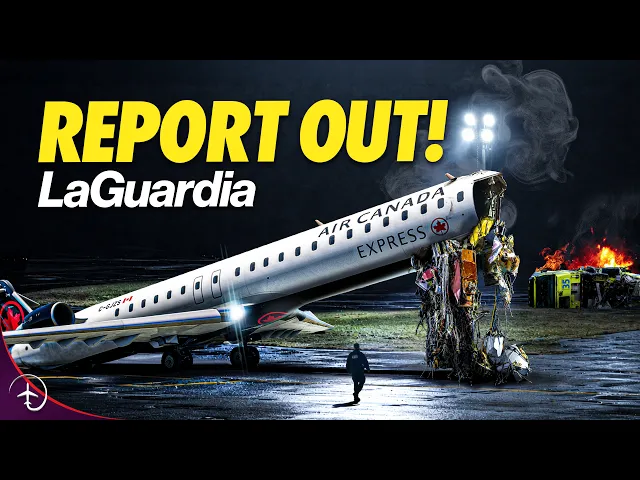
EVERYTHING We Know About The LaGuardia Accident!
Mentour Now!
0:03 On Thursday, 23rd April 2026,
0:05 the NTSB released a very detailed preliminary report on the runway
0:09 incursion accident that happened at LaGuardia Airport on 22nd March, 2026.
0:15 The accident occurred when a CRJ-900 operating as Air
0:20 Canada Express or Jazz Flight 8646 was arriving from Montreal
0:24 in Canada and collided with an aircraft rescue firefighting
0:28 or ARFF vehicle just after touching down on Runway 04.
0:34 According to the report,
0:35 this was the third and last flight of the day for the two
0:38 CRJ pilots who were on the first day of a four-day trip together.
0:43 The captain had a total of 3,560 flight
0:47 hours of which 1,600 hours had been flown
0:49 with Jazz and he had upgraded to captain just
0:53 about three and a half months before this accident.
0:57 His first officer was the pilot flying for the flight and he had
1:01 a total of 718 flight hours of which 435 were with this airline.
1:07 Now this is a preliminary report so we don't know if
1:10 all of the time that these two pilots had with the airline
1:13 was on the CRJ-900 type but we know that this was
1:17 only the second trip that these two pilots had flown together.
1:22 And tragically, neither of them survived this accident.
1:27 But they were the only fatalities in this whole tragedy.
1:31 Among the two flight attendants,
1:33 72 passengers and the two ground crew in the ARFF vehicle,
1:37 39 people were transported to local hospitals,
1:40 six of which with serious injuries
1:42 but everyone except those two pilots survived.
1:46 Now when we're looking at the crew in the firefighting vehicle,
1:49 we now know that the driver had three years
1:51 of experience and was at the time of the accident,
1:53 five and a half hours into a 12-hour shift.
1:57 The second occupant was a turret operator who had 12 years of ARFF
2:01 experience and was four and a half hours into a 12-hour shift.
2:07 In the control tower,
2:08 the controller that was talking to both the Jazz aircraft and the firefighting
2:11 vehicle when this happened had 18 years of experience and was 42 minutes
2:16 into his shift and it is now confirmed that there was also a second
2:20 controller present with 19 years of experience
2:23 and who was 51 minutes into his shift.
2:27 And that second controller was, at the time,
2:29 responsible for departure clearance deliveries and for handling
2:33 the ground frequency, at least on paper.
2:37 Initially there was some uncertainty about which one of these two controllers
2:41 was actually handling the ground frequency because you see during a night shift,
2:46 it was common for a single controller to handle both
2:49 the tower and the ground frequencies and this was the night shift
2:54 for both of these controllers but it was also a little bit
2:57 too early in the evening for that procedure to be in place.
3:01 This accident happened at approximately 11:37
3:03 in the evening and the combining of tower
3:06 and ground positions would generally only be done
3:08 when the traffic volume went down after midnight.
3:13 But at the time of this accident the ground controller who also
3:17 had a supervisory role here was
3:20 busy coordinating the emergency of another aircraft,
3:23 a United Boeing 737 MAX 8 which had
3:26 performed two rejected takeoffs earlier in that evening.
3:30 As this was happening, that aircraft was now sitting on a taxiway since
3:34 its pilots had been unable to find an empty
3:37 gate for their passengers and since they were now
3:41 also feeling some smoke and fumes in the cabin,
3:44 they were considering whether or not they would need to evacuate
3:47 or at least to call for stairs to disembark their passengers on the taxiway.
3:52 That situation meant that the ground controller had his hands
3:56 full and what the NTSB's preliminary report now explains is
4:00 that the tower controller had therefore started handling some taxiing traffic
4:04 to take a little bit of workload away from his colleague.
4:08 Maybe you can see how the Swiss cheese layers
4:11 are starting to line up and be crossed here.
4:15 In any case that other aircraft emergency
4:17 was also the reason why the involved firefighting
4:20 vehicle was on the move and there
4:23 were actually a total of seven vehicles involved:
4:27 four ARFF trucks, a tool truck,
4:29 an air stair truck and a port authority police car.
4:34 When the tower controller cleared Jazz Flight 8646 to land on Runway 04 the CRJ
4:39 900 was still on a five mile final at an altitude of about 1,900 feet.
4:45 And all of the ARFF vehicles were still around the fire station area.
4:50 They only started moving out 21 seconds after the tower had issued that landing
4:56 clearance and the vehicles then gathered
4:58 at a taxiway intersection well clear of Runway 04.
5:03 Initially another vehicle, the tool truck,
5:05 was supposed to lead them all across the airport
5:08 towards that stuck United aircraft but that plan
5:12 then changed because the crew in the tool
5:14 truck had some difficulty contacting the tower.
5:17 It looks like possibly they were stepped
5:19 on, meaning that someone else was speaking on the same frequency when they tried
5:23 to transmit so their message never came out.
5:27 This then meant that the involved trucks used
5:30 their own radio frequency to coordinate swapping roles and places.
5:35 And the truck that would later be involved
5:37 in this accident positioned itself in the lead of the convoy.
5:41 It then contacted the tower, saying that truck one and company wanted to cross
5:46 Runway 04 at Taxiway Delta and the controller
5:49 cleared them to do so likely temporarily
5:52 forgetting the landing clearance he had already issued.
5:56 But LaGuardia also has a runway status lighting system just for this purpose.
6:02 And five seconds before the controller cleared the vehicles to cross the runway,
6:06 those runway entrance lights or RELs for this particular
6:10 intersection on Runway 04 and Taxiway Delta had illuminated red.
6:16 Now I can't overemphasize how important this is.
6:20 Everyone including aircraft and ground vehicles
6:22 must never ever enter a runway when those lights are red and that's even
6:27 if a controller has given clearance to cross.
6:31 In Europe, we have a red stop bar that goes across the taxiway like a barrier
6:36 but in the United States the actual taxiway
6:39 centerline light seems to play that same role,
6:41 turning red when you're not allowed to enter and then
6:44 continuing for the whole segment that you're not allowed to use.
6:49 But in this case, the lead vehicle,
6:51 with call sign truck one now apparently started
6:53 moving across those lights to cross the runway anyway.
6:58 Meanwhile, crew in the other vehicles further back in the convoy,
7:01 saw the landing aircraft and said, "Stop!
7:04 Stop!
7:04 Stop!" on their own frequency and the controller in the tower who, remember,
7:10 was now also giving some taxiway instructions
7:13 to other aircraft at the same time also saw
7:16 the conflict with the landing aircraft and therefore
7:19 radioed out an instruction to the truck to stop.
7:22 Now at that point, the truck was still crossing taxiway Alpha Alpha
7:26 which is the parallel taxiway to Runway 04 but from later interviews,
7:30 it seems like the crew in the truck just didn't realize that this, "Stop!
7:33 Stop!" call on the radio was for them.
7:36 The tower controller then repeated his instruction for the truck to stop when
7:40 it was about a 100 feet away from the edge of the runway.
7:44 And by that point, it was doing 29 miles or 47 kilometers per hour.
7:50 Now for some very curious reason,
7:53 the REL lights then switched off just as the firefighting
7:57 vehicle got to the edge of the runway itself,
7:59 something that can actually be seen in a video
8:02 of the collision, if you look at it.
8:04 And the preliminary report doesn't explain why this happened.
8:08 That happened three seconds before the collision and a second later,
8:12 as the CRJ had touched down and landed its nose wheel,
8:15 the first officer handed over the controls of the aircraft to the captain.
8:19 Now the aircraft's ground speed at that moment
8:21 was about 106 knots with the firefighting
8:24 truck doing 30 miles an hour now appearing right in front of them.
8:29 The NTSB didn't release any information about
8:31 the conversation from the pilots in the cockpit.
8:34 That will likely come in the final report later
8:36 on but it is confirmed that the cockpit voice recorder
8:39 did register the calls between the tower and the firefighting
8:43 vehicle so the two pilots likely did hear it.
8:47 Just before the collision,
8:48 the driver in the fire truck turned sharply left and the aircraft had
8:52 by then started braking slowing it down to 90 knots just moments before impact.
8:58 There was then also a six degree left
9:00 rudder input from the pilot but at that point,
9:03 it was already too late for anyone to stop the collision.
9:08 Now the NTSB's investigation also confirmed that ASDE-X was operating
9:12 at the time of the accident and this is a system
9:16 that allows tower controllers to track movements of aircraft and ground
9:20 vehicles by using information from both ground radar and transponders.
9:25 But the vehicles at La Guardia were not equipped with transponders so without
9:30 those, the system could only use radar returns which are much less reliable.
9:36 This then meant that, at the time of the accident,
9:38 this system was only able to see two
9:40 out of the seven vehicles and it never generated
9:43 any aural or visual alerts likely because the radar
9:47 returns were too intermittent to generate high confidence tracks.
9:51 Now this investigation will now continue and eventually lead to a comprehensive
9:55 final report within a year or so and when it does,
9:58 we will create a detailed full video over on Mentour Pilot but for now,
10:03 I hope that this shows you that just as Ben and I talked about in our podcast,
10:07 Captains Speaking, there were no one single thing
10:10 or one single person to blame for this accident.
10:13 As always, there were several causal factors including systemic
10:17 issues who together ultimately led to this really tragic outcome.
10:22 Now my team and I would not have been
10:24 able to create this video as fast as we have; the report was only just released;
10:29 if it wasn't for the support from our sponsor
10:31 Incogni who was super fast to answer our call.
10:35 If you want a really effective way of making
10:37 sure your personal data is not being sold online,
10:40 Incogni is where you should go.
10:42 I have been using them myself for over a year with great results and if
10:45 you want to reduce your digital footprint
10:48 and get rid of some spam and robocalls,
10:51 well then scan this QR code or go to incogni.com/mentournow.
10:56 You can also support this type of work that we're doing by joining
11:00 our Patreon community on patreon.com/join/mentourpilot.
11:05 I will be hosting a Zoom hangout there
11:07 soon maybe together with Ben actually where we
11:10 will discuss this report in more detail and answer
11:12 your questions so hopefully, I'll see you there.
11:16 My name is Petter Hörnfeldt and you're
11:18 watching a special video from Mentour Now.
11:20 Have an absolutely fantastic day and I'll see you next time.
11:23 Bye bye.