Entirely Ridiculously Big Numbers - Numberphile
Numberphile
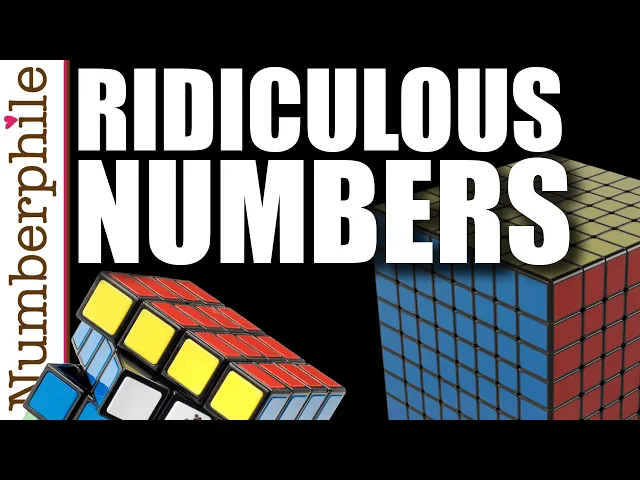
0:00 So, this is an entirely ridiculously ridiculously big number.
0:03 You've spoken to me about bigger numbers.
0:04 I have spoken to you about bigger numbers, but I've never held one in my hand.
0:09 I thought we might talk about Rubik's Cubes today,
0:12 but not about this Rubik's Cube.
0:15 Instead, how about that Rubik's Cube?
0:18 Oh, that's got that's got more cubes in it.
0:20 Yeah, that's What do you call the the elements of a So,
0:23 the opinions are divided.
0:25 I think what most people nowadays call it is a cubie,
0:27 but I'm a bit old school and I call it a cubelet.
0:30 Yeah.
0:31 And that's got more cubelets.
0:32 It's got more cubelets.
0:33 You you can see it's six cubelets wide,
0:36 while your your your classic is three cubelets wide, right?
0:41 So, you might call this a six cube.
0:42 So, the standard three cube has got an awful lot of scrambles,
0:46 lots of different possibilities.
0:47 Do you remember how many different scrambles, Brady?
0:50 I believe 10 seconds ago, before we started the filming,
0:53 you told me it was 43 quintillion.
0:56 43 quintillion on your the standard Rubik's Cube.
0:59 That's Surely it's not a rounded all zeros.
1:01 Is there like a more exact number than that?
1:02 more exact, yeah.
1:03 What's the exact number?
1:04 Uh I don't remember, I'm afraid.
1:06 I'll put it on the screen.
1:08 There it is.
1:09 And what does that number refer to?
1:11 So, it's the number of different possible
1:12 scrambles or different possible states it could be,
1:15 different ways it can be mixed up,
1:16 including of course the unscrambled solved state.
1:20 Is this one of those situations where there are like, you know,
1:22 reflections and mirrors and the same ones exist multiple times
1:25 and you have to do that or Yes, that's right.
1:28 So, we want to make sure when we're counting different states,
1:31 we're not overcounting by counting um ones
1:37 which look identical um to each other.
1:39 In fact, this is going to be more important than
1:41 with this, because you can see it's got all these center pieces.
1:44 And if they get jumbled up between themselves, it doesn't matter, right?
1:47 It's it's still going to be the same state.
1:49 So, we won't have to worry about that, yeah.
1:51 So, if you swapped two of those whites with each other, I wouldn't know.
1:54 Exactly.
1:54 So, we can't we should count them as that as being the same the same state.
1:57 But I thought it might be fun to try and work out
2:00 how many different states there are for a big cube like this.
2:04 Okay, so I'm actually having said that, I think
2:06 it's best to start with a slightly smaller cube.
2:09 So, I'm actually going to start with this cube here, two cube.
2:12 And it's going to be actually easier
2:14 to do the calculation for cubes with even width.
2:19 The question is, how many different states are there for this?
2:23 So, this is a 2 by 2 cube.
2:24 Let's scramble it up a little bit.
2:26 You can see there are eight cubelets, right?
2:30 And there are eight positions that a cubelet could be in, right?
2:34 So, you can put any of the cubelets in any of the positions.
2:39 So, let's just pick a slot, maybe this one here, that position,
2:44 then there's eight choices of which cubelet to put it in.
2:47 So, we can write that down, eight.
2:50 And then once we've got that one,
2:53 for the next slot, there's seven choices, right?
2:55 So, it's times seven.
2:57 And then for the next one, there's six and so on.
2:59 So, you can see how it's going to go.
3:01 The number of choices is 8* 7* 6* and so on down to 1,
3:05 which is usually written as 8 factorial with an exclamation mark.
3:09 That's what that exclamation mark means, okay?
3:12 So, that's the start, but that's not the whole answer,
3:15 because once we've decided maybe we put this white,
3:19 green, and red uh cube cubelets into this slot,
3:25 it can actually be one of three ways round.
3:28 So, if you just look at concentrate on that cubelet,
3:31 if I do that, it's in the same position again,
3:35 but it's in a different it's been rotated, right?
3:39 And we can do it again, okay?
3:40 So, actually there's um for each each
3:44 of these cubelets in each of these positions,
3:46 it can be one of three ways round, right?
3:48 We need to multiply by three for each of these.
3:52 So, you think it's going to be times three to the eight, right?
3:55 Because there's eight of them.
3:56 But actually it's not times three to the eight,
3:59 because it turns out that once seven of them have been fixed,
4:04 the the the final one is automatically fixed.
4:06 You can't do anything more with it.
4:08 So, it's actually times three to the seven.
4:10 So, that's the the number of states for the two cube.
4:13 Well, maybe not quite, because this point we have to rewind and think
4:18 about every cube's favorite thing, the one cube.
4:22 And the question is, how many states does the one cube have, right?
4:25 And I think the what feels like the natural answer is it's got one state, yeah?
4:30 But of course, I mean you could argue that it's got 24 states,
4:33 because you think, okay, which which face will I put on the top?
4:38 I'll put the the white face on the top.
4:41 Um and then which face should I put on the front?
4:43 So, it could be the orange one
4:45 or the green one and so There's four choices there.
4:49 So, you could argue that the one cube has got 24 states, 6* 4, yeah?
4:54 But we probably don't want that.
4:56 We probably want to count them all as being the same,
4:58 which means we need to Likewise for this, a lot
5:01 of these states are going to be the same,
5:02 but just rotations without actually doing any Right,
5:05 so let me call this number we've got so far C, okay?
5:10 I'll explain why it's called C in a moment.
5:12 That's around about 88 million.
5:13 But then to get the number of states for the two cube,
5:16 we need to divide that by 24, okay?
5:18 So, the two cube is C divided by 24.
5:22 The answer is that's about 3.6 million, just for this little cube, okay?
5:26 Wow.
5:27 When we think about uh the bigger cubes,
5:30 so I mean the one I'll do next is the four cube,
5:32 because it's easier to work with um even sides.
5:35 With a two cube, all the cubelets are basically equivalent, right?
5:39 Any can go in the position of any other.
5:41 That's not the case with here.
5:42 Um in fact, there's three different types of cubelets here.
5:46 You've got the corners, and you've got the edges here,
5:51 and then you've got the centers.
5:53 You've got three different types.
5:55 And to work out the number of states for the four cube,
5:59 what we need to do is work out the number
6:01 of possible arrangements of the corners and the number
6:04 of possible arrangements of the edges and the number
6:07 of possible arrangements of the centers and then multiply them together.
6:10 That's that's the plan.
6:11 And I want to start with the two cube,
6:12 because the corners of the four cube in or indeed the corners
6:17 of any cube are basically exactly the same argument as for the two cube,
6:23 because of this is these are corners, right?
6:25 The first thing for the four cube, we need C again, that same number, right?
6:29 So, the next thing to think about is the edges.
6:33 So, for this cube, the sort of overall shape the the the cubic
6:37 shape has got 12 edges and along each edge there's two cubelets, right?
6:42 So, we've got 24 edge pieces.
6:45 So, we've got 24 in total.
6:47 And you can put one in any of the slots.
6:49 So, we've got 24 slots.
6:51 So, for the first slot, we've got 24 choices of cubelets.
6:55 So, 24.
6:56 And then for the next slot, we've got 23 and so on.
6:59 You can see how it's going to go.
7:00 It's going to be 24 factorial.
7:02 Actually, that's it for the edges, because you might think, well,
7:05 we also need to consider the fact that one edge can be either way up.
7:09 But actually it can't in the sense that um once you fit a fix a slot
7:16 to put this uh this edge piece in, it can only go one way up in it.
7:20 The mechanics of the puzzle mean that.
7:22 So, I'm just going to put a dot on this edge.
7:25 And now I can flip those two edges there.
7:29 So, don't worry about the other pieces, just look at those two edge pieces.
7:37 So, I flipped them over, yeah?
7:39 But you can see in flipping them over,
7:41 I've also moved the one that was here to the one that was there.
7:43 The one with the dot was there before, now it's there.
7:46 Um and it's always going to be that way.
7:48 So, once you've put the cube the cubelet in the slot, that's it.
7:53 So, that is the that is the arrangement for the edges, okay?
7:56 So, the number of edge arrangements is just that, it's
7:59 it's just 24 uh which actually is a pretty big number.
8:04 This is around uh six times 10 to the 23.
8:10 So, that's 620 sextillion.
8:12 The next thing is the centers.
8:15 Again, it sort of starts off as the same as the edges,
8:18 because we've got six faces of the cube.
8:21 Inside each face, we've got four center pieces.
8:23 There's 24 center pieces all together.
8:25 So, I'm going to call this I'm going to call this number K,
8:28 which is because C was already taken.
8:30 The number of we can just pick a a slot here and then
8:34 the number of choices of which center piece to put in it is 24.
8:39 And then pick another one and the next one is 23 choices.
8:41 So, it's going to be 24 factorial again.
8:44 But this time we do have to consider something else,
8:46 which is that these four cubelets are identical to each other.
8:52 And if they mix around between themselves, we don't really care, right?
8:57 We don't consider it as a different scramble if you know,
9:00 if I was to swap those two or something.
9:02 It's all it's all the same.
9:03 So, that means every possible scramble is going to have basically
9:10 um different versions of it where the orange centers are swapped around.
9:15 So, that's an overcount at the moment.
9:16 So, we have to correct that.
9:18 How many how many um times is each one counted?
9:21 Well, how many arrangements are of these four centers are there?
9:26 Well, there's four choices for which one to put there times 3 times 2 times 1,
9:32 so 4 factorial, which is 24, okay?
9:35 Yeah.
9:36 So, we need to divide by So,
9:39 this to get the number of total arrangements of all the centers in the cube,
9:43 we need to divide by 24.
9:45 Well, that's for the orange centers, okay?
9:47 And then we have to do the same thing
9:49 for the green centers and for the yellow centers.
9:51 So, we have to divide by 24 six times.
9:54 So, we divide by by to the six.
9:56 And that gives us the number of arrangements of the centers.
10:00 This comes out to be around 3* 10 to the 15,
10:05 which is 3 quadrillion if you like those sorts of words, okay?
10:08 Okay, so now we can all to work out
10:10 the number total number of possible states of the 4 cube,
10:12 we just have to multiply those together, okay?
10:15 So, we've got the number of possible arrangements of the corners, C,
10:19 times the number of possible arrangements of the edges, E,
10:22 times the number of possible arrangements of the centers, K.
10:25 And then we have to divide by 24 for the same reason as previously, right?
10:29 Okay, so that's the answer and that gives us a total
10:31 answer here of uh roundabout 7* 10 to the 45.
10:37 So, that's the number of possible states of a 4 cube.
10:41 How does that differ from our 3 cube,
10:43 that that number that I was supposed to remember?
10:46 [laughter] Septillion.
10:47 43 quintillion.
10:48 Quintillion, that's it.
10:49 43 quintillion.
10:50 How does it differ?
10:51 Is it What sort of magnitude is that?
10:53 For the standard cube, it's 4.3* 10 to the 19.
10:57 And now we've jumped up to 7* 10 to the 45.
11:01 So, it's a very substantial increase, okay?
11:03 Really significant increase.
11:05 Yes.
11:06 Shall we have another substantial increase?
11:08 Always.
11:09 Okay, this is now a 6 cube.
11:11 We can get started because the corners are exactly the same as previously.
11:15 So, we start with the same number C.
11:16 So, now we think about the edges.
11:19 So, there's two fundamentally different kinds of edges on this cube, right?
11:22 You've got the ones here which are uh blue and yellow
11:25 and you've got the ones which are yellow and green.
11:27 They're like They're in two sort of different types of corridors, aren't they?
11:30 They're in two corridors and you can never switch between the corridors.
11:34 So, once you're in one corridor, you're always in that corridor.
11:36 The central edges are different from sometimes they're called wing edges, right?
11:41 If you're in one of the wing edges,
11:42 you can get to anywhere else in any of the other wing edges.
11:46 And if you're in one of the central edges,
11:47 you can get to anywhere else in any of the central edges, okay?
11:50 What that Can the one on the left Can can you If you're in a central edge,
11:53 like those two, can you change between left and right?
11:56 You can.
11:56 Yes, you can.
11:57 So, you're not stuck in your corridor, you're stuck in your brand of corridor.
12:00 You're You're stuck in your brand of corridor, yeah, exactly.
12:02 That's right.
12:03 That's right.
12:04 Um And what What that means is that if you just look at the central edges,
12:08 the um the argument is exactly the same
12:11 as the edges for the 4 for the 4 cube, right?
12:14 Because the the the edges here are just the central edges, right?
12:18 So, the the number of possibilities for the central
12:20 edge is that number E as we had before, right?
12:24 So, times E.
12:25 But then the number of possibilities for the wing edges is the same again,
12:29 so it's times E again.
12:31 So, we times by E squared.
12:33 Okay, so now we've got to look about the centers.
12:35 They call it centers.
12:37 It means everything [clears throat] which isn't a corner or an edge.
12:39 So, actually quite a lot quite a lot of cubes cubelets in here.
12:42 There's um there's sort of 16.
12:44 What are the What's the sort of corridor structure?
12:46 How can you get Which can you get between and which can't you?
12:49 Yeah, how are they constrained, yeah?
12:50 How How are they constrained?
12:51 Yeah.
12:52 If you look at this white white cubelets, right?
12:56 The question is where can it get to?
12:58 So, it can on this face,
13:02 there's four places it can sort of obviously get to, right?
13:06 Those four.
13:07 So, it can be just above the bottom left corner,
13:10 just to the right of that corner, just underneath that corner, right?
13:14 So, there's four four places it can get to.
13:18 Are there any others?
13:19 And actually the answer is no.
13:20 So, you might think you would be able to get
13:22 it get the white cube into that position there, but actually you can't.
13:27 And likewise, you can't get it down there.
13:28 That's sort of maybe more believable.
13:31 And you can't get it there either.
13:33 Just use a different face.
13:34 So, actually the sort of key thing here is
13:39 if you look at this blue square of four cubelets,
13:42 those are the four fundamentally different kinds of centers.
13:47 So, there's four kinds of centers.
13:49 And then for each kind of center,
13:52 the argument goes exactly as the centers for the 4 cube, okay?
13:57 So, the number of ways of arranging those kinds
14:01 of centers is that number K we had.
14:03 And then the number of ways of arranging those kinds of centers is also K,
14:07 and those kinds of centers are also K, and those kinds of centers are also K.
14:10 So, overall we get K to the 4.
14:12 Then of course, we do divide by 24, which matters less and less as these
14:17 [laughter] numbers get bigger and bigger.
14:18 It's a bit of a formality at this point.
14:19 But when you work that out, we're up to 1.6* 10 to the 116.
14:26 We're like beyond atoms in the universe.
14:28 We're beyond atoms in the universe.
14:30 Yeah, there's there's more possible scrambles of this puzzle
14:33 than there are atoms in the universe.
14:36 This is my biggest cube.
14:38 Um it's a recent and rash purchase.
14:41 Um this is a 10 cube.
14:44 And I haven't actually yet dared properly scramble it cuz I
14:47 dread to think how long it would take me to solve.
14:49 Um at some point I will.
14:51 Um So, but I think it might be fun to work out how many I mean,
14:54 has it gotten to a point now where for even numbered cubes,
14:57 we can create an algorithm here or Yeah, we can.
15:00 We can.
15:01 So, the way to think about it is let's call it a 2n cube, right?
15:06 So, um I'll do this as an example.
15:08 So, a 2* 5 cube, so that's my 10 cube, right?
15:11 We're going to let n be sort of half the size.
15:14 You could let n equal 10, but then the algebra comes out harder.
15:17 You've got C, that's the number of corners, that never changes.
15:19 Okay, now we think about the edges.
15:21 How many different edges have we got?
15:23 Now, let's put some different colors on.
15:32 Okay, but the point is how many different types are there?
15:35 Well, there's the central ones, then the next ones out,
15:38 then the next ones out, and then the wings, okay?
15:40 So, we've got four, right?
15:43 1 2 3 4 fundamentally fundamentally different types of edges.
15:48 Um and in general, so here in this cube, n equals 5.
15:54 So, in general, you're going to have n minus 1.
15:56 Yeah?
15:56 And the reason it's n minus 1 is because n is half the width of the cube,
16:01 and we just don't want the the outermost ones, so so n minus 1, yeah?
16:05 Okay?
16:06 So, that means the number of possible arrangements
16:08 of the edges is E to the n minus 1.
16:11 And now we've got to think about the centers.
16:14 Yeah, just give me a second.
16:16 Sorry, it's just a bit slow, this thing.
16:22 So, now if we think about the centers, this white square of 16 cubelets,
16:28 that's representative of the different corridors.
16:30 So, each of those is different to each of the others.
16:33 You can never get from any of one of those to any of the others.
16:36 And once we've chosen one of those types, so there's 16 types here,
16:43 um or in general, that's n minus 1 squared, half the width,
16:48 so that's n, then we take away the edge,
16:51 so that's that width there is n minus 1, then we square it, okay?
16:56 So, there's n minus 1 kinds of centers.
16:59 That kind, by the way, is my justification for using K.
17:02 Um pretty weak, I think.
17:03 And then the argument for each one is exactly as the previous day,
17:06 that's the number of possible combinations.
17:07 So, we need to then multiply here by K to the n minus 1 squared, right?
17:15 And K, remember, is 3* 10 to the 15.
17:18 And that's why you can sort of see here why these numbers
17:20 are getting so big so quickly cuz it's exponential in n,
17:24 but it's not actually just exponential in n, it's exponential in n squared.
17:28 And that's why why it gets so big.
17:29 Of course, we have to go through the formality of dividing by 24.
17:32 Of course.
17:33 Of course, of course.
17:34 Um Okay.
17:35 that does knock one off the power, doesn't it?
17:37 It It knocks one off the power, yeah.
17:38 It knocks one off the power.
17:39 Um so, for 10, if you plug in um n equals 5 into this, well,
17:44 you get C times E to the 4 times K to the 4 squared, so 16, divided by 24.
17:53 Work it out, you get to 10 to the 349 or thereabouts, okay?
17:57 Which is a which is really ridiculously ridiculously big number.
18:00 I mean, that's the sort of place where, you know,
18:03 if you took every atom in the universe and replaced it with a whole universe,
18:08 and then repeated that four times,
18:13 and then counted the number of atoms in that whole thing,
18:16 this has still got more scrambles than that, right?
18:18 Okay, so it's it's an entirely ridiculously ridiculously big number.
18:22 You've spoken to me about bigger numbers.
18:24 I have spoken to you about bigger numbers, but I've never held one in my hand.
18:28 [laughter] You may have noticed we've only dealt with cubes
18:30 with an even number of pieces along the edges.
18:33 If you want to find out how it gets a bit
18:34 more technical and mathematical with an odd number, like that, [music]
18:39 go and have a look on Numberphile 2.
18:41 We've got an extension of the video there.
18:43 We go into way more detail, but before you do that, go and order one of these.
18:50 Order a copy of Huge Numbers.
18:52 It's Richard's new book.
18:53 It's available now to order or pre-order, depending on where you are.
18:57 The cover might look different,
18:58 depending on where you are, but it's a fantastic read.
19:00 It deals with really big numbers, like you've been seeing just now.
19:05 I'll also put some links below to other things that may interest you,
19:08 previous videos we've done about Rubik's Cubes,
19:10 previous videos we've done about big numbers, and of course,
19:14 the link to that extra video, and the order link for Richard's book.
19:18 Go and check it out, people.
19:19 Thanks for your time, and thanks for watching.
19:22 puzzle can be [music] solved in 20 or 15