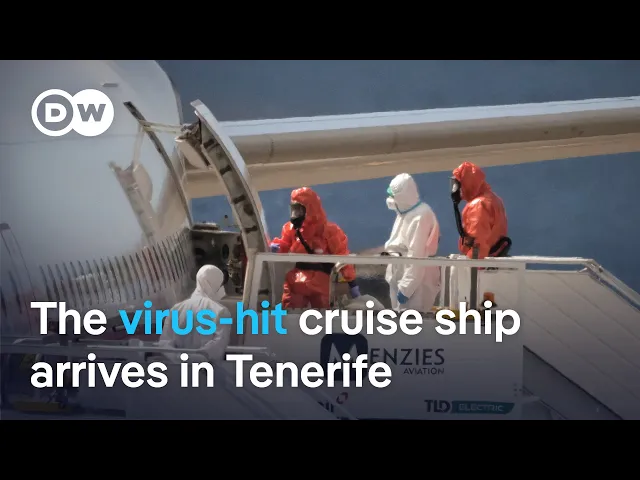
The cruise liner affected by an outbreak of the hantavirus reaches Spain’s Canary Islands | DW News
DW News
0:00 Imagine your dream expedition cruise,
0:03 the one you saved up for, turns into a 40-day nightmare at sea.
0:08 No, this is not a movie plot.
0:10 It's the reality for the 140 people on the MV Hondius.
0:15 The reason, a Hunter virus outbreak on board.
0:19 Three people are already dead.
0:21 A Dutch couple and a German woman and several others are
0:24 infected after weeks of being a pariah ship in the Atlantic.
0:29 It's finally arrived in the Canary Islands.
0:32 The ship pulled into Tenneref under total
0:35 lockdown in the early hours of this morning.
0:38 We're talking a full maritime exclusion zone.
0:40 No, no one gets in and no one gets out without a hazmat suit.
0:46 Passengers and some crew are now being brought to shore
0:49 and uh loaded onto charter flights later back to their home countries.
0:55 Usually hunter is something you catch from rat
0:59 or mouse droppings in a dusty shed, but this outbreak is different.
1:04 Health officials confirmed this is the Andes strain,
1:09 which could jump from person to person.
1:12 The nightmare isn't over for some of the sailors either.
1:16 About 30 of them have to stay on board
1:18 to sail this ghost ship Hondas back to the Netherlands.
1:25 And if you're getting 2020 COVID flashbacks, you're not alone.
1:29 But we have a molecular biologist walking
1:32 us through the science in a few moments.
1:34 But first, let's listen to the head of the WH, the World Health Organization,
1:39 who actually flew into Tenneref to try and cool the internets and locals nerves.
1:44 his message.
1:46 This is not another co
1:49 concern is legitimate because we have all experienced because of COVID
1:57 especially in 2020 and that trauma is still in our minds.
2:03 So people will have questions, people will have concerns.
2:07 The risk uh to the population to the local population is is low.
2:13 uh one is because of the very nature of the disease itself.
2:17 But second, the risk is low because uh the Spanish government
2:21 has made all the preparations um to prevent any uh problem.
2:29 And for the latest, we're going to the Spanish capital,
2:33 Madrid, now where DW correspondent Nicole Ree is standing by.
2:37 Nicole, the ship has arrived in Tenneref.
2:39 We've seen the images there.
2:41 uh people are being uh deboarded onto smaller boats.
2:45 Walk us through what's happening on the ground there.
2:49 Well, it's a big operation which due
2:51 to its nature also requires international cooperation.
2:54 We uh also heard now that the representative of the World Health Organization
2:59 is there on the ground with many more people from the Spanish side.
3:03 Just to give you an idea of the magnitude,
3:06 more than 350 members of the state security forces and cores have been deployed
3:10 to Tenerife to ensure that this operation will
3:14 be carried out smoothly and passengers have been
3:16 evacuated little by little with a bit of a delay this morning on smaller boats
3:22 with the maximum capacity of five people
3:25 uh always accompanied by medical staff as well.
3:28 Um here this has been called um transportation bubbles.
3:32 they have been uh transport transferred to land and then to the airport
3:37 which is very close by around 10 minutes uh as as we hear here.
3:42 And uh as for the Spanish passengers for example,
3:44 a military plane was arranged to fly them to Madrid
3:49 where they will have to quarantine in a special hospital
3:52 that has a special floor that will be basically sealed off
3:56 which is for these circumstances and has special ventilation as well.
4:01 special entrances and they will have to stay
4:04 there for at least a week maybe even more.
4:07 This depends on how for example symptoms and stuff uh pans out.
4:11 We've heard the Spanish health minister this morning Monica Garcia who
4:16 ensured that at the moment nobody is showing symptoms on board.
4:19 So this is basically a good sign.
4:22 But there has been a very meticulous preparations for this operation today
4:27 and it seems to be that um everything has gone well so far.
4:32 Let's see if we stay on the non-symptomatic side of course
4:36 um but yeah evac is ongoing and uh going forward.
4:42 Now how do authorities and doctors at the scene there ensure
4:45 that the virus does not spread from the harbor across the island?
4:51 This was the biggest worry of course and this was uh been talked about uh again
4:57 and again this week also in Spanish media
4:59 but there's actually little room for such spread.
5:02 First of all the passengers of the ship are not going into the city.
5:06 They are not in contact with locals.
5:08 They're only in contact with the medical teams and the operation staff
5:12 that is there on the ground and then in the respective hospitals.
5:16 Um and also it needs apparently according to medical
5:20 expert it needs extensive contact to somebody who is infected.
5:24 So um the spreading is a bit more difficult than some might imagine it.
5:28 Information has been very important throughout the week
5:31 to calm down some people who got very worried.
5:35 Um but also the execution of this operation
5:38 on the ground of course foreseees lots of uh prevention.
5:42 medical staff attending as well as the passengers are equipped
5:44 with the FFP2 masks that we all know from the COVID pandemic.
5:48 They're wearing personal protective equipment such as the special suits.
5:52 People, as I said, are not going into the city.
5:55 There are special corridors with tents on the grounds
5:57 where everything is happening between the ports.
6:00 Um it's only small groups that are being transferred and um they
6:05 even needed passengers even needed to put their belongings into plastic bags.
6:09 Um we haven't heard about the real reason
6:11 for this but this is also precautionary matter.
6:13 They will not sit with normal passengers on these repriation sorry repatriation
6:19 flights which have been organized only
6:21 for this mere purpose from different countries.
6:24 This is um the way it's a common protocol uh
6:29 has it has been explained for these types of scenarios.
6:32 Some critics with medical background also said
6:34 that it's an exaggerate operation citing that the fear
6:38 and the trauma from the covid pandemic probably has led to such a big
6:42 operation on the ground but it actually shows us also at what point we are
6:47 and if and how these protocols work in a worst case scenario now in 2026.
6:53 Now, uh, talking about, uh, the situation there locally on the ground,
6:57 we've been getting reports about protests by residents in Tennere.
7:01 What can you tell us about that?
7:04 Indeed, there have been smaller protests.
7:06 Uh, for example, on Friday, there were also some dock workers included,
7:10 who said they were not being informed.
7:12 They were fearing for their safety.
7:15 Some of them threatened that they would block the arrival of the ship.
7:18 Um, so they were worried about working at the port while this ship
7:22 is coming in and that it might actually get closer to them.
7:25 There was also this whole sense of not being listened
7:28 to and being overruled with a whole political spat between
7:33 uh the Spanish central government and the government on the Canary
7:36 Islands led by Fernando Claviko who is the president there
7:40 and who who almost until the last minute said
7:42 that he would not allow this ship to uh anchor if
7:46 uh if there was no guarantee that people would be
7:49 evacuated um within the the day which is apparently not possible.
7:55 because the last passengers will be flown out on Monday.
7:57 But that said, the whole week we have seen political tension here.
8:01 Also with the opposition parties blaming Pedro Sanchez,
8:05 the prime minister to use this virus crisis to distract
8:10 from uh corruption scandals that he's been surrounded by.
8:13 This came from the farright party vox.
8:16 We have also some criticism from the conservative party PP who
8:19 said that he's not um handling uh this this matter very well.
8:24 But all in all seeing what happens
8:26 on the ground it it seems that these political spats
8:29 have been set aside also in the statements
8:31 we haven't heard much of a what of criticism
8:33 from the health minister today all focus was
8:36 on the evacuation and that things would go smoothly
8:39 and that uh passengers are being transferred back into their respective
8:43 countries with these extra flights that have been arranged.
8:47 DW correspondent Nicole Ree there reporting from Madrid for us.
8:52 Thank you Nicole.
8:56 Now, let's shed some more light on this mysterious
8:59 virus with the science journalist and microbiologist Kai Kopashmidt.
9:05 Uh Kai, how dangerous is this current appearance
9:10 of that virus from a public health perspective in your view?
9:13 The VH says this is not like CO, but is it comparable?
9:19 It really isn't comparable.
9:21 And I think I can totally understand why people who see the news, who, you know,
9:25 hear about this outbreak on a ship, why it might remind them of the pandemic.
9:30 But this virus is just a very different virus.
9:32 And I think it's just really important to realize
9:35 that if you go back to the pandemic, for instance,
9:38 yes, of course, we saw cruise ships there also be affected,
9:41 but it's not like that started the pandemic, right?
9:43 The virus was already spreading everywhere,
9:44 and it also spread really well on cruise ships.
9:47 In this case, what we have is a virus that doesn't
9:49 seem to be very good at spreading human to human.
9:51 We only have a few really good instances
9:53 where we've seen that in the last 30 years, and it got into a cruise ship,
9:57 and there it seems to have had a very good
10:00 chance to spread in a way that it normally doesn't.
10:02 So, you always have to be careful with these things.
10:05 You know, unforeseen stuff can happen.
10:06 There might be a case here or there that's that's not related.
10:10 um somebody who wasn't infected on the boat.
10:13 But so far, everything we've seen is that there are a few
10:17 people on this boat who were unlucky enough to get this virus.
10:20 And to be fair, this is a terrifying
10:22 situation for those people on the boat, right?
10:24 It is not um it shouldn't be a terrifying situation for the rest
10:28 of us because there is the for the rest of us are not at risk.
10:31 Okay, that's good to hear.
10:32 Uh but how dangerous is this virus itself?
10:35 Can you describe the symptoms for us?
10:39 Yeah, the virus is a scary virus to be fair.
10:42 So what what these hunter viruses do, we have hunter viruses across the world.
10:47 We have them here in Germany too for instance,
10:49 but in in Europe really these are old world hunter viruses.
10:53 They are slightly different.
10:54 Andy's virus, the one that's on this ship, that's a new world hunter virus.
10:59 And these viruses, they they seem to go
11:01 for the cells that line our blood vessels,
11:05 especially in the heart, in the lungs.
11:07 And over time that leads them to become a little bit leaky the blood vessels.
11:12 And so the lungs starts filling with liquid.
11:14 The heart can't pump enough blood anymore.
11:17 And basically it's respiratory failure that that leads to
11:21 and so that is why this virus is so dangerous and that happens really fast.
11:26 So the first symptoms people get can just be fever, you know,
11:30 it can even be nausea and then very suddenly
11:33 people can progress to these much more severe symptoms.
11:36 And that's why it's so important to get the sick people off
11:38 the ship uh because they need to be close to to for instance ECMO.
11:43 So an opportunity to make sure you can bypass their heart
11:46 and their lungs and have a machine that does that for them.
11:49 This all does sound pretty serious uh to me.
11:52 How is this virus transmitted from person to person then?
11:57 So this is where we really don't know that much
11:59 partly because again over the last 30 years we've only
12:02 seen a few instances of it spreading from human
12:04 to human where we are really sure that that's what happened.
12:07 One thing that seems to be the case where we have seen
12:10 it it seems to be that it's from respiratory secretions of people.
12:13 So basically probably droplets that people breathed in.
12:17 It seems to take quite close contact most of the time.
12:20 So you're often talking about the the spouses of people who have been infected.
12:24 There are instances where it spread
12:26 at a birthday party for instance and five people
12:28 who were sitting close to somebody who was sick at the time uh were infected.
12:33 So that's that's kind of what we know.
12:36 It's hopefully the boat will actually like an epidemological investigation
12:40 on the ship might actually lead to some more things,
12:43 you know, to that we can learn about this.
12:46 But I think the one thing that's notable that in other
12:49 situations would be worrying is the fact that people
12:52 can become infectious just around the time when they start
12:55 having the first symptoms and that includes just before that time.
12:59 And so if this virus was more transmissible,
13:02 that is something that would worry me.
13:03 But again, as far as we know with this virus, that is not the case.
13:06 Well, that leads directly to my next question.
13:09 this rather long latency period of up to 45 days, some say even 60 days, uh,
13:16 does it mean when I'm infected and it takes
13:20 45 to 60 days for first symptoms to show, does it mean that I'm, uh,
13:24 only infectious once symptoms start to appear or am
13:29 I infectious much earlier on without knowing it?
13:35 So I would generally be a little bit careful with making
13:38 any like blanket statements on this just because we know so little.
13:41 But from the instances we've investigated,
13:43 we know that it seems that people have the highest risk
13:46 of infecting others just around the time that they get the first symptoms.
13:50 So I was talking to researchers in Argentina who obviously
13:53 have the most experience in dealing with this for many decades.
13:56 And when they at one point at a big outbreak in 201819
14:00 they actually instituted um quarantine for people in order to stop the outbreak.
14:06 And there what they assumed was that people were infectious for up
14:10 to 5 days before the infection and then 5 days after.
14:15 Other people have said you know two days before to five days after.
14:18 There's different kind of different numbers but the basic
14:22 idea is your most infectious around that time.
14:26 Now, what is the most important goal now both for the local authorities there,
14:31 but also for organizations like uh the WH?
14:37 You know, honestly, I the most important thing was getting the sick
14:40 people off the boat for the reasons that I outlined, right?
14:42 They really needed to be close
14:43 to a medical center that can provide adequate care.
14:46 In the current situation, honestly, the biggest thing I think is to now
14:51 that there's no immediate risk for anybody involved,
14:54 there's nobody on the boat who has symptoms right now.
14:56 I think the biggest thing is just showing that we can do this.
15:00 Like I was talking to an epidemiologist recently and he told me, you know,
15:04 this whole hunter virus outbreak,
15:05 it's like an emergency broadcasting system being tested.
15:08 It's really, this is not an international health crisis,
15:11 but it will show us how we respond to an international health crisis.
15:14 And so I think I am looking at all of this very closely because I am curious
15:19 how the world after the pandemic is kind
15:22 of set up to deal with something like this.
15:24 And it was interesting to see that there were you know problems even
15:27 getting the boat to to dock anywhere and for countries to work together.
15:30 But overall so far I'm actually quite relieved that you know the science does
15:35 seem to to be winning out in terms of how people are responding to this.
15:39 Definitely a test case of what we've learned in that corona virus crisis.
15:46 The science journalist Kai Kfesmid there,
15:48 thank you very much for sharing your expertise with us.
15:53 Thank you.
15:56 And we'll leave it there for the moment.
15:58 Do me a favor.
15:59 If you found this video informative or even helpful,
16:03 leave us a like or even better
16:05 a comment or still better subscribe to our channel.
16:09 There's a lot more news, deep analysis,
16:12 and interesting background where this came from.
16:14 So go on, check it out and don't forget to hit subscribe.
16:19 Bye for now.