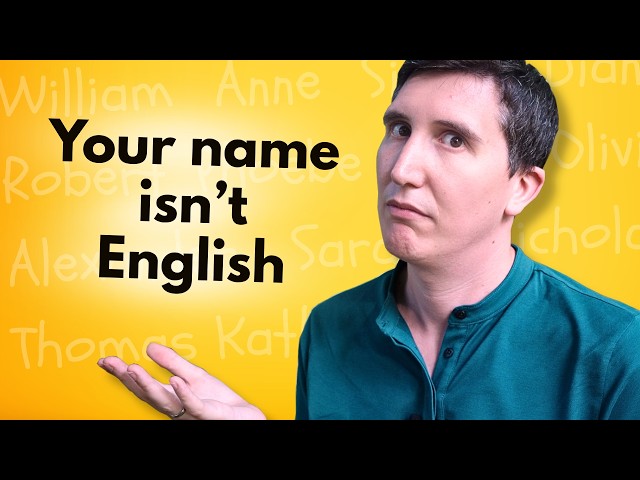
Almost no names are 'English'
RobWords
0:00 Did you know there are only about a dozen truly English names?
0:03 If your name is on this list it’s one of them.
0:07 What do I mean by “truly English”?
0:09 Well, you’ll see.
0:11 All the rest of them had to find their way into our language somehow,
0:14 and at some point they meant something literal in a language other than our own.
0:20 So let’s dig into them in another RobWords.
0:25 Names are weird aren’t they?
0:26 They don’t feel like words because because
0:29 unless you’re called something like Hope or Hunter,
0:32 they don’t mean anything, do they?
0:34 Not in English anyway.
0:36 They’re just collections of syllables we use
0:39 to differentiate one human being from the next.
0:43 But those syllables are not random as is going to become apparent.
0:48 So what was I getting at when I was talking about “truly English names”?
0:54 What I meant is that these names have been
0:57 used in England for as long as England has existed.
1:00 They are Anglo-Saxon names that have survived a millennium
1:04 and a half of history and upheaval and remain in use today.
1:10 And what’s more, unlike the vast majority of the names we’re going to cover,
1:14 they can be traced back to English words.
1:17 Specifically Old English, the, admittedly barely recognisable,
1:21 early form of our language.
1:23 When the Anglo-Saxons named someone,
1:25 they often did what we do now when we call someone Grace or Faith or Earnest.
1:32 They named them after the virtues that they hoped they would possess.
1:36 For example, the name Ethel started out
1:39 as the Old English æþele and meaning “noble”.
1:43 The name Athelstan, spelt in Old English like this, meant “noble-stone”, i.e.
1:49 classy and rock steady.
1:51 There’s also an “athel” hiding in Audrey.
1:54 It is a latinized form of the kick-ass
1:58 Anglo-Saxon name Æðelðryð meaning “noble strength”.
2:02 Pretty cool.
2:03 And while we’re on names we actually use:
2:06 Edward is from the Old English for “prosperity guardian”.
2:10 The “ward” is the same as our modern word “ward”, or “warden”.
2:13 And the Ed means wealth or prosperity.
2:16 Someone who was rich or, later,
2:19 just happy used to be described as eady, which comes from that same source.
2:25 And that Ed also shows up in Edmond, Edwin, Edgar, and Edith.
2:31 All left over by the Anglo-Saxons.
2:34 And if you’re a Ted, Ed or Eddie, you now know where your name comes from too.
2:39 Alfie is a very popular baby name right now.
2:42 It’s a pet form of Alfred, which is also having a bit of a moment itself.
2:46 That’s some serious Anglo-Saxon.
2:48 Ever heard of Alfred the Great?
2:51 Well, the Alf in his name is– I
2:54 think surprisingly– an early form of our word “elf”.
2:57 And the “red” is related to our word “read”, which originally meant “advise”.
3:02 So when we read a book, it’s kind of advising us.
3:05 We are taking in its knowledge.
3:06 So “Alfred” often gets translated as “elf counsel”.
3:11 Which sounds mad, but if you think that an elf
3:14 is essentially a divine being to the Anglo-Saxons, it makes a bit more sense..
3:18 The “fred” in Alfred is not the same
3:21 as the “fred” in another Anglo-Saxon name though: Wilfred.
3:25 That’s the Old English friþ, meaning “peace”.
3:28 The Wil is the same as we still use when
3:31 we say “That is my will!” or “Last will and testament”.
3:35 It means “desire” or “wish”.
3:38 So Wilfred meant something like “desiring peace”.
3:43 Nice.
3:44 Meanwhile, Winifred means “friend of peace” or “peace comrade”.
3:49 The “win” is the same as we saw in Edwin.
3:52 Now you might be thinking, “Rob, who the heck has these names anymore?” Well,
3:57 I’m just telling you to keep this information in your back
4:00 pocket because I think they’re going to come back.
4:02 I met a baby Wilfred just the other day,
4:05 and you have to bear in mind that these names
4:08 were really popular about a century ago and naming experts
4:11 talk about a “hundred year rule” because we like to give
4:16 our kids the sorts of names our great grandparents had.
4:19 So if a name was popular in the 1920s,
4:23 there’s a good chance it’s going to popular in the 2020s too.
4:27 Their time is due.
4:29 It’s worth pointing out that the Anglo-Saxons
4:32 weren’t only giving themselves Anglo-Saxon names.
4:34 Some of them had, for example, Celtic names.
4:37 There was an Anglo-Saxon bishop called Chad.
4:40 Which is ridiculous.
4:41 He sounds like he should be stealing your lunch money in an American movie.
4:44 But no: his name was Chad and it comes from a Celtic word meaning “battle”.
4:50 He actually became Saint Chad, so talk about a megachad.
4:55 Is that what people say?
4:57 Gigachad?
4:58 Megachad?
4:58 I can’t remember the order of magnitude.
5:01 The Anglo-Saxons’ time in charge ends with the death of King Harold,
5:05 who had a Viking name.
5:07 In the 9th century, the Norsemen, the Danes as they used to call them,
5:11 took control of a large chunk of England,
5:13 and as a result, a lot of names from Old Norse slipped into English as well.
5:22 Harold’s loss and death at the Battle of Hastings
5:25 is the next key historical point in the development
5:29 of our names Because he loses out
5:32 in that battle to William the Conqueror who is… foreign.
5:37 He’s from Normandy just across the channel and he speaks a variety of French.
5:44 What William does, after he’s snatched the throne from Harold,
5:47 is replace almost all of the Anglo-Saxons with any power with his Norman pals.
5:53 Suddenly French names were all the rage.
5:56 Not least, William, which has never gone out of fashion.
6:00 Some of these names wouldn’t have been totally unrecognisable to the English,
6:03 because a lot of them are French takes
6:06 on Germanic names left over by the Franks.
6:09 So they were compounds like Alfred, Edward etc.
6:12 were.
6:13 William itself was from a Germanic
6:15 compound meaning “will” or “desire”, and “helmet”.
6:18 So “desire helmet” …which sounds weirdly filthy now I say it out loud, sorry.
6:24 Anyway, you can see it more easily in the modern German equivalent Wilhelm.
6:29 All the “bert” names that seem so French: Albert, Robert,
6:33 Hubert– Albert, Robert (like me), Hubert are actually Germanic compounds.
6:40 They have a bit at the end meaning “bright”,
6:43 actually related to our word “bright”.
6:45 And then they’ve got something else at the front.
6:49 In my case, Robert means “famous and bright”.
6:53 Not bad.
6:54 Richard is another juicy compound from the time.
6:57 The “hard” does actually mean “hard”.
6:59 Richard means “hard ruler” or “strong ruler”.
7:04 Roger is another one, once meaning “famous spear”.
7:08 And Oliver is thought to be a French adaptation
7:12 of the Middle Low German Alfihar meaning “elf army”.
7:17 There’s that elf again.
7:19 Which means Oliver doesn’t actually have anything to do with olives at all.
7:24 Although it’s likely that the Old French for olive tree,
7:28 olivier, influenced its new spelling.
7:30 During the centuries where England is being ruled in French,
7:33 we get a flood of these Frenchified names,
7:35 which all-but replace the Anglo-Saxon ones.
7:39 It’s why we have so few of those now.
7:41 Instead, we have Germanic-tinged French names like Henry,
7:45 Hugh, Leonard, Ralph, Raymond, Walter, Matilda& Adelaide.
7:51 I have fewer female examples to give, by the way, because of what happens next.
7:58 Around the time all this name-swapping has been
8:01 going on, something else has been bubbling away:
8:05 The Crusades, which saw Christians from Western Europe fighting
8:09 for control of holy sites in the Middle East.
8:11 Most notably, Jerusalem.
8:13 That religious fervour and the enormous power of the Roman Catholic Church
8:18 at the time saw a huge surge in the use of Christian names,
8:25 which still account for a huge proportion of the names that we wear today.
8:29 In a somewhat back-to-front fashion, the New Testament names are popular first.
8:34 The names of the apostles,
8:35 the names of the gospels and other key figures in Jesus’ life.
8:39 Mary is a biggie, of course.
8:42 We take all of these names for granted,
8:45 but they had to come from somewhere, didn’t they?
8:48 Yeah, the New Testament.
8:50 One name is conspicuous by its absence though, isn’t it?
8:53 And that is the name of the guy himself: Jesus.
8:58 That’s because it was thought tantamount to blasphemy to give
9:01 that name to anyone other than the son of God.
9:04 Although, not in all cultures, of course.
9:06 You can come across people with the name
9:10 Jesus or Jesús in Portuguese or Spanish, either as a first name or as a surname.
9:16 Anyway, as well as the New Testament names,
9:18 the names of saints who aren’t featured in the Bible also became popular.
9:23 Names like George, Nicholas, Christopher, Lucy, Helena, Monica.
9:29 Medieval saints also get a look-in as well, like Francis,
9:32 Benedict, Gregory– the names of Popes for example– Catherine, Margaret, Clare.
9:38 Actually, religious names are thought particularly appropriate for women,
9:42 which is one of the reasons so few
9:44 of the French feminine names are still around.
9:47 And then, thanks to this guy,
9:50 Martin Luther, the Protestant Church gains influence,
9:53 and it stresses the importance of the whole Bible,
9:56 not just the New Testament, and Old Testament names become the order of the day.
10:01 For the men, Adam, Noah– hugely popular at the moment– Abraham,
10:06 Isaac, Jacob, Joseph, Aaron, Benjamin, David, Solomon, Samuel,
10:10 Daniel– my class at school was full of Daniels.
10:14 And for the ladies, Eve, Sarah– there were a lot of Sarahs as well– Rebecca,
10:20 Rachel, Hannah, Deborah, Judith, Naomi.
10:23 All holy names Some hugely popular names in there.
10:28 And what I would love to do is tell you the history of each of them,
10:31 but we’d be here all day.
10:33 And it’s really cold.
10:34 A good chunk of them, though, come from Hebrew.
10:37 For example, Jacob is from Ya’aqov,
10:38 said to mean “supplanter” or “one who takes by the heel”.
10:42 An apparent reference to him being born holding his twin brother Esau’s heel.
10:47 John is from Hebrew Yochanan,
10:49 said to mean “god is gracious” and Mary is from Miryam,
10:53 which some claim meant “rebellion”, although no one seems to be certain.
10:58 I probably don’t need to tell you also
11:00 that the name Miriam comes from the same source.
11:03 But so does Marie, Maria and Maia.
11:07 You see, the wide spread of Christianity means these names have
11:11 lots of versions from different parts of the world and sometimes,
11:14 we’ve taken to using several of them.
11:17 Just look at the other two examples I gave: Yochanan gives us John, yeah,
11:21 but also its multilingual equivalents Jan, Jean,
11:24 Johannes, Johan, Giovanni, Ivan, Ewan and Ian.
11:30 And Ya’aqov is the source of Jacob, but also James.
11:34 It’s ultimately the same name, along with Iago, Diego, Hamish and Seamus.
11:41 Actually, a very cool fact is that Seamus
11:43 and Hamish are quite literally the same name.
11:45 In Scottish Gaelic, you would refer to your friend
11:48 Seumas as “Seumas” if you were talking about him,
11:51 but if you were addressing him directly- in what’s
11:53 called the vocative case- you would say “A Sheaumais”.
11:57 Get an English person who’s overheard that to write it down,
12:00 and you get the name Hamish.
12:02 One person: two names.
12:05 Actually, spotting related names is quite a fun pastime if you’re sad, like me.
12:10 I only just found out that Liam– the most popular
12:13 name for baby boys in the USA at the moment,
12:16 by the way– is an Irish shortened form of William.
12:20 So not only have you got Will, Willy,
12:22 Bill and Billy, you’ve got Liam in the William family too.
12:26 But that is just the start of it.
12:27 I recently came across this brilliant book.
12:30 “A list of Christian Names, their derivatives,
12:33 nicknames and equivalents in Several Foreign Languages.” Now,
12:36 this was prepared for the US War Office in the 1920s,
12:39 so it’s over a hundred years old, but it is a goldmine of related names.
12:44 For example, did you know that the names Lewis, Luigi, Louie,
12:50 Ludwig, Ludovic, and Clovis, bizarrely, are all variations of the same name?
12:55 Or that Stephen, Esteban and Etienne are the same?
12:59 How about Geordie, George, Georg and Jörg?
13:02 They’re all the same.
13:03 The names Geoffrey and Godfrey are the same name.
13:07 And Walter and Gaultier, as in Jean-Paul Gaultier… they’re the same name.
13:14 I absolutely love this stuff.
13:15 We’ve just swept up so many names, haven’t we?
13:18 From so many different languages.
13:20 And Biblical names just remain so enormously fashionable, especially in the US,
13:25 where Old Testament names– shared between
13:27 Jewish and Christian traditions– are particularly popular.
13:30 Names like Isaiah, Ezekiel, Caleb, Elijah and Elias.
13:34 Actually, those two last ones are variants of the same name as well.
13:39 But let’s move on because I now want to talk about
13:41 the next big historical event that changes our naming culture: The Renaissance.
13:49 Renaissance literally means “rebirth”,
13:51 and it’s so called because of a rebirth of classical culture:
13:56 namely appreciation of Ancient Greek and Roman culture.
14:00 And in England, names got swept up in it too,
14:04 with people giving their kids names derived from Latin and Greek Like Alexander:
14:10 from Greek Alexandros, literally “defender of men”.
14:14 Alexandra is just a feminine version of it.
14:17 That “andra” at the end of Kassandra likely means “of men” too,
14:23 but no-one is certain what the Kass- bit means.
14:26 Maybe it means “shine” or something like that.
14:29 Nicholas is another good Classical name, also popular because of St Nicholas.
14:33 Greek Nikolaos means “victory people”.
14:36 The Nik is the same as in Nike, the sports brand and goddess of victory.
14:42 This all goes for Nichola too.
14:44 Now, if you’ve ever met a Theodore who thought they were god’s gift,
14:49 well, they were sort of right.
14:51 At least, that’s the meaning of the Greek Theodoros.
14:54 Theodora is therefore also a gift of God.
14:57 But check this out: swap those two elements around,
15:01 and if you join the Dots– or indeed,
15:04 follow the yellow brick road– you get Dorothea, aka Dorothy.
15:10 Another of God’s gifts.
15:13 Helen had a face that launched a thousand ships,
15:15 but her name– and that of Helena,
15:18 of course– likely comes from the Greek helenos meaning “bright one”.
15:22 Similarly shiny is Phoebe, the Titaness associated with the Moon.
15:27 Her name is from the Greek phoibos, also meaning “bright”.
15:31 Her granddaughter is Artemis, goddess of the Moon,
15:35 whose Roman equivalent was Diana.
15:38 That has an ancient root meaning– guess what?
15:41 “Shine”.
15:42 That same Proto-Indo-European root also gives us words like “divine”,
15:47 “deus”, “Zeus” and “Jove”.
15:49 Julius Caesar claimed his name meant “descended from Jove”.
15:53 Jove as in Jupiter.
15:55 But that might just have been a bit of megalomaniac myth-making.
15:59 Now, there’s a word for names that invoke the name of a god.
16:02 They’re called theophoric.
16:05 And annother one is Marcus.
16:07 It means “of Mars”, Mars being the Roman god of War.
16:13 And there’s another “of Mars” name: Martin.
16:17 Which means the same as Martian.
16:19 So all Marcuses and Martins are Martians.
16:23 FACT.
16:24 Gods aren’t the only Roman representatives in our names.
16:27 We’ve also got names that refer specifically to Roman virtues.
16:31 Or rather, Latin words for those virtues.
16:33 Victor is the Latin word for conqueror, whence victory and the name Victoria.
16:39 Felix and Felicity are from the Latin for happiness.
16:43 Serena is the Latin for tranquil, from which we get the word serenity.
16:47 And Justin and Justine/Justina are from Iustinus,
16:52 Latin for “fair” or rather, “just”.
16:57 And just one more point here: someone who caught the Renaissance classical
17:01 naming bug was a certain William Shakespeare,
17:04 who used plenty of them in his plays.
17:06 Indeed, some of these hadn’t appeared
17:08 in an English context before Shakey came along.
17:11 He was a great importer of names.
17:14 Names that appear first in his works include Jessica,
17:19 Cordelia, Miranda, and Olivia.
17:21 Olivia was a popular name elsewhere, of course.
17:24 It just means olive, but do remember when I said this earlier?
17:29 “Oliver doesn’t actually have anything to do with olives
17:33 at all!” Meaning the names Oliver and Olivia aren’t related.
17:38 One means “elf army” and the other means “fruit that looks
17:42 like a grape but couldn’t taste any less like one”.
17:44 Isn’t that mad?
17:46 One more from Shakespeare:
17:47 he’s often credited with inventing the name Imogen but the story
17:51 goes that he only did so because he misread another name: Innogen.
17:57 That one’s debated, but it’s worth a mention.
17:59 So I’ve covered the origins of the vast majority
18:00 of what we might consider to be English language names,
18:04 but of course we encounter people with many more names than those day-to-day.
18:09 That’s partly because of the way people have been able to move
18:12 around the planet over the past couple of centuries or more,
18:15 and also a more creative naming cultures.
18:18 But I think I’ve shown that your name almost certainly isn’t English.
18:24 It might be French, Frankish, Latin, Greek,
18:28 Celtic or Hebrew but unless it's Edward or Ethel, it probably ain’t English.
18:34 Why not share this video with an Oliver, Alexander,
18:37 Olivia or Kassandra and I’ll see you in whatever you choose to watch next.
18:43 Until next time, take care.