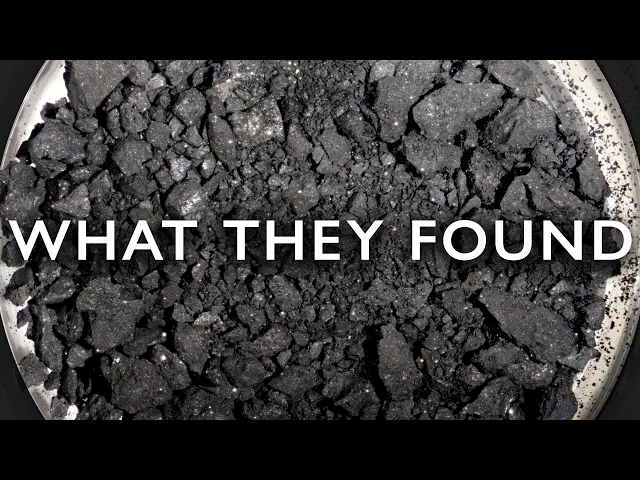
The Weirdest Things NASA Found On Space Rocks
Astrum Extra
0:00 When we imagine aliens visiting Earth,
0:03 we often picture an evil crew on a spaceship,
0:06 scary, threatening, and weirdly humanoid.
0:10 But what if aliens end up slipping onto
0:12 our planet in much smaller and subtler ways, on a microscopic scale, unnoticed?
0:20 Now, flip that question.
0:22 When we send spacecraft across the solar system, land on distant asteroids,
0:28 and bring pieces of them home,
0:30 how can we be sure we aren't leaving traces of ourselves behind?
0:35 Traces that future scientists might one day misinterpret as something alien.
0:42 That's one of the reasons sample return missions are so fascinatingly delicate.
0:48 When we venture out there to bring a piece of the universe back here,
0:52 we need to touch without leaving fingerprints.
0:55 And in the case of asteroid Ryugu,
0:58 what came back to Earth wasn't just a handful of ancient dust,
1:02 but a lesson in just how easy it is
1:05 to confuse what's truly alien with what's all too familiar.
1:11 I'm Alex Mikalogan, and you're watching Astrium.
1:14 Join me today as we explore why
1:16 asteroids like Ryugu are so scientifically valuable,
1:20 how the Hayabusa 2 mission successfully brought home a piece of it,
1:24 and the hidden threat right here at home that almost ruined the whole thing.
1:33 Why study asteroids in the first place?
1:37 Far more than lifeless rocks, they're really more like time capsules.
1:43 You see, our solar system was created over 4.5 billion years ago.
1:47 Its planets, moons, and all other celestial bodies
1:51 are thought to be made from some primordial material,
1:54 but it's hard to tell what that material
1:56 may have been just by studying Earth rocks?
2:00 On Earth, erosion, tectonic activity, and the weather modify the material's
2:05 physical and chemical properties beyond recognition.
2:09 That's not the case with asteroids, [music]
2:11 where this material remains largely unperturbed by time,
2:15 like a window into the earliest days of our solar system.
2:19 There's also evidence to suggest asteroid collisions
2:22 with Earth might have delivered organic compounds
2:25 to our planet when [music] the conditions for life were just starting to emerge.
2:30 Asteroids might hold insights we can't get elsewhere about
2:33 the origins of the solar system and the life in it.
2:36 Yet, getting to asteroids isn't easy.
2:39 Most of them are found in the asteroid belt
2:41 circling the Sun in an orbit between Mars and Jupiter.
2:45 A trip out there, though it has been done before, would take a long time.
2:51 Not worth it just to collect a small sample.
2:54 It is much more efficient to send
2:56 a spacecraft to an asteroid that crosses Earth's orbit.
3:00 So, that's exactly what the Japanese Aerospace Exploration Agency, or JAXA, did.
3:07 In 2010, the Hayabusa mission returned the first ever asteroid samples to Earth.
3:13 Taken from asteroid Itokawa and weighing less than a gram,
3:17 it set the stage for the sequel mission, Hayabusa 2.
3:25 On the 3rd of December, 2014,
3:27 Hayabusa 2 spacecraft launched from the Tanegashima Space Center in Japan.
3:32 The mission aimed to gain insight
3:34 into the origin and evolution of the solar system,
3:37 including the beginnings of life.
3:40 It would do this by collecting samples from the near-Earth asteroid Ryugu.
3:45 Discovered in 1999, it measures 900 m across and comes within 195
3:52 million kilometers from the Sun or 45 million kilometers of Earth's orbit,
3:57 a quarter of the distance to the asteroid belt.
4:01 After almost 4 years of travel,
4:04 Hayabusa 2 arrived at Ryugu on the 27th of June, 2018.
4:10 The spacecraft consisted of an orbiter
4:12 equipped with instruments including optical navigation cameras,
4:16 a near-infrared spectrometer, a thermal infrared imager, and a lidar.
4:22 These tools mapped Ryugu's surface, composition,
4:26 and thermal properties from an orbital altitude of 20 kilometers.
4:31 Soon after arrival, Hayabusa 2 deployed two small Minerva 2 rovers,
4:38 the first to successfully land on an asteroid.
4:42 Rover 1A and Rover 1B used internal
4:45 rotating masses to hop in Ryugu's low gravity,
4:49 capturing images and temperature data of the surface.
4:53 Soon after, the MASCOT lander was released.
4:57 Because Ryugu's gravity was too weak to pull MASCOT toward it,
5:01 the lander was pushed out of the spacecraft by a spring
5:05 and then free fell from a height of 51 meters.
5:09 6 minutes later, it touched down on the asteroid,
5:13 bouncing several times before coming to a halt.
5:17 It operated on Ryugu's surface for 17 hours,
5:20 collecting magnetic, thermal, and spectroscopic data.
5:24 A third rover, Minerva 2-2,
5:27 was released in October 2019 but failed before deployment.
5:32 Instead, it was released into orbit as a gravitational
5:35 experiment before crashing into Ryugu 5 days later.
5:40 Hayabusa 2 retrieved samples from Ryugu during two brief touchdowns in 2019.
5:47 The first touchdown gathered surface samples close
5:50 to the equatorial ridge by firing a small projectile.
5:54 The impact ejected surface material into the sampler horn,
5:58 which then funneled it into sealed
6:00 containers with the spacecraft's return capsule.
6:03 The second sample came from firing a small carry-on impactor
6:07 on touchdown to create an artificial
6:10 crater and expose [music] subsurface material.
6:13 The reasoning behind the two sample types was [music]
6:16 that the surface samples had been exposed to the regular radiation,
6:20 micrometeoroid impacts, and temperature cycles of space.
6:24 Whereas, the subsurface material had been shielded from this cosmic weathering,
6:29 providing a more comprehensive picture of Ryugu's composition.
6:34 By November 2019, the spacecraft had everything it needed.
6:39 With its precious cargo loaded,
6:41 it wrapped up its time at Ryugu and started the return journey home.
6:46 Over a year later, in December 2020, Hayabusa2 emerged above our pale blue dot.
6:54 As it soared past us,
6:56 it dropped a landing capsule containing the 5.4 g of asteroid sample,
7:01 which parachuted down to a soft landing in South Australia.
7:06 NASA and JAXA are sharing samples between
7:09 the Hayabusa2 mission and the similar OSIRIS-REx mission,
7:13 which returned samples of the Bennu asteroid in 2023,
7:17 maximizing research potential and opportunities for peer review.
7:22 As the spacecraft continued on its
7:24 extended mission to another, smaller asteroid,
7:27 scientists on Earth scrambled to extract and analyze
7:30 this little piece of our universe's history.
7:35 The heavy weight of hope was placed on this tiny asteroid sample,
7:41 and it didn't disappoint.
7:44 We already knew that Ryugu belonged to the C-type or carbonaceous asteroids,
7:48 which tend to be found in the outer regions of the asteroid belt,
7:52 and contain similar materials to those from the time
7:55 our solar system was formed.
7:57 But, what we didn't know, and to researchers' delight,
8:01 Ryugu's composition was found to be very similar
8:04 to a rare class of meteorites known as C1 chondrites.
8:10 C1 chondrites are the most chemically primitive meteorites known,
8:14 and are characterized by the presence
8:16 of carbonaceous material other than pure carbon, like diamond or graphite.
8:23 They contain chondrules, which are small,
8:26 round grains that formed in the solar nebula when our sun was still very young.
8:32 It seemed JAXA had hit the nail on the head.
8:35 Their mission had gotten them up close
8:37 and personal with the birth of the solar system, just as they had aimed for.
8:43 Today, Ryugu orbits our sun relatively close to Earth,
8:46 scraping by at a distance of just 114,000 km at its closest.
8:52 But, it didn't always call this galactic neighborhood home.
8:56 Using an X-ray technique called Mössbauer spectroscopy,
9:00 the team put together a timeline of Ryugu's past
9:03 by meticulously analyzing minute chemical
9:06 changes in each sample particle fragment.
9:09 What they found is convincing enough to place
9:12 Ryugu's origins in the outer solar system.
9:15 The asteroid's surface properties support this theory.
9:19 If Ryugu had originated closer to the sun,
9:22 where temperatures are higher, researchers would expect to see coarser grains.
9:27 Additionally, the grain fragments are porous.
9:31 This is exactly what you'd expect to see
9:33 in asteroids that once held water and carbon dioxide ice.
9:38 In order for those compounds to be solid,
9:40 Ryugu's parent body would have been three to four
9:43 times farther from the sun than Earth is.
9:46 Research places Ryugu's formation about 2
9:49 million years after the solar system itself.
9:52 Over the next 3 million years, its parent body lost its ice,
9:57 leaving behind a hydrated interior and dry surface.
10:02 About 1 billion years later, a cosmic impact fragmented it.
10:07 Those fragments eventually coalesced into today's Ryugu.
10:12 Sample analysis also showed the asteroid
10:14 contains a rich mix of organic molecules.
10:17 This is huge as it implies that the fine-grained surface of an asteroid as old
10:22 as Ryugu is able to shield organic
10:24 molecules from the harsh environment of interstellar space.
10:28 Hiroshi Naraoka of Kyushu University in Japan confirms
10:33 that these molecules could be transported through the solar system
10:37 and even be potentially dispersed as interplanetary dust
10:40 by impacts that eject the uppermost layer of the asteroid.
10:44 It seems to add weight to the hypothesis that abiotic chemical reactions
10:48 on asteroids might play a role in creating some of life's ingredients.
10:53 But beyond just organic molecules, one research team at Imperial College London
10:58 also found something a lot more exciting.
11:01 Organic matter.
11:04 Not exactly life, but rods and filaments similar
11:08 to the size and shapes of microorganisms here on Earth.
11:12 If these were true extraterrestrial organisms,
11:15 it would finally prove that the idea of panspermia,
11:19 aka that life originating from elsewhere in the universe
11:22 can survive the transfer between planetary bodies, is possible.
11:27 But before they shouted alien, the team did what any good scientist would do.
11:33 They double-checked their work.
11:36 Space agencies have very tight protocols
11:39 when it comes to preventing contamination.
11:41 The Ryugu sample traveled to Earth
11:43 in a hermetically sealed chamber and was opened
11:46 in a class 10,000 clean room using sterilized
11:50 tools before being stored in airtight containers under nitrogen.
11:54 When scientists went to retrieve the sample to begin testing,
11:57 they first performed an X-ray nanotomography analysis,
12:01 basically X-ray on steroids.
12:05 It allows researchers to image internal structures at scale
12:08 smaller than a micrometer without sectioning or damaging the specimen.
12:13 This was to check that Ryugu sample didn't fall prey to any contamination
12:17 in the process of transferring it
12:19 from the landing capsule into a storage facility.
12:23 The results came in.
12:24 Ryugu sample was clean.
12:27 So, where did the microorganisms come from?
12:32 Upon arrival on Earth, the primary Ryugu samples were carefully subdivided
12:37 into multiple portions in JAXA's specialized facility.
12:41 Some remained sealed in their pristine state for future analysis,
12:45 while others were distributed to different
12:47 research teams worldwide for immediate study.
12:50 This standard practice allows scientists to maximize research
12:53 potential while preserving portions of the irreplaceable material.
12:58 Subsample A0180, measuring just 1 by 0.8 mm,
13:05 traveled to Imperial College London,
13:07 where, despite the meticulous protocols and cutting-edge containment systems,
13:12 the impossible happened.
13:15 During their first observation by scanning electron microscopy,
13:19 the researchers noticed something strange.
13:22 Rods and filaments of organic matter scattered across the sample.
13:27 Cylindrical and carbon-rich,
13:29 these specimens were mainly observed on the surface of the sample.
13:33 Though, 28% were found within porous cavities.
13:38 They counted 11 rods and filaments in total,
13:42 a number which rose to 147 at the second
13:45 scanning electron microscopic examination 19 days later.
13:50 Just to be sure, they surveyed common fabrics and fibers
13:53 in the lab to compare them to these filaments.
13:56 Hair, clothing, wipes, nothing seemed to match.
14:00 They paid close attention to the rate of population growth and decline,
14:04 and concluded that, based on population statistics,
14:08 the specimens were living and had
14:11 infiltrated the Ryugu rock after sample preparation.
14:15 In order to examine a rock under a microscope,
14:18 the sample must first be cut, ground,
14:21 and polished to create a flat, mirror-like surface for examination,
14:25 also known as preparation of the polished block.
14:29 The research team deduced it was
14:31 at this point that the rods and filaments appeared,
14:34 a conclusion supported by the earlier findings of the nano X-ray tomography,
14:39 which came out clean.
14:41 This pointed to one explanation.
14:44 The rods and filaments were likely microorganisms of terrestrial origin.
14:50 Earthly bacteria had contaminated our pristine asteroid sample.
14:56 The team didn't attempt to sequence the bacteria's DNA,
14:59 so we don't know exactly what species it was,
15:03 but it was likely a single spore of some kind of prokaryote,
15:08 probably a bacillus, that started forming a colony.
15:13 Luckily, the team was able to control the spread.
15:16 Once they repolished the block,
15:18 the microorganism population disappeared for good,
15:21 and analysis could go on as planned.
15:24 Despite the contamination setback,
15:27 Ryugu's sample had proven incredibly valuable.
15:30 Combined with NASA's much larger sample from Bennu,
15:33 which weighed 121.6 g and arrived in 2023,
15:38 it had given us a glimpse into the early days of the solar system,
15:42 and new findings about both asteroids are still coming to light.
15:48 As we prepare for more ambitious sample return missions,
15:52 including potential trips to Mars, the stakes get even higher.
15:57 If we're looking for signs of life, we need to be completely certain we're
16:02 not finding hitchhikers from our own planet.
16:05 Space agencies do have planetary protection guidelines
16:08 in place to minimize the risk of forward contamination,
16:11 us taking microbes to other planets, and back contamination,
16:16 setting alien life loose on our planet.
16:19 And Hayabusa 2 is a great example of how space exploration is as much about
16:24 the challenges here on Earth as it is
16:26 about [music] the challenges out there in space.
16:30 Each mission teaches us something new about our target subjects,
16:33 as well as our own methods.
16:36 And despite the unexpected hiccup, Ryugu's ancient material continues to improve
16:41 our understanding of celestial origins.
16:44 I'm excited to see what new findings will come out in the next 5 to 10 years.
16:48 Until then, we'll just have [music] to sit tight.
16:52 Thanks for watching.
16:53 If you enjoyed this video,
16:55 you might want to check out my other videos on asteroid Bennu.
16:58 Until next time.
17:02 Does life originate from stardust?
17:06 Interestingly, this is something the aptly named Stardust
17:10 spacecraft did not originally set out to discover,
17:13 but it's a question that its findings have provoked.
17:16 And it's all thanks to including the lightest substance in the world on board.
17:23 The Stardust spacecraft is known for its involvement
17:26 with the Deep Impact NASA mission to the comet Temple 1.
17:30 However, this was not Stardust's first mission, nor its primary one.
17:35 Before Temple 1, Stardust was out collecting data on another comet
17:39 by doing something that no other probe before it had done.
17:42 Its mission was to travel to the comet Wild 2,
17:46 collect some of the material from its coma,
17:48 and then deliver the sample intact back to Earth.
17:52 And given that this would involve catching
17:54 particles that were moving at over 23,000 km/h,
17:58 all without damaging them, this was no easy task.
18:02 I'm Alex McConaughey, and you're watching Astrium.
18:05 Join with me today as we explore
18:07 how Stardust managed to accomplish this incredible feat,
18:10 and uncover what Stardust's findings taught us
18:13 about cometary origins, as well as our own.
18:20 In the late 1990s, cometary science was still in the early stages.
18:25 Although we had sent six probes up to visit these enigmatic celestial bodies,
18:29 not very much was known about their origins.
18:32 It was believed at the time that comets were
18:35 foreign visitors to our solar system, older than the Sun,
18:38 having been formed from the loose pre-solar grains of dust
18:41 that orbit other stars before drifting through space towards us,
18:46 only to be caught up in the Sun's gravitational pull.
18:50 It was believed that this theory could be confirmed by traveling
18:53 to one of these comets and picking up some of this loose dust,
18:56 or stardust, that surrounds them in space.
19:00 By examining the isotopic composition,
19:02 scientists would be able to tell if it was unusual
19:05 when compared to the dust given off by our own star.
19:09 However, this was a challenging mission.
19:12 As is often the case, it came down to a question of speed and energy.
19:16 Comets travel through the inner solar system at speeds reaching 160,000 km/h.
19:22 While it was possible for a probe to try
19:24 and match that speed and come up alongside it,
19:27 this had to be done without needing too much fuel or the weight of the craft
19:31 would be too heavy and thus too expensive to get into space in the first place.
19:36 For this mission, scientists selected a comet known as Wild 2.
19:40 They believed that they would be able to get
19:42 Stardust alongside Wild 2 at a relatively low velocity.
19:46 However, this velocity would still be around 6.5 km/h or 23,400 km/h.
19:54 As you can imagine, catching even particles
19:57 at that speed would be extremely challenging.
20:00 Although particles would likely not do too much damage to Stardust,
20:04 being too small to really impact it,
20:06 it would do irreparable damage to the particles themselves.
20:11 When an object crashes at 23,400 km/h into a surface,
20:16 the odds of it keeping its original shape and structure are incredibly small.
20:21 Scientists would not learn much about the structure
20:23 of these particles if they smashed those particles into pieces,
20:26 not to mention the warping effect all that kinetic energy being
20:30 suddenly converted into thermal would have on the molecular bonds involved.
20:35 So, what was their solution?
20:37 What was their mechanism for catching objects traveling at those speeds?
20:41 Well, much like how an airbag softens the blow
20:44 for you if you're involved in a car crash,
20:47 scientists realized that they would need an airbag of their own.
20:50 Something that would not halt the particle all at once,
20:53 but would reduce its speed over a longer distance,
20:56 thus reducing the amount of crushing deceleration involved.
21:00 For this, they found an incredible material that was basically air, solid air.
21:05 They decided to use aerogel.
21:09 Aerogel is a fascinating substance that was discovered in 1931 by Samuel
21:14 Kistler when he made a bet with fellow scientist Charles Learned about jelly.
21:19 As you've probably seen if you've ever made it yourself,
21:22 jelly is formed of two parts.
21:24 Firstly, a relatively solid structure that acts like a kind of sponge,
21:28 and secondly, water.
21:31 When you add water to solid cubes of dense jelly,
21:34 it absorbs the water and expands into the wobbly substance we are familiar with.
21:39 If you were to extract the water,
21:41 the solid part of the jelly would normally contract again.
21:44 Kistler's bet with Learned was to be the first one to remove
21:47 all of the liquid from the jelly without making it shrink.
21:52 In short, to make a jelly that was entirely filled with air, an air jelly.
21:57 Without going into all the details,
21:59 Kistler won his bet and at the same time invented the first aerogel.
22:04 Aerogel is a fascinating substance as it is usually over
22:07 99% air and yet has the structural strength to support bricks.
22:13 Nowadays, it tends to be made from silica composites rather than jelly,
22:17 but can be made from a wide range of materials.
22:21 It is incredibly light and is strangely
22:23 enough an even better insulator than regular air.
22:27 And most importantly for Stardust, when particles hit it,
22:30 it would offer just the right amount of resistance
22:33 to slow down the particle without denaturing or destroying it.
22:37 The trails left behind in the aerogel would also be
22:40 useful for scientists to spot where a particle had been captured.
22:45 Stardust was fitted with a tennis racket-sized
22:47 aerogel collector tray made up of 90
22:49 blocks of aerogel 3 cm thick with over 1,000 square centimeters of surface area,
22:55 which would be deployed from inside the main
22:57 body whenever sampling was to take place.
23:00 Stardust would also capture from the interstellar medium to allow comparisons
23:04 and to learn more about the dust in our own solar system.
23:07 Once it had collected these samples,
23:09 it would store them on a sample return capsule,
23:12 which would be fired back towards the Earth for re-entry and collection.
23:16 This SRC was 80 cm by 50 cm, weighed 45 kg,
23:22 and came fitted with an aero shield, navigation recovery aids, and a parachute.
23:27 Also on board Stardust was a navigation camera,
23:30 a comet trajectory and interstellar dust analyzer,
23:33 and a dust flux monitoring system, among other scientific devices.
23:39 The probe launched on the 7th of February 1999
23:41 and spent the next 5 years traveling through space,
23:45 passing the asteroid 5535 Anne Frank along the way,
23:48 which it took some photos of.
23:50 But on the 2nd of January 2004, it finally arrived at its target, comet Wild 2.
23:57 And what it found was immediately extraordinary.
24:01 Scientists had not expected much from Wild 2.
24:04 Some NASA scientists described their expectation of it to be
24:07 a rather bland object looking somewhat like a black potato.
24:11 However, this is not what they found.
24:13 Instead, the surface of Wild 2 was
24:15 covered with spiky pinnacles hundreds of meters tall,
24:19 cliffs, massive holes jetting dust and gas out into space,
24:23 even on parts of the comet that were pointed away from the sun,
24:27 and thus were expected to be less reactive.
24:30 In short, the surface of the comet was unexpectedly alive and self-renewing.
24:37 [music]
24:37 Something else was just as notable for its absence, craters.
24:42 Unlike almost every other body in our solar
24:44 system with surfaces exposed to space,
24:47 there were no craters on the surface of Wild 2.
24:50 This puts it in stark contrast to places like Mars or our own moon.
24:55 Given the period of time Wild 2 is thought to have existed,
24:58 it surely must have encountered other objects which impacted with it.
25:02 So, where had these craters gone?
25:05 It shows that a comet surface can either be self-renewing or active,
25:10 reducing signs of visible craters over short time frames,
25:13 astronomically speaking.
25:16 And of course, during this flyby, Stardust had its aerogel collector exposed,
25:21 and it was rapidly collecting dust samples.
25:24 Just listen to the frequency in which dust [music] struck the spacecraft.
25:33 The samples were carefully stowed away.
25:36 And upon reaching the vicinity of Earth, Stardust ejected the SRC.
25:41 The angle of approach had to be just
25:43 right as it was traveling at tremendous speed.
25:47 If the approach angle was too low,
25:49 it would just skim off the atmosphere and fly back into space.
25:53 If the angle was too high, the heat would disintegrate the capsule.
25:57 So, it was with great relief that the DC-8 NASA airplane monitoring the sky
26:02 saw it approaching at just the right second and just the right angle.
26:07 The SRC landed in the Utah desert, where it was recovered,
26:10 everything having worked and deployed just as it was designed to.
26:14 And taking the samples back to the lab,
26:16 scientists learned another completely unexpected
26:19 fact about comet [music] Wild 2.
26:21 It was not a visitor to our solar system at all.
26:24 Unlike what had previously been believed,
26:27 comet Wild 2 had not originated from another star.
26:30 It had been born from our own.
26:32 By comparing the isotopic composition of the particles Stardust
26:36 collected with the samples from our own solar system,
26:39 it was proven that comet Wild 2 originated from the solar system.
26:44 And contrary to what all the ice on its surface might lead you to believe,
26:47 the rock at its center was formed under white-hot conditions.
26:52 Chondrules and calcium aluminum inclusions were
26:55 both found among the samples Stardust collected.
26:58 These are structures that only form under incredibly hot conditions
27:02 and can be found in other asteroids between Mars and Jupiter.
27:06 So, scientists had to rethink their theory that comets
27:08 formed in cold conditions at the edge of solar systems,
27:11 even if they do spend some time there.
27:14 Both fire and ice go into making comets.
27:18 And thanks to the careful, delicate way that the particles had been collected,
27:22 scientists were able to find out one last surprising thing,
27:26 the amino acid glycine.
27:29 Amino acids are the building blocks that make
27:32 up proteins that are vital for all living things.
27:35 Although this does not mean that there was anything alive on comet Wild 2,
27:39 this does lend weight to the idea that it was from comets such as this crashing
27:43 into our Earth millions of years ago that life's
27:46 first building blocks found their way to our planet,
27:49 which I'm sure you will agree offers a tantalizing glimpse into our own origins.
27:55 What happened next for Stardust?
27:57 As only the SRC were sent back to Earth,
28:00 Stardust remained in space and had enough fuel to visit another object,
28:05 comet Tempel 1, which is just as well
28:07 as the Deep Impact mission there didn't go as planned.
28:10 And you can find out more about Stardust involvement with that mission here.
28:15 After this extended mission, with all its fuel used up,
28:19 it sent one last transmission to Earth to acknowledge
28:21 that it was being turned off for good.
28:26 Comets are truly fascinating things,
28:29 and it was thanks to the incredible work of the Stardust probe
28:32 and all those who worked on it that we could make these discoveries.
28:36 Who would have expected that as we looked out across the wide universe,
28:39 we would discover things that would help us understand ourselves better?
28:44 But thanks to them, we now know life's origins might just lie in stardust.
28:54 The Rosetta-Philae spacecraft that visited 67P
28:57 Churyumov-Gerasimenko was perhaps ESA's most ambitious mission.
29:04 Launched in 2004 and arriving in 2014,
29:08 it spent two informative years around the very interesting-looking comet.
29:14 Although not everything went to plan, the data that Rosetta and Philae were able
29:19 to collect about comets has changed our perspective of what
29:22 we understand about the formation [music] of the solar
29:24 system and even about our home planet Earth.
29:31 The data will continue to be examined for years to come.
29:35 But, what have we learned so far?
29:40 I'm Alex McConaughey and you're watching Astrum.
29:42 And together, we will uncover what
29:44 the Rosetta-Philae mission discovered around 67P Churyumov-Gerasimenko.
29:53 67P is currently a Jupiter family comet,
29:57 meaning its orbit doesn't take it much further out than Jupiter anymore.
30:02 Although it was once a Kuiper Belt object,
30:05 which means it originated beyond the orbit of Neptune.
30:09 Arriving at this comet was a revelation to mission planners by itself.
30:14 So far, nothing in the solar system
30:16 that has been examined closely looks anything like 67P.
30:21 It's about 5 km across at its longest point and has two lobes,
30:28 which are joined by a narrow stretch of material in the middle.
30:32 This by itself was somewhat unusual, but it is also very jagged.
30:37 Unlike a lot of asteroids that we visited, during the course of the mission,
30:43 it was discovered that the surface of this comet is quite changeable.
30:48 If we look closely at the neck connecting the two lobes,
30:52 it becomes apparent that this section is under mechanical stress.
30:57 If we look at these rocks,
30:58 we can see that there are fracture lines running through them.
31:02 Fracture lines are also apparent from a different angle.
31:07 Scientists have used models based on fracture lines found all around
31:11 the neck region to determine
31:13 that these fractures permeate deeply inside the comet,
31:16 up to 500 m below the surface.
31:20 It seems that as the comet rotates about its axis,
31:24 the two lobes are pulling away from each other,
31:26 thinning the neck region gradually over time.
31:31 Huge 10-m boulders were observed being displaced by this mechanical stress,
31:36 as well as from the volatility on the surface,
31:39 sometimes by up to 100 m due to the comet's weak gravity.
31:45 This also implies that the comet is really quite brittle and porous,
31:50 which is something that wasn't known about comets before this mission.
31:54 As well as fracture lines, layers can also be seen,
31:58 implying that during its formation, this comet was built up gradually over time.
32:04 However, although it is brittle,
32:07 the surface of the comet is a lot harder than expected.
32:11 Scientists thought that the initial landing site
32:13 for Philae would almost be soft and fluffy,
32:16 kind of like a dirty snow, but this was not the case.
32:21 As Philae came to land on 67P to directly interact with the comet,
32:26 it found that its final resting location was solid,
32:29 thought to be water ice with a thin layer of dust.
32:33 Mission controllers for Philae tried to get a sample
32:36 of the soil, but as you can see, Philae ended up at an awkward angle and wasn't
32:41 able to get its drill into the surface.
32:45 However, readings were still able to be obtained
32:48 by examining the material on the craft itself,
32:51 which had ended up on Philae after the bounces.
32:57 Of the surface material examined,
32:59 it was determined that there were 16 different organic compounds,
33:03 four of which had never been detected on a comet before.
33:07 While organic compounds do not mean life, life is based on organic compounds.
33:14 While Philae wasn't able to get too many readings from the surface,
33:18 Rosetta was able to get some samples of the comet by collecting some
33:22 of the dust snow that was ejected away from the comet into space.
33:28 One of the most impressive shots Rosetta was able to take is
33:31 this video of dust particles and cosmic rays shooting off in all directions,
33:36 with background stars moving in the background.
33:40 All the particles are visible here because Rosetta
33:42 is looking at the night side of the comet,
33:45 meaning increased exposure can pick up these interesting visual elements.
33:50 Throughout the mission,
33:52 Rosetta collected roughly 31,000 dust particles, and interestingly,
33:57 their composition didn't change much throughout the course of the mission,
34:01 even as the comet became more active,
34:03 meaning that the whole nucleus of the comet
34:05 is likely to be consistent throughout.
34:09 The dust particles consisted of complex
34:12 organic carbonaceous material mixed in with sodium,
34:16 magnesium, aluminum, silicon, calcium, and iron.
34:21 What separates this material from an asteroid's, however,
34:25 is the presence of an abundance of hydrogen and oxygen.
34:29 It is theorized that asteroids have been heated a lot longer
34:32 than comets have due to their closer proximity to the Sun,
34:36 which has stripped the hydrogen from their compositions.
34:40 Comets, however, have been kept away from the inner
34:43 solar system for much of their lives.
34:45 Meaning these dust samples are pristine relics
34:48 from the formation of the solar system.
34:51 And potentially even the molecular cloud the Sun would have originated from.
34:56 Oxygen was an unexpected find as it's highly reactive.
35:00 And if there is hydrogen around, it will usually bind together to form H2O.
35:06 Carbon and hydrogen were also detected
35:08 in the comet's tenuous atmosphere by Philae.
35:12 The dust particles you see here are tiny.
35:15 The biggest that was collected was only 2 mm across.
35:19 But interestingly, it is particles just like these ones
35:23 that light up the sky during a meteor shower.
35:27 What these views do give us though are an insight to the material that formed
35:31 the solar system so that we can see where the solar system evolved from.
35:37 Comets tend to be very dark,
35:38 only reflecting 3 to 4% of the sunlight that falls on them.
35:43 Which you wouldn't expect from something considered to be icy.
35:46 But actually, not a lot of the ice
35:48 in a comet is exposed to the surface directly.
35:51 Most of the comet is coated in this layer of complex carbonaceous dust,
35:55 which is darker than asphalt.
35:59 Light that isn't reflected is instead absorbed.
36:03 Heating the volatile material beneath the dust layer,
36:06 causing outgassing of water and carbon dioxide,
36:10 which also blasts the tiny dust particles Rosetta picked up into space.
36:15 These colored sections in the time-lapse show exposed water ice.
36:20 And as you can see, it's not a very big percentage of the comet itself.
36:27 Zooming out a little bit and looking at comets generally,
36:31 this is why comets have two tails.
36:33 One tail follows the orbit of the comet.
36:36 This tail is the dust tail.
36:39 The dust tail is illuminated as it reflects sunlight.
36:43 The other tail consists of the volatile material,
36:47 the water and carbon dioxide that outgas from the comet.
36:51 This tail follows the direction of the solar wind.
36:54 And these particles are illuminated through ionization
36:57 and interactions with the charged particles from the sun.
37:02 It is often hard to see comets with your naked eye on Earth,
37:06 but every so often a comet will outgas enough material that it is visible.
37:11 In the northern hemisphere,
37:12 the last one I saw was Hale-Bopp in 1997 when I was just a kid.
37:18 What an amazing sight it was.
37:21 You guys in the southern hemisphere have been a bit luckier with comets.
37:25 You've had Comet McNaught in 2007 and Comet Lovejoy in 2011.
37:33 Going back to 67P, there was one other very big
37:37 reason why the Rosetta Philae mission happened in the first place.
37:41 And that was to see if water on comets is the source of water on Earth.
37:47 Before this mission,
37:48 the theory was that Earth was bombarded by comets early in its
37:52 development back when the solar system was a lot more chaotic.
37:57 Considering a large portion of comets are water ice,
38:00 these could have given the surface of Earth the water we enjoy today.
38:05 But, as it turns out from Philae's findings, this was not the case.
38:11 Scientists were able to determine
38:13 this from the water vapor's deuterium ratio to hydrogen,
38:17 which is significantly different from Earth's.
38:21 Deuterium is an isotope of hydrogen with an added neutron.
38:25 The ratio of deuterium to hydrogen in water is key
38:29 to determining where in the solar system an object originated.
38:34 Here's Earth's ratio, and here is 67P's.
38:38 As you can see, they are very different.
38:40 Only two comets have had their water vapor measured for deuterium directly,
38:44 67P and Halley's Comet.
38:47 And neither suggests that comets were the source of water on Earth.
38:51 Instead, this data gives more weight to models
38:53 that suggest asteroids are the source of water on Earth,
38:57 even though their water content is generally very low.
39:00 If this is the case, Earth had a rough time during its formation.
39:05 Rosetta and Philae were also equipped to detect
39:08 if the comet had a magnetic field.
39:11 Initially, scientists thought they had discovered the presence
39:13 of a magnetic field on the comet,
39:15 the hum of which they converted to audio sound.
39:19 And this is what it sounds like.
39:26 [music] However, it turns out that this was not the result of a magnetic field,
39:34 as Philae could not detect the presence of a magnetic field on the surface,
39:38 but rather this sound is the solar
39:41 wind's interaction with the comet's atmosphere.
39:44 In fact, because of this interaction,
39:46 the atmosphere and comet nucleus are completely devoid of any magnetic field,
39:51 which is called a diamagnetic cavity.
39:58 Rosetta finished its mission by crashing into the surface of the comet.
40:03 As the comet was going further away from the sun,
40:06 there was no guarantee it would have enough power for its heaters.
40:09 So, in order to maximize the science gained,
40:12 mission controllers commanded it to perform a controlled descent into the comet.
40:20 During this descent, it took multiple images,
40:22 which you can see in this time-lapse,
40:25 providing better resolution images of the comet than ever before.
40:31 Until finally, it hit the surface and all communication was lost.
40:38 Between Rosetta and Philae,
40:39 they have opened our eyes to what the solar system was like during its
40:43 formation and have provided data that has and will yet lead to many discoveries.
40:49 Here's hoping for many more missions like this one in the future.
40:53 Space exploration is getting exciting.
41:01 When it comes to astronomy,
41:02 the approach of poke it with a stick is usually not a very viable option.
41:08 You cannot poke stars with a stick and not
41:11 much can normally be learned by poking planets.
41:14 However, if your stick is actually a high-tech sample collection device
41:19 and you target a cosmological time capsule composed of loose regolith and dust,
41:24 suddenly we have the setting for the largest
41:27 and most scientifically advanced stick poking in human history.
41:31 And with the OSIRIS REx spacecraft's mission to the Bennu asteroid,
41:35 that's exactly what happened.
41:38 I'm Alex McColgan and you're watching Astrium.
41:41 And today we continue with our third look at the OSIRIS REx program.
41:46 In this video, we explore the moment of truth,
41:49 the culmination of a journey that spanned 4 years,
41:52 the first time in history a US spacecraft poked an asteroid.
41:58 If you watched my other videos on this topic,
42:01 you will remember that the OSIRIS REx,
42:03 or the Origins Spectral Interpretation Resource is a NASA-developed
42:11 spacecraft that was launched in 2016 with the mission
42:15 of collecting and then bringing home to Earth
42:17 a sample from the near-Earth asteroid known as 101955 Bennu.
42:23 This mission is an important one as Bennu is an extremely old asteroid.
42:28 It is thought to have been around since
42:30 the birth of the solar system and as such
42:32 is a treasure trove of information about the solar
42:35 system's formation and maybe even the origins of life.
42:39 However, while missions have photographed asteroids before and have
42:43 even collected stardust from the tails of comets,
42:46 this was the first time a US spacecraft would have ever
42:49 traveled to an asteroid to physically collect the sample from its surface.
42:54 NASA's goal was to collect a 60 g
42:56 sample of regolith and dust from Bennu's surface.
42:59 It would do that by entering Bennu's orbit and slowly descending.
43:03 It would be careful not to disturb or contaminate
43:06 [music] the asteroid surface by using its thrusters
43:09 but would drift gently down extending its long touch-and-go
43:13 sample acquisition mechanism or [music] TAGSAM as it did so.
43:18 Then, at the moment it touched the surface of the asteroid,
43:21 it would release a burst of nitrogen gas from its arm
43:24 kicking up dust and materials which would be captured in its sampler.
43:29 OSIRIS REx would then return home with its sample.
43:33 However, that mission was not as simple as it may sound.
43:36 Bennu is a relatively small asteroid only about 490 m
43:41 in diameter which meant that there was very little gravity.
43:45 While scientists had previously mapped out the rough shape of Bennu
43:48 to a surprisingly high degree of accuracy using radar imaging,
43:53 this low gravity had led them to believe
43:55 that Bennu would be made of relatively fine materials.
43:59 This was not the case.
44:01 Bennu was covered in large boulders, some of which were 58 m across.
44:07 As such, there were limited places where Osiris Rex
44:10 would be able to touch down to collect its sample.
44:13 And so, Osiris Rex spent over a year, 505 days,
44:18 circling Bennu and mapping out its surface,
44:22 choosing the best location for its system-spanning pogo stick hop.
44:27 After careful deliberation,
44:29 NASA had decided on potentially four sites for the sample collection:
44:33 Osprey, Kingfisher, Nightingale, and Sandpiper.
44:37 You might notice a bird theme here.
44:40 Bennu itself was named as the result
44:42 of a contest run by the University of Arizona,
44:45 the Planetary Society, and the LINEAR project in 2012.
44:49 In it, more than 8,000 students submitted name ideas.
44:54 The winner was a third-grade student who wanted
44:56 to name the asteroid after the Egyptian mythological bird Bennu,
45:00 because he thought that the Osiris Rex's TAGSAM arm
45:04 looked like the graceful extension of a heron's neck,
45:07 just like the Egyptian god Bennu.
45:09 Meaning, it was named after the craft visiting it,
45:12 rather than the shape of the asteroid itself.
45:15 NASA seems to have kept with this bird-like naming convention.
45:20 In the end, NASA chose the Nightingale site for Osiris's landing.
45:25 The site was set in a crater that seemed
45:27 to be relatively young and clear of rocks, which came with numerous benefits.
45:32 Not only would landing be easier,
45:34 but the recently exposed material beneath Bennu's surface would
45:37 likely be an accurate reflection of the asteroid's internal workings.
45:43 With the site selected, Osiris began its slow descent.
45:48 However, it did not rush in with a single try.
45:51 Instead, it did practice runs.
45:54 The first took place on the 15th of April, 2020.
45:58 Osiris Rex approached the asteroid to a distance
46:00 of 65 m before activating its thrusters and rising again.
46:04 [music] Everything worked perfectly and its thrusters worked just as intended.
46:10 Satisfied with this run, scientists sent it in again.
46:14 On the 11th of August,
46:15 OSIRIS-REx approached at a distance [music] of 40 m before once again rising.
46:21 Slowly darting forwards and backwards, but drawing ever closer.
46:26 And on the 20th of October, this heron look-alike went in to strike.
46:32 Using onboard computer systems to plan its
46:35 trajectory and perform its operations as the lag
46:38 time for signals from Earth rendered
46:40 real-time remote control of the spacecraft impossible,
46:43 OSIRIS slowly reached out to touch the surface of the asteroid.
46:48 It raised its solar panels in a Y shape to keep them out
46:51 of the way and protect them from any loose dust that was about to go flying.
46:56 It reached out its arm to land.
46:58 It touched the surface and then, surprisingly, it kept going.
47:05 When I think of the surface of asteroids and comets, [music]
47:07 I imagine them as firm and hard enough to stand
47:10 on as you might see in films such as Armageddon.
47:14 But the truth is that, particularly for small asteroids like Bennu,
47:18 their low gravity means that their mass is only loosely held together.
47:23 What looks like a stable surface is actually
47:26 [music] loosely held material interspersed with pockets of nothingness.
47:30 Gaps that mean Bennu is so easy to sink into if you stepped on it,
47:35 you'd likely vanish inside of it.
47:38 Like stepping into foam,
47:40 OSIRIS-REx's arm sank almost half a meter into the surface
47:44 of Bennu before the thrusters arrested its fall.
47:48 Furiously activating its nitrogen gas burst,
47:51 OSIRIS blasted a hole in the side of the asteroid.
47:55 What was expected to kick up a little
47:57 regolith and dust displaced over 6 tons of loose
48:01 rock as all that material so loosely held together
48:05 under Bennu's tiny gravity was catapulted in all directions.
48:11 OSIRIS-REx's thrusters went into overdrive burning the most they had ever burned
48:16 on this trip to pull them away from the expanding cloud of dust.
48:21 Of course, this was all pre-programmed.
48:24 NASA had planned for this, although perhaps not to this extreme.
48:28 OSIRIS-REx had just made a new massive crater in Bennu.
48:33 Upon getting away from the asteroid surface, OSIRIS-REx checked its hole.
48:39 It had hoped for 60 g of material.
48:42 Instead, it found it had collected somewhere between
48:45 400 g and over 1 kg of material.
48:49 So much material had been collected that a rock got stuck in the flap
48:53 that closed the sampler's head causing some
48:55 small amount of the material to get lost.
48:58 However, OSIRIS-REx succeeded in transferring the sampler
49:01 head to a sealed container built into it.
49:04 Its mission had been a huge success.
49:08 For a time, OSIRIS-REx stayed watching flying over the asteroid
49:12 to image it and see the outcome of what it had done.
49:16 The surface of Bennu was different now.
49:18 Even larger materials had moved far.
49:21 Just look at how far this boulder was thrown,
49:24 around 12 m across Bennu's surface.
49:28 However, OSIRIS-REx couldn't linger forever.
49:31 Its sample needed to get back to Earth
49:33 and so after performing one last flyby on April 7th,
49:37 2021, it began a long journey home.
49:42 And there we have it.
49:43 Right now, as of the release of this video,
49:46 OSIRIS-REx is making its way back through the void of space.
49:50 [music] It is thought that it will arrive back around Earth by September 2023.
49:56 Once it reaches Earth's orbit, it will release its sample,
49:59 which will fall through our atmosphere to land in the Utah desert,
50:02 where it will be collected and examined.
50:06 [music] This will mark the culmination of an incredible scientific exercise,
50:09 collecting a sample of an asteroid and returning
50:12 it back in pristine condition to Earth.
50:16 But, [music] as for OSIRIS-REx itself, this mission was only the beginning.
50:21 Having captured a sample of Bennu,
50:23 this Egyptian heron will be off to slay a new beast,
50:26 Apophis, the Egyptian serpent of chaos,
50:29 destroyer of light and order, or more accurately, the Apophis asteroid,
50:35 a 370-m diameter asteroid that is believed to be
50:39 passing within 50,000 km of Earth in 2029.
50:44 Let's hope that the asteroid does not behave
50:46 in a way that's too in keeping with its Egyptian namesake.
50:50 Either way, OSIRIS will be heading off to investigate it,
50:54 once again using its thrusters to kick
50:56 up material from the asteroid's surface for analysis.
51:00 [music]
51:00 To reflect this extension of the mission, OSIRIS has been given a new name.
51:04 No longer is it OSIRIS-REx, [music]
51:06 it is now OSIRIS Apophis Explorer, or OSIRIS APEX.
51:13 [music] With a name like that, perhaps its greatest discoveries are yet to come.
51:19 You may have noticed this video didn't have any sponsors,
51:22 and that's because it was brought to you by our astronauts on Patreon.
51:27 Consider joining our Patreon to keep these videos thriving,
51:30 even when they're sponsor-free.
51:32 It's the reason we can research deep into the topics we love,
51:35 without cutting corners or chasing clicks.
51:38 Every new astronaut allows us to explore bigger ideas,
51:42 and make every upload even better than the last.
51:45 So, if you've ever thought about being a bigger part of this channel,
51:48 join the crew to power Astrium and keep space curiosity alive.