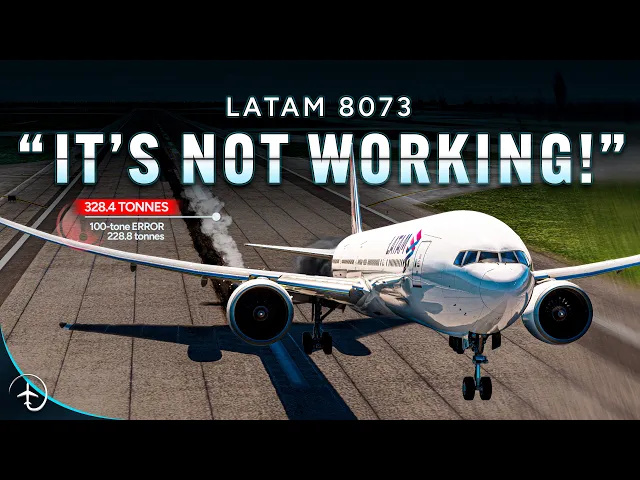
This Should NOT Have Been POSSIBLE! | LATAM 8073
Mentour Pilot
0:01 How could an aircraft find itself trying to take off with a 100,000
0:05 kilos more weight on board than what the pilot had calculated with?
0:09 And exactly what would happen if it did?
0:12 Well, that's the fascinating story that I will share with you today.
0:15 So, stay tuned.
0:19 When you check in your bag at the airport,
0:21 you've probably noticed signs talking about overweight luggage and maybe you
0:26 wondered what would happen if you would go slightly above that limit.
0:30 Of course, on an airliner,
0:32 one overweight bag doesn't make much of a difference at all,
0:34 but what if you forgot something that weighed more than,
0:38 let's say, a fully [snorts] loaded Boeing 737?
0:41 Well, surprisingly, this has actually happened multiple times, in fact,
0:46 and the reasons behind are as simple as they are complicated.
0:51 This particular story started on the 9th of July,
0:54 2024, at Milan Malpensa Airport in Italy,
0:58 where a flight crew from LATAM Airlines Brazil had just
1:01 arrived to operate a long-haul flight over to São Paulo.
1:05 Now, as a subsidiary of the Chile-based LATAM Airlines Group,
1:09 LATAM Brazil is the largest international airline in Brazil,
1:12 with a fleet of 170 aircraft, including 10 wide-body Boeing 777-300s.
1:18 Now, one of those was waiting at the gate in Malpensa,
1:22 ready to operate LATAM flight 8073 over to São Paulo,
1:26 with a scheduled departure time of 13:30 local.
1:30 The crew that had been planned to operate
1:32 this flight included no less than three captains:
1:35 a newly promoted trainee captain,
1:38 a line training captain who was providing the training,
1:40 and a relief captain whose job it was to take over as they rotated
1:44 to get their mandatory rest breaks during
1:46 the 11-hour flight over to South America.
1:49 Now, the trainee captain who was going to be sitting in the left
1:52 seat was 53 years old and had an impressive 16,689 total hours.
1:59 He had earned those partly during his 23 years with LATAM,
2:02 but since he had just started on the Boeing 777,
2:05 he had only flown about 95 hours on that type so far.
2:09 Instead, he had spent most of his career on the much smaller Airbus
2:13 A320, and this was actually going to be his first stint on a wide-body,
2:18 as well as his first time flying a Boeing,
2:21 except a few hours on the 737 almost a quarter of a century earlier.
2:26 On this day, he had only completed nine flights in the 777 and was
2:30 therefore still doing his line training
2:32 under supervision of a line training captain.
2:35 Now, that captain was 54 years old and had accrued an even
2:38 more impressive 18,921 flight hours over a 28-year career with the company,
2:46 which included 1,333 hours on the Boeing 777.
2:51 He was qualified as a line training captain on both the 777 and the 787,
2:56 which he flew interchangeably,
2:58 and that's worth keeping in mind because of what's about to happen.
3:03 You see, normally, we pilots can only fly one aircraft type
3:06 or group of aircraft with a common type rating at one time,
3:10 but even though the 777 and the 787 doesn't really have a common type rating,
3:16 they're similar enough that many airlines around
3:18 the world let their pilots fly both simultaneously.
3:22 And for LATAM Brazil,
3:24 that was ideal because they only had one 787 in their fleet,
3:28 so it was very efficient for them to be able to use their 777 pilots to fly it.
3:33 Anyway, the third and final pilot was the relief captain,
3:36 who was 56 years old and had 17,530
3:41 total hours across a 27-year career with the airline.
3:45 But out of those, only 418 hours had been flown on the 777,
3:50 which he had only started flying a few months earlier
3:53 after 11 years on the little bit smaller Boeing 767.
3:58 So, taken together, these three pilots made up an incredibly experienced team
4:04 with a combined total of more than 50,000 hours and 78 years of experience.
4:10 All three pilots had worked well together on the outbound flight to Milan,
4:14 which had arrived on the morning of July the 8th,
4:17 and they had then spent 24 hours resting at a hotel before
4:21 taking a shuttle back to the airport ahead of this coming flight.
4:25 And while they had been sitting there on the bus,
4:27 the pilots had received their flight plan,
4:29 fuel requirements, weather information, NOTAMs, etc.
4:32 from a proprietary LATAM Airlines smartphone app,
4:36 and they had therefore taken the opportunity to review
4:40 all of this information while they were just sitting there.
4:43 And they saw that there was nothing really unusual
4:46 at all about the flight that was coming up.
4:49 Maybe it was a little bit hot for departure,
4:52 but an outside temperature hovering at around 30° C,
4:56 but the weather was otherwise fine with totally
4:58 clear sunny conditions and a slight variable breeze.
5:03 So, by the time the pilots arrived
5:04 at the terminal and boarded their 12-year-old Boeing 777,
5:08 they were probably expecting this to be a normal and uneventful flight,
5:13 except for the slightly unusual combination of three
5:16 captains on the flight deck, of course.
5:20 As they started their preflight setup,
5:22 the only dispatch document that they were waiting for was,
5:25 as usual, the load sheet.
5:28 That's a document which lists the exact weight of the fuel, baggage,
5:32 and passengers on board for the purpose
5:34 of making performance and weight and balance calculations,
5:37 and it always tends to come a little bit
5:40 late as there might be changes in passengers and cargo,
5:44 which is only really found out during the check-in and boarding process.
5:48 So, whilst they were waiting for that, the pilots decided that the trainee
5:52 captain would be pilot monitoring for the initial part of the flight,
5:55 while the line training captain in the right seat would be pilot flying.
5:59 And this would suit the training plan fine since the new captain was required
6:04 to act as pilot monitoring during at least one leg of this supervised trip.
6:08 And on top of that, the training captain also wanted
6:10 to give the trainee captain some focused practice on the pre-flight procedures.
6:15 So, as this pre-flight got on the way,
6:17 he was mentally very much in instruction mode.
6:22 Meanwhile, as the two other captains were setting up the flight deck,
6:25 the relief captain would handle the exterior inspection,
6:28 liaise with the cabin crew, and conduct passenger announcements.
6:32 After that, he was supposed to take up his position
6:34 on the cockpit jump seat for departure before heading
6:37 back to the crew rest area until it was
6:39 time for him to take over the controls later on.
6:42 Now, whilst he would be on the jump seat,
6:45 he was also supposed to keep an eye on his two
6:47 colleagues as he was officially part of the operating crew.
6:51 But, I can say from experience that it is quite easy to let
6:55 the attention drift a bit when you don't have any real active duties to do.
6:59 In any case, fueling had already been on the way
7:02 when the pilots and their cabin crew arrived to the aircraft.
7:05 So, after having checked that they had their planned fuel quantity on board,
7:10 109,625 kilos to be exact,
7:14 the pilots together concluded that they wouldn't need any
7:16 additional fuel beyond that, which was a little bit
7:19 unusual but welcome since it meant that the fueler
7:22 could now leave and the load sheet could be completed.
7:26 Now, the cockpit voice recording began
7:28 sometime after that decision had been taken.
7:31 So, the first words on the recording
7:33 showed the pilots performing the takeoff briefing,
7:36 which involved discussing the planned taxi, takeoff,
7:39 and departure, as well as the expected take-off performance.
7:44 But because they still hadn't received the load sheet at that point,
7:47 they now deferred that last item,
7:49 the performance, and instead just continued the briefing.
7:53 Now, there will soon be a lot of things to keep track
7:55 of here in order to understand how this was allowed to happen.
7:59 And when we're on that subject,
8:01 actually writing these episodes and keeping track
8:04 of all of the info is not easy.
8:08 I often find myself with dozens of different tabs open
8:11 on my screen showing everything from the final report to ATPL booklets,
8:15 performance data, and historical cases.
8:19 And that's why I am using today's sponsor, Opera.
8:21 [music] I just love how Opera is basically built
8:26 for this kind of deep dive research and scripting.
8:29 For example, I can group everything I use into tab islands,
8:33 one for aircraft performance, one for historical and current procedures,
8:37 and one for relevant accidents.
8:40 And then, there's also the split screen,
8:42 which let me compare things side by side,
8:45 so I can look at company and generic Boeing procedures next to each other,
8:49 and at the same time see weather data and airport layouts.
8:54 Now, [music] if things would still become a little bit chaotic, which they do,
8:58 then tab trace will show me which tabs that I have used the most recently.
9:02 The darker the underscore, the more recently I've looked at it.
9:06 Which might sound simple,
9:08 but you'd be amazed at just how much time and energy it actually saves.
9:14 But probably the most useful feature is Opera AI,
9:17 which is built directly into the browser,
9:19 so I don't need any extra tabs or tools or anything like that.
9:24 I can just ask it to summarize a diagram,
9:26 explain a concept, or analyze a page that I'm looking at.
9:30 And that helps a lot during major investigations like this one.
9:34 Now, you can try Opera out for free yourself
9:37 by using the link here in the description below, which I highly recommend.
9:41 And I'd love to hear what you think of them, as well.
9:43 Thank you, Opera.
9:44 Now, let's get back to the cockpit.
9:47 Around 6 minutes later,
9:49 the relief captain then received the load sheet on his cell phone,
9:52 which he forwarded to his iPad.
9:54 But the trainee captain couldn't get his download to work.
9:58 Back in the day at LATAM Airlines,
10:00 the pilots used to receive an actual physical copy of the load sheet.
10:05 But now, this was all sent via this proprietary app,
10:08 which everyone wasn't that happy with since it meant that there was no longer
10:12 any possibility to put the load sheet
10:14 up on the center pedestal for easy reference.
10:18 Anyway, the relief captain just gave the training captain his iPad
10:21 to read off of, and he then dictated the zero fuel weight,
10:25 takeoff gross weight, and center of gravity to the trainee captain,
10:29 who now entered them into the CDU.
10:32 The zero fuel weight is pretty much what it sounds like.
10:34 It's the weight of the airplane, including all passengers,
10:37 baggage, and cargo, but without the fuel.
10:40 And in this case, after accounting for all 398 occupants and their bags,
10:46 the zero fuel weight was calculated to be 219,460 kg,
10:52 with the projected takeoff weight, including the fuel, being 328,425 kg.
11:00 Now, this takeoff weight was delivered by adding
11:03 the weight of the fuel to the zero fuel weight,
11:05 and then subtracting the weight of the taxi out fuel that was
11:09 expected to be burned during the startup and taxi out to the runway.
11:13 And knowing the precise takeoff weight is crucial,
11:17 because that's what we use to determine both takeoff thrust setting,
11:20 flaps, and also the takeoff or V speeds.
11:24 You see, on modern airliners, we very rarely use a full thrust for takeoff,
11:30 since that causes a lot of excess wear and tear on the engines,
11:33 it uses more fuel and also causes more noise.
11:37 So, instead, we tend to only use the exact amount of thrust that we
11:40 actually need in order for the aircraft to get into the air safely.
11:44 That thrust value is going to depend on several things,
11:48 like the length of the runway, the temperature, and the altitude.
11:51 But, of course, especially on the takeoff weight of the aircraft.
11:55 Now, a takeoff thrust that's lower than the takeoff go
11:58 around or toga thrust is referred to as a derated thrust.
12:02 And on most modern aircraft, that's achieved by inputting something known
12:06 as an assumed temperature or flex temperature on airbus,
12:10 which is higher than the actual outside air temperature.
12:14 You see, the engine electronic control system
12:16 or EECs varies the amount of thrust that can
12:19 be delivered based on the ambient temperature in order
12:22 to avoid going outside of its calculated limits.
12:25 So, if you enter a higher than actual temperature,
12:29 this basically tricks the EECs into using a lower thrust limit,
12:33 thus achieving that derate.
12:36 So, that's the first thing that I wanted to mention.
12:38 But, then we also have the calculation of the V speeds.
12:42 These speeds consist of V1, which is the decision speed above which
12:47 you're committed to continue the takeoff, VR,
12:50 which is the rotation speed where you start pulling back
12:53 in order to lift the nose of the aircraft off the runway,
12:56 and then V2, which is the takeoff safety speed,
12:59 the minimum speed you have to achieve to maintain
13:01 a safe climb gradient in the event of an engine failure.
13:05 Now, these speeds are very heavily dependent on the takeoff
13:09 weight as well as the length of the runway.
13:11 And if they're not calculated correctly, the consequences can be very serious.
13:17 Remember that, because I'm going to dive deeper into that a little bit later.
13:23 Now, I need to also talk a a bit here about how Boeing
13:26 777 pilots at LATAM Airlines calculated their V speeds and their takeoff thrust,
13:31 as well as the checks that were built into those procedures
13:34 in order to verify that those calculations were correct.
13:38 After receiving the load sheet,
13:40 the standard practice was to enter the zero fuel weight and the center
13:43 of gravity into the 777's flight management
13:46 computer using the control display unit or CDU,
13:50 which is that little computer interface that we pilots
13:53 use in order to interact with the flight management system.
13:57 And with those values entered, the flight management computer would
14:00 then automatically calculate [music] the gross
14:02 weight of the aircraft by adding the automatically detected weight
14:06 of the fuel in the aircraft's tanks and then [music] display
14:09 this figure on the performance initialization page in the CDU or perf init.
14:16 The pilots were then supposed to check the fuel on board against the flight plan
14:19 to make sure that it made sense and then
14:22 check the gross weight against load [music] sheet.
14:25 But remember, the load sheet doesn't show the gross weight.
14:28 It only [music] shows the takeoff weight
14:30 and the CDU doesn't display the takeoff weight,
14:33 which excludes the taxi fuel, only the gross weight.
14:38 [music] Now, when I'm talking about this subject,
14:40 I always get asked why the plane doesn't already know its own weight
14:44 or why most planes don't have weight sensors in their landing gear struts.
14:50 And the simple answer is that it's actually surprisingly hard to design a system
14:55 that's capable of estimating the weight more
14:57 accurately than the load sheet math already does.
15:00 So, there isn't actually that much value in such an expensive retrofit
15:05 and also just to keep it [music] calibrated would be a nightmare.
15:09 But some investigations have recommended the installation
15:13 of a weight sensing system anyway in order
15:16 to provide a gross error check against data [music] entry error by the pilots.
15:21 And we will soon see why.
15:24 In any case, after entering the set of fuel weight into the CDU,
15:27 [music] the pilots are then supposed to calculate the performance
15:30 figures using the Boeing onboard performance tool [music] or OPT,
15:34 which is loaded into two iPads that are stored in the cockpit of every aircraft.
15:39 Each pilot is supposed to independently enter the takeoff weight,
15:44 runway information, weather, and so on into the OPT,
15:47 which then produces a recommended thrust setting [music] in the form
15:51 of an assumed temperature as well as the V speeds.
15:54 After that, the two pilots should then cross-check
15:57 each other's results to make sure that they match.
15:59 Or if they don't, then they should clarify any differences.
16:03 Now, this procedure didn't define where
16:06 the pilots should get the takeoff weight from.
16:09 They could get it from the load sheet, which includes the takeoff weight,
16:13 or they could get it by mentally subtracting [music] the startup
16:17 and taxi fuel weight from the gross weight displayed on the CDU.
16:21 Remember that, because it's about to become really important.
16:25 Anyway, after cross-checking the results of the iPad calculations,
16:28 the [music] non-flying pilot should then enter the assumed
16:31 temperature into the thrust limit page of the CDU,
16:35 and then enter the V speeds on the takeoff reference page.
16:38 And on that page, the CDU will then display
16:41 reference V speeds [music] in a column labeled ref.
16:44 And those speeds are derived automatically
16:46 from the aircraft weight entered in the performance
16:49 initialization page and the thrust information
16:51 entered on the [music] thrust limit page.
16:53 So, those are basically the speeds that the aircraft
16:56 itself suggests [music] the pilots to use.
17:00 When the pilots manually enter the V speeds, which they get from their OPTs,
17:04 they should therefore compare those with the aircraft's
17:07 reference speeds as a form of gross error check.
17:10 Basically, those two sets of speeds should be
17:13 within a couple of knots of each other.
17:15 And if they're not, well, then someone,
17:18 somewhere probably have made [music] a mistake.
17:21 Now, after that check,
17:22 the pilots should then complete the rest of the before start
17:25 checklist and finally ask for pushback and start up their engines.
17:28 [music] So, as you can see,
17:31 this procedure has a lot of built-in cross-checks and redundancies, but [music]
17:35 there are still some areas where potential errors could creep in.
17:40 So, let's now return to the cockpit of flight 8073,
17:43 where these three very experienced pilots were
17:46 just about to begin this very same procedure.
17:48 [music] Immediately after having received the load sheet,
17:53 the trainee captain preliminary ran through the performance
17:56 numbers using his iPad and noticed nothing unusual.
18:01 Also, after he and the training captain had entered their airway into the CDU,
18:05 he saw that it produced a gross weight figure, but he soon forgot what it was.
18:11 In fact, just seconds later,
18:13 the Malpensa clearance delivery controller suddenly called
18:17 the aircraft up and informed the pilots that they
18:19 were number two for pushback and that their scheduled
18:22 departure time had been moved up.
18:24 Now, this introduced some unexpected time pressure here and gave the pilots
18:28 very limited time to finish the performance
18:30 calculations and get everything else ready.
18:34 Now, both interruptions and time pressure are factors that increase
18:37 the risk of errors and reduce the effectiveness of cross-checks,
18:41 which is always worth keeping in mind in whatever job you have.
18:45 If this happens, ask yourself,
18:47 do I really need to speed up or can I slow things down somehow?
18:52 And in most cases, the answer will be, "Yeah, I can slow things down." Anyway,
18:57 while some chatter from the clearance delivery
18:59 frequency continued to play over the cockpit speakers,
19:02 the pilots now hurried to finish the performance calculations on their iPads.
19:07 But by the time the trainee captain opened his OPT application,
19:11 he had forgotten the gross weight that was calculated on the CDU.
19:15 So, in order to obtain the takeoff weight to put into the OPT,
19:19 he needed to either navigate back to the CDU's performance initialization page,
19:24 obtain the gross weight, and then subtract the startup and taxi fuel,
19:28 or look at the load sheet in the company
19:30 smartphone app and [music] get the takeoff weight from there.
19:33 But, remember, he hadn't received the load sheet on his smartphone yet.
19:40 At that same time, the training captain decided
19:42 to look at the gross weight from the CDU
19:45 and and mentally just subtract the 400 kilos
19:48 of taxi fuel from it to get the takeoff weight.
19:51 And he did so, and then he said the result out loud.
19:55 Um one moment, OPT, 228.8.
19:59 [music] Now, it's not completely clear from the final
20:03 report whether the training captain said that number out loud
20:06 because he was trying to provide that information to the other
20:09 captain or whether he was just narrating his thoughts.
20:13 Though, it seems likely that it was probably on purpose.
20:18 But, in either case, he had just made an absolutely huge error.
20:24 Because as he now entered the figure of 228.8
20:27 metric tons into the takeoff weight field in his OPT,
20:31 the actual takeoff weight was 328 tons, not 228.
20:38 So, how was that possible?
20:40 Well, most likely, whilst mentally subtracting the taxi fuel,
20:44 the training captain just lost a digit in the hundreds place.
20:48 You know, the kind of brain fart that make you
20:50 groan when you get your math test handed back in school.
20:54 But, of course, the procedure still required both pilots
20:58 to perform the OPT calculations independently and then cross-check,
21:02 specifically to catch this type of error.
21:06 But, instead of looking at the CDU and obtaining the takeoff weight himself,
21:10 the trainee captain now just listened to what
21:13 his colleague was saying and entered that same thing.
21:17 Maybe to save time or maybe because he was
21:19 on the training and therefore just trusted his instructor.
21:23 Now this clearly violated the requirement
21:26 for independent calculations because now
21:28 the same wrong figure had been entered into both pilots' iPads.
21:32 And that obviously then led to the pilots receiving the same flap setting,
21:36 assume temperature, and V speeds back from it,
21:39 all of which were now intended for an aircraft
21:42 that was 100,000 kg lighter than their actual weight.
21:47 And that's a lot, by the way.
21:49 100,000 kilos is substantially more than the weight
21:52 of a fully loaded Boeing 737 NG.
21:55 Or put it another way, about 17 adult male African elephants.
22:02 Now if you forgot to add the weight of 17 elephants in the cabin,
22:05 someone would likely notice that.
22:07 But in this case, the pilots just cross-checked the results and moved on.
22:13 So with that, I feel that I have to address the elephant in the room.
22:18 Which is why didn't this number just feel wrong to them?
22:23 Is it generally, after you've been flying an aircraft type for a while,
22:26 you start to get a ballpark sense
22:28 of the performance numbers that you usually get,
22:31 so you can normally pick up a faulty number quite easily.
22:35 But in this case, the training captain might not have felt that 228 tons was
22:41 an abnormally low number because that is
22:44 a perfectly ordinary takeoff weight on the Boeing 787-9,
22:49 which he was also flying at the time.
22:52 And at the same time,
22:53 the training captain actually did recognize that the results were different
22:57 from the numbers that he had gotten during his quick preliminary calculation,
23:01 but those numbers had now been overwritten.
23:05 And because he was performing only his 10th flight on the 777 after having spent
23:09 many years on the Airbus A320, he probably
23:12 hadn't fully developed that instinctive number sense yet.
23:17 And on top of that, even though he was nominally the pilot in command,
23:21 the instructional tone of his interactions with the training
23:23 captain during the preflight might have predisposed
23:26 him to just accept what he was told
23:28 instead of taking ultimate responsibility for that himself.
23:33 Now, I have been training new captains in similar scenarios, and it is really,
23:39 really hard as an instructor to get the feeling in the cockpit
23:42 right where the trainee captain feels like they are in charge,
23:46 but whilst you still can instruct them.
23:49 It is super, super easy to just transform back into a captain,
23:52 in which case you basically end up with a first officer in the left seat,
23:56 and stuff like this can happen.
23:59 And finally, the relief captain wasn't paying
24:01 attention to the performance calculation at all,
24:03 since at that point he was busy coordinating with the cabin crew.
24:08 Now, even with these factors,
24:10 someone might still have second-guessed the numbers if it hadn't
24:13 been for that time pressure that had just been introduced.
24:17 And what all this meant was that after agreeing that the result matched,
24:21 the pilots now just jumped straight into entering
24:24 the performance data into the CDU without a second thought.
24:28 Remember, the OPT results only had to match each other.
24:31 There was no cross-check against the gross weight already calculated by the CDU.
24:37 In any case, for the thrust D-rate,
24:39 the pilots' OPTs now calculated an assumed temperature of 56° C,
24:44 which would reduce the thrust output during the takeoff quite a bit.
24:48 As you would expect [music] for a very light aircraft,
24:53 which, according to OPT, now only weighed 228 [music] tons.
24:58 It also called for a flap setting of 5°, which is not unusual for takeoff,
25:03 but was the lowest setting available, producing the least amount of lift.
25:08 So, after having entered the assumed temperature
25:10 into the thrust limit page of the CDU,
25:12 the pilots then flipped over to the takeoff reference page
25:16 and entered the calculated flap setting followed by the V speeds.
25:20 145 knots for V1, 149 for VR, and 156 for V2.
25:28 Now, those values were obviously much, much too low.
25:32 At the weight that they were actually
25:34 at, the speeds should have been 173 knots for V1, 181 for VR, and 186 for V2.
25:42 So, about 30 knots higher across the board.
25:46 And at this point, they were now coming up against the next cross-check.
25:50 The comparing of the OPT-derived V speeds against
25:53 the reference V speeds produced by the CDU,
25:56 which should have made this error obvious.
25:59 But, to the pilots' great surprise, those reference speeds were now missing.
26:05 To be perfectly honest, they shouldn't even have been able to enter
26:08 these faulty V speeds into the CDU at all,
26:10 since the system normally prohibits entering V speeds
26:13 that are lower than the CDU calculated reference speeds.
26:16 But, in this specific case, there weren't any reference speeds shown at all,
26:21 so that protection didn't apply.
26:24 Instead, the CDU scratchpad now displayed a message that read,
26:28 "V speeds unavailable." With no further explanation than that.
26:33 Now, the reason for this was actually their selected assumed temperature of 56°.
26:38 You see, at the actual aircraft weight known to the FMC,
26:42 there was no way that the aircraft could take off with that D-rate.
26:46 The runway just wasn't long enough with that thrust and flap setting,
26:50 so the aircraft responded to that by not showing any speeds at all.
26:55 But, of course, that message, V speeds unavailable,
26:58 was a pretty obscure way of communicating this.
27:02 Now, none of the pilots could remember having ever seen that message before,
27:06 and it was only mentioned in one brief
27:09 passage in the flight crew operations manual as well.
27:12 It stated that this message could occur
27:15 with certain combinations of high weight and low
27:17 thrust or low weight and high thrust
27:20 where the performance margins were basically exceeded.
27:25 [music] The manual then gave some fixes to this, but it didn't suggest
27:28 that the pilot should recheck the performance data that they had entered.
27:32 But, it also clearly said that a takeoff
27:35 was not allowed with this message shown.
27:39 Now, none of this helped in this case,
27:40 since the pilots never checked their manual.
27:43 The training captain did read the message out loud when he saw it,
27:47 but none of the pilots knew what it meant.
27:51 The relief captain in the back just
27:52 briefly suggested checking whether the reference V speed
27:55 function was turned on, which the training
27:57 captain then did and verified that it was.
28:00 So, that clearly wasn't the reason.
28:03 At this point, if they would have had some extra time available,
28:06 they might have pulled out the manual
28:07 and discovered that takeoff with that message,
28:10 V speed unavailable, was actually prohibited,
28:13 and that could then possibly have led them back
28:16 to their load sheet and helped them to discover their error.
28:19 But, since they didn't, one of the last safety barriers was now crossed,
28:24 and the jaws of disaster had started opening up.
28:29 The training captain now just told his colleagues to proceed.
28:32 So, they just accepted their manually entered speeds
28:35 and went ahead to finish the before start checklist.
28:38 Time to get this aircraft airborne.
28:41 Now, before we go any further here,
28:43 it's important to highlight what some of the potential
28:45 consequences would be of what I've shown you so far.
28:49 Obviously, the first risk with having a too low thrust setting is that the plane
28:53 just won't be able to reach its takeoff speed before the end of the runway.
28:58 And in most cases, that problem is then
29:01 also coupled with a calculated too low rotation speed.
29:06 You see, the rotation speed is designed to be
29:08 high enough so that by the time we reach it,
29:10 the plane naturally wants to become airborne.
29:13 In other words, the lift that the wings can
29:16 produce should be greater than the aircraft's own weight.
29:20 But in order for that to happen, you need air speed.
29:24 So, if you end up rotating too early, well,
29:27 then the plane just won't have enough lift to climb away,
29:31 and that in turn will mean that the nose will come up,
29:34 but the plane will just continue rolling down the runway on its
29:37 rear wheels until it's built up enough speed to actually fly.
29:42 And that's risky for two different reasons.
29:45 Firstly, if the airplane doesn't lift off when the pilot rotates normally, well,
29:50 then the pilot might instinctively continue rotating more or deliberately try
29:55 to pull in order to get the aircraft off the ground,
29:58 which can then cause the tail of the aircraft to strike the runway.
30:02 And now that can lead to structural damage preventing the later
30:06 pressurization of the aircraft or even worse outcomes than that.
30:11 The second issue is that rolling down the runway
30:13 with the nose high up in the air greatly increases the drag.
30:18 And that comes from both the form drag
30:20 due to the greater surface area that is now
30:22 facing the airstream and the induced drag created
30:25 by the high angle of attack of the wings.
30:28 And if that's combined with a tail also striking the ground,
30:32 that obviously also adds drag.
30:35 So, all of this will make it harder
30:37 to accelerate up to the appropriate takeoff speed,
30:40 and if the thrust setting is already insufficient,
30:43 which is what has caused this in the first place,
30:45 well then this could all combine lead to the aircraft
30:49 overrunning the runway and a potentially catastrophic ending.
30:54 Now, you might be thinking,
30:56 "Surely with all of the training that pilots receive,
30:59 there is no way that this could be
31:01 a regular occurrence." And actually, you would be wrong.
31:07 In 2004, for example, an MK Airlines Boeing 747 cargo plane
31:12 crashed after a crew member had accidentally
31:14 populated the takeoff weight field in their OPT
31:17 with the weight from their previous takeoff,
31:20 where they didn't have any cargo on board.
31:24 Then again, in 2009,
31:25 an Emirates Airbus A340 was departing Melbourne in Australia,
31:30 when the pilots accidentally entered a takeoff weight
31:32 that was also exactly 100 tons too low.
31:37 Now, that aircraft then ended up getting airborne beyond the end of the runway,
31:40 striking the localizer antenna array in the process,
31:43 but after that, it luckily returned and landed safely.
31:48 But in yet another incident back in 2015,
31:52 the crew of a Boeing 777 cargo aircraft,
31:54 which was preparing for takeoff from Paris Charles de Gaulle,
31:57 again inadvertently dropped a digit and entered
32:01 a takeoff weight that was 100 tons too low.
32:04 That plane ended up rotating before it had enough speed to do so,
32:08 almost causing a tail strike,
32:10 but it did eventually get airborne just before the end of the runway.
32:15 And the investigation into that incident found that one
32:18 of the pilots had verbalized the incorrect takeoff weight,
32:22 exactly like in this case.
32:25 Now, my point in sharing these stories is to highlight
32:27 that the problem here likely wasn't only the involved crew.
32:31 Something systemic was also at play here.
32:36 Anyway, completely unaware of the danger
32:39 that they had now set up for themselves,
32:41 the pilots of Latam flight 8073 received clearance
32:45 to push back from the gate at time 13:05,
32:47 just 10 minutes after receiving the load sheet.
32:51 Then, at time 13:14, they were cleared to taxi out towards runway 35 left,
32:56 and at time 13:21, the captain reported reaching the holding point.
33:01 Now, the tower initially held them in that position for about 4 minutes or so,
33:05 and then at time 13:25, they were finally cleared for takeoff.
33:10 Moments later, the aircraft lined up with the runway,
33:13 and the captain moved the thrust levers into the takeoff position.
33:16 [music] This caused the 777's two huge GE90 engines to spool up to 92.8% N1,
33:25 which was the limit imposed by the selected assumed temperature of 56°.
33:29 The aircraft now started slowly accelerating down the runway,
33:33 and on a runway that is that long, the pilots didn't initially notice that they
33:38 were gaining speed slower than normal.
33:41 The pilot monitoring called out, "80 knots",
33:43 which was then followed by a "Checked" from the training captain,
33:47 and 35 seconds into the takeoff roll,
33:50 the aircraft's automated voice called out, V1.
33:53 at a speed of 145 knots, which of course we know was about 30 knots too early.
34:00 Now, since nobody had calculated the V1 for the real weight and thrust setting,
34:05 it was at this point actually impossible
34:07 to know where the real decision point actually was.
34:10 So, even if these pilots would have now realized their mistake,
34:14 they wouldn't know if they had enough runway left to reject.
34:20 But, at this point, they were all still blissfully unaware of their mistake.
34:25 So, 3 seconds after that V1 callout,
34:28 the aircraft reached its calculated rotation speed of 149 knots,
34:32 which the pilot monitoring called out,
34:34 and the training captain now started pulling back on his control column,
34:37 like he had done countless times before.
34:41 Only this time, the airplane didn't lift off.
34:46 In fact, at this point, they were nowhere near the speed required
34:49 to generate enough lift for the aircraft to fly.
34:51 So, while the nose did start to rise,
34:54 the main landing gear remained firmly attached to the ground,
34:57 now eating up the remaining runway with an alarming speed.
35:02 This whole thing caught the training captain completely by surprise,
35:06 and for several seconds, he therefore just continued pulling back instinctively
35:09 to get the aircraft up into the air.
35:13 Now recognizing that its tail was about to hit the runway,
35:16 the 777's built-in tail strike protection system
35:19 kicked in and applied a nose down component to the elevator deflection command
35:23 to try and prevent the imminent tail strike.
35:26 But, its efforts were sadly unsuccessful.
35:30 As the plane accelerated through 160 knots,
35:33 the tail slammed hard into the runway, kicking up a dramatic cloud of dust
35:37 and debris as it dragged itself along the asphalt.
35:39 [music] For several seconds, the pilots seemed stunned,
35:43 caught like deer in the headlights in something called the starter effect.
35:48 Well, this monumental tail strike just kept happening.
35:54 Behind them, the tail skid,
35:56 which is designed to absorb some of the forces from a tail strike,
35:58 now gouged a 6 cm deep scar into the runway surface,
36:03 scattering fragments of metal and pavements in its wake.
36:07 In the cockpit, the training captain shouted
36:10 out a curse and exclaimed, "It's not working.
36:13 Something strange.
36:14 It's not working." But, recognizing that the aircraft wasn't responding,
36:19 the relief captain now just shouted from the jump seat,
36:23 "Toga!" urging the pilots to push
36:25 the thrust levers forward into maximum takeoff thrust.
36:29 Still struggling to comprehend what was going
36:31 on, the training captain just replied with a questioning noise.
36:34 So, the relief captain quickly called the same thing again.
36:37 Toga!
36:39 And this time, the training captain
36:41 reacted promptly and firewall both thrust levers.
36:47 This caused the two giant engines to start spooling up further,
36:50 and with that, they began to overcome the drag
36:52 of the high pitch attitude and the tail strike,
36:55 finally forcing the airplane into the air at the speed of 178 knots.
37:00 So, after having dragged its tail for an incredible 723 m,
37:04 flight 8073 finally became airborne about 80% of the way down the runway,
37:09 largely thanks to the relief
37:10 captain's situational awareness and timely intervention.
37:14 Now, I absolutely have to shout out the relief captain's actions here.
37:18 It takes a real pro to not only figure out what to do,
37:21 but also to give clear and unambiguous instructions
37:24 in a situation which included so much confusion.
37:28 Calling toga was basically the only thing he could have done which
37:31 was simple enough to save the situation and not just make it worse.
37:34 So, well done.
37:38 Anyway, as the plane cleared the end of the runway
37:41 and started climbing away into the bright blue sky,
37:44 the trainee captain soon announced "Positive climb."
37:47 And the training captain called for gear up.
37:50 By this point, the flight data recorder had
37:53 also captured a loss of pressure in both
37:55 fire extinguisher bottles for the APU caused
37:57 by the tail strike damage in the back.
37:59 And the tail strike detector had also sensed the impact and was now sending
38:04 a tail strike warning message on the engine
38:06 indication and crew alerting system or ECAM.
38:09 The relief captain noticed that message and called it out,
38:13 and that was then followed by a continuous
38:15 repetitive chime alerting the crew to the damage.
38:19 So, after having climbed to a safe altitude,
38:21 the pilots now pulled out the quick reference handbook
38:23 and followed the abnormal procedure for a tail strike,
38:27 which called for them to avoid pressurizing the airplane
38:30 to avoid any further damage to the hole,
38:32 and then to land at the nearest suitable airport.
38:35 And this meant that the crew just leveled
38:37 off at 6,000 ft to discuss their options.
38:41 With all of the fuel for the transatlantic journey still on board,
38:44 the 777 was now far over its maximum landing weight.
38:48 So, the relief captain suggested dumping that fuel
38:50 or some of it before attempting to land.
38:54 And since there were luckily no signs of any control
38:57 issues or further system failures other than the APU fire extinguishers,
39:01 the training captain now agreed.
39:04 He then also switched over to the left
39:06 seat and let the relief captain take the right
39:09 seat in order to utilize the most experienced
39:11 crew members for the coming approach and landing.
39:13 And all of this showed really good
39:16 failure management and generally nice non-normal handling.
39:20 I should also mention here that the 777 could have
39:23 landed overweight if the emergency would have been more severe,
39:26 but that would have put undue stress
39:29 on the landing gear and brakes and other structures.
39:31 So, since this crew now didn't really know
39:35 how badly damaged the back of their aircraft was,
39:38 reducing the fuel was, in my view, a pretty good idea.
39:42 Air traffic control soon directed them out over a rural area southwest
39:46 of Milan where any side effects of the fuel dump would be minimized.
39:50 And the pilots then circled for about 36 minutes releasing as much
39:54 fuel as they possibly could until the weight was sufficiently reduced.
39:59 After that, they turned inbound for a normal
40:01 approach and landing on runway 35 right,
40:03 which was reasonably uneventful except they also
40:07 then suffered a bird strike on final.
40:10 But at time 14:36, they landed safely back at Milan again.
40:15 Thankfully, none of the 398 passengers and crew were hurt in this incident
40:20 and the aircraft was later ferried back to LATAM Brazil's base in São Paulo,
40:24 where it was repaired and returned to service by February of 2025.
40:30 The investigation by Italy's National Flight Safety Agency,
40:34 ANSV, found that LATAM Airlines procedures contained ambiguities,
40:38 such as a failure to explicitly prohibit verbalizing data during the OPT entry,
40:44 as well as a lack of clarity about
40:46 where the pilots should find the takeoff weight,
40:48 which increased the risk of human error.
40:52 Now, in his statement, the training captain suggested that there should also be
40:56 a final cross-check between the load sheet, the OPT,
40:59 and the CDU to ensure that the data in all three sources agreed,
41:03 but the ANSV pointed out that new
41:06 procedures might not be the best solution here.
41:09 The preflight phase is already jammed full of checklists,
41:13 checks, and cross-checks,
41:14 and with so many dispatch tasks also now being dumped onto flight crews,
41:18 adding even more checks would likely only increase the pressure
41:21 to complete all of the tasks within the expected turnaround time,
41:25 potentially undermining its own benefit.
41:29 Instead, the ANSV wrote that procedures alone doesn't seem to prevent
41:33 flight crews from making performance calculation errors when under pressure.
41:38 So, the best solution would be to develop flight management
41:40 system software that could detect and flag gross errors instead.
41:45 And in fact, that technology already exists.
41:49 In 2025, the European Aviation Safety Agency announced that all
41:53 newly developed large aircraft would be required to have
41:56 a takeoff performance monitoring system capable of identifying and alerting
42:01 the crew to performance errors both before and during the takeoff.
42:07 Existing aircraft types currently in production will also
42:09 have to have this system beginning in 2033,
42:12 but it won't need to be retrofitted onto aircraft that are already in service.
42:18 Airbus right now offers this system as an optional retrofit to older aircraft,
42:22 but most probably still [music] won't have it
42:26 for a quite a number of years from now,
42:28 which personally I think is a real shame.
42:31 In the meantime, LATAM Airlines have also
42:34 updated its pre-flight procedures to remove any ambiguities,
42:37 and they have also improved their flight data monitoring
42:40 program to detect takeoff performance-related events on its [music] fleet.
42:45 But, the lesson that I want to really highlight here is
42:48 that these type of huge errors are probably much more likely than you think,
42:52 and it can happen to absolutely anyone if you're not careful.
42:57 But, at the same time, I also want to point out something else.
43:01 And that is that even after these guys
43:03 underestimated their weight by 100 metric tons,
43:06 there was still enough of a performance margin available to allow
43:09 this giant aircraft to get airborne inside of the available runway.
43:14 Showing just how much safety margins
43:16 that we build into this fantastic [music] industry.
43:20 Aviation remains incredibly safe,
43:22 and my team and I are here to help spread the word
43:25 about these type of lessons to hopefully make things even safer.
43:29 [music] Now, if you want to help us with this mission
43:31 and get the preview all my videos before everyone else,
43:34 well then please scan this QR code or go
43:36 to patreon.com/join/mentorpilot and become a member of my awesome Patreon crew.
43:43 And here, by the way,
43:44 are also some fantastic comments that you have left on last week's video.
43:49 So, please continue to send those in because
43:51 we absolutely love [music] reading them.
43:54 My name is Petter Hörnfeldt, and you're watching Mentor Pilot.
43:57 Have an absolutely fantastic day, and I'll see you next time.
44:00 Bye-bye.