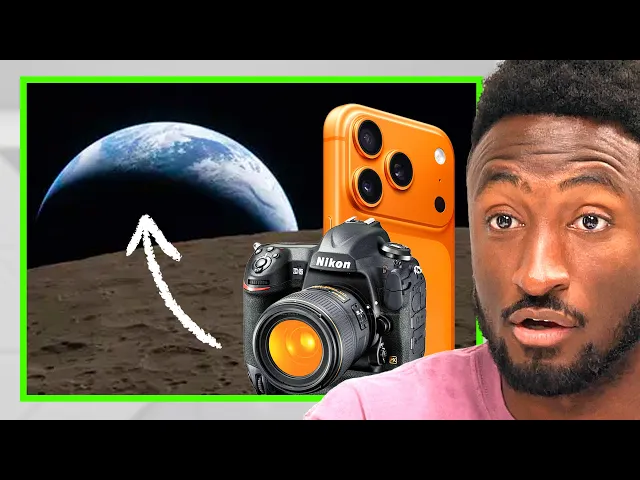
The Cameras NASA Brought to the Moon
Waveform Clips
0:02 Let's talk about it.
0:03 about A this week.
0:07 Rockets.
0:06 NASA sent people around the moon.
0:09 Around the moon.
0:10 I don't think I can name all the planets.
0:11 Is the moon a planet, Andrew?
0:13 It's very specifically worded.
0:14 There are so many interesting things about this and I just
0:16 figured we could just pop through some of the most fascinating ones.
0:19 First of all, the Artemis 2 mission is what it's called.
0:23 These four astronauts went, they launched, they slingshot around Earth,
0:29 they then flew a quarter million miles to the moon,
0:32 slingshot around the dark side of the moon, and then came back to Earth.
0:36 And I think by the time you listen to this on Friday,
0:38 that's when they splashed down in the ocean.
0:40 So, like a week-long mission and about 45
0:44 minutes of that was spent behind the moon.
0:46 Which is the farthest any humans have ever been from Earth.
0:48 Pretty sick.
0:49 So cool.
0:50 Yeah.
0:50 Um they took some incredible photos from back there.
0:52 And they also sent them back to Earth for us
0:55 to look at before they even come back here.
0:57 And the photos are incredible.
0:58 And I have so many thoughts.
1:00 Okay, first thing we started seeing is this is one of the this is like
1:03 I guess the first mission where the astronauts
1:05 were allowed to bring personal devices into space,
1:08 meaning their iPhones and Android phones.
1:10 And so we did get images from their smartphones as well sent back.
1:15 And that's awesome.
1:17 That's really interesting.
1:18 Probably some of the best moon photos any phone
1:20 has ever taken cuz they're super close to it.
1:22 We all like to think we can take moon photos from our phone.
1:25 Well, but The Earth photo was the one that was popping off on Twitter.
1:29 Yes.
1:30 That was very funny.
1:31 They looked great.
1:32 They they took photos out the window of their space
1:37 shuttle and you could see like Earth rise.
1:40 As they got further and further from Earth, the Earth got smaller and smaller.
1:42 And then they got closer and closer to the moon,
1:44 and the moon got bigger and bigger until they like slingshot around the moon.
1:47 I had to Google this, they went within like 5,000
1:49 miles of the moon surface to do that gravity slingshot.
1:52 So, they were really close.
1:53 I mean, in the scale in the scale of
1:57 of the universe.
1:59 they went 250,000 miles and then they got within 5,000 miles of the moon.
2:03 And I think that's pretty cool.
2:03 Compared to the biggest possible thing we can measure, they're pretty close.
2:06 Yeah.
2:07 Yeah, it was pretty it was pretty interesting.
2:08 Does anyone have any thoughts on the shot
2:10 on iPhone photos that we got from Artemis?
2:13 I thought they were pretty cool.
2:14 I have some thoughts.
2:15 I thought they might end up as a billboard pretty quickly.
2:19 Yeah.
2:19 Some people had stakes against that.
2:21 They were like, let it just let it just happen organically and that.
2:25 It's fine if it's never a billboard.
2:26 But also, missed opportunity from Samsung cuz Samsung got Well, Well,
2:30 I saw some funny memes cuz you know the photos where they took
2:33 the photo of the moon in the foreground and then Earth was in the background,
2:36 which is like the opposite of what we usually see.
2:38 Yeah.
2:38 There was a really funny meme where like the moon
2:40 was in the foreground and then the background was a moon.
2:43 It said shot on iPhone.
2:44 I mean, shot on Samsung.
2:46 I was like I saw a bunch of those like
2:48 if Samsung's were this I saw people complaining like wow,
2:51 it's a real shame they didn't use a Samsung
2:53 for this photo with its zoom and it's like you're in space.
2:56 You're literally one of the moon.
2:58 Why do you need You don't need the zoom.
2:59 You're in space.
3:00 This is literally the opposite.
3:01 Also, here's the iPhone selfie camera.
3:04 Wait, was it really from the selfie camera?
3:05 Yeah.
3:06 Yeah, I mean, okay, I might get canceled for this.
3:08 Do it.
3:10 Maybe not.
3:10 I'm just kidding.
3:11 No, I I just don't think it's People are like,
3:13 wow, it's insane that this is the selfie camera.
3:15 I was like Well, yeah.
3:17 I thought it was cool.
3:18 If you took Yeah, it is cool, but it's like yeah, it's the selfie camera.
3:22 I mean, you can do photos with the selfie camera.
3:25 Like what's what's so insane about that?
3:28 I guess it's like I think more so is that this photo
3:31 itself is incredible because it's Earth and we just don't see it.
3:34 It really has nothing to do with the camera.
3:36 Any phone could have basically taken It's just the perspective.
3:39 It's not even so much about the phone that's taking it.
3:42 It's that we have all these like when you open
3:44 your phone camera roll and you see the photos you took
3:47 and that's your perspective from the last couple days and you
3:50 know what a photo from your phone usually looks like.
3:52 It's just crazy to think that their camera roll,
3:55 they open it up and it's a photo looking down on Earth from 250,000 miles away.
4:02 And like a a shot of the moon, which is somehow right next to them.
4:06 Like that's just such a crazy thing to imagine.
4:08 Yeah.
4:08 And it I it kind of I don't know,
4:11 humanizes it or like puts it into perspective for us to appreciate
4:14 that that's really how it looks to them sitting looking out that window.
4:17 Pretty crazy stuff.
4:19 It'll be funny in like 20 years when they're scrolling really
4:22 far back in their gallery one day and they're like memories.
4:24 Oh.
4:25 Oh, yeah.
4:25 Yeah.
4:27 Six years ago just like six years ago today.
4:30 Yeah, what is the AI going to say?
4:32 Like it'll show you your like your lunch
4:34 or your dog and be like you on the moon.
4:36 Does it know that you they were on the moon?
4:37 Like what is it going to say?
4:38 You know how you can track your location
4:40 in Google Maps like going back all the way.
4:42 I wonder what happened to your location.
4:44 My iPhone saying?
4:45 Fog of world would have went crazy.
4:46 Fog of world is like where did you go?
4:48 Yeah.
4:49 Yeah.
4:50 Yeah, what you have people's pins on Find My.
4:52 Where do you think those pins went?
4:53 Oh, that's just off the grid, literally.
4:56 Yeah.
4:56 Can I do a little camera breakdown of all the cameras they used on this?
5:01 Okay.
5:01 So, a lot of people were confused why they were using the Nikon D5,
5:05 which is a camera that came out in 2016.
5:07 And I've been screaming about this for years
5:10 and this is actually like finally starting to get better.
5:13 So, the reason they use the Nikon D5 is because it has a very large pixel pitch.
5:16 That's the size of the the pixel on the sensor.
5:18 If you have a bigger pixel pitch,
5:20 you get more light port per pixel, which means lower noise.
5:23 And for space photography,
5:24 that's very important because most of the background is black.
5:27 Yeah, not a lot of light.
5:29 Yeah.
5:29 So, some people were asking why did they shoot with the Hasselblad?
5:31 The Hasselblad is 100 megapixels, but each one of those pixels is tiny.
5:35 Very tiny.
5:36 Yeah.
5:36 Yeah.
5:36 So, 6.4 is very big and like 10 years
5:39 ago it was more common to have a bigger pixel.
5:41 It's only 20 megapixel camera, you know, which is fine.
5:44 Like that's still a lot of resolution for like if you
5:46 want to use it as a desktop wallpaper or something like that.
5:49 It looks very DSLR-y.
5:51 They did also use a Nikon Z9,
5:53 which is Nikon's like flagship camera that's out right now.
5:56 That has a pixel pitch of 4.35 micrometers.
5:59 So, it's a little bit smaller, still very good.
6:01 45.7 megapixels.
6:03 Obviously, they're going to want to be able
6:04 to zoom in on some of these pictures.
6:06 Yes.
6:06 They used a GoPro Hero 4 Black, which I saw some really cool photos of for
6:12 that Instagram post.
6:13 Yeah, in the Instagram post.
6:15 Yep.
6:16 It's like seven or eight years old at this point.
6:18 We're on Hero 11 or 12 or something, I think.
6:22 Yeah, I was kind of curious why they did that.
6:23 It might have been a similar thing with a bigger pixel pitch.
6:25 I didn't actually look at what that pixel pitch was.
6:28 what happens is these programs take so many years
6:32 to build that they're not using typically state of the art.
6:35 Like when they build this this Artemis 2 thing,
6:38 they're they're using the 2019 2020 cameras when they start building it.
6:42 So, even though there's newer cameras available today,
6:45 that's the stuff that they started with.
6:47 like that would be the easiest thing to just switch out though, you know.
6:50 They're probably similar resolution,
6:51 but like computers and and dimensions and stuff, they just lock that stuff in.
6:55 It's it's the same reason like the software used
6:57 to record the podcast is a stuff called Wildtracks
7:00 and like we're generally like six or seven versions
7:03 behind the most recent version because like God forbid,
7:08 you know, like we just can't validate every single aspect of that.
7:12 If we use one too many threads and it interacts
7:14 with the lighting software weirdly and it crashes or we lose an episode,
7:17 I'd much rather miss a few features and know it works, you know.
7:21 Don't test in production.
7:22 And that's on a podcast.
7:23 Like picture it in space.
7:26 Yes.
7:27 There's no Best Buy in space.
7:28 If anything, GoPro really should have done
7:31 the marketing campaign cuz they're like a dying company.
7:34 Way more up there.
7:35 I don't know if they're allowed yet.
7:38 I saw someone saying because NASA's like government-funded and everything.
7:42 You would have to reach out to the individual
7:44 astronaut and ask them for their permission.
7:46 None of who that is, but There was a lot of misinformation online.
7:49 People were saying, oh, Apple probably paid for it.
7:52 Then like no, there was there was actually confirmation
7:54 that none of these companies paid to have their devices used.
7:57 It's wild to think that when you just look at like these astronauts
8:00 are from the US and what the US iPhone market share is,
8:02 it's really easy to deduce that they probably have an iPhone.
8:06 by the way, everyone's like, why Nikon?
8:08 Why not Canon?
8:09 Nikon was the first ever camera in space.
8:12 And the reason that happened was because one
8:14 of the astronauts just happened to be a photographer
8:16 and he bought a Nikon like before he went
8:18 up into space and he just took some pictures.
8:20 And that was before that was before Hasselblad that's before Hasselblad
8:23 started making their um their custom Hasselblad cameras for for space,
8:28 which they left some of those cameras on the moon.
8:30 Which they should have just retrieved them
8:32 cuz they've been there since 1969 or whatever.
8:34 Oh, the cameras are still on the moon?
8:36 Yeah, the cameras are still on the moon.
8:36 They just took the film backs because they did they needed
8:39 as least the as little weight possible to be able to get back.
8:42 Space litter.
8:44 We should go retrieve those.
8:45 Next week, yes, we have the iPhone 17 Pro Max
8:47 for the candid photos of the moon through the window,
8:51 which I think was very sick.
8:53 Those are fun.
8:53 They're just very sick.
8:54 They're very cool.
8:55 Yeah.
8:55 They had 80 to 400 mm lenses for close-up shots of the moon.
8:59 Those shots look insane.
9:01 Yeah.
9:02 I mean, we get the most detail we've ever seen of the moon.
9:04 I think my favorite shots are the ones that are
9:06 wide-angle through the window of the of the spacecraft.
9:09 So, you can see like the window frame and then
9:11 you see what they see outside the window frame.
9:14 It it's like I it's hard to picture what
9:17 it would be like to be on the spacecraft,
9:18 but those are the shots that help me best understand what they're seeing.
9:22 Yeah.
9:22 It's crazy.
9:23 Yeah.
9:23 And then overall, there were 28 cameras placed
9:25 inside and outside the spacecraft, which is very cool.
9:28 If you go to the NASA website,
9:29 there they've been uploading all of these basically in real time.
9:32 I mean, with a slight delay at the speed of light.
9:35 But they're really cool.
9:36 If you download the original images, you can get all the metadata for it.
9:40 And these are very good OLED wallpapers.
9:43 And I don't think that they're going to be OLED,
9:45 you know, right as you download them,
9:46 but if you take them into Photoshop and you lower the black point to zero,
9:49 then they'll become OLED.
9:51 So, yeah, I'm definitely planning on using one of these as a wallpaper for sure.
9:56 My favorite photo that I've linked in the doc,
9:59 which is the second link there, it's on Flickr.
10:02 Uh is the eclipse that they saw.
10:04 So, when they flew around to the dark side of the moon,
10:07 there were there's a brief moment where the sun was behind the moon,
10:12 and the side of the moon was being lit up by a reflection of the Earth.
10:15 So, they had the the rarest solar eclipse of all time.
10:18 Nobody other than these four people have
10:20 ever seen this perspective of a solar eclipse.
10:23 And they took a photo of the moon,
10:25 which is just this ball floating in space in front of them on a Z9.
10:29 It's like a 2-second exposure,
10:30 and it's just the trippiest I can't believe that's a real photo.
10:34 It's insane.
10:35 Yeah.
10:35 Uh and then all of the background, you see all these stars and planets lined
10:39 up and galaxies in the background behind them.
10:41 Incredible wallpaper material.
10:43 Uh one of my favorite photos I've ever seen, for sure.
10:45 Yeah.
10:46 No, it's it's absolutely It's already the wallpaper on my phone.
10:49 The glow on the back is so good.
10:50 It's awesome.
10:50 Yeah.
10:51 Yeah.
10:51 Uh one more thing that a lot of people were curious about,
10:54 they did live stream a lot of this.
10:55 I remember watching the launch on NASA's YouTube channel on last Wednesday.
11:02 There was like 2.8 million concurrent viewers, which is pretty sick.
11:05 What a lot of people don't know is they kept streaming Yeah.
11:08 for a week and showing like the perspective of the astronauts
11:11 as they got closer to the moon and farther from the Earth.
11:14 And uh you might be wondering how they
11:16 did that because there's no internet in space.
11:18 Yeah.
11:19 Um they just were sending information directly back to I think
11:23 there's a series of three satellites on Earth where at least one
11:26 of them is always pointing towards the moon or one of them's
11:29 always pointing towards the spacecraft no matter where they were in orbit.
11:33 So, they were always able to send data back to Earth, and that's how we have,
11:36 you know, this little super low-res,
11:38 but effectively live stream of the astronauts.
11:41 And it's a it's one light-second away tops,
11:43 so it's not that much of a delay as they send that information.
11:45 Yeah.
11:46 Pretty cool.
11:46 Pretty awesome.
11:47 Crazy they could live stream this whole thing,
11:49 yet Netflix constantly can't get Love
11:51 Is Blind reunion streamed properly on time.
11:53 There's more demand for that, Andrew.
11:55 For Love Is Blind?
11:56 Yeah, yeah, I know.
11:58 Yeah.
11:59 I think they'd get it right.
12:00 Yeah, if you want to go see those photos,
12:02 download those pictures, go to the NASA website.
12:04 We could link that in the show notes to make it easier.
12:06 Speaking of I really don't know how to make this transition.
12:11 Things that don't exist.
12:12 Are you I'm We can joke saying "allegedly" every time you guys have talked about
12:18 We can joke about that.
12:19 even want to put it in.
12:20 We can believe that this is real.
12:22 No, no.
12:23 Stop.
12:24 Don't put Come on.
12:26 Shabroon is real.
12:27 There is a moment There is There is a thing
12:30 happening on social media where there's way more conspiracy theory content.
12:33 Yeah.
12:34 I don't even know how to talk about it.
12:36 It's just like obviously bait, and it's engagement bait,
12:39 but it's also like there's never been so much of it,
12:42 and it's never been so easy for dumb people to see
12:44 it and probably just jump right along and believe it.
12:49 Or weird.
12:50 Like you said, it's also it's like that and rage
12:52 bait where people want to feel smart by saying no,
12:55 you're wrong and stupid, which is engagement and makes that person money.
12:59 Yeah.
12:59 So, don't engage.
13:00 Don't engage.
13:01 See the rage bait, just keep scrolling.
13:03 Yeah.
13:04 That's how you win.
13:04 Dude, this this question, what was the first camera in space?
13:08 Yeah, okay.
13:08 I is so interesting because it begs the question
13:11 what is space and also What is a photo?
13:14 what is a camera?
13:15 Yeah.
13:15 This is so This is like bonus episode gold, right?
13:18 Yeah, maybe we should do that.
13:19 I know that the NASA has been licensing
13:22 or been using Nikon cameras since like 1971 or something.
13:25 71, yeah.
13:26 Yeah, I knew that.
13:28 There's some interesting Officially.
13:29 There's some interesting stuff in here.
13:30 The original moon rise photo was a Hasselblad, right?
13:33 Hasselblad was the first camera that night that NASA was like,
13:36 "We're going to work with a camera company and make a space camera." Yeah, yeah.
13:40 John Glenn went to a drugstore and bought a Minolta that he had
13:44 modified by NASA to uh be able to hit with his space suit.
13:47 But then uh in '61, like a year a few months before
13:52 that, a cosmonaut brought a 16 mm a Soviet 16 mm camera.
13:58 But then also, seems like there were submissions with automated TV cameras outs
14:02 like There's There's some interesting I think we should dive deeper into this.
14:05 Yeah.
14:06 So, Hasselblad made special versions of the Hasselblad 500 series cameras
14:09 that basically are pump action because the astronauts wear space suits.
14:13 When you the regular Hasselblad 500 CM has like a small little
14:18 shutter button that is like very hard to even with your regular finger,
14:21 it kind of like pricks your finger a little bit.
14:23 Not actually like through your finger.
14:25 But it's like kind of hard to use anyway.
14:26 They made it a pump action, and then there's only three distance settings.
14:29 There's close, medium, and far.
14:31 Um I They made a replica series 20 years later.
14:34 They made a replica series of those cameras that they made a thousand of.
14:38 Um which I own one of them because I'm crazy.
14:41 And uh they made these special backs that could
14:43 fit like way more film than most cameras.
14:47 But um I should have brought that in.
14:48 Maybe I'll bring it in next week, and I can show you guys.
14:50 It's pretty cool.
14:51 Hey, thanks for watching this clip.
14:52 Uh and now that the astronauts are hopefully back here safe on Earth,
14:55 I want to know what phone would you have
14:57 brought to space to take pictures out the window.
15:00 There's no wrong answers here.
15:02 Nokia 3310 so I could throw it at the moon and blow it up.
15:06 Poco F1.
15:07 Don't you Come on.
15:11 Come on.
15:12 moment There is There is a thing happening
15:14 on social media where there's way more conspiracy theory content.
15:17 Yeah.
15:18 I don't even know how to talk about it.
15:20 It's just like obviously bait, and