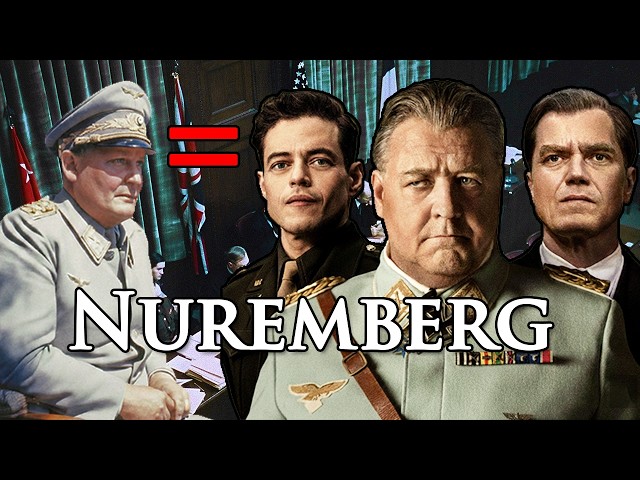
Nuremberg, the Trial and Legacy | Based on a True Story
The Cynical Historian
0:00 Hi, I'm Dr.
0:01 Joe Hall Patton or Cipher on this channel.
0:03 There's a new film about the Nuremberg trials and it's incredible.
0:07 I want to talk about it.
0:08 Any coverage of the topic requires considering
0:11 the conundrum at the center of these trials.
0:14 They essentially established the concept of crimes against humanity.
0:18 So, how could they make something retroactively illegal?
0:21 In answering that question,
0:23 the trials secured their legacy for international law.
0:26 But the outcome is far different from the popular conception.
0:30 So let's discuss what the Nuremberg trials meant.
0:55 Prior to World War II, international law was the province of treatymaking.
1:00 While there had been many conventions and declarations on human rights,
1:03 nothing had truly made them enforceable.
1:06 A court of arbitration in the HEG had been functioning since 1899,
1:10 but that was purely for solving disputes between states.
1:14 The League of Nations formed after the First
1:17 World War along with a court of international justice,
1:20 but it was completely ineffective.
1:22 The United Nations formed during the sequel,
1:25 but in the aftermath of the war and revelations about the Holocaust,
1:30 that made prosecuting these atrocities all the more urgent,
1:34 faster than the UN could enact their declaration of human rights.
1:38 Some allies wanted vengeful executions,
1:41 while others thought this was a rare opportunity
1:44 to establish international law in a new way.
1:47 Stalin proposed that at least 50,000 and perhaps 100,000
1:52 of the German commanding staff must be physically liquidated.
1:57 Summary executions were part of the Morganthal plan,
2:00 but a leak made that extremely unpopular with the American public.
2:05 French, British, American, and Soviet leaders met in London to decide
2:09 what to do after victory in Europe was secure.
2:12 US Supreme Court Justice Robert Jackson
2:15 argued most convincingly that trial should
2:17 be given because it would be a lesson to the world in justice.
2:21 This rested on the fact that Germany signed the 1928 treaty
2:25 for the renunciation of war as an instrument of national policy.
2:29 Terrible name, the Tro that meant that prosecuting war crimes
2:35 and violations of human rights would be based on that.
2:38 Jackson later explained, "I think our proof amply demonstrated that the campaign
2:44 against the Jews was intended to remove what they,
2:47 as in the Nazis, regarded as an obstruction to instituting war
2:51 and that the extermination was a part of the objective of the war.
2:56 The London Charter created the Nuremberg trials,
2:59 where judges from each of the four nations would hear
3:03 the cases of 24 defendants for conspiracy and crimes against peace.
3:08 ultimately ruling from the bench by majority vote,
3:11 which this was officially titled the International Military Tribunal.
3:15 There would be full due process largely based on American
3:19 procedural norms with the real possibility of a quiddle.
3:22 Defendants had attorneys and were
3:24 officially assumed innocent until proven guilty.
3:28 Jackson would be one of the lead prosecutors.
3:30 They met at the Palace of Justice in Nuremberg beginning in November of 1945
3:36 and held court for almost a year even while the city still lay in ruins.
3:40 There were four major arguments that the prosecution had
3:44 to basically ignore for they were immaterial to the charges.
3:48 First was the fact that there was no German judge,
3:51 making this a victor's justice.
3:53 But who else was to try these crimes?
3:55 They also pointed to the fact
3:57 that the allies had committed some war crimes themselves.
4:00 This is what's called a toki defense as in uh you too.
4:05 For instance, the Soviets had also invaded Poland, Finland,
4:08 and the Baltic states just after agreeing
4:11 with Germany to split their spheres of influence.
4:14 Even if such crimes were at all commenurate,
4:17 that would not excuse Nazis for beginning a war of aggression.
4:21 Then they could argue that this was expostfacto legislation,
4:25 as in making something illegal after the fact.
4:28 The defense could argue that the Holocaust
4:30 wasn't illegal according to German laws,
4:33 and that they had abregated the 1928 treaty,
4:36 but they actually hadn't abregated it, at least in any official capacity.
4:41 Furthermore, murder and deprivation of property without
4:44 trial was in fact illegal in Germany.
4:47 Their own laws contradicted that argument.
4:50 Crimes against humanity were a new charge for 1946,
4:54 which is why they anchored that in already established war crimes.
4:58 The Nurmer trials were not expost facto.
5:01 And finally, every defendant claimed that they
5:04 were merely following the orders of Hitler,
5:07 who had taken his own life, and therefore no one should be tried.
5:10 The prosecution proved that these orders were not only illegal,
5:13 but most of the defendants knew that they were illegal when following them.
5:18 Most of the defendants pretended to be meek and feeble
5:21 in an attempt to appeal to the mercy of the tribunal,
5:24 but one twisted the proceedings to his will.
5:27 Herman Goring was the highest ranking remaining Nazi,
5:31 having been president of the rich dog and chief of the Lufafa for over a decade.
5:36 He used his time on the stand to narrate his career,
5:40 enraging Jackson in the process.
5:42 Nonetheless, all the witness testimony
5:44 and evidence presented was quite indisputable.
5:47 In doing so, they created a definitive
5:50 record of the atrocities committed during the Holocaust.
5:53 From Nazis own documents,
5:55 we learned of the sheer scale and wickedness of their extermination campaign
6:00 and just how complicit nearly every
6:03 level of leadership was in countless atrocities.
6:06 When presented through the strictctures of proper
6:09 procedures and a completely recorded trial,
6:12 the facts of the Holocaust became undeniable.
6:15 This invaluable archive is fully digitized now and keyword searchable.
6:20 This was perhaps the most important legacy of the trials,
6:24 rendering anyone who denies or downplays Nazi crimes an open and obvious bigot.
6:29 And bigots get banned on this channel.
6:31 After much deliberation, the tribunal acquitted three of the accused,
6:35 much to the chagrin of the Soviet judge who wanted death sentences for everyone,
6:40 seemingly at the direction of Stalin himself.
6:43 Those three were a leading propagandist, a financier,
6:46 and the former chancellor and ambassador France von Poppin.
6:50 Von Poppin would serve two years of hard labor as part of denazification,
6:55 but successfully appealed those charges.
6:58 Two others were indicted, but never stood trial.
7:01 One industrialist was too sick,
7:03 and the Nazi labor dictator took his own life beforehand.
7:07 Roughly twothirds of the charges rendered guilty verdicts,
7:11 meaning there was incredible leniency to these criminals,
7:14 rendering doubts about the defendants's claims against
7:17 the legitimacy of the International Tribunal completely mute.
7:21 Of the 21 convicts, 11 were sentenced to death,
7:25 but only 10 were executed since Goring managed to take
7:28 a cyanide pill that someone snuck into his cell.
7:31 The rest faced prison sentences of 10 to 20 years with one exception.
7:36 Rudolph Hess who had been deputy furer from 1933 to 41
7:41 and would spend the rest of his life in Spandow prison.
7:44 When he finally died in 1987,
7:47 what remained of the four powers council utterly demolished
7:51 the prison and dropped the ashes into the sea.
7:53 Hitler's personal secretary and temporary replacement,
7:57 Martin Borman, was convicted in abstentia,
8:00 but he likely died during the siege of Berlin.
8:03 The tribunal had effectively established the idea of international crimes.
8:08 Simultaneous to this, another tribunal was held for Asia in Tokyo.
8:13 These were less prestigious because they were essentially
8:16 ordered into being by Supreme Commander Douglas MacArthur,
8:20 who very much influenced the outcome.
8:22 They documented and prosecuted the war of aggression Japan had begun,
8:27 including many of the atrocities from genocide to torture and sexual slavery.
8:32 The scientists and engineers who committed crimes but actively surrendered,
8:37 both Nazis and Japanese,
8:39 were often allowed to escape justice
8:41 for the sake of their technological advancements,
8:44 many becoming significant parts of American and Soviet innovations that was
8:50 quite tarnishing for the entire concept of international criminal codes.
8:55 Yet, there were subsequent Nermberg
8:57 trials using the American separate jurisdiction.
9:00 Soviets would hold their own version of both the Tokyo and Nermberg trials,
9:06 fulfilling some of the mass executions that Stalin advocated for.
9:10 The American sector continued a series of trials in Nuremberg,
9:13 beginning almost immediately after the originals.
9:16 They prosecuted doctors who had euthanized their patients,
9:20 a lufafa marshall for slavery,
9:22 judges who upheld eugenics, more officers involved in the concentration camps,
9:28 a bunch of industrialists who aided the Holocaust,
9:32 generals who massacred civilians and prisoners,
9:35 administrators of Nazi racial policies,
9:38 commanders of the Ians groupin, and a few others.
9:42 Over 1,400 were convicted with almost 200 getting executed.
9:47 Most of those imprisoned had their sentences commuted in the 1950s by American
9:52 High Commissioner John Mcclo as a sign of goodwill to West Germany.
9:57 Though most Germans eventually regretted calling
10:00 for this because it made a mockery of justice.
10:03 There'd been a series of further trials for war crimes related to World War II,
10:07 with thousands upon thousands of convictions elsewhere,
10:11 especially at the actual concentration camps.
10:14 Furthermore, there were even more killed
10:16 for reprisals and vengeance totaling hundreds of thousands.
10:21 One clear precedent these subsequent trials created is that the just
10:26 following orders excuse was better substantiated
10:29 as specifically being about illegal orders.
10:32 If personnel knew the order was illegal and they still followed it,
10:36 then they had committed a crime, which is a high evidentiary bar to clear.
10:41 On top of that, numerous war criminals received leniency over the decades.
10:46 So the actual legacy of Nuremberg is mixed.
10:49 Beyond that, the prosecution of international crimes laid dormant.
10:54 By the 1980s, many analysts thought it was a derelict concept.
10:59 David Luben said in 1987, "If one of the aims of the Nuremberg trial was
11:04 to burn the history of Nazism into the memory of mankind,
11:07 we must conclude that it failed." Atrocities hadn't ceased.
11:12 Yet, no one could bring together a court to try them.
11:15 For the most part, that simply remained for the country in power to prosecute,
11:19 which was obviously a problem when the country in power often
11:22 was the perpetrator and remained in control thanks to their misdeeds.
11:28 It was especially difficult when capitalist and communist powers
11:32 had a veto authority in the United Nations Security Council.
11:36 When a capitalist country committed atrocities on behalf of defeating communism,
11:41 Britain, France, and the United States would prevent any proposals to prosecute.
11:45 When a communist country did the opposite, Russia, and China would obstruct.
11:50 The Cold War prevented justice.
11:53 Circumstances changed afterward.
11:55 As Yugoslavia broke apart, Serbs raped, massacred, and expelled Bosnians.
12:01 Finally, the United Nations began criminal
12:04 proceedings based on the Nuremberg president.
12:06 They were founded with a declaration of human
12:09 rights and formulated a definition of genocide.
12:13 Finally, they could put that into practice.
12:16 Simultaneously, the Rwanda genocide began, prompting another set of trials.
12:21 Both resulted in 151 convictions after a decade of hearings,
12:26 but these were temporary courts meant solely to prosecute those specific crimes.
12:32 The International Criminal Court, ICC for short,
12:35 formed in 2002 with the purpose of being
12:38 a permanent body to prosecute all such further crimes.
12:42 They have rarely done so because it
12:45 requires another country to recognize the atrocity,
12:48 submit evidence on behalf of victims,
12:50 and have no ongoing effort from the originating
12:53 nation for the ICC to become involved.
12:56 Allied nations of perpetrators remain almost
13:00 insurmountable obstructions once that process begins.
13:04 Since the beginning of this decade,
13:06 there's been the Taliban's repression in Afghanistan,
13:09 Russia's invasion of Ukraine, Israel's genocide of Gazins,
13:13 and the misal genocide in Sudan, just to name a few.
13:16 The current Trump administration is certainly
13:18 committing a few war crimes themselves.
13:20 The world is a bleak place when you look for atrocities,
13:23 and there's so many more.
13:25 Of those named, only Afghanistan, Russia,
13:27 and Israel are currently being prosecuted, which will take many years to do so.
13:33 Even if the United States ceases to oppose justice like we have since
13:38 the ICC's beginning because we committed so
13:40 many atrocities ourselves during the war on terror.
13:44 That is understandably frustrating for everyone who seeks justice.
13:48 But the legacy of Nerburgg proves that being prudent and working
13:52 with the constraints of the international
13:54 community is better than expediting persecution.
13:58 Those trials in 1945 and 46 remain the basis of international criminal justice.
14:04 It took many decades for that to finally be
14:06 implemented and we have a long way to go.
14:09 But now that it exists, Nermberg's legacy is enshrined in international law.
14:15 Beyond that, it is the basis of our documentation
14:18 of the Holocaust along with other Nazi atrocities.
14:21 They had to overcome significant legal, ethical,
14:24 and compassionate obstacles, some to greater effect than others.
14:29 The evidence itself, freely available to anyone,
14:32 remains an extremely compelling artifact of not only these trials,
14:37 but all subsequent trials following its precedents.
14:41 While the ICC's record since 2002 is lackluster,
14:45 hampered by stringent requirements and belligerent nations,
14:49 it continues to improve its procedures and legitimate human rights.
14:54 Ultimately, the Nuremberg trials still serve as a beacon
14:58 of juristp prudence for those seeking justice.
15:06 The Nuremberg trial itself is incredibly wellstied.
15:10 I lacked for no secondary sources.
15:12 Plus, the primary sources are readily accessible.
15:14 Anyone may read them.
15:16 Yet, you may be able to tell that I
15:18 wrote the reality section before the movie ever came out,
15:22 expecting to create an episode to release alongside the film's release.
15:26 I didn't get that done in time,
15:27 so I withheld creating this until after having watched this at home.
15:32 Upon finishing it, I realized that there was
15:34 a fundamental aspect that I had not researched.
15:37 the story of the psychiatrist.
15:39 Douglas Kelly is the protagonist of this movie,
15:42 so I had to add the book it is based on to answer
15:44 some of the questions I had by the end of the movie,
15:47 which gave me a greater appreciation of what the movie did.
15:51 It is excellent and has a really important message,
15:54 a problem deep at the core of prosecuting war
15:57 crimes is what the nature of these criminals are.
16:01 Kelly had his own conclusion that he saw as a dire
16:05 warning for Americans in what he understood of Nazi leadership,
16:09 and that was that the hatred,
16:10 narcissism, and ruthlessness that drove them may be found anywhere,
16:15 and that the villain that they perpetrated
16:17 was not from some unique wickedness or nefariousness.
16:21 Everyone is capable of evil.
16:24 That realization drove Kelly mad with bouts
16:27 of drunken rage that often tipped into domestic violence,
16:31 eventually taking his own life.
16:33 So, this is a delicate topic and I
16:35 think the filmmakers handled it incredibly well.
16:38 But the movie is not without its inaccuracies, some of which are confounding.
16:42 So, let's get through those before talking
16:45 about what's good and interesting about this movie.
16:53 Most inaccuracies are somewhat necessary to keep the plot going.
16:58 For instance, Kelly is shown identifying Goring's
17:01 drugs when it was really a laboratory.
17:03 Nor was it Kelly who saved Goring from his near-death withdrawal.
17:08 So, in a way, there is some character amalgamation here.
17:12 They age up Goring's daughter, who was only seven at this point.
17:17 I suppose that's to make Kelly's growing
17:19 affinity for goring a little more compassionate.
17:23 The other psychologist, Gustav Gilbert, is very incorrectly depicted in this.
17:29 He shows up as a second opinion after inmate Robert Lei committed suicide.
17:39 I'm bringing in another doctor.
17:41 It's been determined a second opinion is required for some of your patients.
17:45 In reality, he came as the court's psychologist,
17:49 whereas Kelly was the prison shrink.
17:51 In this, Gilbert is antagonistic to Kelly when it was quite the opposite.
17:57 Well, that is what a second opinion is for.
18:00 I'll share research.
18:01 We'll co-author.
18:07 That was me being honest with my patient.
18:10 Something you ought to try sometime.
18:11 You destroyed him in there.
18:13 So, it was Kelly who reneged on jointly publishing.
18:18 He duplicitously took research materials on his own.
18:22 In order to increase the drama,
18:23 Kelly is shown to drunkenly explain to a reporter
18:27 that Jackson will be beaten by Goring.
18:30 Jackson's going to get killed.
18:33 Look at that.
18:34 And this gets him fired.
18:37 Sir, you're finished.
18:38 I signed your transfer order this morning.
18:40 In reality, Kelly simply quit,
18:42 wishing to finally return to his wife after so many years away.
18:46 This dramatic distraction is meant to be a turning point.
18:50 Interpreter Howard Trieste, whose real story of escaping Germany because he was
18:55 a Jew and only arriving in New York by 1940,
18:59 though his parents did not escape the Showa
19:01 camp was liberated January 27th, 1945.
19:05 No sign of him.
19:06 Four years earlier, I left this country scared
19:11 and alone in the middle of the night, but I came back with a goddamn army.
19:16 To all of Germany, Guring has to fall.
19:20 That's all extremely compelling and convinces the movie
19:23 version of Kelly to stay and help the prosecution,
19:26 which turns the tides against Goring.
19:29 Obviously, that did not happen.
19:30 Kelly had hardly any interaction with Jackson.
19:33 He was simply a small part of the prison's medical team.
19:37 So these may seem egregious departures from history,
19:41 but the accuracies are far more impressive.
19:49 The movie covers some of the difficulties of instituting the International
19:53 Military Tribunal in a way that is somehow not distracting.
19:57 But what you're talking about is trying them in some sort of legal
20:00 limbo that doesn't exist using case law that hasn't been written yet.
20:04 That easily could have been a bunch of expository dialogue, but it is engaging.
20:09 What do you charge them with?
20:11 Conspiracy to wage aggressive war on the world.
20:14 And you want the United States to argue that as the prosecution?
20:18 I do.
20:19 You're talking about a tribunal.
20:22 Exactly.
20:22 We can't prosecute the Nazis for planning aggressive
20:26 wars if you guys were planning aggressive wars.
20:29 While they do that, they also explain
20:31 why Nuremberg was so important and necessary.
20:35 The world needs to know what these men did.
20:38 If we don't win that trial, there won't be any more trials to come,
20:41 and our respective governments will be the laughing stock of the world,
20:45 defeated by the very men we've imprisoned.
20:48 If 15 years from now they come back even stronger,
20:53 I don't know if we can beat him a third time.
20:55 The stakes are clear without having to go into all the details.
20:59 Once the trial begins, the dialogue is taken directly from the transcript.
21:04 Obviously, they pick and choose which quotes
21:06 to use and how to put it all together.
21:08 For instance, they have the British prosecutor
21:11 follow Jackson immediately when these were days apart.
21:16 The United States is always happy to hear
21:18 from our distinguished colleague from Great Britain.
21:21 An estimated 6 million Jews in total as well as Soviet and Polish citizens.
21:27 People killed not in combat, not in enemy fire,
21:31 but exterminated by the state, the state which you were the rice marshal of.
21:37 And you contend that you had no knowledge knowing what happened.
21:44 Would you still follow the Fura?
21:47 Yeah.
21:50 Effort.
21:52 They show a few minutes of the hour-long documentary
21:56 that John Ford made showing the conditions at the camps,
22:00 which was incredibly effective during the actual proceedings.
22:04 Given that Team YouTube banned the last time I showed that footage,
22:07 I'll avoid doing so here.
22:09 But understand, it is very graphic.
22:12 So, the filmmakers are not pulling punches here.
22:15 If you do want to see my episode about the Holocaust and Schindler's List,
22:19 be sure to check that out.
22:21 But the drama of the court and the general feeling of what
22:24 Nermberg was like during those days is all very accurate in this.
22:29 Goring is especially charismatic throughout the movie as he was in reality.
22:34 Once sentenced, we see Goring's body getting discovered.
22:38 We even see the botched hanging of one convict.
22:42 All of that is well done.
22:43 They end the movie with Kelly trying to sell his book,
22:46 but being told that he shouldn't draw comparisons between Americans and Nazis.
22:52 There are people in America who would willingly climb over the corpses of half
22:56 the American public if they knew they could gain control of the other half.
23:00 Trashing our country is probably not the best way to sell your book.
23:04 That was indeed the reaction to his book,
23:07 but it wasn't his sales pitch being read on the radio in that scene.
23:11 That's just quotes of his actual book.
23:14 The movie is correct in stating that he was not
23:17 wellreceived for this, and ultimately that's what the film is about,
23:21 but those are contested waters.
23:24 They've waited into the enormity of the crimes
23:32 Nazis perpetrated have forever equated them with evil.
23:36 In the expanse of just a few years,
23:39 they slaughtered 11 million people purely out of prejudice.
23:43 An industrialized genocide we have never seen before or since.
23:47 The war they initiated purely for territorial expansion
23:51 killed another 60 to 70 million, the deadliest ever.
23:55 Ever since, scholars have attempted to understand
23:58 what made Nazis so uniquely murderous, an answer to that could yield a warning
24:03 for others to prevent such atrocities from recurring.
24:06 It is part of the mission to never forget.
24:09 Yet, no definitive conclusion can be found.
24:12 Some scholars argue that fascism inevitably leads to bloodshed
24:16 or that Nazis had some sort of mental disorder.
24:20 But perhaps the most popular interpretation was that these were
24:24 ultimately benile men corrupted by their search for total power.
24:28 Gilbert was among the psychoanalyzing folks postumously
24:32 diagnosing Hitler with any number of neurosis.
24:36 But Kelly was somewhat different.
24:38 The idea of a criminal type is simply folklore.
24:42 But the belief is widespread.
24:45 This is the lesson that I think we must learn.
24:48 This is the lesson that I think we must teach our children.
24:53 That there is no such thing as a criminal characteristic.
24:59 He did not see his subject as benal nor unique.
25:03 He argued that these kinds of men were everywhere.
25:06 It wasn't fascism itself that led to murderousness,
25:10 but the hatred it was built upon.
25:13 A hatred that could be found among anyone.
25:16 That interpretation is what this movie is trying to provide the audience with.
25:21 They practically speak directly to us on several occasions throughout the film.
25:26 And along comes a man who says,
25:29 "We can reclaim our former glory." Would you not follow a man like this?
25:36 You know what sets them apart from us?
25:41 Nothing.
25:42 Would you even acknowledge we were human?
25:44 One debt to society later.
25:47 Individuals who are humans are humans.
25:50 They stoke hatred.
25:54 It's what Hitler and Guring did and it is textbook.
25:58 You can tell that they do this as a warning
26:00 against the rise of neofascism throughout the world.
26:03 The radical right has gained power and continues to worsen.
26:08 Are you affirming that you think President Trump is a fascist?
26:11 I've spoken about That's okay.
26:13 You can just say yes.
26:14 Okay, that's easier.
26:17 Many look to the International Criminal Court in hopes
26:20 that those currently ruling may face the same justice that Nermberg issued.
26:25 The movie and its message seemed timely as ever,
26:28 even though this was years in the making.
26:31 Kelly himself obviously is not someone we should turn into a hero, though.
26:36 He did not need to be made into the savior of the trial,
26:40 especially given his domestic violence.
26:42 Whether you like his interpretation of the nature of evil is up to the viewer.
26:47 I am simply elated that they are at least making the argument,
26:51 and that's no small feat.
26:52 But of course, as a historian,
26:54 I prefer we move beyond the labels of good and evil in analyzing the past.
26:59 Such moralizing is an unnecessary hindrance to the pursuit of truth.
27:04 No matter what, people are still just people, even when they are war criminals.
27:09 But that is for historians, not regular folk.
27:12 We all have some sort of internal morality and yearn for a greater ethics.
27:16 So, if you too have been dreaming
27:19 of recent war criminals facing justice, this movie beckons.
27:26 Hello, king.
27:28 A labor dictator.
27:32 What do you want?
27:38 What are you saying?
27:41 Yeah, but you're purring.
27:46 But you're purring.
27:51 Yeah.
27:52 Yeah.