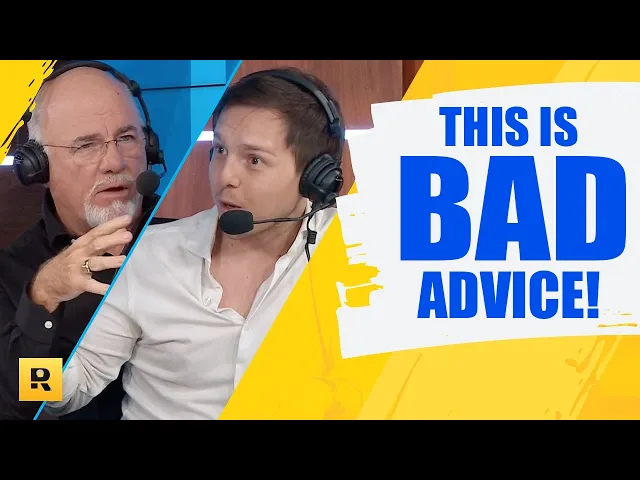
STOP Listening To Dave Ramsey!
The Graham Stephan Show
0:00 Welcome back to the Graham Stephan Show,
0:01 and this is exactly why you shouldn't listen to Dave Ramsey or Suze Orman.
0:05 And I'm not going to say I agree with all these statements,
0:08 but it is worth considering because this guy Azul posted
0:12 a video on this that I got a comment on.
0:14 As soon as you hit the like button, subscribe.
0:16 Thank you so much, and also a big
0:17 thank you to Cook Unity for sponsoring this video,
0:19 but more on that later.
0:21 I'm going to get in at least a little bit of trouble for making this video,
0:24 but I think it's important that I share with you my views
0:27 on why I think you should stop listening to Dave Ramsey and Suze Orman.
0:33 And I'm going to read you a quote that we're going to go over.
0:35 If you're poor, you listen to Suze Orman.
0:38 If you're middle class, you listen to Dave Ramsey,
0:41 but the rich think differently.
0:44 It's funny how everyone gets put into these categories like,
0:46 "Oh yeah, if you're poor, listen to Suze Orman." First of all,
0:49 I've never heard of anyone poor listening to Suze Orman.
0:53 I mean, most people listening to Suze Orman
0:55 probably have a good shoulder on their head.
0:57 So, probably budgeting already, they're saving, they're doing something.
1:01 For Dave Ramsey, it seems like a lot of people
1:04 who made mistakes in the past listen to Dave Ramsey,
1:07 and and they're getting out of it, and they're making a lot of progress forward.
1:10 And then if you're homesick from school, you listen to Caleb Hammer because,
1:13 oh my gosh, his entertainment value, I got to say is through the roof.
1:17 Like, I watch almost all of his videos just for the intros alone.
1:20 See like how insane they are.
1:22 But uh yeah, with that said, we'll continue.
1:24 My clients used to pay me thousands of dollars a year
1:27 as a financial advisor to share my thoughts with you.
1:30 And one of the things I love about YouTube
1:33 is I get to give you my views completely free.
1:36 All I ask is you give me a thumbs up for a like.
1:39 If you've watched a couple of my videos, think about subscribing.
1:43 As the kids say, "Thumbs for like and subs for love." That's my love language.
1:48 So, give me a subscribe or a like.
1:50 Thank you.
1:50 That is probably one of the best call to actions I've ever seen on a video.
1:53 Just for that, I'm going to give it a like.
1:56 I don't even know if I could compete with something like that.
1:58 If I ask you to hit the like button, like he does it with such sincerity.
2:03 How about this, guys?
2:04 If you're watching this video, and you haven't done it already, all I ask,
2:09 my only wish, just hit the like button
2:11 and subscribe if you haven't done that already.
2:13 And this promised because a lot of people were upset that I
2:16 didn't give them a picture of a snail in my last video.
2:18 Here's a picture of a snail.
2:20 The article's from Forbes.
2:21 It's called The Rich Don't Listen to Suze Orman and Dave Ramsey.
2:25 The author starts off saying, "The whole idea is that if you save,
2:30 scrimp, and avoid spending your entire life, you can die a millionaire.
2:35 And that didn't sit well with the author." He goes on to say,
2:39 "The thought of handling handing the money I'd worked my entire
2:43 life over to my children and grandchildren who'd likely blow it because
2:48 they don't they didn't work hard to earn it sounded like
2:52 a recipe for life for a life of misery to this person."
2:56 I do not think saving money and scrimping and investing
3:00 have anything to do with passing off your wealth to kids.
3:04 The whole point of it is really to save up for the life that you
3:06 want to live and make sure you're not overspending on the path to get there.
3:12 If you want to go and give it to your kids who
3:14 are going to blow it in like two generations, by all means.
3:18 But this whole concept really has more to do with the book Die with Zero,
3:22 which really suggests that you should be maximizing
3:24 your life experiences at different points of your life
3:26 and saving up for this experience specifically instead of just
3:30 trying to die with as much money as possible.
3:31 So, I tend to agree.
3:33 Yes, if you want to become wildly rich,
3:35 you cannot do what everyone else is doing.
3:38 I mean, there are certain principles that you could follow,
3:40 but if you follow what everyone else is doing,
3:43 and everyone else isn't rich, you're not going to be chances are absurdly rich.
3:47 So, yes, you do have to think differently, but at the same time,
3:50 I mean, it has nothing to do with giving your kids money like this.
3:53 He goes on to say, "Dave Ramsey's advice is to live debt-free.
3:57 And debt in Dave's world is a bad thing.
3:59 It means owning owing anyone on any
4:03 loan." "In addition to thinking differently about money,
4:07 the rich build all-star teams around themselves,
4:10 and that was a game-piecing piece of advice for this author
4:14 in his journey." I'm going to come back to that, but in general,
4:17 his point here is the aversion to debt.
4:20 Again, we're comparing apples to oranges here.
4:23 We're comparing building wealth, saving, investing, paying down debt.
4:27 It's one category.
4:28 And then we're talking about another category
4:30 of extreme wealth building through starting your own business,
4:34 running teams, hiring employees.
4:36 The two are totally separate.
4:38 You could have the business, have the employees,
4:41 and be massively in debt, overspending all your money, and be completely broke.
4:45 You could also be in a safe W-2 job earning
4:48 $80,000 a year and be worth a million dollars by saving,
4:52 investing, not going into debt, not living extravagantly.
4:56 Again, the two are completely separate and really
4:58 just depends on what sort of lifestyle you want.
5:00 Like for me, the idea of managing like hundreds of people doesn't sound fun.
5:05 But on the other hand, when I could just go into a half-converted
5:09 garage on my own accord because I felt like
5:11 it today and make a reaction video talking
5:14 about why you should stop listening to Dave Ramsey,
5:17 and it's just me editing these videos cuz that's what I enjoy doing.
5:20 So, that is my idea of fun, and that is how I'm able to save
5:24 and invest and do all these things because you know,
5:27 I I just take a path that works for me,
5:29 and it's not hiring hundreds of people, but it's doing this, and I enjoy it.
5:34 And but again, that has nothing to do with paying off debts.
5:37 I'm a fan of Dave's.
5:39 I think he really helps people save their first maybe $250,000,
5:44 but I think his aversion to debt is maybe a little too extreme,
5:49 and it can it can steal from us the joy of enjoying the journey.
5:54 Once you've learned how to save,
5:55 once you've learned how to spend less than what you earned every year,
6:00 once you've proven yourself you can be responsible with that, I
6:04 think it's okay to have debt for something like a mortgage.
6:07 To me, it really just depends on where interest rates are.
6:10 Like right now, at today's interest rates,
6:13 if I got a mortgage, let's just say at 6.5%,
6:17 I would probably want to pay that down
6:19 as soon as possible because long-term in the stock market,
6:21 you're probably going to get 8%,
6:24 which is going to be about 6.5% after taxes anyway.
6:27 So, when I get a guaranteed 6% return right off the bat immediately after tax,
6:32 I would probably rather just pay off the mortgage as soon as possible.
6:36 On the other hand, if I can get a mortgage for 3%,
6:39 3.5%, maybe even 4%, I'd keep that debt as long as possible.
6:43 So, I really just think it depends what the debt is, what the interest rate is,
6:48 what sort of inflation there is,
6:50 where else you could invest your money, and just do the math.
6:53 To me, it's just a math equation.
6:54 If your interest rates are too high, pay them off.
6:57 Don't do the debt.
6:58 If the interest rates are really low, keep the debt for as long as possible.
7:01 And in the middle, maybe you could split it here and there.
7:05 Now, let's talk about Suze Orman.
7:08 And for this, we're going to turn to a different article.
7:11 You know, there's one part about building wealth that almost no
7:12 one talks about because it's not complicated and it's not flashy,
7:16 but it makes a huge difference.
7:17 And it's simply how you manage your everyday decisions.
7:20 Like the people who actually do the best aren't focused on these huge wins.
7:23 They're just focused on the everyday decisions
7:25 that get them closer to their goals.
7:27 Think about it.
7:28 How often do you overspend on takeout, waste time figuring out meals,
7:32 or eat something that's not the best for you simply because it's there?
7:36 Well, that personally is why I'm a huge fan
7:38 of today's sponsor Cook Unity because for those unaware,
7:41 they deliver restaurant-quality prepackaged meals that get shipped on a regular
7:45 basis right to your door for an amazing price.
7:47 And no joke, when I first tried it out,
7:49 I was blown away by how good the quality was.
7:51 Like without exaggeration,
7:52 it tasted like I was eating food cooked right from a restaurant except
7:56 at the price that was less than what I would pay for a bowl at Chipotle,
8:00 and I didn't have to drive there and stand in line.
8:02 Personally, I really enjoy their grilled Asian
8:05 hanger steak made by Chef Stacy Barang,
8:07 this Peruvian flat iron steak made by Chef Nelson Breazu,
8:11 or this roasted salmon and lobster sauce by Chef Andre Mendes.
8:14 I've just been genuinely a huge fan of their food.
8:16 I eat them on a regular basis,
8:18 especially on days like today where I am slammed and I'm
8:21 trying to get this video out as soon as possible.
8:23 And they have hundreds of options to pick
8:24 from, each prepared by award-winning chefs with high-quality ingredients.
8:28 They're all delivered fully cooked.
8:30 They're ready in a few minutes, so all you have to do is heat them up.
8:33 And if you're trying to eat lean like me,
8:34 they even have tons of options that are under 600 calories.
8:37 Not to mention, their flexibility is amazing.
8:39 You could choose between four to 16 meals a week.
8:42 You could pause or cancel at any time and personalize everything.
8:45 So, if you want to save time, save money, cut food waste,
8:48 and actually eat healthier, check out Cook Unity down below in the description.
8:52 And for a limited time, use the code Gram50 at checkout to get 50% off
8:57 of your first order with the link down below in the description.
9:01 At that price, I have no idea
9:03 how they're actually able to maintain profitability,
9:05 but you may as well just take the deal before it goes away.
9:09 Again, with the code Gram50 for 50% off.
9:12 At that price, I almost guarantee it's cheaper than whatever else you're eating.
9:15 So, you may as well try it out.
9:16 Give it a shot.
9:17 The link is down below.
9:18 Thank you so much.
9:19 Now, let's get back to the video.
9:20 Now, let's talk about Suze Orman.
9:22 The title is Suze Orman says a $10 million nest egg is chump change.
9:28 Is she right?
9:30 That would be funny if she said 10 million.
9:32 I think I think he meant to say 2 million.
9:34 Imagine, people would lose their minds.
9:35 All you got to say to go viral is say, "Hey guys,
9:38 $20 million is nothing." My gosh, you can't buy anything with $20 million.
9:45 You can't even afford to fly private jets at $20 million.
9:49 What are you going to do?
9:50 And then people lose their minds.
9:52 But a small portion of people say, "Oh man, this guy is right.
9:56 Let me go follow him." And then you get millions
9:58 of dollars saying just what the most nonsense stuff out there.
10:01 The more nonsense you spew out, the more views you tend to get, unfortunately.
10:05 That's the nature of social media.
10:06 But anyway, $2 million retirement Trump change
10:09 really just depends on where you live, what your expenses are.
10:12 I'd say a lot of people could get by on $2
10:14 million if they spent 4% of that every single year.
10:17 Pretty good.
10:18 It's a good retirement.
10:19 $2 million is nothing.
10:21 It's nothing.
10:23 It's pennies in today in today's world, to tell you the truth.
10:27 So, is she right?
10:28 Is $2 million nothing?
10:30 Let's Let's look at the numbers because you and I know
10:34 $2 million is a heck of a lot more than nothing,
10:38 and it's a heck of a lot more than the vast majority of Americans have.
10:43 She's getting clicks.
10:44 She's just playing to like whatever gets headlines.
10:46 It gets her name gets out there.
10:48 She's able to like sell more speaking engagements, more bucks.
10:51 Again, anyone with like three brain cells
10:53 could see that the more outlandish you are,
10:57 the more you stand out.
10:58 And you have to stand out if you want
10:59 to get any sort of viewership on social media.
11:02 So, that's my interpretation of this.
11:05 This is according to the survey consumer finance from the Federal Reserve.
11:09 And this shows how much Americans have saved for retirement.
11:12 And you can see almost half of all Americans have $0 saved for retirement.
11:17 Another 9% have have less than 10,000.
11:22 From 10,000 to 50,000, it's another 13% 50,000 to 100,000, it's another 7%.
11:30 So, in aggregate, that's about 80% of America
11:34 has less than $100,000 saved for retirement.
11:38 And they would love that $2 million that Suze Orman says is nothing.
11:43 It's really all about just getting started as soon as possible.
11:45 And how about this?
11:46 If you guys are interested in it,
11:48 I do have an affiliate link down below to WeBull.
11:50 When you sign up, they will just give you
11:52 a whole bunch of freebies when you make a deposit.
11:55 Some of these freebies are basically like getting free money.
11:58 So, if you're interested in doing that, the link is down below.
12:00 And no joke, I've been using WeBull now since like 2017 or 2018.
12:05 They're one of the most advanced platforms out there when
12:08 it comes to just about anything you could ever need.
12:10 So, if you want to try them out and be growing your money,
12:13 the sooner you start the better.
12:15 Again, that link is down below.
12:16 Would mean a lot.
12:16 That would support the channel.
12:17 That's my love language.
12:18 How about that?
12:19 When you sign up for WeBull.
12:21 No, seriously, it would help out a lot.
12:22 So, enjoy.
12:23 Enjoy the freebies.
12:24 You You may as well do it.
12:25 It's like getting a credit card bonus except with a stock brokerage.
12:28 So, enjoy.
12:29 Let's look at the median net worth.
12:31 Half of the people have more, half of the people have less.
12:34 And you can see here 45 to 54-year-olds have about $250,000 total net worth.
12:41 55 to 64, so this is when people
12:44 are starting to think about retiring, have about 365,000.
12:49 65 to 74-year-olds have about 410,000.
12:53 And then in retirement, that goes down to about 1/3 of $1 million.
12:58 So, you can see somewhere between 365,000 and let's call it 410,000 is what
13:06 people have their median net worth when
13:08 they decide to pull the trigger and retire.
13:10 It's crazy the difference between median and average.
13:13 So, for those unaware, the median is split right in the middle.
13:16 That's getting rid of the outliers, getting rid of the trillionaires out there,
13:20 so to speak, which pull up the average.
13:22 But when you see the average,
13:23 you could see that's pulled up by the people who are really,
13:26 really, really wealthy.
13:28 So, when you see this, just know the averages are
13:30 definitely skewed by the few individuals who have a lot.
13:34 And the challenge I have with Suze's quote that $2 million is nothing.
13:39 Yep.
13:39 Yes, of course we'd we'd rather have $5 million instead of $500,000.
13:46 But we do the best that we can,
13:48 and I think Suze's quote about $2 million being nothing,
13:52 unfortunately, an unnecessarily stokes fear in people.
13:57 And this is from a Goldman Sachs survey, and they say that 58% of people are
14:03 worried that they're going to outlive their savings.
14:05 And And that causes people to to work years longer than they might
14:10 have to, and give up what I call the youth of their senior years.
14:15 Is that fear, or is it really just like a rage bait?
14:18 It's just rage bait.
14:19 She's good at it.
14:21 She's good at it.
14:22 That's all it is.
14:22 It gets people going.
14:24 It gets them all Oh my god, I got to respond to this.
14:27 Let me share it.
14:27 Ooh, did you see what Suze Orman just did?
14:30 Now, the people who do worry about this, in my opinion, from this 58%,
14:35 I have a feeling they're probably closer to the median
14:38 where they have a few hundred thousand dollars saved.
14:40 And there is a chance they're going to outlive their savings.
14:43 That's a real concern that a lot
14:45 of people have if they don't have enough savings.
14:47 And for some people, they need to continue working hard working more years.
14:52 I'm not saying to retire before you have enough money to retire.
14:56 But what I am saying is be thoughtful
14:58 and deliberate about do you have enough money to retire?
15:03 Ben Shapiro got a whole bunch of flak.
15:05 I remember when he said this that people shouldn't retire,
15:08 that retiring's actually a bad thing.
15:10 And statistically, when you look at the data, he's not actually wrong.
15:13 Because when people retire, you see their cognitive skills go down.
15:16 They stop contributing.
15:17 They stop feeling a sense of fulfillment.
15:20 They stop socializing, and they just go downhill.
15:23 And I know a lot of people say, "Oh,
15:25 well, if I retired, I would go skiing every day.
15:28 I would do this.
15:29 I would do that." Well, the data shows something completely different.
15:32 And a lot of people who do retire, they are in their 60s or their 70s.
15:36 And what they do instead is nothing.
15:39 Their health declines.
15:41 They lose their purpose.
15:42 They lose their sense of community.
15:43 And again, it's not everybody.
15:45 There are exceptions to this.
15:47 But by and large, it goes to show you
15:49 that you should have something you're doing every day.
15:51 It doesn't have to make money.
15:52 You could be volunteering.
15:54 You could just be working at a place that you enjoy for fun,
15:56 and it could be your sense of retirement to do something on your own terms,
16:00 which I think is really important.
16:02 But going and just doing nothing,
16:04 that actually has shown to shorten your lifespan.
16:07 Believe it or not, there you go.
16:08 That's the data.
16:09 Love it or hate it.
16:10 That That's just what happened.
16:12 Retired people had about 25% more money if they had a written
16:18 financial plan than their counterparts that did
16:21 not have a written financial plan.
16:23 Because when you retire, what I saw is a lot of people unnecessarily sacrificed.
16:29 They could have been spending more money or maybe retired sooner.
16:33 So, that was about 3/4 of my clients.
16:36 But about 1/4 of my clients,
16:38 probably not that much, less than that, but were unknowingly,
16:42 before they started working with me,
16:44 putting their financial future at risk cuz they were spending too much.
16:48 And if you don't have a written financial plan,
16:50 those two feel real close to each other.
16:52 The reality is, there's no way to time this perfectly and save the perfect
16:56 amount of money because you have no idea what the market's going to do.
16:59 You have no idea about any potential
17:01 health emergencies or something that might come up.
17:04 So, it's either you work harder, you save too much money,
17:08 and you don't spend it, or you don't work enough.
17:12 It's going to be one or the other.
17:13 There's no way that you're going to be able to say like, "Oh,
17:15 well, if I stop working here and I save this amount of money,
17:19 and I have all these expenses coming up,
17:20 and the market does that." You just don't know.
17:23 So, I tend to think it's usually better to overplan,
17:26 to save a little too much money than not enough.
17:29 Now, let's talk about that team aspect
17:31 that the first Forbes article was talking about.
17:34 How the author of that said working on a team.
17:37 And what this person meant was, you know,
17:39 having somebody to make sure that they they had an estate plan,
17:42 at least a will in place, some common trust.
17:45 There are There are things that you can do
17:47 that are really a gift to your heirs that will
17:51 make things go smoothly and make sure that the people
17:54 and the causes that you care and love about,
17:57 make sure that all of that goes smoothly
17:59 for them with as few headaches as possible.
18:02 Just don't give them too much money.
18:03 That's all it is.
18:05 Or, if you're going to do anything, it seems like just from what I've seen,
18:08 if you give your kids a controlling interest
18:11 in a business that you bring them up into.
18:14 Like, you get them incorporated when they're young.
18:16 They could see what's going on.
18:18 You teach them the business.
18:19 They grow into it.
18:21 And then eventually, when you're still alive,
18:24 they kind of take over the reins a little bit, and it's their business.
18:27 And they got to work for it.
18:28 Instead of just being like, "Oh, here's a few million dollars.
18:31 Have fun." They're going to blow it cuz they didn't work for it.
18:34 They didn't do anything for it.
18:35 But when you incorporate them into a business,
18:37 make them work for that, then it seems to actually work out pretty well.
18:41 The other thing I I've seen that seems to work
18:43 well is giving them some real estate to manage.
18:46 It's like you give them a 10 unit, and you know, the money's not free.
18:49 They could squander it.
18:50 But if they manage it properly, they could grow it.
18:53 It just gives them something to do.
18:54 That's all it is.
18:55 So, that's what I think.
18:56 Just from what I've seen talking to a lot of people.
18:58 And also be thoughtful and deliberate about the age that you decide to retire.
19:03 And that's why I made this video here.
19:05 Why waiting to 65 to retire might be a big mistake.
19:09 Here's my honest take on Dave Ramsey.
19:11 On the fundamentals, he is absolutely fantastic,
19:13 and he attacks everything from a psychological perspective.
19:17 He's not a math guy.
19:19 He just looks at how dumb is the average
19:22 person when it comes to spending money on credit cards,
19:25 spending too much money on things they don't need,
19:27 and living beyond their means.
19:29 He takes that person and he says,
19:31 "These are the financial principles that are best
19:34 for you psychologically speaking." And he is correct.
19:38 But on a mathematical standpoint,
19:40 a lot of what he says is a little too conservative,
19:42 and it's not going to get you as far.
19:44 So, if you're a logical person who's big into the numbers,
19:47 who could separate their psychology from what actually works logically,
19:51 then get the credit card, get the low interest rate mortgage,
19:55 leverage the debt a little bit smartly.
19:57 If you know, on the other hand, that you get $100,
20:00 you see it in your wallet, and you're like, "Oh, you know what?
20:02 I'm going to spend it tonight on drinks,
20:04 even though rent is due next week." Listen to Dave Ramsey.
20:07 That is my thought.
20:08 Everyone has their own purpose, but that's my take on it.
20:11 Let me know what you think down below in the comment section, and as always,
20:14 I do my best to read and reply to as many of you as I can.
20:17 If you haven't done it already, hit the like button, subscribe.
20:20 Almost tipped that over.
20:21 Thank you very much.
20:22 I'm going to link to uh Azul's channel down below in the description as well.
20:25 Check him out.
20:26 Uh definitely worth uh subscribing to him as well,
20:28 because his earlier uh subscribe comment, that got me.
20:32 I'm I've already subscribed to him as well.
20:34 So, uh thank you so much, and until next time.