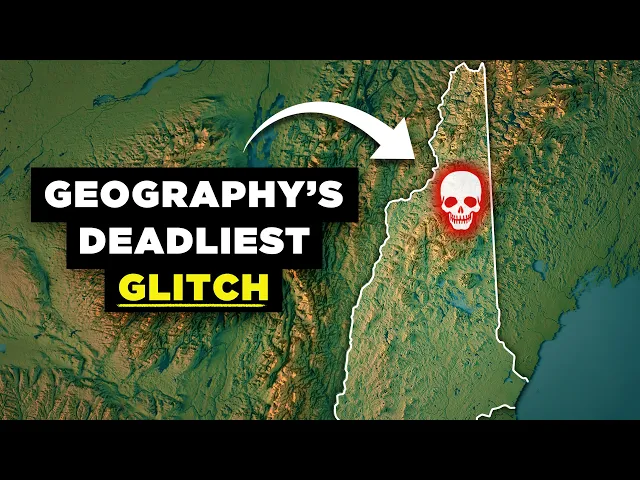
The Nightmare Geography Glitch Hiding in New Hampshire
RealLifeLore
0:00 If somebody asked you what the deadliest mountain in the world is,
0:03 your first thought would probably wander to ones
0:04 that are obviously very dangerous like Mount Everest.
0:07 Or maybe even K2 if you're familiar
0:09 with the world's second tallest mountain's brutal reputation.
0:12 If you were limited to answering the deadliest mountain in the United States,
0:15 you might think of examples like Denali in Alaska,
0:18 Mount Rainier in Washington, or Mount Hood in Oregon.
0:21 All of these mountains indeed have infamous reputations
0:24 and they all look extremely intimidating as well.
0:27 That's probably at least partially why you actually heard about them.
0:31 But what if I told you that instead, the deadliest mountain in America,
0:35 and indeed the deadliest mountain in the entire world,
0:38 isn't actually any of these, but is rather
0:40 a much much smaller and unassuming looking mountain
0:43 in New Hampshire that you've maybe never even
0:46 heard about if you're not from around here, that's called Mount Washington.
0:50 With a total elevation of 6,288 ft above sea level,
0:54 Mount Washington is the tallest summit that can be found anywhere in New
0:57 England and more broadly anywhere in the entire
1:00 northeast region of the United States.
1:02 Nonetheless, when compared to the elevations
1:04 of mountains elsewhere across the western US,
1:07 Mount Washington appears as basically a dwarf mountain.
1:10 Despite being the tallest mountain in the northeast,
1:13 it is only the 550th tallest mountain nationwide with literally hundreds
1:18 of mountains taller than it dotted all across states west of the Mississippi,
1:21 across the Rockies, the Sierra Nevada, and the Cascades.
1:25 In fact, it's less than half the height
1:27 of dozens of mountains found across Colorado and Alaska.
1:30 And yet, it has claimed more people's lives than nearly all of them anyway.
1:35 Since 1948, more than 32 people have died
1:39 on Mount Washington due to a combination of falls, avalanches, and hypothermia.
1:43 More than every other mountain in the United States other than Denali,
1:46 Mount Rainier, and Mount Hood.
1:48 Mount Washington is tied for the fourth highest
1:51 number of deaths on any mountain in the country,
1:53 tied with Grand Teton in Wyoming.
1:56 And of course, the principal attribute of Mount Washington that sets it
1:59 apart from all of these other
2:00 deadly mountains is its dramatically shorter height.
2:04 Mount Washington is less than a third the height
2:06 of Denali and is roughly half the height of Mount Rainier,
2:09 Mount Hood, and Grand Teton,
2:11 despite having the same number of fatalities since 1948 as the latter.
2:15 Since modern record keeping began a century before that in 1848,
2:19 more than 160 people are known to have lost their lives on Mount Washington.
2:24 Adjusted for the number of deaths per foot of vertical climb,
2:27 Mount Washington becomes not only the deadliest mountain in America,
2:31 but the deadliest mountain anywhere in the world.
2:34 A fact that becomes all the more strange when you realize that you can
2:37 simply drive a car or take a train all the way up to the summit.
2:41 Unlike any of these other super deadly
2:42 mountains that are dramatically taller than it,
2:45 where the only way up is basically to climb.
2:48 This is, in a sense, precisely what makes Mount Washington so deadly.
2:52 The fact that it simply doesn't appear to be deadly when
2:54 all of the other mountains do on the list of deadliest mountains.
2:58 Denali is in an extremely remote location
3:00 in rural Alaska that isn't connected to any roads.
3:03 You basically have to charter a plane just to fly you to Denali's base camp,
3:08 and climbing up from there and back
3:09 again often takes weeks to accomplish through massive
3:12 glaciers and crevasse fields that are apparent
3:15 from miles away before you even get there.
3:18 Mount Rainier is similarly covered in glaciers,
3:20 full of cavernous crevasses that are large enough to swallow
3:23 up entire houses all that you can see from far away.
3:27 While hiking up more than 10,000 vertical feet through all of that in order
3:31 to reach the summit serves as too much of a deterrent for most.
3:35 The kind of people who decide to climb
3:37 these kinds of mountains are usually well aware of how
3:39 dangerous they are and have spent a serious
3:42 amount of time and effort preparing to tackle them.
3:45 Mount Washington, on the other hand,
3:46 doesn't really look all that different from just about
3:49 any other mountain within its range in New Hampshire, the White Mountains.
3:53 There aren't any glaciers that are present to frighten people away,
3:55 [music] and unlike many of the other deadliest mountains,
3:58 it's hardly in a remote location that's difficult to get to.
4:01 [music] It's only about a 3 and 1/2 hour drive from the big
4:04 city of Boston to reach the parking lot at the base of the mountain.
4:07 And from there, it can only take all of about 2 hours
4:10 for an unprepared hiker to get in way over their heads and capabilities.
4:14 The summit of Mount Washington is actually
4:16 the sixth most visited mountain summit in the world,
4:19 largely because of how accessible it
4:20 is from major metropolitan areas like Boston,
4:23 the fact that you can usually just drive or take
4:25 a train all the way up to the summit,
4:27 and its status as the highest peak in New England in the Northeast.
4:30 But all of the other mountain summits in the top
4:32 most visited are either much shorter and therefore safer,
4:35 or they're much higher and therefore people know to prepare better.
4:39 Mount Washington is basically at this weird middle sort of height,
4:42 where underprepared climbers or even drivers expecting
4:45 something easier might get caught off guard,
4:48 especially when luck doesn't favor that.
4:51 It's not really Mount Washington's height
4:53 that makes it so incredibly deadly, though.
4:56 It's the fact that the mountain, arguably,
4:58 is the site of the worst weather that can be found anywhere on planet Earth,
5:03 despite its rather unassuming-looking appearance.
5:06 Let's start with wind and explain why Mount Washington
5:09 is actually the single windiest location anywhere in the world.
5:13 On an afternoon day in April of 1934,
5:16 researchers at the summit of Mount Washington at the Mount
5:18 Washington Observatory measured wind speed that should have been impossible,
5:22 an astonishing 231 mph.
5:26 To put that in a perspective, in order to become a category 5 hurricane,
5:30 wind speeds only need to reach 157 mph.
5:33 231 mph is enough to obliterate any house made out of wood,
5:38 and will even cause serious structural issues to well-built houses.
5:43 For decades, that measurement on the top of Mount Washington was the fastest
5:47 wind speed ever measured anywhere on the Earth's surface until it was
5:51 surpassed in 1996 by a monster tropical cyclone that clocked in at a speed
5:57 of 254 miles per hour off the western coast of Australia.
6:01 It is still the fastest wind speed ever measured on the Earth's
6:04 surface outside of the context of a tropical cyclone or a tornado.
6:09 Hurricane force winds or wind speeds greater than 75
6:12 miles per hour are generally observed on the summit
6:15 of Mount Washington for an average of 110 days
6:18 a year or for nearly one out of every three days.
6:22 And during the winter season, the wind speeds will be at or above
6:25 hurricane force about every other day on average.
6:28 The most consistently dangerously fast winds
6:31 that are experienced anywhere in the world.
6:34 These wicked fast winds that blow over Mount
6:37 Washington are of course a frequent and significant hazard.
6:40 And they happen for an interesting combination of reasons.
6:44 Mount Washington, while not exactly a tall mountain compared to those out west,
6:48 is still a giant in the east.
6:50 Its summit is the highest geographic point
6:52 for nearly a thousand miles away in every direction.
6:56 It happens to exist at almost exactly
6:58 the midpoint between the North Pole and the Equator
7:00 and it's hit precisely at the intersection of three
7:04 major weather systems from the Atlantic to its south,
7:06 from the Arctic to its north and its west
7:08 and from the Gulf of Mexico to its far southwest.
7:12 These three clashing weather systems bring warm,
7:14 humid tropical air from the southwest, moist maritime air from the Atlantic,
7:19 and cool drier continental air from the north
7:21 all precisely to the summit of Mount
7:24 Washington where they clash and generate powerful
7:27 low pressure systems and strong pressure gradients,
7:30 which drives the freak storms and extreme winds up there.
7:34 Wind is usually slowed down by friction from the ground,
7:38 but since Mount Washington is by far the highest
7:40 point anywhere around for thousands of miles in most directions.
7:44 The higher winds that strike it haven't
7:46 ever been slowed down by this usual process.
7:49 The overall presidential range that Mount Washington
7:52 crowns in the north forms a B shape that points directly where the cold
7:56 winds blowing across southern Canada come from.
7:59 As the higher winds that haven't been slowed
8:00 down for thousands of miles reach the presidential range,
8:04 they're suddenly forced upward and accelerate in speed
8:07 through a process known as the Venturi effect.
8:09 Similar to how a river's velocity increases as it passes over a rapid,
8:13 this, combined with a clashing of cool dry air with warm moist air,
8:17 is what can create some of the most freakish weather on the planet up here,
8:21 and going well beyond just the insane wind speeds.
8:25 As you'd expect for a mountain at its elevation and its latitude,
8:28 it gets pretty cold up on the summit of Mount Washington.
8:31 The summit's all-time low recorded temperature was
8:34 -50° Fahrenheit back in January of 1885.
8:38 A high temperature of 0° Fahrenheit still occurs about 13 days a year,
8:43 while low temperatures at or below 0° Fahrenheit usually happens every
8:47 single day between the middle of November and the start of April.
8:51 Between December and March across the winter season,
8:53 the temperature on the summit will only get
8:55 above freezing for an average of just 15 days.
8:59 Across the whole year,
9:00 the average ambient temperature on the summit is just 27° Fahrenheit.
9:05 Now, a lot of that might not sound too bad, to be honest,
9:08 but you have to remember that none
9:09 of those ambient temperatures take into account
9:11 the crazy fast wind speeds and the absolutely
9:15 bone-shattering wind chill effect they have.
9:18 To give you just an idea of how nuts this can get,
9:21 consider the horror that the mountain summit
9:23 experienced on the 16th of January in 2004.
9:27 That day, the ambient temperature on Mount
9:29 Washington summit was -46.3° Fahrenheit or -42° Celsius.
9:35 Already very cold, but it was also sustaining wind
9:38 speeds of just over 87 miles per hour, too.
9:41 As a result, the wind chill value on the summit
9:44 that day was a brutal -102.6° F, or -74.7° C.
9:53 Enough to cause frostbite to exposed human tissue in under 5 minutes
9:57 and lethal in as little as 30 minutes without proper Arctic survival gear.
10:02 And then, somehow, even that brutal record was beaten pretty recently
10:07 over the night of the 3rd to 4th of February 2023,
10:10 when an ambient temperature of -47° F
10:13 and faster wind speeds of more than 100 mph
10:17 produced a new record low US wind chill
10:20 temperature on the mountain summit of -108° F.
10:24 Simply put, that is nearly as cold Simply put,
10:26 that is nearly as cold as the coldest
10:28 surface air temperature ever recorded in history,
10:30 which was measured at -128.6° F in 1983
10:36 at the Vostok Station deep within the interior of Antarctica.
10:39 The summit of Mount Washington can therefore literally get
10:42 as cold as the depths of Antarctica can during the winter,
10:45 and it is rather surprisingly the site of the coldest
10:48 temperature ever measured anywhere in the United States,
10:51 even beating out anywhere in Alaska.
10:54 During that event in 2004,
10:56 when the wind chill effect plunged the temperature down to as low as -102.6° F,
11:02 the wind chill never once rose to be warmer than -50° F for more than 71 hours,
11:09 or for nearly three straight days.
11:11 Even throughout the summer months,
11:13 temperatures can unexpectedly plunge and winter-like
11:16 conditions can exist at the summit,
11:18 which is the next big dangerous problem on the mountain.
11:21 Due to Mount Washington's location along clashing weather patterns,
11:24 its relative proximity to the Great Lakes that brings
11:27 lake effect snow along with the Canadian winds,
11:29 and its relatively high elevation compared with its surroundings,
11:33 Mount Washington gets a ton of snow,
11:36 which is extremely unusual for its modest elevation.
11:39 Mount Washington's summit will see an average
11:41 of almost 97 inches of precipitation per year,
11:45 the vast majority of which falls on it as snow,
11:47 which is surprisingly even more precipitation than
11:50 the summit of Mount Rainier in Washington receives,
11:52 despite it being about twice as tall.
11:55 Mount Washington receives by far the most snow of any
11:58 mountain of its height or lower anywhere in the United States.
12:02 For basically the same reasons why it's so windy up there, too.
12:06 Huge volumes of snow will get picked up all along the lower Presidential
12:10 Mountains and then gets blown up around
12:12 Mount Washington over to its eastern side,
12:14 where the snow packs and fills up deep ravines there like Tuckerman,
12:19 that can sometimes reach up to 50 feet deep during the winter.
12:23 In the winter and the spring,
12:24 this thickly packed snow, especially in Tuckerman Ravine,
12:27 can morph into an almost concrete like
12:30 layer that can easily fracture and generate avalanches,
12:34 which is a major hazard for hikers and backcountry
12:36 skiers all throughout the winter and spring seasons as well.
12:40 Many of whom might not expect such a potentially
12:42 high avalanche risk for such a relatively small mountain.
12:46 As recently as 2024,
12:48 backcountry skiers have lost their lives because of this here
12:51 in the Tuckerman Ravine by falling hundreds of feet.
12:54 And as recently as 2012, a man slipped and slid down the side of Tuckerman
12:58 Ravine in April [music] and then fell into a hidden crevasse.
13:02 And his body wasn't able to be recovered for 7 weeks.
13:06 Others have gone missing on the mountain
13:07 for years until their remains were discovered,
13:10 sometimes [music] being buried beneath dozens of feet
13:12 of snow during particularly catastrophic avalanche events.
13:16 While others simply wander off too far away
13:19 from the road or the railroad that takes you up
13:21 safely to the summit and get trapped alone up
13:23 there when the weather suddenly turns for the worse.
13:26 Near the summit, it can literally go
13:28 from relatively nice to blizzard-like and life-threatening within minutes.
13:33 While temperatures can plunge by upwards of 20° just as quickly,
13:37 and they're very difficult to predict.
13:39 And if all of those hazards weren't enough,
13:41 there's also the added concern of what is often very,
13:44 very limited visibility on the summit of Mount Washington as well.
13:47 With all the wind, storms, and precipitation that falls on Mount Washington,
13:51 cloud cover up there is nearly constant all throughout most of the year.
13:56 In fact, only about 50 days out of the entire year
13:59 on average are clear on the summit between sunrise to sunset.
14:02 Visibility conditions near the summit can
14:04 and do rapidly deteriorate within minutes sometimes,
14:08 just like with the temperature.
14:10 Including complete whiteouts and literally zero visibility where you can't
14:14 even see more than a foot or two ahead of you.
14:16 These poor visibility conditions, when they happen suddenly and unexpectedly,
14:20 can be particularly dangerous for hikers or backcountry skiers when
14:24 they're nearby [music] massive cliffs and drop-offs like the Tuckerman Ravine,
14:28 which features plunges of up to 600 ft in some locations.
14:32 If you get blinded during a total whiteout
14:35 up there to become disoriented on your location,
14:37 it's not inconceivable to see how you might just
14:40 take one wrong step into an abyss like that.
14:43 Now, there's a lot of places in the world that have
14:46 worse conditions in a single category than Mount Washington does,
14:49 but very few of them combine all
14:51 of these factors together in such an overwhelmingly negative way.
14:55 The Vostok Research Station in the middle of nowhere
14:58 in Antarctica might get colder than Mount Washington does,
15:01 but it has nowhere near the same level of wind
15:03 speeds with a yearly average of just 11 mph,
15:07 and it also receives virtually zero precipitation or snowfall either.
15:11 Hurricane and tornado-prone areas may experience similar freak wind speeds,
15:15 but they're nowhere near as frequent,
15:17 and they're never in areas that get anywhere near as cold.
15:20 Denali in Alaska might have a much higher summit and lower
15:23 oxygen levels in a more remote location with similar visibility issues,
15:27 but Denali gets virtually zero precipitation
15:30 and doesn't get anywhere near as windy.
15:33 And again, for the most part,
15:35 Mount Washington doesn't exactly appear to be dangerous for most
15:38 of the climb up it until you get beyond the mountain's tree line.
15:43 The wicked fast winds that whip across Mount Washington contribute
15:47 to a very unusually short tree line at only about 4,400 ft up
15:51 in elevation with the climate any further up simply too hostile
15:55 to support any plant life more than just a few inches in height.
15:59 The climate also radically changes very
16:01 quickly as you climb up Mount Washington.
16:04 In [music] the mountain's parking lot,
16:05 you're experiencing a humid continental climate that's typical for New England,
16:09 but as you move up it,
16:10 you quickly transition through a subarctic climate until you reach
16:13 the end of the tree line where it immediately transitions
16:17 into a tundra climate not too dissimilar from Labrador
16:20 or Greenland the rest of the way up to the summit.
16:23 This can often catch hikers off guard on Mount Washington who
16:27 don't expect to be going from a calm walk through the woods
16:29 at the mountain's lower elevations to a potentially lethal walk through
16:33 the Labrador or Greenland tundra further up beyond the tree line.
16:37 The treeless upper reaches of the mountain towards
16:39 the summit are fully exposed with zero cover to hide
16:43 behind or take shelter in when weather conditions rapidly
16:46 turn for the worse with the infamous super fast winds,
16:49 whiteouts, and plunging temperatures.
16:53 The total of 65 acres of Mount
16:55 Washington's peak is classified as tundra terrain,
16:58 which is, again, perhaps unexpectedly the most tundra
17:01 present on any mountain east of the Rockies.
17:04 The potentially extreme, life-threatening danger of being exposed to the brutal
17:09 elements beyond the tree line on your climb
17:11 up towards the summit is not apparent to most people who climb the mountain,
17:16 and it's only when you're far removed from both
17:18 the tree line and the summit about halfway
17:21 up that you might realize just how deep
17:24 into this quiet danger zone you've gotten yourself into.
17:28 While the elevation of the tree line ends at 4,400 ft above sea level,
17:32 it only takes about 3 mi worth of hiking
17:34 from the parking lot in order to reach it,
17:36 which is notably significantly less hiking than it even takes
17:40 to reach the base camp on Mount Rainier in Washington.
17:44 In other words, you can reach the most dangerous zone on Mount
17:47 Washington before you even reach the base camp on Mount Rainier,
17:51 which is a recipe for disasters for hikers who aren't
17:54 coming as well prepared as they usually do for Rainier.
17:57 Near where the tree line ends on Mount Washington,
18:00 the US Forest Service has put up ominous signs on trails like this one,
18:04 warning that the area ahead beyond
18:06 the trees contains the worst weather in America,
18:09 and that hikers have lost their lives
18:11 to the elements out there exposed even during the summer.
18:16 Then, there's also the fact that Mount Washington is actually a lot
18:19 more of a climb than many people might initially expect as well.
18:23 While it is only the 550th tallest mountain
18:26 in the United States by elevation above sea level,
18:29 Mount Washington's prominence is substantially more impressive than that.
18:33 Prominence is a measurement of how much
18:35 a mountain stands out relative to its surrounding terrain,
18:38 and is basically the vertical distance between a mountain summit and the lowest
18:41 point you have to descend to before climbing up a higher peak.
18:45 In Mount Washington's case, you have to descend from its summit all the way
18:48 down to 140 ft in elevation at the Champlain
18:51 Canal before journeying toward a higher peak at the Potato
18:54 Knob all the way down in North Carolina.
18:58 This means that nearly all of Mount
19:00 Washington's sea level elevation is pure prominence,
19:04 since it rises from a very low elevation.
19:07 6,148 ft of its height is prominence to be precise.
19:12 And this gives Mount Washington astoundingly the 24th highest prominence
19:17 of any mountain in the contiguous 48 US states beyond Alaska
19:21 and Hawaii with a greater prominence than even some of the 14,000
19:26 footers out west in Colorado like the well-known Pikes Peak.
19:30 This means that despite its overall elevation being
19:33 only a fraction of most mountains out west,
19:36 actually hiking up Mount Washington includes a similar
19:38 vertical height to that that hikers truly experience.
19:42 Something that inexperienced hikers who only look at elevation
19:45 values alone might not anticipate or plan for.
19:48 Few might plan more seriously for a 14,000
19:51 foot mountain than a 6,000 foot mountain
19:54 without realizing that the actual vertical climb you
19:56 experience on both of them will be comparable.
20:00 There are just so many factors at play on Mount Washington that deceive people
20:04 into underestimating its true hidden danger only
20:08 for them to end up getting trapped unprepared,
20:10 exposed to the brutal freezing blinding windy
20:14 weather with nowhere to hide all to either
20:17 fall down off of a cliff or to succumb to hypothermia and the elements.
20:22 Mount Washington's reputation to serious climbers is
20:25 such that it's actually a preferred training
20:27 ground for the way higher peaks up in the Himalayas like Everest and K2
20:32 because you can experience similar weather
20:35 and climatic conditions on Mount Washington as them
20:37 without the added threat and danger
20:39 of altitude sickness complicating things even further.
20:42 And that's great and can be managed when you're prepared to face it,
20:46 but it's not at all for when you're not.
20:48 And there are many many examples from history of the more
20:52 than 160 recorded deaths that have taken place on it since 1848.
20:58 There's an entire Wikipedia list that is
21:00 specifically dedicated to all of these victims.
21:03 If you'd like to go down the rabbit hole into their individual stories later.
21:08 And while you're probably not planning a dangerous hike on Mount Washington,
21:12 even your usage of the internet right now
21:13 in the safety of your own home can still be dangerous.
21:17 And a great way to add a layer of security to whatever
21:19 it is you do on the internet is by using a trusted VPN.
21:22 Like this video's sponsor, NordVPN.
21:25 With NordVPN's no logs policy, your internet service provider isn't able to see
21:29 whatever it is you're searching and neither does NordVPN,
21:32 which actually gives you a true incognito viewing experience
21:35 on the internet that Google's incognito mode doesn't truly provide.
21:39 I especially like to use Nord whenever I'm
21:40 using unfamiliar Wi-Fi networks at airports or cafes.
21:44 And Nord is much more than just a VPN.
21:47 I've known creator friends here on YouTube who've gotten their accounts
21:50 hacked after a successful fishing attempt or a password leak.
21:53 have even seen one or two of them every so often whenever a normal
21:56 channel you love suddenly becomes a crypto
21:58 hype machine seemingly out of nowhere.
22:01 This unfortunately happens way too often and NordVPN's threat
22:04 protection includes specific features that warn you about fishing leaks.
22:08 Along with features like a blocker for malicious ads and dark web
22:11 monitoring to alert you if any of your passwords have been leaked.
22:15 And of course, NordVPN also does great VPN things, too.
22:18 With Nord, you can safely browse the internet
22:20 anonymously and your location always stays private.
22:23 It enables me to set my location anywhere in the world
22:26 and access all the different versions of my favorite websites.
22:29 And it's the fastest working VPN on the planet that provides
22:32 24/7 customer support to help you whenever you need it,
22:36 along with a 30-day money-back guarantee for all users.
22:40 So, if you'd like to give NordVPN a try,
22:43 scan the QR code here on your screen right
22:45 now or click the link down below in the description.
22:48 Every purchase of the 2-year plan will receive four bonus months
22:51 on top and it's completely risk-free with Nord's 30-day money-back guarantee.
22:56 So, click or scan to get started with NordVPN today and as always,
23:00 thank you so much for watching.