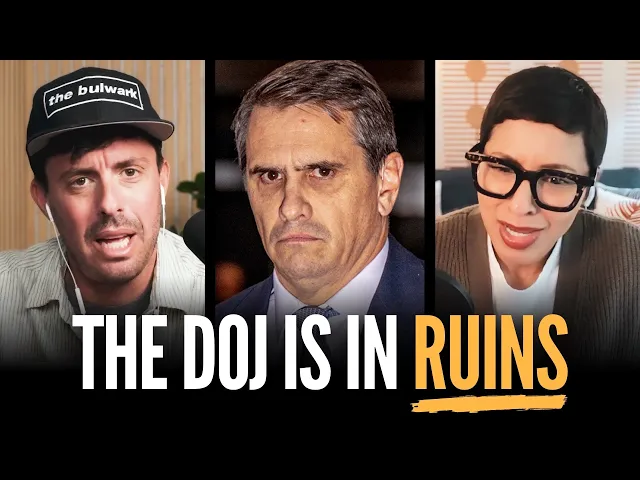
A Quarter of DOJ’s Lawyers Left. What Comes Next Is Worse. (w/ Melissa Murray) | Bulwark Podcast
The Bulwark
0:00 It was a dark day for democracy last week.
0:02 I don't know what else to say about it.
0:04 And it was even darker because the court was so craven about what it did.
0:09 And Justice Alo wrote that he was
0:11 preserving section two of the Voting Rights Act.
0:15 That's like, you know,
0:16 my teenager tossing his room and then telling me he cleaned it.
0:19 Like really?
0:20 Okay, we rearranged it.
0:23 [music] Hello and welcome to the Bullwork Podcast.
0:30 I'm your host Tim Miller.
0:31 Delighted to welcome back to the show professor at NYU Law School,
0:34 co-host of the Strict Scrutiny Podcast,
0:37 an author of a new explainer on the Constitution,
0:39 the US Constitution, a comprehensive and annotated guide for the modern reader.
0:42 It is out today.
0:44 She is car holding it.
0:47 It has a salt rimmed edge.
0:49 [laughter] It's looking good.
0:51 Best margarita you'll ever read.
0:53 Happy Cinco de Mayo.
0:54 Do some light constitution reading.
0:56 I also just found out in the green
0:57 room you somehow have a child going to college,
1:00 which feels impossible.
1:01 You look amazing.
1:02 How is that possible?
1:03 Oh, Tim, thank you.
1:05 Um, yes, Melissa Murray has a college-aged child.
1:08 Melissa Murray is in her fifth decade.
1:12 Wow.
1:12 But, um, you know what keeps me looking so young?
1:14 Keep keeps me looking younger than some members of this administration.
1:17 What's that?
1:18 I can read the Constitution.
1:19 And I do.
1:20 And that's that's moisturizing and the truth.
1:24 That's the ticket.
1:25 It's the real originalism.
1:26 Read the Constitution.
1:28 Look like a younger person.
1:29 How do you think things are going with the Constitution right now?
1:32 Just overall, it's not great, Tim.
1:34 I'm not going to lie.
1:36 Um, okay.
1:37 We've got Congress that seems to be asleep some amulant.
1:43 Um, we have a president who is asserting what I think is
1:49 the most muscular vision of executive authority that we've seen in decades,
1:54 um, maybe even ever.
1:56 And we have a Supreme Court that basically does what it wants.
2:00 Um, precedent be damned, uh, prior rulings, everything.
2:05 Just, you know, does whatever it wants and facilitates
2:09 this administration in some of its worst excesses.
2:11 So, it's not great.
2:13 Um, but I think that's exactly the kind
2:15 of moment where we the people need to intervene, read the Constitution, um,
2:20 read what the Constitution was about and reclaim it for ourselves.
2:24 Yeah.
2:24 I was so excited, um, when I saw that this what you're writing on.
2:27 I when I heard Melissa Murray has a book and wants to, you know,
2:30 you're always welcome on no matter the topic.
2:32 But I was like, this is great for a number of reasons, but for one,
2:35 as like a former Republican,
2:37 maybe this is not true in the world, but I don't know.
2:40 But for me is like there was a period
2:42 of time when the constitution was kind of republican coded.
2:47 They at least wanted to talk about it more.
2:48 You know, there was like this very like we were
2:50 the ones it was the young Republicans that had our pocket constitutions.
2:54 I've got a pocket constitution in like six
2:56 drawers in the house like a old Catholic
2:58 granny has a you know has the pictures of the saints in every in every room.
3:01 I've got the pocket constitution and you know the young de I was a little
3:05 cringe I think for the young Democrats and I do think that in this moment
3:10 that that I'm I think an effort to flip it is important and need
3:14 it or you can object to the fact that that was ever even a thing.
3:17 Well, I mean I think I probably would
3:19 have hung out with you young Republican or not.
3:21 I was never a young Republican but I also did have a pocket constitution.
3:25 I think that was the point.
3:26 I think just being a young American means you ought to have a pocket
3:30 constitution because the whole point of this was that people would read it,
3:34 they would debate it, they would grapple with it.
3:36 And you know, maybe this is more of a tenant
3:39 of an older brand of Republican partisan affiliation.
3:45 But the Constitution at bottom is
3:47 a document that's about limited government, right?
3:50 It is genuinely about putting restraints on the state and you know
3:56 I think that's something right now we could all get down with.
3:59 Hell yeah.
4:00 Okay.
4:00 Um we we're going to to do a little bit
4:02 of the book to the context of some there's a lot
4:03 of legal news items I want to run through with you
4:05 and then you know maybe some other news items as well.
4:08 Uh and then I want you to regail me with some book anecdotes.
4:11 I want some fun constitution facts.
4:13 So start thinking about that.
4:14 There are a couple I've already spotted from from skimming the book.
4:17 Um the uh the first one is obviously the big news of on the Voting Rights Act.
4:21 Um and uh you know the the gutting of it.
4:25 I had Mark Elias on over the weekend.
4:27 We kind of did a deep dive on this and I
4:29 think kind of even since we taped on Saturday,
4:32 we're seeing even more of the southern states coming out and basically
4:36 saying they're going to try to jam through a redistricting here.
4:40 Even though in some of the states ballots are printed in my state of Louisiana,
4:44 people have already voted.
4:46 Um but they're still going to do it anyway.
4:48 Um what is your sense on the state of the play
4:50 both like on the politics and the and the legal side.
4:54 So I mean this is basically a bravo house real
4:58 housewives of Atlanta who going to check me boo moment right?
5:01 I mean these states are like who going to check me?
5:03 Nobody.
5:04 Not the Supreme Court probably nobody.
5:06 Uh it's a really this is a break glass emergency moment I think for democracy.
5:12 uh the Supreme Court in that opinion written by Justice Alto,
5:15 a 6 to3 opinion written by Justice Alto basically eviscerated the Voting
5:21 Rights Act and its promise of a multi-racial democracy for this entire country.
5:27 I mean, the idea that when states seek
5:31 to remedy racial gerrymandering by thinking about race
5:35 and constructing a map that gives minority voters
5:40 an opportunity to elect candidates of their own choice,
5:42 they're the ones engaging in race discrimination.
5:45 I mean, that's just bonkers.
5:47 I mean, this is the court taking its vision of colorblind constitution,
5:52 its imagined understanding of the 14th amendment as entirely colorblind,
5:57 which does not code with the history of the 14th amendment at all,
6:00 and now extending it beyond the usual
6:03 context like college admissions and affirmative action,
6:06 and now extending it to the most important right that we have,
6:10 the right to vote, the right to make our voices heard.
6:13 Um, it was a dark day for democracy last week.
6:16 I don't know what else to say about it.
6:18 And it was even darker because the court was so craven about what it did.
6:23 And Justice Alo wrote that he was
6:25 preserving section two of the Voting Rights Act.
6:28 That's like, you know,
6:30 my teenager tossing his room and then telling me he cleaned it.
6:33 Like really?
6:34 Okay.
6:35 We rearranged it, right?
6:37 Well, that's basically what he said.
6:38 We realigned section two and its jurist prudence
6:41 um to to to accommodate this new understanding.
6:45 that's eviscerating the Voting Rights Act.
6:47 I mean, the whole idea of section two
6:50 was that you could bring these claims against
6:54 individuals who were trying to limit the power
6:58 of minorities to get to the ballot box.
7:00 That was what the 15th Amendment was about, infranchising African-Americans.
7:04 First, African-American men.
7:05 And then the Voting Rights Act in 1965 made
7:08 the promise of the 15th Amendment good for everybody.
7:11 and the courts pretty much put pretty much put the kibos on that.
7:15 uh the impact on representation is going to be so dramatic and I
7:19 mean some of this is kind of obvious but I just when I
7:22 was looking at a chart um that uh was put out of lean
7:26 just of like black representatives in Congress like over time in history and you
7:31 look at it and there's like a small period where there were some
7:33 in the south um uh you know before uh the rules were in place
7:38 of the voting rights act uh remedied uh to prevent them from having
7:42 representation uh and then there's a gap
7:44 of a period where there's basically none.
7:45 There's a couple in the Northeast and then the Voting Rights Act passes and then
7:49 like you see a big jump to where black representatives like match or get,
7:53 you know, around the percentage of their, you know,
7:57 representation in the population, right,
7:58 which is a community actually being represented.
8:01 And you're already seeing that kind of trying to tick back down.
8:04 And and I just think that the the chart will be so shocking uh you know,
8:07 if you look at it in 2029 if
8:09 this isn't fixed because you'll see almost a total reversal.
8:12 Well, I I'll put it in even more stark terms.
8:15 Um, the House is obviously one aspect of this.
8:17 I think it's even more pronounced in the Senate,
8:19 which is already a chamber that is somewhat distorted
8:22 by the whole idea of minority rule and the fact
8:25 that least the least populous states get to be
8:27 represented in the same way as the most populous states.
8:30 But prior to the Civil War,
8:33 there obviously hadn't been any black representatives or senators in the Senate.
8:39 After the Civil War, Mississippi appoints Hyram Rebels to the remainder
8:44 of a term and he serves from 1870 to 1871.
8:48 He's the first African-Amean to be appointed to a seat in the Senate.
8:52 Um he's only there for a year.
8:54 The whole time he is plagued by claims that he is an illegitimate senator,
8:59 that he's not a citizen,
9:00 and they advert's Dread Scott decision for that argument.
9:05 Uh there's another senator also elected from Mississippi, um Blanch Bruce.
9:10 He serves until around 1881.
9:13 After reconstruction ends in 1875, I think 1875 in the Hayes Tilton compromise.
9:20 We don't get another black senator in the Senate until 1967.
9:26 And that's 2 years after the Voting Rights Act.
9:28 And we've only had I think now it's 13 black senators in the Senate.
9:33 So, I mean, it has been really stark.
9:35 I don't think we're going to have a Congressional
9:37 Black Caucus going forward if this is allowed to stand.
9:42 Um, in large part because it's not just
9:43 that it's going to decimate black representation throughout the South.
9:46 Like, that's already happening and it will happen.
9:49 But the fact that Justice Alo left the shards of section two
9:54 in place means that it is available
9:57 going forward so non African-American litigants um
10:02 can challenge California for example when
10:04 California draws an opportunity district to counteract
10:08 what is going on now and counteract the losses that are being made.
10:11 Now, white voters can simply say,
10:13 uh, section two, this is racial discrimination,
10:16 and they will sue, and under this court's ruling,
10:19 they will likely be successful.
10:20 So, that's the even more craven part about what the court has done.
10:24 They haven't been honest about actually eviscerating it,
10:27 and they've left the shards of it in place so
10:29 that it can be co-opted and used against minority representation going forward.
10:35 Hey everybody, Mother's Day is this weekend.
10:37 No, really, that's what the script says.
10:39 Apparently, Mother's Day is this weekend.
10:41 I haven't bought anything.
10:43 __] Well, if you're like me and you're still looking for the perfect gift,
10:48 you're in luck cuz I've already got my mother an aura frame.
10:50 So, I need to come up with another idea.
10:52 But for you, we've got the perfect idea.
10:55 The best thing about aura frames is they last longer
10:57 than flowers or a card that gets open and thrown away.
11:02 Uh, I gave my mother, I gave a grandmother,
11:05 I've given all kinds of different mothers aura frames and they all love it.
11:10 You know, it's nice.
11:10 You can update the pictures if it's if
11:12 it's a mother or a grandmother or an aunt,
11:15 you know, you can send them pictures of the grandchild, the grand niece.
11:20 Keep it keep it keep the flow going.
11:22 You know, maybe they're not on Instagram.
11:25 Maybe they're not following your stories religiously.
11:27 You maybe there's some funny things you want to put
11:29 in there that you wouldn't put on your Instagram feed.
11:31 It's great.
11:32 It's easy.
11:32 You send new photos right from your phone.
11:34 And you can send as many as you want.
11:36 Uh, Aura Frames is an easy gift to send with just a few days less.
11:40 I I mentioned I think last week that there's a dude at Jazzfest came up to me.
11:43 He's like, "Bro, I got the Aura Frame.
11:45 I use your code.
11:48 Father's happy." So, do what that guy did.
11:51 Make Mother's Day special with Aura Frames.
11:53 Named number one by Wire Cutter.
11:54 You can save on the gifts moms love by visiting aura.com.
11:58 For a limited time, listeners can get $25 off
12:00 their bestselling Carver mat frame with code the bullwork.
12:04 That's auraf frames.com.
12:07 Promo code the bullwork.
12:09 Support the show by mentioning us at checkout.
12:10 Terms and conditions apply.
12:12 You talk about in the book about this 14th,
12:14 but all just the reconstruction amendments put together,
12:16 the 13th, 14th, 15th, and you know how, uh, you know,
12:21 the way that they were written, uh,
12:23 the contain clauses that have Congress like enforce the amendments through
12:27 different types of legislation like this is essentially what the VRA was.
12:31 Uh I'm just wondering talk about
12:32 that and and how you know the for these originalists
12:36 like how this uh reflects like what
12:39 the original intent was of those reconstruction amendments.
12:42 So the reconstruction amendments are passed
12:44 in the wake of the American Civil War,
12:45 the bloodiest conflict that's ever been fought
12:47 on American soil and a true moment of rupture
12:51 for this country where the country is sort
12:52 of like how do we put ourselves back together?
12:55 And they recognize that they're going to have to do something drastic.
12:59 they're going to have to actually remake how they are organized as a country.
13:04 And this means a series of new amendments.
13:06 So the 13th amendment abolishes slavery.
13:09 It basically says that slavery or the badges
13:12 and incidents of slavery cannot be used going forward.
13:16 Um they do make a provision for forced labor as a punishment for a crime,
13:20 but otherwise you're not going to be able
13:22 to just like re-entrench this under some other name.
13:25 and they enforce it not just against the state but also against private actors.
13:29 The 14th amendment deals with the entire question of citizenship.
13:33 Um it is to counteract Dread Scott,
13:36 that 1857 decision that said African-Americans and anyone
13:39 descended from African slaves could never be citizens.
13:42 Uh they counteract that uh with the 14th amendment.
13:46 They also lay out a whole series of provisions
13:48 of individual rights that the states are not to infringe upon.
13:54 And then they realize that that's not going
13:57 to be enough to guarantee a multi-racial democracy.
14:01 It's not going to be enough to integrate
14:03 the formerly enslaved into the body politic.
14:06 They actually need to do something explicit about infranchisement.
14:09 And so what they do is they pass the 15th amendment that says
14:12 that you cannot deny the right to vote on the basis of race.
14:16 And that effectively infr infranchises African-American men.
14:21 From the start, there is an immediate campaign
14:24 to cabin the impact and effect of the 15th amendment.
14:28 Uh the South does all sorts of things, much of it raceneutral,
14:32 like the imposition of pole taxes and literacy tests.
14:35 And you know, they'll say like if you want to vote,
14:37 you have to pay this pole tax.
14:39 Um or if you want to vote, you have to pass this exam.
14:42 And you might get a buy though if your grandfather
14:45 voted in this election or voted in, you know, two elections beforehand.
14:49 So they do these raceneutral very sneaky ways
14:52 of making sure that the black electorate is absolutely disenfranchised.
14:58 The 15th amendment has a section two and that section two authorizes
15:03 Congress to pass legislation to enforce the terms of the 15th amendment.
15:07 The 14th amendment has an analogous enforcement clause.
15:10 It's section five of the 14th amendment which gives
15:13 Congress the power to pass legislation to enforce its terms.
15:17 It is under those enforcement provisions
15:20 that the Voting Rights Act of 1965 is passed
15:23 in 1965 in the wake of a bloody battle that results in people being killed,
15:28 people like literally fighting for the right
15:30 to vote and paying for it in their blood.
15:33 And Congress passes this law that is meant to address
15:37 the fact that the states of the former Confederacy have for years,
15:41 a generation and more been suppressing the right to vote on the basis of race
15:46 and the terms of the voting rights act
15:48 and section 2 basically mimic the 15th amendment.
15:51 And so for this court to come back and say the 15th amendment is race blind,
15:56 the 15th amendment is colorblind.
15:58 You're not supposed to take race into account just
16:00 belies the whole purpose of what they were doing.
16:02 They knew that what they were dealing with and they
16:05 knew that to remedy the impact of race discrimination,
16:09 they might actually have to think about race and race discrimination.
16:12 And so the idea that you shouldn't or you can't,
16:14 it's impermissible to do so is just literally mind-boggling.
16:18 But that's what this court is doing.
16:19 We move on to some of the other uh court news.
16:21 We have the Myth Prese case.
16:23 So on Friday, the fifth surf circuit issued a nationwide injunction banning
16:28 the mailing of the drug uh drug material to the Supreme Court and Alto.
16:32 interestingly on Monday temporarily lifted the ban on mailing.
16:36 I'm not really sure what to read into that.
16:38 I would read anything into that.
16:40 Um I mean essentially it's a oneweek stay of the lower court's order.
16:45 Um first of all the fifth circuit is on one and has been on one for some time.
16:50 I mean it is so far off the wall that even the court has to rein it in.
16:55 I mean the fifth circuit is basically the Supreme Court's PR machine.
16:58 It does stuff that's so outlandish that when the court comes in to correct them,
17:03 they the court basically looks normal and the court is not normal.
17:06 So the fifth circuit serves an important role.
17:09 Maybe I should go hang out down there just going to see what's happening.
17:11 That's right.
17:12 Those are your people, Texas.
17:14 Those are your people, Tim.
17:15 Those are your people.
17:16 Um but they initiate they basically implemented
17:20 this nationwide ban on mepherristone on the view that uh these doctors who have
17:26 challenged the distribution of mephrristone via teleaalth
17:31 and through the males are effectively thwarting
17:34 Louisiana's law that prohibits abortion and it
17:38 is denying Louisianans and the state
17:40 of Louisiana the opportunity to protect unborn life.
17:44 uh that it is uh dangerous to use meopristone.
17:48 Um this is a little spotty here because uh they say
17:51 that two women have had ill effects from the use of meopristone.
17:55 Yet they note that thousands of women have been
17:58 ordering and receiving meopristone through the mail via telealth.
18:02 So two women have ill effects but thousands are actually receiving it.
18:06 I'm not sure what that says about the safety record of mephipristone.
18:09 do know that the FDA for years has determined that my methopristone
18:13 is safe and that not only is it safe for terminating a pregnancy,
18:18 it's needed to terminate a pregnancy in circumstances where the pregnancy
18:21 has already been lost and the woman has had a miscarriage,
18:24 uh, medication, abortion is the standard
18:27 protocol of care in those circumstances.
18:29 And this obviously throws that into disarray and endangers
18:33 the lives of many women who will need it.
18:35 one in three women suffers pregnancy loss and needs to have this kind
18:39 of treatment uh to maintain fertility and to have children going forward.
18:44 So the court steps in um there is
18:46 a request for a stay of the fifth circuit's decision.
18:50 Uh it comes from the manufacturers of the drug Danco
18:53 and another manufacturer and Justice Alo who's the circuit justice
18:57 for the fifth circuit is the one to whom the petition
19:00 for the stay is directed and he grants a oneweek stay.
19:04 So that has lifted this ban for a week.
19:08 Um, member Pristone is broadly available through
19:11 teleaalth and through the mails for a week
19:14 and we'll basically get a timeline for how this is going to go before the court.
19:20 Steve Vadic, a friend of my podcast, Strict Scrutiny, uh noted on his Substack,
19:25 that Justice Alto frequently as the fifth circuit circuit justice,
19:30 um will have to implement stays.
19:31 And he often implements stays with no deadline
19:34 and no time limit in issues that he likely agrees with, but puts a time limited
19:40 stamp on the ones with which he disagrees.
19:42 So, the only thing I might read into this is that we
19:45 already know what Justice Alto's vote will be on this case.
19:48 I think the real question is what will be
19:49 the vote of Brett Kavanaaugh who in the DOB's
19:51 opinion talked about the importance of states being able
19:54 to do as they liked in the context of abortion.
19:58 That might weigh in favor of Louisiana.
20:00 It might also weigh in favor of the states with physicians who are
20:04 prescribing this medication because it's lawful
20:06 for them to do so in their states.
20:08 So I mean there are a lot of really important questions here.
20:11 And I will just say in conclusion,
20:13 this court told us they were settling the issue
20:15 of abortion when they overruled Row versus Wade and Dobs.
20:19 And here we are again.
20:20 It's it's just so weird.
20:22 Is seen as a swing vote, I would say.
20:24 I would assume on this or Gorsuch
20:26 h I mean, I don't like it's a six to three court.
20:29 I'm pretty much I I know how I think most of them are going to vote.
20:31 Like Justice Thomas is definitely not going to be
20:34 allowing me to flow freely throughout the United States.
20:37 I think the real sort of wild card might be the chief justice.
20:40 Um I'm not sure about Justice Barrett.
20:43 Um she's a little wonky on that.
20:46 Uh Justice Kavanagh I think has said a lot
20:48 of different things about federalism and the right to travel.
20:51 I'd just be interested to see what he says at oral argument.
20:53 So is that uh going to be then in this session resolved?
20:58 Possibly.
20:59 I I think maybe not.
21:00 I mean this session is pretty much winding down.
21:02 Um it might be something that they hold
21:03 over for formal argument in the next term.
21:06 Um, I think we're going to find out.
21:07 I think right now there are sort of interim emergency um,
21:11 rulings that will be issued on the shadow docket,
21:14 the interim docket, and then we're going
21:15 to find out how this gets slated and resolved.
21:17 There's this New York Times story in the shadow docket
21:19 a couple weeks ago that was so interesting that I haven't
21:22 I had haven't had a chance to get to, but I'm
21:23 just wondering if you kind of want to weigh in.
21:25 I I didn't as I love this article as Okay, great.
21:28 Well, as not a court watcher,
21:29 I I guess I didn't realize just it's it's sort of similar.
21:34 It's sort of akin to like the filibuster story a little bit, right?
21:37 Which is like the filibuster was something that was used like a little
21:40 bit for a while in certain cases that were ext, you know,
21:43 where there were extreme cases and then all
21:45 of a sudden it gets institutionalized and now like every bill
21:49 requires the filibuster and like if you look at the charts
21:51 like a hockey stick on how often the filibuster
21:53 is invoked and I guess that's basically what happened
21:55 with the shadow docket starting in the Roberts court which is
21:57 something that I I didn't really realize but talk
22:00 to a little bit about that and what the implications are.
22:02 Sure.
22:02 So, you know, there's always been a shadow docket.
22:05 Um, it's usually for issues that have
22:08 to be resolved very quickly while litigation is pending.
22:11 So, it often was used in the context
22:14 of the death penalty or election related cases.
22:18 Um, that came up a lot.
22:20 It wasn't really used for issues like the issues we see it being used for now,
22:24 like actual substantive issues about the exercise of presidential authority
22:29 or whether the executive has intruded upon the prerogatives of Congress.
22:34 Those questions typically weren't resolved on the shadow docket.
22:37 Those questions were and I think properly resolved on the court's
22:42 merits document where it would be set for oral argument.
22:45 There would be full briefing from the parties.
22:47 there would be an oral argument and then the court would write a decision
22:51 explaining how it resolved the case and maybe
22:54 there are concurrences or dissents or whatnot.
22:57 What is happening now is that um more and more cases are
23:00 being decided um in the interim on the shadow docket which means
23:05 that the litigants will run to the court while the litigation is still
23:08 pending at the lower courts and ask the court to resolve a particular issue.
23:12 So, for example, when the Trump administration
23:16 tried to dismantle the Department of Education, it was sued and a lower federal
23:22 court implemented an injunction saying that they couldn't
23:25 do what they wanted to do um
23:27 by stripping the Department of Education of its funding.
23:30 And then the Trump administration left that trial
23:34 court that had issued that ruling and went
23:36 immediately to the Supreme Court to ask the court
23:39 for a stay of the lower court's ruling.
23:41 the state would effectively lift the lower court's
23:43 injunction and allow the administration to continue doing
23:46 what it was doing while the litigation then
23:48 made its way through the lower federal courts.
23:51 And um you know my colleague Leah Litman at Strict Scrutiny
23:55 uh refers to the shadow docket as the just the tip docket.
24:00 And [laughter] at first I didn't know what she meant.
24:04 Well, so was I.
24:05 And I got an education, I'll tell you what.
24:07 Um, so she explained to me I'm like,
24:09 "Why do you call it the just the tip docket?" She's like, "Well,
24:12 it's like when people who ab advocate
24:16 for abstinence say that if it's just the tip,
24:19 it's not really sex and you're not getting effed,
24:23 right?" She's like, "But you are getting effed."
24:25 And so the court says it's just the shadow docket.
24:28 It's not doing anything.
24:29 They're just interim decisions.
24:31 They're not changing anything.
24:32 But in fact, we're all getting[ __] Yeah.
24:35 You know, super interesting just like the types of things that it
24:38 was used for like they did a part of education thing
24:40 like it just be has begun to be used for a lot
24:42 of different things where it's like it's not an emergency actually
24:45 like that that should percolate up but like
24:46 the administration recognizing that the court is
24:49 amendable to these shadow docket requests is just
24:51 channeled more and more to the shadow docket.
24:54 And the thing that this um reporting from Jod Caner and Adam Liptac really made
24:58 clear was that there's a moment where it all kind of comes together and it's
25:02 in 2016 with the clean power plan where
25:06 the litigants the the energy industry the states
25:09 immediately run to the court uh to challenge
25:14 this clean power plan hasn't gone into effect.
25:17 It has the longest timeline for its implementation.
25:20 I think it wasn't even supposed to go fully into effect until 2030.
25:23 Uh but in 2016 they get a ruling on the shadow docket from the Supreme
25:28 Court and the memos that are reported
25:31 in this article in the New York Times makes
25:33 clear that the court and John Roberts
25:37 the chief justice in particular is really on one
25:40 to decide this and to like like to show the Obama administration who is boss.
25:44 like they really are worried that the Obama administration is thumbming its nose
25:48 at the courts that the EPA is thumbming its nose at the courts that they're,
25:53 you know, taking into account all of these outofc court
25:56 statements that EPA administrators and officials have made in like,
26:00 you know, newspapers or magazines or on TV,
26:02 but none of it is part of the record because there is no
26:04 record because this case has not formally been adjudicated in any lower court.
26:10 And you know, the court is just basically
26:12 of the view that the Obama administration can't do this.
26:16 And they don't wait for formal briefing.
26:18 They don't wait for oral argument.
26:19 They just stop it in its track.
26:22 And that's basically and and they don't give
26:24 a lot of explanation for why they're doing it.
26:26 It's a decision that they make and they decide to take
26:29 this unprecedented procedural step um
26:31 with very little discussion among the justices
26:35 and there's no discussion of the impact on the environment of you
26:40 know not allowing the clean power plant to go into effect.
26:44 Um, all the chief justice and the other justices are really
26:47 concerned about are the effects on the states and regulated industries
26:51 on the domestic power industry and the harm to those litigants
26:56 if the clean power plan is allowed to go into effect.
27:00 And it's contrasted with the way the court talks about
27:04 irreparable harm now when it's making decisions on the shadow docket.
27:07 is now when the Trump administration comes seeking a stay on the shadow docket,
27:13 the court is very solicitous of the administration's claims of irreparable harm.
27:18 Like basically thwarting the administration and doing
27:21 anything causes the administration irreparable harm,
27:24 which means the Trump administration almost always wins.
27:26 And so there's a real contrast between when the president
27:29 is a Democrat and when the president is a Republican.
27:32 Um, anything else particular on the court
27:33 you're watching over the next few months?
27:35 Well, I mean, I think the girls are fighting and I would love to see it.
27:39 I just want to know everything that's going on.
27:40 Justice uh Sotomayor at the University of Kansas had
27:44 some sharp comments for Justice Kavanaaugh about basically him
27:48 being clueless about how these Kavanaaugh stops where you
27:51 can basically racially profile people for purposes of ICE detention,
27:54 how that works in real life.
27:56 And I guess she kind of got some
27:58 flak from her colleagues about that because she issued
28:02 an apology u through the court's public information offices
28:05 and then said that she'd apologized to her colleague.
28:08 But on the same day that she issued that apology,
28:11 Justice Thomas gave a speech at the University of Texas at Austin.
28:16 And before he actually launched into his speech,
28:18 he acknowledged that sitting in the audience was Harlon Crowe.
28:22 And if you think that sounds familiar, who's that guy?
28:25 Uh, it was that guy.
28:26 He was like taking Justice Thomas on fancy
28:28 vacations and private jets and yachts and stuff.
28:30 So, Justice Thomas wants you to know
28:32 that he's still pinging around with Harlland
28:34 Crow and he basically doesn't give a[ __] if you care about it.
28:38 So, there's that.
28:39 Um, and then he went on to talk about how progressives
28:42 are basically a scourge that have cultivated the conditions under which Hitler,
28:47 Mao, and other despots have been allowed to rise.
28:50 And no, no apology was forthcoming from Justice
28:54 Thomas for basically insulting more than half the country.
28:57 This episode is sponsored by Better Help.
28:59 May is mental health awareness month.
29:01 It's a good opportunity to remember
29:02 that whatever you're going through, you're not alone.
29:04 We all have good days and bad days, stuff that keeps us up at night.
29:08 Sometimes it feels like we have to figure it out by ourselves.
29:11 But the truth is, nobody is all the answers, and no journey should be alone.
29:14 Having someone to listen to, understand,
29:16 and to support you can make all the difference.
29:18 This mental health awareness month is an opportunity to check in with yourself.
29:21 If you've been feeling overwhelmed, stuck, anxious, unsure,
29:24 those feelings are more common than you think.
29:26 We all got them.
29:28 I'm getting them, trust me.
29:30 Um, and you don't have to navigate them alone.
29:33 And, you know, listening to a podcast helps,
29:34 but it's not professional mental health advice.
29:37 You know, that's just something to consider.
29:38 I appreciate it when you guys tell me that that I'm keeping you sane,
29:42 but I don't know if that's true in the clinical sense.
29:44 So, BetterHel therapists on the other hand,
29:47 they work according to a strict code of conduct,
29:50 they're fully licensed in the US,
29:51 and BetterHel does the initial matching work for you,
29:54 so you can focus focus on your therapy goals.
29:56 If you aren't happy with your match,
29:58 switch to a different therapist at any time for the tailor directs.
30:01 You don't have to be on this journey alone.
30:02 Find support and have someone with you in therapy.
30:05 Sign up and get 10% off at betterhelp.com/thebullwork.
30:08 That's betterhp.com/thebullwork.
30:11 The only good part that I can think of, the only silver lining to Justice
30:15 Thomas DJF is um that if he
30:21 was purely motivated by ideology instead of self-interest,
30:25 he would retire this fall.
30:27 Um just, you know what I mean?
30:29 Because he's pretty old.
30:30 Uh and uh getting up there and and I and you know,
30:34 if the Democrats take the Senate,
30:36 uh might be the last chance for him to get replaced for six years.
30:40 Uh maybe, maybe not.
30:41 or 10 years or or maybe that will not
30:43 happen and and MAGA will stay in power forever.
30:45 But it's a risk like he's putting he's putting
30:47 that seat at risk and he's doing so because
30:50 he wants to be the longest running Supreme Court
30:51 justice of all time and he only cares about himself.
30:53 So uh sometimes selfishness knocking on wood
30:56 that that in this case selfishness might backfire.
30:59 I mean let's all do a Ruth Bader Ginsburg.
31:01 [laughter] Seriously speaking of self selfishness.
31:04 Anywh who um the uh I want to talk briefly about Iran.
31:08 Um the the war seems to be escalating uh which is
31:12 relevant in the legal context because I was assured last week uh
31:18 that uh the president and the administration did not have to abide
31:21 by the war powers act because the war was basically over.
31:24 I mean it wasn't like over over but it
31:26 was over like we've won and there's a ceasefire.
31:30 This is what Trump [snorts] and Bessant and and Hegath were saying
31:33 on different words and so they didn't have to go to Congress about
31:37 this and uh you know now we have uh a a uh
31:43 you know a kinetic fighting starting again uh Iran shooting drones at UAE,
31:49 Iran and US shooting each other's boats in the straight.
31:52 Um uh you know uh Trump made a threat uh on Monday
31:57 afternoon saying basically Iran has 24 hours to get their[ __]
32:00 together or else no whatever I'm going to blow them to smitherines
32:04 again or whatever you know kind of fake bombast threat he's using.
32:07 So I'm just wondering I any broad thoughts you have on the state of play
32:11 are welcome but also how it intersects with the with the war powers act.
32:15 So again, most would say that this war that has
32:22 been conducted in the absence of any congressional authority,
32:25 much less just letting Congress know, hey,
32:27 I I plan to do this, uh, raises some real constitutional questions, right?
32:32 Um, Congress has the authority to declare war.
32:34 Obviously, the president is commander-in-chief of the armed forces,
32:38 but the whole idea is that they're working in concert together,
32:41 and this does not seem to be the kind of coordination
32:45 that was imagined by the framers in the conduct of war.
32:50 Uh the question of whether you could bring a claim under the War Powers Act,
32:54 um whether you know there is some sort of action one could take,
32:57 I think that's a harder question.
32:59 Um the Supreme Court has often been wary to take up questions
33:04 around war making powers on the view
33:07 that they present non-justitiable political questions.
33:10 The idea that the whole power to wage war
33:14 uh has been committed by the constitution to the congress
33:19 and the president the political branches and you know
33:22 the courts don't have much jurisdiction to weigh in on that.
33:26 So, I'm not sure that this is something that's ever going to get to the court,
33:29 but I do think there are real questions for Congress.
33:33 And, you know, it would be nice to see Congress
33:36 be more to see Congress more jealously protect its own prerogatives.
33:41 Maybe I'm wrong about this.
33:43 Obviously, there's nobody's won any money in the last
33:46 decade betting on Republicans in Congress to show some backbone,
33:50 but uh there is the Epstein example.
33:53 Now, there's only a couple of them.
33:55 Uh but we're kind of in the situation now and the majority is so small
33:59 and the war is becoming such a boondoggle
34:02 and it's impacting people so directly at home
34:06 um that you do wonder if some pressure starts to mount for them actually
34:11 for them actually to act um and to kind of use this as a way in.
34:15 I mean this is your belly wick and so I you
34:17 know I'm interested to hear what you have to say about it.
34:20 I, you know, [snorts] you've got to wonder when some
34:25 of these Republicans are going to figure out that it's musical chairs, right?
34:31 Like one chair is coming out.
34:33 Is it yours?
34:33 I don't know.
34:34 Like, but this guy isn't going to be president forever.
34:37 Um, not clear who the heir of Slytherin will be, but it's not going to be him.
34:44 like how how invested are you in continuing to carry
34:48 water for this guy um at your own expense?
34:52 I mean like it's a very unpopular war uh for all manner of reasons.
34:59 Why continue?
35:00 I I just don't get it.
35:01 Yeah.
35:01 This is why I wish Marjorie Taylor Green had stayed in Congress.
35:04 I know that's such a weird thing to say.
35:06 if you if you had taken this clip of myself before [laughter]
35:11 like why are you saying this you know taken it out of context
35:13 and showed it to myself I was like I must have been like man
35:15 shit's getting weird in 2026 who knows why I would have said that but because
35:19 I think she could have survived it and um and and and you
35:24 know you can you see it only takes like a little bit of backbone
35:27 for other people to start to to start to jump on board you
35:30 see this in other areas and and we'll see how Massie ends up
35:33 in his primary but I just think that a lot of Like this is unpopular.
35:38 I mean unlike all the other Trump stuff,
35:41 like he's done other things that are unpopular before.
35:43 The last time his approval rating was
35:44 anywhere near this was right after January 6th.
35:47 January 6th didn't actually affect anybody.
35:49 I mean like in the esoteric it did.
35:51 It affected our democracy.
35:52 It was a like nobody's personal life
35:54 changed on January 7th except for like obviously
35:57 officer Siknic and like the handful of people got jailed but like but the rest
36:01 of the country who was not there that day their life didn't change any
36:04 people's lives are getting worse and so I do think that this is a different
36:08 situation for that reason I don't well TBD I was intrigued by Marjorie saying
36:12 today that she had some text messages from Trump that she would be arrested if
36:16 she released so she's welcome on the pod anytime and we're happy to challenge
36:20 that because he has a very bad track
36:21 record of trying to arrest his political foes.
36:23 Um, so [laughter] so may maybe you should give it a shot.
36:27 But, uh, what actually what do you think?
36:28 That's a decent transition.
36:29 Uh, like what do you think about the revenge the revenge campaign by the DOJ?
36:34 I have a bunch of DOJ questions for you.
36:36 Is is pretty ham-handed.
36:38 And so, how do you balance talking about that um,
36:41 versus the obvious threats to the to the rule of law?
36:46 So, I mean, the first thing we have to just be very honest about
36:49 is that Todd Blanch is working overtime
36:53 to be America's next top attorney general.
36:56 And, you know, that's what a big part of this is because I mean,
37:00 the seashells indictment, like [laughter] when you've lost Jonathan Turley,
37:05 I I think you've lost the plot.
37:07 Um so one like some of this is obviously animated by personal ambition
37:13 and you know there is there is that and it is what it is.
37:18 The other thing I will say though is um I don't think
37:22 anyone in the Department of Justice or even in the Trump administration thinks
37:28 that any of this is going to be availing like resulting in Jim
37:31 Comey and you know an orange jumpsuit somewhere or anyone for that matter.
37:36 Everyone knows that the purpose of all
37:38 of these prosecutions is to cow dissenters into silence,
37:43 to stop dissent, to stop critics of this president and this administration.
37:48 Uh you can basically trace those prosecutions,
37:53 those ridiculous prosecutions to what the president
37:56 is doing with regard to the media.
37:59 Uh there is a very important Supreme Court
38:02 case New York Times versus Sullivan that is basically
38:04 the bedrock of a free press in the United
38:07 States and it basically says that you know
38:10 reporters will make mistakes in the course
38:12 of their reporting and they cannot be held accountable
38:15 as defaming an individual unless the individual can establish
38:19 that they made the untrue statement with actual malice.
38:23 is a very hard standard to meet um and it is what insulates the press uh because
38:29 and very meaningful about our free press
38:31 versus what you see in other countries actually.
38:33 Right.
38:33 Right.
38:33 I mean this is not what they have in the UK for example
38:36 where it's much easier to bring a defamation suit or a liel suit.
38:40 But it is what makes the press free here
38:43 and what enables the press to be able to hold
38:45 truth to power because they can speak freely um
38:49 so long as they're not doing it with actual malice.
38:52 the president though in suing these media institutions whether it's
38:56 CBS or ABC uh and and negotiating these settlements with them.
39:01 Right?
39:02 So these are cases that don't go to adjudication.
39:05 Um and you know most experts most first amendment
39:08 experts say that a lot of these cases aren't meritorious.
39:12 They're not going to result in the president winning.
39:14 But when they're settled,
39:16 it basically allows the president to sort of circumvent
39:20 the high standards that New York Times versus Sullivan
39:23 and other presidents would be require that would have
39:26 to be satisfied in order for him to prevail.
39:28 Allows him to circumvent them entirely and basically establish
39:31 the kind of system that they have in the UK,
39:34 a system that he has on many occasions said he would prefer.
39:38 And that's the worst part of the but only for him.
39:42 Yeah, it's an impartial system.
39:44 It's an unbiased system or or it's a biased system, right?
39:47 Not an impartial, it's a bias.
39:48 It means that every like when other people see
39:51 the settlements like when the public sees the settlement one,
39:54 they're like, well, something must have happened or ABC
39:57 wouldn't have settled or CBS wouldn't have settled.
39:59 And so that, you know,
40:00 cultivates in the minds of the public that maybe the press are against him.
40:03 Maybe there is something biased here.
40:04 So there's that aspect of it and then it just cows other
40:08 people from dissenting because nobody wants to get sued by the president.
40:12 No, it's a it's a good insight and I think that it was one of the things
40:15 that frustrated me the most about the White House
40:16 correspondents discourse and all this where I was just
40:19 I was just so frustrated that people
40:21 that the journalists that work at these outlets were were
40:24 going along with the charade while this assault
40:26 on their on their rights to free speech was happening.
40:30 It would be one thing if it was and I still would have
40:32 been against it probably but maybe less
40:33 passionately if it was just Trump calling
40:36 them the enemy of the people and it's a big kayfabe dinner and like
40:39 whatever they call each other names and you know we pretend like that's normal.
40:44 Uh that would be one thing but it's he's not just calling them names, right?
40:46 He's doing it a direct assault on their ability to do their jobs.
40:50 only when it comes to reporting on him and him
40:53 and his admin administration are they put at these threats um from attacks
40:58 from him and [snorts] and so uh participating in that to me
41:02 felt like uh you're giving aid to his effort to undermine
41:08 well that I mean it's not just the press he's
41:11 undermining with this so you know when he's rewriting for himself
41:14 and cowing other people into you know basically subscribing
41:18 to this vision of what the legal landscape looks like for media.
41:23 He's circumventing the court.
41:25 The court said what the law was in New
41:27 York Times versus Sullivan and they haven't said anything different.
41:30 Um, in fact, the court turned down an opportunity to rethink
41:34 and reappraise the whole landscape um in a challenge brought
41:37 by Steve Win that would have or could have overruled
41:41 New York Times versus Sullivan and they declined to do so.
41:43 This is the president basically usurping the court's
41:47 prerogative to say what the law is.
41:48 And it's not just in the context of the press.
41:50 He's also doing it with these executive orders against law
41:53 firms where he's telling law firms that DEI is impermissible.
41:57 And all of these law firms say, "Okay, DEI is impermissible.
42:00 We're not going to do DEI anymore.
42:02 We're not going to have like, you know,
42:03 a women's club or a women's alliance or anything like
42:06 that." The Supreme Court has never said that you could not address
42:10 the lack of representation or the historic the historic lack of representation
42:15 of a particular group in your industry by having these groups.
42:20 They never said that that was impermissible.
42:22 He's saying it's impermissible and people are just going along with it.
42:25 And so, you know, one it is obeying in advance.
42:28 Um it is obeying and creating a legal landscape that doesn't actually exist.
42:33 In fact, a couple Epstein items that have have popped up
42:36 and I think this is going to be more
42:37 and more in the news uh as the Dem Democrats
42:39 take over the House of Representatives most likely next year.
42:41 But even right now, you have House oversight um
42:44 now doing uh trying to do oversight on Pam Bondi.
42:47 I know that she's not administration anymore as a former attorney general.
42:50 The Dow Dow a [laughter] couple uh well, is the Dow back to 50?
42:55 Not, you know, we'll see uh whether or not she'll be able
42:58 to testifi testify depending on where the where the Dow Jones is.
43:02 Look at that.
43:03 489.
43:04 It's It's creeping back up.
43:05 We'll see how long that lasts.
43:06 Um B So Bondi, two interesting story items related to this.
43:10 Uh one was that Jim Comr was asked whether they were looking into offering
43:17 a a pardon or clemency to Gla Maxwell in exchange for her testimony.
43:22 And he said, "My committee split on that." So about half of the Republicans
43:26 apparently are in favor of a Glain Maxwell pardon in exchange for her testimony.
43:32 Uh it's pretty noteworthy.
43:33 The other thing is Har Dylan is has filed uh indicating she's
43:38 representing Pam Bondi in the Apstein
43:40 oversight hearing in her personal capacity.
43:43 Harme Dylan is the Yeah.
43:46 Yeah.
43:46 Yeah.
43:47 So anyway, I don't know.
43:48 Assistant attorney general for civil rights.
43:49 [laughter]
43:50 Any thoughts on on the Bondi and Epstein affair and the latest I mean,
43:57 I think the most delicious day of DOJ watching that I
44:01 had was the day when her meet Dylan was on one.
44:05 I think it was on Twitter and or maybe it was True Social.
44:08 Look, they're indistinguishable at this point.
44:10 Um, but she called her critics hoes.
44:14 Okay.
44:14 Did you see that part?
44:15 Did you see that?
44:15 Yeah, I remember.
44:16 I don't recall what she was calling them hoes about, but I do
44:19 and and that's just where I end like like I
44:22 you can't take her I I don't take like Yeah.
44:24 Like you're not supposed to have another job
44:26 when you're the assistant attorney general for civil rights.
44:30 Like that's your job cuz we're paying you.
44:32 Actually, I'm paying you.
44:33 I'm not paying you to also
44:35 as a side hustle represent the former attorney general.
44:38 It's like Pam Bondi got Hermit Dylan
44:41 on Task Rabbit to represent her in the overseas.
44:43 It's a gig.
44:44 It's a gig.
44:44 the attorney general was covering up a pedophile
44:48 like information about about sex criminals, pedophiles,
44:53 and so I don't really want somebody that I'm paying who works for the Department
44:56 of Justice to be representing her in that in a defense of that effort.
45:00 But the real question is just about just Congress, the executive like adversity.
45:07 Like the whole thing is is the whole thing is weird.
45:09 They're running out of lawyers though is
45:11 maybe part of the reason why doing this.
45:12 There's that story and show the DOJ has
45:15 lost a quarter of its lawyers since January 2025.
45:20 Yeah, that is wild.
45:22 Not surprising.
45:22 Um between surprising the purges the purges uh the way in which
45:27 the administration kind of realigned uh the missions of certain offices.
45:32 I like within DOJ like I'm not surprised at all.
45:36 And like people voluntarily left, people were made to leave.
45:39 And yeah, it'll take a generation to remake the Department of Justice.
45:44 Back to the book stuff.
45:45 How'd you have the time?
45:46 When were you doing this?
45:47 Your parenting, you have TV, you have podcast.
45:49 Where were you?
45:50 And then my actual real job at the research.
45:52 [laughter] Yeah.
45:53 You're teaching.
45:55 When were you doing the constitution research in there?
45:58 Well, you know, I was on sobatical last year and I was working on another
46:02 project and then decided to do this in part because it seemed really urgent,
46:09 especially after 2025, after January 2025,
46:13 just like wanting to know the constitution because
46:15 every moment I was like, can they do that?
46:17 I don't think they can do that under the constitution.
46:19 So, I was like looking things up and I was like,
46:21 you know, I should be writing this down.
46:23 Um, but the real impetus for the book actually
46:25 happened back in the day when I was on Twitter.
46:28 Do you remember how fun Twitter used to be?
46:30 Like it just I loved it.
46:32 I know it was a guilty pleasure, but it was it was and now it's just it's gross.
46:39 Um, but back in the day when I was in the Twitter streets,
46:42 um, I came across a thread from Luther Campbell.
46:46 Do you know who this is?
46:48 Let me see how how like how southern you really are to Okay, Luther Campbell.
46:51 No, I don't have it.
46:53 Luke Campbell.
46:53 Uncle Luke.
46:55 Oh, Uncle Luke the rapper from Two Live Crew, right?
46:58 So, he was in the Twitter like I'm from Florida as you know,
47:02 and Uncle Luke like Two Live Crew was big when I was a teenager.
47:06 Anyway, so he was on these on these Twitter streets um
47:10 talking about what Joe Biden should be doing and you know,
47:12 Joe Biden should be addressing the price of gas and Joe Biden should be
47:15 doing this and Joe Biden should be doing that and vaccines and blah blah blah.
47:18 And about half the things he wanted Joe Biden to do,
47:21 I was reading and I was like, Joe Biden can't do any of that.
47:24 Um, half these things he can't do because he's
47:26 not authorized because the president doesn't have that authority.
47:29 And it just sort of occurred to me that there
47:32 probably lots of people out here who are like Uncle Luke.
47:35 Um, in this world in which we've devested
47:38 public education of art and music and civics education,
47:42 like No Child Left Behind,
47:44 no child is left behind with a copy of the Constitution.
47:46 Like they don't know it.
47:47 They don't know how a bill becomes a law.
47:49 And we're basically creating a whole generation
47:52 of Americans who don't know how this government works.
47:54 And so I decided I was going
47:55 to spend the sbatical sitting down trying to explain
47:58 the constitution and the whole purpose of limiting
48:02 government so that it doesn't become despotic.
48:07 Just winning over my never Trumper.
48:09 You're kind of like I'm tingling.
48:11 I got a tingle up my leg right now.
48:13 Limited government restraint.
48:16 Yes.
48:17 Anti- tyranny.
48:19 Yes.
48:18 Oh, man.
48:19 Young college Republican Tim is on fire right now.
48:22 What this is this leads me I guess I'll leave it to you
48:24 with this because I think that the ramifications of this going forward are real,
48:28 which is let's just let's just be positive.
48:31 Okay, let's be positive.
48:33 Let's say I'm positive.
48:34 Let's say now I'm not so I'm speak I'm really
48:37 it's I'm more you know giving myself a pep talk.
48:39 Let's say that the Democrats take back the Senate and let's say
48:42 that Clarence Thomas for some reason is not able to be a Supreme Court
48:46 justice anymore and he can be replaced from the Supreme Court
48:48 and and a Democrat and the Democrats use the uh Merrick Garland rule and it's
48:53 like ooh sorry we'll revisit this in January 2029 and then in January
48:57 2029 a Democrat becomes the president and it's a Democrat who cares about
49:01 the rule of law and loves the Constitution and the Supreme Court is
49:05 at least it's 54 but at least it's a little bit more manageable.
49:09 Okay.
49:09 In that world, within the confines of the Constitution that you just annotated,
49:14 like what are some reforms you think
49:17 that the Democrats could do that they could actually do?
49:21 Because I do think a lot of times in in progressive podcast space,
49:25 you know, there's a lot of talk about like, oh,
49:27 we just need to do this or that or the other thing
49:29 that are going to make them sound kind of like Uncle Luke.
49:32 You know, they want this immediacy, right?
49:34 Like we're going to change everything immediately.
49:37 And it's like, well, no, we we still have a system here.
49:40 So, what are some things that come to mind,
49:42 you know, that might be worth thinking about?
49:45 So, one, we have to address partisan gerrymandering
49:48 because it not only affects the composition of Congress,
49:51 it affects the composition of state legislatores,
49:54 it affects the composition of local like county representation, all of that.
49:59 But really important,
50:01 the state legislators are necessary if you're going to amend the constitution.
50:05 So the fact that the state legislatores are so skewed in one direction,
50:08 especially in states that are like where the political
50:12 divide is much closer than the representation in the state
50:15 legislature would suggest that has to be addressed or you're
50:18 never going to be able to amend the constitution.
50:20 Um like realistically,
50:22 uh how do you address the whole question of partisan jerrymandering?
50:25 Um well certainly Congress can pass some laws.
50:27 States can also pass laws that make it um a violation
50:32 of either state statute or in some cases the state
50:34 constitution to organize your state legislatores in ways that are
50:39 anti-democratic or unrepresentative in the way
50:41 that partisan gerrymandering might be.
50:43 So those are some steps.
50:44 Um as an initial matter um you know we
50:46 the people can step up and actually take voting seriously.
50:50 Um, I I know lots of people who listen to this podcast do,
50:53 but a third of the electorate sat out the 2024 election.
50:57 And if if those people had come out,
51:00 maybe we have a just an entirely different outcome here.
51:03 Like, you know, we can't be apathetic anymore.
51:05 But with all of that, um, and not only can we not be apathetic, um, we,
51:10 it hurts us to be apathetic because right
51:12 now we need the numbers in order to counteract
51:16 the level of distortion that gerrymandering and suppressive
51:19 voter laws are doing to the electoral landscape.
51:22 So, you actually have to rise up in quite significant numbers.
51:26 And, you know, that's part of part of what they're why they're doing this.
51:29 Um, if you're able to do all of that and you're
51:32 able to do actual constitutional change through the amendment process,
51:37 we're not going to get amendments.
51:39 Amendments change.
51:41 I don't know that it is.
51:42 If you can change the state legislatores, maybe um, you know,
51:45 I think Democrats should really think about DC and Puerto Rico and statehood.
51:49 I mean like truly I mean if you read the chapter
51:52 in here about the amendment that allows DC to vote in presidential elections,
51:57 it is so unbelievable how much race shapes the history
52:02 of the constitution and our entire relationship with the District of Columbia.
52:09 So you know there's that agree on that one.
52:13 Um Supreme Court stuff.
52:14 I think we have to think about court reform.
52:16 We are the only constitutional democracy in the world
52:20 where the Supreme Court has life tenure.
52:23 Like every other constitutional democracy has
52:25 implemented term limits for their justices.
52:28 Um some say that this can't be done without a constitutional amendment.
52:33 You know, I I think there are ways that you can structure
52:35 it where justices of the Supreme Court don't lose their life tenure.
52:39 They simply move to a different role within the federal judiciary.
52:43 And I think that might suffice the whole for the whole
52:45 question of um not avoiding the constitution's requirement of life tenure,
52:50 but term limits is definitely on the table.
52:53 Uh some people have talked about adding justices to the court and I don't think
52:57 that's off the table and it's not
52:58 something that would be impeded by the constitution.
53:01 Like we've had different numbers of justices before.
53:03 It doesn't have to be nine.
53:04 It could be fewer.
53:05 It could be more.
53:06 uh that might be necessary in order to recalibrate the court
53:10 and make a court that is perhaps more reflective of where
53:16 the country is as opposed to this 6 to3 conservative supermajority
53:20 which feels not reflective at all of at least half the country.
53:24 Um other kinds of electoral reforms I think
53:28 we really have to talk about the electoral
53:30 college and we came so close to amending
53:33 the constitution to get rid of the electoral college.
53:36 Um, nobody talks about Bir,
53:37 but Burb literally pushed through a whole bunch of amendments
53:41 and he got so close with some of these others,
53:44 including an amendment that would have eliminated the electoral college.
53:47 The electoral college is about minority rule.
53:50 It is about the framer's distrust of the populace, of ordinary people.
53:55 We don't live in that world anymore, and we shouldn't be governed by that.
53:58 Pretty good.
53:58 I liked one of the fun constitution facts that I got reading it.
54:02 Okay.
54:02 Okay.
54:02 Which I may have known at one time, but I didn't know anymore.
54:05 Uh was that there was a committee on style.
54:08 The committee on style.
54:09 So they all agreed to kind of certain language or whatever the rules.
54:12 Then it got sent to the committee on style
54:15 which like in my mind are, you know, kind of some
54:19 hand like Miranda Priestley, Anna Wintor, Chloe [laughter] Maul.
54:24 It's like the the saratoral drafters, you know,
54:26 the ones who have the best taste.
54:28 And uh and I love that the committee on style was one that changed the preamble
54:34 from it.
54:35 It had it had it had listed out the 13
54:37 states and they they changed that to we the people.
54:40 Can you imagine?
54:41 I mean like just like think about like law roach being like I hate it.
54:45 Let's change [laughter] it.
54:46 We the people.
54:48 We the people.
54:49 It's not giving.
54:50 [laughter] It's we the people is giving.
54:53 I know.
54:54 It's so good.
54:54 So I love that.
54:55 Yes, there are other good if Constitution facts in there
54:58 if you go get today the US Constitution,
55:01 a comprehensive and annotative guide for the modern reader.
55:04 Melissa Murray is the author.
55:06 She's got it right there for the YouTube viewers.
55:08 It's looking good.
55:09 It's looking cute.
55:10 The little uh what is that?
55:12 The feather pen.
55:12 The quill.
55:13 The quill.
55:13 It's a quill.
55:14 The quill.
55:14 It came to me.
55:15 I got it.
55:16 Um the quill.
55:18 Looking nice.
55:18 Looking chic.
55:19 The committee on style approves.
55:21 It's giving.
55:22 Melissa Murray, thank you so much.
55:24 Thank you for having me, friend.
55:26 I appreciate it.
55:27 Of course.
55:27 Uh we'll be back tomorrow.
55:28 I think we got a double header for you.
55:29 Go check out the next level if you want
55:31 the politics talk today and uh we'll see everybody soon.
55:34 All right.
55:34 Go get the book.
55:36 Peace.
55:37 [music]