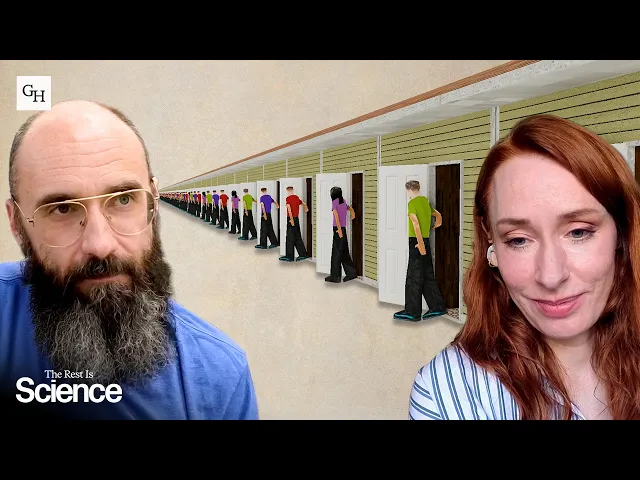
Paradoxes Of Infinity (Infinity Part 1)
The Rest Is Science
0:00 Would you want to live forever?
0:03 No.
0:02 No, me neither.
0:03 I think I think life only has meaning because it's finite.
0:06 Here's another question for you though that's uh related.
0:10 If you had the choice between dying
0:12 in the next 5 minutes or living another week,
0:14 what would you what would you choose?
0:16 Well, both of those are finite, but I will pick the larger of the two.
0:19 I would pick a week.
0:20 You're right.
0:21 So, now now let's imagine I ask this question again in a week's time.
0:24 Would you rather live another 5 minutes or or survive for another week?
0:28 What what would
0:29 I would imagine that a week from now I would still uh prefer one more week.
0:32 Mhm.
0:33 What about What about the week after that?
0:34 Another week, please.
0:37 I mean, you may see where I'm going with this.
0:40 Right.
0:40 Because here's the thing, if you continue on with the argument forever,
0:42 this is like a classic philosophical experiment.
0:45 This is originally put forward by Thomas Nagel
0:48 in The View from Nowhere in 1986, and he said,
0:50 "Given the simple choice between living for another week and dying in 5 minutes,
0:54 I would always choose to live for another week.
0:56 Thus, I conclude I would be glad to live forever."
0:59 I don't agree with that conclusion.
1:00 I mean, I'm not I'm not saying that Nagel's a liar.
1:04 I just think that eventually you will not prefer a week over 5 minutes.
1:10 Eventually in my life I I imagine I will reach a point where I say,
1:14 "Yeah, give me just 5 more minutes.
1:15 That's all I need, and that's all my loved ones and friends need of me.
1:19 Like, I'm done, and it's their turn."
1:23 [gasps] [sighs] You're happy with a finite life, effectively.
1:27 I'm happy with it, and I desire it.
1:28 Yeah.
1:29 I think that if I was granted immortality right now,
1:33 my first emotion would not be,
1:35 "Whoa." It would be an immense anxiety and claustrophobia,
1:39 a feeling of being so trapped.
1:41 I'm trapped here in this universe, and that would be terrifying.
1:45 It would not be freedom at all.
1:50 No.
1:50 The concept of infinity is just a bit too much to bear.
1:54 And so today, we're going to bear it.
1:56 We're going to wade into and grasp infinity.
2:02 Or at least try.
2:04 [music]
2:08 This episode is brought to you by Cancer Research UK.
2:11 If you wanted to type out the entire human genome,
2:14 you would have to type at 60 words a minute
2:18 for 8 hours a day for about 50 years.
2:21 Okay, that's the scale of the DNA rulebook inside
2:25 each one of your cells telling it when to grow,
2:27 when to divide, and when to stop.
2:30 And different tissues read that same rulebook in different ways.
2:33 So, a skin cell doesn't behave like a lung cell.
2:36 And cancer can begin when those instructions change.
2:39 Not one dramatic moment, but through small gradual edits over time.
2:44 Now, cancer isn't one disease.
2:46 It is more than 200 types shaped by where
2:50 those changes to the rulebook happen and how cells respond.
2:54 Cancer Research UK is the world's largest charitable funder
2:58 of cancer research backing studies across all types of cancer.
3:02 Work that takes years of very
3:03 careful steady progress to deliver each breakthrough.
3:07 For more information about Cancer Research UK, their research breakthroughs,
3:12 and how you can support them, visit cancerresearchuk.org/therestisscience.
3:21 [music] First things first, let's set the ground rule about what infinity is.
3:28 When When I say infinity, and I want to hear what you think, too.
3:30 Infinity to me is a number.
3:33 It can be It can be a number.
3:35 It can be an amount.
3:37 And the amount that infinity means is unending.
3:41 Okay, there's there's no end to it.
3:43 There's no final number.
3:45 And so, it's not on the number line,
3:48 but if you if you think of the entire number line,
3:51 and you ask how many numbers are there?
3:53 The answer is infinity.
3:56 Yeah, see I think I'm going to slightly disagree with you
3:58 because because I don't think it's a number in the traditional sense,
4:01 purely because, you know, you can't do number-like things with it, you know?
4:07 You can't like it doesn't really lend
4:09 itself to addition or multiplication or like subtraction.
4:13 I think that infinity, and by the way,
4:16 we're going to do two episodes on infinity,
4:19 but I think that for the purposes of this episode,
4:22 I think it is something that you can approach but never reach.
4:27 I think it is something that is boundless, that is endless,
4:30 that is that is larger than any other measurable quantity.
4:36 Excellent.
4:35 And I completely disagree.
4:37 I think that we reach it every day multiple times.
4:40 I think that infinity is an amount.
4:44 I think that there are different kinds of numbers.
4:46 Yes, you it's hard to do certain kinds of arithmetic with infinity,
4:50 but try taking the square root of a negative number, you know?
4:54 I think that we just have to admit that there are different kinds of numbers.
4:58 There's rational, there's irrational, there's imaginary, and there's infinite.
5:02 They're all numbers, though.
5:06 [snorts] Can we just talk a little bit about how weird infinity is because
5:09 it is so much weirder than any of the other numbers that you've described?
5:12 Yeah, I I grant that.
5:13 So, let's let's let's talk about it.
5:15 Okay, so um I think one of my favorite explanations about
5:18 how weird infinity is uh comes from uh the mathematician Hilbert,
5:23 German mathematician.
5:24 He imagined this hotel, okay,
5:26 called Hilbert's Hotel, and it's a wonderful demonstration.
5:30 So, essentially, this hotel has got an infinite number of rooms, all right?
5:34 Which is a wild to imagine,
5:36 but also every single one of those rooms right now happens to be fully booked.
5:41 It is an infinite hotel that is infinitely full.
5:44 You turn up to the hotel looking for somewhere to stay for the night.
5:49 And how do you get in?
5:51 I mean, the the hotel's completely full.
5:53 It's booked.
5:53 Yeah, it's booked.
5:54 And I I just wanted to like say, just just for clarity's sake,
5:57 this hotel does not have a lot of rooms.
6:00 It has an unending number of rooms.
6:02 You think you found the last room, there's always one after it.
6:04 Always.
6:07 Yeah.
6:06 it's fully booked.
6:07 So, like I it's there's no vacancy.
6:10 Or is there?
6:11 Right.
6:11 There is there's no vacancy or is there?
6:13 Because you're very clever.
6:15 So, you say, "Well, it's fine.
6:16 You can make room for me in this infinite
6:17 hotel." Because all you need to do is everybody
6:20 needs to leave the room that they're currently
6:22 in and then go to the room that is one along.
6:26 So, if you're in room two, go to room three.
6:28 Room room seven, go to room eight.
6:31 And then all of a sudden, there's always a room that you can
6:34 move down to, even though it's infinitely full.
6:37 But now, the very first room, room one,
6:41 is now vacant because nobody has gone into room one.
6:43 So, you as the additional guest have suddenly
6:46 found space in an otherwise completely completely booked hotel.
6:50 So, okay.
6:51 Addition doesn't really work in the same way for for infinity.
6:54 But but there's I mean, it gets way weirder than this.
6:57 Because now imagine that a bus with an infinite number of seats on it,
7:03 which is also full, turns up to your infinite hotel,
7:07 which is also completely full.
7:10 I mean, this is much more of a puzzle.
7:12 How on earth do you fit infinity inside infinity?
7:15 This isn't just infinity plus one.
7:16 How do you do it?
7:17 But there is in fact a way to do this.
7:20 You it's a similar trick to before.
7:22 All you do is you say, "Okay.
7:23 If you are in room n, you double the number of your room.
7:28 You go to 2n." So, if you're in room two, you move to room four.
7:33 If you're in room seven, you move to room 14.
7:35 If you're in room 25, you move to room 50.
7:38 But because everybody has doubled their room number,
7:42 suddenly all of the odd numbers are completely vacant
7:46 and there is an infinite number of odd numbers,
7:49 which means you can fit the infinite bus
7:52 load of people into this infinitely full infinite hotel.
7:56 Yeah, infinity plus infinity is just still infinity.
7:59 It's still a fully booked hotel.
8:01 You had room, you can always make room.
8:02 You can always make room for one more because infinity is unending.
8:06 There are There are layers to this, right?
8:08 Because I mean, you can go further with the weirdness of this infinite hotel.
8:11 And we shall.
8:13 And we shall, no less.
8:14 Because now imagine that you've got this infinite car park outside.
8:18 And now instead of one person or one bus
8:20 or one bus with an infinite number of people,
8:23 now this infinite car park is full of an infinite number
8:27 of buses which are full of an infinite number of people.
8:31 How can you fit an infinity of infinities inside of infinity?
8:37 And it And it turns out you can do that, too.
8:39 There's not even a problem.
8:41 You can do it because you start off with the same trick as before.
8:43 Every person doubles their room number,
8:45 leaving all of the odd number rooms completely free and open.
8:48 There's this infinite number of prime numbers.
8:50 So, the first bus, you say, "Okay, you can be bus number three,
8:52 all right?" The first real useful prime, you know, the first odd prime.
8:57 You're bus number three.
8:58 The first person goes into three to the power of one, the third room.
9:04 The second person goes in three to the power of two, the ninth room.
9:07 The third person goes in three to the power
9:09 of three and so on and so on and so on.
9:11 You go through and you fit that infinite number
9:14 of people all into odd rooms, by the way.
9:16 All powers of three.
9:18 All powers of three.
9:19 But, you have completely left untouched room five, room seven, room 11.
9:25 All of the other prime numbers, you can repeat this trick for all of those.
9:29 So, the second bus is bus five.
9:31 The first person goes in five to the one.
9:33 The second person goes in five to to two.
9:35 And so on and so on and so on.
9:37 I mean, a bit difficult to follow this on a podcast,
9:39 I'll admit, but you can trust me.
9:42 [laughter] You can trust me that this works perfectly.
9:45 An infinite number of buses with an infinite number of people can fit
9:49 into an infinite hotel with an infinite number of rooms that are all booked.
9:53 Like, this is extremely strange.
9:57 So, yes, this is all very strange behavior,
9:59 but it's still numbery behavior in my opinion.
10:05 Yeah.
10:05 Infinity.
10:06 What does it even mean?
10:06 It just means in, which means not, finity, finite.
10:12 So, not finite, not ever coming to an end.
10:15 And, you know, today we're very familiar with the concept of infinity.
10:20 The word is very popular, you know.
10:23 And the symbol is flopped over eight, let's be honest.
10:29 [laughter] The lemniscate, yeah, it's a flopped over eight.
10:30 It's it's a lazy eight.
10:32 And [laughter] it represents infinity,
10:36 but we actually don't know why that symbol came to mean without end.
10:42 The very first, the very earliest use of the lemniscate
10:45 to mean unending was by John Wallis in 1655.
10:51 And he he just uses it,
10:53 but does not explain what it means or why he chose that symbol.
10:57 So, maybe people were already talking about using this symbol.
11:01 I think the best guess is that my my favorite
11:03 at least is that it came from Roman numerals.
11:09 Oh.
11:08 Yes, there was a an like a one of the earliest forms of Roman
11:13 numerals did this thing where parentheses were
11:16 used to change the value of a number.
11:19 And so, 500 in Roman numerals, we all think of as being the letter D,
11:25 the capital letter D is what it looked like,
11:27 but before it was a D, it was an I followed by a backward C,
11:32 which is I'll do it for the mirror.
11:35 Yeah.
11:35 Which you combine them, that's a D.
11:37 So, the D for 500 may have come from an I
11:41 followed by a backwards C and they got squished together.
11:45 So, before the whole D thing,
11:48 the the parenthetical arrangement would of Roman numerals
11:52 worked where for every backwards C you added,
11:56 the value went up by a thousand more.
11:58 So, I backwards C backwards C wasn't 500, it was 5,000.
12:04 But, if you put a C on either side of the I,
12:07 it didn't represent one, it represented 1,000.
12:11 So, C I backwards C represented a thousand and it's
12:15 believed that that might have been where the M came
12:18 from that eventually came to be and today we usually
12:22 think of as being the Roman numeral for a thousand.
12:24 That it was originally regular C I backwards
12:27 C and then they not only melted together,
12:30 but the bottom broke open and it became an M.
12:32 All right?
12:33 But, Yeah.
12:34 this this like I that's encapsulated in a circle
12:37 gets us really close to that sideways eight.
12:40 In John Wallace's time,
12:42 a thousand was often used hyperbolically to mean can't even count.
12:48 Massive.
12:48 thousands.
12:48 So, a thousand in Roman numerals could mean never ending,
12:51 is what I'm really saying.
12:52 Not exactly 1,000, not you know, 1000s, but just, you know, infinite.
12:58 I really like that a lot.
13:00 I really like that.
13:01 I'd always sort of assumed that it was related to the number zero.
13:04 Zero being the symbol from from Indian
13:07 mathematicians that's very related to this idea
13:09 of like a state of nothingness and and like no beginning, no no end.
13:14 So, I'd always I think assumed that it
13:16 was something like that, like a twisted zero.
13:18 But, you know, if you're saying 1655, right,
13:22 that this symbol, I mean, zero wasn't even I mean,
13:26 was it even widely used in as far away as Britain at that point?
13:29 I think it's around about the same time, right?
13:32 That makes much more sense that it comes from from the Roman.
13:35 It could have it could have come from Greek, right?
13:37 So, another theory is that the letter omega,
13:39 which in lower case looks like a little W,
13:41 it could have gotten closed up and made the lemniscate.
13:43 And the omega is the last letter, you know, the end.
13:47 So, I don't know.
13:48 It could be something like that.
13:49 Thank goodness we started using zero.
13:52 Like Roman numerals are a joke.
13:54 I don't even care if the ghost of some Roman soldier comes to
13:59 Julius Caesar comes to kill you.
14:01 All right.
14:02 Dude, don't even try.
14:03 You don't even understand positional notation.
14:05 Like give it a break.
14:07 Uh-huh.
14:07 Because Yeah.
14:08 I I just just yesterday I finished Ursula Le Guin's short story The Masters.
14:12 And it's this really I don't know if you read it,
14:14 but I'll tell you the story is fantastic because the premise is
14:19 that there was some terrible apocalyptic
14:22 thing caused by human technology, right?
14:25 You could imagine that it was like a nuclear war.
14:27 They just call it the hellfire.
14:28 And it happened 14 generations ago.
14:30 Because it was so traumatic and all these famines occurred,
14:34 there's been this taboo created around rational thinking,
14:38 the scientific method, using numbers.
14:40 No one's allowed to do them.
14:42 But they still have all the technology that we have,
14:44 you know, they have steam engines and cars and all this stuff.
14:47 But everything's built just with comparing sticks.
14:50 You're not allowed to have numbers like Western Arabic numerals,
14:54 you know, 1 2 3 4, 0 through 9, those things.
14:56 You can't use those.
14:57 Everyone's been forced to revert back to Roman
15:00 numerals because they're so hard to do math with.
15:02 And you've got you know,
15:04 you've got the apprentices who are building the steam engines being like,
15:07 "Hey, what's a what's XIV+ XXVI?" And they can't do it mentally.
15:14 They have to just memorize this stuff.
15:16 But there's a guy who draws a circle in the sand and he's like,
15:19 "Guys, that's the symbol for nothing." And they're like, "Stop it.
15:24 That's one of the black letters.
15:25 We're not allowed to talk about that." And it's
15:28 just very cool and all the examples
15:29 of people trying to do math with Roman numerals
15:31 is so hilarious that Julius Caesar, come at me.
15:35 I am not afraid.
15:37 Yeah.
15:37 I don't know.
15:37 I think as we'll come to in the second part of this this episode,
15:40 zero and infinity, they're sort of sisters, you know?
15:43 They they really do go hand in hand.
15:45 And so I think it is quite interesting actually
15:47 that it's around about the same time that English mathematicians,
15:51 at least, are writing about infinity as zero is is coming into common usage.
15:57 You know, I think that's that's probably not a coincidence.
15:59 I mean, the the folks on the rest of history can can correct us on [laughter]
16:03 on a whole wild wild guesses as to what might have happened in the past,
16:07 but but I think that's probably not a coincidence.
16:09 Okay, just picking up on that idea of omega,
16:13 cuz the ancient Greeks, they did have this like inkling about infinity.
16:18 They weren't They were some I mean, they didn't like it.
16:22 It didn't feel comfortable.
16:23 They sort of wanted to avoid it as much as possible,
16:26 but they definitely had this inkling that there might be something there.
16:29 So the the the particularly famous story
16:31 is about Pythagoras and his his disciples.
16:34 So by the way, Pythagoras is like he's kind
16:37 of survived through history as this like this genius figure,
16:40 this this lone genius.
16:42 Not true at all.
16:42 He's basically a cult leader.
16:44 He had some He had some absolutely wild ideas um about uh well,
16:49 notably about beans.
16:51 I can't remember if I've mentioned this in this podcast before,
16:53 but he was absolutely terrified of beans.
16:55 He thought that they were essentially little humans.
16:58 Why Why did Do you know why he thought beans were little humans?
17:01 I think he I think he sort of thought that they looked like them.
17:04 I mean, once you get this far back,
17:06 the number of interpretations and original source materials
17:09 that you have to work on, there's many, many fold different ways to go.
17:14 I think also that um there's a few different reports
17:17 that Pythagoras was trying to persuade bulls not to eat fava beans.
17:21 Um, you know, it's it's uh, it's it's commitment.
17:25 The thing about Pythagoras, his cult,
17:27 and actually the ancient Greeks more generally,
17:30 is they had this really deep belief
17:33 that the universe was made up of exquisite order.
17:37 You know, that the the movement of the planets in the sky, that you know,
17:41 the the shape of circles, of triangles, it was just,
17:46 you know, unending beauty in fractions and whole numbers.
17:51 So, in music, for example, this whole idea of harmonics,
17:55 it was the Pythagoreans who worked out that uh, frequency of certain notes,
18:02 they sound good together when that you mix
18:06 frequencies that are an exact multiple of one another.
18:09 You know, that's how you get sort of harmonic and beautiful sounding music.
18:13 And so, the Pythagoreans, they had this list,
18:15 this table of opposites, they called it.
18:18 In one side, there would be good, the good things, the things they liked,
18:21 things they were happy with, and on the other side,
18:23 there'd be sort of the bad things.
18:24 So, they had odd and even, um,
18:27 one and many, uh, right and left, male and female.
18:31 So, if you can guess which column female went in,
18:34 It's [laughter] the good or bad side.
18:36 The evil side.
18:38 Yeah, it was joined by good and evil.
18:40 Evil's also in the uh, the the the bad column.
18:42 Uh, square and oblong.
18:44 Oblong, disgusting.
18:45 Oblongs and females, get over there.
18:47 Light and darkness.
18:49 Light and darkness, exactly.
18:51 But also, finite and infinite.
18:53 An infinite being like this horrible,
18:56 disgusting thing that kind of go belongs over there.
18:59 There is this story that Hippasus, who was an early follower of Pythagoras,
19:03 and he was playing around with triangles,
19:05 and he had a right angle triangle with two
19:08 sides that were both equal to one, right?
19:10 So, they're kind of equivalent to each other.
19:13 And then he was working at how long the hypotenuse was,
19:16 how long the the diagonal that cut between those would be.
19:19 Or essentially, if you take a square and you split it across the diagonal,
19:21 how long is that line?
19:23 And it's equal to the square root of two,
19:26 which Hippasus was like, "Okay, hang on a second.
19:29 The square root of two, there's no order to it.
19:31 There's no natural beauty.
19:33 There's this these numbers that continue on indefinitely.
19:37 There is infinity contained within this beautiful geometric
19:41 shape." And uh the the the story goes, and we can never be quite sure,
19:47 the story goes that they took Hippasus um out
19:49 on the ocean and then just chucked him off the boat,
19:51 drowned him at sea for arguing.
19:54 Wait, for for the sin of of what, entertaining an irrational number?
19:59 I think he had a proof for it.
20:00 I think he even managed to prove that it was irrational.
20:03 And they were like, "Don't you come
20:04 at me with this with this sacrilegious nonsense.
20:08 This is This is despicable."
20:11 Despicable.
20:11 Almost a little female.
20:15 [laughter]
20:15 Almost a little female, exactly.
20:17 What if What if it turned out that I was a closet Pythagorean
20:21 and I I believed all these things and I was part of his cult,
20:24 like a modern-day neo-Pythagorean cult and I was like, "Look, Hannah,
20:29 infinity is evil and so is darkness and so is So were
20:34 odd numbers and women." Just Did you not know that about me?
20:38 There's um there's there's a very easy way to test this.
20:40 I'll just I'll just make you baked beans on toast to see what you do.
20:45 Beans?
20:45 More like human beings.
20:47 See, now the language at least matches our weird belief.
20:50 I think we should bring back the idea of um
20:52 being a closet Pythagorean as an insult, you know?
20:55 I think we should start throwing it around.
20:57 Well, I know, but the problem is that they also had some really great things.
21:00 I mean, I love their their like worship
21:03 of numbers and ratios as being something really fundamental,
21:08 something that was so timeless it was outside of time.
21:12 It didn't change.
21:13 It was god like.
21:15 Maybe numbers and math literally were god, right?
21:18 I don't know why they also hated beans.
21:21 But look, this is just it's just too long ago and we
21:24 can't ask them and we don't have a lot of what they wrote.
21:27 Speaking of which, we don't have anything that that famous guy Zeno wrote.
21:32 Mhm, cuz he was also attacking infinity, right?
21:35 Well, kind of.
21:36 You know, it's unclear to what extent Zeno was around in like the 5th
21:41 century BCE and Zeno was a follower of a guy named First of all,
21:47 here's a cool here's a cool trick.
21:49 People bring up Zeno and especially Zeno's paradoxes all the time.
21:54 And whenever people bring them up,
21:55 I like to be like like I act confused at first and I go, "Oh, Zeno of Elea.
22:00 Right, yes, of course,
22:01 go on." As though there like other Zenos I know and I need the clarification.
22:06 So, the the Zeno of Elea is the kind of the full
22:09 name and Elea is the Greek colony that he lived in.
22:14 The mathematicians and the well,
22:15 really the philosophers who lived there were the Eleatics and they
22:19 had a very to me impenetrable belief that motion was impossible.
22:26 Like I I cannot describe this in a way to convince you,
22:30 but they believed that there was no change,
22:32 that it was all an illusion, that everything was just one.
22:36 Everything was the monad.
22:38 That's it.
22:39 When we think that something's changing or moving, we're being fooled.
22:42 And so the the the righteous,
22:44 the wise thing to do was just to sit and do nothing and chant, "It is.
22:48 It is." That's it.
22:50 It it, everything.
22:51 And of course, there were other thinkers at the time who were like,
22:53 "You guys are ridiculous.
22:55 What does this even mean?
22:56 Obviously, things can move.
22:58 Obviously, things can change and it's real.
23:01 And so, Zeno was like, "Guys,
23:04 I know you think that we're silly, but you're just as silly.
23:07 Listen, if I believed in motion, then here's a contradiction.
23:12 Let's have Achilles race a tortoise.
23:15 The tortoise is obviously slower, so Achilles says,
23:18 "Oh, I'll give you a head start.
23:19 I'll let you, you know, go for, you know,
23:21 a minute before I even start." And the question is, who wins?
23:26 And you might think, well, I guess it kind of depends.
23:28 Like, Achilles can clearly outrun the tortoise eventually.
23:33 But Zeno says, "Logically, no.
23:37 Because, sure, when Achilles starts running,
23:40 the tortoise is already somewhere up ahead.
23:43 And Achilles has to first run to where that tortoise was when he started.
23:47 But in that period of time, the tortoise has already moved a little bit.
23:51 So, the tortoise is now ahead of him.
23:53 And Achilles now has to run from where the tortoise
23:56 used to be to where the tortoise is now.
23:58 But by the time Achilles gets there,
24:00 the tortoise will be yet a little further ahead.
24:03 And Achilles has to close that gap.
24:05 But by the time Achilles has closed that gap,
24:07 the tortoise will be a little bit further still.
24:09 So, it's impossible.
24:11 Since we can divide this out forever,
24:13 it's impossible for Achilles to ever outrun the tortoise.
24:17 And the other thinkers were like, "Yes, but he does.
24:19 It does happen." And Zeno was like,
24:21 "But you can't explain why." And so, that's the paradox.
24:25 And Zeno wasn't making a joke.
24:28 He wasn't necessarily arguing, "Here's proof that motion is impossible." He was
24:32 just saying that if you believe in motion, you have to embrace contradictions,
24:36 just like we are are perhaps embracing some as the Eleatics.
24:41 Well, that was the conclusion that he was drawing, right?
24:42 Was that like, this idea that motion is real
24:46 really obviously breaks down once you consider this paradox.
24:49 Yeah.
24:50 And thus And thus motion can't be real.
24:52 Motion must be this illusion.
24:54 Yeah, how do you explain that?
24:55 And And Zeno and and the people that we that we do have existing writings
25:00 from never really used the word infinity
25:03 to talk about what Zeno was describing here,
25:05 but they they did have to dismiss it in some way.
25:09 Usually just by literally getting up and walking and saying,
25:12 "Eh, what do you think about this?
25:13 How am I possibly doing this?" But, you know, Zeno would say,
25:17 "Guys, I don't But, how does it make sense that you can move?
25:20 Because in order to move, you have to, you know,
25:22 first cover like half of the distance that you're going to cover.
25:26 But, before you can do that, you have to cover a quarter of it.
25:28 And an eighth of that first, but then a 16th of that first." And so,
25:31 wait, you have There's How do you even start?
25:33 How does a journey even begin?
25:34 And they were like, "Yeah, where is the problem?"
25:36 At the heart of it is infinity there, right?
25:38 And But, infinity has this philosophical monster that nobody
25:40 could could quite get their head around that was,
25:43 I mean, essentially breaking human logic.
25:45 And that was the case for many, many hundreds of years.
25:47 I mean, thousands of years, frankly.
25:50 Until
25:52 Until Until Newton, the big fat baby, came along.
25:55 The big The big fat baby.
25:58 And And started squealing about it.
26:01 squealing about it and like seemingly resolved the paradoxes.
26:05 Right?
26:05 Today, we have a very powerful tool.
26:08 I would argue though that really we haven't solved Zeno's paradoxes.
26:12 We have constructed a bunch of great answers about them,
26:16 but I think we should look at those answers
26:17 because they approach infinity in a really different way,
26:20 where instead of just dancing around it, they hold it.
26:24 Okay, I'll tell you all.
26:25 Let's do this after the break.
26:26 Um I am going to do a little story about why Newton is a big fat baby.
26:33 [laughter] What he did that resolved Zeno's paradox.
26:36 And then Michael and I can argue till the end
26:38 of the program as to whether it actually is resolved or not.
26:41 Sound good?
26:41 Good.
26:42 Let's do it.
26:44 Okay.
26:45 [music] This This is brought to you by Project Hail Mary,
26:53 the new spectacular space adventure movie coming
26:55 to cinemas from the author of The Martian,
26:57 Andy Weir, and the directors of the Spider-Verse movies,
27:00 Phil Lord and Christopher Miller.
27:02 But, here's an even better combination: teachers in space.
27:07 Hello.
27:07 Thank you.
27:09 Project Hail Mary stars Ryan Gosling as science teacher Ryland Grace,
27:12 who is sent unexpectedly on an impossible mission into space
27:17 to discover why the sun and the stars are dying.
27:19 And he teams up with an unimaginable ally
27:22 to defy all odds and save the universe from extinction.
27:26 Okay, here's a question for you, Michael.
27:28 What What kind of prep would you hope Ryan Gosling had done
27:30 for this role in order to play the role of a of a science teacher?
27:33 He should have spent a bunch of time with cool teenagers and tried
27:39 to teach things to them so that it wasn't just like a good explanation,
27:43 but also kept their interest and made them want to hear more
27:48 and understand it so that they could share it to be cool, too.
27:51 See Project Hail Mary now in cinemas and IMAX everywhere.
28:00 Okay, the thing that we're hinting at here is calculus.
28:03 You know, we don't It's not mandatory in the UK, probably rightly so.
28:07 You don't really learn it until you're 17 or 18 and you're doing A levels.
28:10 There is There are huge swathes of the of the British population
28:13 who just have never have never come across this absolutely beautiful subject.
28:19 I think it's my favorite area of mathematics, by the way.
28:21 I think calculus has become like slang for difficult math.
28:27 Mhm.
28:26 And that's that's so somewhat unfair.
28:28 I I felt that way up until I was in my 30s
28:32 and I got a copy of Calculus by Michael Spivak,
28:35 which is literally a textbook, but I don't know if you've read it.
28:38 Um I once recommended this on Twitter
28:40 that this was like the best way to understand calculus,
28:43 and some of the most brilliant people that I
28:45 follow on Twitter who are mathematicians were like,
28:47 "No, that's a terrible book to recommend
28:49 to people." And I'm like, "No, well, okay.
28:51 So, take this with a grain of salt,
28:52 but it changed my life because Spivak doesn't just say,
28:56 'Look, here's how to solve problems.' He says, 'What the heck is change?
29:01 And can we make sense of change in smaller and smaller increments or even change
29:08 at an instant?" He he like breaks down what
29:10 all these terms mean so fundamentally that he's like,
29:14 "Look, we need to define even what like an ordered pair is.
29:17 What is a function?" And suddenly it just
29:19 unlocked an understanding of of everything that mentions calculus.
29:23 So, I love that book.
29:25 We should start from the beginning here then because
29:27 because calculus it's it is the mathematics of change.
29:30 Everything that came before it, you know, geometry, number theory,
29:35 they're all sort of standing still as it were.
29:38 But but in the real world, everything's constantly changing.
29:41 Everything is moving, speeding up, slowing down, moving on curves, fluctuating.
29:47 And so, calculus was this really big idea that is what we
29:52 use to measure and understand anything that is moving or changing effectively.
29:57 The idea of it is is actually incredibly simple.
30:02 And essentially what you say is,
30:04 let's say that you've got this this really wibbly wobbly line, right?
30:08 Like a kind of really strange little curve.
30:11 You can't measure it with a ruler.
30:13 I mean, you can't really you can't really sort of say anything
30:16 proper about it if all you've got to work on is a ruler.
30:19 But what Newton and Leibniz, I'm going to say the other way in a second,
30:23 what both of them realized is that if you zoom in closer
30:27 and closer and closer on any section of this really curvy line,
30:32 if you zoom in close enough, it will look straight.
30:38 Yeah.
30:37 And so, this was the this was the really big idea is
30:41 that if you cut up any line into an infinite number of chunks,
30:47 each one of those chunks you can handle yourself.
30:50 You can handle it.
30:50 There's no There's no problem there.
30:52 So, if you want to look at the area under a curve,
30:55 if you want to work out the shape of anything,
30:58 no matter how kind of crazy the outside of it is,
31:01 you can use calculus to chop it up and then
31:04 not actually have to do the infinite number of steps
31:07 because what this method gives you is a shortcut of doing
31:11 an infinite number of things all in one go, essentially.
31:15 And this is by using the concept of a limit.
31:18 Of a limit, yeah, exactly.
31:20 for me what's happening here because if I
31:23 am trying to walk from here to the door, I have to cover half the distance.
31:28 You do.
31:28 But then I have to cover uh half of what's left
31:30 and then half of what's left and then half of what's left.
31:32 And this goes on forever.
31:34 It's an infinite number of things.
31:36 And yet, I cover them all in a finite number of time.
31:40 How?
31:40 Because the key thing that was missing from the original
31:43 formulation of Zeno's paradox is that the amount
31:45 of time that it takes for you to do
31:48 that, it's a certain amount of time for your first step,
31:50 it's a smaller amount of time for the next step,
31:53 smaller and smaller and smaller.
31:54 So, you are doing an infinite number of things,
31:57 but once they get infinitely small,
32:00 they take you an infinitely small amount of time, too.
32:05 And so, you can sum up an infinite number
32:09 of things and end up with a finite number.
32:14 And calculus formalized this and made it not just an idea,
32:18 but a mathematical, logical, dis- demonstrable thing.
32:25 Exactly.
32:25 And one with which I mean it's it's
32:28 in in at the heart of it it's an incredibly simple idea, right?
32:32 Zoom in close enough and everything is you can handle everything.
32:36 Um but the power of it is just phenomenal.
32:39 I mean, you know, there's no like Newton's uh orbital mechanics,
32:45 roller coasters, right?
32:47 Like race cars.
32:48 I mean, everything you can imagine,
32:50 anything that moves or changes, the stock market, right?
32:53 Like anything at all is going to have calculus in there somewhere.
32:56 The this mathematics of change.
32:58 I I've sort of been saying Newton so far, right?
33:01 But the thing about Newton is he did come up with this.
33:04 He wrote it down, and then he [laughter] stuck it in a drawer for 40 years,
33:08 didn't tell anyone about it.
33:10 And then uh a little while later, this this German diplomat,
33:14 actually this diplomat and philosopher
33:17 called Gottfried Wilhelm Leibniz or Leibnitz, he completely independently,
33:23 he came up with his own version of exactly the same thing.
33:26 And uh Newton Newton had been doing it looking at motion and time,
33:30 and Leibniz had been looking at at geometry and space.
33:33 I mean, Newton's a big deal, right?
33:34 So, Leibniz knew he'd heard some rumors that that maybe
33:37 Newton had done a bit of this stuff already.
33:38 So, he writes this letter to Newton saying, "Oh,
33:42 I've heard this rumor that you're that you're working on this.
33:44 I don't want to tread on your toes.
33:46 Uh but Newton, who uh if you've listened to our previous episodes,
33:50 we know was like a right little whiner, [laughter]
33:54 he was not happy about this at all.
33:56 And so, what he did is he sent
33:58 back Leibniz this this really bizarre Latin anagram,
34:02 where if you unscramble and translate it,
34:05 basically, it was uh it was very cryptic.
34:08 It was essentially the kind of equivalent of sending
34:11 a a sort of very cryptic subtweet and time stamping it.
34:16 So, that when you look back at it later, it said something like,
34:19 "Given any equation involving any number of of fluent
34:22 quantities to find the fluxions and vice versa." Right?
34:25 That's the sort of what he was saying.
34:28 He was proving that he knew how this thing worked without telling him.
34:32 But he could prove later, "Look,
34:34 I described it all in this letter that's got a date on it,
34:37 so I deserve the credit." Totally.
34:41 So, anyway, Leibniz is just like, "Well, okay,
34:43 not really sure what to do about Newton.
34:45 He's just a bit of a weird guy,
34:46 but I'm going to publish it anyway." Everyone loves it,
34:49 it goes great, and then Newton forms one of the deepest, most vengeful
34:57 [laughter] attacks on Leibniz for the rest of his life.
35:01 So, it starts off, and Newton
35:03 gets this Scottish mathematician called John Keill.
35:07 He sets him off as his attack dog,
35:09 and Keill writes this article publicly accusing Leibniz of being a thief.
35:13 Leibniz is not a thief, to be absolutely clear.
35:15 What's the the evidence that he's a thief?
35:17 Is it that he received this cryptic letter
35:20 and then solved it and stole the idea?
35:22 No.
35:23 So, I mean, this is I mean, evidently not.
35:26 [laughter] Right, evidently not.
35:27 He'd already come up with the theory by that point.
35:29 But Newton had been sending letters to people
35:32 in Europe that had inklings of this idea,
35:37 and he had done it He had done it a few decades earlier, right?
35:39 We know now for sure that Newton did come up with it independently,
35:42 and Leibniz came up with it independently.
35:44 But Newton just didn't want He wasn't happy that this that this other guy
35:47 had come in and got the credit for an idea that he'd already had.
35:50 So, it's it's just basically a smear campaign, bluntly.
35:54 Um so, there's all these public articles.
35:57 Leibniz is furious about this, like, you know,
35:59 this this this Scottish mathematician accusing him of of whatever.
36:02 So, he he writes a formal letter of complaint to the Royal Society,
36:05 who's sort of the ultimate arbiter of science in the day.
36:08 And Newton, who was the president of the Royal Society, okay, is like,
36:13 "I'm sorry, I'm I'm not going to censor any of these members.
36:15 They can say what they want to." But secretly was going
36:18 behind everybody's back and whispering in the ear of John John Keill,
36:22 being like, "Here's what I need you to say next.
36:23 Here's how you can attack him more." So,
36:26 this argument like extends and extends and extends until the early 1700s
36:31 when Newton's like publicly accusing him of being a fraud and a plagiarist.
36:36 And this fight gets so bad that the Royal Society decides
36:40 that they're going to assemble this independent impartial committee of like
36:43 the greatest minds in order to work out once
36:46 and for all who actually came up with the idea of calculus.
36:49 Now, I mean I've mentioned that that Newton
36:51 was the president of the Royal Society.
36:52 So, what he does is he secretly
36:55 hands things every member of the independent jury.
36:57 When they release their their official report,
37:00 which destroyed Leibniz's or Liebniz's reputation,
37:03 we now know that actually Newton secretly wrote that report himself, okay?
37:08 Um and then to like really twist the knife,
37:11 Newton then anonymously publishes the glowing review of his own secret report
37:18 in the Royal Society's journal saying about
37:21 how undeniable undeniably correct and thorough it was.
37:25 And then uh Leibniz is his reputation is genuinely ruined, like he's over,
37:30 and uh he ends up dying, you know, a few years later.
37:33 He's impoverished.
37:34 He's out of favor with the royal courts.
37:36 And then Newton in his private notes writes
37:41 how proud he was that he'd broken Leibniz's heart.
37:44 Goodness gracious.
37:46 I mean, Newton honestly is not a nice guy.
37:48 He's horrible.
37:49 This is like the whole time I've been listening, I've been imagining Tina Fey.
37:55 If you're out there listening, let's do a prequel to Mean Girls and have
37:58 it set in the time of Newton and Leibniz.
38:01 And uh the Royal Society can be a little clique.
38:06 Yeah.
38:06 Luckily, we got the knowledge.
38:08 We got the knowledge.
38:09 We did.
38:10 And here's the thing, right?
38:11 So, while Newton did come up with the idea
38:14 before and Leibniz came up with it independently,
38:18 the thing is is that Newton's the way that he writes it,
38:22 Newton's notation, as we describe it, was kind of rubbish.
38:25 It just doesn't way more clunky.
38:27 It's like the Roman numerals of calculus effectively.
38:30 Leibniz's is one is way neater, makes way more sense.
38:35 And because of this loyalty that sort of the national
38:38 loyalty that the British mathematicians had to Newton,
38:42 they refused to to use Leibniz's um notation.
38:47 Whereas on the continent, in France in particular, they're quite happy.
38:51 They were using Leibniz's notation.
38:52 And because it was so much better, so much clearer,
38:55 so much easier to work with, actually British mathematics
38:59 on that front kind of stalled for a few hundred years.
39:03 So now, if you do learn calculus in school
39:06 or even in the Spivak book that you were recommending earlier,
39:10 almost certainly they'll be using Leibniz's notation.
39:13 And the word calculus itself was Leibniz's, not Newton.
39:17 He wanted to call it method of fluxions.
39:20 Okay.
39:21 So first of all, fluxions is a pretty cool word.
39:24 It's a pretty cool word.
39:25 Like I got to admit that.
39:27 But I guess that's a a nice little
39:30 like happily ever after story that at least Leibniz
39:33 got to name it and decide on the uh the symbols and the way we learn it today.
39:41 I mean, it's probably not worth the the horrible death, but you know.
39:45 Yeah, I bet if you asked him, he would have said,
39:47 you know, "Hey, give me one more week, please." Yeah, exactly.
39:50 By the way, to be absolutely clear,
39:52 this is going to be a continual running theme
39:54 in the rest of science about what a massive Newton was.
39:58 Yeah, as it should be.
39:59 This is one of my favorite parts of the podcast.
40:02 Um because I think yeah, it's like yin and yang.
40:05 You know, Newton did a lot, gets a lot of accolades,
40:08 gets an entire uh unit of force named after him.
40:11 I think it's about time we applied some force, too.
40:14 Quite right.
40:15 He's still a human and had lots of human flaws.
40:18 It did resolve Zeno, though.
40:20 It did resolve Zeno.
40:21 Or at least I think many generations
40:23 of mathematicians are comfortable that it resolved Zeno.
40:26 That's right.
40:26 We all feel like we've moved on from Zeno's paradoxes.
40:30 We say, "Look, it's possible, and you know,
40:32 you can you can use the calculus concept
40:36 of a limit to show that you arrive at the door,
40:39 even though you've got an infinite number of little pieces."
40:48 This segment is brought to you by Cancer Research UK.
40:51 In England every year,
40:52 around 4,300 people begin treatment with a drug that is designed
40:57 to switch off a very specific
40:59 cancer-driving signal that appears inside their cells.
41:02 That, by the way, is enough people to fill 10 jumbo jets.
41:05 And those drugs are now used worldwide,
41:07 boosting the impact of existing cancer treatments
41:10 and giving millions of people more time.
41:13 And the idea of finding the signal that driving
41:16 a cancer and then and then blocking that specifically,
41:19 it traces back to research that Cancer
41:22 Research UK was funding back in the 1980s.
41:25 That's right.
41:26 And so today, we are asking, "How did a clue from chickens lead
41:30 to targeted cancer drugs?" So a long time ago,
41:34 like in 1916, scientists noticed that chickens
41:38 that were infected with a specific virus developed cancer.
41:41 That that this virus produced cancer-causing molecules.
41:44 But it was also noticed that this molecule called epidermal growth
41:48 factor would cause cells to grow out of control in Petri dishes.
41:52 Now, epidermal growth factor, EGF, was was pretty well understood.
41:56 But what we didn't know a lot about was the EGF receptor on the cells.
42:01 And so that's what Julian Downward needed to collect a lot of.
42:05 And as it turns out,
42:06 placentas are a great place to collect EGFR, epidermal growth factor receptors.
42:15 So, then he started working out the sequence of amino acids that made
42:18 them up and and to find out how they worked and then he compared
42:21 those sequences to other known proteins and was doing this late at night
42:25 just like waiting for the you know the X to appear to have say,
42:27 "Oh, we found a match.
42:28 We found a match." And suddenly, boom,
42:30 a match was found with proteins created by a virus
42:34 that was known to cause cancer in chickens.
42:37 And so, this this was huge news, right?
42:39 He famously like called his boss middle of the night.
42:42 The boss comes over and they spend all night working
42:44 on this because this was the beginning of much more targeted cancer drugs.
42:48 Right, because you have to realize that idea that it could be your own
42:52 internal cellular machinery that could just simply
42:56 go a bit haywire and cause cancer.
42:58 At this point in time, it was it was, you know, still a barely formed thought.
43:03 But, what Julian Downward had done here in looking
43:07 at stuff that is naturally occurring in humans, this this EGFR,
43:12 this cell surface receptor that sits on the outside
43:15 of your cells and helps to regulate cell growth and division,
43:19 by noticing that it had this link to chicken cancer, it changed the entire game.
43:25 It meant that people started realizing that it could be something in your own
43:29 body that causes your cells to to to just go go completely overactive.
43:34 But, having that knowledge, having that groundwork,
43:38 that is what has led to this gigantic shift in treatment.
43:41 Because if you know exactly which signal is faulty,
43:45 which naturally occurring signal in the human body is going wrong,
43:49 then you can design a drug to block just that, which then in turn,
43:54 hopefully, results in far fewer side effects.
43:57 And so, by the early 2000s, the very first generation of of EGFR inhibitors,
44:02 things that that block this protein, ended up reaching the clinic.
44:06 And now, there are 13 different drugs out there that target EGFR,
44:12 which are used to to treat six different types of cancers,
44:15 including certain types of lung cancer,
44:17 of bowel cancer, of head and neck cancers.
44:20 And all of this can be traced to that exact
44:22 moment late night in the lab when Julian,
44:26 the Cancer Research UK-funded PhD student, discovered this incredible link.
44:31 And I mean, this is an entire wave
44:33 of innovation that got sparked from from that moment.
44:36 In the UK today, more than eight in 10 people who receive cancer drugs are
44:41 receiving a treatment that was developed either
44:43 by Cancer Research UK or with their involvement.
44:46 Yeah, so the story here is about the question changing.
44:50 It's not just about what causes cancer,
44:53 but which signal inside the cell is driving it.
44:57 And once you can identify that, uh that that specific signal,
45:00 you can try to interrupt it,
45:01 and you can tailor treatments to the biology of each cancer,
45:05 which makes treatments kinder and more effective.
45:09 And and for the 11 people every
45:11 day who are beginning these treatments in England,
45:13 and many more people across the world,
45:15 that change is shaping the care that they receive.
45:18 So, for more information about Cancer Research UK, their research,
45:22 their breakthroughs,
45:23 and how you can support them, visit cancerresearchuk.org/restisscience.
45:35 [music] There still remain a lot of metaphysical puzzles around here,
45:39 and I think we should sort of kind of leave everyone with these.
45:42 Let's imagine that I get up and I walk to the door.
45:45 Yes, I have to cover half the distance,
45:48 and then I have to cover half of what's left,
45:50 and then half of what's left, and half of what's left forever.
45:53 But now, imagine that I've got two flags.
45:56 Like I've got a green and a red flag,
45:57 and after each half of the journey that I cover,
46:01 I switch which flag I'm holding.
46:02 So, I walk halfway there, put up the red flag.
46:05 Then, I cover half of what's left, put up the green flag.
46:07 Half of what's left, put up the red.
46:09 Half of what's left, put up the green.
46:11 And I keep alternating.
46:12 Eventually, I get to the door.
46:14 As we know I do, which flag am I holding up when I reach the door?
46:19 Aus 2 1 That's right.
46:21 Is the number of halves I've covered even or odd?
46:24 I'm asking for the last number, the biggest number.
46:27 And how do you feel about these kinds of questions?
46:30 Because they're not resolved.
46:32 They're not resolved because I think that this is when it
46:35 really becomes clear that infinity doesn't act like a normal number.
46:40 We did that episode on really large finite numbers,
46:43 like Graham's number that we know ends in a three.
46:45 You know, infinity is not like that.
46:48 We don't know what it ends in because it doesn't ever end.
46:53 Right.
46:53 And yet my flag question presupposes that there's an end.
47:00 Mhm.
47:00 Because we reach the destination, so it ends.
47:03 I should be able to figure out, you know, what the state there is.
47:07 Another famous, very similar thought experiment is called Thompson's lamp,
47:11 where I'd say you're you're going to you're
47:13 going to play with a lamp for a minute.
47:15 And what you do is you wait half a minute and you turn the lamp on.
47:19 Starts off.
47:20 And then, you wait 15 seconds and you turn it off.
47:24 And then, you wait 7 and 1/2 seconds and turn it back on.
47:27 So, as you can see, after half of the time that's left has passed,
47:31 you switch the state of the lamp, okay?
47:33 So, it's going off, on, off, on, off, on in this accelerating rate.
47:38 A minute eventually passes.
47:40 When that happens, is the lamp on or off?
47:43 And in exactly the same way, it's like what's the last step?
47:46 What is the last step of an infinite number of steps in a finite amount of time?
47:51 Surely, a minute can pass, but yet the lamp cannot be on because
47:56 every time it's on, it's immediately turned off.
47:59 Because infinity is unending.
48:01 But every time it's off, it's turned back on right afterwards.
48:04 There can't be an end, and yet the sequence itself can end.
48:09 So, um the the best I've heard as a response to these paradoxes
48:16 is is I don't even know if it totally answers them,
48:20 but it basically says we don't have enough information.
48:23 There's a trick to these questions,
48:25 where we're being asked to say something about the state of a lamp or a flag,
48:32 but we've only been given rules about its behavior before that moment.
48:37 You've told me when a certain flag will be raised or not,
48:40 and I can tell you um at which step which flag will be up.
48:44 I can always tell you that.
48:45 But now you're asking me a question about when you reach the door.
48:51 But that's not part of the flag rules, so I can't know.
48:56 I don't know if that just kind of sidesteps the problem.
48:58 So, what you would do um in a mathematical sense with this?
49:05 Because I think ultimately the problem here comes in when you are
49:09 trying to make this ultimately imaginary
49:14 concept of infinity fit into reality, right?
49:17 Because because planting the flag suddenly makes it real, right?
49:23 Suddenly you're you're physically interacting with the world.
49:27 Cutting something into an infinite number of pieces that you never actually do,
49:31 you're just using that as a shortcut to get you to the answer.
49:35 It sort of works, right?
49:36 But but once you're planting flags and then saying what's the last one,
49:40 that's where you end up coming into this problem.
49:43 So, what you do in this situation,
49:45 I'm thinking about like in fluid dynamics, for example, right?
49:49 You have this concept of this perfectly smooth fluid that you can cut
49:53 and cut and cut and cut and cut an infinite number of times.
49:57 But once of course you actually get to reality, reality isn't made like that.
50:01 You can't cut up reality an infinite number of times or maybe you can.
50:04 We'll discuss that more in the next episode maybe.
50:07 But you know, there comes a point where you're
50:08 down to atoms and then you're down to quarks.
50:11 And so what you can do mathematically is you can say,
50:16 "Okay, we're going to draw a line in the sand, right?
50:19 And anything that is below this order
50:21 of magnitude can't be included." Um because
50:25 there's it comes a point where your infinitesimally
50:29 small steps no longer match with reality.
50:34 Yeah, they don't have any physical meaning anymore.
50:37 So it's like a clash between our ability
50:40 to think and reason and the world we've been given.
50:44 The lamp, I can imagine turning it on and off in this accelerating fashion,
50:49 but yet at a certain point, and I'd love to know when actually,
50:51 at a certain point I am having to push this lamp switch
50:55 faster than the speed of light in order to continue following the rules.
51:00 And so are we just actually prohibited from ever actually doing these?
51:05 And so they're what, like little made-up fictitious paradoxes?
51:09 If reason can create the paradox, why can't it also resolve it?
51:12 What What Where's the problem?
51:14 I get that the real world won't allow
51:16 us to experiment and and just observe the answer.
51:20 Doesn't feel very satisfying though, does it?
51:21 It doesn't feel very satisfying.
51:23 There's another famous one called the Ross-Littlewood paradox,
51:26 and this one is is pretty fun cuz it doesn't
51:28 even involve having to cut space up into small pieces.
51:31 Here's the experiment.
51:32 You You think in your mind that you're going to do this.
51:35 You're going to take a big jar and you put 10 balls in there.
51:37 Let's say they're ping pong balls.
51:40 Then you take 10 more balls and you put them in.
51:43 But when you do that, you also remove one ball.
51:47 Then you put in 10 more and remove one.
51:49 You put in 10 more and you remove one.
51:51 You put in 10 more and you remove one.
51:53 And you do this an infinite number of times.
51:55 Which because of the the tasks we've already described,
51:58 we can imagine doing in a finite amount of time.
52:01 You know, you put the first balls in after half a minute,
52:03 you put the second batch in after just 15 seconds and remove one.
52:07 After you've done this process an infinite number of times,
52:10 10 balls in, one out.
52:11 10 balls in, one out.
52:12 How many balls are left in the jug?
52:14 I think a lot of people out there listening are going to say, well,
52:17 it's an infinite number because yeah, you put in 10 and then remove one.
52:20 That means you really just put in nine.
52:22 And nine plus nine plus nine plus nine forever is infinity.
52:27 However, let me let me put it to you this way.
52:30 Let's say that the balls have numbers on them.
52:33 1 2 3 4 going all the way up, right?
52:36 And I put in balls one to 10.
52:39 And then I put in balls 11 to 20.
52:41 And I remove ball number one.
52:43 And then I put in the next 10 balls and I remove ball number two.
52:47 And then I put in another 10 balls and I remove ball number four.
52:51 Or three.
52:51 I forget where I was.
52:52 But but you see what I'm saying here, right?
52:54 If that's what I do,
52:55 then the answer is at the end of an infinite number of steps, the jug's empty.
53:01 There are no balls in it.
53:02 Because ball number one was removed at, you know, step one.
53:06 Ball number 10 was removed at step 10.
53:08 Ball number uh 18 bajillion was removed at step 18 bajillion.
53:12 For every single ball I put in, there is a moment when it was removed.
53:16 So, there are no balls or are there an infinite number of balls?
53:21 There's that zero and infinity are kind of like twins thing again,
53:24 where it's like it's one of those.
53:25 It's either none or unending.
53:29 Not anywhere in between.
53:30 I mean, what you are describing here essentially
53:32 is it it does take us back to calculus.
53:35 You're you're you're essentially describing what
53:37 happens in the limit of something.
53:39 But you're describing sequences that have no limit, that don't converge.
53:43 You know, the the the sequence half plus a quarter
53:47 plus an eighth plus a 16th and so on and so
53:49 on and so on, which is the Zeno's paradox um
53:52 one in in one of the formulations that you described it.
53:54 That's fine.
53:54 That equals one.
53:55 No big deal.
53:56 We can deal with that.
53:57 But on off on off 0 1 0 1 0 1 0 1, it just carries on oscillating forever.
54:02 It doesn't have a limit.
54:03 You know, likewise the thing that you're describing there.
54:05 Because there are other sort of strange paradoxes which in the are similar
54:10 to the one you're describing that do have limits that that can have resolutions.
54:15 So one that I really like is imagine that you
54:17 have an ant that is on an an elastic band.
54:20 This elastic band is pretty special.
54:21 You can stretch it as much as you like, right?
54:23 You can can carry on stretching it forever.
54:26 So this elastic band in the first second, it's 10 cm long.
54:31 In the first second, the ant can crawl 1 cm along the the length of the band.
54:36 But at the end of 1 second, you stretch the elastic band to 10 km long.
54:43 Now, the ant crawls another 1 cm.
54:48 You stretch it again to another 10 km.
54:52 And this goes on and on.
54:53 Every second the ant traverses 1 cm
54:56 and the rubber band gets stretched an additional 10 km.
55:00 Question is, does the ant ever reach the end of the elastic band?
55:06 I reckon we should leave this one as a as a as something that the
55:10 the the listeners can work on.
55:12 I reckon we leave that cuz it does have a solution.
55:15 It does have a solution.
55:16 It has a solution and and I mean this is a bit of a spoiler,
55:20 but it's surprising.
55:21 The answer.
55:23 It's really surprising.
55:24 The ant covers 1 cm of distance every second,
55:28 but the entire string or band becomes 10 km longer every second.
55:34 Can he reach the end?
55:35 And I I I want to I want to add two
55:37 that in the next episode we will tackle another question which I really love,
55:41 which is, okay, fine, Hilbert's Hotel, to go back to the beginning,
55:45 Hilbert's Hotel can always accept more guests.
55:49 But we're having to move the guests from the front and on, right?
55:53 But what if another hotel opens next door and it
55:59 needs to buy some number plates to put on its doors,
56:01 but Hilbert's Hotel annoyingly has bought all the plates that there are.
56:06 It's got every numbered plate.
56:07 What should the first room in this new hotel be numbered?
56:11 What number plates does it use?
56:13 Um or even better, let's imagine you're running a race and you're really slow.
56:17 An infinite number of people finish the race before you do.
56:22 What place did you get?
56:24 Now we're not talking about rearranging
56:26 infinity or approaching infinity or completing infinity.
56:29 We're talking about after infinity.
56:33 What numbers are there?
56:34 And that's where we're going to go next week.
56:36 It certainly is.
56:37 And we're going to come to, I think, the even more mind-boggling conclusion
56:43 that some infinities are larger than others.
56:46 It's going to hurt.
56:48 Yeah.
56:47 Prepare your brains for some more mind-bending infinity strangeness.
56:52 And if you'd like to ask us uh a question,
56:55 we might answer it in our Thursday Field Notes episode.
56:58 So send those questions to the rest is science@goathanger.com.
57:01 And in the meantime,
57:02 you can also sign up to our free newsletter, therest is.com/science.
57:07 See you next time.
57:09 Bye.