Heinz CEO DIRE WARNING: People Running Out Of Money
Breaking Points
0:00 The economy is certainly headed in a very dangerous direction as well.
0:03 No question about it.
0:04 Republicans right now saying bombing might have to begin once more,
0:07 but the American people are obviously not on board with the war,
0:10 have not been on board with the war from the beginning.
0:13 And the question is still whether the American
0:15 people are making up their mind on the war
0:17 with accurate information is now front and center
0:20 because of a new well, some new reporting.
0:22 There's been some significant new reporting actually on this front.
0:25 Do we know how much the war is actually costing?
0:30 Let's put this New York Times tear sheet up on the screen.
0:33 It's a headline.
0:34 Hegseth says this war has cost $25 billion.
0:39 up the true amount.
0:40 This is from Justin Wolfers,
0:42 obviously professor public policy at the University of Michigan.
0:46 And Wolfers wrote in the Times, quote,
0:49 "The Defense Department says the conflict with Iran has cost $25
0:51 billion so far." He says this tally significantly understates the true cost.
0:56 By my calculations, the bill for a typical American household
0:59 likely runs to thousands or even tens of thousands of dollars.
1:05 He says, "Yes, that's a wide range.
1:07 Blame the economic fog of war." But man, Crystal,
1:11 these numbers right now as they become more and more pronounced
1:16 and obvious in the media and the American people are paying
1:20 more at the pump and then looking at exactly how much
1:23 more debt we're going into to fund the war per person.
1:27 So, it's not even just I think first and foremost for most people,
1:29 it's about prices increasing and what you're seeing every day on the table,
1:33 but then just the the long-term ramifications for your own budget
1:39 as a as an American and American family because of this.
1:43 As that becomes more and more obvious, I mean, let's put B2 up on the screen.
1:47 And it becomes more obvious in people's everyday lives.
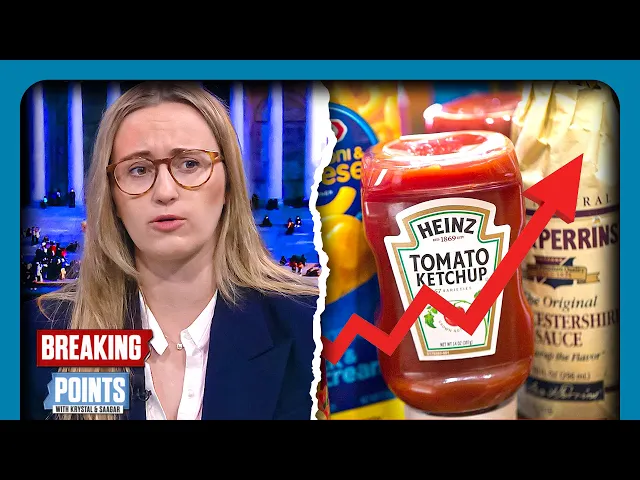
1:49 This is the Kraft Heinz CEO who said in an interview this this last week,
1:54 quote, "They're literally running out of money at the end of the month.
1:58 We're seeing negative cash flows in the low
2:01 lower income brackets where they're dipping into savings.
2:05 So, just about what you're already seeing in consumer patterns." We're what,
2:10 2 months into this thing?
2:11 2 and 1/2 months into this thing and even if it were to hypothetically,
2:15 someone waves a magic wand and today,
2:19 the economy is not just going to get better.
2:21 It's turning the Titanic around at this point, Crystal.
2:23 So, heading into the midterms,
2:25 Trump is poised to lose what little support for the war he has left.
2:29 The more we see of this.
2:30 We haven't really even seen the beginning here in the United States.
2:33 Or I should say we've probably just seen the beginning,
2:35 just the tip of the iceberg.
2:37 This is about to get much, much worse.
2:39 Yeah, that's absolutely the case and Americans famously, you know,
2:43 already don't have a lot of savings, don't have a lot of margin for error.
2:48 So, when you have the specter of gas prices
2:51 going up and up and up day after day,
2:54 week after week after week with no end in sight.
2:57 You know, people in elites in DC, policy makers,
3:00 they may not be feeling the pinch yet, but I can promise you, I can promise you,
3:05 ordinary Americans, for them it's already a crisis.
3:09 And that's what you see reflected there in the comments from the Kroger CEO.
3:12 I always pay very close attention to those things,
3:14 you know, we've covered before.
3:15 McDonald's CEO saying, "Hey, you know,
3:17 people are just skipping breakfast now." And not
3:19 that we're celebrating people getting breakfast from McDonald's,
3:21 although I am personally a big McGriddle fan, but we'll put that aside.
3:25 But, when people are just saying,
3:27 "I I'm just not doing this at all." That's a very dire sign.
3:31 Um, I wanted to go back just briefly to that that estimate
3:34 from Justin Wolfers because I think it's so significant.
3:37 He says not only does the cost directly to each American
3:40 family total in the thousands to tens of thousands of dollars,
3:44 but when you look at the total cost of this war and you factor in, as you said,
3:48 the increase in the cost to service our debt,
3:51 which has already gone up significantly.
3:53 When you factor in new disability benefits
3:56 and mental health problems for veterans who are serving,
3:59 God forbid if we do go in some sort of a ground invasion,
4:02 those sorts of costs are going to escalate.
4:05 When you think about repairing all the damages
4:07 of those bases that have been obliterated, destroyed,
4:11 if we even decide we're going to go back
4:12 in there and fix them and and, you know,
4:14 take up those positions in the region again, which I think is a big question.
4:17 But, those are huge, huge costs.
4:20 Then you think about the economic costs day-to-day of the oil markets,
4:24 the gas prices going up, the way that fuels inflation.
4:28 And he says, "25 billion is an insane lowball." This is his quote,
4:33 "The best any economist can do right now is get the order of magnitude right,
4:36 and my math suggests the Iran war will cost
4:38 hundreds of billions of dollars and very possibly trillions.
4:43 Trillions of dollars for this folly, for this, you know,
4:47 so far 40-day and counting folly." He says, "War is hell,
4:52 and hell comes with a hefty price tag." So,
4:55 that is what this president has signed us up for.
4:58 Yeah, and I also wanted to go back to Wolfer's
5:00 just on another point about what's happening in the market.
5:02 So, before we go back to Wolfer's, let's put up this next tear sheet.
5:06 This is before.
5:07 This is a quote from a Financial Times article.
5:11 Yeah, where the you have a a banker speaking anonymously to FT saying,
5:15 "Does anyone really care if the Strait of Hormuz is open?" Now, Oh my god.
5:20 Wolfer's article, he writes,
5:22 "Wall Street is worried despite the market touching new highs.
5:24 Every time the president takes a more belligerent stance, stocks tank,
5:28 suggesting that investors think this conflict will
5:30 undermine the value of leading US companies.
5:33 My estimate, based on the movement of oil prices along with the S&P 500,
5:36 is that stocks are about 5% lower than they otherwise would be,
5:39 suggesting that the war has wiped out about 3 trillion off
5:42 3 trillion dollars off the value of these companies." And Crystal,
5:45 the contrast between Wolfer's, I think,
5:47 reading what's happened in Wall Street pretty accurately and one
5:51 banker just talking about how Wall Street is riding
5:55 this AI boom for now for now is pretty
5:59 interesting cuz it kind of depends on your vantage point.
6:03 If you're like if you're worried about the market as a whole
6:07 or what it means for average Americans or what it means for your returns.
6:11 I guess you're probably thinking of this world differently depending
6:14 on that vantage point because if you're cool to just coast off
6:18 of the AI boom as opposed to being like an average American
6:21 who really does have to worry about what's happening in the S&P 500.
6:25 That is a pretty different vantage point.
6:28 Just extraordinary.
6:29 Yeah, and it wasn't just that one person.
6:32 Apparently there was a sort of rough poll show of hands about hey,
6:36 do you think the stock market is going to end up
6:38 even further on the year or do you think it's going
6:40 to end down from where we are right now and the overwhelming
6:43 consensus was that the line was going to continue to go up.
6:46 The headline describes it as blissful ignorance and look,
6:51 I think this is proof positive that the stock market is
6:55 not only divorced from the reality of what ordinary Americans lives are.
7:00 It is a negative indicator.
7:02 The more the stock market goes up often
7:04 times in recent years it's been because oh,
7:07 we did a bunch of layoffs because we can use AI to replace a bunch of workers.
7:10 Like that is what they're betting on.
7:12 When you we talk about this big bet on AI,
7:15 it's not just oh, the technology is going to help us cure cancer whatever.
7:18 No, what they are betting on is that AI is going
7:21 to be we're able to replace a large number of human beings.
7:25 That is the bet.
7:27 Now, will that bet pay off or not?
7:28 It's not entirely clear.
7:30 I think that in some ways it will.
7:32 You could also have a major bubble pop when
7:35 one company succeeds and the rest of them fail etc.
7:37 There are a lot of dire outcomes that could
7:39 come from this, but I think it's very important
7:42 to understand that largely largely at this point when
7:46 the stock market goes up given the large bet on AI,
7:51 that is a negative indicator for the well-being of Americans.
7:55 And so, yeah, if you're in the top 0.01% as these individuals, you know,
8:00 hanging out at the this Milken gathering as they would as they would likely be,
8:06 the little more gas prices at the pump.
8:08 Yeah, you don't care about that.
8:09 Who Who cares if the straight of farmers is so bad?
8:11 It's not really affecting my life.
8:12 I haven't changed my consumption habits.
8:14 So, they are blissfully oblivious to what the reality is and they don't care.
8:20 I mean, they genuinely don't care about the way
8:24 that this will cause ordinary people to struggle and suffer.
8:27 Now, I think they're somewhat delusional that look,
8:31 at the end of day, do you need some kind of consumer base?
8:35 At the end of the day, you do need to avoid some sort of revolutionary fervor,
8:39 which is very much increasingly on the table,
8:41 especially the more they push things in this direction.
8:44 But, for today, apparently, they're feeling pretty good, huh?
8:46 Yeah, but we have another indicator from Costco.
8:49 Let's put this up on the screen.
8:50 This is the Costco CFO who is saying
8:56 that members are basically switching from beef to chicken.
8:59 Actually, I'm just going to read this whole quote cuz it's very interesting.
9:02 By the way, not just in this current quote recession or concern for recession,
9:05 he said, "Historically, we've always seen some like within fresh protein,
9:08 we've always seen when there's a recession, whether it was '99, 2000, '09, '08,
9:12 '09, '10, we would see some sales
9:14 penetration shift from beef to poultry and pork.
9:17 We have seen some of that now.
9:18 I think anecdotally, I heard a few months ago from our head
9:21 of food and sundries buyer that we saw some
9:23 switch even from some to some canned products like
9:26 canned chicken and canned tuna and things like that.
9:29 So, again, just to emphasize, this is the really the tip of the iceberg
9:33 in terms of in price inflation that we're likely to see.
9:36 If the war were to end today, hypothetically,
9:39 that a lot of these prices would still
9:41 be spiking for the months ahead and there's already
9:45 what feels like I mean we had Rohit Chopra
9:47 on last week from the head of the CFPB,
9:49 Crystal, to talk about the circular funding in a lot
9:52 of AI companies actually just in AI in general, the entire structure,
9:57 which is now like 30% of the S&P 500 is the mag seven companies,
10:01 which is actually really horrifying because if you
10:03 have investments from Nvidia to Microsoft and Microsoft
10:06 to Nvidia and that sort of thing
10:08 and they're not anticipating particular shift in the market
10:12 or they just haven't they don't have it
10:13 as a a high likelihood they haven't priced
10:15 it in exactly as they probably should be
10:17 doing and everything starts dissolving in front of us.
10:22 What could happen economically, what could happen culturally,
10:25 we are not prepared for what we could be seeing in the next 6 months,
10:29 year, 2 years just right on the cusp
10:32 of something potentially catastrophic, I think at least.
10:35 I mean I I hope that's not the case, but also all of this is going to amount
10:39 to more and more spending from the US government,
10:42 which I think a lot of people on the right were correct to point to.
10:45 I mean yes, you have greedflation that's absolutely already taking place.
10:49 There's no question about it.
10:49 You see it sometimes in the earnings calls showing up,
10:52 but also the government spending is going to cause average people who
10:57 now are losing jobs because of the AI boom to spend more.
11:03 They think prices are going to go up.
11:05 Like that's how this works and so it's just a complete mess,
11:09 a complete mess from the administration that was
11:11 elected on a pledge to stop inflation,
11:14 to bring inflation or to to halt the growth
11:17 at least of inflation and is now back
11:19 up to about the inflation level month about
11:23 the monthly inflation level as when Trump took office.
11:27 It's around 3% in January of 2025.
11:31 So any improvement that was made has been reversed effectively.
11:35 Tax cuts, too.
11:36 We've Have you seen the the calculations that what average people are coming
11:39 are getting from their tax cuts has been erased by gas price increases?
11:42 Yeah.
11:43 Well, and I learned from you that they were really betting
11:45 hard on uh the the everything's going to turn around for us.
11:48 Once people see their tax bill and they get getting their tax breaks,
11:51 then that's going to save us.
11:52 And guess what?
11:53 Here it is May.
11:54 People know what they're getting in terms of their refund,
11:57 and they're not feeling the love here.
11:59 They're not feeling like this is going great than whatsoever.
12:02 Yeah, zooming out, it's just a very volatile mix.
12:05 You've got this AI backlash both at the ground level in terms of data centers.
12:11 You've got deep concerns about the way they want to replace
12:15 labor if this technology is anything like what they say,
12:19 even if in the long term.
12:21 The most hopeful, optimistic projections, which I don't believe,
12:24 but let's give it to them that over the long term,
12:26 it's going to cause more job creation than it is job loss.
12:30 In the immediate to medium term, like go look at the Industrial Revolution,
12:34 how long it took for in in the developed world, right?
12:38 In the places that really ended up
12:39 being net beneficiaries of the Industrial Revolution,
12:42 it took over 100 years Mhm.
12:45 for all of that to ripple through the economy.
12:48 It's not like you just flip a switch.
12:50 It's going to be extremely disruptive and extremely
12:53 painful if anything approaching what they promise comes true.
12:57 And if it if it doesn't come true, then you've got the biggest bubble probably
13:00 in human history that's been inflated here.
13:02 I mean, the amount of money that's being
13:04 spent on these data centers is utterly, utterly insane.
13:08 So, you've got that.
13:10 You have in addition to the labor displacement,
13:13 obviously that is going to lead to a further spiraling of vast inequality,
13:20 again, of the the worst that we've probably ever seen in human history.
13:24 You have an extraordinarily volatile political climate and a an empire
13:29 here that is coming unglued and that part
13:32 of why it's coming unglued at this point is because
13:34 of this disastrous war that the population did not want,
13:39 does not want, that has now been decisively lost from a strategic
13:43 perspective and it's imposing massive daily costs on the American people.
13:49 I mean, it's it's a pressure cooker, Emily.
13:51 That's the only way you could put it.
13:52 It is an absolute pressure cooker and obviously we talked to Professor every
13:56 week here because we found his insights on the escalation trap very valuable.
14:00 He's also writing a book on the likelihood of political violence
14:04 and we need to have a conversation with him about that as well
14:07 because he's deeply concerned about the confluence of some of these events
14:11 and the way that they contribute to a rising trend of political violence.
14:15 I think I mentioned this last week but my final thought
14:17 here is Rod Dreher has been he's a Orthodox Christian conservative who's
14:21 been working on a book about Weimar America sort of drawing up
14:25 parallels between Weimar Germany and what we're seeing in America right now.
14:31 Just any like cultural indicators looking at some
14:33 of that and economic indicators and looking at that stuff
14:36 and he finished it a couple of weeks ago and said in his newsletter on Substack
14:39 basically that he believes the one thing that would
14:43 really be the tipping point from America as we
14:45 know it today to something much much darker
14:48 including more political violence would be an economic crisis.
14:52 And cuz I feel like people sense that.
14:54 I don't think it's you you have to write a manuscript on this and I'm not saying
14:58 of course not making the cliche apples to apples
15:02 parallel between Weimar Germany itself and what came after
15:04 in America and what might come after but obviously
15:07 when you have economies as you just laid out
15:10 with this level of instability and precarity you could
15:14 go to some dark places really really really quickly.
15:17 Hey, if you like that video hit the like button or leave a comment below.
15:20 It really helps get the show to more people.
15:22 And if you'd like to get the full show ad-free and in your inbox every morning,
15:26 you can sign up at breakingpoints.com.
15:28 That's right.
15:29 Get the full show, help support
15:30 the future of independent media at breakingpoints.com.