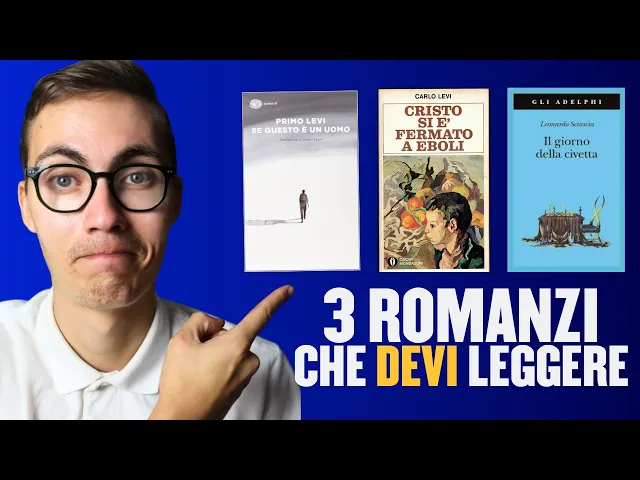
Che cosa LEGGERE in italiano? 3 libri FONDAMENTALI
Podcast Italiano
0:00 Three books by three great twentieth-century Italian authors,
0:04 three classics of contemporary Italian literature,
0:07 three masterpieces of different genres that share
0:10 an ethical intent and a spirit of denunciation.
0:13 If you want to improve your Italian by discovering
0:17 three of the most important works of twentieth-century Italian literature,
0:22 this video is for you.
0:23 You'll see, when your Italian friends discover you know these three books,
0:27 they'll be speechless.
0:28 The first is Christ Stopped at Eboli by Carlo Levi:
0:32 the story of an exile in the forgotten South of Italy,
0:36 where the state is distant, almost unreal,
0:39 and peasants feel excluded even from history.
0:44 The second is If This Is a Man by Primo Levi:
0:48 a testimony born in Auschwitz, inside the concentration camp,
0:51 to answer a terrible and necessary question...
0:54 what remains of man when everything is taken away?
0:57 The third is The Day of the Owl by Leonardo Sciascia:
1:01 a crime novel set in Sicily that for the first time
1:05 dares to publicly utter an uncomfortable
1:09 word—mafia—and exposes the silence of omertà.
1:12 These are three "necessary" books, born from the urgent need to inform
1:17 the Italian community about truths that, until then,
1:22 had been either silenced or ignored.
1:25 This is Podcast Italiano,
1:27 a channel for those learning the Italian language and culture, and I'm Davide.
1:32 Turn on subtitles if you need them;
1:34 the full transcript is on my website, podcastitaliano.com.
1:37 I've also prepared a PDF to accompany the video,
1:42 which contains a summary of the video's contents,
1:46 some insights into the works and authors cited,
1:50 and other book recommendations that are
1:53 essential for understanding the twentieth century.
1:55 You can also print this PDF, if you like,
1:58 both to follow the video better and to study and practice after watching.
2:03 I'll leave the link in the description,
2:06 but you can also scan this handy QR code.
2:09 Let's go!
2:09 The three texts I've chosen for you,
2:12 beyond their spirit of denunciation, have one thing in common:
2:15 they dramatize the conflict between the individual
2:18 and the power structures that oppress them.
2:22 These are abstract, impersonal, threatening, if not cruel,
2:27 structures in the face of which the only possible
2:30 attitude for the individual seems to be acceptance and resignation.
2:33 In Christ Stopped at Eboli,
2:36 the power is that of a state, the central Italian state,
2:40 which the peasants of Southern Italy perceive as a distant,
2:45 indeed very distant, entity, sometimes an enemy, sometimes simply absent.
2:52 "The state is further away than heaven, and more malignant,
2:54 because it is always on the other side," Levi wrote.
2:58 In If This Is a Man,
3:00 the criminal power is obviously that of the Nazi extermination machine,
3:04 responsible for the Holocaust.
3:06 And in The Day of the Owl, finally,
3:08 the occult power against which the individual clashes is both
3:12 that of the Sicilian mafia and that of a corrupt and collusive state.
3:18 Although with different nuances, the three novels fall within the cultural
3:23 climate of Neorealism (or immediately follow it).
3:27 They share the need to use clear, direct, and rational language;
3:34 to document reality as it is, without literary embellishment;
3:38 and finally, starting from autobiographical or real-life events.
3:46 Let us now examine each of these works,
3:49 in order of publication, beginning with Christ Stopped at Eboli.
3:55 The book was published in 1945 by the Turin-based publishing house Einaudi.
4:03 It was an immediate success and quickly achieved international fame.
4:09 It is an autobiographical work,
4:11 somewhere between a memoir and a historical-anthropological essay.
4:16 The story is set in Southern Italy,
4:21 specifically in Basilicata, or even more specifically in Lucania.
4:24 It is in this region that the author—a native of the North,
4:30 Turin, like me—was condemned to exile
4:33 by Mussolini for his anti-fascist political activities.
4:36 In the book, Carlo Levi raises the "problem of Southern Italy," that is,
4:42 Southern Italy, describing the poverty, backwardness,
4:46 and neglect of the Lucanian peasants.
4:50 The book deserves credit for having brought
4:56 the gap in socioeconomic development between Northern
4:58 and Southern Italy to public attention and the center
5:01 of political debate for the first time.
5:03 The book was adapted into a 1979 film of the same name,
5:08 directed by Francesco Rosi, starring, among others, Gian Maria Volonté,
5:12 whose iconic face helped bring the image of Levi's exile
5:17 in Lucania to life and eternal in the Italian collective imagination.
5:22 The book deals with this exile,
5:25 between the villages of Gagliano (now Aliano) and Grassano.
5:29 The Eboli mentioned in the title is a small town in Campania,
5:33 just north of Lucania,
5:35 which symbolically represents the boundary between the possibility
5:39 of a human existence and the reality of an animal existence.
5:43 The Lucanian farmers, who live south of Eboli,
5:47 among whom Levi spends his days of exile,
5:51 speak of themselves thus: "We are not Christians.
5:54 Christ stopped at Eboli." In their language,
5:57 "Cristiano" means "man." “We are not Christians,
6:00 we are not men, we are not considered as men,
6:04 but beasts(…), and even less than beasts(…),
6:07 because we must(…) endure the world of Christians,
6:10 who are beyond the horizon, and bear its weight and comparison.
6:14 Christ truly stopped at Eboli,
6:16 where the road and the train leave the coast of Salerno and the sea,
6:21 and enter the desolate lands of Lucania.
6:24 Christ never arrived here, nor did time, nor the individual soul, nor hope,
6:31 nor the link between cause and effect,
6:34 reason and History.” A world– that of Lucania– irrational,
6:41 primitive, magical and pagan.
6:43 A world populated by archaic and mysterious characters,
6:46 whom Levi observes and describes: incompetent doctors,
6:50 pedophile and drunken priests, gravediggers skilled at taming wolves,
6:56 witch-women, jealous husbands, actors, travellers, bandits.
7:00 Here, brigands, let's focus on them for a moment,
7:06 because the book's very lucid contextualization of the phenomenon characteristic
7:10 of the South of Italy at that time is particularly interesting:
7:15 "brigandage." This term refers to the actions of criminal gangs, brigands,
7:21 who infested the countryside and roads to steal and kill,
7:27 an action induced by desperation and authorized by an absent state.
7:33 Levi describes it thus:
7:34 "Brigantage is nothing but a fit of heroic madness and desperate ferocity:
7:39 a desire for death and destruction, without hope of victory." The anthropologist
7:44 and ethnologist Clara Gallini has emphasized the "capital"
7:48 importance of Carlo Levi's book
7:50 in the history of anthropological disciplines in Italy,
7:54 marking a turning point in the understanding of the "global
8:01 South." Let us now turn to the second of our novels,
8:04 If This Is a Man, by another Levi, Primo Levi.
8:07 It is a memoir, a novel-testimony set in Auschwitz,
8:11 inside the concentration camp.
8:13 The author was held prisoner in that camp,
8:16 and can denounce the horror and dehumanization he witnessed.
8:21 The manuscript, he believes,
8:23 was rejected twice by the major publishing house Einaudi.
8:26 The author was forced to turn to the small De Silva publishing house,
8:32 which printed the work in 1947 in a run of just 2,500 copies.
8:37 The book's success would have to wait until 1958,
8:41 when it was republished by Einaudi.
8:45 By the author's own admission, the book was "born during the concentration camp
8:51 days out of the irrepressible need to tell others,
8:55 to involve others," and it was written to satisfy this profound need.
9:01 The book's title, If This Is a Man, is explained by the introductory verses,
9:06 inspired by an ancient prayer from the Jewish liturgy.
9:09 Very famous lines, which make your veins tremble,
9:13 and which place each of us before a responsibility,
9:18 the responsibility of memory: You who live safe in your warm homes,
9:23 you who return in the evening to find hot food and friendly faces:
9:28 Consider if this is a man who works in the mud who knows no peace
9:34 who fights for a scrap of bread who dies because of a yes or a no.
9:40 Consider if this is a woman, hairless and nameless,
9:43 with no more strength to remember her eyes empty
9:47 and her cold womb like a frog in winter.
9:51 Meditate on what happened: I command you these words.
9:56 Carve them into your heart as you stay at home and walk along the street,
10:01 Going to bed, getting up.
10:03 Repeat them to your children.
10:04 Or may your house fall to pieces,
10:07 illness prevent you, or your children turn away from you.
10:11 These are verses that, unfortunately, are still very relevant.
10:15 In just a few lines, the author manages to do many things at once.
10:18 He manages to succinctly describe the reality of the concentration camps,
10:23 the lives of prisoners: men working in the mud for a crust
10:29 of bread and women stripped of femininity and identity.
10:33 He manages to place life in the concentration camps outside of life, real life,
10:37 through the contrast with the warm,
10:39 safe homes where you find hot food and friendly faces.
10:43 He manages to launch an appeal to readers,
10:45 the "you" to whom: the appeal is that of memory,
10:49 "this has been," a memory that becomes a duty,
10:52 "I command you," to be passed down from generation to generation,
10:56 "repeat them (these words) to your children." In the book,
11:00 the author analyzes the senseless and arbitrary rules that govern camp society,
11:04 the group dynamics that arise among prisoners,
11:09 the strategies for survival and for maintaining dignity,
11:13 and the isolated episodes of solidarity among prisoners.
11:18 He describes the harshness of physical labor,
11:20 and then the hunger, a condition that constantly torments the prisoners,
11:24 along with the mathematical certainty that most
11:27 of the living are destined to die.
11:30 He recounts the nights, nights of half-sleep,
11:33 in which the boundaries between reality and dream are blurred.
11:37 Levi describes these nights in a famous passage:
11:40 You can hear the sleepers breathing and snoring, some moaning and talking.
11:46 Many smack their lips and wriggle their jaws.
11:49 They dream of eating: this too is a collective dream.
11:52 It is a merciless dream(…).
11:54 You don't just see the food, you feel it in your hands,
11:57 distinct and concrete, you perceive its rich,
12:00 powerful odor; someone brings it close to your lips,
12:03 then some circumstance, different each time,
12:06 prevents the act from being completed.
12:09 Not even in their dreams are the prisoners of Auschwitz able to eat.
12:12 In their dreams, food is close, very close; it has a shape, a color,
12:17 a smell, it almost touches the hungry mouth,
12:20 but finally disappears before it can be eaten.
12:23 The story of the hell of Auschwitz continues until
12:27 the arrival of the Soviets on January 27, 1945.
12:36 Finally, we move on to today's third and final book,
12:38 Il giorno della civetta (The Day of the Owl) by Leonardo Sciascia,
12:42 published in 1961, which was adapted into the 1968 film of the same name,
12:47 directed by Damiano Damiani.
12:48 This is a detective novel, a crime novel, set in Sicily.
12:54 With this work, Sciascia denounces for the first time
12:57 the Sicilian mafia system and the culture of silence,
13:01 that is, the silence of witnesses
13:04 to mafia crimes enforced through fear of revenge.
13:08 The book is a denunciation of the Mafia's power in Sicily,
13:13 the author's native land, and an unfiltered snapshot of the society of the time.
13:20 The story takes place in 1960.
13:22 In a small Sicilian village near Syracuse,
13:25 the president of a small housing cooperative is found murdered at a bus stop.
13:31 The causes and perpetrators of the murder are shrouded in mystery.
13:36 Carabinieri Captain Bellodi investigates the crime,
13:39 but getting to the truth is not easy,
13:42 because everyone in the village is afraid to speak out:
13:45 a code of silence reigns.
13:47 As time passes, it is discovered
13:50 that the case also involves prominent public figures.
13:53 At a certain point, even the only
13:55 person who had recognized the murderer is killed.
13:58 But Captain Bellodi does not give up and, thanks
14:01 to the information of the widow of the last victim,
14:04 he is finally able to reconstruct the facts.
14:05 I will not tell you more about the story
14:07 so as not to spoil the pleasure of reading.
14:10 Instead, I'll leave you with a page from the book,
14:12 where the narrator delves into Captain Bellodi's thoughts,
14:15 to give you a taste of the narrative
14:18 style and the culture of the time and place.
14:21 The language isn't exactly simple,
14:23 but let me know in the comments if you understand.
14:26 Otherwise, you can always use the transcript on our website,
14:30 which includes a glossary with explanations of difficult words.
14:33 And in these cases, it's very helpful!
14:36 the captain thought that the family is
14:38 the only truly "living" institution in the Sicilian consciousness:
14:42 but "living" more as a dramatic contractual,
14:46 legal knot, than as a natural and sentimental aggregate.
14:50 The family is the Sicilian State.
14:52 The State, what for us is the State, is outside:
14:56 an entity de facto created by force;
14:59 and it imposes taxes, military service, war, the Carabiniere.
15:03 Within that institution that is the family,
15:07 the Sicilian crosses the boundary of his own
15:11 natural and tragic solitude and adapts,
15:13 in a sophisticated contractual nature of relationships, to coexistence.
15:17 It would be too much to ask him to cross the boundary between family and State.
15:23 We have reached the end of today's reading recommendations.
15:26 What do you think of the selection I suggested?
15:29 Which of the three books caught your attention, and why?
15:31 Which would you like to read first?
15:34 Let me know by leaving a comment.
15:36 And if you want to continue exploring today's authors and themes,
15:40 download the summary PDF.
15:41 And if you're interested in delving even deeper into the historical,
15:44 social, and cultural dynamics that have shaped contemporary Italy,
15:47 then I'm waiting for you in Inside Italy,
15:51 the advanced course (level C1) I created with historian Marco Cappelli.
15:55 It's designed for those who already have a good
15:59 level of Italian and combines advanced Italian with historical,
16:02 social, and cultural themes: we're talking about the economic miracle,
16:07 politics, the Church, the Mafia, regional identity...
16:11 complex topics, real, very important, and often a bit controversial,
16:15 just the way I like it!
16:18 Each episode is accompanied by grammatical and lexical insights,
16:23 exercises, transcriptions, flashcards,
16:25 and even a community where you can exchange
16:27 and test your skills with other students and our teacher.
16:31 So, if you truly want to delve into the complexity of the country—and not stop,
16:36 like many do, at the more touristy side— Inside
16:40 Italy is the natural next step in your journey.
16:43 You'll find all the information in the link in the description.
16:49 Happy reading, happy studying, and...
16:53 see you next time!