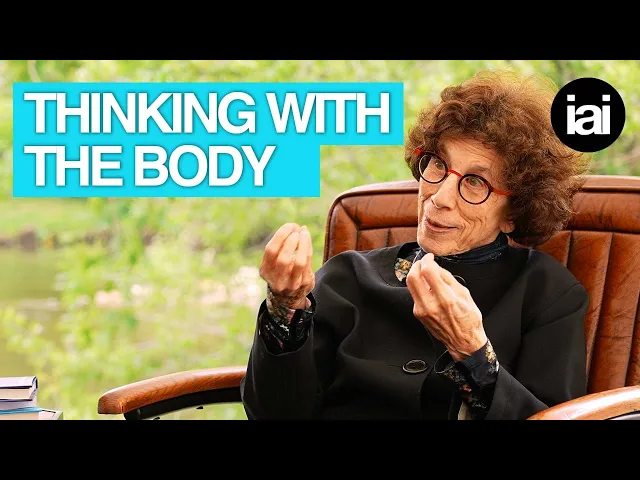
Thought doesn't just happen in the brain | Barbara Tversky
The Institute of Art and Ideas
0:00 The people sit on their hands,
0:02 it's harder for them to find [music] words to explain
0:05 how to get from their house to the train.
0:09 And when they explain those things,
0:11 they generally gesture, and the gestures precede the words.
0:16 So, they're somehow facilitating not just the words, but the thinking,
0:20 [music] and that's a bit of a mystery to me.
0:25 Why movements of the body uh seem to be core [music] to thinking.
0:37 Barbara [music] Tversky, welcome to How the Light Gets In.
0:40 Thank you.
0:40 I'm delighted to be here.
0:42 [music] So, in your um book Mind in Motion,
0:45 you argue that thinking is fundamentally spatial and embodied.
0:49 Can you explain how this changes the way that we understand [music] the mind?
0:53 So, uh the our spatial thinking takes up half our cortex.
1:00 It evolved long before language.
1:03 We communicate, create, and so forth with our bodies.
1:07 And again, it goes back evolutionarily
1:11 to one-celled creatures that either approach
1:15 things that are attractive or nutritious or avoid things that are noxious.
1:21 And that's the first kind of interaction with the world.
1:25 And again, before any language gets in there.
1:30 So, humans use spatial thinking in many different ways.
1:35 How we get around the world,
1:37 how we grasp objects in the world, and then how we communicate.
1:43 So, if I'm reaching for a glass, you know what I'm doing.
1:48 And I can use grasp as the word or um
1:53 the action as a way of communicating to you.
1:56 So, I grasp ideas and pass them on to you.
2:02 And those are all actions in the world,
2:05 but get into our language as actions on thought.
2:10 And which forms of thinking would you say are spatial and embodied?
2:14 And which forms of thinking aren't uh spatial and embodied?
2:17 So, for example, people might point
2:19 to things like linguistic reasoning and mathematical abstraction.
2:23 I think you touched on it there,
2:24 but would you say that those are also spatial and embodied as well?
2:28 In in many cases, they're going to be spatial.
2:32 They're going to be uh mathematicians will draw functions,
2:36 they'll draw spaces on pieces of paper,
2:40 they'll they'll gesture them with their hands.
2:44 Um and the that again will be spatial.
2:47 Even reasoning is one step after another.
2:53 So, is that spatial, temporal?
2:57 Um it's hard to separate what's spatial and what's temporal.
3:01 One step after another, even if it's not a two-dimensional,
3:05 three-dimensional, or n-dimensional space, it's still linear in some sense.
3:12 So, it's hard to think of things that can't in some way be reduced to spatial.
3:19 I mean, if we get into terms like justice, freedom, those are hard to grasp.
3:26 And and talking about them spatially is
3:29 a little harder or grasping them spatially.
3:32 So, there are limits, but I think a great deal of scientific
3:37 and mathematical thinking is as a spatial basis.
3:42 And why do you think this recognition is is an important one?
3:45 Because it seems like you're pushing back against a certain type of view
3:49 where thinking is something that just primarily
3:51 happens in the head and the brain.
3:54 And that's that is arguably been quite central in a lot of Western philosophy,
4:01 especially in the past few centuries.
4:03 Do you see it as in as you pushing back against a type of view
4:08 that is that is the idea that thinking happens primarily sort of up here?
4:13 So, there are two ways of approaching that.
4:16 One is thinking only in the brain or does the body contribute?
4:20 And another is pushing back against language-based view.
4:25 So, I can talk about the first, and it puzzles me.
4:30 So, we find These are old experiments.
4:34 If people sit on their hands, it's harder for them to find words to explain
4:40 how to get from their house to the train.
4:43 And when they explain those things,
4:46 they generally gesture, and the gestures precede the words.
4:51 So, they're somehow facilitating not just the words, but the thinking,
4:56 and that's a bit of a mystery to me.
4:59 Why movements of the body uh seem to be core to thinking.
5:06 And I think the neuroscientist will work that through.
5:10 Is it through It must be reflected in the brain,
5:14 but how necessary is the body for that kind of thinking?
5:19 So, clearly, we can do that kind of thinking.
5:22 People without arms, without sensation below the neck can think and can explain.
5:29 So, we have alternative bases.
5:32 Um just like blind people can navigate without vision.
5:37 So, that's part of it, and it remains a bit of a mystery to me
5:41 how the body seems to be important for thinking.
5:45 I mean, another thing we know is if we
5:48 put people deprive of them any sensation, their mind wanders.
5:54 They can't keep control of the mind.
5:58 And that again indicates something about the body
6:01 promoting the thinking independent of the brain.
6:05 The brain is still active, but the body is desensitized and not moving.
6:11 Um the other part is language, and there I think Western philosophy,
6:17 certainly educated people, is very dominated by language.
6:22 And language can mean many things.
6:24 Some of it is highly codified system of words organized by rules.
6:31 And there, things like gestures, body movements can't be discretized in the way
6:40 that language can be coded into words, nor are there rules.
6:45 So, if I'm giving you directions and I say there's an intersection or there's
6:50 an intersection or there's All of that sort of captures the same meaning,
6:56 but it's not the same way of expressing it.
7:00 And if I get to vague concepts like it's rocky,
7:04 uh that's going to be again not something that's easily codified.
7:10 Conductors use very different ways of communicating with their orchestras.
7:16 Their orchestras somehow get it and play music,
7:20 but it's not easily codified in the way that language is.
7:24 So, that would be another contrast where thinking
7:28 with the body and space is different from language.
7:33 And um people say this intuitively,
7:36 but I think there are some studies that also suggest
7:38 this, which is that there are a group of people
7:41 in the world um who primarily feel that they reason more
7:46 with with with spatial images and and pictures and things like that.
7:52 And there are some people who um think more in words essentially.
7:55 They think in sentences.
7:57 And then there are another group of people who just say,
7:59 "Oh, well, um they I have an internal monologue in my head,
8:03 and that's how I come to think about
8:05 things and I come to conclusions." How would you
8:08 say this sort of understanding or this research interacts
8:11 with what you say about in in bodied thinking?
8:14 So, we'd need evidence that people really are thinking differently,
8:20 and I'm open to that kind of evidence.
8:23 Um and I do know people who think who don't have spatial imaginations at all.
8:30 They can't find their way in environments easily.
8:34 And they're brilliant people who think one step after another.
8:38 And again, that would be linear thinking,
8:40 whether we want to call that spatial or not, simplify.
8:45 So, yeah.
8:46 Um Most people that I encounter are pretty flexible
8:52 in in the way that they think, again varying.
8:56 Um I don't think we think in words.
9:02 The words kind of come after the thoughts.
9:06 And we don't really have access to the thoughts.
9:09 We can sometimes into introspect on that.
9:13 And if you look at at athletes, and they're going to often do mental practice.
9:21 How do I do a dive?
9:23 How do I dance a step?
9:25 That again isn't words.
9:27 It's somehow encoded in their body in some way,
9:31 and they might be making miniature movements doing that.
9:36 And again, I think many people can do a bit of this and a bit of that.
9:40 We aren't restricted to one way of thinking.
9:45 But the individual difference work needs to be done,
9:49 and I think it would be fascinating.
9:52 I want to separate images from spatial because again,
9:59 blind people can have excellent spatial memory and spatial thinking.
10:04 They often gesture.
10:06 Children blind from birth gesture.
10:09 And it seems to help their thinking.
10:11 Adults who are blind gesture and it seems to help their thinking.
10:15 These are spatial motoric sorts of things don't come with visual images.
10:22 So I want to keep those things separate.
10:26 I mean there are people who say they don't
10:28 have visual images and you I trust them although again,
10:33 I'd love to know the neuroscience behind it.
10:37 On this like side note because you mentioned blind people,
10:41 is there any literature on the difference in the way
10:43 in which blind people from birth think and interact with the environment
10:48 in the way in which people who weren't blind from birth
10:51 but were blind in became blind in later years think?
10:56 Um What what is that?
10:59 Again, you'd have to know what you mean by thinking.
11:03 I don't mean I don't think the literature there is very rich
11:07 but there are blind mathematicians who've been
11:11 blind from birth and who think spatially,
11:14 blind physicists blind from who think spatially.
11:18 They do need to reach for things, interact with things in the world,
11:24 get around their houses and they learn to do that spatially.
11:28 The sorts of things they pick up, the ground, the texture of the ground,
11:33 wind, smells and things that we might
11:37 be picking up but not necessarily consciously.
11:41 So they're using those cues of from the world around them,
11:45 sensory cues that are different from vision.
11:49 So many of them can navigate quite well
11:52 and better than I can from their spatial sense.
11:58 Is there is evidence that people blind from birth or deaf
12:01 from birth different parts of the brain pick up different things?
12:05 So for blind people often the back of the brain,
12:10 the occipital lobes will pick up all sorts of spatial things even tactile
12:15 things that aren't that that in sighted people are used for other things.
12:22 So especially people who are blind or deaf from birth,
12:27 the brain will will accommodate in many ways.
12:32 Um some like Iain McGilchrist have put forward the view that cognition
12:36 and thinking is fundamentally made up of two hemispheres of the brain.
12:41 The right brain which sees things in a more
12:43 holistic and contextual way and would maybe map
12:46 onto the sort of embodied thinking that you're talking
12:49 about and the left that's more sort of analytical,
12:52 instrumental and linguistic and logically based.
12:56 Um and and both these sides, the the left and right hemisphere have their own
13:01 personalities and are kind of vying for power.
13:03 Does this share similarities with your embodied thinking of view?
13:07 Do you have any thoughts on that kind of view?
13:10 Yeah, I mean people love dichotomies or there
13:13 are two kinds of people in the world,
13:15 those who love dichotomies and those who don't.
13:19 So it's probably saying the whole hemisphere is one
13:22 thing or another is a little extreme but language does
13:26 tend to be left-sided and is more sequential logical
13:32 and the right side is seems to be more holistic.
13:36 So on a very abstract way, there's something to that.
13:41 He's not the only one who's made that distinction.
13:44 Many people before him have.
13:48 So sure that but it it's it doesn't
13:53 respect the complexity of the brain and right.
13:58 In what ways do you think it doesn't respect the complexity of the brain?
14:01 Oh, you know there there are places in the brain that are specialized for faces.
14:07 There are places in the brain
14:09 that are specialized for certain objects, recognizing them.
14:13 So the brain is there's a place in the brain that recognizes mirror
14:22 that that recognizes that a small b and a small d are mirror images.
14:28 They aren't the same.
14:29 The many other visual portions of the brain
14:34 don't care if something is mirror reversed.
14:37 There's one tiny place in the brain
14:40 that does care if something's mirror reversed.
14:43 That tiny place is used for recognizing reading.
14:48 Now the brain didn't evolve with reading but that area of the brain capitalizes
14:55 on small b and small d are mirror images and and distinguishes between them.
15:01 So looking at that complexity of the brain is
15:04 fascinating and if you just split hemispheres, you'll miss that.
15:11 Okay.
15:12 A lot of philosophy from Plato to Descartes and Christian theology has placed,
15:17 I think you said earlier, premium on logos, language and reason.
15:21 Do you think this has been a mistake
15:23 in causing confusion about the way we think about thinking?
15:28 A mistake I wouldn't say.
15:30 I mean we're we're settling on one theory or another is difficult.
15:37 Data keep coming in, views keep coming out and that makes
15:41 life very interesting that we like to have things
15:46 permanent and and complete and a way of dealing
15:51 with the world but the world doesn't behave in that way.
15:56 So we have to keep adapting and changing.
15:59 Things unexpected things keep happening that aren't under our control.
16:04 So it feels to me like relying on one
16:07 system or another is is relying on shaky grounds.
16:13 Um And you mentioned earlier which
16:16 was interesting that um with embodied thinking, when we start to get to concepts
16:22 like justice or equality or fairness or infinity,
16:27 it then starts becoming quite difficult to to apply
16:31 the embodied or spatial thinking hypothesis to it.
16:36 Do you think these are things that will be
16:38 accounted for within that framework or do you think
16:42 they'll sort of be mysteries outside of that framework
16:44 or things that aren't fundamentally just not embodied thinking?
16:49 So we can talk about justice using this kind of um this kind of gesture,
16:56 are things balanced in unjust equal?
17:00 I mean that kind of gesture and I remember one
17:03 of my grandchildren at three or four was using that kind of gesture.
17:08 And we know that babies respond to unjust actions viscerally.
17:17 So if they watch, you know, puppets and one is grabbing something from another,
17:22 these are kids that don't yet conceptualize in language,
17:27 they will react viscerally.
17:29 They'll be they won't like the puppet that grabbed from another puppet.
17:36 So it it that's embodied in a way.
17:40 We have a visceral response to watching injustice and then
17:47 the concept can get generalized in some way from that.
17:51 It's again going back to the primary response is emotional.
17:58 Are we going to approach something or avoid it?
18:02 And we don't want to approach something that's doing harm to another thing.
18:09 Um Freud stated Sigmund Freud stated that philosophy sometimes seems to me
18:16 like a person who keeps cleaning their glasses and they still stay dim.
18:21 And it seems in a lot of empirical
18:23 psychology has done away with the need of philosophy.
18:28 In your view, what is the role of philosophy in psychology?
18:33 That's a hard one cuz I get puzzled about philosophy [laughter] as well.
18:38 So you agree with Freud's view or And I studied philosophy
18:42 as an undergraduate and psychology and I it came to a point where should
18:47 I specialize in one or the other and I went to my philosophy
18:51 teacher and he said you'll do just fine but let me tell you,
18:56 you don't think like a philosopher.
18:59 And he was absolutely right.
19:01 I think empirically.
19:02 How would you answer that question using data?
19:06 And I think that's my lens on the world
19:09 and I don't completely grasp the lens of philosophers.
19:13 Partly, there are so many different kinds of philosophers.
19:18 And the ones I'm most familiar with are seem
19:21 to be concerned with the way I use language.
19:25 And and they're sure philosophy has
19:30 a role in sharpening concepts and making clear
19:35 and that can be the basis for empirical empirical research, the kind that I do.
19:43 So I I appreciate philosophers for their clarity
19:48 or that kind of philosophy for the clarity it provides.
19:55 Barbara [music] Tuchman, thank you very much.
19:57 Thank you.
20:03 [music]