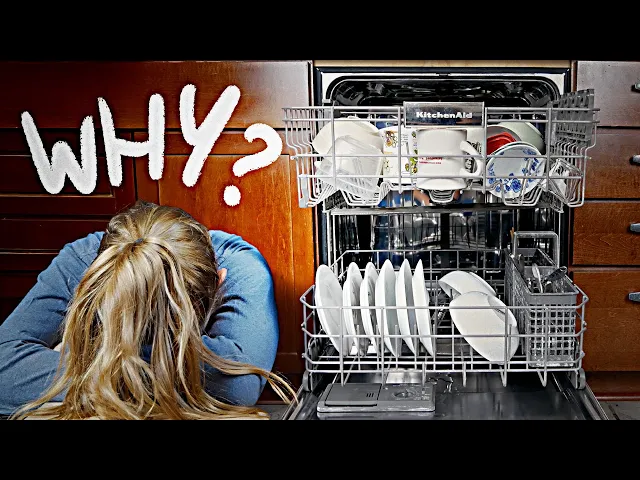
Yes, dishwashers ARE getting slower. Here's why.
MinuteFood
0:00 This video is sponsored by Squarespace.
0:03 In the time it takes my dishwasher [music] to run,
0:06 I could fly from Chicago to Atlanta or watch the entire
0:10 first [music] season of The Office or run a half marathon.
0:14 Okay, I couldn't, but the average actual runner [music] could,
0:17 but I could definitely wash those dishes myself in like a fraction of the time.
0:22 Dishwashers literally have one job.
0:24 [music] Why do they take so forking long to do it?
0:28 This is Minute Food and this is a new dishwasher.
0:31 We just upgraded from a 2015 model which took, let me see here,
0:36 about 110 minutes [music] to run, according to the manual.
0:39 So, my brand new dishwasher takes nearly
0:42 20% longer than its decade old counterpart.
0:45 I've heard other people complain about this [music] trend, too.
0:48 But we are a science channel.
0:49 We need cold, hard data.
0:51 So, I started digging and I found a graph of how
0:54 long it took dishwashers [music] on average to fully clean
0:57 and dry a load of dishes from 1983 to [music]
1:00 2018 based on data from my favorite appliance stalwart consumer reports.
1:06 [music] By the way, the facts and figures in this video are mostly US specific,
1:10 but similar things are happening in other places for similar reasons.
1:14 Okay, so according to this [music] data,
1:15 the average length of a US dishwasher's normal
1:18 cycle more than doubled over those 35 years.
1:21 [music] And today, normal cycles take on average more than 2 and 1/2 hours.
1:27 Some take as long as 4 hours.
1:29 So yeah, dishwashers are slower than they used to be.
1:32 Like [music] a lot.
1:34 But it turns out that's actually on purpose.
1:36 At least kind of.
1:37 And it has to do with how a dishwasher [music] works.
1:40 Well, how cleaning anything works really.
1:42 your dishes, your clothes, your dog, whatever.
1:45 [music] Back in 1959, a German chemist named Herbert S introduced the idea
1:50 that there are four main factors [music] that determine cleaning effectiveness.
1:55 Mechanical action like scrubbing or tumbling,
1:58 chemical action, that's like soap or detergents,
2:01 heat, that's I mean, you know, [music] and time.
2:04 He arranged these factors in a circle, now known as sinners [music] circle,
2:09 a wildly debaucherous name for something so squeaky clean.
2:13 Some newer sinner [music] circle diagrams
2:15 also include an additional factor of water,
2:17 which like sure to get a thing clean,
2:20 you need to fill this entire [music] circle,
2:22 but depending on what you're cleaning or how you're doing it,
2:26 you might need to tweak how much you rely on some factor,
2:29 like because your dog can't handle boiling hot water.
2:32 [music] And crap, you're almost out of shampoo, too.
2:35 So, to get your pup clean, to close the circle,
2:38 you're going to need to rely more heavily [music] on other factors.
2:41 Maybe more scrubbing or a longer bath.
2:44 Research suggests that these relationships aren't always perfectly proportional.
2:48 Like, decreasing one factor by 20% doesn't necessarily mean
2:51 you have to make up exactly [music] 20% elsewhere.
2:54 But sinner circles are a really good conceptual framework
2:57 to understand the basic trade-offs involved in cleaning pretty much anything.
3:01 [music] So, enough about dogs.
3:03 Let's look at dishes.
3:04 Modern home dishwashers work by filling up with some hot water.
3:08 That accounts [music] for the heat
3:09 and water sections of a dishwasher center circle,
3:12 then pumping that water through spinny things called spray arms,
3:15 [music] forcing crud off your dishes.
3:18 That's the mechanical action.
3:19 At some point, the detergent pops out and dissolves
3:21 [music] into the water that's getting sprayed around,
3:23 providing the chemical action.
3:25 This process [music] of filling, spraying,
3:27 and draining happens multiple times during a cycle
3:29 and is generally followed by a drying [music] period.
3:32 All that makes up the time section.
3:34 So, we have the entire circle accounted for.
3:37 But starting in 1987, federal regulations aimed [music] at conserving
3:41 resources and costs have repeatedly
3:44 limited how much water and energy home dishwashers can legally [music] use.
3:48 And a voluntary US program called Energy Star.
3:51 If you live in the US, you have almost certainly seen these labels
3:54 on appliances that promotes [music] even stricter efficiency standards.
3:58 So over time, manufacturers have been rejiggering [music] their dishwasher
4:02 center circles to reduce how much water and heat they use.
4:05 The heat section in a dishwasher is basically a proxy for energy
4:08 [music] because the vast majority of energy that a dishwasher uses,
4:12 as much as 90% goes toward heating up the [music] water.
4:16 But as we know, reducing those sections of the center circle means
4:19 that manufacturers need [music] to compensate
4:21 by increasing their reliance on the other factors, most noticeably time.
4:26 Put simply, cleaning dishes with less water at lower
4:29 temperatures is [music] just going to take longer.
4:32 You can see on this graph how each time
4:34 there's a new federal efficiency standard for [music] dishwashers,
4:37 the average cycle length increases.
4:40 But before you go and yell about how the government
4:43 and the tree [music] huggers are ruining your life, this isn't the whole story.
4:47 Because check out how the cycle length increases
4:49 even when no new standards have been introduced.
4:52 I mean, look at this huge increase without any government action at all.
4:56 Something else must also be driving cycles longer.
4:59 And one likely culprit is noise.
5:03 What?
5:04 Noise.
5:06 What?
5:04 Hang on.
5:05 The culprit is noise.
5:09 What?
5:09 Okay, while the noise inside a dishwasher from all
5:12 that [music] water spraying around can be weirdly relaxing,
5:16 we have an entire ASMR compilation over at our Patreon page.
5:20 From [music] the outside, dishwasher noise can be really annoying.
5:23 One study found that [music] sound was the second most important factor,
5:27 second only to price in people's dishwasher buying decisions.
5:30 [music] Better insulation can help reduce noise,
5:33 but in order to produce these super
5:35 quiet dishwashers that consumers [music] demand,
5:37 manufacturers have had to dial down all that spraying around,
5:41 which again means longer cycles.
5:44 People also want their dishwashers to, you [music] know,
5:46 actually wash dishes well.
5:48 And back in the day when cycles were shorter,
5:50 dishwashers [music] didn't get dishes all that clean.
5:53 I mean, in 1995, only 80% of dishwashers had
5:57 Consumer Reports [music] performance ratings of very good or better.
6:01 In other words, many dishwashers weren't
6:03 actually [music] closing their sinner circles.
6:05 Today's longer cycles are almost certainly helping close those circles.
6:09 [music] In part because more time simply helps dishes get cleaner,
6:12 and in part because modern enzymebased dish
6:15 detergent [music] takes a while to work.
6:17 These days, 99% of all models are rated [music] very good or better.
6:22 There are obviously other innovations out there, soil sensors,
6:25 better spray arms, clever rack designs
6:27 that have also helped improve performance.
6:29 But the point is that making dishwasher cycles longer is
6:32 a conscious trade-off to [music] not only save water and energy,
6:36 but also to help produce blissfully quiet,
6:39 high-erforming dishwashers that people actually want to own.
6:42 So based on the science,
6:44 it would be logical [music] for me to say something here like,
6:46 "So don't expect dishwasher cycle lengths
6:48 to decrease much anytime soon." But in 2020,
6:52 legislation created a new product class here in the US,
6:55 dishwashers with a normal cycle time of 1 hour or less.
7:00 The goal to, let me [music] get this right,
7:02 liberate dishwashers from federal efficiency mandates.
7:06 As an entirely different [music] class of appliances,
7:09 these dishwashers wouldn't have to abide
7:11 by the existing water and [music] energy standards and could therefore use more
7:14 and hotter water to wash dishes more quickly.
7:18 But uh almost every [music] dishwasher on the market today
7:22 already has a quick or speed cycle that does exactly this.
7:28 Mine only [music] takes an hour to wash and dry a full load.
7:31 Just like that entirely new class of dishwashers,
7:34 the fast [music] cycles on existing
7:36 dishwashers aren't beholden to federal efficiency standards.
7:39 Only the normal cycles [music] are.
7:41 But lots of people complain that these cycles don't work all that well.
7:44 And indeed, some are only recommended for lightly soiled dishes.
7:48 And that's because, [music] as we've talked about,
7:51 long cycles simply work better.
7:53 What's more, it turns out that people actually value efficiency.
7:57 Remember that survey where noise level ranked number
7:59 two as far as dishwasher [music] buying priorities.
8:02 Several measures of efficiency ranked high up there, too.
8:05 Way above a dishwasher's [music] cycle length.
8:08 All this is probably a big reason why, to my knowledge,
8:12 no dishwashers in this liberating new class have actually been manufactured,
8:16 much less sold in [music] the US since the legislation passed in 2020.
8:21 So, you know what?
8:22 I am going to go ahead and say [music] it.
8:24 Don't expect dishwasher cycle lengths to decrease much anytime soon.
8:28 Clever new innovations may incrementally [music] shorten cycles, but for now,
8:33 just enjoy your quiet, effective, and efficient cleaning machine.
8:38 I'm going to go for a run.
8:40 Well, hi, Ar.
8:43 I do I do a lot of things here at Minute Food.
8:46 I draw, I design, I code.
8:48 So, when Squarespace, the sponsor of this video,
8:50 asked if I wanted to try building a website with their [music] tools,
8:53 I was like, I don't need all that.
8:55 I already know how to build a website.
8:57 And they were like, "Come on, just try it." And oh my god, was my mind blown.
9:05 Look at this.
9:06 This would have taken me days of coding and tweaking and changing,
9:10 which you know can be fun.
9:12 Sure.
9:12 But between Squarespace's amazing design tools and templates,
9:15 which by the way have literally won awards,
9:17 [music] I was able to drag, drop, and whip this all up in no time.
9:21 Honestly, the entire team has had to put me on a leash
9:24 to prevent me from adding even more stuff to the website.
9:26 I could I could set up a secret exclusive garlic finale club if I wanted to.
9:30 Actually, you know what?
9:31 Screw it.
9:34 Boom.
9:34 We're making a super secret garlic thing.
9:36 And I just added a mailing list to the website
9:38 so you can stay garlic updated on it.
9:40 That was that was fast.
9:42 Honestly, take Squarespace for a spin with a free trial.
9:45 And when you're ready to launch,
9:46 head over to squarespace.com/minutfood [music] to get
9:50 10% off your first website or domain.
9:52 Okay, Argari out.