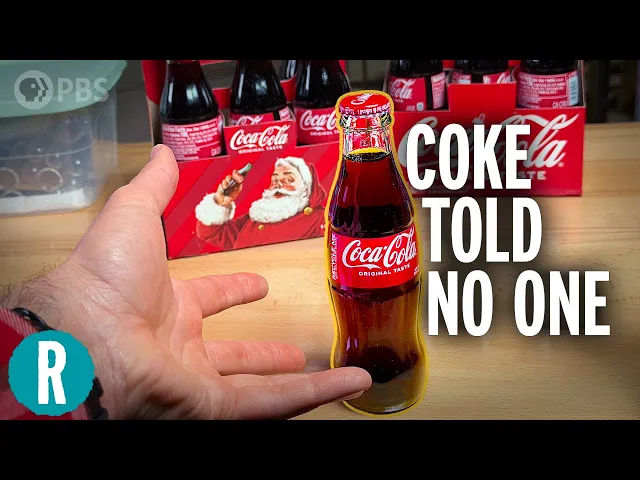
Coke Just Revolutionized Coke
Reactions
0:00 In my last video about Mexican Coke,
0:02 I made an incredibly bold claim: Mexican Coke is a lie.
0:05 This bottle that I tested at the beginning of the video contained,
0:08 from what I can tell, zero sucrose in it.
0:10 And that led me here, which led me here.
0:13 And I discovered something that Coke is doing that they haven't told anyone.
0:19 (mellow music) -This is the American Coke?
0:24 -Correct.
0:24 Okay.
0:25 That's not what I expected to see.
0:27 And Coke is not telling anyone about this.
0:29 They're keeping it as secret as the federal government will let them.
0:33 It doesn't even say it anywhere.
0:35 It says, yeah, it says...
0:35 In my first video, I tested Mexican Coke with a blood
0:39 glucose meter and a more than century-old chemical reaction.
0:43 And based on those results, I claimed that Mexican Coke has no actual sucrose,
0:48 also known as sugar, in the bottle,
0:51 despite saying cane sugar right here on the label.
0:53 That was an aggressive claim,
0:55 especially because I never actually measured the sucrose.
0:59 I only measured glucose.
1:01 So two chemistry professors decided to call me on it.
1:04 This is Jeb and John.
1:06 They're both professors at Shippensburg University.
1:08 And what they did is they hired an undergrad,
1:10 this is Rebekah, to attempt to replicate my results.
1:14 She used this machine.
1:15 It's a high-performance liquid chromatograph.
1:17 Everyone in chemistry just calls it an HPLC.
1:20 Rebekah bought several samples each of Mexican and American Coke.
1:23 She sonicated them to get rid of all the carbonation,
1:25 and then she filtered them, and then she ran them on the HPLC.
1:29 The data this machine spits out looks like this.
1:32 It's called a chromatogram.
1:33 The x-axis is time and the y-axis is millivolts,
1:37 but you can just think of it as concentration.
1:39 Now, each of these peaks that you're seeing represents a single chemical.
1:44 And you know which peak is which because before you ran your actual samples,
1:47 you ran pure compounds, and you saw how long each of those took to elute.
1:51 Elute, that's a good word.
1:54 And the area under each peak is proportional
1:56 to the amount of each of those chemicals.
1:59 With the same amount of sucrose, glucose, and fructose,
2:01 the sucrose peak would be visibly larger- -I see.
2:04 -than a glucose peak.
2:05 And the glucose peak would be visibly larger than the fructose peak.
2:08 [George] Now, in my creepy basement,
2:09 the best I could do was to sort of semiquantitatively measure only glucose.
2:13 But this HPLC can measure all three sugars
2:16 at the same time with much higher precision and accuracy.
2:20 Now, look at these two chromatograms.
2:22 One of them is American Coke and the other is Mexican Coke.
2:25 And if you wanna pause the video here and guess which is which,
2:28 please do that right now, because I'm about to tell you that the one
2:31 with the larger fructose peak is the American Coke,
2:34 which makes sense because it's sweetened with high-fructose corn syrup.
2:38 In other words, corn syrup that has more fructose than glucose.
2:40 So you would expect a larger fructose peak.
2:43 Black line is Mexican Coke and pink line is American Coke.
2:47 [Rebekah] Yes.
2:48 Nailed it.
2:49 Now, this is the Mexican Coke, and as you can see,
2:50 the fructose and glucose peaks are basically equal in size, more or less,
2:54 because all the sugar in the Mexican Coke started out as sucrose,
2:59 which is one unit of glucose bonded to one unit of fructose,
3:03 so you get equal amounts of fructose and glucose.
3:06 The bottles of Mexican Coke that Rebekah tested had
3:10 on average 2.8 grams per liter of sucrose left in them.
3:14 So in these bottles of Mexican Coke,
3:17 97% of the cane sugar had been destroyed by the acid.
3:22 In other words, in my first video,
3:25 I was 97% right, which I'll take, I'll take that.
3:28 The next interesting question is how long does
3:31 it take for 97% of the sucrose to disappear?
3:34 And does that mean that any bottle of Mexican
3:36 Coke you buy will have no sucrose in it?
3:39 Now, to really answer this question,
3:40 you need a bottle of Mexican Coke in which the reaction hasn't started yet.
3:43 You need freshly bottled Mexican Coke.
3:45 That's a problem, because if Mexican Coke really and truly is made in Mexico,
3:49 then it would take at least a few days to get up here to Pennsylvania,
3:52 by which time it might be too late to get the measurements you need.
3:56 So the team found a local soda company,
3:58 Reading Soda Works, that was about an hour away.
4:01 And they bought a bottle of freshly bottled
4:03 sarsaparilla soda that was sweetened with cane sugar,
4:06 and they ran it on the HPLC.
4:09 And they were doing this as a baseline,
4:10 basically to figure out how much sucrose had been hydrolyzed.
4:14 And they found that basically none of it had: none of it.
4:18 So they tested the pH of the sarsaparilla soda,
4:21 and they found that it was about 4.6.
4:23 That is 1.85 units higher than Mexican Coke, which is way down at 2.75.
4:29 So that means that Mexican Coke has almost
4:31 100 times more acid than the sarsaparilla soda.
4:37 Hang on.
4:37 Is that right?
4:38 I think that's right,
4:39 'cause you do 10 to the 4.6 or 10 to the minus 4.6 or something?
4:44 Sorry, 71 times more acid than the sarsaparilla soda.
4:47 Okay, it's not a hundred.
4:48 So then the team did something that I think is super clever.
4:53 They took this sarsaparilla soda and they added hydrochloric acid
4:57 to it to get it down to a pH of 2.75;
5:01 in other words, matching the pH of the Mexican Coke.
5:04 And then they split it up into three batches
5:07 and they stored it at three different temperatures: three Celsius,
5:10 which is about the temperature of your fridge; 22 Celsius,
5:13 which is roughly room temperature; and 39 Celsius,
5:16 the temperature of a hot summer day.
5:18 And they followed all three batches for three weeks.
5:22 And after just 14 days at 39 Celsius, all the sucrose was gone.
5:30 All of it, even at room temperature.
5:33 After just three weeks, that's an additional one week,
5:36 almost half the sucrose had hydrolyzed.
5:40 This is not the shocking thing that Coke is doing,
5:42 but it did make me wonder if the Mexican Coke you
5:45 buy at the store contains a 50/50 mixture of fructose and glucose,
5:50 and the American Coke you buy at the store contains
5:52 those same two sugars but in a slightly different proportion,
5:57 55 and 42%, is this very subtle difference really what
6:01 people are tasting when they distinguish between American and Mexican Coke?
6:06 This was a big question in my first video.
6:09 Now, I had a hunch that the answer was no.
6:11 So I brought a sample of pure high-fructose corn
6:14 syrup to Jeb and John's lab, and we ran it.
6:17 Look at this chromatogram.
6:18 All right, so these are the fructose and glucose peaks.
6:21 They are, as you'd expect, the fructose peak is higher,
6:23 and this right here is a little tiny sucrose peak.
6:26 But what is this?
6:29 This small peak at 5.825 minutes.
6:33 Now, as soon as we saw this, we went back
6:35 and looked carefully at the chromatograms of Mexican Coke and American Coke,
6:39 and we confirmed that, yeah,
6:41 this tiny little peak is present in American Coke but not in Mexican Coke.
6:49 So my interpretation of this is that there is something,
6:52 probably a sugar, in American Coke that is not present in Mexican Coke.
6:58 [Jeb] Yeah.
6:59 Now, the The amount isn't large, but it's detectable.
7:03 But like this is at a concentration
7:05 that is well above taste thresholds, like- -Probably.
7:08 -Depending on what this is and what the actual taste threshold is,
7:12 you could probably taste this.
7:14 -Possibly.
7:15 -Possibly.
7:16 Back in 2014, during the initial Mexican Coke wars,
7:20 a group of scientists from the International
7:23 Society of Beverage Technologists published this paper:
7:26 and this paper contains a chromatogram
7:28 of a soft drink sweetened with high-fructose corn syrup.
7:32 And there are actually multiple peaks that come off before the glucose,
7:36 which they identify as maltose, maltotriose, and maltotetraose.
7:41 Now, those are fancy names; all they are is two,
7:43 three, and four glucose subunits joined together respectively.
7:47 Now, it's possible that this peak right
7:50 here that we found in our high-fructose corn
7:52 syrup is maltose or maltotetraose or even
7:56 a mixture of all of these glucose oligomers, or some other higher-order sugar.
8:01 In my last video about Coke, I glibly dismissed the idea that anyone
8:06 could taste the difference between sugars.
8:08 But what about everybody who claims they can specifically taste
8:11 the difference between cane sugar and high-fructose corn syrup in a soda?
8:15 Those people are just wrong.
8:17 Yeah, it turns out I might be wrong (laughs).
8:20 Yeah.
8:21 Here's the deal.
8:22 We are gonna run a taste test in this video that will help answer that question,
8:26 a taste test that it would not have been possible for anyone to run before now.
8:33 The night before we got to Shippensburg,
8:35 Jeb found this bottle in a store in Mechanicsburg, Pennsylvania.
8:40 This is a holiday-edition American Coke, except it's made with cane sugar.
8:45 This is the holy grail.
8:47 It's the thing that started the Coke wars.
8:49 It's American Coke with cane sugar and no other differences.
8:54 It's not Mexican Coke with this double the sodium and who knows whatever else.
8:58 Obviously, Jeb bought a couple of bottles,
9:01 and we immediately threw it on the HPLC.
9:03 Now, we were all expecting to see
9:05 basically the same chromatogram as Mexican Coke:
9:07 complete inversion, complete hydrolysis of the sucrose.
9:11 But that is not what we saw.
9:12 Look at this massive sucrose peak.
9:14 There is still roughly 64 grams per liter
9:18 of the original cane sugar left in this bottle.
9:21 And so now we have to rewrite this whole video.
9:24 From a sugar standpoint, this Coke is nothing like Mexican Coke.
9:28 So either this is not very old or it was kept at a very cold temperature.
9:33 Yeah.
9:35 I can actually do the math, if you want me to.
9:37 Yeah, let's do the math.
9:38 So based...
9:40 -Oh, I'll be back.
9:41 -Okay.
9:41 Yeah, I'll be back.
9:42 Yeah.
9:42 That's the best kind of math, when somebody else does it for you (laughs).
9:47 What I get, based off the idea that it
9:48 was stored at room temperature the whole entire time,
9:50 was that it was only bottled 21 days ago.
9:53 They could market this as different.
9:55 Because if I were to consume this versus a regular American Coke,
9:58 I would've had a different sugar profile experience.
10:02 You know what I mean?
10:03 Coke did something very special here.
10:05 They gave us a soda that has the low pH that we've come to expect from Coke,
10:09 gives us the bite and the burn,
10:10 but it also has most of the intact cane sugar left in the bottle.
10:17 It's mostly a cane sugar soda.
10:22 Coke has not done this before.
10:24 This is an achievement.
10:28 And who did they tell about this achievement?
10:31 No one!
10:36 They didn't tell anyone.
10:37 It doesn't even say it anywhere.
10:38 Yeah, you have to look to find that it's cane sugar.
10:42 That's mine.
10:42 Look, nowhere on this bottle does it say cane sugar or real sugar or any
10:48 of the other marketing terms that other
10:51 companies fall all over themselves to tell you.
10:53 The only place on the entire packaging where you
10:57 will see cane sugar is in the ingredients label,
11:00 which Coke is required by law to disclose.
11:04 This is the Coke that allows us to run a taste
11:07 test that we have never been able to run before,
11:09 which is American Coke with cane sugar
11:13 versus American Coke with high-fructose corn syrup.
11:18 Can people taste the difference?
11:21 At the same time, I was also struggling to figure out what is Coke up to here?
11:26 Have they lost their minds?
11:29 Do they know something we don't know?
11:32 And I don't know anything about marketing,
11:36 economics, companies, or really capitalism,
11:38 so I found some people who know more about economics than I do.
11:41 Let's go.
11:42 I broke into NPR headquarters and tracked down two of the hosts
11:45 of "Planet Money." Could I have you guys close your eyes?
11:47 -Sure.
11:47 -We did some taste tests.
11:49 -Taste all three.
11:50 -Okay.
11:50 Think about whether or not one of them is different from the other two,
11:55 and if so, which one?
11:56 Okay.
11:57 I think number three is different.
11:58 -Vote locked.
11:59 -(buzzer beeping) It's maybe a little less sweet, -number three.
12:01 -I agree.
12:02 No, no.
12:02 Maybe one.
12:03 -One.
12:03 I think one is...
12:04 -(buzzer beeping) -Oh my God.
12:05 -Oh my God.
12:06 Maybe one and two are less sweet and three is sweeter.
12:09 Okay.
12:10 Three is sweeter.
12:10 Jeff's now named all of them.
12:12 [George] And they disabused me of some of my conspiratorial thinking.
12:15 What better marketing than the president of the United States saying,
12:18 "Go buy some cane sugar Coke." Yeah.
12:21 Yeah.
12:21 And that feels a lot less conspiracy theory and more like what
12:24 a company would try and do if they were on their game.
12:27 A rapacious, profit-maximizing company that wants
12:30 to sell as much sugar water as possible.
12:32 Yes, exactly.
12:33 US cane sugar prices are just artificially high.
12:37 You could always count on cane sugar being more expensive, to some degree.
12:40 And so high-fructose corn syrup could sort of always sneak
12:43 in under The amount of sugar in a can of Coke,
12:46 if it's high-fructose corn syrup, it costs wholesale maybe 4 cents.
12:50 You're looking at 4 cents of sugar.
12:51 Wow.
12:52 Okay, that's lower than I expected.
12:55 And if that were cane sugar,
12:56 at the current spot price, that would be 4.70 cents.
13:01 And then multiplied by however many bajillion cans that Coke sells,
13:05 like, it makes a difference.
13:07 And then I wanted to see if they could taste
13:09 the difference between cane sugar and high-fructose corn syrup in American Coke.
13:13 So now we are tasting Coca-Cola products.
13:16 I think they're all the same, George.
13:17 -(buzzer beeping) -Take a bunch of...
13:18 Number one is sweeter to me.
13:20 -Okay.
13:21 -Well, okay.
13:21 He had a one in three chance of getting it right.
13:23 No, no, you have to test Kenny again right now and see if he can replicate.
13:27 Absolutely not.
13:27 I refuse.
13:28 [George] So we tested Kenny again.
13:31 Oh no.
13:32 I think this was the cane sugar.
13:33 -Nailed it.
13:33 You're right.
13:34 -(gasps) What?
13:35 You nailed it.
13:36 Kenny, are you a supertaster?
13:38 -Maybe.
13:38 -And we tested Kenny again.
13:40 I think it's this one.
13:41 -So you're actually wrong.
13:42 -(buzzer beeping) -It was the middle one.
13:43 -No!
13:43 -No!
13:44 -Yeah.
13:44 -I'm not a super– -Nooooo.
13:46 That was a fluke.
13:47 That was a fluke.
13:47 I don't think so.
13:48 I think it's really hard to tell the difference.
13:50 And yes, obviously, Jeff and Kenny are
13:52 very far from making a statistically significant sample.
13:55 But this is what I think of these very limited results.
13:58 Jeff and I got it wrong.
14:00 I think the one to my furthest left is cane sugar,
14:03 and the other two are high-fructose corn syrup.
14:05 -No.
14:05 -(buzzer beeping) [George] Kenny tried it three times and got it right twice.
14:09 Should I quit this job and go become a sommelier?
14:11 [George] So maybe there are some people
14:13 whose taste buds really can detect this difference.
14:16 And maybe all of them commented on my last video.