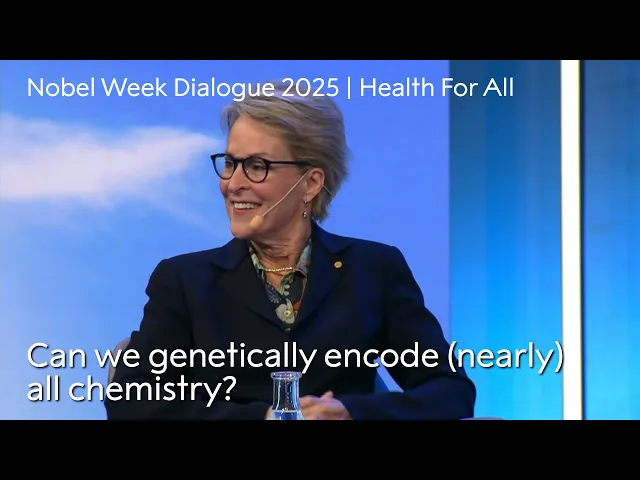
Can we genetically encode nearly all chemistry? | Nobel Week Dialogue 2025 | Health For All
Nobel Prize
0:00 Thanks to the excellent Swedish train system,
0:03 I was able to just walk on stage here and um tell you about chemistry.
0:08 Yay chemistry, right?
0:10 And I have three brilliant students who apparently I
0:13 just met them cover the whole gamut of chemistry.
0:17 But I want to introduce an idea that I'm having a lot
0:20 of fun with these days and it is provocative because I'd like to replace
0:24 all chemists with microbes because they truly are the best chemists
0:29 on the planet thanks to these remarkable
0:32 molecular machines that they have called enzymes.
0:35 And I've been playing with enzymes for a really long time trying to get them
0:40 to do new things that serve human
0:43 beings rather than the organisms that make them.
0:46 Now, enzymes, of course, like all proteins are encoded in DNA.
0:53 And they're the products of this incredible process called evolution.
0:59 Enzymes were made by evolution and it's really
1:03 powerful process to make yet more new ones.
1:08 There's no reason that evolution would have stopped.
1:11 And you know, so I I'm trained as an engineer.
1:14 Actually, I'm not a chemist and the chemists love to tell me that.
1:19 [snorts]
1:18 But as an engineer, we looked at the most powerful design process that was
1:24 ever developed that works from molecules all
1:26 the way to ecosystems and that's called evolution.
1:30 Now, um because proteins are the products
1:35 of this simple algorithmic design process.
1:38 You turn the crank of mutation and natural selection.
1:42 It means that they can be evolved further through this process.
1:46 And that's really unlike any other human engineered system.
1:51 I mean, think about it.
1:52 Materials, uh elevators, buildings, automobiles,
1:57 these are not the products of mutation and natural selection.
2:01 Although sometimes it may seem to be that.
2:04 And so that means that there are very
2:06 special properties in the genetic encoding of new things.
2:11 Now, uh of course, I won the Nobel Prize for figuring out
2:14 a long time ago that you can evolve and artificially select new
2:19 enzymes that do very strange new things pretty much the same way
2:23 that human beings have been evolving hairless cats and corn and cattle.
2:29 We've been making things that are not
2:31 really biologically fit but that serve our purposes.
2:34 You can do the same thing with enzymes.
2:37 But now what's happened?
2:38 So can those enzymes are amazing, right?
2:41 And we can use this relatively laborious process to make new ones.
2:46 I want to replace that and I want to use the new tools of machine
2:51 learning and uh artificial and generative artificial
2:54 intelligence because if you think about evolution,
2:57 it's very much like active learning in a machine learning algorithm.
3:01 And we take lots of data during directed
3:05 evolution because we have to screen for new things.
3:07 We throw those data into building models that then
3:11 tell us which next generation to go for improvement.
3:16 And then the great thing that happened in the last
3:19 5 years is generative AI AI which can take all
3:23 this marvelous data that are in the databases of protein
3:27 sequences and use that to help us build completely new ones.
3:33 It's still hard to do that but if you connect
3:36 uh if you connect this ability to generate new enzymes,
3:41 you know, crazy enzymes that do chemistry you can't find
3:44 in the biological world but we can start to generate those.
3:47 You connect that to optimization by evolution,
3:51 you should be able to with now robotic tools
3:55 in the next few years just push a button.
3:58 Push a button and genetically encode virtually any chemistry.
4:04 Bringing me closer to the idea of replacing chemists with microbes.
4:09 So I I want to know what you think of that proposal
4:14 and whether that would help you in any of the research you're doing, right?
4:17 Because you're doing chemistry.
4:19 Could I replace you with microbes?
4:24 [laughter] Yes, okay.
4:29 But when you say um that you can technically encode all of chemistry,
4:36 do you really mean that you can actually
4:38 do anything or are there any limitations to that?
4:42 [laughter]
4:42 Boy, I get the hard ones here.
4:44 Well, of course, we um we exaggerate to make the statement.
4:47 That's why I said nearly all of chemistry because what
4:51 are the limitations of using biological biology to make things?
4:55 You're working in water primarily, a medium of water.
4:59 It's biologically relevant but may not be relevant for making,
5:03 you know, fuels, for example.
5:05 Might be hard to make some things in water.
5:08 Uh in inorganic chemistry,
5:10 you're you're I know you're working with some surfaces
5:13 that we would not call easily accessible to enzymes.
5:17 So those are some of the detailed limitations I would say uh to this idea.
5:24 Maybe I should just say virtually any organic chemistry but that's
5:27 not true either because we made the first carbon-silicon bonds.
5:31 And you know, we're starting to add new elements
5:34 to the catalytic uh to the to the periodic table of biology.
5:42 Could I do Do you use enzymes in your work?
5:46 Uh no, but I I guess there could definitely be a possibility of doing that.
5:52 Uh my main work focuses on developing
5:54 new materials that have antibiotic or antimicrobial properties.
5:59 So fighting bio um bacterial infections without actually having
6:04 to use antibiotics or having to use as much antibiotic.
6:08 And uh Yeah, so it would definitely be a possibility of using
6:13 enzymes in that even though we haven't really considered it today.
6:17 Well, if in fact, if you're trying to replace
6:20 chemical antibiotics with these new materials that you're making,
6:24 you're you're working towards reducing resistance
6:27 that comes out of evolution of enzymes, right?
6:30 Because nature's nature solves the problem
6:34 that you pose with your new antibiotic.
6:36 She just finds a mutation in the enzymes that choose
6:39 up the antibiotic and you're back to ground zero.
6:42 So maybe those surfaces then would be
6:45 less attractive to evolution to find solutions.
6:50 So you're fighting enzymes.
6:54 [laughter] Okay.
6:53 You can say it that way.
6:57 Do you see any any potential risks with do you sing a lot of AI in research?
7:05 Like risk losing potentially this trial and error process
7:10 that has been important for a lot of discoveries.
7:15 Oh, I love that question.
7:18 One of the beauties of just doing things randomly.
7:22 I mean, people told me that's not science
7:24 but one of the beauties of doing things randomly,
7:27 making random changes and then seeing how the system which changes
7:34 are beneficial is that you actually learn something you didn't already know.
7:39 If you sit down and design, you're just using what you already know.
7:42 So yes, I see that um losing that randomness
7:48 is you could send you in the wrong direction.
7:51 But the the benefit, of course,
7:55 of losing the randomness is that you can save a lot of time because
7:59 there's so many ways that evolution could
8:02 go and most of those are totally useless.
8:05 If using data sends you in the right direction,
8:09 you might miss out on some great opportunities but you might find
8:12 some pretty good opportunities and save a lot of time doing that.
8:19 But I love random.
8:22 [laughter] [sighs and gasps] Do you see any way to use generative
8:26 AI to speed up this evolution of the enzymes?
8:29 Because the limiting factor will be the actual generation of the enzymes, right?
8:33 The mutations themselves.
8:35 So how do you see incorporating AI to speed up this process?
8:40 What's happening is it it it's really incredibly exciting
8:44 is that we have all these tools for taking You
8:49 can type out any sequence of DNA you want
8:51 and you get the physical DNA back in the mail.
8:54 We couldn't even dream of that when I was a student.
8:58 But now, as long as you can compose it with AI or evolution or however it is,
9:05 you can actually test those things.
9:08 Um and and so you're right.
9:10 The the rate-limiting step is where do you get started?
9:15 That's the hard thing.
9:16 If you want to genetically encode chemistry that biology has never seen before,
9:22 we have to know something about
9:24 that in order to get started using generative AI.
9:27 But that's last year's Nobel Prize to David Baker was for technology that can
9:32 really make some bad enzymes but good
9:36 enough where where evolution could take over.
9:41 And that's really all you need is a starting point.
9:43 And the other power, Jasper, is that there's so much data available now.
9:49 50, 60 years of sequencing DNA
9:52 from the biological world all deposited in databases.
9:56 We're learning how to use that.
9:59 And of course, high throughput experimentation.
10:02 Do any of you want to incorporate machine learning in your experiments?
10:08 Do you see opportunities for that?
10:10 If not enzymes, how about the these new technologies?
10:16 Yeah, I think for me working in analytical analytical chemistry,
10:23 we do see a trend where AI is becoming more
10:27 and more useful and something that I'm considering like also getting into.
10:34 But that leads me on to a question
10:37 that I have cuz directed evolution of enzymes,
10:42 it spans many different like fields.
10:47 And sometimes like a success to creativity seems
10:51 to be to cultivate an interest in many areas.
10:56 So, but like do you see any risks with this being like
11:05 this expert's dilemma kind of being in many different uh fields not being
11:12 like fully the the expert deep expert but maybe being knowledgeable in a lot
11:19 of things and like can you connect that to like AI also?
11:27 Right, I should be replaced by AI.
11:30 I'm not expert in anything but know how to pull information from lots of places.
11:35 AI's pretty good of that at that and maybe I'll be be replaced.
11:42 [laughter] If not by enzymes, by AI.
11:44 Well, of course we need both.
11:46 We need experts who have deep foundational knowledge in a in a particular area.
11:52 But I've seen that the biggest opportunities for science lie at the interfaces.
11:58 And and of course, that's my experience being
12:01 an engineer and seeing a problem in chemistry
12:04 and having a lab next to molecular biologists in the late in the early 1980s,
12:10 I could put together this optimization I knew
12:13 from engineering with molecular biology to solve chemical problems.
12:18 And of course, everybody thought that that was just
12:21 nuts to do that because it wasn't you know,
12:25 it was so outside of what people were doing deeply in each field.
12:32 But and you know, after 30 years of applications,
12:35 it actually has proven to be very useful.
12:39 But I couldn't have done that, right?
12:41 Without collaborating with the domain experts.
12:46 So, it really depends on who you want to be.
12:48 Do you want to be that person that bridges sciences?
12:52 Or do you want to be that person who really develops
12:55 the deep knowledge and the tools you need for example to diagnose cancer.
13:02 You need a lot of novel tools to do that for the work that you do.
13:07 Where do you want to be?
13:10 [laughter] Yeah, that's that's like a constant struggle.
13:13 There are so many interesting things that you can get into.
13:17 But you also don't want to lose like
13:20 credibility in the separate fields because they're too broad.
13:26 So like navigating that.
13:29 Credibility is something I never worried about.
13:34 [laughter] In the sense that I didn't care if people said, "Oh, well,
13:37 she doesn't know any chemistry." It just went in this ear
13:39 and out that ear and served me well not to know too much.
13:43 I think you can actually know too much
13:46 that you talk yourself out of doing crazy things.
13:50 Sometimes ignorance is bliss.
13:52 Now, ignorance is not always a good excuse.
13:56 But sometimes it works pretty well because you
13:59 can take a very different approach to solving
14:01 a problem if you know all the if you don't know all the ways it can't be done.
14:07 Yeah.
14:08 [clears throat] Okay, we talked a lot about AI and the possibilities with AI.
14:14 But there is also a lot of talk about the dangers with AI.
14:18 Do you have anything to say about that and in related
14:20 to your field since you're using a lot of AI?
14:23 So, that's a very good question um and it I could go into it for some length,
14:29 but I'll just point out yes, we evolve DNA to do new things.
14:34 And a lot of people find that nerve-racking and potentially dangerous.
14:40 But I'll just point out that human beings have been evolving
14:43 DNA for as long as we've been on the planet, right?
14:46 And every time you wash your hands with antibiotic soap,
14:49 you're leading to evolution of antibiotic resistance.
14:53 And when we put pesticides on the planet, we're leading to you know,
14:57 evolution of pesticide resistance and it and every
15:01 time we choose to breed hairless cats, we're evolving things.
15:07 So, we've had at our hands a lot of powerful tools.
15:10 And the real question is you know, do the benefits that you get
15:14 from this really clean chemistry that biology can do,
15:17 do those benefits greatly outweigh the potential risks?
15:26 Do you see the field of research in general evolving
15:29 into a state where a certain type of research conducted completely by AI,
15:33 whereas more optimization is done by humans?
15:37 So, that's a very good ending question, right?
15:41 [laughter and snorts]
15:41 Will we develop ourselves to where we don't need scientists anymore?
15:47 [snorts] Um I know some people who think that that's largely the case.
15:51 I don't believe it for a minute because we'll
15:53 just go on to ask even more interesting questions.
15:57 And I think we'll just continue to push the frontiers
16:00 and I haven't seen any asymptoting towards not needing scientists.
16:06 [laughter] I thought is time up?
16:14 Yeah, I think so.
16:16 [laughter] Okay.
16:18 [applause] [applause]