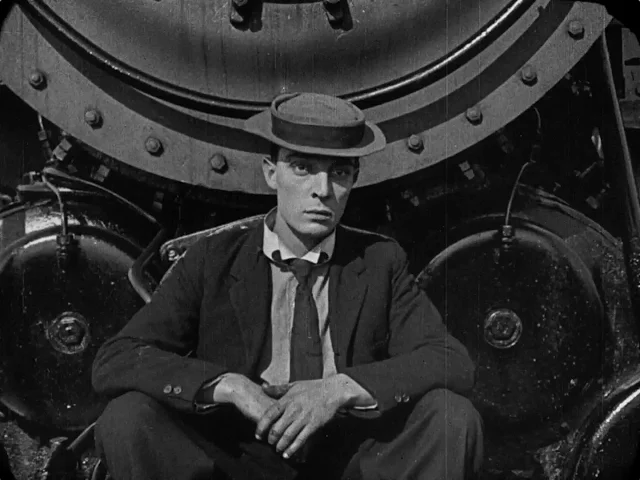
Buster Keaton - The Art of the Gag
Every Frame a Painting
0:03 Hi my name is Tony and this is Every Frame a Painting.
0:08 There are some filmmakers who are so influential that no matter where you look,
0:12 you see traces of them everywhere.
0:16 I see this filmmaker's framing in the works of Wes Anderson.
0:23 His acrobatics and stunts in Jackie Chan.
0:28 And his deadpan posture in Bill Murray.
0:34 He, of course, is Buster Keaton,
0:36 one of the three great silent comedians "He was,
0:39 as we’re now beginning to realize...
0:42 ...the greatest of all the clowns in the history of the cinema." And nearly
0:48 a hundred years later I think he still
0:50 has plenty to teach us about visual comedy.
0:52 So today, let’s take a look at how the master builds a gag.
0:56 Ready?
1:00 Let's go.
1:07 The first thing you need to know about visual comedy
1:10 is that you have to tell your story through action.
1:12 Keaton was a visual storyteller and he never liked it
1:15 when other directors told their story through the title cards.
1:18 -"The average picture used 240 titles...
1:21 "...that was about the average." -"240 was the average?" -"Yes.
1:25 And the most I ever used was 56" He
1:28 avoided title cards by focusing on gesture and pantomime.
1:31 In this shot, you never find out what these two are talking about.
1:34 Everything you need to know is conveyed through the table&
1:37 their body language "But what you had to say...
1:40 "You had to communicate to the audience
1:42 in only one way..." -"Through action" -"Right.
1:47 We eliminated subtitles..." "...just as fast as we could if we could possibly
1:50 tell it in action" Keaton believed that each gesture you did should be unique.
1:55 Never do the same thing twice.
2:00 Every single fall...
2:02 is an opportunity… for creativity.
2:08 But once you know the action we come to the second problem:
2:11 Where do you put the camera?
2:18 Visual gags generally work best from one particular angle.
2:22 And if you change the angle...
2:24 then you’re changing the gag and it might not work as well.
2:27 Finding the right angle is a matter of trial and error.
2:30 So let’s take a look at two possible camera placements for the same joke.
2:33 Here’s the first one.
2:42 And here’s the second.
2:52 You’ll notice in first angle, the car takes up most of the frame and we
2:55 don’t get a clear look at Buster until he turns around.
2:58 But in the second angle,
2:59 the car’s placed in the background and we always have a clear view of his face.
3:04 This split second, where he doesn’t know what’s happening but we do...
3:07 ...that’s much better from over here.
3:10 And in the first angle, the framing splits our attention.
3:13 Our eyes want to look at his face and the sign at the same time.
3:17 But after reframing the scene...
3:19 Our eyes naturally look at him...
3:21 then the sign then back to him.
3:24 Much better.
3:28 Now we come to the third question...
3:31 What are the rules of this particular world?
3:35 Buster’s world is flat and governed by one law.
3:43 If the camera can’t see it, then the characters can’t see it either.
3:47 In Buster’s world, the characters are limited by the sides
3:48 of the frame and by what’s visible to us, the audience.
3:53 And this allows him to do jokes that make sense visually but not logically.
4:00 A lot of his gags are about human movement in the flat world.
4:03 He can go to the right...
4:05 to the left...
4:07 up...
4:09 down...
4:11 away from the lens...
4:13 or towards it.
4:15 Look familiar?
4:16 -"She’s been murdered.
4:17 And you think I did it." -"Hey!" Like Wes Anderson,
4:25 Buster Keaton found humor in geometry.
4:31 He often placed the camera further back so you could see the shape of a joke.
4:34 There are circles...
4:37 triangles...
4:39 parallel lines...
4:40 and of course, the shape of the frame itself: the rectangle.
4:45 I think staging like this is great because it encourages the audience
4:49 to look around the frame and see the humor for themselves.
4:53 In this shot, think about where your eyes are looking.
4:59 Now where’s he?
5:02 Some of these gags have their roots in vaudeville
5:04 and are designed to play like magic tricks.
5:11 And like all great magic tricks part of the fun
5:14 is trying to guess how it was done.
5:19 Keaton had a name for gags like these.
5:21 He called them “impossible gags.” They're some
5:26 of his most inventive and surreal jokes.
5:30 But as a storyteller,
5:31 he found them tricky because they broke the rules of his world.
5:34 -"We had to stop doing impossible gags,
5:37 what we call cartoon gags." -"We lost all of that when we started making
5:42 feature pictures." -"They had to be believable
5:45 or your story wouldn’t hold up." So instead,
5:48 he focused on what he called the natural gag.
5:52 The joke that emerges organically from the character and the situation.
5:56 Consider what he does with this door.
6:04 Keaton claimed that for visual comedy...
6:05 you had to keep yourself open to improvisation.
6:08 -"How much of it was planned and how much
6:10 came out in the actual doing?" -"How much was improvised,
6:13 you know?" -"Well as a rule,
6:15 about 50 percent…" -"...you have in your mind before you
6:19 start the picture..." -"...and the rest you develop as you’re
6:22 making it." Sometimes he would find a joke he liked
6:25 so much that he would do a callback to it later.
6:30 But other times, jokes that he’d planned beforehand wouldn’t work on the day.
6:33 So he would just get rid of them...
6:36 -"...because they don’t stand up and they don’t work well." -"And then
6:39 the accidental ones come." He was supposed to make this jump.
6:43 But since he missed...
6:45 He decided to keep the mistake and build on it.
6:49 -"So you seldom got a scene like that good
6:51 the second time." -"You generally got em that first one."
6:54 -"Maybe that’s one of the reasons..." -"...there was so
6:56 much laughter in the house the other night." -"I mean,
6:59 the younger people and I had this feeling..." -"...that what we were
7:01 seeing was happening now." -"That it had happened only once..." -"...It was
7:07 not something that was pre-done and done and done." And that brings
7:10 us to the last thing about Buster Keaton and his most famous rule.
7:16 Never fake a gag.
7:18 For Keaton, there was only one way to convince the audience...
7:21 ...that what they were seeing was real.
7:23 He had to actually do it… ...without cutting.
7:29 He was so strict about this that he once said...
7:32 “Either we get this in one shot… ...or we throw out
7:39 the gag." And it’s why he remains vital nearly 100 years later.
7:43 Not just for his skill but for his integrity.
7:46 That’s really him.
7:50 And no advancement in technology can mimic this.
7:53 Even now, we’re amazed when filmmakers actually do it for real.
7:57 But I think he did it better 95 years ago.
8:01 So no matter how many times...
8:02 you’ve seen someone else pay homage to him… Nothing beats the real thing.