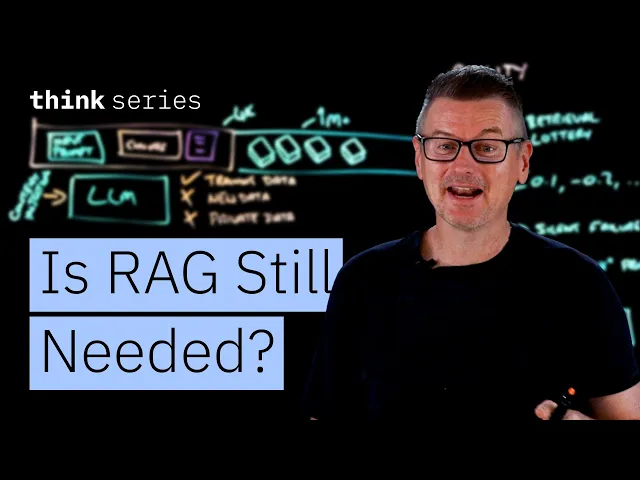
Is RAG Still Needed? Choosing the Best Approach for LLMs
IBM Technology
0:00 There's a fundamental truth about LLMs, large language models.
0:05 They are frozen in time.
0:09 They know everything about our world up
0:12 until their training cutoff date and absolutely
0:16 nothing about what happened 5 minutes ago.
0:18 Nor do they know anything about your private data,
0:21 your internal wikis, your proprietary codebase.
0:23 And if we do want an LLM to know any of that stuff,
0:28 well, we have to solve the problem of context injection.
0:32 How do we get the right data into the
0:36 model at the right time?
0:37 And there have been two very different ways to handle this.
0:42 Now, the first is really what we can think of as the engineering approach.
0:49 It's RAG, retrieval augmented generation.
0:52 So here we've got an LLM and we've also got an input prompt from the user.
0:59 Now ahead of time
1:01 we take some of the documents that we want to give to this LLM.
1:06 So these are documents that could be
1:09 PDFs or code files or entire books and we chunk them.
1:14 We break them up into smaller chunks and
1:19 we pass them through to an embedding model and
1:23 the embedding model takes those chunks and it
1:27 turns them into vectors and those vectors are
1:32 then stored in a dedicated vector database.
1:36 Now when a user asks a question,
1:41 it performs a semantic search to retrieve the most relevant chunks
1:47 and then inject them into the context window.
1:51 So now the context window has the user prompt,
1:54 but it also has all of these chunks that we
1:59 have taken from the vector database and together this
2:03 forms the context window.
2:04 Now this works but it does rely on something.
2:08 It relies on the
2:10 hope that your retrieval logic actually found
2:12 the right information in the vector database.
2:15 Now the the second approach is really a bit more
2:19 of a brute force approach and that one is called
2:23 long context.
2:24 Now this is really the model native solution
2:28 because you skip the database here and
2:31 you skip the embedding model.
2:33 All you do is you take your documents and you just well you put them
2:38 straight into the context window and then you
2:41 let the model's attention mechanism actually do the
2:44 heavy lifting of finding the answer.
2:46 Now for a long time this kind of brute force method wasn't
2:50 really much of an option because initially context windows were tiny.
2:56 Early LLMs had context windows
2:58 that could maybe store what like 4K of tokens.
3:02 You couldn't fit a novel in there, let alone a
3:06 corporate knowledge base.
3:07 You basically had to use RAG.
3:10 But today's models have much larger context
3:14 windows.
3:14 Some of them have, you know, a million tokens plus.
3:19 And to put that into perspective,
3:21 a million tokens is roughly 700,000 words.
3:24 and you could fit the entire Lord of the Rings series into
3:29 the prompt and still have room for The Hobbit.
3:32 So, this massive jump in capacity forces us to ask a
3:36 difficult question about our architecture.
3:38 Because if we can simply command A, command C, command V,
3:43 all of our documentation into the models context window,
3:46 do we really need the overhead of
3:49 embedding models and vector data stores?
3:52 Is RAG becoming an unnecessary complexity layer?
3:56 Well,
3:56 if we accept that we can fit whatever data we need into the context window,
4:02 then the argument for doing so basically boils down to one word, simplicity.
4:07 And let me give you three reasons why
4:11 stuffing the context window directly may indeed be the way to go.
4:17 And reason number one is collapsing
4:20 the infrastructure.
4:20 A production RAG system.
4:22 Well, it is quite heavy.
4:25 You need a a chunking strategy
4:27 which is like fixed size maybe or sliding window or recursive.
4:31 You decide.
4:31 You're going to need
4:33 a embedding model to encode the data.
4:35 You need a a vector database to store it.
4:39 You're going to need a reranker to sort the results.
4:42 you need to keep all the vectors in sync with your source
4:45 data.
4:45 It's basically a lot of moving parts, a lot of places for things to break.
4:51 And long context offers what we might call well
4:55 just simply the uh the no stack stack.
4:59 You remove the database, you
5:01 remove the embeddings, you remove the retrieval logic.
5:04 The architecture simplifies down to getting
5:06 the data and just well sending it to the model.
5:11 So that's reason number one.
5:13 Reason number two is the
5:15 retrieval lottery.
5:16 Now, RAG introduces a critical point of failure here, the retrieval step itself,
5:23 because when a user asks a question,
5:26 RAG looks at mathematical representations of the data, which are
5:30 stored in vectors.
5:31 And vectors are basically just like a really long series of numbers in
5:37 an array.
5:37 And it tries to find the closest match.
5:41 That's semantic search.
5:42 But semantic search is probabilistic and for all manner of reasons,
5:46 the retrieval might fail to find the
5:49 relevant document.
5:50 And we actually have a name for this.
5:53 It's called silent failure.
5:54 The answer, well, it existed in the data,
5:57 but the LLM never saw it because the retrieval step didn't return
6:01 the right results.
6:02 With long context, there is no retrieval step.
6:05 The model gets to see everything.
6:08 Now, reason number three that is well,
6:10 I think we're going to call this the whole book problem.
6:15 A RAG is fundamentally designed to retrieve what exists.
6:18 It relies on finding a semantic
6:21 match between your query and a specific snippet of text in your database.
6:25 But what if the answer
6:27 lies in what's not in the database?
6:30 So, so let's say you have a set of product requirements stored
6:35 as a document and you've also got a set of release
6:39 notes stored as a document and then we ask which
6:42 security requirements were omitted from the final release.
6:46 Now using RAG when you query for omitted
6:50 security requirements the vector search looks for
6:54 chunks discussing well security and requirements.
6:57 It retrieves snippets from the requirements doc.
7:00 It retrieves snippets from the release notes,
7:02 but it cannot retrieve the gap between them.
7:05 And because RAG only shows the model a few isolated
7:09 snapshots,
7:09 the model never sees the full picture required to spot the missing pieces.
7:14 The model really needs both of these
7:17 documents in full to perform the comparison,
7:20 which is exactly what
7:22 long context does by dumping the whole book,
7:25 the full requirements doc and the full release notes
7:28 into the context window.
7:30 So, is RAG dead?
7:31 Is the vector database destined for the museum of things
7:35 we needed in 2024?
7:37 Well, not quite because while long context wins on simplicity, RAG still has a
7:43 place.
7:44 And I got another three reasons to support that.
7:48 So, reason number one is the rereading text.
7:53 Now, long context creates a massive compute inefficiency.
7:56 So, if we take a manual, let's say
7:59 this is like a a 500 page manual, and we've got to turn this into tokens.
8:06 Well, that's something like
8:08 250k of tokens.
8:09 And we need to do that every time we make
8:13 a user query and we put this document in
8:17 the prompt.
8:17 You're basically requiring the model to process that manual every time.
8:22 Now, RAG also has to process that manual,
8:25 but it only pays that processing cost once at indexing time.
8:29 Now, prompt caching that can partially offset some of this for static data,
8:34 but for dynamic data streams where
8:36 content changes frequently, you are stuck paying the full tax on every request.
8:43 Reason number two is the needle in the haystack problem.
8:48 Now, there's a an intuitive assumption that if data
8:52 is in the context window,
8:54 the model's probably going to use it, but research suggests otherwise.
9:00 Because as we start with a context window and then it
9:03 grows and it continues to grow and now we're at
9:06 like 500,000 tokens, well,
9:08 the model's attention mechanism can get a bit diluted.
9:12 If you ask a
9:14 specific question about a single paragraph that's buried in,
9:16 let's say, the middle of a 2,000 page
9:19 document, well, the model often fails to retrieve it
9:23 or it hallucinates details from the surrounding
9:26 text.
9:26 But with RAG, we're giving the model less noise.
9:31 So by retrieving, say only the top five
9:35 relevant chunks,
9:36 RAG has removed the haystack and presents the model with just the needles.
9:42 It forces the model to focus on the signal and not the noise.
9:47 And then reason number three,
9:49 well that is the infinite data set.
9:52 Now a context window of millions of tokens sounds great but in
9:57 the scheme of enterprise data that's really just a drop in the bucket.
10:03 I mean an enterprise data lake
10:05 that's probably measured in terabytes or or maybe even petabytes.
10:10 So if you want an infinite data
10:13 set that stores everything,
10:15 you really do need to have a retrieval layer to filter information down
10:19 to something that fits into the LLM context window.
10:23 So where does this leave us?
10:25 Well, if your problem involves a bounded data set
10:28 and requires complex global reasoning like analyzing
10:30 a specific legal contract or summarizing a book,
10:33 I think long context is the way to go.
10:37 It simplifies the stack and it improves the reasoning.
10:40 But if you're navigating the infinite data set of
10:44 enterprise knowledge,
10:44 the vector database remains the only viable warehouse for your data.
10:50 But how about you?
10:52 Are you team long context, team RAG, maybe a bit of both?
10:59 Let me know in the comments.