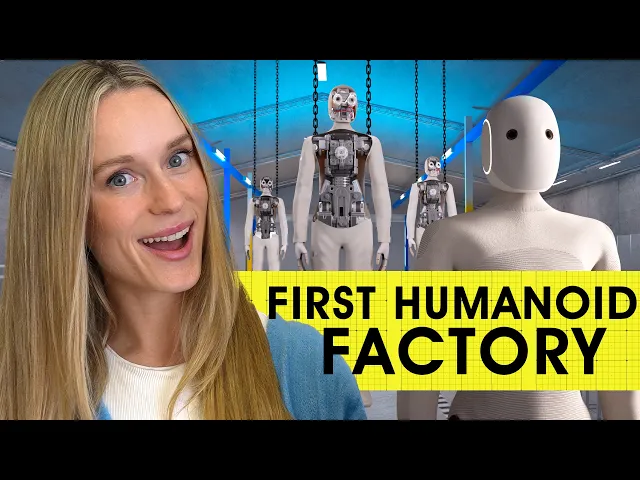
The Engineering Reason this Robot Feels Human | 1X Neo Factory
Tiff In Tech
0:00 Just imagine like blocks of aluminum going back
0:03 there and then it gets formed into parts.
0:05 Parts get formed into joints.
0:07 Joints get formed into limbs and lints get put up as a neo.
0:11 I walked into this factory expecting to be impressed by the humanoids.
0:15 But what I was not expecting to find was one quietly sorting
0:19 parts in the corner of the same building where it was made.
0:23 Okay, so that's Neo and it's working in its own factory.
0:27 And that kind of detail broke my brain for the rest of the day.
0:31 You produce almost everything in house.
0:34 So why was that so important to you?
0:36 And what are some of the benefits?
0:37 For humanoid robotics,
0:38 there exists no supply chain or systems that actually solves the problem.
0:42 So ideally, you can take existing industrial robot
0:45 systems and just put that together in humanoid form.
0:47 And that might work reasonably well in a factory,
0:50 but it's not going to get you to actually true general labor.
0:53 There needs to be real innovation all the way down
0:56 to the fundamental principles of how the machine works and how it's built.
0:58 If you want inter iteration speed, you have to do everything yourself.
1:01 Pretty proud that we're now going essentially raw materials
1:05 to finished humanoid with our own foundation models within one company.
1:09 Right?
1:09 If you go back to Ford, right, in the river factory,
1:12 they mined the ore, but they didn't just mine the ore.
1:15 They grew the cotton.
1:16 They had the cows.
1:17 The entire ecosystem of that area could be turned into a car.
1:20 If you want to re-industrialize America, this is where we need to go.
1:23 Now, I really want to emphasize this.
1:25 Every single thing built in this building, from the motors,
1:28 the battery packs, the metal parts, 1x made it.
1:31 And I kept on asking Burnt, "Why?
1:33 Why not just buy the components like everyone else does?"
1:36 And he kept coming back to the same word, iteration.
1:39 How fast can you find the problem, fix it, and try again?
1:43 If the part comes from a supplier, I mean, the answer is weeks.
1:47 But if you just made it yourself, the answer is tomorrow.
1:51 That is the whole bet.
1:53 Then I met Vicram and he runs robotics at 1x.
1:56 He wanted to show me something about the arm which I found really fascinating.
2:00 Check this out.
2:01 Because we build and test everything here.
2:03 It's just um
2:05 and the engineers are on the floor here.
2:07 So if there's any issue, it get fixed in like a day.
2:11 It's wild.
2:11 Yeah.
2:12 So the communication is
2:13 the communication, the feedback is for sure.
2:15 So that's why we can keep on improving.
2:17 Yeah.
2:17 So this is the tendon.
2:19 Tendon.
2:19 Call it the tendon.
2:20 The entire architecture as you can see we
2:22 have our own handbuilt custom motors over here.
2:26 Wow.
2:25 So this is all built internally.
2:27 This motor holds the world record in torque to strength to uh torque to weight.
2:32 It's 5x more powerful than any motor in the world.
2:36 We wow.
2:38 Now the reason that matters and Vicram showed me
2:40 this in person is what happens when something hits the robot?
2:44 When the hand hits something, this motor is still spinning.
2:49 Yeah.
2:49 If the motor is still spinning, the hand is going to keep going.
2:51 So, it's gonna hurt you.
2:53 I see.
2:53 Yes.
2:54 In the tendon drive system, as you can see, there are no gears.
2:57 It's basically just these ropes.
2:58 It's incredible.
2:59 And then, and then if you see, it's all back drivable.
3:02 So, if there was a hand over here, for example, I can do this and this moves.
3:07 You will not be able to do this in any gear drive.
3:09 So, you can try it yourself.
3:10 So, not only is it, you know, safer,
3:13 but two, the movements of Neo are so natural.
3:16 So, human.
3:17 Yeah.
3:17 Humanike.
3:18 Exactly.
3:18 They're not stiff.
3:19 They're just organic.
3:20 You know, when he goes to shake your when
3:21 Neo shakes your hand or anything like that.
3:23 Exactly.
3:23 Neo is 30 kg.
3:25 Mass reduction is one of the key tenets of safety.
3:28 We kind of draw upon all the sports research
3:30 that goes on in like in the NFL or wrestling
3:34 and we take all that information and we develop
3:36 our soft goods so that we can prevent concussion.
3:39 And yeah, so I would just uh just uh look out for the pinch point.
3:42 So I would I would just hold it from down here.
3:46 This this structure over here and just lift it like this.
3:48 It's a little heavy.
3:49 So see like here, right?
3:53 Yes.
3:54 Perfect.
3:54 It's not as heavy as I thought it would be.
3:55 It's not
3:56 this.
3:56 It's not bad.
3:57 I mean, I can do some curls.
4:00 It's amazing.
4:02 If your robot is safe,
4:03 your robot can learn faster because it can go into any environment.
4:06 Now, I want to stay on that for a second.
4:08 If you cage the robot,
4:10 I mean keep it in a controlled environment to avoid accidents,
4:13 you cap how much it can learn.
4:16 Safety and intelligence are not intention here.
4:18 Safety is what lets Neo be in the real world.
4:22 And the real world is where it gets smart.
4:26 We can go from raw materials to finished product in less than a month.
4:31 Wow.
4:31 aluminum block, machined part, joint, limb, head,
4:37 the whole thing in under a month.
4:39 And they're already trying to get it down to just weeks.
4:44 The head is where it gets interesting.
4:46 That is essentially where the robots, the humanoids brain lives.
4:51 But when the head gets put on, that's
4:52 when the brain actually connects to the nervous system
4:55 and we light it up with the uh robot operating system.
4:58 It calibrates itself and then it does uh a little bit of a robot,
5:02 we call it the robot gym where it does some squats.
5:05 It it does some, you know, curls and it does, you know,
5:08 uh walking and running and jumping and then and then we do a final check and
5:13 it really is a work of art, isn't it?
5:14 Like when you look closely at, you know,
5:16 all the covers, how that's done, it's it's really incredible.
5:19 And then I went to the machine shop.
5:20 Julian's team makes every metal part in the building.
5:24 You want to you want to talk about in the shop?
5:27 So, this is basically one of these tools.
5:30 Oh, I see.
5:31 Yes.
5:31 Taking it.
5:34 Changes the pool.
5:35 Yes.
5:37 Yeah.
5:36 Is this the hardest or the most most complex or one of
5:39 It's a really complex part.
5:40 I would say this is a 10 out of 10.
5:43 Honestly,
5:44 because you have to machine it from every direction.
5:46 The second time when you clamp it, you lose tolerance.
5:49 It's not as precise anymore.
5:50 You can hold this and see how complicated this is.
5:52 So intricate.
5:54 That's a It's like a watch.
5:57 Incredible.
5:59 Wow.
5:59 Julian's team programs the tool path for every single part Neo is made of.
6:03 That hand piece takes an hour and a half to machine.
6:06 The complexity is frontloaded into the part
6:08 so that assembly downstream is cleaner.
6:11 The hardest thing to build is the thing that makes everything else easier.
6:15 We run this and this runs all night until it breaks.
6:18 So we find we find the failure point.
6:21 Yes.
6:21 We see what caused the failure and we go and fix it.
6:25 And then we come and run the test again.
6:29 Yeah.
6:28 And then we see whether it fixed it and then we will run it to failure again.
6:33 Yeah.
6:32 And then we'll find something else that needs to be fixed.
6:34 And we keep doing this until we have like
6:37 been satisfied that this is a very reliable joint.
6:40 And then we do this for every single joint.
6:42 As you can see, we're getting upwards to hundreds of thousands of cycles,
6:45 approaching a million in some cases.
6:47 So, wow.
6:50 Yeah, that room runs all night.
6:51 Joints are literally cycling until they break.
6:54 Then they figure out why, fix it, and run them again.
6:58 I mean, hundreds of thousands of cycles, some approaching a million.
7:02 Now, I know it kind of sounds obsessive.
7:04 They're going to be in your house, around your family.
7:07 That room is why you can trust that.
7:10 It's kind of wild that what is sitting in front of us becomes Neo.
7:15 Exactly.
7:15 Like it's hard to wrap your head around that.
7:17 It is.
7:17 It is.
7:18 Yeah.
7:18 It It's fascinating.
7:19 It really is.
7:20 Now, I seen Neo a few months back before coming into this factory,
7:25 but standing on the factory floor having
7:27 a conversation with it that felt different.
7:30 And Burnt has one word for what
7:32 makes every Neo different from every other humanoid.
7:35 What truly makes every Neo unique is the memory.
7:40 Yeah.
7:41 The only parallel I have is kind of like it's it's my hobbs in Calvin and Hobbs.
7:46 So that means it's not like getting a dog.
7:50 It's not going to replace my kids.
7:52 It's not going to replace my wife.
7:54 It's something new.
7:55 Now, I've covered a lot of different hardware on this channel.
7:58 A lot of different futuristic tech, but I don't think I've ever heard a founder
8:02 describe their product as a Calvin and Hobbs companion.
8:05 And I found it really interesting because he wasn't trying to be poetic.
8:08 He was being precise.
8:10 pretty confident like a lot of people now will agree
8:13 that in 10 years we will actually have true abundance across society.
8:18 We will have what I would say is a hard takeoff meaning robots building robots.
8:23 We're already working on that.
8:24 But it's not just about the robots building the robots.
8:26 You actually need the robots building the data centers,
8:29 the energy infrastructure, the chip fabs.
8:31 We're going to run our chips building out servicing and running
8:34 the mining and refining to ensure you have the raw materials.
8:38 You can actually get this fully self-sufficient kind of on Newman machine.
8:43 Yeah.
8:43 Where it's producing itself.
8:47 Yes.
8:46 From like Adam to sand to intelligence.
8:49 The entire loop automated.
8:51 Who knows maybe like 200 years from now
8:55 my grandkids grandkids Ara will tell them about me.
9:02 whether the 10-year timeline is right,
9:04 and BERT will tell you 10 is more honest than say five.
9:09 I don't think the direction is really any question anymore.
9:12 I mean, the factory is running, the humanoids are shipping.
9:16 I have a 10-month-old, almost 11-month old son,
9:18 and I genuinely have no idea what the world looks
9:20 like when he's old enough to understand any of this.
9:23 And to me, that used to feel, if I'm being honest,
9:25 a bit of a scary thought, intimidating, if you will.
9:28 But walking out of this factory, out of this building,
9:31 it felt more like a wide open one.
9:33 Like there was so much more possibility for the world that he will be living in.
9:37 You know, I feel like I need to talk about
9:39 Neo sitting behind us here and the case Neo is in.
9:42 It's so interesting to me.
9:44 So, is this the case that Neo will be
9:46 shipped in or tell me about this case in particular?
9:49 So, this is currently the case Neo is shipped in.
9:52 Okay.
9:52 Currently, we will see.
9:53 We will see.
9:54 We're having a big discussion about this internally.
9:56 My personal opinion is that Neo just knocks on your door.
10:01 But how do you do that?
10:02 How how do you do that from the shipping standpoint?
10:05 Should we partner with Whimo?
10:06 I think that would be pretty cool.
10:07 That actually would be really your robot comes delivered with an autonomous car.
10:11 I would like to just Neo to just call a Whimo and uh just get to someone's home.
10:16 Okay.
10:16 So you're you're you and Brent are on the same uh wavelength with that.
10:20 We don't need cases, Neo.
10:21 Just just go just go uh just go to your home.
10:23 It's amazing.
10:24 I know.
10:24 Go home.
10:27 Okay, so 1X starts shipping this year and I
10:30 still haven't decided which delivery I would want.
10:32 I mean, the case, the Whimo, or having Neo show up at my door
10:36 with his charger already in hand, ready to work.
10:39 I think a combination is what's going to happen here.
10:41 Now, if this is your first time here,
10:43 I make videos about the technology that's actually building the next thing.
10:47 Make sure to subscribe and I will see you in the next one.
10:50 Oh, and I linked 1X down below.
10:51 So, you know, you can go buy your own humanoid today,
10:54 which is so wild to say out loud.
10:57 I had to give it a shot.
10:58 All right, I'll see you in the next one.