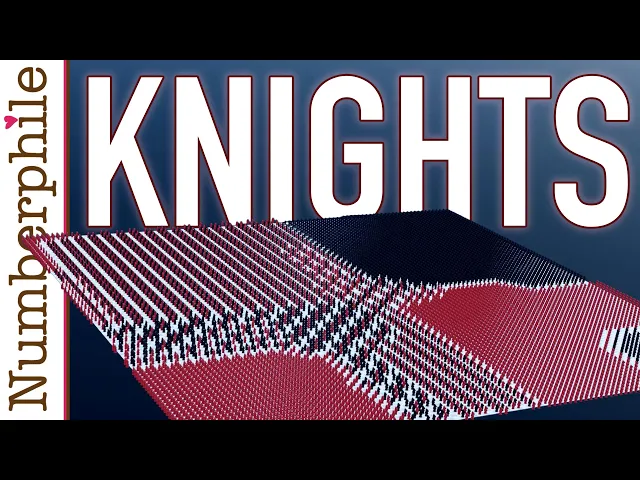
Red & Black Knights (extraordinary result) - Numberphile
Numberphile
0:00 Remember one of the first videos we did together was
0:03 about a knight that gets trapped and we can't repeat square.
0:06 We have to always go to a new square.
0:09 The night is moves around on a square spiral in an infinite chessboard.
0:13 And we've numbered the squares and you start at zero.
0:22 So I'll put a penny where you've been.
0:27 And where you move to has to be the lowest square that you haven't visited.
0:33 Lowest.
0:32 The lowest.
0:33 The smallest number you haven't been to.
0:35 So from zero, we could go to 9, 11, blah blah blah.
0:39 So he goes here.
0:40 Okay.
0:41 Now, where does he go?
0:42 I put a penny to mark where he started.
0:44 He can go to two and and so on.
0:48 And he keeps going.
0:49 From two, he can go to five.
0:51 From five, he can go to eight.
0:53 He can't go back to one he's been to.
0:55 That's right.
0:55 It's got to be a new square, an unoccupied square.
0:58 From eight, he can go to three, and from three, he can go to six, and from six,
1:02 he can go back to So, he's filled in one,
1:05 and then he fills in four, and he keeps going.
1:07 So, so it looks like he he's going to go on, but in in fact,
1:10 after a while, he runs out of squares to go to.
1:13 He gets trapped.
1:14 He ends up at a square where all
1:16 of the eight things he could move to, he's visited already.
1:19 So, it's a finite sequence.
1:21 The sequence of squares that he stepped on.
1:23 Today's video we have a lot of knights, not just one.
1:26 And we put them down in a way they are courteous knights,
1:30 very friendly, gentlemanly knights, and they don't want to attack each other.
1:36 They want to keep their distance from all the other knights.
1:39 And we we just put them down.
1:40 The rule is you walk along the spiral and when you come
1:44 to a square if it's not in the domain of any existing knight,
1:50 if it's not being attacked by any existing knight, you put a knight there.
1:54 So that we put a knight at zero.
1:56 That's a knight on zero.
1:57 And we will go around the spiral.
1:59 Now we come to square one.
2:00 Now square one is not attacked by any can't see any knights from it.
2:04 This knight is not a knight's move from that.
2:06 We So we can put a knight there because the first knight couldn't catch him.
2:10 The first knight couldn't catch him.
2:11 It's not in the domain of any existing knight.
2:15 Right?
2:15 Now we come to two.
2:16 Two isn't two is also unattacked and three is unattacked.
2:21 Four would be attacked by this knight on square one.
2:24 So we can't put a knight on four.
2:26 So we we can't put knights at 12 because of that or 13 14 15.
2:31 No.
2:32 The first one we come to.
2:33 No.
2:34 16 is is attacked by that.
2:36 17 18 19 20 is the first time we can put down another knight.
2:41 All right, let me keep going.
2:43 25 is free.
2:45 So, we put a knight at 25.
2:46 26.
2:47 No, no, no, no, no.
2:48 30 is good.
2:49 31, 32, 32, they're all attacked.
2:52 35.
2:53 Well, it's really interesting because you start thinking, oh, hang on now.
2:56 That one's going to catch that one.
2:57 And that like they all start coming into play in different ways.
3:01 Yeah, it's complicated.
3:01 We get some interesting patterns which you you might think
3:05 would be random or they you might think they'd be regular.
3:07 Well, you'll see what happens.
3:09 40 is okay.
3:10 Nobody is attacking 40 or 41 or 42.
3:14 49.
3:15 They're all good.
3:17 Woohoo.
3:18 53 is out.
3:20 Yes.
3:21 And 54 is okay.
3:23 And 65 is 64 is not, but 65 is free.
3:28 So, we got a cluster of five.
3:30 We can't do 67, 68, 69, 70 we can do.
3:34 And we've filled up a cluster of five and so on.
3:38 And it keeps going.
3:39 We got a cluster of four in the middle.
3:41 And then we get clusters of five around it.
3:44 And that pattern sort of continues.
3:54 And here's a picture of what it looks
3:56 like after about a thousand steps of the spiral.
4:01 And you can see it's periodic in a a very precise mathematical sense.
4:07 In this quadrant, we have clusters of five separated by single knights.
4:14 Upon this vertical line,
4:17 we have clusters of 2 4 2 4 2 4 that keep going forever.
4:21 And similarly in all the others.
4:22 So, so this is a periodic structure.
4:25 Pretty but regular.
4:27 So, it's pretty nice.
4:28 But if we have knights of two colors,
4:30 something totally different and unexpected and amazing.
4:34 Red and black knights.
4:36 All right.
4:37 And they take turns.
4:38 And the rule is when it's black's turn to place a knight,
4:41 he places a black knight at the first
4:44 square that isn't attacked by a red knight.
4:46 They don't mind collaborating.
4:49 Black can be knight moves from black knights but not from red knights.
4:53 So if I'm on a spot and I'm a black knight,
4:56 it's okay if a black knight could catch me because he won't catch me.
4:59 He won't.
4:59 They were we're friends.
5:01 We got two armies really.
5:02 They got the black knights and the red
5:03 knights and they're they're really competing for Europe.
5:06 You have to think of the great plane of Europe and um these are the knights.
5:11 Neil, who even thought of this doing this?
5:13 Jonas Carlson in Sweden sent me a letter with describing some some
5:18 interesting problems that he'd been looking at and this was one of them.
5:22 And he said, "This this blows my mind.
5:25 This is so incredible." He started off, as I just did with you,
5:29 with black knights, and we get a periodic structure.
5:32 No mystery at all.
5:33 But wait till you see what happens with the red knights.
5:36 Oh.
5:36 Oh, boy.
5:38 So the rule is you go around the spiral again and you place a black knight
5:42 on the first square that is not occupied and is not attacked by a red knight.
5:49 Red gets to play.
5:50 They take turns.
5:51 Red puts down a a red knight and the first square.
5:55 It can be attacked by a red knight,
5:57 but it must be unoccupied and not be attacked by a black knight.
6:02 Reds and blacks are very respectful of each other.
6:06 Black goes first and puts his knight at the lowest square, not occupied.
6:10 Okay, red goes next.
6:12 One is free.
6:13 It's not attacked by that black knight.
6:16 So, it goes there.
6:17 Black's turn to play.
6:18 Black claims that square three is not attacked by a black knight.
6:24 Black's turn to play.
6:25 Black would ideally like to place a knight there,
6:29 but that square is under attack by that red knight.
6:32 So, it can't go there.
6:33 So it goes to the next one that it can.
6:35 Now it's red's turn to play.
6:37 This square was attacked by this red knight, but that is fine.
6:41 The red knights collaborate, cooperate with each other.
6:45 So you can fill squares that have come before if your opponent hasn't filled it.
6:49 Yes, obviously.
6:50 But some squares are going to be unoccupied at the end of the day.
6:54 All right, black's turn.
6:56 Black can't go there because of that red knight or there, but it can go there.
7:02 Red's turn.
7:03 Red plays here.
7:05 Black's turn.
7:06 Black it can't go here because it would be attacked by that red knight.
7:10 It's got to avoid any square that's being attacked by a red knight.
7:15 And we It's got to be the smallest unoccupied number.
7:18 So, I think it could go there.
7:21 There's no red knight within a knight's move of that square.
7:25 All right, it's red's turn.
7:27 Red continues from where it left off.
7:30 Seven.
7:30 Uh, seven is no good because of that.
7:32 Eight is no good because of that black knight.
7:34 10.
7:36 10 is free for red.
7:39 So now it's black's turn to play.
7:41 Can't go there because of that.
7:43 It can't go there.
7:45 It can No, it can't.
7:47 It can go there.
7:49 All right.
7:50 Black just played on square 15.
7:52 Red's turn.
7:53 Red can go here.
7:55 Black.
7:56 We left black at 15.
7:59 And we can put a black here.
8:03 Okay, red.
8:03 Back to red.
8:04 Here's red.
8:05 The last red was at 12.
8:07 We can't do 13.
8:08 We can't do 14.
8:10 15 is occupied.
8:11 We can do 24.
8:13 I think 24 can be red.
8:15 And it keeps going like that forever.
8:18 This is not a game that ends.
8:19 And it's not really a game.
8:20 The game, you could say it's a matter
8:22 of seeing um who can control the most territory.
8:26 But for the moment, we're just putting down knights and looking at the pattern.
8:30 And I am.
8:30 Yeah, you got me wondering that.
8:32 Yeah, obviously it's all predetermined,
8:34 but did playing first give you an advantage to have more territory or Yeah.
8:39 No,
8:40 in the end, no.
8:41 Didn't matter.
8:42 It evens out.
8:43 It It's pretty obvious it's going to even out in this kind of game.
8:47 There's no particular advantage.
8:48 And what you get, and this Jonas sent me a picture of this.
8:53 He he showed me what you get after a thousand squares.
8:57 I've indicated the starting square with a little
9:00 black circle and they alternate black.
9:02 It's this board but done for a thousand squares.
9:08 And you can see some strange things happened.
9:11 This bottom quadrant here is all red and it looks there's
9:16 an awful lot of black here and here it's all mixed.
9:20 So it's not clear what's going to happen.
9:22 That's a thousand a thousand squares.
9:25 And Jonas said it is totally unbelievable what happens.
9:30 This is for a 100,000 cells.
9:35 And you can see this is a a continuation of the first thousand cells.
9:44 This picture is a subset of this.
9:46 It's embedded.
9:46 It's in the middle.
9:47 You can see this chunk of red here has become a wide strip of reds.
9:52 In this strip, there are only red knights.
9:55 And then there's a strip of black knights.
9:58 And here you've got mixed.
9:59 So this little red corner you showed me is the start of this section here.
10:04 But it's only a strip.
10:07 Yeah.
10:06 And it's amazing that you would get this.
10:10 Where do these strips come from?
10:12 You'd think it would be totally random.
10:14 Yeah.
10:14 You had all this black.
10:15 You can still see the bits of white in there, too, though.
10:17 These are the blank squares.
10:18 The blank squares.
10:19 Yes.
10:20 Yeah.
10:20 Yeah.
10:20 How do these islands form?
10:22 What?
10:22 Yes.
10:23 Yes.
10:23 It's mysterious.
10:25 Yeah.
10:25 It's fantastic.
10:26 Did Did you catch that?
10:27 All right.
10:27 Let me show you the next stage in the evolution.
10:31 That was that was 100,000 cells.
10:34 When we get up to a million cells, it's fantastic.
10:41 Michael Branicki got involved at this point and he he contributed some drawings.
10:46 This is one of his.
10:47 There are my islands.
10:48 They're like,
10:49 "Yeah, they're the islands." And there are islands.
10:51 There they are.
10:53 And they stay there.
10:54 I mean, this this is a subset of this.
10:56 It gets it's the same picture, but just bigger.
10:59 This is a million squares.
11:01 As we go up, the red the black expands and gets more and more black.
11:06 By the time we get to 64 million,
11:09 black has totally taken over one quadrant of the board.
11:13 In fact, two quadrants separated by a strip which are kind of indecisive.
11:18 They can't really decide whether they're Republicans or Democrats
11:22 or in in terms of uh Stendal's novel where the red
11:27 represents the military and the black represents the church whether
11:31 they're going to be join the military or join the church.
11:35 solid black in two quadrants, two quarters of the whole infinite board,
11:41 or solid red in the top half.
11:44 Does this black and red now last forever or Yes.
11:46 Yes.
11:47 It just gets bigger and bigger.
11:51 Yeah.
11:50 Yeah.
11:50 They grow and the strips are thin strips and people
11:57 who are undecided whether they're going to be red or black.
12:01 And I don't know if this has any political implications,
12:05 but it certainly is astonishing.
12:08 It's very unexpected that it for so long it was making
12:12 patterns and then when it suddenly just said, "No, that's it.
12:15 That's it.
12:15 We're done." Yeah.
12:17 It's contagious.
12:18 You could say amazing.
12:22 Amazing.
12:22 Yeah.
12:33 Do you know what?
12:34 Has anyone done it with three colors now?
12:36 That would be interesting, wouldn't it?
12:38 Yeah.
12:40 Yeah.
12:39 Let's do it.
12:40 Let's do it now.
12:42 Should we do it?
12:43 No.
12:43 Because it'll take a long time to get enough colors for it.
12:46 It's going obviously going to be unsettled until the jelly sets.
12:50 Will it settle?
12:51 Will three colors settle?
12:53 Well, how will three colors settle?
12:55 because you haven't got those quad those obvious
12:57 quadrants like you do with a square board.
13:00 Like what will three colors do?
13:01 I'll investigate.
13:03 Giving you credit for suggesting it unless you want to work on it.
13:06 I I don't think I have the firepower.
13:08 We'll show you what happens with three pieces
13:10 in a bonus video over on number file 2.
13:13 We'll also show you what happens with more
13:15 pieces and pieces which move in different ways.
13:19 Trust me, it gets pretty crazy.
13:21 Check out the links below.
13:28 It gets stuck.
13:29 It cannot move.
13:30 Every square, every one of the eight squares around
13:33 it that it could move to, it's already been to.
13:36 So it d the sequence dies at that