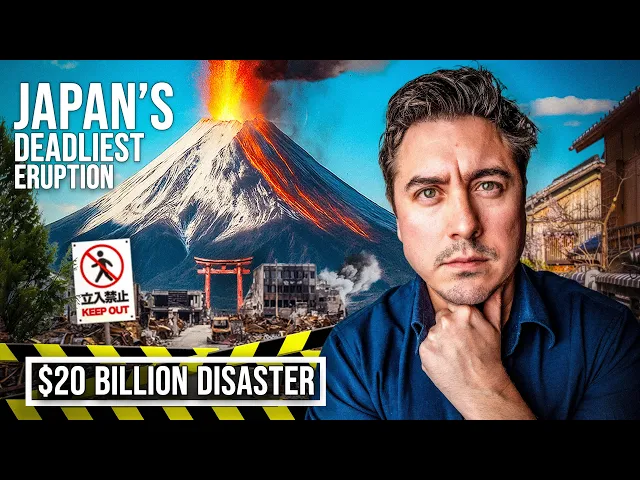
What Happens if Japan’s Most Powerful Volcano Erupts? ⛩️ Documentary
Abroad in Japan
0:06 You know, given the roof over our heads at the moment,
0:09 it might be tempting to assume that these are artificial
0:11 homes built to illustrate a point about something truly awful.
0:17 And yet, the unfortunate reality is these are real
0:19 homes that were once lived in by real families,
0:22 now buried 2 to 3 m beneath the soil.
0:24 Because it just so happens that these homes were in the firing line
0:28 of a destructive event that seems to hit
0:30 this part of Japan once every two centuries.
0:44 [Music] Japan lies on the Pacific Ring of Fire,
0:52 where four colliding tectonic plates have led to 111 active volcanoes.
0:56 In the last three centuries alone,
0:58 these giants have taken the lives of more than 20,000 people.
1:03 And the ultimate question is never if they'll awaken, but when.
1:07 We're traveling across Japan from snowy Hokkaido to subtropical
1:11 Kyushu to uncover the stories behind these ticking time bombs.
1:15 We'll meet the people who live in their shadow and those who dare to get closer.
1:19 From towns that have taken drastic measures to protect themselves to the most
1:24 catastrophic eruption in Japan's recorded history
1:27 and the one everybody fears could be next.
1:30 It's a story of fire and ash and an everpresent
1:33 threat that shaped the soul of a nation.
1:35 As we go in search of Japan's deadliest volcanoes,
1:43 [Music] the Japan Meteorological Agency runs one
1:48 of the most sophisticated volcanic warning systems on the planet.
1:51 But unfortunately, even the best systems aren't entirely foolproof.
1:56 On a clear September morning in 2014,
1:59 hikers are climbing the trails of Mount Antake,
2:03 Japan's second tallest volcano, with seemingly no signs of danger.
2:06 Then, without warning, at 11:53 a.m.,
2:09 it explodes for the first time in 35 years.
2:16 A colossal plume of ash and rock tears into the sky.
2:20 Within seconds, the tranquil mountain is transformed into a hellscape.
2:26 Shocking footage shows panicked hikers fleeing as a thick
2:29 cloud of toxic ash thunders down the mountain.
2:36 They try their best to outrun it.
2:37 But unfortunately, the wind isn't in their favor,
2:41 and they're quickly engulfed in the thick black clouds.
2:44 Tragically, for many on the mountain, this is the last thing they'll see.
2:49 [Applause] [Music] In the days that followed,
2:54 the world's media turned their gaze
2:56 to a mountain that had become an unrecognizable desert.
2:59 While rescue teams desperately dug out survivors on the summit,
3:03 63 lives were lost, making it Japan's most lethal eruption in over a century.
3:12 [Music] Japan is home to 10% of the world's active volcanoes.
3:15 And the worrying truth is 50 are under constant surveillance given
3:19 their proximity to populations and their risk of a potential eruption.
3:22 For some communities, the sign of smoke rising is merely a daily occurrence.
3:27 But for others, it's an ominous sign that everything is about to change.
3:37 Lake Toya, Hokkaido.
3:38 A scenic resort town enjoyed by 3 million tourists a year.
3:43 Travelers come here to escape, relax, and unwind.
3:46 Yet, concealed beyond the town lies an inaccessible landscape,
3:50 whispering stories the guy books are keen to emit.
3:53 Like along the shoreline of the lake
3:54 and the hotels facing outwards, you can miss it.
3:58 But turn around, look up,
3:59 gaze up 700 m to the towering strato volcano that looms large
4:04 overhead and you can see something fairly unsettling has taken place here.
4:08 Right, the entire town of Lake Toya is effectively behind a barrier.
4:13 A vast network of walls and dams separating it from Mount Usu,
4:16 a terrifying volcano that has unleashed its wrath no
4:20 less than four times in the last 150 years.
4:25 On March 27th, 2000, the Muran Meteorological Observatory detects a flurry
4:29 of small earthquakes beneath Mount Usu.
4:32 By the hour, they multiply and by the end of the day,
4:35 109 earthquakes have been recorded.
4:37 The following day, there are 590 earthquakes
4:41 recorded and 2 days later over 1,600.
4:48 [Music] On March 31st, Usu finally erupts.
4:54 A pillar of white smoke and ash burst through the sky as high as 3,200 m,
5:00 sending with it 290,000 metric tons of ash and volcanic debris
5:03 and reaching as far as Sapuro City, over 180 km away.
5:08 In the aftermath, 200 homes are destroyed.
5:11 But to the locals, this doesn't come as a surprise.
5:13 Mount Usu never stays quiet for long.
5:16 The previous eruption in 1977 saw over 20,000 people being evacuated.
5:21 And with nine major eruptions over the last 400 years,
5:24 every generation that's lived in this region
5:26 has been reminded of its destructive power.
5:31 Despite their image of explosive momentary destruction,
5:34 volcanoes don't often return to a state of calm after erupting.
5:38 The Mount Usu eruption in 2000 lasted for 18 months.
5:42 Imagine 1 and a half years of ash, steam,
5:45 and tremors, never quite knowing what to expect next.
6:06 Lake Toya is also home to a rather spectacular occurrence.
6:11 In 1943, a perfectly ordinary wheat field decided it had bigger ambitions,
6:16 like becoming a mountain.
6:18 Over the next two years, the ground steadily ballooned ever upwards until
6:22 the crops were replaced by a fullyfledged volcano.
6:25 Locals named it Shaw Shinszan, and to this day,
6:27 it remains the only mountain in Japan you
6:30 could have watched grow while eating your lunch.
6:32 But, as you'd expect, a volcano seemingly coming out of nowhere and growing
6:37 in 2 years led to some bizarre kind of events unfolding.
6:40 Number one, it was actually seen as a bad omen.
6:43 The Japanese government covered up the birth of Shaw Shinsza back in the day.
6:47 It wasn't until 1948, a volcano conference in Oslo,
6:50 that it was formally announced.
6:51 But the second bizarre thing that happened was as there was no public
6:54 knowledge of this volcano and no scientists on hand to kind of monitor it,
6:58 postmaster called Masal Mimatsu who worked
7:00 at a neighboring town kept track of it
7:02 and actually kept diaries and kept a really kind of comprehensive report on it.
7:05 Best of all though, he actually bought the land that the volcano is on.
7:09 So technically this is private property.
7:10 So if you ever see a volcano growing in your back garden,
7:13 buy the land and uh keep a reading of it.
7:14 You might get a free trip to Oslo.
7:17 Yeah.
7:18 There is a tragic irony to life in Toyok,
7:21 a hotring town whose very existence depends
7:23 on the geothermal energy of Mount Usu.
7:25 Yet, where residents live with the constant awareness
7:27 that they may have to evacuate at a moment's notice.
7:30 And to the locals, such events haven't been simply consigned to history.
7:34 Around the base of Mount Usu,
7:36 a 2 km stretch of land has been deliberately preserved,
7:38 left exactly as it was in the aftermath of the 2000 eruption.
7:43 Among the ruins stands the Toyoko kindergarten, a silent,
7:46 haunting reminder of just how suddenly normal life can be swept away.
7:53 It's very eerily quiet up here, apart from the the snow gently falling around.
7:57 And you know, most Japanese towns that are affected by disasters
7:59 tend to get rid of the destruction that was left thereafter.
8:02 The town of Tora has kind of embraced it.
8:04 And around the volcano,
8:05 you can see places like this that have been left up uh as a sort
8:08 of ominous reminder to the locals and to travelers coming to this region.
8:12 And there's lots of rocks strewn throughout the playground.
8:14 And that was what led to the damage here on this building.
8:17 They flew out the volcano and crashed into the sides of the building,
8:20 smashed windows, the roofs caved in.
8:22 From a distance, the building looks mostly structurally sort of intact.
8:25 But it's inside it looks like a real horror show.
8:28 And the playground is also kind of littered with burnt out,
8:32 broken vehicles like the old school bus,
8:34 which is a, you know, pretty haunting sight to witness.
8:39 [Music] The town surrounding Mount Lusu have been shaped both
8:44 physically and culturally by their uneasy relationship with the volcano.
8:48 Which raises the question,
8:50 why would anyone choose to live in the shadow of something so volatile?
8:54 To find the answer, we travel 1300 km south
8:56 to a Japanese island with a volcano that doesn't just erupt occasionally,
9:01 it breathes fire almost every single day.
9:11 Sakurajima is Japan's most active volcano.
9:15 Since 1955, it's erupted almost continuously
9:18 with some years seeing over a thousand eruptions.
9:20 For the half a million residents of Kagashima City,
9:24 life means living at the mercy of the wind.
9:26 On a bad day, it can rain a blizzard
9:28 of volcanic ash straight into the heart of the metropolis.
9:31 Nowhere else in Japan offers such a front row seat
9:34 to both the beauty and the menace of living beside a volcano.
9:39 Once a true island, Sakurajima was separated from the mainland
9:43 of Kagashima prefecture until the great Taiishu eruption of 1914.
9:47 One of the most powerful in Japan's history that the landscape changed forever.
9:51 Almost 10 billion tons of lava poured forth with the molten
9:55 flood filling the 400 meter straight separating it from the mainland,
9:59 permanently welding the island to the Osumi Peninsula.
10:02 Sakurajima's fusion with the mainland may have been a geological marvel,
10:05 but it came at a terrible cost with 58 islanders losing their lives.
10:10 And today, scars from the 1914 eruption remain etched
10:13 into the communities through landmarks that survived the event.
10:16 Honestly, one of the most beautiful yet haunting Tory gates that I've ever seen.
10:21 You know, red wooden Tory gates get all the acclaim,
10:24 but it's actually the stone ones that I think are more
10:26 poignant because you get a sense of the sheer passage of time.
10:28 In the case of this Tory gate, it's actually 3 m tall.
10:31 You just wouldn't know it because 2 m of it buried
10:34 beneath the soil in the volcanic ash that fell here in 1914.
10:38 In just the space of one day,
10:41 2 m of ash fell from the sky, smothering 687 homes.
10:45 Luckily, the villages knew it was coming.
10:47 Due to water in the wells actually boiling in the days ahead,
10:50 fish dying in the sea, Sakurajima sort of announced what was about
10:54 to happen in the days leading up to it.
10:56 After the 1914 eruption, the uh the town was thinking of excavating it.
11:00 And then one of the elders of the community decided
11:02 why not leave it as a reminder to future generation.
11:04 It's one of the few reminders of what happened back over
11:08 100 years ago and become a tourist attraction in its own right.
11:13 It's not something you see every day.
11:16 And yet, the constant clouds of smoke that eject
11:18 from Sakurajima go mostly unnoticed by the people living here.
11:21 When filming this documentary,
11:22 the island was at an eruption warning level of three,
11:25 preventing people from going within close proximity of the volcano
11:29 due to the likely event of an eruption,
11:31 with level five being an all-out evacuation.
11:33 Something made possible by the 24-hour ferry that runs
11:36 to and from Kagashima City across the sea every 20 minutes.
11:41 Still on a good week,
11:41 the only sign of the volcano's wrath lies in the governmentissued
11:45 ash removal bags that quietly fill the island's streets.
11:48 Just another part of everyday life for those who live here.
11:51 But what's it really like to live and grow
11:53 up in the shadow of Japan's most active volcano?
11:56 I spoke with Hikarisan, who helps promote tourism in the region.
11:59 Fukushima, the director of the Sakurajima Museum, and Naman,
12:03 a local who's given kayak tours around the volcano for many years.
12:08 What's this uh bag you've got here, Kylie?
12:11 It's called Kokuhai Buro, meaning overcoming volcanic ash.
12:16 Oh, wow.
12:17 Yeah, it's this bag is distributed by the city, Kagosima city.
12:22 So, the residents sweep the volcanic ash and put them inside a bag.
12:27 Some areas they have to clean like almost every week.
12:31 Every week?
12:31 Yeah.
12:32 I mean, I'm bad enough cleaning my house as it is.
12:35 I'll take that home to my my partner Charlotte.
12:51 She'll love that.
12:55 Would it be scary living here?
13:19 I know you live across the bay, right?
13:22 But would would you ever consider living on the island?
13:25 Yeah, in my heart I always say good morning Sakuraja.
13:29 Yeah, it's like family member.
13:32 Like a family member.
13:34 Who's sometimes beautiful, sometimes very angry.
13:37 Yeah, it's next time.
13:45 Next time.
13:45 Perhaps it's not so unreasonable to feel
13:48 a sense of reverence towards these towering geological giants,
13:51 particularly when viewed through the lens of Japanese history and belief.
13:55 In Shintoism, volcanoes are thought to be
13:57 the dwelling places of powerful deities known as kami.
14:00 For centuries, pilgrims would ascend these sacred
14:02 peaks to offer prayers and appease the gods,
14:04 hoping their devotion might prevent the next eruption.
14:08 Even the origin of volcanoes in Japanese mythology is steeped in drama.
14:12 According to ancient law, the divine creators of Japan,
14:14 Izzanami and Izanagi, gave birth to the fire god, Hagatsuchi.
14:18 But the child emerged wreath in flame, in doing so, mortally wounded his mother.
14:23 Stricken with grief,
14:24 Ianagi drew his sword and cut the god of flames into eight pieces,
14:28 tossing them into far-flung locations across Japan and sprouting
14:32 the eight major volcanoes of the Japanese islands.
14:35 And honestly, it's not hard to see why volcanoes were once feared as the wrath
14:39 of the gods when you look at the deadliest eruption in Japanese history.
14:43 For that, we head to our final destination.
14:53 [Music] Now, if you were to come here without context,
15:00 it might be safe to assume that this destruction was caused by an earthquake.
15:04 That is until you look up at the horizon towards Mount Unen,
15:08 a smoldering giant that looks innocent enough, but make no mistake,
15:12 this volcano is an absolute monster because it's not
15:16 only the most deadly volcano in all of Japan,
15:18 one of the deadliest volcanoes on the planet.
15:26 Japan is in the midst of the Edeto era,
15:29 a time of peace, isolation, and rigid control.
15:31 But in the quiet coastal town of Shimabara,
15:34 something far less orderly is unfolding.
15:36 For months, the ground has been restless.
15:38 Small tremors ripple through the earth around Mount Unen,
15:41 unsettling villages and local monks alike.
15:43 On Mount Mayama, a lava dome has begun to bulge ominously,
15:47 an unspoken warning that few can yet comprehend.
15:51 Then on May 21st, the mountain finally gives way.
15:54 What follows is the deadliest volcanic disaster in Japanese history.
15:58 A powerful magnitude 6.4 Four earthquake strikes the region,
16:02 violently shaking Mount Mayuyama and dislodging
16:04 the unstable lava dome perched on the summit.
16:08 A colossal landslide tears down the mountains western slope,
16:11 obliterating everything in its path.
16:14 Entire neighborhoods in Shimabara vanish in seconds
16:17 with 5,000 lives lost almost instantly.
16:20 The avalanche continues,
16:22 crashing into Aryak Bay and displacing an enormous volume of water,
16:25 unleashing a mega tsunami.
16:27 As the landslide slices Mount Mayyama down from 760 m to just 400,
16:33 the waves in the bay rise an astonishing 57 m,
16:37 slamming into Kumamoto across the sea.
16:39 By the time the tsunami loses its power,
16:41 it's reached as far as 24 km in land and taken the lives of over 10,000 people.
16:47 It's a cataclysmic event that Kyushu never saw coming
16:50 and a reminder that one of the most dangerous
16:52 things about volcanoes is the inability to predict just
16:55 what part of the eruption will become the deadliest.
16:58 There's no greater example of this than
17:01 the catastrophe that struck 200 years later.
17:03 In 1991, after months of volcanic activity,
17:06 Mount Unen made its presence known once again with tragic consequences.
17:11 In the days leading up to the eruption,
17:14 anticipation had been building with news crews,
17:16 photographers gathered at the base of Mount Unen,
17:18 staking out fixed positions in the hope
17:20 of capturing the moment the volcano brought to life.
17:24 Volcanologists expected a dramatic eruption.
17:26 Instead, the mountain began to swell.
17:29 A lava dome started forming at the summit.
17:32 Thick, viscous magma rising slowly,
17:34 reshaping the landscape like a balloon filling with molten rock.
17:37 But these domes were inherently unstable,
17:40 fragile, pressurized, and prone to sudden collapse.
17:44 Then on June 3rd, 1991, at 400 p.m., the worst case scenario unraveled.
17:53 [Applause] The dome gave way, triggering a violent pyrolastic flood caught
18:05 on film with this terrifying footage.
18:08 A lethal surge of superheated gas, ash,
18:10 and volcanic rock up to a,000° C in temperature
18:13 tore down the mountain side at 200 kmh.
18:17 Many of the media and news teams that were assembled were unable to escape,
18:21 including amongst them world famous
18:23 French fulcanologists Katier and Maurice Craft,
18:25 who had traveled to Japan to document the eruption.
18:28 Tragically, 43 people were killed, many of them members of the media,
18:32 waiting to witness history, and sadly instead becoming a part of it.
18:41 Wow.
18:43 Having spent many of my years up in Tohoku
18:46 along the coastline where they've basically terraformed it,
18:48 reshaped it after the tsunami,
18:50 I'm used to seeing massive infrastructure projects,
18:52 but the scale of this is breathtaking.
18:55 These dams, right, to prevent mud flow coming down the mountain side.
18:58 It's almost like stepping stones for a giant.
19:01 My god, absolutely incomprehensible.
19:04 Even now, you know, about 30 years after the last eruption,
19:08 it's sobering to think that uh the defenses
19:10 that are being built now could be protecting people,
19:12 you know, 200 years into the future here in this part of Japan.
19:17 This is where the iconic shot of the pyrolastic
19:20 flow was taken that barreled down the mountain,
19:23 destroying farmland and taking the lives of dozens of people,
19:26 including uh Katia and Maurice Craft.
19:28 And you can see amidst the trees and the foliage
19:31 that's actually kind of sprung it back into life,
19:35 these huge massive boulders of rock,
19:37 chunks of the volcano that fell down, came down with the eruption,
19:42 strewn throughout the forest and the fields beneath Mount.
19:45 Even today, it's uh ominously kind of smoldering at the top.
19:50 Little bit uh little bit scary looking up at that.
19:55 It's an unsettling thought that it might erupt
19:57 once again in the not too distant future.
19:59 And yet for many, the spectre of the volcano hasn't
20:02 been a deterrent for those wanting to live and work here.
20:07 While construction crews raise concrete walls to keep people out,
20:09 the locals quietly edge ever closer.
20:11 And when I say locals, I don't just mean the humans.
20:16 Emanuel Carlon's lived in Shimabada for several years,
20:19 promoting Unzen's Hell's Valley hotspring town.
20:21 He also shows me the real reason the local
20:24 cats have fallen in love with the place.
20:27 That's uh Oh, son of a That's really hot.
20:30 Right.
20:30 Right.
20:31 You can really feel, you know,
20:32 the power of the volcano just by touching the ground.
20:34 It's very It's very hot.
20:35 You could cook a Sloin steak on that.
20:37 Yeah.
20:37 And we should not probably very clean,
20:41 but but that explains why there's so many cats around here, right?
20:45 Yes.
20:45 They love it.
20:45 I mean, this hell over here, it's it's the volcanic gases are not toxic.
20:50 So, it's actually, you know, there's living things going around over here.
20:53 And it's not too hot.
20:54 It's just the right temperature.
20:57 Very cute.
20:57 No location in Japan would be complete without dozens of cats having a fight.
21:03 Very cute.
21:04 Cats benefit from the heat, and so do the hotels.
21:07 Inn built around the hellish landscape get to save roughly 40%
21:10 on their gas bills by sending
21:12 their pipes through the scalding hot natural steam.
21:16 But is it really worth the trade-off?
21:18 operating so close to something so destructive given what
21:20 could happen if and when it all goes wrong.
21:24 In a sense, Devil can has been active for thousands of years and people,
21:26 you know, sometimes it erupts, but people keep living here.
21:29 They want to live here.
21:31 They also want to protect this environment.
21:33 That's something that struck me actually looking
21:35 at the footage of uh mountains and in like 1991, 1992, the destruction, right?
21:40 You would think people wouldn't want to live there
21:42 and yet there is a lot of people living there.
21:45 the city the town sort of recovered as a certain point you start thinking about
21:49 it as as a living thing also almost as a person or as a god
21:52 itself and you know as an entity itself it's pretty fair you know it erupts
21:56 every 200 years or so so when you know that it's about 200 years you're like
22:00 ah maybe I can get a long vacation or maybe I can start to look
22:04 into different options but then after that you
22:06 know that it's going to be you know
22:07 pretty pacific for for the rest of the years let's hope so anyway let's hope
22:10 it is another 200 years cuz mountains then
22:14 certainly doesn't seem to play by the rules.
22:17 Exactly.
22:19 At the base of Unzen on Nagasaki's west coast lies the hottest onen town
22:23 in all of Japan with the spring water
22:25 reaching an astonishing 105° C from the source.
22:30 The town happens to be called Obama.
22:31 The second town in Japan with the name of the former
22:34 president and with no affiliation with the man himself,
22:37 though of course the locals have gleefully stuck his face on a towel.
22:41 I meet with Nahok Kato who works in Obama but is
22:45 originally from Chiba and she wouldn't choose to be anywhere else.
22:56 Oh yeah.
23:21 Oh yeah.
23:44 Oh, wow.
23:46 That's a beautiful thing.
23:46 Very beautiful.
23:48 And you have a We love Obama towel.
23:52 President Obama is the mascot of Obama Town.
23:59 Come on, Obama.
24:00 Get down there.
24:01 Get down there now.
24:03 Enjoy the foot.
24:04 Yes, we can.
24:05 Yes, we can.
24:06 Get in the foot path.
24:06 Obama, if you're watching, she definitely is.
24:12 Despite the destruction Unen unleashed both centuries ago and in living memory,
24:18 chances are you've never heard of it.
24:20 But what about the volcano everybody knows?
24:23 the one everybody fears erupting perhaps more than any other.
24:26 With over 300,000 climbers every year,
24:29 it's easy to forget that Japan's most iconic
24:32 mountain is in fact a ticking time bomb.
24:35 When Mount Fuji last erupted from 1707 to 1708,
24:39 it blanketed the region in 800 million cubic meters of ash.
24:43 Tokyo, over 100 km away, was plunged into darkness.
24:47 If the same eruption were to happen today,
24:49 with almost 40 million people living around the mountain,
24:51 it wouldn't be so much a natural disaster as a full-blown national emergency.
24:58 Experts predict it could bury the capital in up to 30 cm of ash.
25:03 Enough to paralyze transport, knock out power grids,
25:06 and grind the world's most populated city
25:08 to a halt with an estimated $20 billion of damage.
25:12 Of the two times I've climbed Mount Fuji,
25:14 I'll never forget standing on the summit, peering into the vast crater,
25:18 a crater large enough to swallow a whole town
25:21 and wondering what it might still be holding back.
25:24 The seismic data tells a rather worrying story.
25:26 When I spoke to Professor Kenji Satake at the earthquake research institute,
25:30 he pointed to the Nankai trough, a fault line that many believe is overdue.
25:35 Eruption Mount Fuji may be related to the earthquake in Nankai Trough.
25:39 In 1707, earthquake happened.
25:42 Then several months later, Mount Fuji erupted.
25:44 That's where both related to the subduction of the Philippines plate.
25:49 Along the khai trough, the government says the uh chance of the next
25:53 earthquake in the next 30 years is 70 to 80%.
25:56 An earthquake here could set off a chain
25:59 reaction that triggers Mount Fuji with some
26:02 experts saying there's a 5 to 10% chance
26:04 of an eruption within the next 30 years.
26:06 For now, Japan's most beloved mountain sleeps.
26:08 But one day it will wake and when it does the whole world will be watching.
26:19 My god, this is absolutely stunning.
26:23 This is Hibaruyama Flower Park at the base of mountains.
26:25 And throughout this documentary,
26:27 it's been fascinating hearing about the locals complicated relationship.
26:30 The volcanoes wreak unimaginable damage on this country
26:34 and yet they also give back.
26:35 the nutrients in the soil, the hot springs beneath our feet,
26:39 there are clear benefits to having volcanoes in your country.
26:41 And you know, while tsunamis and earthquakes might come and go,
26:44 volcanoes are an everpresent symbol of Japan's relationship with nature
26:48 and those kind of seismic threats they face every single day.
26:53 And for me, having traveled to Hokkaido,
26:56 Kagashima, to Unzen, hearing people's stories, experiences,
26:58 and their relationship with these volcanoes,
26:59 I've come to appreciate that Japanese culture
27:02 simply wouldn't be the same without them.
27:04 that we have to be grateful.
27:05 And even the absolute monster that is
27:08 Mountain Zen looks particularly stunning today
27:10 as we stand here in the very flower garden that helped create [Music]