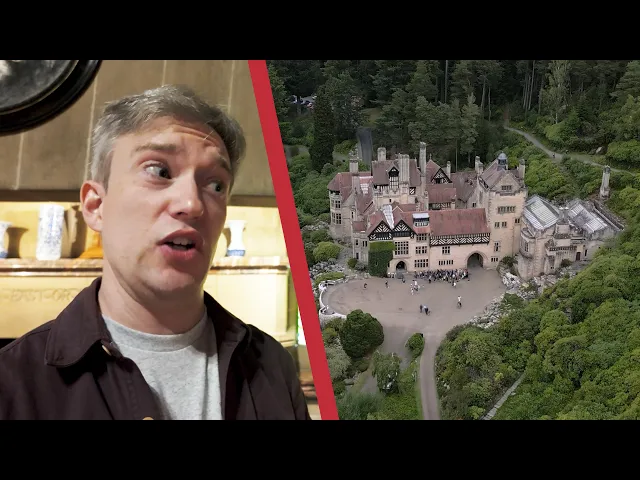
I should not have liked the world’s first smart home.
Tom Scott
0:00 I went as far north as I could go on my road trip,
0:02 at least not without crossing the border to Scotland.
0:04 Northumberland is rural and coastal,
0:07 and I was there to see the home of the Magician of the North,
0:10 a place far ahead of its time: the world’s first smart home.
0:16 It doesn’t look like a lot of the other country houses I’ve seen.
0:20 Like, there’s some detail that feels English in here.
0:24 But also, some of this feels like a German castle or a Swiss castle,
0:28 something like that.
0:29 Inside, I met the house’s curator, Clara.
0:32 So, welcome to Cragside.
0:33 We’re in the entrance hall here,
0:35 so this is where Lord and Lady Armstrong would have greeted their guests.
0:40 When you come in here,
0:41 one of the things that is most noticeable is our huge Dent clock.
0:46 So it’s incredibly accurate.
0:48 It’s the master clock for the whole estate.
0:50 Okay.
0:51 And one of the things that the first Lord Armstrong,
0:53 who created Cragside with his wife, Margaret,
0:55 was absolutely obsessed with was keeping time.
0:59 To the point that when guests came to Cragside,
1:02 they complained about how structured their days were.
1:05 Oh, wow, okay.
1:07 So, everything at Cragside was scheduled,
1:09 and this clock is the same as that used at Greenwich.
1:14 So it’s really extraordinary in terms of how well it keeps time.
1:18 To explain why I’m impressed there,
1:20 by Greenwich, Clara means the Royal Observatory.
1:24 The Dent company made clocks for the people who kept time for the country,
1:28 as well as the clock that still rings Big Ben at the Houses of Parliament.
1:31 They were the watchmaker to the Royal Family.
1:34 If you wanted the best clock possible in the late 19th century,
1:38 and you had a staggering amount of money, you talked to the Dent company.
1:42 There was also a very fancy, elaborate recording barometer for weather
1:46 records and perhaps even short-term forecasting.
1:49 Why does somebody need that?
1:51 He’s created this estate that relies on rainfall to fill up the lake.
1:57 So if you think about kind of control of when you need to raise and lower
2:01 dams to let water into different parts
2:03 to run the hydraulics and the hydroelectricity elements,
2:08 so it’s really important that he knows.
2:10 -Yeah.
2:11 -I think he’s also just interested.
2:13 (laughing) Right.
2:14 I’m recognising this guy in my head!
2:17 He’s just curious.
2:18 You know, he just wants to kind of...
2:20 understand the world around him and understand its potential
2:26 and that Victorian interest in, kind of, taking the natural world,
2:31 understanding it, recording it, controlling it.
2:34 Yep.
2:35 How do you bend it to your will?
2:37 The first step is understanding it, and that’s what he’s doing here in his home.
2:43 The man in question is William George Armstrong.
2:46 We’ll talk more about him later.
2:49 Now, in the videos I used to make, years ago,
2:51 I’d do huge amounts of research before visiting a place,
2:54 and I’d turn up with a script ready to go,
2:56 but for this road trip, I tried to learn things as I went along,
2:59 knowing I could always clean it up here in the studio later.
3:02 So at that point, all I knew was that Armstrong was a wealthy
3:06 and famous Victorian industrialist who had
3:08 commissioned the world’s first smart home.
3:10 Not that they called it that at the time.
3:12 So on that note, let’s go look at the kitchen,
3:15 because a wealthy Victorian industrialist and his family
3:18 would not be cooking for themselves.
3:19 Or doing any chores for themselves.
3:22 -Oh, this is colossal!
3:24 -Magnificent space, isn’t it?
3:26 This is enormous.
3:28 I have so many questions.
3:30 -Yeah.
3:31 I’m going to start with the rotating spits.
3:34 Yeah.
3:35 That’s a complicated set of gears and things.
3:39 What’s going on there?
3:40 So it’s using technology, again, that existed, so off-the-shelf parts.
3:46 But it’s being powered, instead of by something like a clockwork
3:49 jack that would have been more conventional,
3:52 it’s being powered by a water turbine.
3:55 (laughs) So it’s all about efficiency.
3:58 So everything Armstrong does is about making everything run better.
4:04 To make what is essentially...
4:06 I mean, I imagine the word kebab had not made it to...
4:09 It’s essentially a kebab, yeah.
4:11 Not made it to Cragside in Victorian times.
4:13 That is essentially a kebab rotator.
4:17 The word I was looking for there was “rotisserie”,
4:19 but sure, let’s go with “kebab rotator”.
4:22 Also, technically, the word “kebab” had reached England by Victorian times,
4:26 but it wouldn’t have been in common use.
4:28 So there’s like a take-off from the river that’s running through?
4:31 So it’s pumped.
4:33 It’s pumped!
4:34 Our hydraulic engine that is down in the pump
4:36 house that was built at Armstrong’s works,
4:40 that is pumping spring water that’s collected in a tank
4:44 at the pump house up to a basin tank behind the house,
4:48 and that gravity-fed system is what’s
4:51 feeding this, the central heating, the plumbing.
4:54 -(laughs) -The cascades in the rock garden.
4:58 -It’s all coming from one spot?
5:00 -Yeah.
5:00 We went downstairs to see the water turbine.
5:03 It’s tiny and doesn’t show up well on camera,
5:05 but it’s basically like this simple garden sprinkler,
5:07 water jets out of the side of the turbine,
5:10 that spins the whole thing, and that’s what powers the...
5:13 kebab rotators.
5:15 You can follow the chain of gears from the meat hooks,
5:17 all the way across, down, under the floor and down again to the turbine.
5:22 I’m just standing here, slightly gobsmacked,
5:25 because I thought about filming Cragside for a long time, -Yeah.
5:30 -I was like, “It’s just an old house...” What the?!
5:34 Yeah!
5:37 Hydraulic lift?
5:40 The house had a domestic passenger lift in the 19th century in rural England!
5:45 It’s no longer working, and it’s also not particularly well documented,
5:48 because why would you keep precise details about changes to a private home?
5:53 Very few people keep a formal record and plans when they remodel their bathroom.
5:58 This was just his house.
5:59 Most of what we know comes from visitors,
6:02 so from people recording how amazing this house was.
6:06 But one of the things he makes is hydraulic machinery.
6:10 So he makes hydraulic cranes, he makes accumulators,
6:13 so the mechanism that opens and closes Tower Bridge in London,
6:17 those are Armstrong accumulators.
6:19 Oh.
6:20 Oh!
6:20 -So he’s an expert in using water power.
6:25 Hydraulic accumulators are sort of water-based batteries.
6:29 They can be as simple as a water tower: use energy to pump the water up,
6:33 store it there, and then use the potential
6:35 energy in that water when it falls back down.
6:37 Armstrong’s invention was basically putting a huge
6:40 heavy weight on top of that water, like a giant plunger.
6:44 So the water pressure is higher,
6:45 you can store more potential energy per litre of water,
6:48 ’cos it’s taken more to lift that weight up,
6:50 and on its way out it stays a lot closer to constant
6:53 pressure because you’ve always got that heavy weight on it too.
6:56 And while the story of any invention is complicated,
6:59 it is fair to say that Armstrong invented them,
7:01 kept improving them, and made a lot of money from them.
7:06 Anyway, we headed back upstairs.
7:08 The family’s part of the house is all traditional,
7:10 but behind the scenes for the servants,
7:11 there’s a lot of industrial iron girders on show.
7:14 Because of course there are,
7:16 that’s what Armstrong’s companies were using and building elsewhere.
7:19 The stone comes from the site.
7:21 So we have quarries on site that again are using Armstrong’s hydraulic cranes.
7:26 Of course they are.
7:27 And his, kind of, massive workforce.
7:30 So he’s got the ability to bring literally train loads of his staff
7:35 from the Elswick works in Newcastle to supply
7:39 enough manpower to create something like this.
7:42 What do you do if you have effectively unlimited money?
7:45 Yeah.
7:46 And want to build the future?
7:48 -Yeah.
7:49 -And it’s 1870-something.
7:50 Wow!
7:52 It’s, um, well, you do this, yeah.
7:54 You can go and look at the quarry if you follow the right trails.
7:56 And we haven’t even started talking about the electricity yet!
7:59 Our next stop is the library.
8:01 And I wouldn’t normally include a detail about the exact construction of a vase,
8:05 but it will be important shortly.
8:07 So there are four vases around the edge of the room,
8:11 and they’re not ceramic, they’re metal.
8:13 So they’re pieces of copper wire that form the outside of the pattern,
8:17 and then the lozenges that are created
8:19 by the copper wire are filled with coloured enamel,
8:23 and that’s what creates the effect.
8:25 So his friend Joseph Swan, who lived in Gateshead,
8:30 they were all part of the same circle of people.
8:34 He demonstrates his incandescent light bulb, and everyone’s amazed.
8:39 The incandescent light bulb is the inefficient,
8:42 slightly orange type of light bulb that was used
8:45 worldwide until about the end of the 20th century.
8:47 They were invented by many people, in many different ways,
8:50 but Swan was one of the most successful.
8:53 And he was also from up north.
8:55 Mosley Street in Newcastle was the first street
8:58 in the world to be lit by incandescent lamps.
9:01 And that makes sense if you’re in a city, but...
9:05 Armstrong suggests that they try it at his house.
9:08 Because of course he does,
9:09 ’cos he’s got this house with loads of experimental things.
9:13 And he’s got a source of electricity, which is,
9:16 of course, incredibly unusual in a private home.
9:19 By this point, Armstrong already has a hydroelectric system,
9:23 a turbine provided by the Siemens company.
9:26 The same company that is now a multi-billion-dollar worldwide conglomerate,
9:31 but was then just some guy’s company.
9:34 Wilhelm Siemens, who is a German industrialist and inventor,
9:39 who is living in Britain and is friends with Armstrong,
9:47 he uses one of his dynamos to hook it up to water power.
9:53 And he basically uses an artificial waterfall and the lake
9:58 to create enough power to generate electricity from this one dynamo.
10:02 -Wow.
10:03 That’s used to power arc lamps in the gallery.
10:06 I’ve filmed with arc lamps before,
10:07 and there aren’t many places in the world that still use
10:10 them ’cos you have to replace the carbon rods in there regularly.
10:14 They also let out a load of UV light.
10:16 They’re not safe to be around.
10:17 They’re not safe.
10:19 They’re messy.
10:20 They’re noisy.
10:21 They’re essentially an open current of electricity.
10:24 They’re not okay for a domestic space.
10:28 So they kind of work outdoors for street lights.
10:31 You wouldn’t want them in your home if you can avoid it.
10:33 I mean, it’s amazing that’s Armstrong’s like, “Well,
10:36 I’ll give it a go...” (laughing) And then he rapidly decides,
10:39 “No, we’re going to use these instead.” I mean,
10:42 I can imagine the reaction that his wife and...
10:45 -(clock chiming) -Oh, yeah, there you go.
10:47 Bang on, we’re still efficient.
10:49 (laughs) Sorry, it is exactly 10 o’clock on my phone, from...
10:55 Yeah, we’re efficient!
10:57 (laughter) I don’t know why you’re surprised, Tom!
11:00 Okay, Armstrong decided to have a go with his friend’s new invention,
11:04 so he just plugs it in, right?
11:06 Except there’s no standard wiring or sockets or anything, so...
11:09 remember those vases with the metal wire construction?
11:12 However you’re imagining that might work,
11:15 the reality was probably even more dangerous.
11:18 And I will explain that...
11:20 after this break.
11:20 Hello from NordVPN’s actual, real-world headquarters!
11:25 I’ve been using NordVPN for years.
11:28 They’ll let you pretend that your computer,
11:30 phone and tablet are in any one of more than 100 countries.
11:33 But if you want, they’ll also help you keep those devices safe.
11:37 Upstairs, I met Marius, their Chief Technology Officer.
11:40 If you turn on our Threat Protection tool, we can help you block malware sites,
11:44 phishing sites and fake sites as soon as we know about them.
11:47 Also, we have a Dark Web Monitor,
11:50 which alerts you if your personal details are up for sale.
11:53 There are a lot of good reasons to not want your internet service provider
11:57 to be able to track every domain name that your phone and computer talk to.
12:01 Or, you might want to use your paid streaming services while you're travelling.
12:05 We’ve got multiple independent assessments done that show we
12:09 don’t log any traffic that goes through our VPN servers.
12:12 I actually use NordVPN.
12:15 Regularly.
12:15 It’s been on my phone and laptop for years, because when I’m on the road,
12:19 websites will regularly try and send me to local versions,
12:22 when I want the British one.
12:23 Or, some American sites block all of Europe because they
12:26 can’t be bothered to comply with the local privacy laws.
12:29 You can try it, risk-free,
12:30 with a 30-day money-back guarantee, Also, just as a test,
12:34 I tried to unsubscribe, and it was easy, and it was done with just a few taps!
12:38 Scan the QR code, or click the link in the description,
12:40 to go to nordvpn.com/tomscott and you'll get
12:43 the best deal that they’re currently offering.
12:45 That’s nordvpn.com/tomscott.
12:49 Hey, I think we got that!
12:50 That’s...
12:51 that’s great.
12:51 You were talking so fast!
12:52 I want to do the same, you know?
12:54 (crew laughing) You’re like, da-da-da-da-da, and I was like, auuugh!
12:59 Now, we were talking about the big vases
13:01 with the metal-wire construction all the way through them.
13:04 These are really experimental.
13:05 So how they turned on is that they were sat in a...
13:09 There’s no light switch.
13:10 Nobody’s invented the light switch yet.
13:11 No, of course they haven’t!
13:12 So they use the fact that these are not ceramic, they’re metal.
13:17 -Oh, no.
13:17 -And they put them in a...
13:19 It gets worse.
13:20 They put them in a charged bowl of mercury.
13:22 Oh, no!
13:23 And the youngest member of the household,
13:27 who was a ten-year-old boy called Andrew Crozier,
13:31 was given the task of literally picking them up,
13:34 and he got given gloves so he wouldn’t get
13:36 electrocuted and placing them in the charged bowl of mercury.
13:39 -They just had, like, on here...
13:42 -Yep.
13:42 ...a bowl of mercury effectively plugged into the mains.
13:45 Like it’s not the mains,
13:46 but it’s just electrified whenever guy-in-the-powerhouse switches it on.
13:51 Yep.
13:52 And they just pick up the lamp and put it in.
13:55 Yes.
13:59 ’Cos no one’s invented the light switch!
14:00 I’m not certain if any domestic light switch had been invented,
14:03 but the standardised, mass-produced ones hadn’t.
14:06 But Cragside’s lighting did have a switch.
14:09 Armstrong would call down to the powerhouse at the other end of the estate,
14:13 where there was lots of big electrical generating equipment...
14:15 ...and the staff member down there, the Caretaker of Electric Light,
14:19 would pull the big switch and energise the wires.
14:23 And the astonishing bit that I completely missed
14:25 in that story first time I heard it...
14:27 There was a telephone system on the estate!
14:30 The telephone had only just been invented,
14:32 and Armstrong had wires not just inside the house and around the grounds,
14:35 but running all the way to Newcastle, 30 miles away,
14:39 so he could talk to the folks at his factory.
14:41 Also, that ten-year-old boy with the insulated gloves
14:44 putting the lamps in charged-up toxic liquid metal?
14:47 He went on to be the head butler and retired when he was in his seventies.
14:51 Anyway, Cragside has incandescent light bulbs.
14:54 -Is that still incandescent now?
14:56 -No, it’s an LED.
14:57 It’s an LED now.
14:58 -I think that’s reasonable.
14:59 You know, it’s inside a globe there.
15:02 -Yeah.
15:02 But you’ll have matched the colour temperature.
15:04 Well, yeah, we’re still working on it ’cos these are actually a bit too white.
15:08 -Oh.
15:08 -So ideally, they should be more orangey.
15:11 It’s something that we want to improve
15:13 is actually getting the right tone of light.
15:15 But there’s no single correct tone of light.
15:18 Because that will have changed as the technology changed.
15:21 In theory, Cragside could have never been sold to the National Trust,
15:24 and the owners could have kept updating it as anyone does to their own home.
15:28 The Trust, including Clara as curator,
15:30 they have to make a decision on what year,
15:33 or mix of years, visitors should see as they walk around.
15:37 So, we continue walking around, upstairs,
15:39 to the drawing room and its enormous marble fireplace.
15:43 It’s completed in 1884.
15:46 So it’s the fourth extension to the house.
15:49 Completed just in time for a visit from the Prince and Princess of Wales.
15:55 And that’s really significant because Armstrong isn’t even a lord yet.
15:58 He’s just Sir.
15:59 -Oh, he’s a commoner.
16:00 He’s a commoner.
16:02 And royalty are coming along.
16:03 Because Cragside is so spectacular.
16:06 A commoner, someone without any formal title or nobility,
16:10 has more luxuries than a royal palace.
16:12 And also, the royal palaces probably didn’t
16:14 have a marble fireplace on the second floor,
16:17 because how do you build something strong enough to take that weight?
16:20 -Is that solid granite?
16:21 Marble?
16:22 -It’s marble.
16:22 -It’s marble.
16:23 -Ten tons of Italian marble.
16:26 And alabaster.
16:28 And it’s being held up by giant steel girders...
16:33 (laughs) ...that eventually go into the connecting crag.
16:39 But it gives the effect of it floating on the second floor.
16:44 That’s not a ghost in the background there,
16:46 that’s the person from the National Trust’s media department,
16:49 and in hindsight, I should have given a second camera to them,
16:51 so my editor had something to cut between.
16:54 Anyway, while the fireplace is technically on the second floor of the building,
16:57 Cragside is also built on a steep, rocky hill.
17:00 Otherwise known as a crag.
17:03 Which is why it’s called Cragside,
17:04 and it took me far too long to figure that out.
17:07 Anyway, we were talking about the fireplace.
17:09 -So it looks like it’s in pieces?
17:11 -It is, yeah.
17:12 -There’s a join there.
17:13 -Yeah.
17:14 So it’s in big blocks.
17:15 So you can get up through the skylight and behind the chimney breast,
17:21 and all of the pieces are numbered.
17:22 So it’s a big jigsaw.
17:23 -They’re numbered?
17:24 -Mm-hm.
17:25 -They’re solid blocks.
17:26 -So it was constructed off-site?
17:28 So it was carved in London and then shipped up to the coast at Amble,
17:33 and then a horse and cart to here.
17:36 Carved off-site and constructed here.
17:39 Yeah, once you look...
17:40 -You can see the joins.
17:41 -You can see the joins!
17:42 -Yeah.
17:43 And they didn’t even use the fireplace.
17:46 So...
17:47 Of course they didn’t!
17:48 You didn’t need to, you had heating.
17:49 -Of course...
17:50 -So it’s all about showing off.
17:54 Sure.
17:56 So it was pretty much for display
17:59 because all around the room are heating grates.
18:02 So if you look here, it’s essentially massive pipes filled with water.
18:10 So it’s a wet system that’s being heated by a boiler.
18:12 So essentially they’re giant radiators.
18:15 That’s giant underfloor radiators.
18:18 Yeah.
18:20 -Sure, okay.
18:21 Oh, yeah!
18:21 -You need it in winter in Northumberland.
18:23 You absolutely need it in winter in Northumberland, but I’m just...
18:26 In 1884, that house had central heating and incandescent light.
18:31 There are plenty of older people alive in the city of Newcastle
18:34 today who will remember not having either of those things in their homes.
18:38 The most recent census showed that there are still hundreds
18:40 of thousands of homes across the UK without central heating.
18:43 And in 1884, Cragside had it.
18:47 Because when you have that amount of money,
18:49 and you’re looking to the future, why wouldn’t you?
18:52 We did go and have a look at the central heating system.
18:54 -So it was coal-fired.
18:56 -Mm-hm.
18:56 So he’s not trying to, you know,
18:59 Armstrong’s not interested in sustainable energy in the same way that we are.
19:03 -No.
19:03 A bit too early for that!
19:05 -So, they are debating coal in...
19:08 It’s called the coal question.
19:10 They are actually debating the fact that coal is a finite resource.
19:14 Huh.
19:15 So they obviously don’t understand greenhouse gas emissions.
19:19 They don’t understand global warming.
19:22 But they do understand that coal reserves will run out.
19:25 And the whole of the British Empire and the Industrial Revolution...
19:28 -Runs on coal.
19:29 -...is being powered by coal.
19:30 So part of what Armstrong is doing
19:32 when he’s experimenting with hydroelectricity is going,
19:35 “Well, water is free.” He also talks about the possibility of solar power.
19:41 Yeah.
19:41 In the 1860s.
19:43 Wait, yeah, sorry!
19:44 -(laughter) -So...
19:46 But he hasn’t worked out a way of creating heat...
19:51 Right.
19:52 ...without anything but burning a fossil fuel.
19:56 And at this point, I’m kind of empathising a bit with William Armstrong.
19:59 I’m like, I think I get this guy.
20:02 If I had a ridiculous amount of money,
20:04 of course I’d want to try out all sorts of new,
20:07 experimental technology to make my life easier.
20:09 I like not being cold, and I like my home not being dark.
20:13 I’d like to think I’d donate some
20:14 of that ridiculous amount of money, too, and indeed,
20:16 Armstrong was something of a philanthropist,
20:19 but my read on this guy was that he’s a Victorian-era nerd.
20:24 The word “nerd” had not even been invented at that point.
20:26 Dr Seuss, who coined the word “nerd”, wasn’t even born.
20:30 But Armstrong is hanging out with scientists,
20:33 and he’s inventing stuff himself, he’s got the fancy smart home.
20:37 His nickname is The Magician of the North,
20:40 that’s the title of one of his biographies.
20:42 He’s built up this colossal construction
20:44 company in Newcastle through his own inventions.
20:46 And, like...
20:47 look at me, of course I’m going to feel like
20:50 I’ve got a bit of a connection to someone like that.
20:54 And so, congratulations to Clara,
20:57 who set up the punchline of this video perfectly, and I fell for it.
21:01 Because the last place we go in Cragside is the dining room.
21:05 So which one is the man himself?
21:07 Is he up there?
21:08 -He’s there!
21:08 That’s him there.
21:09 -That’s him just there.
21:10 And that’s him sitting here.
21:12 Oh!
21:12 Sitting...
21:13 literally just there?
21:14 -Yep.
21:14 So this is a replica of the settle,
21:17 because we let visitors sit in it and pretend to be Armstrong.
21:19 Right.
21:20 So he’s just sort of perched here, one leg up there, yeah, reading the paper.
21:24 Yeah!
21:24 In his favourite spot, you know?
21:26 No, I don’t feel comfortable.
21:28 That’s, nope.
21:28 -(laughs) -Nope, not feeling comfortable.
21:31 ’Cos I have the worry that, like, you know...
21:34 old Victorian guy in the 1870s, what was he invested in?
21:37 -(inhales sharply) -Was it?
21:38 I would like, if I may,
21:41 to just play that hesitant breath in from Clara one more time.
21:45 Old Victorian guy in the 1870s, what was he invested in?
21:48 (inhales sharply) Armstrong actually started out as a lawyer.
21:52 He got interested in engineering.
21:54 And all was well for a while.
21:56 His big mentor, Armorer Donkin, which is a great Victorian name,
22:01 sets him up with funds to create a reservoir and a connecting
22:07 system that provides clean drinking water to Newcastle and Gateshead.
22:11 And that’s his first kind of big enterprise.
22:13 And from that, he starts to set up his hydraulics business.
22:17 So he supplies cranes to Liverpool docks.
22:20 He supplies the accumulators that open Tower
22:23 Bridge or the Swing Bridge in Newcastle.
22:26 -No wonder he got so rich.
22:27 Yeah, but that isn’t where he made the big money.
22:29 Ah.
22:30 By the time Armstrong could afford to have Cragside constructed,
22:33 he’d come up with a different invention and entered a very different business.
22:37 In the Crimean War, a lot of British
22:39 soldiers were killed when their guns failed.
22:41 And we’re not talking about handguns here,
22:43 we’re talking about field guns, the ones that look more like cannons.
22:46 So he creates a better gun, the first modern, breech-loading gun,
22:50 where you can open up the gun to put in the shell,
22:52 instead of shoving it down the barrel.
22:54 So he creates a field gun that has a better range,
23:00 it’s safer to fire, it’s more efficient.
23:03 And he sells that patent to the British government.
23:07 And they essentially make him the head of their ordnance.
23:10 On the scale of things that a very
23:13 rich Victorian guy could have made their money from...
23:15 -Yeah, it’s pretty bad.
23:16 It could be worse.
23:18 It gets worse.
23:20 Essentially, in 1863, he quits the British ordnance.
23:23 He’s had enough of the politics involved with working for the government,
23:28 the pressure from other rivals trying to compete for that patent.
23:34 And while he still allows the British government to produce his guns,
23:39 he creates a private enterprise.
23:42 -Right.
23:42 And he starts selling to the world.
23:45 Arguably, he is the first international...
23:47 -Arms dealer.
23:48 -Arms dealer.
23:49 And he’s selling to competing imperial powers.
23:53 -Oh, he’s playing both sides.
23:55 -Oh, yeah.
23:55 So, for example, he’s selling to both China and Japan.
24:00 Right.
24:01 He’s shipping guns to South America.
24:04 He, potentially, we’re still trying to find concrete evidence,
24:09 but we suspect that he was also selling
24:12 to both sides of the Civil War in America.
24:15 And there are quotes from Armstrong, later in life,
24:17 that showed he had no regrets about this.
24:20 -He’s a complicated person.
24:22 -Yeah.
24:22 By the standards of the Victorians...
24:25 Yep.
24:26 ...he’s making his money in a completely legitimate way.
24:29 In a hundred years’ time, are some tourists going to be walking around, say,
24:33 Mark Zuckerberg’s former mansion,
24:35 some high-tech compound that’s been preserved for history, and say, sure,
24:38 the company he founded had a horrible effect on society,
24:41 and fuelled international violence,
24:43 but by the standards of the early 21st century,
24:45 he was making money in a completely legitimate way?
24:49 Maybe.
24:49 Times and standards do change.
24:51 But if those future tourists are doing that, then I can only
24:54 hope that they’re also thinking about
24:56 all the luxuries that those billionaires have,
24:58 all the equivalents of central heating and electric light
25:00 that only the very rich have access to right now.
25:04 And I hope those future tourists are saying:
25:07 isn’t it wonderful that so many more of us have access to that as well.
25:11 Next time, or right now on Nebula:
25:14 I go underneath a river, and get very cold and wet.