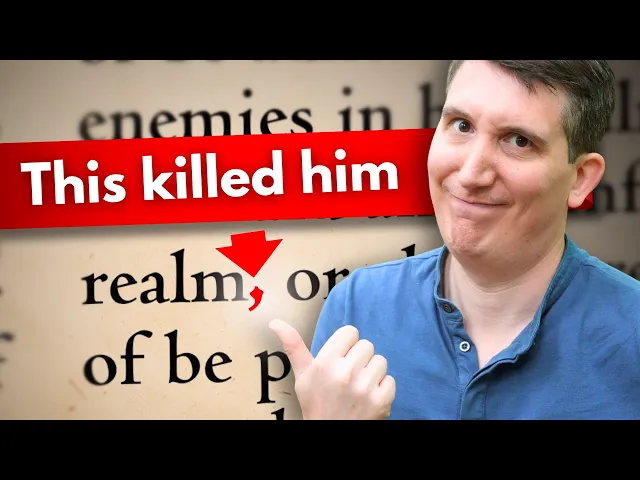
Hanged by a comma
RobWords
0:00 “Hunters: please use caution when hunting pedestrians using walk trails.” “Oh!
0:06 Boy syrup” “Made “fresh” in store” A misplaced
0:12 or absent punctuation mark can lead to hilarity.
0:16 But at its worst it can cost you millions.
0:20 Or it can even cost you your life.
0:23 So let’s explore some of the worst uses and misuses of punctuation from history.
0:28 Welcome to another RobWords.
0:32 This is the state funeral in Ireland of Sir Roger Casement in 1965.
0:38 However, by this point, the hero of the Irish nationalist movement
0:43 had already been dead for almost 50 years.
0:46 In the meantime, his remains had been languishing in the grounds
0:49 of a prison in London where half a century earlier,
0:53 he’d been executed for treason.
0:55 The story of Roger Casement’s death is the right
0:58 place to begin a video about the power of punctuation,
1:02 because he has gone down in history as the man who was “hanged by a comma”.
1:07 Casement’s trial in 1916– in the thick of the First
1:11 World War– was big news either side of the Irish Sea.
1:15 Sir Roger had been arrested by the Royal Irish Constabulary after travelling
1:19 by German U-boat to Ireland and was taken to the Tower of London.
1:24 Remember: Ireland hadn’t yet achieved independence from Britain at this point.
1:29 He stood accused of trying to recruit Irish
1:31 prisoners of war in Germany to the independence
1:34 movement in Ireland and of procuring weapons
1:38 from the Germans to use against the British.
1:41 There was zero doubt that Sir Roger had done what he was accused of.
1:46 The playwright George Bernard Shaw– a fellow Irishman and fan
1:49 of the Republican– wrote supportive letters
1:51 to Casement as he was awaiting trial.
1:53 But later also wrote that “the facts were undeniable”.
1:58 Instead, his defence team was hoping to keep him
2:02 from the gallows by contesting a point of law.
2:06 This is where the fateful comma comes in.
2:09 Sir Roger was being tried under the 1351 Treason Act.
2:13 a piece of legislation that was already over half a millennium old,
2:18 and it said a treasonable offence was committed… “if a Man
2:21 do levy war against our Lord the King in his realm,
2:25 or be adherent to the King’s enemies in his realm,
2:28 giving to them aid and comfort in the realm, or elsewhere…” Dot, dot, dot.
2:34 We can stop there, because there it is.
2:36 The comma upon which Casement’s life supposedly hung– right near the end,
2:42 just before “or elsewhere”.
2:44 The sentence– or rather, fragment of a sentence– is hideous, isn’t it?
2:48 It is ambiguous, and in such a way that makes
2:52 what Roger Casement did either treason or not treason.
2:56 His defence argued that this described two possible treasonable acts: One:
3:02 levying war against our Lord the King in his realm,
3:06 and two: adhering to the King’s enemies in his realm.
3:10 The bit about “giving to them aid and comfort in the realm
3:13 or elsewhere” was simply a clarification of what “adhering” meant:
3:18 helping the King’s enemies whether those enemies were in Britain or abroad.
3:23 Now, under this interpretation, for the act to be treason the traitor
3:28 had to be acting within the King’s realm, i.e.
3:33 on British soil.
3:34 However, Roger had done the acts he was accused of while in Germany.
3:40 Therefore: not treason.
3:42 It’d basically make him a prisoner of war or enemy agent rather than a traitor.
3:47 The prosecution, of course, had other ideas.
3:50 They argued that the “or elsewhere”, separated off by a comma,
3:55 in fact referred to where the “adhering to the King’s enemies” had taken place.
4:00 It was treason if the adherence had happened “in his realm… or elsewhere”.
4:07 It’s tough, but if you are lost, it’s not a big deal.
4:10 The point is: read the sentence one way and Sir Roger is not a traitor.
4:14 Read it another and he’s guilty as sin.
4:18 And the comma is a big part of the ambiguity.
4:22 Take it away and the defence has a stronger case.
4:25 Leave it in, and the law remains confusing.
4:29 So where’s the argument?
4:30 The comma is there.
4:31 We’re looking right at it, aren’t we?
4:34 Well, yes we are.
4:35 But just have a look at the other side of this document.
4:40 This is exactly the same text but in a different language.
4:43 How’s your French?
4:44 Well it doesn’t really matter because this is 14th century Anglo-Norman French,
4:49 which is rather different to the French spoken today.
4:52 Nevertheless, I’m confident that this is the equivalent bit
4:57 and do you notice anything about this bit of text?
5:01 No commas at all.
5:02 And definitely not before the “ou par aillours”, which means “or elsewhere”.
5:09 Does this matter?
5:10 Well, yeah.
5:11 Because this is the original version of the law.
5:14 The English translation comes later and might
5:17 not be an accurate interpretation of it.
5:20 Someone just decided to put those commas in.
5:23 In the end, the judge sided with the prosecution.
5:27 His activities, even though they were in Germany, were treason.
5:32 After being found guilty, Casement wrote:
5:34 “God deliver from such antiquaries as these, to hang a man’s
5:39 life upon a comma and throttle him with a semi-colon.” Dramatic.
5:44 Casement was stripped of his knighthood,
5:46 earned from the King just five years earlier for highlighting
5:49 atrocities against indigenous people in the Belgian Congo and Peru.
5:53 He was an impressive fella who despised colonialism in all forms.
5:57 And he was sentenced to death.
6:00 In the century since he was hanged,
6:02 the importance of the comma in his case has become somewhat inflated,
6:05 I think it’s fair to say.
6:06 Sir Roger was doomed as soon as he entered the dock,
6:10 with the British acting as both the victim and the judge,
6:14 jury and executioner in the case.
6:16 What’s more, the discovery of his diaries
6:19 at that time revealed that Sir Roger was gay.
6:23 A serious crime all of its own back then.
6:25 He died a martyr to the Irish cause and 50 years later,
6:29 his remains returned to Ireland and where he received that state funeral,
6:34 and is remembered as a hero of the Republican movement.
6:38 Next, we’re going to explore what happens when punctuation meets piracy.
6:44 But first, let’s see how many punctuation marks I can get into this next bit.
6:49 When you dash away on holiday any websites
6:52 you visit know that you’re in another country.
6:55 This can make accessing some of the content
6:57 you’re used to a bit of a catapostrophe.
7:01 However, you can surf the net like you’re
7:04 still at home using this video’s sponsor, NordVPN.
7:08 NordVPN enables you to change your online location,
7:11 meaning you can say “goodbye geoblocked content” and “hyphen-omenally
7:15 good access to media from around the world”.
7:20 But that’s not all: disguising your I.P.
7:22 also protects you on public wifi,
7:24 bringing online snoopers hoping to access your data to a full stop.
7:29 And NordVPN is much more than just a VPN.
7:32 It helps you move your internet security forward,
7:35 slashing your chances of falling victim
7:38 to cyber criminals using its Threat Protection feature.
7:42 It helps you effortlessly dodge any dirty tricks by online
7:45 mob rackets by scanning any downloaded files for malware,
7:49 directing you away from websites known for scamming people,
7:52 and blocking irritating or harmful popups.
7:55 I have NordVPN switched on all the time and I can protect my whole
8:00 family from head to colon by having it on up to 10 devices.
8:04 Don’t leave a question mark over your cyber security.
8:07 Use my special link or go to NordVPN.com… uh… slash robwordsvpn.
8:13 That’s nordvpn.com/robwordsvpn to get an exclusive
8:16 deal with 4 extra months on top.
8:20 There is a 30-day money back guarantee, so why not try it out for a period?
8:26 Now, in 1818, the US Supreme Court was faced with a quandry as it so often is.
8:33 In the case of United States v.
8:35 Palmer et al, it had to decide whether three men,
8:38 John Palmer, Thomas Wilson, and Barney Calloghan, were pirates.
8:44 “Shiver me timbers!” The Court set out the facts,
8:46 in typically impenetrable legal prose:
8:47 The three men “did piratically and feloniously set upon,
8:51 board, break, and enter a certain ship called
8:55 the Industria Rafaelli.” It was a Spanish ship.
8:58 They then “piratically and feloniously” did various other nasty things,
9:03 before making off with thousands of dollars worth of sugar,
9:07 rum, honey, hides, coffee, silver and gold.
9:11 Now, that sounds pretty piratey to me.
9:13 But was it in the eyes of US law?
9:16 That’s what the Supreme Court had to decide and it
9:20 mattered because piracy was a crime punishable by death.
9:24 But the law was so unclear that it prompted the judge to say:
9:28 “It really is the fact in this case,
9:31 that these mens’ lives may depend upon a comma.” Here’s the statute,
9:35 and it is rammed full of things.
9:37 Comma after comma after comma.
9:40 And they’re positioned in such a way as to create two perfectly reasonable,
9:45 very different interpretations.
9:47 It’s basically saying that certainly crimes,
9:49 if they carried the death penalty on land,
9:52 should be considered piracy on the high seas,
9:55 and therefore also receive the death penalty.
9:58 But the controversy surrounds this bit here.
10:03 The glut of commas makes it impossible to know
10:07 whether this caveat applies to just this bit, or to all of this bit.
10:14 And that’s a disaster,
10:15 because one of those interpretations makes all robbery on the high seas piracy,
10:21 but the other makes only the kind of robbery
10:24 that could get you sentenced to death on land piracy.
10:27 If the latter is the correct interpretation,
10:29 the three fellas walk away with their lives.
10:32 [Pirates] “Huzzah!” “Yay!”.
10:34 But the Supreme Court decided that it wasn’t.
10:37 [Disappointed pirates] “Oh…” Robbery on the high seas did count as piracy
10:40 whether it would be a capital offence in the US or not.
10:44 Are the three men pirates?
10:46 Yes they argghhhhh.
10:48 And yet… the trio walked free.
10:51 While the Supreme Court agreed what they did was piracy,
10:54 it also ruled that the US had no
10:57 business prosecuting them when the crime committed had been
11:00 against a foreign ship and they’d been commissioned
11:03 to rob it– it turned out– by a foreign government.
11:07 The three would-be pirates lived to plunder another day.
11:11 Next, can I show you what is easily
11:14 my favourite deployment of punctuation of all time?
11:16 Because it occurs just 30 years after the piratical punctuational escapade.
11:22 It’s in this 1848 book, “A pickle for the knowing ones”.
11:28 It’s was written by a, let’s say, “quirky” fella called Timothy Dexter,
11:33 an American businessman whose successes are
11:36 generally attributed to luck rather than skill.
11:39 In this book he tells the story of his life in breathless fashion.
11:45 So breathless, in fact, that there is not a single use of punctuation.
11:50 His sentences are technically endless.
11:54 However, at the very end of the book he appended this page.
11:58 A leaf filled with commas, colons, semi-colons, etc.
12:03 all of which come with no explanation.
12:06 Not in this edition anyway: in an older edition,
12:10 Lord Dexter included a small note
12:12 for the printer about this weird collection of marks.
12:16 “The knowing ones…”– by which he means, normal,
12:19 intelligent people– “...complain of my book the first edition had no stops.
12:23 I put in enough here and they may pepper and salt
12:27 it as they please.” So what he’s saying here is,
12:30 “You don’t like the lack of punctuation?
12:32 Here.
12:32 Choose your own.” What a guy.
12:36 Now, so far in this video, we’ve seen how sloppy punctuation can cost lives.
12:41 But it can also cost you an awful lot of money.
12:45 In 1872, the US Congress published its riveting-sounding Tariff Act of 1872.
12:53 It set out what duties importers of all manner of goods
12:56 would have to pay to get those goods into the United States.
13:00 However, it also included a “free list” which
13:03 described which goods were not subject to tariffs, i.e.
13:07 they were free to import.
13:09 On that list was written this: “Fruits, plants, tropical and semi-tropical,
13:15 for the purposes of propagation or cultivation.” So,
13:19 it’s reasonably clear, isn’t it?
13:21 There’s a bit of ambiguity over whether
13:23 the “tropical and semi-tropical” refers to just the plants,
13:26 or to the fruits and plants, and it’s a bit clunky to read,
13:29 but what is clear is that we’re dealing with two types of goods, aren’t we?
13:34 Fruits and plants.
13:36 Simple.
13:37 Except… this contains a rather unfortunate printing error.
13:41 Congress had in fact intended for the statute
13:44 to contain an exemption for “Fruit-plants, tropical and semi-tropical,
13:48 for the purposes of propagation or cultivation.” Uh-oh.
13:54 There’s quite a difference between these two, isn’t there?
13:56 One allows just plants and the other allows fruit and plants.
14:01 At the time, the publishers responsible
14:03 for this error were humiliated in the press.
14:07 The New York Times pointed out that firstly,
14:09 the “s” on fruits shouldn’t be there, and that secondly the hyphen after fruit
14:13 had been idiotically converted to a comma.
14:16 The Times then dramatically declared, “Here we have it!
14:20 The intention of Congress depending on a punctuation mark!” It witheringly
14:25 added “Such loose and slip-shod legislation by persons pretending to understand
14:30 the English language is disgraceful.” Importers of course took advantage
14:35 of the loophole created by the comma that should have been a hyphen,
14:38 and before it was closed, it’s since been estimated the mistake cost
14:44 US taxpayers two million dollars in unpaid revenue.
14:48 That’s the equivalent of today, 40 million dollars.
14:53 Ouch.
14:54 That is one costly comma, but not the only one witnessed in the United States.
14:59 Let’s move forward in time, quite a long way,
15:02 actually, to less than a decade ago,
15:04 to 2017 and to a hearing where the first words
15:08 out of the judge’s mouth were “For want of a comma,
15:12 we have this case.” Do you know what an Oxford comma is?
15:15 It’s sometimes also called a serial comma,
15:17 and it’s the comma that appears just before “and” or “or” in a list,
15:22 like“ “blood, toil, tears, and sweat” from the famous Winston Churchill quote.
15:28 That final comma is essentially optional.
15:31 Actually, despite the name “Oxford” comma,
15:33 it’s less likely to be used in the UK than in the US.
15:37 In fact, the official transcript
15:39 of that Churchill quote doesn’t actually have one.
15:42 I cheated.
15:43 Optional or not, without doubt the Oxford
15:46 comma can help avoid certain ambiguities.
15:49 Take this sentence, for example: “Meet my parents, Barney the Dinosaur,
15:54 and Shrek.” The serial comma makes clear we’re meeting four people:
16:00 my parents, Barney, and Shrek.
16:02 Leave the comma off,
16:03 and it appears to reveal I’m the offspring of dino and ogre.
16:07 [Barney and Shrek] “We love Rob” Which I’m not.
16:10 And just such an ambiguity is responsible
16:13 for the case before the Court of Appeals in 2017.
16:17 Delivery drivers for Oakhurst Dairy
16:19 argued that, despite their employer’s insistence,
16:22 their work should be eligible for overtime pay.
16:26 They pointed to a section of the law in the State of Maine
16:29 that provided that only the following activities should be exempt from overtime.
16:34 “The canning, processing, preserving, freezing, drying, marketing, storing,
16:38 packing for shipment or distribution of: Agricultural produce;
16:42 meat and fish products;
16:44 and perishable foods.” The dairy delivery drivers insisted
16:48 that they didn’t do any of these things,
16:51 so must therefore be eligible for juicy overtime pay.
16:56 However, Oakhurst disagreed saying the drivers were very
17:00 clearly responsible for the “distribution of” “perishable foods”.
17:05 Now, can you see what’s happening here?
17:07 The drivers and dairy are in disagreement
17:10 over one specific bit of this sentence.
17:13 So, Oakhurst is saying that “distribution” is one of the items on the list.
17:18 However, the drivers are claiming that it isn’t,
17:21 but rather “packing for shipment or distribution” is a single task.
17:26 A task that they do not perform.
17:30 They’re drivers not packers.
17:32 Initially, the District Court sided with the dairy,
17:35 saying the law clearly exempted distribution
17:38 of perishable foods from overtime protection.
17:41 But the circuit judge at the Court of Appeals thought otherwise,
17:45 saying “If that exemption used a serial comma…” i.e.
17:48 and Oxford comma “to mark off the last of the activities that it lists,
17:53 then the exemption would clearly encompass
17:55 an activity that the drivers perform.” However,
17:58 the law contained no such comma and thus
18:01 the judge adopted the drivers’ narrower reading of the exemption,
18:05 and reversed the previous judgment.
18:08 The drivers won and the case and it
18:11 was reportedly settled for $5 million dollars.
18:13 Looking at the legislation in Maine now,
18:15 you can see that they’ve fixed the law– opting to go
18:18 belt and braces by using semi-colons to separate up the list.
18:21 You can also see that, ultimately,
18:24 the dairy’s interpretation was the correct one.
18:26 The comma is not the only punctuation mark
18:29 whose addition or omission has had oversized consequences.
18:33 One of the marvellous things about English is that with a single
18:37 squiggle and a dot we can transform a statement into a question.
18:41 For example, “You ate my hamster”.
18:44 Statement.
18:45 “You ate my hamster?” Question, to which the answer will hopefully be “no”.
18:50 A mere question mark can turn the certain into the uncertain.
18:55 And there is a marvellous historical instance in which
19:00 this punctuation superpower was used to ridiculous effect.
19:04 In 1916, while Britain was bogged down
19:06 in the First World War and executing Irish heroes,
19:10 the USA– which was yet to join the war– was holding a presidential election.
19:15 Incumbent Democratic President, Woodrow Wilson,
19:18 faced Republican challenger Charles Evans Hughes.
19:22 Now, it had been almost a century since
19:24 a Democrat incumbent had won a second term,
19:26 and as the results came in, it became apparent
19:29 that Woodrow Wilson wasn’t about to buck that trend.
19:32 Hughes looked on course for victory,
19:35 and so confident were some newspaper editors that the Republican had won,
19:38 that they put their papers to bed that very
19:41 night with headlines declaring that he had done.
19:44 Supposedly among the papers to do this was New York’s The Evening World.
19:48 I couldn’t actually find the front page in question.
19:50 It appears to have been expunged
19:52 from the record for reasons that will become apparent.
19:55 But according to accounts from the time, The Evening World initially went
19:59 with the headline “HUGHES ELECTED IN CLOSE CONTEST”.
20:03 President-elect Charles Hughes must have gone
20:05 to bed on election night pleased as punch.
20:08 Victory was assured.
20:11 However, the journalist Walter Millis later wrote about what happened next.
20:16 “When Mr Hughes awoke that morning his photograph was
20:19 still resplendent upon the front pages of the late editions.
20:22 The World’s banner headline stood as before save
20:26 the the addition of one small punctuation mark.
20:30 It now read: “HUGHES ELECTED IN CLOSE CONTEST?”” The element
20:35 of doubt injected by the question mark was well founded.
20:38 Hughes had in fact lost,
20:41 as the Library of Congress’s archived edition of the New York World shows.
20:45 They did eventually get it right,
20:47 although they were still hedging their bets with “probably”.
20:49 That whole incident must have
20:51 been absolutely gutting for almost-President Hughes,
20:54 but at least that punctuation mark didn’t cost
20:57 anyone their lives or anyone millions of dollars.
21:00 And in that spirit of frivolity, let’s look at a few more of some
21:03 of the sillier punctuation errors that the internet has to offer.
21:07 I’m a big fan of this Reddit called “suspicious quotes”
21:11 which charts all manner of bonkers use of quotation marks.
21:15 Usually what’s happened is somebody has used them for emphasis,
21:17 which is not what they are for.
21:20 For example: “If you drop a “cup” on the floor
21:24 please pick it up.” What is “cup” code for here?
21:28 What is the actual name of this hotel, if it’s not actually “Aragon”?
21:33 What meat is this if it isn’t actually “pork”?
21:37 And unless this is really a front for some other sort of laundering,
21:41 get rid of the quotation marks.
21:43 And from the “Punctuation Kills” reddit,
21:45 this meme always serves as food for thought,
21:48 stressing the difference between “Congrats” on your baby.
21:52 Congrats on “your” baby.
21:54 And, Congrats on your “baby”.
21:58 Yeah.
21:59 “Punctuation matters”.
22:00 Thanks for watching.
22:01 If you enjoyed this, I reckon you’ll like this one too.
22:05 Ooh, and if you happen to be in London on the 11th of April and at a loose end,
22:09 I’m doing two live shows at the Bloomsbury Theatre.
22:12 Come and see me.
22:13 I’ll leave a link to tickets below.
22:15 You can also check out my free newsletter.
22:19 Until next time: take care.