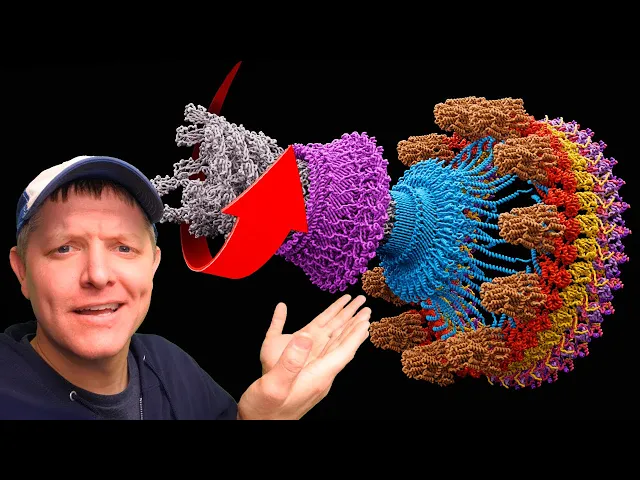
Nature's Incredible ROTATING MOTOR (It’s Electric!) - Smarter Every Day 300
SmarterEveryDay
0:00 Hey, it's me, Destin.
0:00 Welcome back to Smarter Every Day.
0:02 This is the 300th episode, which is cool.
0:04 Thank you so much for watching.
0:06 I was on the internet the other day.
0:07 I was just scrolling on my phone.
0:08 I was probably wasting too much time.
0:10 But I came across this amazing animation that blew my mind.
0:15 It's a motor that appears to be made out of molecules.
0:19 And I'm a mechanical engineer.
0:21 When I saw this thing, I was like, that's a motor.
0:24 That's a spinny thing that has a power source.
0:29 It has an axel of some sort, and it is moving.
0:33 Furthermore, this one, I have a little switch here,
0:35 can reverse directions, which is amazing.
0:38 So I thought I've got to get to the bottom
0:42 of this because the implications for a biomechanical motor are insane.
0:48 Now, specifically, the thing this is called is called a flagellar motor.
0:52 You may have heard of the flagellum on the back of sperm or on bacteria.
0:56 That's what this is.
0:57 A flagellum is that whipy thing
0:59 in the the single cellular organism that helps provide locomotion.
1:03 But I've never thought about that thing has to spin,
1:07 which means it has to have a shaft it rotates around.
1:11 It's just the implications are wild.
1:14 So the more I got to reading about this flagellar motor is what it's called,
1:18 the more I realized this is a really big topic,
1:22 not only in biomechanics and things like that, but in philosophy.
1:26 The complexity of a flagellar motor implies
1:30 many things about the origin of life.
1:32 And I'm not going to answer that in this video,
1:36 but it raises questions that people are debating,
1:39 and they're talking about, how can this be?
1:42 It's so complex.
1:44 Well, You don't understand the time involved with how this came.
1:47 All this is fascinating.
1:49 So I just wanted to see it.
1:51 So to get to the bottom of how this thing is,
1:54 I decided to go to the researchers that made the image,
1:57 which is a guy at Vanderbilt University.
1:59 So I'm a Smarter Every Day.
2:01 I did this about a month ago.
2:02 Just got in the car, drove to Vanderbilt,
2:04 and we're going to learn about a flagellar motor.
2:07 Let's go get Smarter Every Day.
2:12 So I bobbed and weaved my way across the Vanderbilt University campus
2:15 till I got to the School of Pharmacology and connected with Prashant sing.
2:19 Yeah, doing well.
2:20 Nice to meet you.
2:20 How are you?
2:21 Yeah.
2:22 Prashant is a Senior Research Associate at the Iverson Laboratory at Vanderbilt.
2:26 Just to give us whole context here,
2:28 you have written a paper with your team in Nature...
2:31 What was the- [P] Microbiology.
2:33 [D] Nature Microbiology.
2:34 It's about a motor that's made of molecules that's on bacteria.
2:39 Yes.
2:39 Okay, can you show me where on a bacteria the motor is?
2:43 [P] Sure.
2:44 If You see on the screen here, this is how a bacteria looks like.
2:48 The bacteria has two membranes.
2:50 These two membranes protects the bacteria from getting disrupted.
2:54 [D] We're talking about the outer shell of the bacteria.
2:56 [P] Outer shell of the bacteria.
2:57 [D] Okay.
2:57 [P] If you see here, there will be The two membranes, the orange and the blue.
3:02 Now, zoom into that.
3:03 [D] Okay, so it's almost like a submarine.
3:06 Forgive me, Prashant.
3:07 I'm going to say a bunch of engineering terms because I'm an engineer.
3:10 [P] I understand.
3:10 [D] It feels like a submarine with the outer
3:14 hull and then the inner pressure hull.
3:16 [P] That's correct.
3:17 My dad was a submariner himself.
3:18 [D] Was he really?
3:19 [P] Yeah, he was an Indian Navy submariner for 15 years.
3:23 [D] So this bacteria, in my head, is like a submarine.
3:25 [P] Yes.
3:26 [D] Okay.
3:26 And is this the propeller of the submarine?
3:29 [P] That is correct.
3:30 This is the propeller or the flagella.
3:32 Now, this submarine does not have a rudder.
3:35 It doesn't have a rudder, but it uses a propeller to turn as well as swim.
3:40 So what we see here, the two membranes that are here,
3:44 and there's proton filled in here.
3:46 [D] Did you say proton?
3:47 [P] Yeah, it's filled with protons, hydrogen ions in here.
3:51 [D] Oh, hydrogen ions.
3:52 Okay.
3:53 [P] The hydrogen ions in here filled,
3:55 and on the inside here, there's very little hydrogen ion.
3:59 There's a It's a gradient.
4:00 [D] Forgive me.
4:01 We have to go slow for me.
4:02 When you say proton, you're meaning an atom that is lacking an electron?
4:06 [P] Yes, just a proton.
4:07 It's a hydrogen ion.
4:08 This is high concentration of protons in this region
4:13 and low concentration of proton in the inside of the bacteria.
4:17 Now, protons, every time there's a gradient, for example, there's a dam,
4:21 water is up there, and there's a lower, there's less water,
4:24 there's a gradient, energy can be generated, or it could be used,
4:28 that potential energy could be used to kinetic energy.
4:30 [D] There's a potential difference of electrochemical force of some sort?
4:36 [P] Yes.
4:37 That's the gradient that this motor uses to turn itself.
4:41 What happens is, if you see here, this flagella,
4:44 which is a propeller, is connected to a motor system.
4:48 [D] How does it know when to turn the motor on?
4:49 [P] There are sensors on the outside of the bacteria.
4:55 Once it knows that there's a threat or there's more energy near me,
5:00 it senses that it gets a chemical signal,
5:03 and there's a cascade of signals that go through.
5:07 One of the protein well known for this is called CHeY,
5:12 C-H-E and Y, capital Y, QY.
5:14 The moment it senses that I need to run away
5:17 from this location or I want to go to a different location,
5:20 that protein comes and binds to it,
5:22 and it encourages the motor to turn in clockwise direction.
5:28 [D] Okay, so we need to talk about what you just
5:30 said because you just created a coordinate system inside the bacteria.
5:36 You put sensors on the outside of the bacteria.
5:38 Well, it already exists.
5:40 Okay, there are sensors on the outside of the bacteria.
5:42 Somehow the bacteria knows where a sensor is triggered and it
5:49 knows how to trigger what motor on what side of the bacteria.
5:52 [P] Yes, and how to turn it.
5:54 [D] And which direction to turn it?
5:57 [P] Which direction.
5:57 So that particular protein it will make it go in clockwise.
6:02 This is clockwise direction.
6:03 When it is not attached to it, it will go in counterclockwise.
6:08 The default motion is counterclockwise.
6:10 When the motor turns counterclockwise- [D]
6:12 You say counterclockwise from which direction?
6:14 [P] From this direction.
6:14 [D] From the outside.
6:15 [P] From the outside, yeah.
6:16 [D] The outside, okay.
6:17 [P] Yeah.
6:17 So counterclockwise would be this.
6:19 And when the motor is running in counterclockwise,
6:22 the bacteria will swim forward.
6:24 So it's just the board goes straight.
6:26 [D] And that has to do with the shape of… If I were to design
6:29 this, I would say that would have to do with the shape of the impeller.
6:33 So the tail?
6:34 [P] Yes.
6:35 The way the flagella is made, it's like a whip.
6:38 So when it starts rotating, it thrusts,
6:41 the force goes backwards and it moves it forward.
6:44 Now, you would think that it would also do
6:46 the same thing when it's going in the opposite direction, right?
6:48 [D] Yeah.
6:49 [P] Now, what happens is when it's going in the counterclockwise,
6:53 there are multiple flagellas on the bacteria body.
6:56 All of them start forming a bundle,
6:59 and multiple propellers form into one big propeller
7:03 and pushes this straight and it goes boom, straight.
7:06 Now, when it has to sense it like there's a danger,
7:08 I need to stop, I need to reanalyze my situation gradient,
7:11 I need to test, I need my sensors on and test it again, it turns clockwise.
7:16 When it does that, the bundle opens up.
7:18 When they open up, it just pauses the whole
7:21 bacteria and the bacteria starts stumbling all around.
7:24 [D] Starts floating, yeah.
7:25 It no longer has a certain… There's got to be a word Latin in here, taxis.
7:30 [P] Yeah, chemotaxis.
7:32 Chemotaxis, yeah.
7:33 Exactly.
7:34 We call this whole process of bacteria's mobility like chemotaxis.
7:37 It's a chemical signal that allows the bacteria
7:40 to taxis or move from one place to another.
7:43 Everything happens in milliseconds.
7:45 There are some videos that show bacteria moving from one place to another,
7:48 and it's just like crashing.
7:50 It's a biased, random walk.
7:52 Researchers have done this experiment.
7:55 There's a petri dish,
7:55 and they put food in the center and put bacteria on the edges of it.
8:00 You would think the bacteria would go straight to the food,
8:02 but no, it just goes a little bit straight,
8:04 then turns around and goes in the wrong direction,
8:06 realizes, Oh, I'm in the wrong direction, goes back.
8:09 That, as a person, you think random.
8:12 [D] I'm getting emotional now because there's
8:14 a missile that I've worked on in the past,
8:16 and it has what we call pulse-width modulation control.
8:20 And so what we do is we take the fins
8:22 on the side of the missile and we dither them.
8:24 We go like that.
8:26 And then all we do is we bias the dithering up or down.
8:30 We go...
8:33 So it's constantly moving,
8:34 but we just bias it just a little bit in order to make a movement.
8:38 And so what took us a long time to figure out, you're just describing it.
8:45 This molecule or this bacteria has an operating system.
8:48 It has sensors.
8:50 It has effectors.
8:53 It has actuators.
8:54 [P] Exactly.
8:55 [D] And it has feedback.
8:56 And I'm getting emotional.
8:59 Because It's a neat design is what I'll say.
9:02 [P] It is.
9:03 Over the years, this design has evolved to be so perfect.
9:07 It just takes some time, but it does go where it's supposed to go.
9:11 It doesn't have eyes like we do.
9:12 It figures out by sensing and moving in directions.
9:15 [D] It's an emergent behavior based on a few inputs.
9:18 Emergent behavior?
9:19 [P] Yeah, that's a good term.
9:21 [D] The structure of this motor, is it well known in the community?
9:24 In all of research, people know about this?
9:28 [P] They have seen a low resolution structure.
9:31 Basically, if I blur this up, they have known that for 15, 20 years.
9:35 They have known it looks like this blob.
9:37 There's a ring at the bottom, there's a ring on the top.
9:40 But what we have is a high-resolution structure,
9:42 meaning we can see each and every amino acid.
9:45 [D] I noticed on your video, it's almost like a big gear and a small gear.
9:51 [P] Yes, that small gear is MOT-AB.
9:53 That is what the proton comes through, and that's what turns this thing.
9:56 [D] Prash explained that the MOT-AB,
9:58 the little part that spins like an ion pump,
10:00 is able to interact with this band of red called Fly-G,
10:05 and that has the ability to pivot 180 degrees,
10:08 which enables the motor to change directions.
10:11 So in your animation, you have one small gear going in.
10:14 Is it literally Is that really one small gear or are there many all around?
10:16 [P] It can employ more if it needs more torque.
10:21 It's two, three, four, five, six, seven, eight, nine, 10, 11.
10:24 Up to 11 is what we see can fit on there, but maybe 12 or 13 as well.
10:29 But we don't know the exact number how many can be employed.
10:31 But it is a sequential increase depending on the load of the flagella.
10:36 [D] Okay, so I'm going to get all engineering with you now.
10:39 If you have a torque, you have to have a thing to react against.
10:44 So So that little pinion, I'll call it, the little...
10:47 What did you call it?
10:49 Mot AB.
10:49 Mot AB?
10:50 [P] Mot, M-O-T-A-B.
10:52 [D] Mot AB.
10:53 [P] Yeah.
10:53 [D] So Mot AB is this little thing that's driving it.
10:55 [P] Yes.
10:57 [D] Is it pinned to the sidewall or something?
10:59 What is it?
11:00 [P] It's also in this inner membrane.
11:03 So it's right here.
11:04 So there's multiple colors that you see, orange, cream, and green.
11:09 This all is one Mot AB.
11:11 And it takes protons or hydrogen ions
11:13 from the top and goes into the low gradient here.
11:17 And as it's doing it, it makes interaction with this red protein here.
11:21 And this rotates, and it causes the motor to rotate.
11:24 [D] Okay, but it's pinned in that wall.
11:27 [P] Yes, it is pinned in this membrane, but it can go around,
11:30 and it can shift a little bit in and out.
11:32 Mot-ab is only turning in one direction.
11:35 It cannot go in two directions.
11:36 Here, the energy is only going from top to bottom.
11:39 So how does this motor go in two directions?
11:41 And that does because the MOT-AB, first it's outside,
11:44 but when it has to go in the other direction,
11:48 the red protein turns 180 degree, pulls the MOT-AB with it,
11:52 and then MOT-AB keeps doing what it's doing.
11:54 It's churning in the same way,
11:55 but that causes the motor to go in the other direction.
11:57 [D] It's like shifting into reverse in a manual transmission car.
12:01 [P] Yeah, it's almost like back to you has a reverse gear.
12:05 It reminds me of my motor that my grandfather
12:08 worked on where there's copper coils that he's making,
12:12 putting in these old, rebuilding these motors and putting fresh copper coils.
12:15 It reminds me of that structure.
12:18 [D] Because your grandfather was an electrical engineer, right?
12:20 [P] Electrical Engineer.
12:21 He used to build and rebuild motors for factory at factories.
12:25 [D] Is it fun to know that you're
12:27 working on motors now just like your grandfather?
12:28 [P] Yes, it is.
12:30 It feels very rewarding to be working
12:34 on something that my grandfather worked in the past.
12:37 Obviously not the same scale, not the same thing.
12:40 But just to know that I'm working on motors is fun.
12:45 It's rewarding.
12:45 [D] Okay, this is incredible.
12:47 I love this.
12:48 We're going to go back and talk to Prash later
12:50 to understand how he got these images of the motor.
12:52 But to get more context, let's go over and talk to Dr.
12:55 Tina Iverson, who runs this lab.
12:57 She's the PI or the Principal Investigator.
12:59 This is Dr.
13:00 Iverson, and this is your lab, right?
13:02 [T] This is my lab.
13:03 [D] So congratulations on getting this published.
13:05 That's a big deal.
13:06 And simply put, what have you found here?
13:09 [T] So we are looking at really this nuts and bolts of how bacteria can move,
13:15 how they can move toward something that attracts them,
13:18 like a food source, and how they can move
13:21 away from something that would kill them, like an antibiotic.
13:24 Bacteria are moving toward a food source as driven by their metabolism.
13:29 [D] Okay.
13:29 [T] And metabolism is like the foods that you eat.
13:32 It's how you bring in energy into your body.
13:35 But we're asking that question at a larger level,
13:38 not just for bacteria, but for human cells.
13:41 How does metabolism affect what our cells do
13:45 in a way that dictates their self- fate.
13:48 And so we were trying to understand just at a general level,
13:53 why does metabolism change what cells do?
13:57 [D] I feel like every time we as humans
13:59 have the the ability to see smaller or farther.
14:02 We make big discoveries.
14:03 [T] Yeah.
14:04 [D] Do you feel that?
14:05 [T] Oh, yeah.
14:06 I think that one of the ways the entire field is going now
14:11 is there's been this ability to image very small things with fine detail,
14:18 but medium and larger things in the cell with more blob-like characteristics.
14:25 Some of the new technologies are now getting
14:28 to these larger assemblies proteins at finer details.
14:32 [D] So we're seeing the overall system.
14:34 [T] Yes.
14:34 So before we were putting the system together from component parts,
14:38 and now we're seeing the system more and more intact.
14:42 And these bridges between the molecules at an individual level,
14:47 which can tell us a lot about how they work.
14:49 But molecules together working in concert tells us much, much more.
14:53 [D] So we've got this motor that for the first
14:56 time we can see an image down to the protein level.
14:58 The question is, how do we get that image?
15:00 How is Prash able to see this motor and understand its
15:04 component parts in a way we haven't been able to understand previously?
15:07 To answer this question,
15:08 Prash took me over to the imaging lab where they use a series
15:11 of cryo-electron microscopes to look
15:12 at the structures to understand how they work.
15:15 He introduced me to Miriam and Scott, who were kind enough to show me around.
15:19 So now we're with Scott and Miriam, and these are the imaging experts.
15:22 Am I saying that correctly?
15:24 [S] Sure.
15:24 [M] Yeah.
15:25 [D] Okay.
15:25 Yeah.
15:25 Does that work?
15:26 [S] Absolutely.
15:26 So all of our sample goes onto a grid that's right here.
15:30 It's a mesh work on there.
15:32 [D] What's it made out of?
15:34 [M] Copper.
15:34 [S] Copper.
15:35 So they can make it made out of a copper, gold.
15:36 There's some other materials that we use for other various niche purposes.
15:41 Most of them are copper.
15:42 [M] You have whatever sample you have that's in a buffer.
15:45 It will get plunge frozen.
15:47 You literally just drop it in, drop your sample
15:50 into liquid ethane and just gets flash frozen.
15:53 So your sample is in vitreous ice.
15:55 [S] We're just making a network that can hold
15:57 little tiny sheets of ice with protein trapped in it.
16:00 [M] So that's what you start off with.
16:01 And then after plunging, then we load it into that little...
16:06 Cartridge.
16:07 [S] Our middle room here is our Glacius microscope.
16:09 So we'll walk in and look at it.
16:11 So this is the Glacius.
16:12 This is our screening microscope.
16:14 [D] So this is like a quick look.
16:16 [S] It's a quick look.
16:16 We have a source at the top that transmits
16:19 an electron beam all the way through the column,
16:22 and we put our sample in the middle and a detector at the bottom.
16:24 [D] So you're shooting through it?
16:26 [S] We're shooting transmission.
16:26 We are going all the way through that sample.
16:28 [D] The process that the scientists use to get these images is incredible,
16:32 and I'm going to take a crack
16:33 at explaining it with a super sophisticated animation style.
16:36 So behold, markers and paper.
16:39 All right, so there's two types of bacteria at work here.
16:42 You've got Salmonella and E.
16:44 Coli.
16:44 Now, Salmonella, that's where the flagellum motor is located.
16:49 That's these little yellow things back here.
16:50 So that's the flagellum, and that's the little motor.
16:53 Ecoli, a different bacteria,
16:54 has a little factory in it that can make things if you tell it what to do.
16:59 So So this process is called transformation.
17:02 So basically, I just took that motor off,
17:05 and I'm not going to put the motor itself into the factory in Ecoli.
17:10 I'm going to put the instructions of how to make the motor into Ecoli.
17:15 Ecoli is not the only type of cell that has a little factory like
17:18 this, but this is the one that the scientists
17:20 chose to 3D print this particular motor.
17:22 This is called transformation.
17:24 This little factory goes to work, right?
17:26 It makes a bunch of these little motors, and then you have a bacterial cell
17:32 that has all these little protein structures in it.
17:35 The act of creating this is called expression.
17:38 We are now going to take all
17:39 of these motors and do this process called purification.
17:43 We're going to pop this and we're going to use this grid and we're
17:46 going to basically dump all of the stuff
17:50 that's been purified onto this grid array.
17:52 We're going to flash freeze it.
17:54 And then after that, we're going to use this really fancy 200 kVA microscope
17:59 and We're going to go through and we're going to look at the grid.
18:02 Now, when we look at the grid, we're going to screen these.
18:05 So this is like a course view of what we're doing.
18:07 We're going to go through and we're going to say,
18:09 Hey, look, there's one right there.
18:11 That's important.
18:12 Over here.
18:13 Oh, that's important.
18:14 And then you're going to go all the way through this whole grid,
18:16 look in and see which one has motors in it.
18:18 How many motors does it have?
18:19 It might be a lot.
18:20 You're then going to move it over to the big microscope, the 300 KVA microscope.
18:25 And that's where we're really going to take our close up images.
18:28 So what they do is they zoom in, and then
18:30 they're going to take 50 frames of each individual little motor.
18:36 The reason they have to do that is because at this level,
18:38 you're down at the angstrom type level, like the atomic level.
18:41 Things shake a little bit down at that level.
18:43 So you have to take 50 images in order to compile that together,
18:47 you have to make sure you take out that dithering.
18:49 So at that point, you then have an image of a structure.
18:52 Now, that structure at that point, it could be like this, it could be like
18:56 this, it could be at any number of different aspects.
18:59 And Prash is going to tell us what he does with that information.
19:02 Before we talk to Prash,
19:04 if you want to learn more about microscopy and how the scientists do all
19:07 this, I've got way more information over on a video on the second channel,
19:11 which is Smarter Every Day 2.
19:12 Go check that out if you want to learn more about this.
19:14 So you get the images from the microscope.
19:17 [P] So when you get the images from the microscope,
19:20 they look somewhat like this.
19:21 [D] And I can see the little crown-looking thing there.
19:24 Is that the bottom of a motor?
19:26 [P] Yeah, this is the bottom.
19:28 This is the top view.
19:29 So I would say that this is how it looks.
19:32 This motor right here is the view of this one.
19:35 Then this view right here is a side view, something like this.
19:40 We click on all of these particles,
19:43 meaning we pick those proteins by hand and using the computer.
19:46 We run a program of 2D classification,
19:49 meaning we run a program where all these particles that has
19:53 been picked so far are similar-looking particles are put together into classes.
19:57 What we see here is some are just junks,
20:01 and some are actually our protein complexes.
20:04 [D] You go through there and you pick the ones that are the good stuff.
20:07 [P] Yes, exactly.
20:09 This looks like a good stuff.
20:10 This is a good complex.
20:13 This is good, this is good, but these are not.
20:16 We don't select those, but select the good particles
20:19 and put them together into a program for 3D modeling now.
20:23 We have 2D classes.
20:24 Once we have 2D classes, we put them together here to get a 3D version.
20:30 [D] Oh, so you build a 3D model.
20:32 You make these shapes actually match up.
20:35 [P] Yes.
20:35 Each of those classes on pictures that we saw,
20:38 we start matching them up as to which one is the top view,
20:41 which is the side view, and program starts doing matching those up,
20:44 and it does a very good job at doing that.
20:47 [D] It's really the ability to replicate so many.
20:49 That's the secret sauce.
20:50 You have the transformation, putting that information into Ecoli to replicate,
20:55 and then Ecoli expresses it.
20:56 That's expression and then purification.
20:59 Transformation, expression, purification, that's how you get it done.
21:03 [P] Once we get the 3D model, it looks something like this.
21:07 We can see all sides.
21:09 Now what we see is a low-resolution model.
21:12 We try to collect all the good signals and remove all
21:15 the bad signals and try to come up with a high-resolution structure.
21:19 What you see here is an 8 angstrom.
21:21 From here, 8 angstrom to 4 angstrom,
21:22 it took us about two weeks to get there, 2-3 weeks.
21:25 [D] You're removing bad data to get to the high resolution.
21:28 [P] Get to the high resolution.
21:29 [D] Then once you get to the high resolution,
21:31 then you actually start drawing and mapping the proteins.
21:33 [P] Yes, exactly.
21:34 To get this map, we're trying to put the pieces
21:36 in, the puzzle pieces in, and try to find what protein,
21:40 what amino acid goes in which place.
21:42 So since we know the sequence of the protein, we have the pieces.
21:45 We just have to fit it in this electron density.
21:47 [D] So we have these 2D images that we
21:50 wrapped together using software into a 3D model.
21:53 And at this point, we know it's made up of proteins,
21:56 which are made up of amino acids.
21:58 And so the question I had is, how do you know what chemical is where?
22:02 And it's my understanding that biochemists are just smart,
22:04 and they know that certain amino acids are shaped in certain ways,
22:09 like physical shapes.
22:10 So it's like a puzzle piece, and they just know what they look like.
22:12 So they're like, oh, here's blobafil, or here's quadraline.
22:16 I don't know these words,
22:18 but they can physically put the puzzle pieces in on the computer,
22:22 and they can figure out what the structure looks like, which is incredible.
22:25 [P] So if you see this curve, there's a curve here.
22:28 [D] The coil.
22:29 [P] The coil, and that's alpha helix.
22:31 This coil, now we know alpha helix, only certain amino acids make in a certain
22:36 orientation or sequence would make that coil.
22:39 So this prior information helps us trace this puzzle.
22:43 So if you see now, We can fill these gaps with these proteins.
22:48 [D] This is a shape a biochemist person would not be intimidated by this shape.
22:52 [P] No, that's very common.
22:53 It's commonly found in almost every protein.
22:57 Not every protein, but like 90%- [D] It's intimidating to me,
23:00 hah looks like a bunch of squiggles.
23:02 Yeah, but this is normal.
23:03 [P] This is normal.
23:04 [D] This is easily interpretable data.
23:07 [P] Yes, it is.
23:08 [D] Did you map these by hand and then just turn the image on?
23:11 Is that what just happened?
23:12 Or did you tell the computer to find the shape?
23:14 [P] No, we mapped this.
23:15 Our previous researchers have mapped this in the past.
23:18 We use the information as like, Oh, they have done part of this.
23:22 Let's use that and see if that fits in here.
23:25 If it does, it's good.
23:26 If not, we go in and do it by hand.
23:28 [D] Wow.
23:28 [P] Yeah, it can be doing one at a time.
23:31 It can take weeks to months sometimes, depending on how big your protein is.
23:35 [D] But you like it?
23:35 [P] Oh, yes.
23:36 This is the best part.
23:37 This is where we get answers.
23:38 This is what we have been doing all the work for.
23:42 Even when we are driving here, we are so excited.
23:44 What will I find today?
23:45 So now we come back and sit down, drink our coffee, and we're like, Oh.
23:49 So for example, I can go here and be like,
23:51 Let me see if there's any bonds being formed.
23:54 I go, Turn on the distances and angle.
23:56 So there's a definite interaction between this and this.
23:59 Maybe that is what's stabilizing this complex so well.
24:02 They're forming some bond between two amino acid.
24:05 So this is what gets us excited that we
24:08 have found the interaction that are happening in this complex,
24:12 what stabilizes this.
24:13 And if we disrupt this, this can disrupt this can disrupt the motor.
24:16 This can disrupt the connection it's having
24:18 or interaction it is having with other proteins.
24:21 [D] Once you disrupt this motor,
24:23 if you could destroy the motor or if you could stabilize it,
24:27 whatever, just if you had control,
24:30 then you could start to do things that would affect the chemotaxis?
24:34 [P] Yes, bacterial chemotaxis.
24:36 [D] You could disrupt the ability for the thing to move where it wants to go.
24:40 [P] Yeah, exactly.
24:41 For infection, stopping the bacteria is almost like having an antibiotic,
24:45 but not with an antibiotic, because bacteria can get resistant to antibiotic.
24:49 This is one of the many other options that people
24:51 are- [D] Maybe you get to invent a new word.
24:53 Instead of an antibiotic, it's a letharga biotic.
24:56 [both laughing] You get to slow them down.
24:59 [P] I like that.
25:00 [D] Thank you very much.
25:01 [P] Thank you so much.
25:02 [D] So the flagellar motor exists, and it's amazing.
25:06 It's complex, and it reminds me of an electric motor, and I love it.
25:10 I love this thing, and I think it's incredible.
25:14 There are implications for the fact that something so complex
25:18 exists and is so integral to the creation of human life.
25:22 I mean, this is fascinating stuff.
25:25 So it also opens up a huge debate.
25:29 People say, well, how can something this complex come to be out of nothing?
25:33 The logic goes like this.
25:34 If this motor system is composed of complex individual parts,
25:38 and all these parts work together to perform the overall function of rotating,
25:42 then how did the individual parts come to be?
25:45 Did it all have to happen at the same time?
25:48 Or is there some evolutionary advantage
25:50 to the cell for every intermediate stage of development?
25:53 Is 15% of this motor advantageous to the cell?
25:57 What function would 50% of the structure perform?
26:00 What were the steps these components took to assemble
26:02 into such a complex molecular machine in the first place?
26:06 Scientists are trying to figure this out,
26:08 and I encourage you to read their papers.
26:10 Many seem to be focusing on the Type 3 secretion system,
26:13 which works like a hypodermic needle that a cell can use to inject other things.
26:17 This device looks similar, but it's quite different in its protein structure.
26:22 The complexity and origin of the bacterial
26:24 flagellar motor is a really interesting conundrum.
26:27 As I was a younger man,
26:28 and I would read things on the I would find people saying,
26:31 Hey, you got to believe all this over here.
26:33 People say, Hey, you got to believe all this over here.
26:36 There's a big war going on.
26:37 It's between science and faith.
26:39 You're either in one camp or the other.
26:41 Get your flag and figure out where you're going to put your flag.
26:43 And the more I have matured and started
26:47 to not really care about defending where my flag is,
26:50 the more I've been able to learn from people no matter where they are.
26:54 I'm still working on this.
26:56 There's a really interesting book that I'm reading.
26:58 I can't speak for everything in the book.
26:59 I'm not done with it.
27:00 It's called Where the Conflict Really Lies.
27:04 It talks about this interplay between science, religion, naturalism.
27:10 It's very interesting.
27:11 It goes more into the areas of philosophy,
27:13 and I love it because it challenges me, and it's fantastic.
27:17 So this is what I would encourage you.
27:19 If you have your flag in a camp somewhere,
27:22 I would encourage you to not defend a flag.
27:25 I would encourage you to look at a flagellar motor and just
27:29 think about it and think about how it is and what it be.
27:34 It's a fantastic thing to think about.
27:36 How did this get here?
27:38 You have intelligence and you get to make up your mind.
27:42 And I love that about consciousness.
27:44 I love that about life.
27:46 And so for me, the flagellar motor makes me happy.
27:49 I feel joy.
27:50 You know how when you go outside at night and you look up at the stars
27:53 and you see all these stars and you feel small and you feel wonder,
27:58 that's what this makes me feel like, even though it is small.
28:01 I feel awe and reverence toward this thing.
28:04 And as a Christian, this makes me want to thank God that it exists.
28:09 I feel compelled with gratitude that this thing is so awesome.
28:12 So that's just where I'm at.
28:14 But what I would encourage you to do is just think critically.
28:17 You have a brain.
28:18 Don't defend a flag.
28:19 Just think about how things are.
28:21 And I hope you are very happy and experience the same
28:25 joy I feel about this, no matter what you think about it.
28:29 So anyway, enough about that.
28:31 I want to say thank you to everybody that supports Smarter Every Day on Patreon.
28:36 You'll notice there's not a sponsor on this video.
28:39 I just wanted to make this for you, and I just want to say thank
28:43 you to everybody that supports at Patreon.com/smartereveryday.
28:47 You're smart.
28:48 You know what I'm doing.
28:49 I'm just going around asking questions, and that's all these videos are.
28:52 So this is the 300th episode.
28:55 So thank you for supporting Smarter Every Day to allow me to do this so long.
28:59 And I would encourage you, if you're interested,
29:01 I would ask to consider supporting at Patreon.com/smartereveryday.
29:05 to let me keep doing it.
29:07 And if that's not your thing,
29:08 totally cool with it because I'm having fun and I'm grateful to all of you.
29:13 Thank you for watching.
29:14 I am Destin.
29:15 You're getting Smarter Every Day.
29:16 If you'd like to learn more about the deep detail of all this stuff,
29:20 I'll have a video on the second channel that goes
29:22 into more discussions about how all this works, but I love it.
29:25 Big thanks to everybody at Vanderbilt for helping me make this video.
29:28 I'm Destin.
29:29 You're getting Smarter Every Day.
29:31 Have a good one.
29:32 Bye.