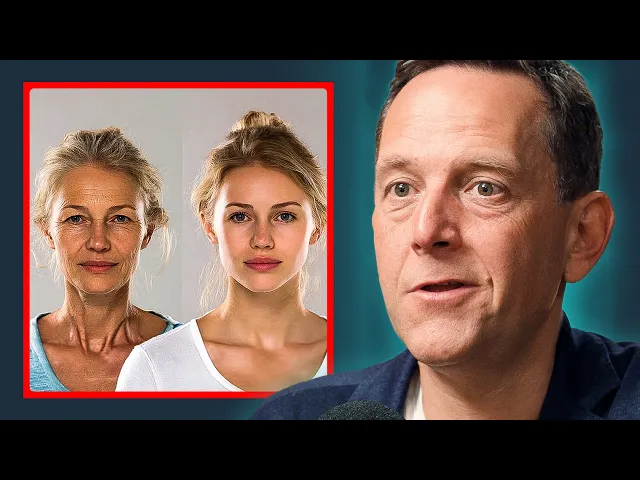
This Could Change Human Life Forever - David Friedberg
Chris Williamson
0:00 Speaking of prospering, how far off are we from age reversal, do you think?
0:04 That's one I'm most excited about.
0:06 Um, so have you looked at Yamanaka factors
0:08 or have you talked about this on your show before?
0:10 Uh, David Sinclair's been on and I know that he's
0:12 sort of tangentially associated with it, but assume no.
0:16 Do the 30,000 foot view of the Yamanaka factors.
0:19 So, every cell in our body has the same DNA.
0:22 Okay.
0:23 Uh, we know that.
0:24 And the DNA is in every cell because of a process called mitosis.
0:28 Every time we make a new cell,
0:30 from the time we're in the womb to today, we're making new cells.
0:33 Both our entire DNA gets copied over into every cell.
0:36 But what makes my eye look and act differently than my skin?
0:40 If it's got the same DNA, how's it different?
0:43 How's it different than my brain or my tongue or my feet?
0:46 They're all they're all those are different cells.
0:48 There's different cells in different organs in the body.
0:51 Those cells are different because the genes in the DNA are on or off.
0:55 M so there's a bunch of switches and the switches are either on or off
0:59 and that creates cellular differentiation which it's
1:02 what makes one cell different from another cell.
1:04 The eye cell different from the heart cell
1:06 different from the skin cell or the lung cell.
1:08 And the switches that are on or off are these little molecular switches.
1:12 They're molecules that sit on top of the DNA
1:15 and they keep that gene from working.
1:18 It blocks it off and then the other gene is open.
1:21 And when it's open, that means that your cell is making
1:25 RNA copies of that gene and turning it into a protein.
1:28 Zeros and ones.
1:29 Zeros and ones.
1:29 And each gene makes a unique protein.
1:32 The proteins that then come out do a bunch of stuff.
1:36 They're machines.
1:37 They're molecular machines.
1:38 And they're constantly doing all this stuff in your cell.
1:41 And that's what makes every cell different is
1:43 what genes are on and what genes are off.
1:46 And the complexity of this is astounding.
1:50 If you were to think about a cell being the size of Manhattan.
1:53 So imagine a cell is a is a is
1:55 a city the size of Manhattan with 500tory tall buildings.
1:59 That's how big it would be.
2:01 And every person is a protein.
2:03 There's 10 billion people living in this 500 story tall building
2:06 island of Manhattan going in between the buildings up and down
2:09 all day long building stuff together never sleeping always working
2:13 into each other having coffee making
2:14 stuff together breaking stuff together working.
2:17 10 billion of us.
2:18 Those are the proteins in the cell
2:20 in one cell running around doing stuff for 80 years.
2:24 That's one second in one cell.
2:26 That's how complex this is.
2:28 So the proteins that are on or off matter a lot and then they make stuff.
2:32 So that's why the eye cell does totally different
2:33 stuff than the brain cell or the heart cell.
2:36 As we get older, this is the current science on this.
2:40 It looks like what happens is we have DNA breaks.
2:43 DNA gets damaged from radiation and sunlight and bad eating
2:47 and alcohol and all the other As those DNA breaks happen,
2:51 your cell actually fixes the DNA.
2:53 It's very good at fixing it.
2:54 Goes in, there's a bunch of proteins.
2:55 They're the worker proteins that are repaired proteins.
2:57 They go in, they fix the DNA.
2:59 Every time the DNA gets fixed, there's a chance that those ones and zeros,
3:03 those ons and offs, get moved around a little bit.
3:06 And as they get moved around over time, they get moved to the wrong place.
3:11 So what ends up happening over time is that the wrong
3:15 genes get turned on and the right genes can get turned
3:18 off in a cell and then that cell stops working right
3:22 stops the eye cell stops doing what it's supposed to be doing.
3:24 The heart cell stops getting the right
3:27 electrical cascade to flow through the other cells.
3:30 all of the cells the the skin cell becomes a little wrinkled and eventually
3:32 if enough of those cells have
3:34 those epigenetic is what it's called epigenetic errors
3:38 you start getting wrinkles your heart stops beating as well you go blind all
3:41 these sorts of things happen with aging it looks like the root of all disease
3:45 may be aging and aging is a disease so it is a disease rooted
3:50 in the fact that the epigenetic factors
3:52 these little molecules move around in the wrong
3:54 place that's what we discovered is basically aging in 2006 a guy named Shina
3:59 Yamanaka found that he could take four proteins and put them on a cell.
4:05 They would go into the cell and they would move all of those epigenetic markers,
4:08 those ones and zeros to make that cell into a stem cell
4:13 which can then be turned into any other cell in the body.
4:15 So that was the magic thing he won the Nobel Prize for.
4:18 In 2016, another scientist published a series of papers showing that instead
4:22 of putting a lot of those four proteins on the cell,
4:24 you could put a small amount.
4:26 And if you put a small amount, instead of resetting all those molecular markers
4:30 and making that cell back into a stem cell, what it actually does,
4:34 it just moves those markers back to where they're
4:36 supposed to be to make it a young cell.
4:38 And suddenly that retinal cell becomes like a young retinal cell.
4:41 The skin cell becomes a young skin cell.
4:44 The heart cell becomes a young heart cell.
4:46 All of these cells get reset.
4:48 And they did this in mice and they made the mice age to like 250 plus years old.
4:52 They put it in monkeys.
4:53 The wrinkles went away.
4:55 and they've done it in um specifically applying it
4:57 to retinal cells in the eye and reversed blindness.
5:00 So
5:00 this is Sinclair's stuff, right?
5:02 Sinclair has one of these companies that's in clinical trials now.
5:05 And there's dozens of others.
5:06 Altos Labs is like one of the most
5:07 funded startups in history that no one talks about.
5:09 Um they've raised, you know,
5:11 close to probably $10 billion at this point uh to pursue these technologies.
5:15 But basically what this means is we
5:17 are now discovering not just the four proteins,
5:19 but a whole bunch of other little molecules that we can put into a cocktail.
5:23 either we're going to drink it, take it as a shot, uh, uh, or take it as a pill.
5:28 It will get into our cells and it will reset
5:31 the epigenetic of that cell to make it young again.
5:34 They're starting with targeting diseases like a particular like
5:37 like blindness or glaucoma in the eye or, you know,
5:40 rheumatoid arthritis or some other heart issue and they're
5:42 applying these factors to the cells in that tissue only
5:47 locally locally.
5:47 But over time what'll end up happening
5:49 is this becomes a systemic treatment and they're
5:51 already doing it in animal models and then you can either do it continuously
5:56 or what I think will end up happening is we'll probably have a system
5:58 whereby these factors will be continu when I say the word factor I mean protein.
6:03 These proteins can be continuously made
6:05 and released inside our body as they're needed.
6:09 So we maintain our youth and we will live theoretically for as long as we want.
6:15 That's where this is headed.
6:16 And the technology shows now that we can do this in animals.
6:19 We can re redose them, redose them, and keep them.
6:22 Has it been done systemically yet?
6:24 You mentioned Yeah.
6:25 This is the mouse the mouse model where they've made these mice.
6:28 The equivalent of like having someone live like 200 plus years old,
6:31 you know, and this is like so early, they haven't even optimized the molecules.
6:34 They haven't optimized how you deliver the molecules.
6:36 They haven't optimized the dosing.
6:38 They haven't optimized the method of the do.
6:40 Like there's all these techniques that are going to be developed on top of this.
6:44 For every one year we can extend average human lifespan,
6:46 we're adding tens of trillions of dollars to GDP, right?
6:49 So this is also another big economic driver.
6:51 But it's not just how long people live,
6:52 it's how healthy they are and how energetic they are and how happy they can be
6:56 and they can now go out and not feel all the pain and have the disease.
7:00 You know, theoretically, this can lead to a reversal in rates
7:03 of cancer proliferation or reversal in diabetes or reversal
7:07 in many of these other diseases that are fundamentally
7:09 rooted in this kind of failure of your epigenome.
7:13 the the markers that are turn your genes on and off.
7:16 So this is a technology category that I am like I think is one
7:21 of these other things that you can kind of think about the compounding effect
7:23 free energy right like AI automation um uh and you know infinite labor uh
7:30 for people to do all the things they want to do and potentially living forever.
7:34 I mean you start to think about how these all kind of compound.
7:36 That's why I'm excited about the future.
7:38 like these very quickly become these sort of compounding
7:41 effects that drive us into a happier tomorrow.
7:43 And then again it becomes a question of abundance.
7:45 How do you want to spend your time you know again 100 years ago I don't
7:48 think people would have had the job option
7:50 of being a yoga instructor or being a podcaster
7:53 or being a wedding photographer or you know
7:55 go down the list like there's so many things that people have found joy in doing
7:58 with their time and they can be productive doing it.
8:01 I think more of that starts to happen tomorrow and it's
8:05 less of the like you got to go work the corporate
8:07 shitty job on a trading floor in a corporate office
8:10 at a cubicle or you know in a factory or all
8:13 the things that maybe we will look back one day
8:16 and say hey that was kind of limiting human potential like maybe
8:20 humans could do a lot more and maybe they should
8:22 and these shifts to more abundance give us that opportunity to do that.
8:26 How far do you think we're off from getting
8:28 to the stage where we can do age reversal?
8:32 One decade, five decades, way less than that.
8:36 Way less than that.
8:36 We are in clinical trials now on several of these cocktails.
8:43 And if there's always a risk in going from animals to humans,
8:46 but we've done it with human cells in um in vitro in in a petri dish,
8:52 and we see the effect that we are expecting to see.
8:54 So we have a lot of reasons to believe that you know over
8:59 the next 10 to 20 years um more of this starts to proliferate.
9:05 We've heard Peter Demandis' idea of longevity
9:07 escape velocity right that you need to stick
9:10 about every year that you live means that you're going to live a little
9:13 bit longer but that when you cross a particular threshold you just need to stick
9:17 about until this happens essentially or whatever
9:19 the equivalent is whatever the technology is.
9:21 Yeah, it allows you to extend lifespan indefinitely.
9:24 I think it's fair.
9:25 You just hold on.
9:26 Hold on.
9:26 It's It's probably the best long-termist view for looking after your health.
9:34 Yeah.
9:34 That now is not the time to it, right?
9:36 Totally.
9:37 Because in the past, there wasn't really any reason to stick about.
9:40 Yeah.
9:40 You're going to live 80 years or 70 years or 60 years,
9:43 but you know, you're playing around with fives and tens.
9:45 Whereas if the difference is between 80 and 100 or 80 and 120.
9:51 Yeah.
9:51 You're like, "Hey, keep it together." And by the way,
9:54 a lot of like the number one thing you can do to fix your epigenome,
9:57 which you can do without taking these drugs, is exercise.
10:00 Fasting.
10:00 Well, fasting helps.
10:02 Uh fasting does have an effect,
10:03 but exercise like exercise releases molecules that in many cells in your body
10:07 will go in and start to address the epigenome and make you more youthful.
10:11 And then there's other things that you can start to take.
10:13 some of this peptide stuff that people are
10:15 crazy about has shown that it has an effect.
10:17 Um, some of I I don't want to be prescriptive on these things.
10:20 Um, but there's a lot of ways that uh you can start to kind of edge your way
10:27 Mhm.
10:26 before all the big clinical stuff is done and and the big,
10:29 you know, products come out to market.
10:31 Look, you know, sleep matters, but let's be real,
10:33 most nights you're probably not getting
10:35 the sort of sleep that's actually restorative.
10:37 Eight Sleeps Pod 5 fixes that.
10:39 It's a smart cover that you throw over the top of your mattress
10:42 that actively cools or heats each side of the bed up to 20°.
10:46 They've even added a temperature regulating duvet
10:48 and pillowcase so you and your partner
10:50 can sleep at your preferred temperatures covered
10:52 head to toe like some temperature controlled mummy.
10:55 Plus, it's got upgraded sensors that run health checks when you're asleep,
10:58 tracking things like abnormal heartbeats
11:00 and breathing issues and sudden HRV changes.
11:02 There's a built-in speaker for white noise.
11:04 The autopilot feature learns your sleep patterns,
11:07 makes real-time adjustments to improve your sleep.
11:09 It even detects when you're snoring,
11:10 and lifts your head a few inches to help you breathe better.
11:13 That is why eight is clinically proven to add
11:16 up to an hour of quality sleep per night.
11:18 And best of all, they have a 30-day sleep trial,
11:20 so you can buy it and sleep on it for 29 nights.
11:22 And if you don't like it, they will just give you your money back.
11:24 Plus, they ship internationally.
11:26 Right now, you can get up to $350 off the Pod 5 by going to the link
11:30 in the description below or heading to eightsleep.com/modwisdom
11:33 and using the code modernwisdom at checkout.
11:36 That's ei.com/modernwisdom and modernwisdom at checkout.