WTF Is Happening To The Housing Market?!
The Graham Stephan Show
0:00 Welcome back to the Graham Stefen Show.
0:01 And it's one of those rare times where I'm just going to turn on the camera
0:04 and talk about exactly what's going
0:06 on and what I'm finding throughout the housing market.
0:08 There's no agenda.
0:09 There's no script.
0:09 I'm just going to be off the cuff
0:11 on this one because what I'm finding is really interesting.
0:13 To start, all of this really began
0:15 with China's real estate market that has erased
0:18 all of its gains from the last 20 years because they've simply built so much.
0:23 New buyers aren't flooding in the market.
0:25 you have so many more sellers and that has completely
0:28 collapsed their housing market which led me to this here.
0:31 Apparently 1.1 million American homes are now in negative
0:34 equity up a massive 15% in a single year.
0:37 Now you might be asking yourself here but Graham what is negative equity?
0:42 I haven't heard that term before but you know what man
0:46 it was quite common when I started doing real estate in 2008.
0:49 Negative equity was everywhere.
0:51 And this is concept that you owe more on the house than what the house is worth.
0:56 And what a lot of people don't realize is
0:58 that when they bought a property from like 2022,
1:02 three and four and they locked in a low interest rate, they might be fine.
1:07 Their payment might be normal, but a buyer today is going to have
1:10 to pay substantially more because they're getting
1:13 a 6.5% interest rate whereas a buyer a few
1:16 years ago is paying a 3% interest rate.
1:19 So, when a new buyer comes in, they're going to say,
1:21 "I can't afford that same monthly payment, and therefore,
1:24 I can't afford to buy your house unless the price comes down."
1:27 But the issue for a lot of sellers these days is that they say,
1:31 "Okay, well, for me to be able to break even on the sale,
1:35 counting for 6% commissions and closing costs,
1:38 I have to get this amount, and I can't get this amount.
1:42 I could only get like basically what I
1:43 paid or maybe a little less." And that means
1:46 their equity is completely wiped out once
1:48 you account for those commissions and closing costs.
1:51 And that is why in California we have an average of $25,000 of negative equity.
1:56 Nevada $16,000 of negative equity.
1:59 Arizona $24,000.
2:02 Texas19,000.
2:04 And somehow Wyoming, they're crushing it over there.
2:07 Wyoming is flushed with cash.
2:08 Like if you look at the entire country,
2:10 Wyoming just stands out like a sore thumb.
2:13 they're actually sitting on $23,000 worth of equity.
2:15 So, this all means that if people need to sell,
2:19 if they are in a position where they had no choice,
2:21 they can't stay where they're at, they're going to have
2:24 to take a loss on that property in order to move it.
2:28 I mean, or they're going to foreclose on it.
2:29 But but I mean these aren't like big enough numbers to me
2:32 that would signal walking away entirely and foreclosing on a house.
2:36 But it does signal that most likely people are going to have to either
2:39 lose their equity or their down payment in a property or come up with some
2:43 extra cash to bridge the gap on this which then leads me to this over
2:47 here is that most Americans now think it's a bad time to buy a house.
2:52 67% of US adults say it's a bad time to buy
2:55 a home while only 29% say it's a good time.
2:58 Now, of course, when it comes to this, it's the young adults ages
3:00 18 to 34 who are the most pessimistic from all the age groups,
3:05 with 77% of them saying it's a bad time to buy,
3:08 compared to 63% of those aged 35 to 54 and 64% of those aged 55 and older.
3:15 Now, some of that also has to do with the fact
3:16 that apparently the housing market's running out of buyers.
3:19 Now, I highly recommend if you guys are on Twitter, follow the Coobesie letter.
3:23 I I really hope I'm pronouncing that correctly.
3:25 I really like them a lot.
3:26 I find that their research is fantastic
3:28 and they just have some good data surrounding them.
3:31 Uh, but when it comes to this, it's estimated
3:33 that there's an extra 46% more home sellers than buyers.
3:36 In February, which is the biggest difference
3:38 since Red Fin began collecting data in 2013.
3:41 Now, when you compare that to where we were in 2022,
3:44 there were 36% more buyers than sellers.
3:47 So, now it's just completely flipped to the opposite where more
3:51 people want to sell than there are people who want to buy.
3:54 This also comes at a time where, believe it or not,
3:57 with all the bad data that's out there,
3:59 pending home sales rose 7.7% year-over-year,
4:02 reaching their highest level since September of 2022.
4:06 Of course, when it comes to pending home sales,
4:08 you know, some of that is a little mortgage specific.
4:10 And we saw like right before the conflict in the Middle East,
4:15 mortgage rates were going down.
4:16 They were trending downwards.
4:17 Everyone was so optimistic for a rate cut this year.
4:21 And then all of a sudden the Middle
4:22 East stuff happened and mortgage rates went back up.
4:25 So some of this could be some of that pent-up demand of like,
4:28 oh, mortgage rates are coming down, things are getting better.
4:30 Let's go and buy a house right now.
4:33 Uh so I would be interested to see how this changes over the next uh you know,
4:37 month, maybe month and a half, give or take.
4:39 But when it comes to selling prices,
4:41 the median sales price for a new single family home fell $21,600 month
4:46 overmonth or $5.3% in March to its lowest level since July of 2021.
4:52 This also means when you adjust for inflation,
4:54 the median real home price fell 6.3% month overmonth, the lowest since 2014.
5:00 Now, this next part is where uh things get really interesting.
5:03 This is the part that I'm really into.
5:05 And a lot of this other stuff I brought
5:06 up only to give you context of what's going on.
5:10 But here's what I find really interesting.
5:12 Okay, according to their research,
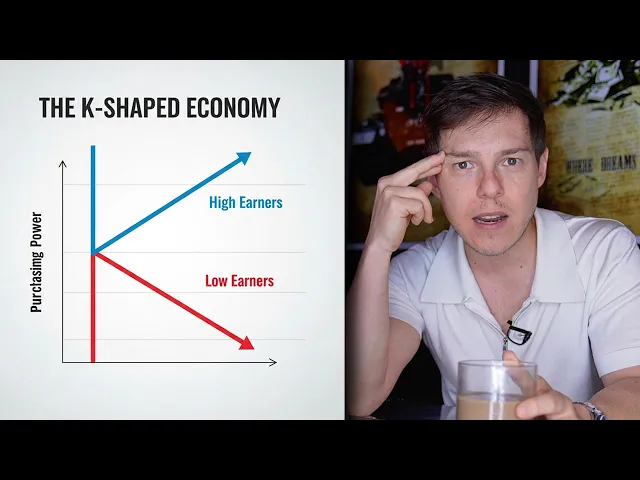
5:14 this suggests that a handful of luxury homes are inflating the average
5:18 price upwards while most Americans are
5:20 purchasing at significantly lower price points.
5:23 After all, when it comes to this, the income needed to buy
5:25 a typical US home has increased 79% in just the last 6 years,
5:29 which means you now need to make $93,000 a year
5:34 just to finance the typical property here in the United States.
5:37 Although, before we go into the next topic,
5:39 there is one more part about the economy that rarely gets discussed.
5:42 Yet, it affects almost everybody, and that would be travel.
5:45 Like, we just saw what happened to Spirit Airlines.
5:48 Believe it or not, travel's one of the first places
5:49 that people start cutting back when things are getting tight.
5:52 And it's also one of the places that people
5:54 start spending more money on once they feel confident again.
5:57 Like people still want vacations.
5:59 They want to get out of town.
6:00 They want to visit family.
6:02 And they still want someone who could help them make the most of it.
6:05 Even for myself, the more I've traveled and the more I help coordinate travel
6:08 for a mastermind that I run
6:10 with a small group of entrepreneurs every single quarter,
6:13 the more I've realized that good travel planning is not just booking a hotel.
6:17 It's knowing where to stay, what's worth it,
6:19 what's not worth it, what's overpriced, what's a good deal.
6:22 It's a lot that goes into it,
6:23 and that of course is where our sponsor, Fora, is there to help.
6:27 For those unaware, Fora is a modern travel agency built
6:30 for people who love planning and want to help others travel well.
6:33 As a For Advisor, you'll get access
6:36 to their all-in-one platform that gives you the tools, training,
6:38 booking technology, payment support,
6:40 and community to help turn your passion for travel into a viable business.
6:45 But basically, you get to earn a commission for every trip that you book.
6:48 So instead of all that effort going to waste,
6:50 you actually get something back for it.
6:52 And what I like about this is that you're not just guessing on your own.
6:54 Your forum membership gives you access to industry training,
6:57 a global community of travel experts,
6:59 and more than 7,000 preferred travel partners from iconic
7:03 hotels and cruise lines to smaller boutique properties.
7:06 This means that you can help
7:07 your clients get elevated travel experiences and VIP
7:10 perks that most people aren't aware of or don't know how to get.
7:13 So whether you're already the person putting together trips for friends
7:17 and family or you just love
7:18 researching and putting together the perfect itinerary,
7:21 Fora gives you the professional tools and support to take it seriously.
7:25 All you have to do to become a Fora
7:27 adviser and start earning commissions is to go
7:29 to foratravel.com/youtube or click the link down below
7:33 in the description to learn more and get started.
7:35 Again, that's foratravel.com/youtube with the link
7:38 down below to get started today.
7:40 Thank you so much.
7:41 Enjoy.
7:42 Now, let's get back to the video.
7:43 So, what's going on with the housing market?
7:45 Well, I will tell you because again, this is just what I'm seeing firsthand.
7:49 I probably spend, I want to say an hour,
7:52 maybe two hours a day of researching the housing market.
7:55 I see every property that comes on the market,
7:57 everything that sells throughout Las Vegas, Nevada, California, Florida.
8:02 I could I just love seeing what's going on.
8:04 It's like one of my hobbies.
8:05 I have these like Zillow alerts all set up and I'm like, "Oh, you know,
8:08 I track prices and I see like I kind
8:10 of basically just bet against myself and I say,
8:12 "Oh, I think this property will sell
8:14 for this and this." And then I compare if I'm right or wrong.
8:17 But what's interesting is that baby boomers are dominating the housing market
8:20 as the largest share of both buyers
8:22 and sellers per the National Association of Realtors.
8:25 Why is this?
8:26 Well, I will give you my own theory of exactly what's going on.
8:30 first-time home buyers, Gen Z, younger millennials,
8:34 or millennials with not a lot of money.
8:36 I hate to say it, you're okay, there's no way around it.
8:39 You are absolutely in the toilet.
8:42 Why is that?
8:43 Well, unless you have significant assets invested,
8:46 you are just getting reamed every day with rising prices,
8:50 inflation, we're seeing more national debt, they're printing more money,
8:53 and they're doing it at the expense of people
8:55 who don't have extra money and disposable income to invest.
8:58 But here's what I'm noticing.
8:59 All of a sudden throughout Las Vegas, California, there are an influx of buyers.
9:07 And I'm trying to think where are these buyers coming from?
9:09 They're coming out of the woodwork all of a sudden.
9:11 And you could say, well,
9:13 maybe they're moving out from Washington because of the millionaires tax.
9:16 And there aren't that many people moving right now.
9:20 Yes, they exist, but uh not to this degree.
9:22 They're not like instantly up and leaving overnight.
9:24 There's a lot of people there that uh will probably have to take a year
9:27 or two to to really exit the state to move and all that good stuff.
9:31 But what I am finding is that right
9:34 now because the stock market's moving up so much,
9:38 you're getting all of these buyers who have this extra
9:41 confidence because the market is at its all-time high,
9:44 their portfolio is doing the best it's ever done in history,
9:48 and they're saying, "Well, now I could just trim some of this and put it over
9:52 here and buy this house." If interest rates are a little higher,
9:55 I don't really care that much because I've
9:57 just made so much money in the market.
9:59 And I don't think it's a coincidence over the last two months, give or take,
10:03 that I have seen more properties just randomly open
10:06 up in escrow at prices that I think is dumb.
10:11 Okay, dumb prices.
10:13 And I'm trying to think the only rational explanation just
10:17 anecdotally from what I'm seeing is the market's doing well.
10:20 They're trimming some of that, putting it back in real estate,
10:23 and we're seeing a very bifurcated market because the market that I'm seeing
10:26 with the most traction right now in Las Vegas is 5 million and higher.
10:33 Keep in mind, most of the market in Las Vegas is probably 850 grand or lower.
10:39 And that market is uh, you know,
10:42 suffering to a certain degree because one, those buyers are really impacted.
10:47 When mortgage rates go up a little bit,
10:49 that could mean the difference of qualifying for a house or not.
10:52 But the 5 million plus segment,
10:54 even though it makes up a smaller portion of the entire market here,
10:58 a lot of those buyers are also heavily invested in the markets.
11:02 And so those are the buyers that are not
11:04 as price sensitive that can go and pay these prices.
11:07 And they are bidding up some of these properties
11:09 to levels that I just I don't see it worth it.
11:12 Okay?
11:12 Unless you're just trimming these like crazy Nvidia gains
11:15 or you have private equity and this and that, whatever.
11:17 Okay, but this basically means the average
11:20 person in the housing market is getting
11:22 screwed and everyone else who's invested is able to reap the benefits of both,
11:29 you know, a somewhat stagnated market for the most part,
11:32 but then using that as leverage to get
11:35 great deals in properties and just buy them outright.
11:38 The level of cash deals that I've seen lately in the market is astounding.
11:42 Uh, a lot of the deals that I'm seeing, they're cash at 5 million plus.
11:46 And it's one of the reasons why I have this chart here that says
11:48 the US stock market has almost never been this expensive in 150 years of data.
11:53 The PE ratio is currently at 38, the second highest reading in history,
11:57 only surpassed by the dot peak of 44.2.
12:01 Now I had said this before but Ben Carlson of the wealth of common
12:05 sense blog he has pointed out that this PE ratio uh when you look back
12:10 really to 1880 is not the best to look at like it includes a lot
12:15 of data and a lot of information
12:18 from an economy that's no longer relevant today.
12:21 And I see his point, okay?
12:22 Because before the computer, companies operated differently.
12:26 They were restricted in terms of their reach.
12:29 And really, as you could see,
12:31 since the year 2000, our PE ratios have skewed higher.
12:34 And so Ben Carlson points out that the PE ratio today that we're at is high,
12:39 but it's nothing unusual given the last 30 years of data.
12:44 And if we just extrapolate and look at the right half of the chart,
12:47 this could just be the new normal because this is the way the internet works.
12:51 This is the way other companies and businesses
12:53 and the world is going to come together with AI.
12:55 And we have a global marketplace now that never
12:57 existed 30 plus years ago to this degree.
13:01 So by that metric, we could very well just be
13:04 in a new normal where all of this data is uh somewhat irrelevant.
13:08 This is also why they say that the Buffett indicator might be completely broken.
13:11 And for the longest time, this was always a measure of how well
13:14 the stock market is valued relative to its past performance.
13:18 And for a long time, the Buffett indicator has been overvalued.
13:20 If you've looked at that metric, you basically think,
13:22 I shouldn't have invested over the last like 15 years
13:24 because it's been high outside of like the great financial crisis.
13:29 But this really argues that GDP badly
13:31 undercuts the digital economy because you have YouTube,
13:34 Instagram, WhatsApp, Gmail, Google.
13:36 Same applies to AI models and all
13:38 these new technologies that the Buffett indicator
13:40 was never designed to fully take into account when it comes to their valuations.
13:45 Yes, it is no surprise the stock market is expensive.
13:49 Okay, I found this interesting too.
13:51 According to Charles Schwab,
13:52 it's either very expensive or expensive relative to past
13:55 performance across every single metric that they track,
13:59 which is quite remarkable.
14:00 All of that is to say that right now in the housing market is
14:03 just dominated by older people who have assets who are making money in the stock
14:08 market taking some of that money and then reinvesting it back into housing
14:12 or people who have significant amounts of money tied up in AI chip companies.
14:17 I mean, if you're in that segment of the market,
14:20 money is like coming so easily right now.
14:23 Money is coming faster than it ever has been in like, you know, decades.
14:27 And so again, I think for those people in that market,
14:31 they are flooding these houses.
14:33 They are bidding them up.
14:34 They are offering these cash deals and everyone else is
14:37 kind of unfortunately screwed a little bit for the rest
14:40 of the market that uh seems to be beginning
14:44 to level off and cooling off in terms of affordability prices.
14:49 Yes, they are still expensive,
14:51 but relative to what you're seeing in the luxury market,
14:53 that's exactly what's going on.
14:54 So, I would love it, by the way,
14:56 if you guys give me your own take down below in the comments section.
14:59 I will do my best to read and reply to as many of you as I can.
15:03 And uh let me know what's going on on your end.
15:06 And also, don't forget to check out our sponsor, Fora.
15:08 I felt really bad.
15:09 I posted them in a prior video,
15:10 and that video for some reason just like completely bombed.
15:13 Like, it just seems like people would rather me just
15:14 kind of rant to the camera for a little bit, which I'm good with.
15:17 Like, I I kind of prefer this over the the reaction.
15:19 I just started getting tired of the reaction videos unless it's a great video.
15:23 I prefer just uh just chatting just chatting with everybody,
15:26 you know, something a lot more low-key.
15:28 So, feel free to check out Sephora because again, I just I felt bad for him.
15:32 And with that said, thank you so much.
15:34 Hit the like button, subscribe, and till next time.