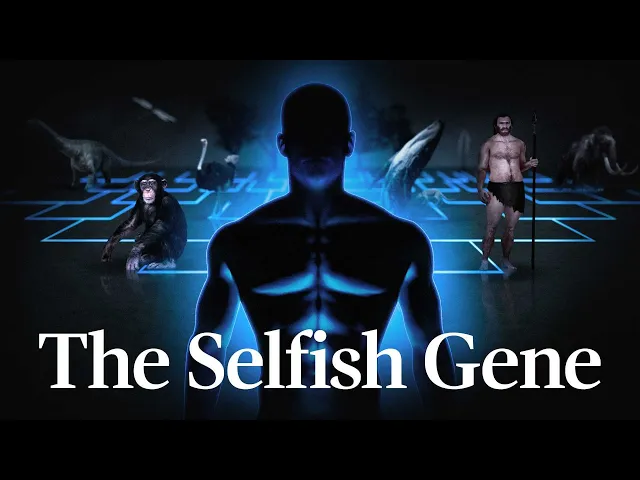
The Most Controversial Idea In Biology
Veritasium
0:00 If you want to know if someone really understands evolution,
0:03 just ask them this one weird question.
0:05 Why does poop smell bad?
0:07 Oh.
0:08 Oh, gosh.
0:09 Because it has bacteria in it, I guess?
0:10 Microbiome, probably.
0:12 Trash- Yeah, trash from the gut.
0:14 of the body.
0:15 The food we eat?
0:16 Because of the chemicals?
0:18 Farts don't always smell bad.
0:20 Yeah.
0:20 Well, that's a different question entirely.
0:22 Do you think it objectively smells bad?
0:25 Yes, I think so.
0:26 Yes.
0:26 How do you think it smells to flies?
0:29 Like the fly?
0:30 Yeah- They like it.
0:31 They love it.
0:31 They like it, yeah.
0:31 They love it.
0:32 Animals love stinky things.
0:34 Yeah.
0:34 They're attracted to it.
0:35 Poop smells good to flies because poop is full of nutrients.
0:39 They use it as food.
0:41 But it's also full of bacteria that can be life-threatening to humans.
0:45 So the real reason poop smells bad to us
0:48 is because if anyone ever thought it smelled good,
0:51 they would probably get really sick, die, and not pass on their genes.
0:55 After all, it's about survival of the fittest.
0:58 But survival of the fittest what?
1:01 I mean, most people think of natural selection
1:02 as being about the survival of the fittest individual animal.
1:06 Individual.
1:06 Individuals.
1:07 Individual animal.
1:08 Animal.
1:09 Okay, so it's like an individual.
1:10 Yeah.
1:11 Which makes sense.
1:12 I mean, individuals best adapted
1:13 to their environment have increased odds of survival,
1:16 and therefore a higher likelihood of passing on their genes.
1:18 So it follows that each individual should
1:21 do everything it can to survive and reproduce.
1:24 That is, it should be selfish.
1:26 But if that's true, then how do you explain this?
1:30 Worker bees will sting predators to protect the hive,
1:34 even though it might kill them in the process.
1:37 Female worker ants are sterile, so they can't reproduce, but regardless,
1:42 they work for the colony for their entire lives until they die.
1:46 Monkeys adopt orphans, wolves bring meat to non-hunting members of the pack,
1:52 and squirrels can let out alarm calls to warn others about nearby predators.
1:58 So if natural selection is all about selfish individuals,
2:01 why do we observe so much altruism in nature?
2:05 The survival is of the species that can adapt.
2:08 I think generally the species.
2:09 For the survival of the species.
2:10 So it's the survival of the species.
2:12 Okay.
2:12 Yeah, you're right.
2:12 Okay.
2:12 But survival of the fittest species or the fittest group also doesn't work.
2:17 I mean, think about what you need for natural selection to occur.
2:21 You need something that replicates itself many times over,
2:25 creating copies, and then you need a pruning process,
2:28 whereby some of those copies get eliminated and some
2:31 thrive to go on and create more copies.
2:33 The problem with groups or species is
2:36 that they don’t typically make copies of themselves.
2:39 So you almost never get copies of groups fighting
2:42 other copies of groups to see which groups win out.
2:45 So if it's not survival of the fittest individual and it's
2:48 not survival of the fittest group, then what is it?
2:51 Well, to explain that, I want to take you on a little journey,
2:55 all the way back to the beginnings of the Earth.
3:06 Where we are now, there is nothing.
3:09 Well, not really nothing, but nothing interesting.
3:12 There are only simple things, like these blobs.
3:15 This one might be a carbon dioxide molecule, or it might be cyanide.
3:19 We don't know for sure what they are,
3:20 but we do know that these compounds are very simple.
3:23 So for now, they'll just be blobs floating around our void.
3:27 In fact, much of what we'll encounter
3:29 along our journey here are just hypotheses.
3:31 A lot of Earth's early history is still a mystery, so keep that in mind.
3:35 Now, every so often, our blobs get a surplus of energy,
3:38 maybe from a ray of UV light or a nearby hot source.
3:42 This is the first major upgrade to our void, excess energy,
3:46 as it allows our blobs to interact with each other.
3:49 And most of the time, this interaction leads to nothing,
3:52 but sometimes these blobs can combine into more complicated compounds.
3:57 Here's a simple simulated example, where we only have four red blobs.
4:01 Right now, they are all individual particles,
4:03 but each time step we move forward,
4:06 let's say there's a 10% chance that all four combine into one red mega-blob.
4:11 And now imagine this mega-blob isn't very stable.
4:14 For every time step it's alive,
4:16 it has a 95% chance of falling apart back into the four smaller blobs.
4:21 If we add more of these red blobs into the mix,
4:24 you'll notice that they rarely ever come together.
4:26 On average, a mega-blob only exists around 10% of the time.
4:31 But if we were to reduce the chances of the mega-blobs dissolving to only 1%,
4:35 the void would suddenly be filled with them.
4:39 This fact hints at an important law that governs our void, the law of stability.
4:45 Unstable blobs fall apart and vanish.
4:49 Stable ones endure.
4:52 Now, watch what happens if we speed this up dramatically,
4:54 maybe a couple of years per second, maybe even a couple million.
4:58 You can see our blobs keep getting random jolts of energy,
5:01 so they combine with others to form more complex compounds.
5:06 Most attempts fail and fall apart, but every so often, by pure chance,
5:11 you get a compound that is more stable than the blobs it's made of.
5:15 This doesn't happen because the blobs want to build more complex structures.
5:20 It's just because these new configurations happen
5:22 to be more favorable in the environment.
5:24 And now when these complicated compounds become abundant enough,
5:28 they too get a chance to combine, making our void increasingly complex.
5:34 And one day, by accident,
5:36 this causes an extremely unique shape to form, one with a special property.
5:42 See, the blobs it's made of just happen
5:45 to attract similar blobs from the surrounding environment.
5:48 This red blob always attracts green blobs,
5:50 and this purple blob always attracts yellow ones, and piece by piece,
5:54 all these blobs attract their opposites until their counterparts
5:57 suddenly snap into position next to the original shape.
6:01 Now, this shape goes on to do the same thing.
6:03 Its green blobs attract red ones and yellow ones attract
6:07 the purple until another shape yet again snaps into position.
6:11 This new shape looks exactly like the original.
6:14 What just happened fully spontaneously is replication.
6:19 One shape became two.
6:20 This marks the birth of the first replicator.
6:24 We don't know exactly what this replicator looked like.
6:27 It might've been a single standalone molecule
6:30 or a group of molecules that worked together to replicate.
6:33 There's a lot of debate on this today,
6:35 so instead, let's represent the replicator as a character.
6:38 How about this one here?
6:40 Perfect.
6:41 Keep in mind it's still just a lifeless molecule,
6:44 one without any intent or purpose.
6:48 Now, you might think that the chances for the replicator
6:51 to form were extremely unlikely, but in our void,
6:53 where we have hundreds of millions of years to play
6:56 with, what might seem impossible to us becomes virtually inevitable.
7:00 And the thing is, the replicator only has to arise once.
7:04 Once it's here, it can take the simpler compounds available
7:07 in the environment to copy itself at a much faster pace.
7:11 And so it does that, until it entirely fills our void.
7:16 At least, that's what you'd expect, but there is a flaw in the process.
7:21 See, during the replicator's conquest of the void,
7:24 one of its copies makes a mistake.
7:27 Perhaps a stray ray of UV light hits it during the replication process,
7:31 or the replicator uses a building block it wasn't supposed to.
7:35 As a result, what we're left with is a new shape,
7:38 which is slightly different from its parent,
7:40 and so its properties might be slightly different too.
7:44 This error might be harmful.
7:46 For example, it might make the copy less stable.
7:48 It could be beneficial, making the copy better at replicating,
7:52 or it could be neutral, not changing the replicator in any meaningful way.
7:56 This marks the final milestone in our void, mutation.
8:00 Many species of replicators now occupy the void,
8:03 and what they do is they replicate themselves.
8:07 The problem is they all need the same limited resources,
8:10 and so our void turns into a battleground.
8:13 So which replicator will win?
8:15 What kind of properties will the void favor?
8:18 Well, let's try to simulate what happens.
8:22 Now, if you’re looking to run your own simulations,
8:24 or need a place to run your own
8:26 code look no further than today’s sponsor— Hostinger.
8:29 Say you wanted to keep track of everyday science news.
8:32 Manually filtering through thousands of articles
8:35 for the most important stories would be almost impossible!
8:39 But Hostinger lets you easily automate this.
8:43 You can use n8n, a platform that lets you automate tasks,
8:47 but you need a place to host it.
8:49 And the easiest, most price-effective and secure place to host n8n
8:52 workflows is on a Virtual Private Server or VPS from Hostinger!
8:56 It’s like a powerful computer you rent on the cloud.
8:59 So here’s how you can create an article scrubber:
9:02 The workflow can grab every new science article from a list of portals.
9:06 Then, it can send the articles to Chat GPT to summarize their content.
9:10 And finally, you can add these quick summaries to a board in Notion.
9:14 Using Hostinger’s pre-installed n8n template, the setup only takes one click,
9:18 and you’re good to start creating workflows.
9:21 By hosting n8n on a Hostinger VPS,
9:23 you get all the resources needed to run your workflow smoothly, 24/7!
9:28 Plus, you can have unlimited workflows running simultaneously.
9:31 Imagine the things you could do and the time
9:34 you can save with automations on Hostinger.
9:36 They’re having a Black Friday sale right now, so don’t miss out!
9:40 Scan this QR code or visit hostinger.com/veritasiumn8n and use the code
9:45 VERITASIUM to get an extra discount on top of the sale prices!
9:49 Thanks to Hostinger for sponsoring this part of the video,
9:52 and now back to our simulation.
9:54 To simulate what a replicator battle might look like,
9:56 let's assign simplified traits to each of the replicators,
9:59 starting with the first one.
10:01 This replicator is special, since it's the only one that can
10:05 form spontaneously from smaller building blocks.
10:07 So we'll give it a spawn rate.
10:09 This should be quite rare,
10:10 so let's set the chance of formation to 1% per time step.
10:15 Just keep in mind we're just making these numbers up.
10:18 The simulation is purely illustrative.
10:19 Now, once the replicator spawns, let's say it's governed by three key traits.
10:24 First, a death rate,
10:25 the chance of it falling apart or being destroyed with each time step.
10:29 Let's set that to be, say, 2%.
10:31 Second, a replication rate, the chance to copy itself with each time step.
10:36 Let's say 4%.
10:37 And finally, a mutation rate, the chance a copy comes out mutated.
10:41 If it's 4%, roughly one in 25 copies will be a mutation.
10:46 So every time a new mutation spawns,
10:48 it will inherit the replication death and mutation stats from its parent,
10:53 but slightly randomized.
10:54 Notice that we won't give any of these secondary replicators a spawn rate.
10:58 They'll only be able to form as mutations from previous generations.
11:01 So if all of their copies die out, they'll be gone for good.
11:06 Now, before we run the simulation,
11:07 I want to quickly shout out the YouTube channel Primer.
11:09 Our setup was inspired by his amazing
11:12 in-depth simulations on evolutionary biology.
11:14 You should really check him out.
11:16 Okay, let's run it.
11:18 The graph on the right will show how the populations grow,
11:20 and this box on the left will show a slice of the void,
11:23 with all the winning replicators and the correct ratios.
11:26 You can see how the first replicator appears and then immediately disappears,
11:31 because it just happened to die before it got the chance to replicate.
11:35 But that's okay.
11:36 The original replicator can be created from smaller blobs,
11:39 so it'll come back at some point.
11:41 This time, it's starting to take off.
11:44 You can also see that it spawns some mutations,
11:47 but they're struggling to keep up.
11:48 Eventually, though, superior mutations pop up
11:51 and start to replicate faster than the original.
11:54 But you can see almost all of them are growing exponentially,
11:57 which is unrealistic.
11:58 That's because we're missing the final
12:00 piece of our simulation, limited resources.
12:03 The building blocks should eventually run out.
12:05 We can simulate this effect by introducing a sort
12:08 of resource factor to each species' replication rate.
12:11 This factor should depend on the total number of replicators in the void,
12:16 N, which will also divide with an arbitrary crowding factor, C.
12:20 C lets us define the maximum number of replicators we'll allow into the void.
12:25 Say C is 10,000.
12:26 Then once there are 10,000 replicators,
12:29 the two terms cancel out and drive the replication rate down to zero,
12:33 meaning none of the replicators will be able
12:35 to make copies until the population drops again.
12:37 So let's see how this changes our simulation.
12:41 Okay.
12:41 Like the last time, the original replicator starts to grow,
12:44 after which it's quickly taken over by its mutations,
12:49 but this time, most of these mutation populations start to decline.
12:54 Because of the scarce resources, the new best population,
12:57 the lime one, actually starts stealing resources from the others.
13:02 After that, a few more mutations pop up, even more powerful than the lime.
13:06 Ultimately, the purple replicator takes over,
13:09 occupying around 9,000 of the 10,000 available spaces.
13:13 It completely curbs all the other populations.
13:16 It goes without saying that the environment
13:18 plays a massive role in which replicator wins.
13:21 If you change the environment, you likely change the outcome.
13:24 But let's look at the stats of the replicator that came out on top this time.
13:29 That winning species has a replication rate of 20%,
13:32 compared to the 17% average across all populations.
13:36 Obviously, being able to replicate quickly pays off here.
13:39 Its death rate is below average.
13:41 Replicators that fall apart less quickly can make more copies.
13:44 And finally, it has a 1% mutation rate, compared to the average of 3.73%.
13:50 Although mutations help by injecting diversity,
13:53 for any single species, fewer mutations mean more faithful copies.
13:58 If we rerun the simulation,
14:00 you'll notice the outcomes are always slightly different,
14:04 but the winning species consistently have high
14:07 replication and low death and mutation rates.
14:10 Now, in the real void, things wouldn't have been as simple.
14:12 Instead of just tweaking these three stats,
14:14 the replicators would have to mutate all
14:16 sorts of different ways to gain an advantage.
14:19 For example, one replicator might mutate a trait that lets it destroy other
14:23 individuals and then use their building blocks to make more copies of itself.
14:27 This looks like strategy, but it's really just chemistry that gets copied
14:31 over and over because it helps the replicator survive.
14:35 Naturally, a risk of offense would
14:37 likely favor mutations that result in defense.
14:40 So an opposing replicator might stumble upon a mutation
14:43 that helps it form protective barriers from nearby materials,
14:46 letting it endure those attacks.
14:48 These barriers would also help protect the fragile
14:51 replicators from environmental damage, like UV light.
14:54 This marks an important threshold.
14:56 The replicator's traits aren't limited to just
14:58 determining the properties of the molecules themselves.
15:01 They can also shape the environment.
15:04 So by chance, the replicators inevitably mutate in ways that build
15:08 scaffolding around themselves to increase the chances of their survival.
15:12 They stumble upon ways of making structures to propel themselves around.
15:16 They develop senses and ways of storing energy.
15:19 They even mix, exchange, and steal traits from each other.
15:23 Through billions of years of trial and error,
15:26 this scaffolding gets more and more complex, and as a result, the replicator's
15:31 interactions with the void become exceedingly indirect.
15:35 They build complex survival machines for themselves,
15:38 machines whose sole purpose is to protect the replicators inside.
15:42 These machines became such experts at surviving,
15:46 they're still around some 4 billion years later.
15:49 They are the bacteria, plants, fungi, and animals all around you.
15:54 Everything alive, including you,
15:57 was built as a survival vessel for these replicators.
16:01 But today, you'd barely recognize them as replicators.
16:04 Now we just call them genes.
16:08 They're hidden deep within every living creature,
16:11 strands of DNA made from the sequences of A, T, G, and C nucleotides.
16:16 Now, one of the leading theories is that those earliest replicators
16:19 were actually something closer to RNA molecules, but then over time,
16:23 this must have evolved into a more stable system of storing information,
16:27 the DNA and proteins we use today.
16:29 They are the code that shapes our traits.
16:31 We’re taught that these traits are here solely to help
16:34 ensure our survival the survival of the individual or the species.
16:38 But do we have this the wrong way around?
16:41 When you have a child, what do you pass on?
16:43 The DNA.
16:43 The DNA, the genes.
16:44 Yeah, the genes.
16:44 Genes.
16:44 Okay, yeah.
16:46 These tiny replicators are still fighting the same
16:49 battle that started billions of years ago,
16:51 and the logic behind them hasn't changed.
16:53 The traits just become more convoluted.
16:56 Replicators that produce traits poorly suited
16:58 to their environment tend to become less common,
17:00 while those that produce advantageous traits
17:02 become more numerous in the population.
17:04 So it's not about the fittest individual or group,
17:07 it's fundamentally about the survival of the fittest genes.
17:10 They are the core unit of natural selection.
17:14 But why would natural selection care exactly for the gene?
17:17 Why not something smaller or something bigger?
17:21 Well, for something to undergo selection,
17:23 it needs to have three characteristics.
17:25 First, it needs to be able to make near identical copies of itself.
17:28 Second, it needs to exhibit traits
17:30 that affect its interaction with the environment which,
17:33 third, affect the probability of survival and reproduction of the replicator.
17:37 Something small like a single nucleotide doesn't work,
17:40 because, sure, it'll make identical copies of itself,
17:43 but alone, it doesn't exhibit a trait that could be selected for.
17:47 What about something bigger, like a chromosome?
17:50 Well, each chromosome affects potentially thousands
17:52 of traits that could influence its survival,
17:54 but when most creatures reproduce, sections of chromosomes get swapped around.
17:59 So a chromosome doesn't stay together as a cohesive replicating unit,
18:03 and therefore it can't be selected for.
18:06 But a gene is somewhere in the middle.
18:08 It's a long enough stretch of DNA that it can independently influence a trait,
18:12 but it's also short and stable enough
18:14 to be faithfully copied over into future generations.
18:17 This is why the gene is the unit of natural selection.
18:21 This perspective led to one of the most
18:23 powerful and controversial ways of seeing evolution,
18:25 one popularized by Richard Dawkins in his book The Selfish Gene.
18:29 Based on the work of evolutionary biologists in the 1960s and 1970s.
18:32 And as a response against the, then very popular, group selection theory.
18:36 Dawkins argued that just about every trait,
18:39 from animals helping each other to being completely selfish,
18:42 is a strategy that helps their genes survive and replicate.
18:46 Genes that maximize their own survival are the genes that propagate best,
18:49 even if they do so at the expense of others.
18:52 Or in Dawkins' words, we are survival machines,
18:56 robot vehicles blindly programmed to preserve
18:59 the selfish molecules known as genes.
19:02 Now, you might think this framework isn't all that groundbreaking.
19:06 I mean, take the emperor penguins in Antarctica for example.
19:09 They hesitate to jump into the water until
19:12 they are sure there are no seals around.
19:14 So what kind of genes could help a penguin survive in this environment?
19:18 Well, if the penguin’s set of genes make it more likely to be timid,
19:21 the penguin might stay back until someone braver tests the water.
19:25 That way, the penguin is at a lower risk of being eaten,
19:27 and has a better chance to survive, reproduce and pass on its ‘timid’ genes.
19:32 Here, you can think about this either as ‘the timid
19:35 genes help the penguin’ or ‘the penguin helps the timid genes’.
19:38 Either way works.
19:40 So is there any real benefit to viewing things from the gene's perspective?
19:44 Well, look at what happens when you
19:46 use these two frameworks to explain altruistic behavior,
19:48 which appears in a lot of places in nature.
19:51 Take California ground squirrels for example.
19:54 Females will let out alarm calls if they spot a predator, like a fox or a hawk,
19:58 to warn other nearby squirrels, even though this puts her survival at risk.
20:04 The genes influencing this behavior surely don’t help the squirrel.
20:08 But can the squirrel still help the genes?
20:10 I think this is a bit more clear if you
20:12 think about the fact that most living things reproduce sexually.
20:16 Right.
20:16 So a squirrel will get half its DNA from its mom and half from its dad.
20:21 So it's actually sharing half its genes with each parent.
20:24 But also, any child that it has,
20:26 it's also going to share half of its genes with the child,
20:29 but also any siblings.
20:31 But then if you take a step out to an uncle or up to a grandparent,
20:35 then it's sharing one-quarter, and then another step out is one-eighth.
20:38 All to say, you share a lot of genes with your immediate family.
20:43 And California ground squirrels, females in particular, they live around family.
20:48 So if a squirrel has a set of genes
20:50 that make her call out when it spots a predator,
20:52 there is a very good chance that the squirrels
20:54 that hear her warning call also carry those genes.
20:57 Now, as a result of her alarm call,
20:59 let's say the squirrel attracts a predator her way,
21:02 and it ends up getting eaten.
21:04 This action cost the ‘call’ genes the chance to pass
21:07 themselves on to any future offspring of that squirrel.
21:10 But, if the warning call saved at least 2 copies
21:13 of those genes in two of the squirrel’s relatives… well then,
21:16 in total, these 2 squirrels have a better chance of passing
21:20 on the genes through their offspring than the single squirrel did.
21:23 From the gene's perspective, this could be a good trade-off.
21:27 It doesn’t matter which individual helps the genes replicate,
21:30 only that as many copies as possible survive.
21:34 This principle, that altruistically helping your close
21:36 relatives helps preserve your own genes, is known as kin selection.
21:40 And the payoff behind any altruistic gesture under kin selection depends
21:44 heavily on how related you are to the individuals you're helping,
21:48 because the less related you are, the smaller the chances that you will
21:52 share that particular gene with another individual.
21:54 And you can see this in nature.
21:56 Male squirrels that don't live near
22:00 relatives almost never give out warning calls.
22:03 Now, there is a big question this gene-centric view still has to address.
22:08 If selection really favors genes that replicate well,
22:11 then why would sex ever evolve as a means of replication,
22:14 if it throws away roughly half the genes?
22:17 Most animals reproduce sexually.
22:19 So why do it, when some organisms, like certain plants and fungi,
22:22 get to pass on all of their genes through asexual reproduction?
22:26 From a gene's perspective, this seems like a much better deal.
22:30 When it comes to sexual reproduction, people like to say, "Okay.
22:34 Well, it mixes up the genes.
22:36 It's like shuffling a deck of cards,
22:38 and isn't that better for creating more variation?
22:41 And clearly, that's advantageous." Another way this has been explained is
22:45 if the genes that regulate
22:47 sexual reproduction benefit from replicating sexually,
22:51 then they're going to keep pushing for these genes.
22:53 Right.
22:54 Even if it's a net negative to all the other genes in the genome.
22:58 Yeah.
22:59 So if it benefits them, they'll keep pushing for it.
23:02 So are there any problems with how The Selfish Gene explains natural selection?
23:06 Well, yes.
23:07 I mean, it turns out the framework comes with a lot of controversy.
23:14 One of the biggest criticisms against The Selfish
23:16 Gene is that it leaves little to chance.
23:18 It implies that every gene present in the genome is
23:21 there because it actively got selected for, by natural selection,
23:24 over many generations.
23:26 But many genes are actually invisible to natural selection,
23:29 because they don't really exhibit meaningful traits in the population.
23:33 Yet, they can still evolve over time.
23:36 Imagine 20 blind cave fish, 10 with green eyes and 10 with blue.
23:40 Since they’re blind, we’ll assume that their eye color traits make no difference
23:44 to their survival so they get passed down purely by chance.
23:47 Now, to form the next generation,
23:49 randomly “pick” any fish from the first group and replicate it.
23:52 If you repeat this 20 times, you get a 2nd generation.
23:55 By chance alone, one color will probably appear more often than the other.
23:59 And if you repeat this process over many generations,
24:03 one color might eventually completely take over.
24:06 Not because it’s better, but purely due to random sampling.
24:09 This shift in the frequency of gene variants is called genetic drift.
24:13 It’s most apparent in small populations and for traits
24:15 that aren't pruned for by natural selection.
24:18 But it doesn’t only apply to silent genes.
24:22 Even when genes exhibit meaningful traits,
24:24 there is a chance that genetic drift overrides natural selection,
24:27 and a less fit gene will spread through the population just by chance.
24:31 Look back at our replicator battle.
24:33 If we run our simulation enough times,
24:35 sometimes the winning gene won’t be the one
24:37 with the traits that maximize its own survival.
24:39 Here, you can see that the winning population actually
24:42 has a higher than average mutation rate, just by chance.
24:45 And the average mutation rate is also higher than the starting value.
24:49 These are simplified examples,
24:50 but there is an ongoing argument about how much of evolution was actually
24:54 due to natural selection and how much of it was up to chance.
24:59 Another major criticism of The Selfish Gene is
25:01 about the unavoidable implication behind the word selfish.
25:04 It seems to imply that genes have agency,
25:07 like they know what they're doing and they understand the consequences,
25:11 but it's only a metaphor, just as portraying them as characters was a way
25:15 for us to make the story more engaging.
25:17 Of course, molecules don't know what they're doing.
25:20 They don't decide to replicate or conspire to out-compete others.
25:25 They just react according to the laws of physics.
25:28 So what may look like intention is just
25:31 simple chemistry that happens to work well and propagates.
25:34 But perhaps the most obvious and easiest to understand criticism
25:37 is that the whole framework is an oversimplification, and that's true.
25:41 Genes are much more complicated than we thought.
25:43 It's not as simple as one gene equals one trait.
25:46 One gene can influence many traits,
25:48 and one trait can be influenced by many genes.
25:51 There are genes that are wholly contained within other genes.
25:54 There are genes that inhibit or activate others,
25:57 and then there are even genes that seem to not encode for anything,
26:00 the so-called non-coding DNA.
26:03 All to say, we still have a lot to learn about genes.
26:06 Not to mention that the environment itself, like whether it's hot or cold,
26:09 or how much food there is, also affects how different genes get expressed.
26:13 Genes are much less deterministic than they might seem!
26:16 So you might think that a single gene would rarely have
26:19 a large enough effect that natural selection can directly impact it,
26:23 but it doesn't matter how convoluted the pathway is.
26:27 If a gene has a measurable effect on its own survival and replication,
26:30 it will be subject to some amount of natural selection.
26:34 And surely, the whole theory is a simplification,
26:37 but any theory or framework of nature is.
26:40 And what we're covering in this video is
26:42 an even more simplified picture of that framework,
26:44 but that doesn't take away the fact that viewing the world through
26:47 this lens has an incredible power
26:50 to help us understand the process of evolution.
26:53 It helps us understand why we see such
26:55 a range of different behaviors in our world because fundamentally,
26:58 those traits tend to cause the increasing
27:00 prevalence of the genes they are associated with.
27:03 It's like the whole point is figure out what's true.
27:08 Get to the truth.
27:09 And this, to me, is the baseline truth of evolution.
27:13 This is what I love about making Veritasium,
27:16 is that we get to sort of unpack and dig under the hood.
27:21 And it's what I loved about reading The Selfish Gene book,
27:25 is that it really opened my eyes to this.
27:27 Previously, I'd always just probably thought at the level of the individual,
27:31 but it makes more sense to think at the level of the gene.
27:35 The feeling that you and every other living organism is being
27:40 driven by some molecules deep in every cell is fundamentally unsettling,
27:46 and seems to remove agency from you as an acting, thinking being in the world.
27:52 Yeah, it's pretty grim.
27:54 But whether or not you agree with the fact that we
27:58 might be controlled by our genes and we're simply their flesh robots,
28:03 I think it's kind of unreasonable and unrealistic to go
28:07 through life thinking that every decision is governed by this.
28:09 It doesn't really do you any good, because we perceive the world as individuals.
28:14 So I think it's very beneficial to see
28:18 yourself as your own thing, as your own unit.
28:25 I want to give a big shout-out to Joe
28:27 Hanson from BeSmart for helping us out with this video,
28:29 and another shout-out to Primer for letting
28:31 us adapt his simulation on the first replicators.
28:34 I have put links to their channels down in the description,
28:37 so please check them out.
28:38 And finally, I want to say a huge shout-out to you.
28:41 Thank you for watching.