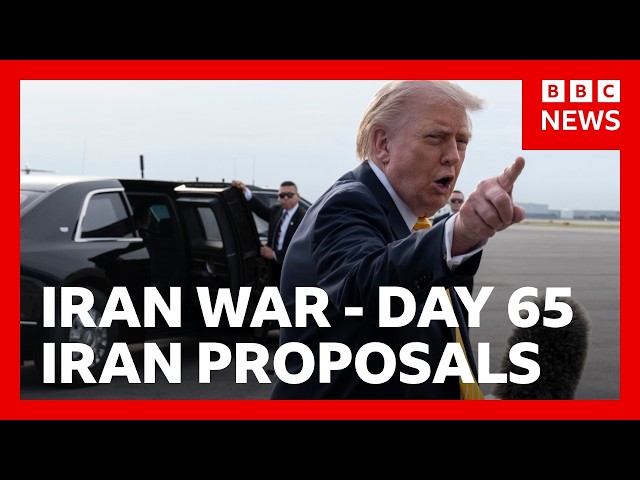
Iran puts forward its latest peace proposal, according to Iranian state-linked media | BBC News
BBC News
0:04 Hello, I'm Lauren Taylor.
0:05 This is Iran War Today, our daily briefing bringing you up to date with all you
0:09 need to know on day 65 of the USIsrael war with Iran.
0:13 Let's start with some of today's key developments.
0:16 Iran says the US will be forced to choose
0:18 between an impossible military operation or a bad deal.
0:22 As President Trump indicates plans to reject the latest peace offer,
0:26 the Israeli military issues new evacuation warnings in southern
0:30 Lebanon for villages beyond the area it occupies.
0:34 The British government announces plans to make it easier for airlines to cancel
0:38 flights if they face fuel shortages because of the war in Iran.
0:43 And we'll hear from someone smuggling Starling satellite terminals into Iran.
0:48 We have sent over a dozen and we are
0:51 actively looking for other ways to smuggle in more.
0:57 Let's start with the situation with Iran and the US.
1:00 The intelligence arm of Iran's Revolutionary Guard says the United States will
1:04 be forced to choose between an impossible military operation or a bad deal.
1:09 In a statement, the Iranian Revolutionary Guard Corps says
1:12 the decision-making space for the United States is limited.
1:16 Donald Trump though says Iran hasn't yet paid a large
1:19 enough price as he expects to dismiss their latest peace offer.
1:23 One post on social media, President Trump wrote,
1:26 "I will soon be reviewing the plan that Iran has just sent to us,
1:29 but can't imagine that it would be acceptable
1:31 in that they have not yet paid a big
1:33 enough price for what they've done to humanity
1:35 and the world over the last 47 years.
1:39 Iran state media is reporting some details of the 14point peace
1:42 plan submitted to Pakistan which is
1:44 mediating negotiations with the United States.
1:47 Our world news correspondent Joe Inwood has the details.
1:50 Right at the top of this list is a secession of hostilities,
1:53 an end to the fighting, a permanent end to the fighting.
1:56 They also are asking for compensation for some
1:59 of the damage that's been done to their country
2:01 by this war to be paid for by the Americans
2:04 and presumably by the Israelis as well.
2:06 There has been a huge amount of damage done to the economy
2:09 and to the infrastructure of Iran and I
2:12 think they want some money back for that.
2:14 And when it comes to money,
2:15 they also want the unfreezing of some of their frozen assets.
2:20 Uh the Iran Americans have frozen many Iranian assets.
2:23 They want that freed up probably to help with the reconstruction effort.
2:27 Also on the financial side of things,
2:29 the sanctions that Iran is under has been under for many years.
2:32 They want some easing,
2:33 some lifting of that to try and improve the overall economic situation.
2:39 On top of that, they have asked
2:40 for the withdrawal of all US forces from around Iran.
2:44 Now, what we don't know is whether they're kind of reiterating their previous
2:48 suggestion or demand that American troops
2:51 withdrew from the ent entire Middle East.
2:53 That is not going to happen.
2:54 But it could be that what they're referring
2:56 to here is pulling back from the coast and also the ending of the blockade
3:00 that the Americans have currently put upon Iranian ports.
3:03 But of course the most difficult issue,
3:05 the most thorny issue of which there is no mention in the readout
3:08 that we get from the official agencies is about Iran's nuclear program.
3:13 Now they've always insisted that is for civilian purposes,
3:16 something the Americans and the Israelis very much doubt.
3:19 Um but they have not mentioned this.
3:22 We know it's going to be one of the key things for the Americans.
3:24 It is, they say, one of the main reasons
3:26 that they started this war in the first place.
3:29 And so I think whatever is in these proposals,
3:31 there will be very, very difficult negotiations ahead,
3:34 if those negotiations even start.
3:38 One of the points in that peace plan is ending the fighting in Lebanon.
3:42 But strikes have continued despite there being a ceasefire.
3:45 And now the Israeli military has issued an urgent evacuation warning.
3:49 The warning covers more than 10 villages and towns,
3:51 including several in the district of Nabatier,
3:54 which lies north of the Litani River,
3:56 south of which Israel has stationed troops.
3:59 The Israeli military said anyone near Hisba facilities would be at risk.
4:03 Let's go live to Jerusalem now and speak to our correspondent, Wira Davis.
4:07 We're what more do we know about this evacuation order?
4:11 Yeah, it's quite worrying, I think,
4:12 because it's a further indication that the the peace deal between
4:15 the Lebanese government and Israel is only hanging by a thread.
4:19 Of course, Hezbollah aren't part of that ceasefire agreement which
4:23 has been in place since the middle of last month,
4:25 and that is part of the problem.
4:26 Under the ceasefire agreement, it signed with the Lebanese,
4:30 Israel says it still has the right to attack Hezbollah positions
4:33 from where it says Hezbollah is firing rockets towards northern Israel.
4:38 And in that sense, Israel continues
4:39 to attack towns and villages in southern Lebanon.
4:42 But as you said, many of these targets now,
4:44 many of these areas where they issued evacuation orders are well north
4:49 of an evacuation zone that is about 10 kilometers or six miles wide.
4:54 That area continues to be occupied uh by Israeli soldiers
4:58 after uh the invasion which followed the start of this war.
5:01 But Israel is continuing to target many towns and cities north
5:05 of that area which is putting
5:06 the the ceasefire agreement under considerable strain.
5:10 Um we've heard that since Friday about 30 people
5:12 at least have been killed and many uh according
5:15 to the Lebanese government many strikes taking place in areas
5:18 where there had not been an Israeli evacuation order.
5:22 So a very difficult situation on the ground.
5:24 Hezbollah is certainly continuing to attack Israeli
5:27 military operations and positions inside that southern
5:30 exclusion zone um using these very
5:33 lowcost but high capability fiber optic drones.
5:37 The kind of thing that many of would have seen used
5:39 in Ukraine and that is is causing a problem for the Israeli army.
5:43 But it's a very difficult situation on the ground.
5:45 Israel is exercising what it sees as its
5:47 right to attack imminent threats to its soldiers.
5:51 And the ceasefire, many people say, is a ceasefire in name only.
5:55 We're Davis, thank you very much indeed.
5:58 One of the big impacts we're seeing from the war
6:00 in the Middle East is a rise in jet fuel prices.
6:03 It's due to a blockade of a vital shipping lane, the Straight of Hormuz,
6:06 meaning the transportation of fuel across the Middle East has slowed.
6:10 Here in the UK, the government has announced new contingency
6:13 plans in case there's a jet fuel shortage this summer.
6:16 Our business correspondent Mark Ashdown has all the details.
6:20 Airports operate at near full capacity.
6:23 So the smooth running of takeoff and landing slots is crucial.
6:27 But because of this current squeeze on jet fuel
6:29 supplies because of the conflict uh in the Middle East,
6:33 there is concern that we could be in for a summer
6:35 of lastm minute cancellations and misery for passengers.
6:38 Now it works like this.
6:40 Airlines have slots and they closely guard them because they
6:44 have to operate them at least 80% of the time.
6:47 If they don't, they risk losing that slot to arrival.
6:50 So sometimes they'll operate a flight that's not full just to keep that slot.
6:55 Now what's happening now is the government's brought in new rules,
6:57 meaning they can temporarily hand back a slot.
7:00 So for example, if they fly to IBA six times a day,
7:04 they could only fly four times potentially,
7:06 making sure those flights are full are full and saving fuel
7:10 in the process without the risk of you losing that slot.
7:13 that they would have to give passengers
7:15 at least two weeks notice of any changes.
7:17 And the government hopes this will cut down on the possibility
7:20 of people turning up at the airport and finding their flight cancelled.
7:24 Uh now the airlines have welcomed it.
7:26 They've been saying there's no current shortage of jet fuel,
7:29 but of course there's concern the longer this goes
7:32 on uh that could impact their ability to operate uh flights.
7:35 And of course the UK does import 65% of its jet fuel.
7:39 Some is brought in uh from America, but lots of it from the Middle East as well.
7:44 There are refineries here.
7:46 There's currently four of them.
7:47 There were six, but two closed.
7:48 They've been asked to maximize production for the time being.
7:52 Uh and there's a possibility, too,
7:53 that the rules may be relaxed further to allow airlines to bring in some
7:58 lower grade jet fuel from America to help cope with the difficulty of supplies.
8:04 There's a cautionary tail really out in America.
8:06 a budget airline Spirit uh went bust just on Friday.
8:09 The last straw really was the huge soaring costs of jet fuel and the hope
8:14 is that will prove to be the exception
8:16 and because of these changes to the rules,
8:18 we will get a smooth summer of travel.
8:21 Getting information out of Iran can be difficult
8:23 because of an internet blackout in the country.
8:26 But the BBC has learned that a network
8:28 of Iranians are smuggling Starlink satellite terminals into the country.
8:33 The satellite technology owned by Elon Musk's Space X is helping people connect
8:37 to the internet and has become the most
8:39 widely used way of bypassing the shutdown.
8:42 The BBC has spoken to one man who is smuggling the technology into Iran.
8:46 His name has been changed to protect his identity.
8:49 I'm not going to give you the exact number, but we have sent over a dozen and we
8:54 are actively looking for other ways to smuggle in more.
8:59 I am smuggling Starlinks to fight the internet blackout.
9:03 The Iranian regime has proven that during the shutdown they can keep.
9:09 It is crucial for Iranians to be able to portray
9:13 the real picture of the situation on the ground.
9:17 With me is Yavash Adelan, senior reporter for BBC Persian and they
9:21 are the Persian language service of BBC News
9:23 used by many people in Iran despite being
9:25 blocked and routinely jammed by the Iranian authorities.
9:28 So, how does BBC Persian and people like
9:30 you get information out of Iran at the moment?
9:33 Well, our Instagram followers are 23 million.
9:36 That's a huge number.
9:37 That's almost a quarter of Iran's population
9:40 who use BBC Persian account on Instagram.
9:44 The internet disconnectivity in Iran, it's in its 65th day.
9:48 So, that's a record-breaker.
9:50 But still during this time,
9:51 there are different ways Iranians can connect to the outside world.
9:56 uh some of them use uh domestic applications and then someone
10:00 from outside the country downloads
10:02 those domestic applications and manages to keep
10:04 in touch with their family members but that you know has
10:07 some security concerns so not everyone
10:10 outside feels comfortable about accessing them.
10:13 Uh there are also a lot of people
10:15 sometimes there are moments of connectivity through
10:18 which Iranians a lot of Iranians take
10:20 advantage and they send messages abroad as well.
10:23 And now we have a system of multi-layered
10:26 multi-targeted internet access where if you pay some
10:29 money you can get access through uh through
10:32 your mobile phone to the worldwide web or if
10:35 the government uh trusts someone some of those people
10:38 who push the state narrative uh officials
10:42 academics uh activists and so on NOS's they
10:45 provide them with this internet access as well.
10:48 Uh and you mentioned the state narrative there.
10:49 So that segus on to you know what what is it what are they saying at the moment
10:52 about the peace proposals and and the two
10:54 backwards and forwards between the US and Iran.
10:57 Well this is a timeline.
10:58 So Iran has offered a counter proposal
11:01 to the US consisting of 14 different articles.
11:04 In that counter proposal the US has received them.
11:08 That that's the counter proposal that President
11:10 Trump was talking about yesterday when
11:11 he said I haven't read through it but I probably won't accept it.
11:15 Something like that.
11:16 Uh and then uh the US has responded with its
11:20 own proposal and the latest news that we just
11:22 had just virtually a few minutes ago was that the Iranians
11:26 are studying the US's response to its counter proposal.
11:31 Now in that original proposal that the now
11:34 the counter proposals come in there were
11:36 some quite um big areas that that looked
11:39 like they wouldn't be acceptable to the US.
11:40 Do you think those have been put in there
11:42 deliberately so that they can then say, "Well,
11:44 we won't do this, but we will do that to give
11:46 them some room for maneuver to have a way of bridging things."
11:49 It's very difficult at the moment to compare the original proposal that Iran had
11:53 two weeks ago with this counter proposal
11:55 now because all of it has been speculative.
11:57 None of it has been officially confirmed.
11:59 No government body has actually said what is in the proposal.
12:03 We're just getting media reports, little pieces and there.
12:06 for putting the pieces together and it
12:08 seems like Iran has somewhat softened its stance
12:11 in this second counter proposal that it
12:14 has offered in terms of its nuclear program.
12:17 But what still Iran wants the the structure
12:20 of that proposal is that things come in phases.
12:23 So the first phase is to open those waterways the naval blockade
12:27 and the blockade of the uh per of the straight of hormones.
12:31 Once that is you know done and the US provides
12:34 enough guarantees to Iran that it will not attack it
12:37 during the talks like it did in the previous two
12:40 instances last year then uh they can move on to discussing
12:45 the bigger issues pertaining to the relations between the two
12:48 countries including the nuclear issue and is at that point which
12:52 it is being said reportedly that Iran has made some concessions
12:56 in terms of how long it's prepared to freeze nuclear enrichment.
13:01 The US wanted a period of 20 years.
13:03 Iran was saying five.
13:05 Some unconfirmed media reports say that Iran
13:07 has now accepted a 15-year nuclear freeze.
13:11 Adan, thank you very much indeed for all that insight.
13:13 Thank you.
13:15 And whether you're joining us on YouTube, Tik Tok,
13:17 sounds, radio, or TV, thanks for your time.
13:19 We'll be back at the same time tomorrow with the Iran War today.