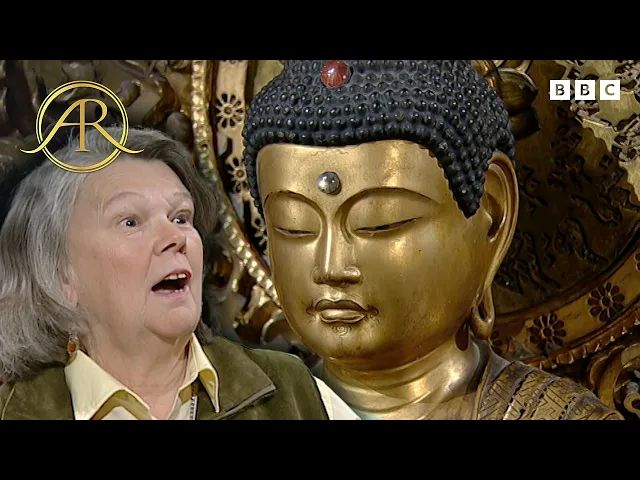
Mystery 'Buddhist' Figure Stuns Owner With Five-Figure Valuation | Antiques Roadshow UK
BBC Antiques Roadshow
0:00 Tell me, you keep this in a cardboard box in the attic.
0:03 No, not at all.
0:04 No, no, no.
0:05 It has an honoured place in an alcove in our sitting room.
0:08 It must look wonderful.
0:10 Well, it's clearly a Buddhistic figure.
0:13 And Buddhistic figures are extremely difficult
0:17 to attribute as to where they came from.
0:20 Because, like Russian icons,
0:22 the idea is to keep the things the same as possible throughout generations.
0:29 But once we start looking at it, maybe there are some clues.
0:33 We've got on here, some characters which are cut out of metal.
0:38 Yeah.
0:39 Which is very unusual.
0:40 I haven't seen that before.
0:41 I didn't know that.
0:43 But the characters are either North Indian or Tibetan.
0:47 Yeah.
0:48 So that, we think, maybe is where it comes from.
0:51 Ah, right.
0:52 The mandala here is carved with scrolling clouds.
0:58 We come down here.
1:01 The Buddha is standing on a lotus throne, which is his symbol.
1:05 The lotus is a symbol of purity.
1:09 We come down to these very strange and unusual flower leaf scrolls,
1:14 which I've not seen before.
1:17 Oh, right.
1:18 To a group of six immortals who've got various attributes.
1:25 And these are Buddhist immortals, or Luohan.
1:31 And then down to the bottom, we've got a dragon.
1:40 A sort of qilin, I think it's supposed to be.
1:44 A turtle.
1:45 And the turtle supports the world...
1:48 Yeah.
1:49 ..in part of the mythology.
1:52 Now, the quality of the carving- because this is
1:58 all carved wood which has then been gilded,
2:01 this is gold leaf on here, is a very, very high quality.
2:08 Much better quality than one would have expected,
2:12 had it come from Tibet or India.
2:17 Nor does it say to me China, oddly enough.
2:22 But when we get back up here again,
2:25 the quality says to me, nowhere else but Japan.
2:31 Ah, now that is interesting.
2:33 That, I hadn't thought.
2:35 This date, and I think we're talking about 1890, 1900s…- Yeah.
2:40 ..this was made in Japan possibly for export to Tibet.
2:47 Right.
2:48 I think it's absolutely splendid.
2:50 Because it's Japanese,
2:51 it's going to be worth more than if it were anything else.
2:54 More than Chinese, more than Indian, more than Tibetan.
2:58 I think we're looking at about £10,000 to £15,000.
3:03 Right.
3:04 Oh.
3:05 Because it was the end of the war,
3:08 they couldn't get the fabric they wanted to make a coat.
3:11 So all the ladies gave some material and designed it and sewed it up themselves.
3:19 So the way they've done it is they've done it as if it were a patchwork quilt.
3:24 That's right.
3:25 So they would have done it round a template, joined it up in the patterns,
3:29 just using up bits of material that they would have had in their bottom drawer.
3:33 As you can see, some of the red is crepe de Chine.
3:36 You just wouldn't get that these days.
3:37 So do you reckon they were using old dresses as well?
3:39 Yes, some of it was old dresses.
3:41 And the white, some of the white, was a lady's wedding dress.
3:46 Really?
3:47 Well, that was a great sacrifice.
3:49 That's right.
3:49 But why do you think it was made?
3:51 Let's have a look at the back.
3:53 Why do you think?
3:53 Was it made for a special occasion do you know?
3:55 It was their best coat to wear for great festivals like Christmas or Easter.
4:00 I wear it when I'm doing baptisms or doing a wedding.
4:05 I have to be a bit careful when I'm doing a wedding because it is so beautiful.
4:09 I find if I'm not careful,
4:10 I tend to upstage the bride when I sweep in with this.
4:14 Well, it's not the sort of thing that we very often get on the Roadshow.
4:17 Needless to say, as far as a value is concerned, it's irrelevant.
4:22 I'm not saying it doesn't have a value, but it has a wonderful social story.
4:27 And that's the value to you and I.
4:29 Absolutely.