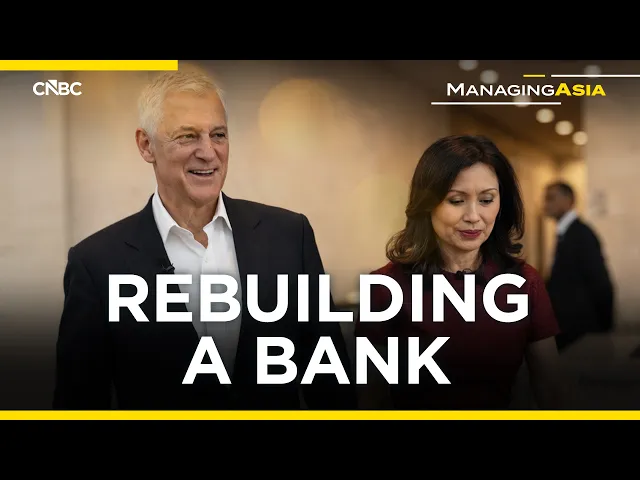
How Standard Chartered Fixed a Bank in Crisis
CNBC International
0:00 What do you do when the house is already on fire?
0:04 We cut expenses, we streamlined the management structure,
0:06 we exited a couple of businesses, but, you know, it was tough.
0:08 When bad debts are rising,
0:11 regulators are circling and the culture is slipping away.
0:15 There was a core of really strong people in the bank,
0:17 and then there were people that I
0:19 sometimes not so affectionately refer to as mercenaries.
0:21 So, what did you do with these mercenaries?
0:22 I fired them.
0:29 In 2015, Bill Winters took over Standard Chartered
0:32 at one of the most fragile moments in its history.
0:37 Before Winters stepped in, Standard Chartered was struggling,
0:40 grappling with a toxic mix of rising bad debts,
0:44 ballooning costs, and high stakes legal battles.
0:47 The fallout was swift.
0:50 Investor confidence evaporated with the bank's share price falling
0:54 40% in the years leading up to his appointment.
0:59 Rewind back to 2015 when you first stepped into Standard Chartered.
1:02 What was the first thing you did that told
1:05 people this was the start of a new era, things had to change?
1:09 I had the view that it was really a great company
1:11 that had lost its way a little bit, or maybe a lot.
1:14 And you know I came in in the beginning,
1:17 did the work that we all do when you first
1:19 come in just to understand things and get to know people.
1:21 And what did you find?
1:22 So, the obvious things from the outside were the bad loans,
1:26 there were a few hummers there in the book
1:28 that were that were quite well understood.
1:30 The bank had had some problems in financial crime compliance,
1:32 had gotten on the wrong side of the US authorities,
1:35 had been sanctioned and you know had monitors and a big remediation program.
1:39 There was kind of a generalized looseness around controls,
1:43 and you know my first step was to just try to tighten things up.
1:47 Put out these little fires that you found.
1:49 Little fires but also just to set a different tone in terms of, so
1:52 I think that the bank had had
1:54 overemphasized growth and to basically feed that sense,
1:59 and underemphasized controls.
2:01 Standard Chartered may be headquartered in London
2:04 but its business is firmly rooted in Asia, Africa and the Middle East.
2:09 Nearly three quarters of its $530 billion
2:12 dollars in customer deposits come from these markets,
2:16 which meant when problems hit, they weren't contained in one place.
2:21 They were everywhere.
2:23 Were people receptive to what you were proposing,
2:25 how did you handle what must have been resistance within the company?
2:29 People who didn't want to change.
2:31 There was some of that for sure.
2:33 And yeah, I think that there were a few
2:34 things sort of culturally that were going on.
2:36 There was a core of really strong people
2:38 in the bank that had been there for a long time,
2:40 and then there were people that I
2:42 sometimes not so affectionately refer to as mercenaries.
2:44 Mercenaries?
2:45 Yeah, I mean they came in they did
2:48 things that were not really value-accretive for shareholders.
2:51 They took risks that were not really appropriate.
2:54 They got paid big bonuses.
2:56 So, what did you do with these mercenaries?
2:58 I fired them immediately.
2:59 You fired them.
2:59 A lot of them left before I came because they knew it was coming.
3:02 And the ones that were left, they went because I found that the people who had
3:06 stayed around through that less controlled period felt a bit liberated.
3:10 Of course, it was hard because we cut expenses,
3:12 we streamlined the management structure,
3:14 we exited a couple of businesses and, nothing major,
3:16 but you know, it was tough for people that were here.
3:19 Now, as it happens, I probably went too far because in fact...
3:24 You went too far?
3:24 Probably.
3:26 Winter's early days at Standard Chartered did little to calm investors.
3:30 In fact, the share price continued to fall as markets reacted
3:34 to fears of a global slowdown and his sweeping restructuring plans.
3:40 The previous you know administration in the bank had realized
3:43 that there were problems and had begun to tighten things up.
3:46 I came in and tightened things up further.
3:48 So, we actually hit the brakes pretty hard.
3:50 Balance sheets shrunk a lot, earnings dropped a lot.
3:52 Did we overdo it?
3:53 We'll never know, you don't get to rerun these things.
3:55 I may have overdone it a bit,
3:57 but we definitely had the benefit at that point of starting
4:00 from kind of a rock solid foundation which was low,
4:02 and then we just built steadily over the subsequent eight, nine,
4:05 ten years and we're sitting here today with a very,
4:09 very strong business, good momentum, good stock price.
4:12 The reset played out most clearly in Asia.
4:17 In your ten years as CEO running Standard Chartered,
4:19 how fast has the Singapore market grown for the bank?
4:21 When I joined Standard Chartered,
4:23 Singapore was a good franchise that wasn't actually making any money.
4:26 And the colleagues, who are still here,
4:29 who just said we can make Singapore the strong market
4:32 in Standard Chartered and they've done a really good job.
4:35 So now Singapore is catching up to Hong Kong as our largest market.
4:38 There's always a healthy competition between Singapore and Hong Kong.
4:40 Do you think there's a chance that Singapore might overtake Hong Kong one day?
4:43 Well, first of all, I love
4:45 the competition between Hong Kong and Singapore because
4:46 it makes them both very strong and each getting better and better and better,
4:50 but they're different.
4:51 They're both global financial centers,
4:52 but Singapore is a hub for ASEAN with a strong connection to China,
4:56 and Hong Kong is a hub for China with a strong connection to the rest of Asia.
5:00 So, they actually complement each other quite well.
5:02 A decade on, the crisis may be over, but the next challenge is already here.
5:08 We're sitting here today in the I'd say the early adoption
5:12 of AI as a super powerful
5:14 tool for customer satisfaction and corporate productivity.
5:16 You know that that requires a whole different set of mindsets,
5:21 investments and we don't think we're ahead of the game in AI,
5:25 we don't think we're behind either.
5:27 We think that we're all in a race right now and we have to stay relevant.
5:33 A huge preoccupation for us right now,
5:34 thankfully something that we've been thinking about
5:36 for the better part of eight or nine years now, is the digitization of money.
5:40 We've got a fundamental view that all money will be digital,
5:44 and all financial assets will settle on blockchains.
5:47 Let's talk about the external environment.
5:49 You've said that the current ongoing U.S.-
5:52 China tensions haven't really hit your business, but yet at the same time,
5:55 your clients are telling you there's increased cost
5:58 of doing business and there's supply chain disruptions.
6:01 Can Standard Chartered really be immune to geopolitics
6:04 when your clients are feeling the pain?
6:06 No, no, and we're not immune, just to be clear.
6:09 There's definitely a reconfiguring of supply chains.
6:10 There has been a reconfiguring of supply chains for the past decade.
6:14 China started as a low-cost low value-added
6:17 manufacturer that was less concerned about pollution,
6:20 I mean going back 10 or 15 years,
6:23 into a high value-added manufacturer that's very focused
6:25 on the climate agenda and both emissions and quality of life.
6:29 And so inevitably jobs were moving out of, low
6:32 value-added jobs were moving out of China into other locations.
6:35 And we saw that countries like Vietnam, Thailand,
6:38 Malaysia, more recently India, have been beneficiaries of that.
6:41 It changed further with the tariff wars that have subsequently,
6:45 the trade wars that have subsequently broken out.
6:47 So our clients are feeling lots of anxiety
6:49 and of course there's been some compression of profit margins,
6:52 in particular on the back of tariffs.
6:54 Our job is to help our clients through those challenges that they
6:57 face and we're doing that, and if we do a good job, they find a way to pay us,
7:01 which is why our profits have been very strong and it's because
7:04 we're solving their problems not because we're taking advantage of their pain.
7:08 Investors can be rather vocal, they can be rather demanding.
7:11 They want faster returns.
7:13 They want bigger buybacks.
7:14 They want higher dividends.
7:15 How do you balance delivering these short-term
7:18 demands versus this long end-game of transformation?
7:22 First and foremost, we're looking at how we create
7:24 the most value in the medium to long-term for the bank.
7:26 So, you know, the investments that we made in, for example, in our ventures lab,
7:30 they don't generate anything in terms of, in fact,
7:32 they're a short-term negative for long-term gain.
7:34 As we sit here today,
7:35 I'm really happy that we invested in digital assets seven years ago,
7:39 you know, five, six, seven years ago, and continue to invest.
7:42 So, the efforts are paying off.
7:43 And now we're seeing the value.
7:45 So, now we're seen as a leader in the new world of digital money.
7:48 Did you know what you were getting to during
7:50 that time when you were investing in digital assets?
7:52 Was it a gamble on your part?
7:53 Was it a gut instinct?
7:54 It was all of the above.
7:55 So, I think we had some ideas on the direction things could go.
7:58 So, we had a sense that being,
8:00 if I could use the basketball analogy, being around the hoop- so,
8:04 just investing in things that were going to help
8:06 us to learn and understand the way markets could go.
8:08 But, you know, of all the ventures that we built,
8:10 and we'd built dozens at this point, none of them had gone in a straight line.
8:13 You know, whatever the original business plan was,
8:15 we've pivoted one, two, three, four, five times.
8:18 Some haven't worked, some have worked spectacularly and we've realized
8:22 big gains and some are works in progress,
8:24 but very different than what we imagined when we started them two,
8:27 three, four, five, six years ago,
8:28 and that's what venture building is about and that's what innovation is about.
8:31 You know in those times as CEO, being human is always challenging.
8:35 What's the one lesson you've learned about empathy,
8:37 the hard way, when dealing with people.
8:40 Personally, I think that empathy is one
8:42 of the two key characteristics of leadership,
8:44 the other being curiosity, and they feed off each other.
8:48 So, my hard lessons?
8:49 I think where we've moved too fast in some cases and not made
8:55 the investment to understand how clients may
8:58 react or how local colleagues may react,
9:01 especially the ones who are staying behind,
9:03 who then feel vulnerable for whatever reason,
9:07 I wished that we invested more upfront in understanding.
9:10 But thankfully, I think the bias in this organization,
9:12 I'm pretty sure that my personal bias, maybe to a fault, is to overindulge
9:18 in terms of the communication upfront, the transparency...
9:22 What do you mean by overindulge?
9:23 So, you know we have all these, like
9:25 every company we have continuous feedback mechanisms.
9:27 And you know, when I look at the feedback I get from my colleagues,
9:30 people will say sometimes, oh you know Bill we wish you'd be a little bit
9:33 faster in decision-making or a little bit harsher in dealing with...
9:37 Really?
9:37 Yeah.
9:38 Those were the feedback you were getting?
9:39 Sometimes.
9:39 You know, I get you're too fast and you're too harsh.
9:43 I mean, you get everything.
9:44 Sometimes you're very deliberate in your decision-making and you overindulge
9:49 an individual in terms of getting to know them or, you know,
9:52 maybe you could do less of that.
9:54 I say, okay, that's fine, when you run the bank, you can do things your way.
9:57 You say that to them?
9:58 Of course.
9:58 Thank you for the feedback and I do reflect on that all the time,
10:02 I try to course-correct.
10:03 Look, I've been in banking for 42 years.
10:06 I can tell you I'm learning as much today as I did in 1983
10:10 when I started at what was then called the Morgan Guaranty Trust Company.
10:14 I'm learning more today actually than I did then because I have more to learn.
10:18 And maybe as you get older, you realize how much you don't know,
10:21 in addition to how much you do know.
10:23 When you're 23, you think you know everything, when you're 35,
10:26 you're sure you know everything, and at 64,
10:28 you realize you actually know almost nothing.
10:31 So, I love learning.
10:32 I love continuing to learn and that means improving myself
10:35 and I know that I've got more that I can do.
10:37 People at Standard Chartered are going to look back at the Bill Winters era.
10:43 What do you hope they'll say what you stood for?
10:46 That they see a culture and a bank that plays to all
10:52 of the core strengths of Standard Chartered
10:54 but is absolutely fit for the future.
10:57 So, at the cutting edge of the future
10:59 of finance- I feel that we're there right now,
11:01 but I also feel that there's a very strong connection to our heritage,
11:05 to our culture, to that unique diversity, which is Standard Chartered.
11:08 Global and local, in 55 markets around the world,
11:12 with 160 nationalities walking through the hallways of this building, etc., etc.
11:17 And there aren't that many companies that can say,
11:20 "Yeah, the heritage is so clear in that company today,
11:24 but it's totally fit for the present
11:26 and the future." That's what I would love to do.
11:28 There's more work to do as always.
11:30 What do you hope they'll say about Bill Winters as a person?
11:33 I hope they'll say that I was a really good custodian of that process,
11:37 of reinforcing the very strong roots and the unique nature of our bank,
11:43 but also positioned it very well,
11:45 you know, a future-thinking, future-looking professional.
11:48 I also hope people think that I've been true to my core values
11:52 and true to the core values of the company which are perfectly aligned.
11:55 Bill, thank you so much for talking to me.
11:57 Thank you.